
Cellular Respiration CRs Why is CRs Important Cellular

- Slides: 34
Cellular Respiration (CRs)
Why is CRs Important?
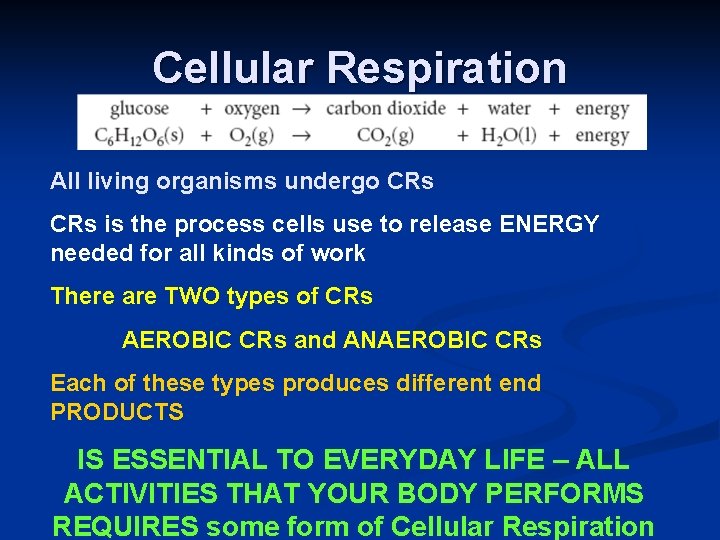
Cellular Respiration All living organisms undergo CRs is the process cells use to release ENERGY needed for all kinds of work There are TWO types of CRs AEROBIC CRs and ANAEROBIC CRs Each of these types produces different end PRODUCTS IS ESSENTIAL TO EVERYDAY LIFE – ALL ACTIVITIES THAT YOUR BODY PERFORMS REQUIRES some form of Cellular Respiration
What Do Cells need ENERGY for? Cells require ENERGY in the form of ATP n Energy demands of cells are very diverse n Chromosome movement (cell division) n Active Transport of Materials n Large scale movement – muscle contraction n A SINGLE human cell contains approx ONE BILLION ATP MOLECULES!!!!
Cells, ATP and GLUCOSE n GLUCOSE is a high energy molecule that is small enough to diffuse into our blood (“blood sugar”) n BENEFICIAL/USEFUL form of energy storage in cells Breaking bonds consumes energy and RELEASES energy n CRs = overall (NET) energy RELEASE n
Efficiency of CRs n Overall efficiency of energy transfer is quite LOW (~36%) n n BUT the loss of energy in the transfer as THERMAL energy is used by some organisms to maintain body temperature!! Meaning that about 36% of the energy in a SINGLE glucose molecule is converted into ATP – energy available for the cell
ATP and GLUCOSE = CELLULAR CURRENCY ANALOGY 1 dollar = loonie 100 dollars = 100 dollar BILL *** Compare how MANY of each *** $100 = 100 loonies/1 bill Which would be more useful in a vending machine? ? ATP is like the loonies GLUCOSE is like the 100 dollar bill Cell is like the vending machine RELATION TO EFFICIENCY: like exchanging your 100 dollar bill and getting 36 loonies!!!!
Cellular Respiration n Takes place in the cytoplasm and mitochondria
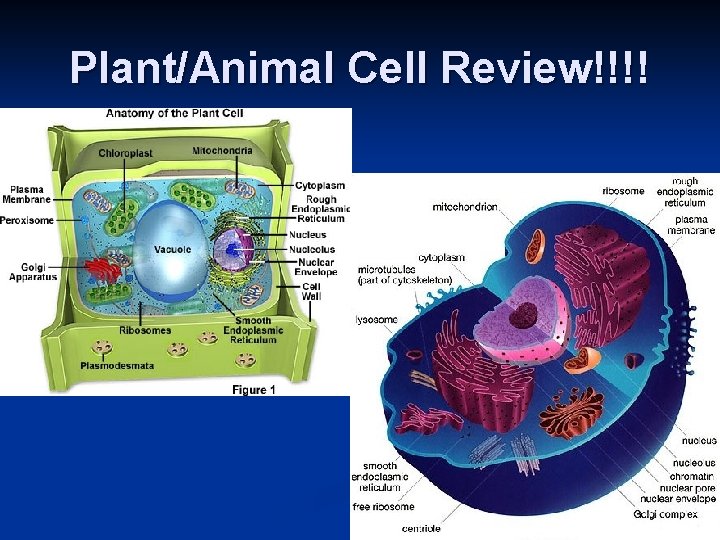
Plant/Animal Cell Review!!!!
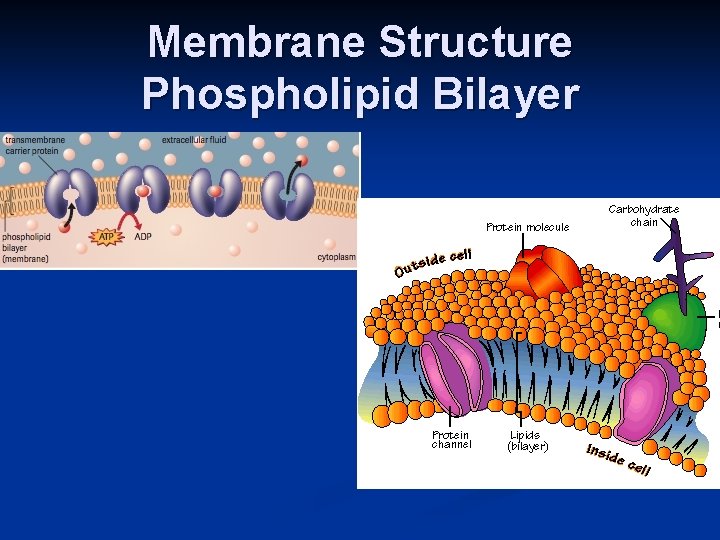
Membrane Structure Phospholipid Bilayer
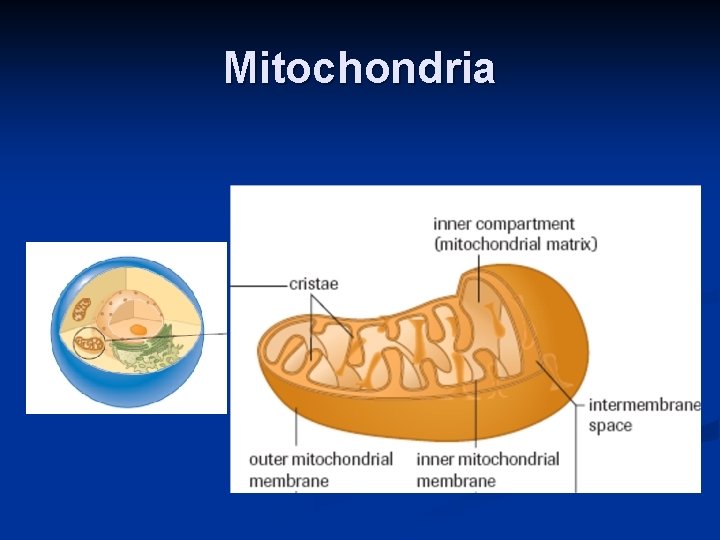
Mitochondria
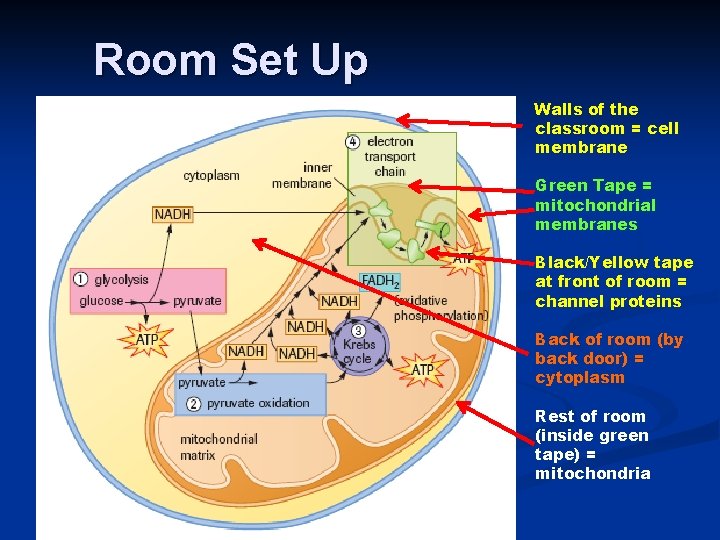
Room Set Up Walls of the classroom = cell membrane Green Tape = mitochondrial membranes Black/Yellow tape at front of room = channel proteins Back of room (by back door) = cytoplasm Rest of room (inside green tape) = mitochondria
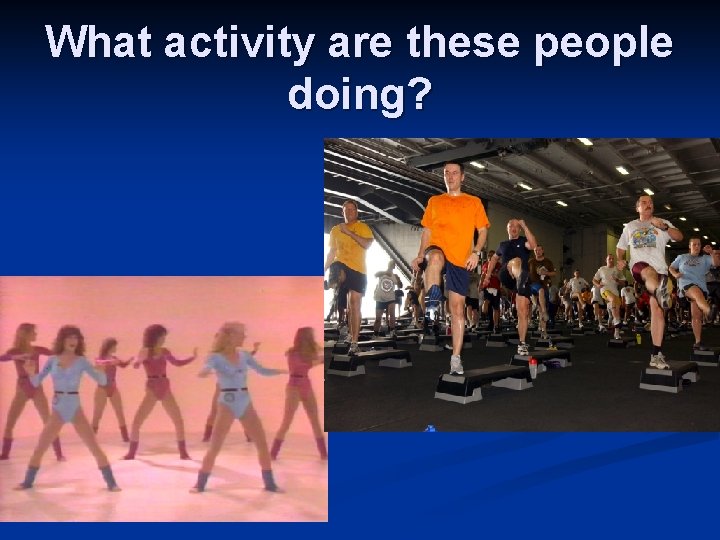
What activity are these people doing?
Types of Cellular Respiration n Aerobic CRs – takes place in the presence of OXYGEN PRODUCTS = CO 2 , H 2 O, 36 ATP n 4 Stages: n n Stage 1: Gylcolysis n Stage 2: Pyruvate Oxidation n Stage 3: Krebs Cycle n Stage 4: ETC and Chemiosmosis
Types of Cellular Respiration n Anaerobic CRs – takes place in the absence of OXYGEN n Two Types n PRODUCTS = ethanol (C 2 H 5 OH), CO 2, 2 ATP n PRODUCTS = lactic acid (C 3 H 6 O 3), 2 ATP n 2 Stages: n Stage 1: glycolysis n Stage 2: fermentation http: //www. science. nelson. com/ABbio 20 -30/teacher/protect/otr/Bio 2030 OTR/attachments/i_Animation. Simulation/energy_releasing. html
Background Info ATP = ADP + phosphate n Reduction and Oxidation (REDOX) reactions involve the transfer of electrons “LEO GER” n Lose Electron Oxidation n Gain Electron Reduction *** NADH = NAD+ + electrons *** FADH 2 = FAD + electrons n BOTH MOLECULES ARE ELECTRON CARRIERS IN THEIR REDUCED FORM
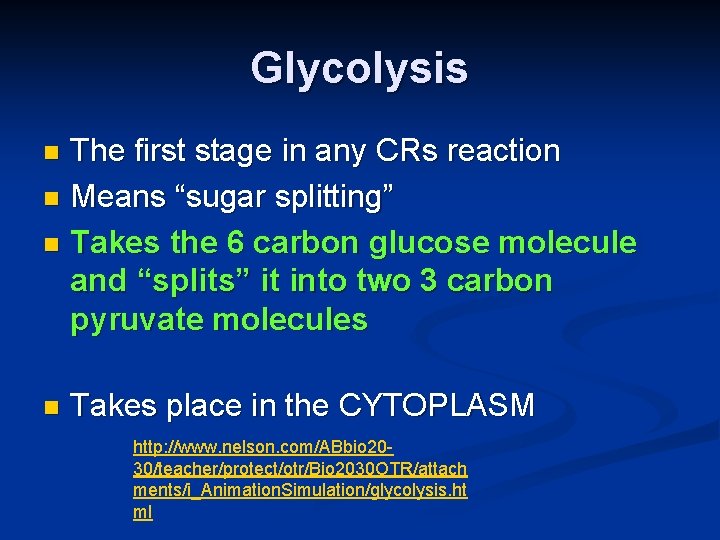
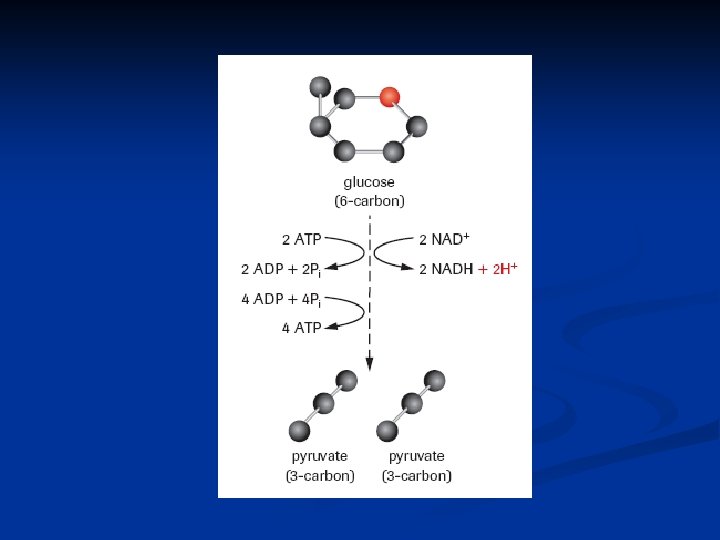
Glycolysis The first stage in any CRs reaction n Means “sugar splitting” n Takes the 6 carbon glucose molecule and “splits” it into two 3 carbon pyruvate molecules n n Takes place in the CYTOPLASM http: //www. nelson. com/ABbio 2030/teacher/protect/otr/Bio 2030 OTR/attach ments/i_Animation. Simulation/glycolysis. ht ml
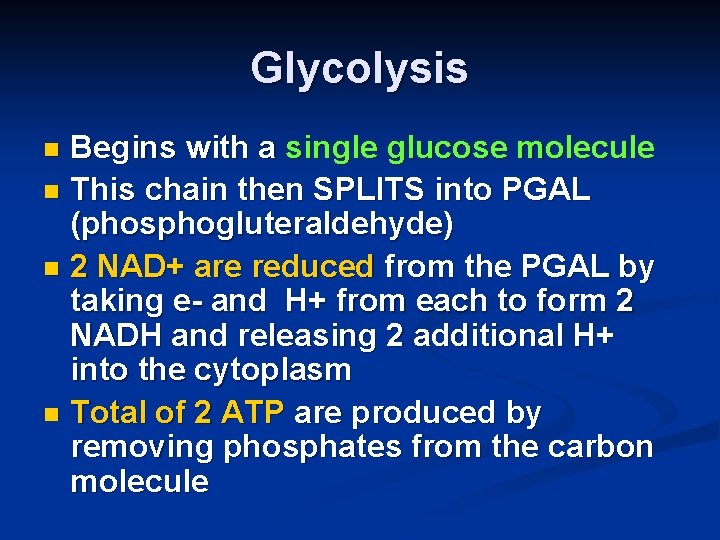
Glycolysis Begins with a single glucose molecule n This chain then SPLITS into PGAL (phosphogluteraldehyde) n 2 NAD+ are reduced from the PGAL by taking e- and H+ from each to form 2 NADH and releasing 2 additional H+ into the cytoplasm n Total of 2 ATP are produced by removing phosphates from the carbon molecule n
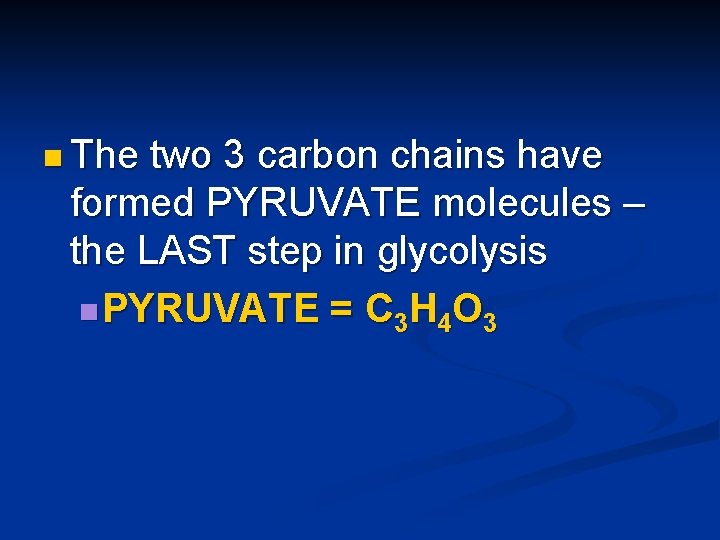
n The two 3 carbon chains have formed PYRUVATE molecules – the LAST step in glycolysis n PYRUVATE = C 3 H 4 O 3
n In aerobic respiration the 2 NADH produced from glycolysis are converted into FADH 2 http: //www. youtube. com/watch? v=n. Kg. UBs C 4 Oyo http: //www. youtube. com/watch? v=AFLu 6 lh F 1 YI&feature=related
Try it out!! I need 14 volunteers 6 carbons “atoms” n 2 ATP “molecules” n 2 ADP “molecules” n 2 NAD+ “molecules” n 2 FAD “molecules” n
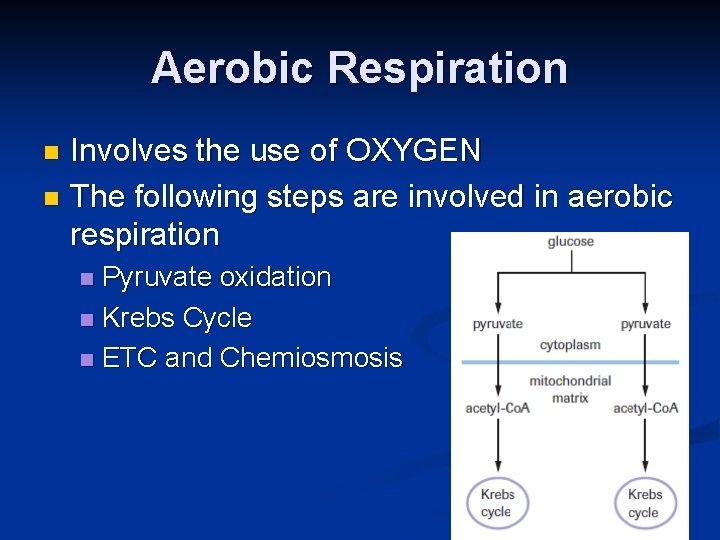
Aerobic Respiration Involves the use of OXYGEN n The following steps are involved in aerobic respiration n Pyruvate oxidation n Krebs Cycle n ETC and Chemiosmosis n
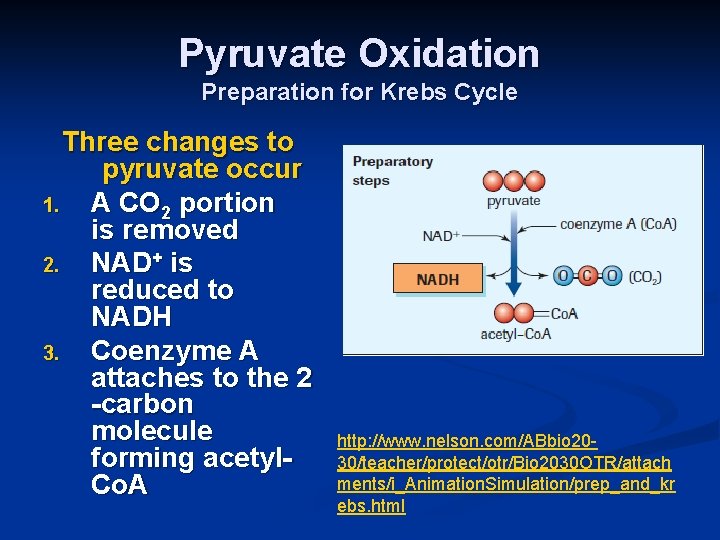
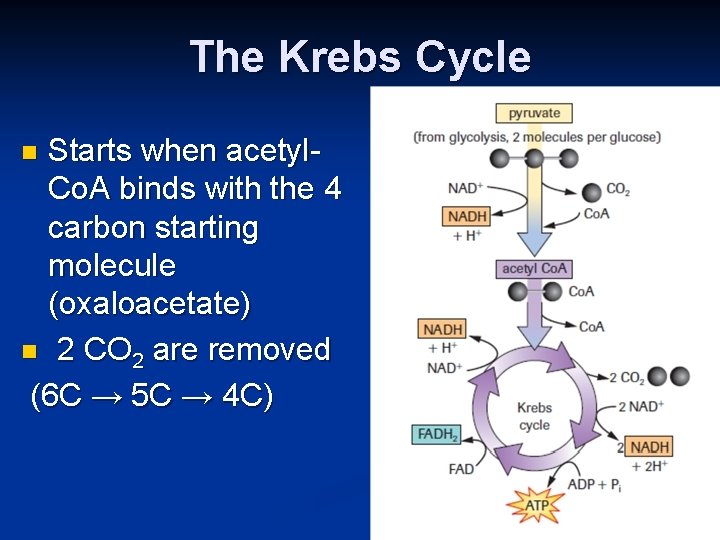
Pyruvate Oxidation Preparation for Krebs Cycle Three changes to pyruvate occur 1. A CO 2 portion is removed 2. NAD+ is reduced to NADH 3. Coenzyme A attaches to the 2 -carbon molecule forming acetyl. Co. A http: //www. nelson. com/ABbio 2030/teacher/protect/otr/Bio 2030 OTR/attach ments/i_Animation. Simulation/prep_and_kr ebs. html
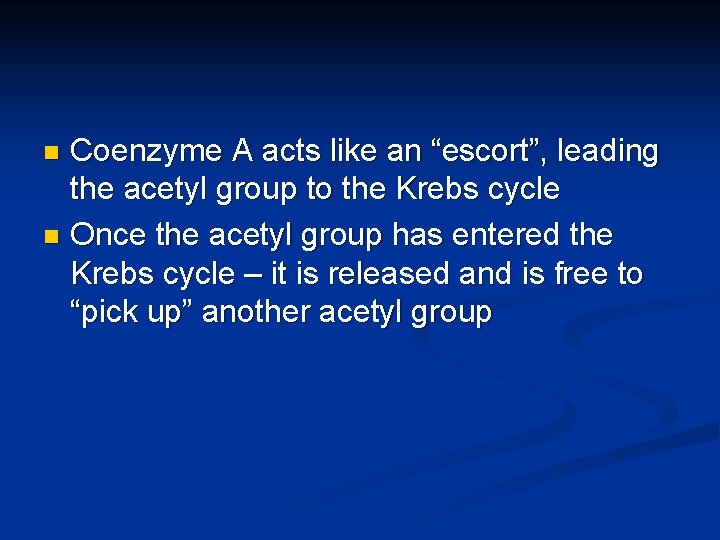
Coenzyme A acts like an “escort”, leading the acetyl group to the Krebs cycle n Once the acetyl group has entered the Krebs cycle – it is released and is free to “pick up” another acetyl group n
The Krebs Cycle Starts when acetyl. Co. A binds with the 4 carbon starting molecule (oxaloacetate) n 2 CO 2 are removed (6 C → 5 C → 4 C) n
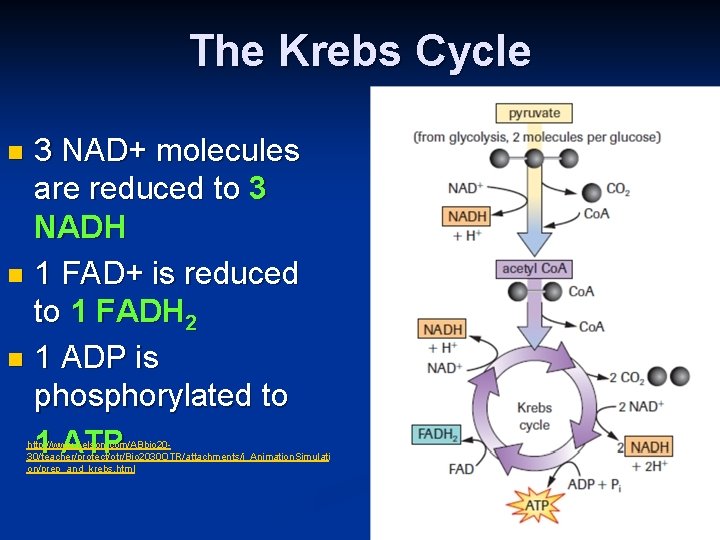
The Krebs Cycle 3 NAD+ molecules are reduced to 3 NADH n 1 FAD+ is reduced to 1 FADH 2 n 1 ADP is phosphorylated to 1 ATP n http: //www. nelson. com/ABbio 2030/teacher/protect/otr/Bio 2030 OTR/attachments/i_Animation. Simulati on/prep_and_krebs. html
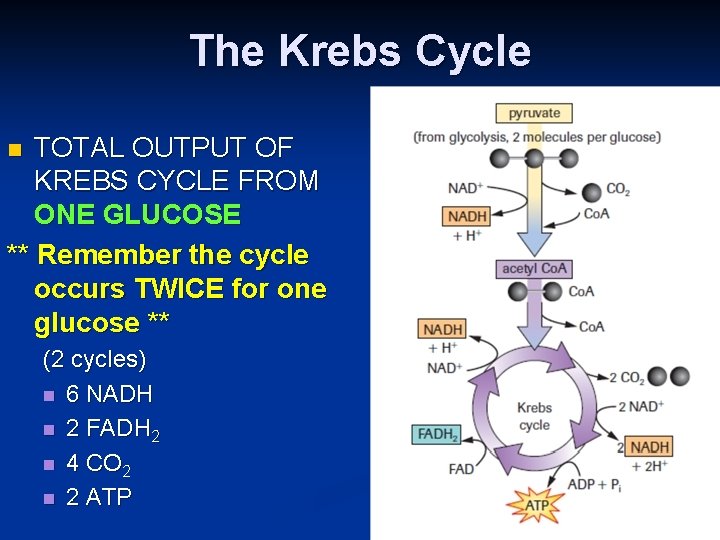
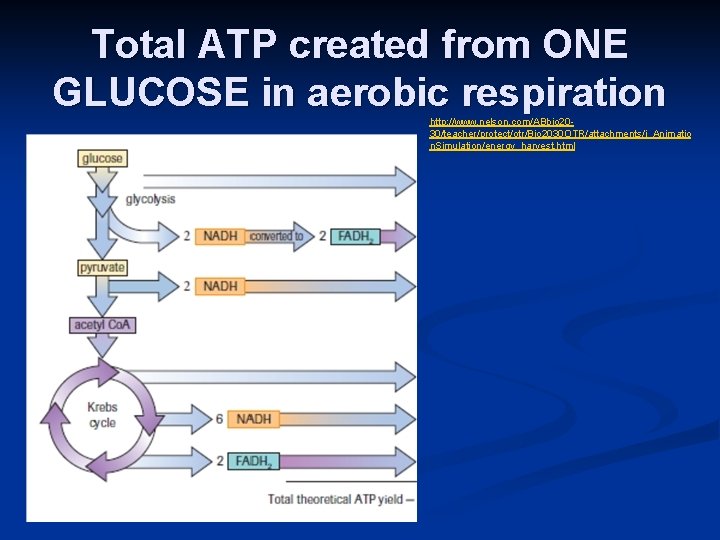
The Krebs Cycle TOTAL OUTPUT OF KREBS CYCLE FROM ONE GLUCOSE ** Remember the cycle occurs TWICE for one glucose ** n (2 cycles) n 6 NADH n 2 FADH 2 n 4 CO 2 n 2 ATP
LETS PLAY!!!
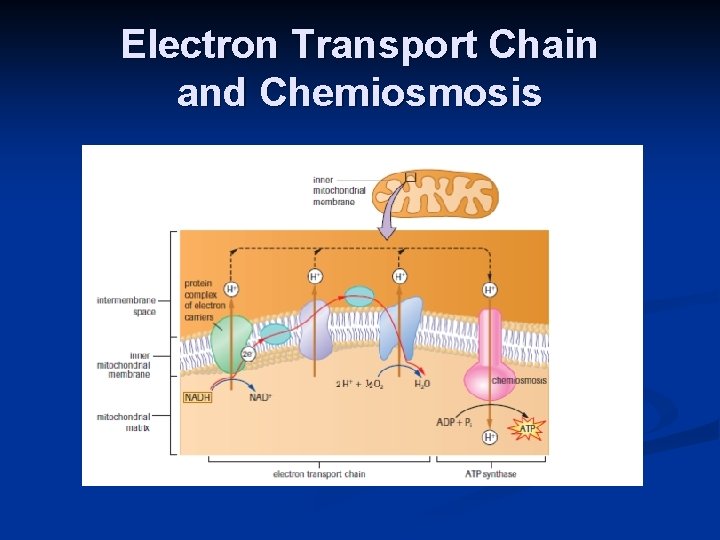
Electron Transport Chain and Chemiosmosis
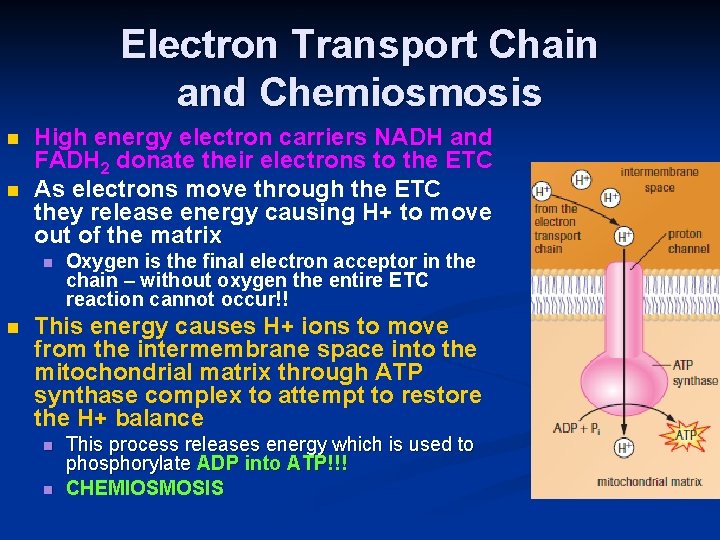
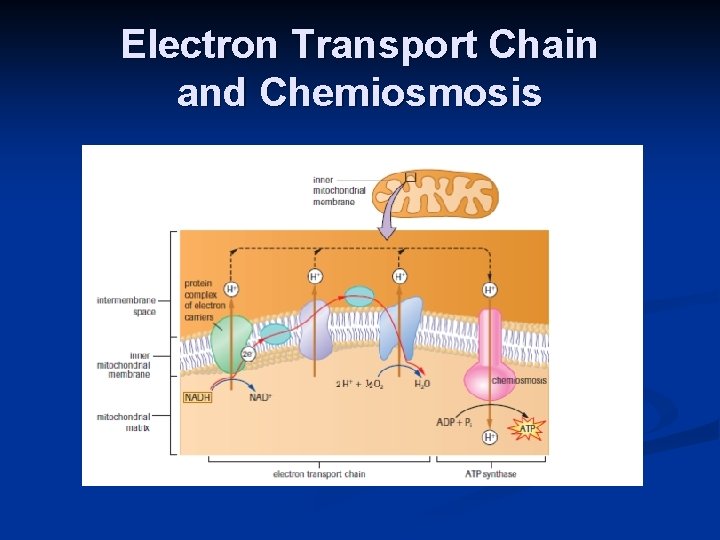
Electron Transport Chain and Chemiosmosis n n High energy electron carriers NADH and FADH 2 donate their electrons to the ETC As electrons move through the ETC they release energy causing H+ to move out of the matrix n n Oxygen is the final electron acceptor in the chain – without oxygen the entire ETC reaction cannot occur!! This energy causes H+ ions to move from the intermembrane space into the mitochondrial matrix through ATP synthase complex to attempt to restore the H+ balance n n This process releases energy which is used to phosphorylate ADP into ATP!!! CHEMIOSMOSIS
Electron Transport Chain and Chemiosmosis n REMEMBER Every NADH donating electrons creates enough energy release to form 3 ATP Every FADH 2 donating electrons creates enough energy release to form 2 ATP
Electron Transport Chain and Chemiosmosis
Total ATP created from ONE GLUCOSE in aerobic respiration http: //www. nelson. com/ABbio 2030/teacher/protect/otr/Bio 2030 OTR/attachments/i_Animatio n. Simulation/energy_harvest. html