
Cellular Respiration Chapter 9 Objectives 3 0 Identify
Cellular Respiration Chapter 9 Objectives: 3. 0 Identify reactants and products associated with photosynthesis and cellular respiration and the purposes of these two processes. AOD B. 3. 1 Identify the function of photosynthesis and cellular respiration. AOD B. 3. 2 Describe photosynthesis and cellular respiration, including their reactants and products. AOD B. 3. 3 Recognize the relationship between reactants and products associated with photosynthesis and cellular respiration. AOD B. 3. 4 Recognize a given formula as either photosynthesis or cellular respiration.

Overview Fill in the major steps in cellular respiration while watching the following video clip: http: //www. youtube. com/wa tch? v=a. XC 9 j. MNIRn. E
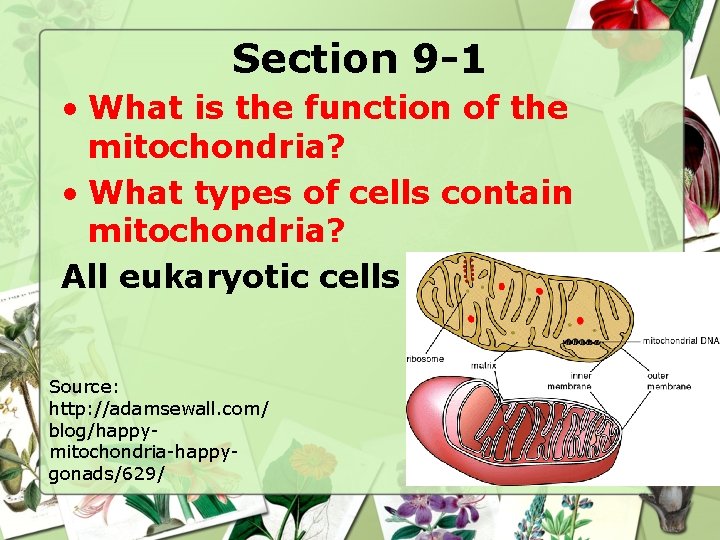
Section 9 -1 • What is the function of the mitochondria? • What types of cells contain mitochondria? All eukaryotic cells Source: http: //adamsewall. com/ blog/happymitochondria-happygonads/629/
• Mitochondria release the energy from glucose and other food compounds. • Step 1: Glycolysis • Step 2: – If glycolysis takes place in the presence of oxygen, then the Kreb’s cycle and electron transport chain work to produce lots of ATP. – Without oxygen, fermentation occurs.

Cellular Respiration • Made up of all three processes: glycolysis, Kreb’s cycle, and electron transport chain • Occurs in the presence of oxygen C 6 H 12 O 6 + 6 O 2 6 CO 2 + 6 H 2 O + energy • Glucose, if converted all at once, would set the cells on fire!
Glycolysis • Breaks 1 glucose molecule in half, producing 2 molecules of pyruvic acid (a 6 -carbon molecule becomes 2 3 -carbon molecules). • Requires 2 molecules of ATP to break the glucose molecule. • At the end, the cell will have 4 ATP molecules --- a gain of 2
NADH Production in Glycolysis • 4 high-energy electrons and 2 H+’s attach to 2 electron carriers called NAD+ (comparable to NADP+ in photosynthesis), converting it into NADH. • Glysolysis yields low energy amounts, but extremely rapidly, and with or without oxygen.
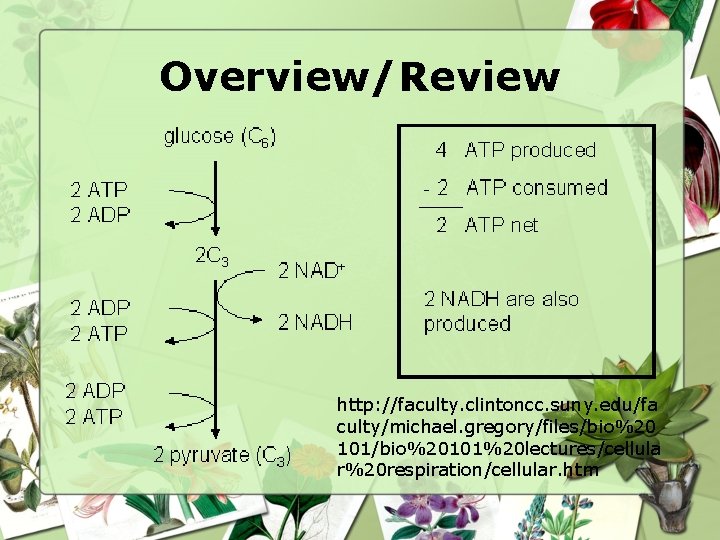
Overview/Review http: //faculty. clintoncc. suny. edu/fa culty/michael. gregory/files/bio%20 101/bio%20101%20 lectures/cellula r%20 respiration/cellular. htm
Fermentation (“Anaerobic Respiration”) • Releases energy from food particles by producing ATP in the absence of oxygen. • Cells convert NADH back to NAD+ by passing electrons back to pyruvic acid. This allows glycolysis to continue producing ATP.
2 Types of Fermentation: 1. Alcoholic fermentation – Yields ethyl alcohol and CO 2 – Pyruvic acid + NADH alcohol + CO 2 + NAD+ – What types of cells? 2. Lactic acid fermentation – Yields lactic acid – Pyruvic acid + NADH lactic acid + NAD+ – What types of cells?
Assessment • Refer to the “Overview/Review” for glycolysis, and Figures 9 -3 and 9 -4, as needed, to create a simple flowchart for: 1. Glycolysis 2. Alcoholic fermentation 3. Lactic acid fermentation • (Remember, flowchart instructions/example are found on p. 1065)

Section 9 -2
- Slides: 12