
Cellular Respiration Chapter 9 1 g of sugar
- Slides: 25
Cellular Respiration Chapter 9
1 g of sugar will release 3811 calories of heat energy Calorie: ◦ Amount of energy needed to raise the temperature of 1 g of water 1 degree Celsius Chemical Energy and Food
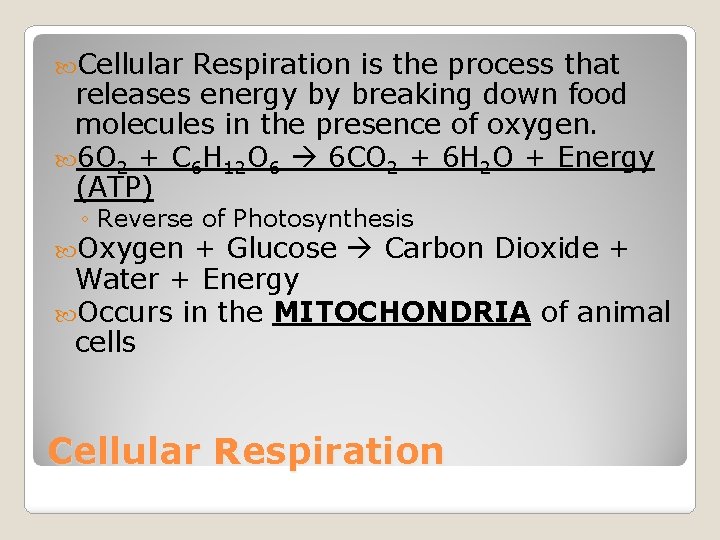
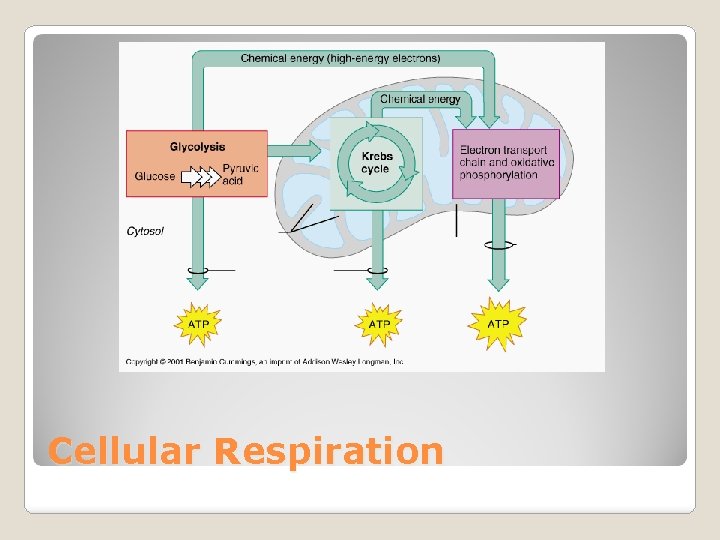
Cellular Respiration is the process that releases energy by breaking down food molecules in the presence of oxygen. 6 O 2 + C 6 H 12 O 6 6 CO 2 + 6 H 2 O + Energy (ATP) ◦ Reverse of Photosynthesis Oxygen + Glucose Carbon Dioxide + Water + Energy Occurs in the MITOCHONDRIA of animal cells Cellular Respiration
Reactants ◦ Oxygen ◦ Glucose Products ◦ Carbon Dioxide ◦ Water ◦ Energy (36 ATP) Cellular Respiration
Cellular Respiration
Glycolysis is the process in which one molecule of glucose is broken in half, producing two molecules of pyruvic acid (a 3 carbon compound). This cycle requires oxygen. “breaking glucose” 2 ATP needed to start reaction, 4 ATP are produced thus the net gain is 2 ATP. Occurs in the cytosol of the cell Glycolysis
ATP Production: ◦ Before Glycolysis can begin producing energy it needs energy to get things going ◦ At the beginning of the reaction 2 molecules of ATP are required. Think of the needed ATP as an investment, you must put money into the bank before you can gain interest on it. By the end of glycolysis there will be a production of 4 ATP. A net gain of 2 ATP. Glycolysis
NADH Production ◦ One of the reactions of glycolysis removes 4 high-energy electrons and passes them to a carrier molecule known as NAD+ (just like NADP+ in photosynthesis). ◦ NAD+ is passing energy from glucose to other pathways in the cell Glycolysis
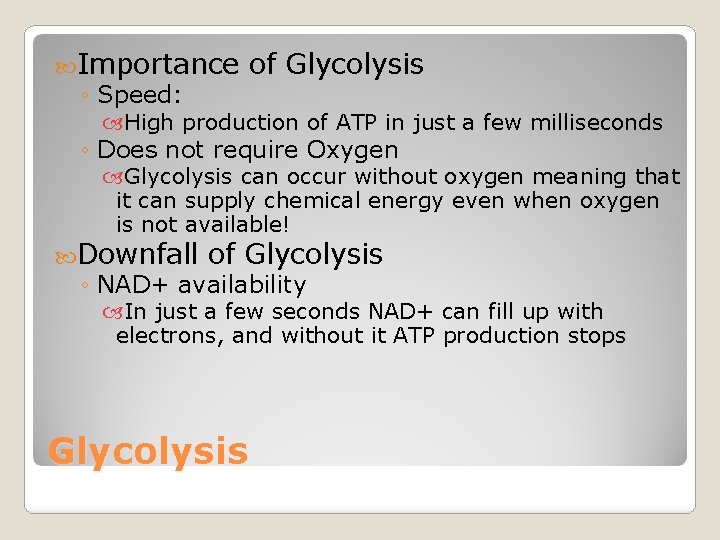
Importance of Glycolysis ◦ Speed: High production of ATP in just a few milliseconds ◦ Does not require Oxygen Glycolysis can occur without oxygen meaning that it can supply chemical energy even when oxygen is not available! Downfall of Glycolysis ◦ NAD+ availability In just a few seconds NAD+ can fill up with electrons, and without it ATP production stops Glycolysis
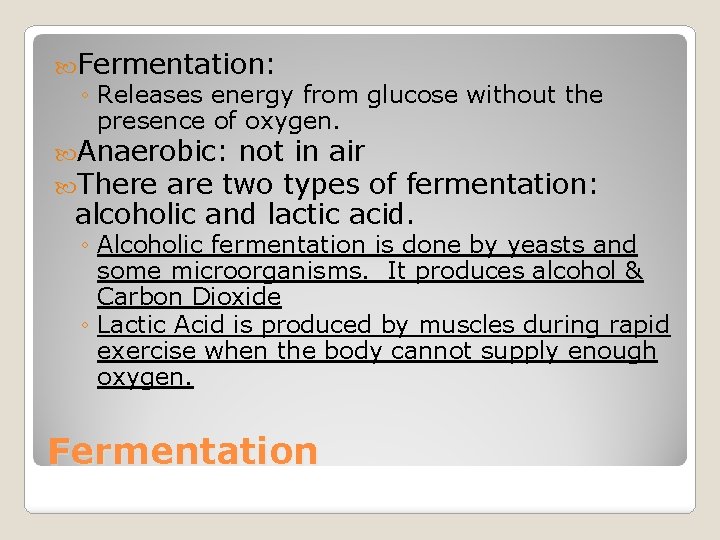
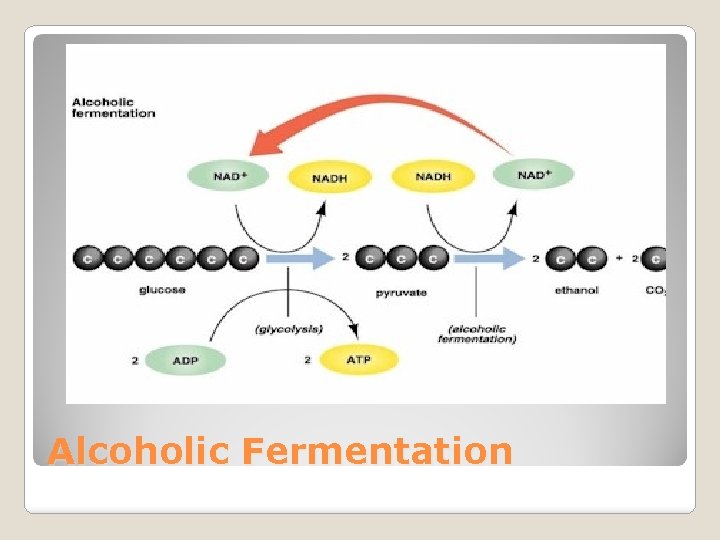
Fermentation: ◦ Releases energy from glucose without the presence of oxygen. Anaerobic: not in air There are two types of fermentation: alcoholic and lactic acid. ◦ Alcoholic fermentation is done by yeasts and some microorganisms. It produces alcohol & Carbon Dioxide ◦ Lactic Acid is produced by muscles during rapid exercise when the body cannot supply enough oxygen. Fermentation
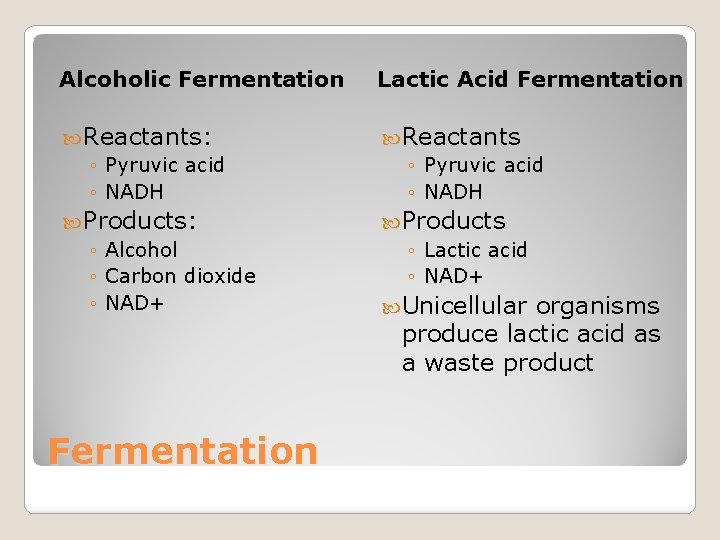
Alcoholic Fermentation Lactic Acid Fermentation Reactants: ◦ Pyruvic acid ◦ NADH Reactants ◦ Pyruvic acid ◦ NADH Products: ◦ Alcohol ◦ Carbon dioxide ◦ NAD+ Products ◦ Lactic acid ◦ NAD+ Fermentation Unicellular organisms produce lactic acid as a waste product
Alcoholic Fermentation
After glycolysis 90% of chemical energy is unused, locked in Pyruvic acid To release that energy in Pyruvic acid the cell needs to bring in oxygen. ◦ This is how cellular respiration got its name. After Glycolysis
During the Krebs Cycle, pyruvic acid is broken down into carbon dioxide in a series of energy-extracting reactions. Citric Acid is created in this cycle thus giving it the nickname Citric Acid cycle. Net ATP Production is 2 ATP. Occurs in the mitochondria The Krebs Cycle
Step 1: ◦ One carbon atom from the Pyruvic acid, produced in Glycolysis, becomes part of a Carbon dioxide molecule ◦ The other 2 carbon atoms from Pyruvic acid join with coenzyme-A to make acetyl-Co. A Acetyl-Co. A is made up of: ◦ 2 carbons, 1 oxygen, and 3 hydrogen ◦ Acetyl-Co. A then joins with a 4 -carbon molecule producing a 6 -carbon molecule (citric acid) The Krebs Cycle
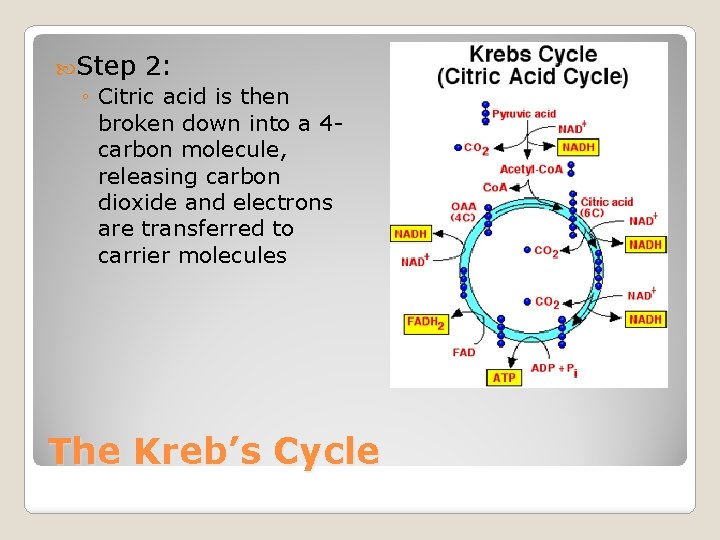
Step 2: ◦ Citric acid is then broken down into a 4 carbon molecule, releasing carbon dioxide and electrons are transferred to carrier molecules The Kreb’s Cycle
Reactants ◦ Pyruvic acid ◦ Oxygen Products ◦ Carbon dioxide (every time we exhale) ◦ Electrons joining carrier molecules ADP and P = ATP (at each turn) NAD+ and H+ = NADH (occurs 5 times in each turn) FAD and 2 H = FADH 2 (occurs 5 times in each turn) The Kreb’s Cycle
The electron transport chain uses the high -energy electrons (NADH and FADH 2 from the Krebs Cycle to convert ADP to ATP. This cycle requires oxygen. Total ATP 32. Electron Transport Chain
Step 1: ◦ The high-energy electrons are passed along the ETC from one carrier protein to the next. ◦ At the end of this the H+ ions join with O 2 ions to make water ◦ Oxygen is the final acceptor of the electrons making it essential for getting rid of low-energy electrons and hydrogen (waste of cellular respiration). Electron Transport Chain
Step 2: ◦ With every 2 high-energy electrons that travel down the ETC, their energy is transported to the H+ ions across the membrane. A collection of H+ ions makes the intermembrane space positively charged. Electron Transport Chain
Step 3: ◦ The difference in the charges allows for the formation of ATP to be formed. As the H+ ions escape through the channels into the ATP Synthase, they begin to spin. With every spin the enzyme grabs a ADP and attaches a phosphate, forming high-energy ATP. Electron Transport Chain
Glycolysis ◦ Uses: 2 ATP ◦ Produces: 4 ATP ◦ Net gain: 2 ATP Krebs Cycle ◦ Produces: 2 ATP Electron Transport ◦ Produces: 32 ATP Total = 36 ATP Totals Chain
What causes the difference between glycolysis ATP production and the Kreb’s cycle and Electron Transport Chain? ◦OXYGEN
Quick energy – Lactic Acid fermentation is used to get quick energy and gives off lactic acid as a by product, thus the muscle pain. Long-Term Energy – Use cellular respiration to produce energy. Exercising or activities that last for at least 15 to 20 minutes. Best form for weight control. Energy & Exercise
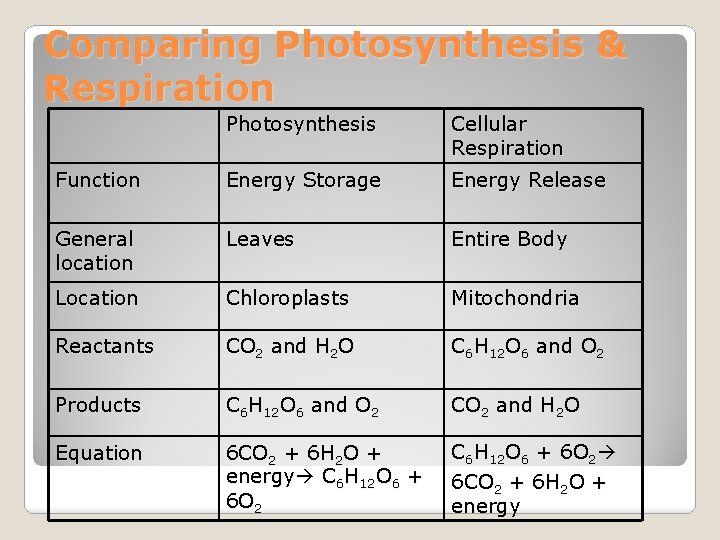
Comparing Photosynthesis & Respiration Photosynthesis Cellular Respiration Function Energy Storage Energy Release General location Leaves Entire Body Location Chloroplasts Mitochondria Reactants CO 2 and H 2 O C 6 H 12 O 6 and O 2 Products C 6 H 12 O 6 and O 2 CO 2 and H 2 O Equation 6 CO 2 + 6 H 2 O + energy C 6 H 12 O 6 + 6 O 2 6 CO 2 + 6 H 2 O + energy