
Cellular Respiration Chapter 8 Cellular Respiration cellular process
- Slides: 34
Cellular Respiration Chapter 8
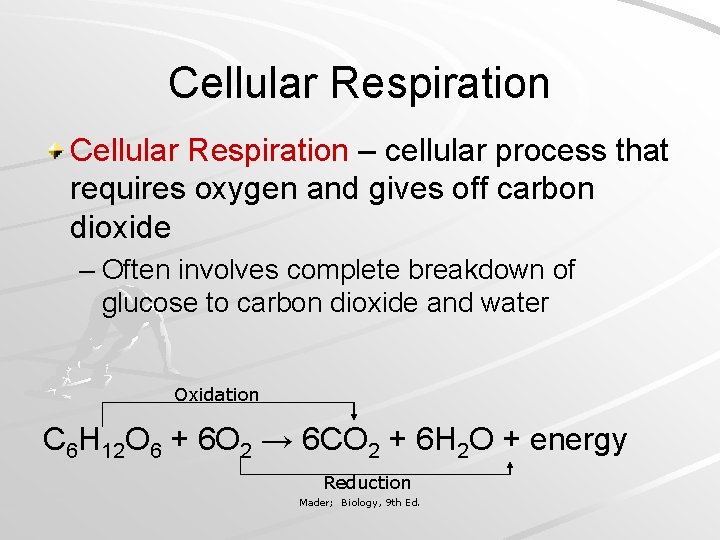
Cellular Respiration – cellular process that requires oxygen and gives off carbon dioxide – Often involves complete breakdown of glucose to carbon dioxide and water Oxidation C 6 H 12 O 6 + 6 O 2 → 6 CO 2 + 6 H 2 O + energy Reduction Mader; Biology, 9 th Ed.
Cellular Respiration Energy within a glucose molecule is released slowly so that ATP can be produced gradually NAD+ and FAD are oxidation-reduction enzymes active during cellular respiration Mader; Biology, 9 th Ed.
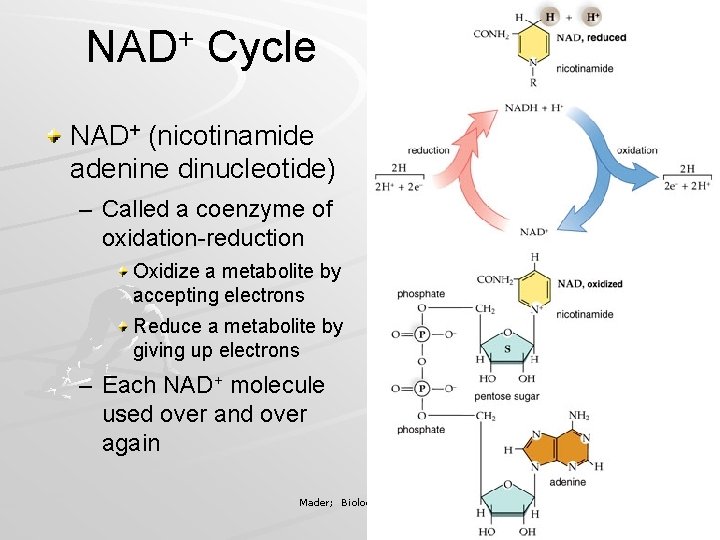
NAD+ Cycle NAD+ (nicotinamide adenine dinucleotide) – Called a coenzyme of oxidation-reduction Oxidize a metabolite by accepting electrons Reduce a metabolite by giving up electrons – Each NAD+ molecule used over and over again Mader; Biology, 9 th Ed.
FAD (flavin adenine dinucleotide) – Also a coenzyme of oxidation-reduction – Sometimes used instead of NAD+ – Accepts two electrons and two hydrogen ions (H+) to become FADH 2 Mader; Biology, 9 th Ed.
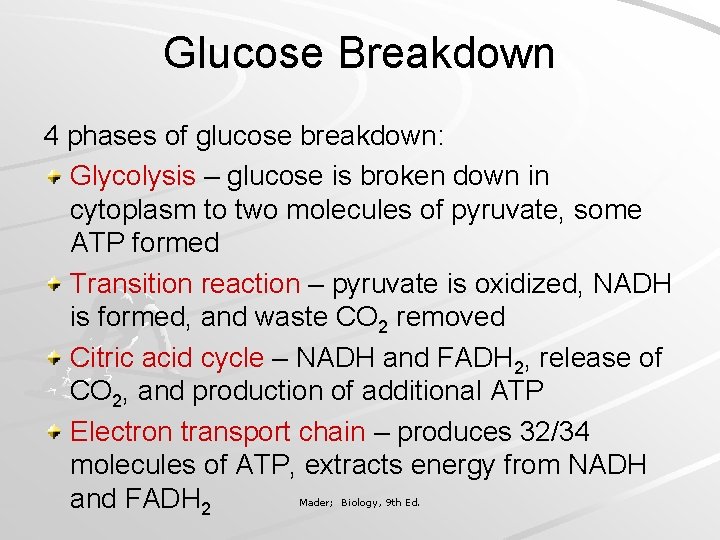
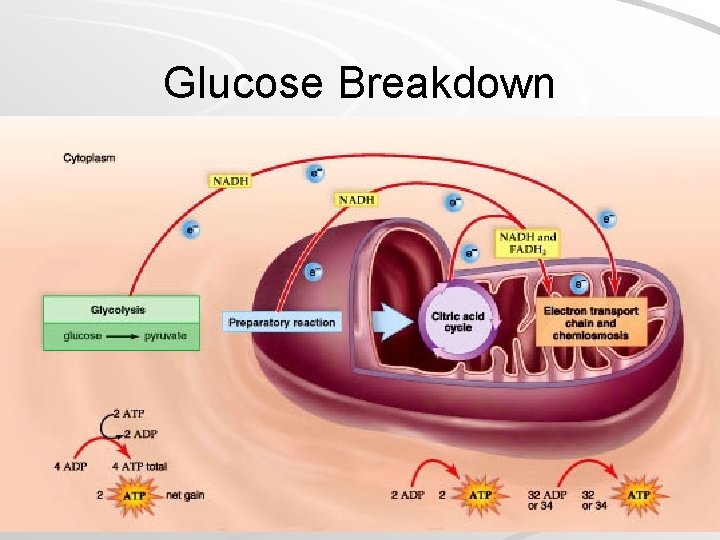
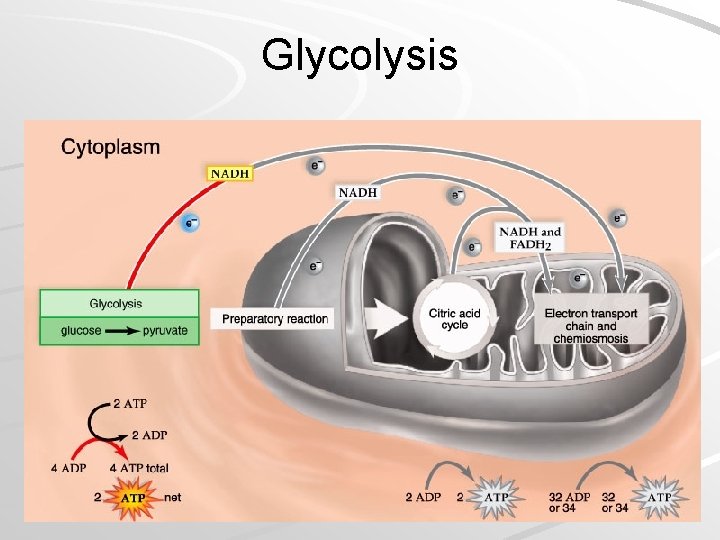
Glucose Breakdown 4 phases of glucose breakdown: Glycolysis – glucose is broken down in cytoplasm to two molecules of pyruvate, some ATP formed Transition reaction – pyruvate is oxidized, NADH is formed, and waste CO 2 removed Citric acid cycle – NADH and FADH 2, release of CO 2, and production of additional ATP Electron transport chain – produces 32/34 molecules of ATP, extracts energy from NADH and FADH 2 Mader; Biology, 9 th Ed.
Glucose Breakdown Mader; Biology, 9 th Ed.
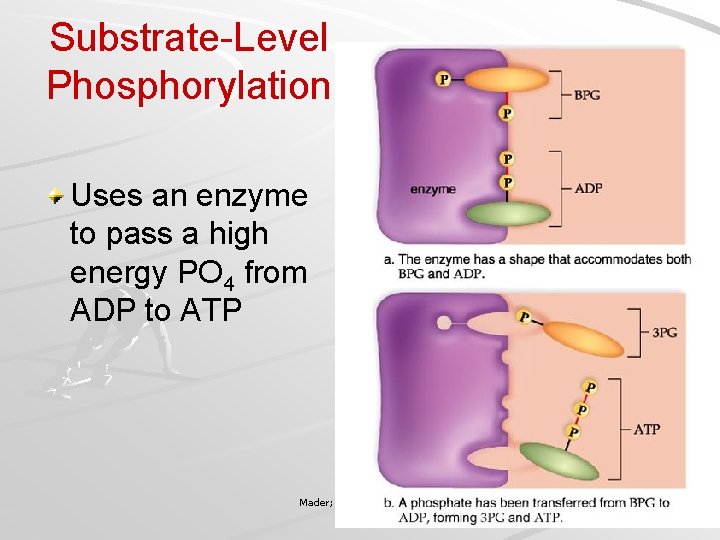
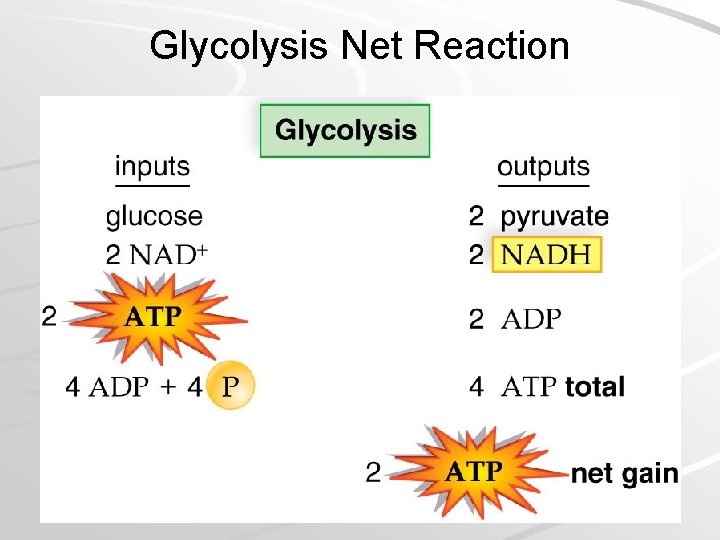
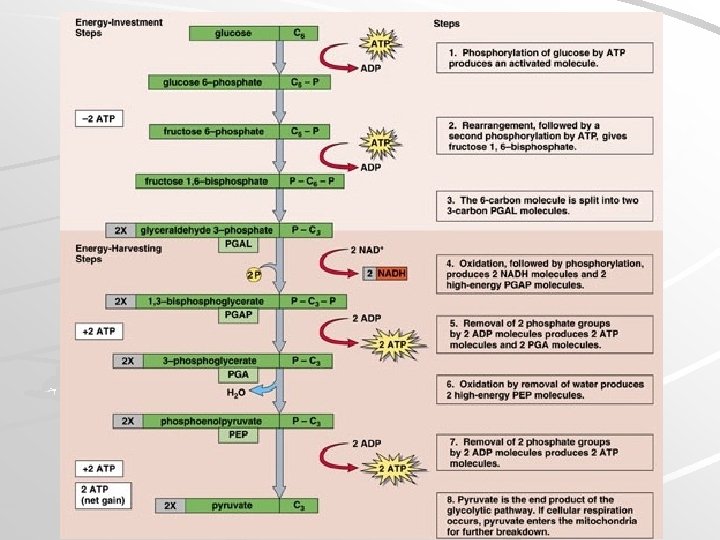
Glycolysis Occurs in cytoplasm, outside mitochondria Requires initial investment of 2 ATP – ATP activates glucose to split into PGAL/G 3 P Oxidation of PGAL and subsequent substrates results in 4 high-energy PO 4 groups, which synthesize four ATP – Substrate-Level Phosphorylation Mader; Biology, 9 th Ed.
Substrate-Level Phosphorylation Uses an enzyme to pass a high energy PO 4 from ADP to ATP Mader; Biology, 9 th Ed.
Glycolysis Net Reaction Mader; Biology, 9 th Ed.
Glycolysis Mader; Biology, 9 th Ed.
Mader; Biology, 9 th Ed.
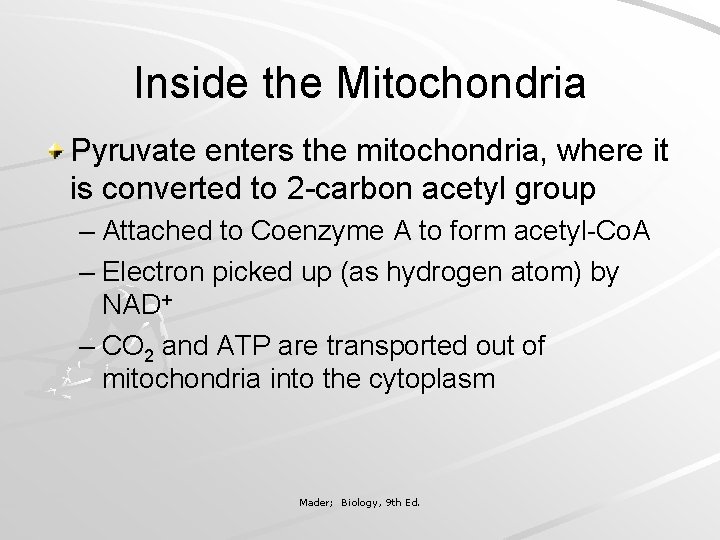
Inside the Mitochondria Pyruvate enters the mitochondria, where it is converted to 2 -carbon acetyl group – Attached to Coenzyme A to form acetyl-Co. A – Electron picked up (as hydrogen atom) by NAD+ – CO 2 and ATP are transported out of mitochondria into the cytoplasm Mader; Biology, 9 th Ed.
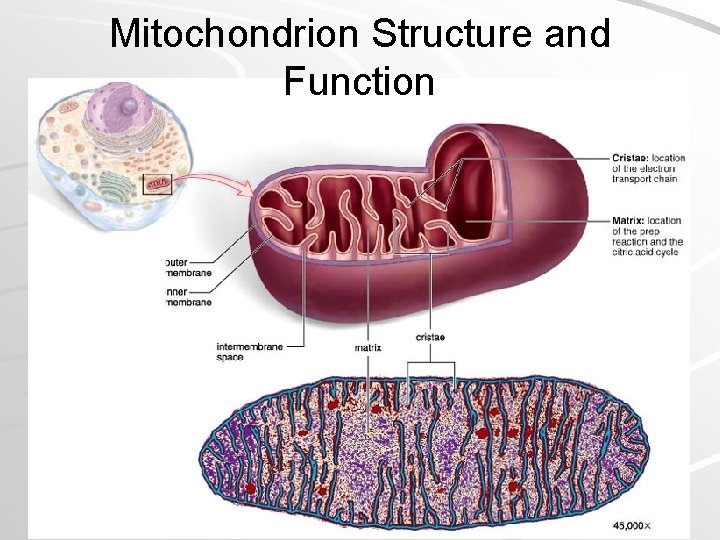
Mitochondrion Structure and Function Mader; Biology, 9 th Ed.
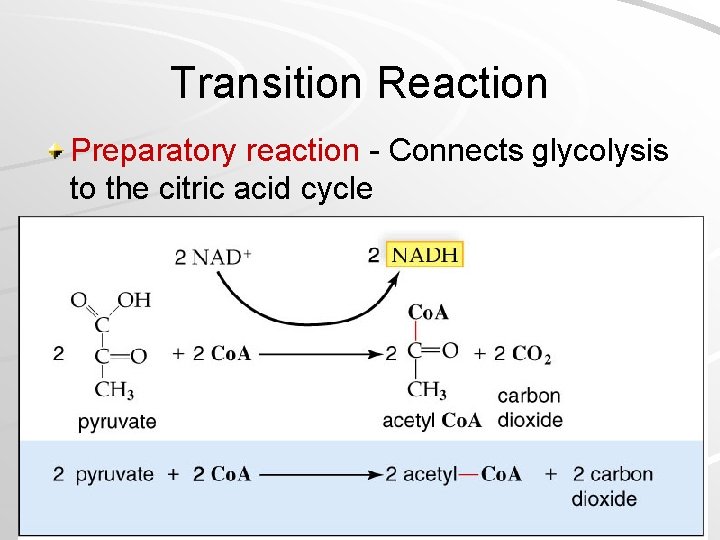
Transition Reaction Preparatory reaction - Connects glycolysis to the citric acid cycle Mader; Biology, 9 th Ed.
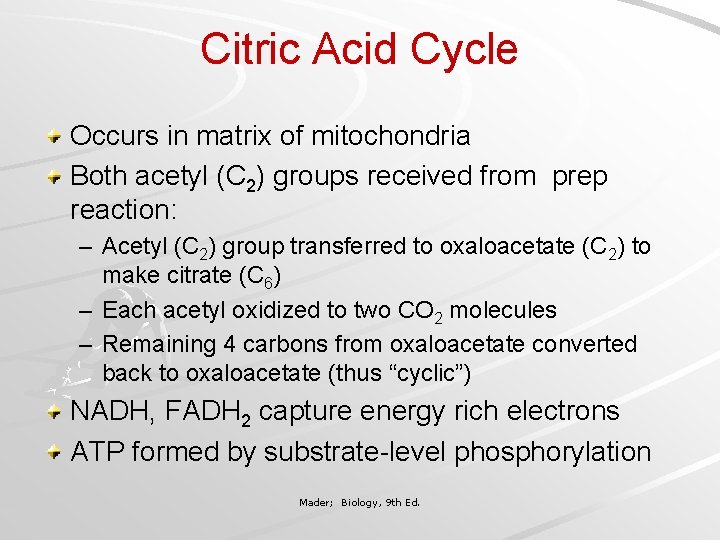
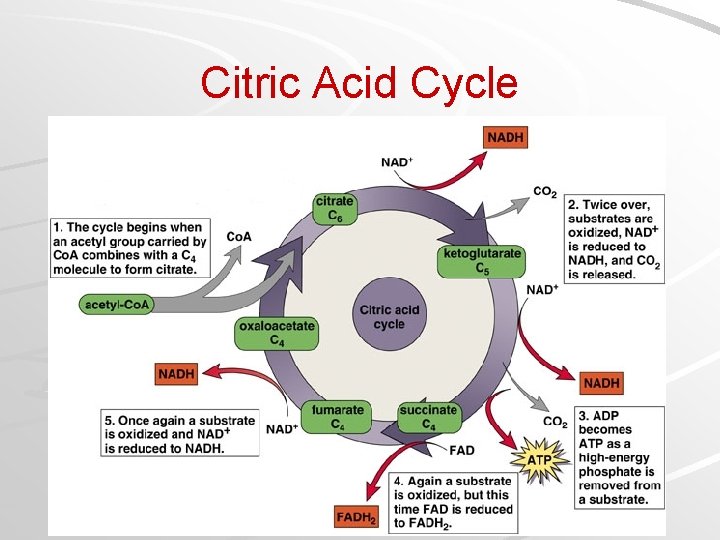
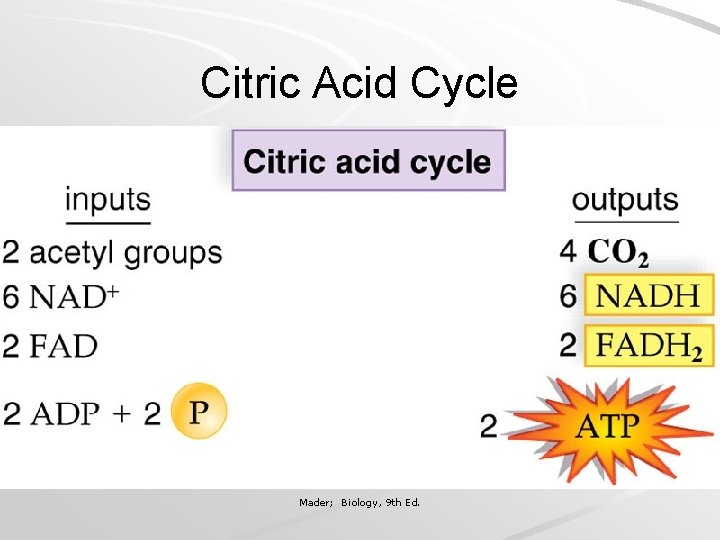
Citric Acid Cycle Occurs in matrix of mitochondria Both acetyl (C 2) groups received from prep reaction: – Acetyl (C 2) group transferred to oxaloacetate (C 2) to make citrate (C 6) – Each acetyl oxidized to two CO 2 molecules – Remaining 4 carbons from oxaloacetate converted back to oxaloacetate (thus “cyclic”) NADH, FADH 2 capture energy rich electrons ATP formed by substrate-level phosphorylation Mader; Biology, 9 th Ed.
Citric Acid Cycle Mader; Biology, 9 th Ed.
Citric Acid Cycle Mader; Biology, 9 th Ed.
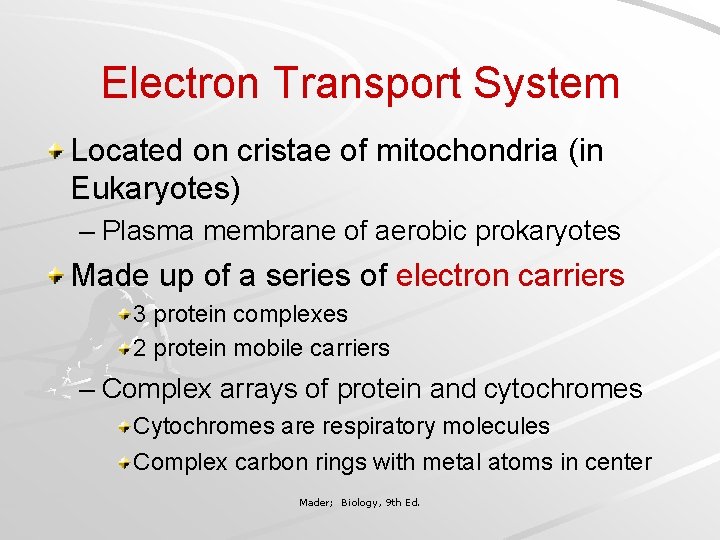
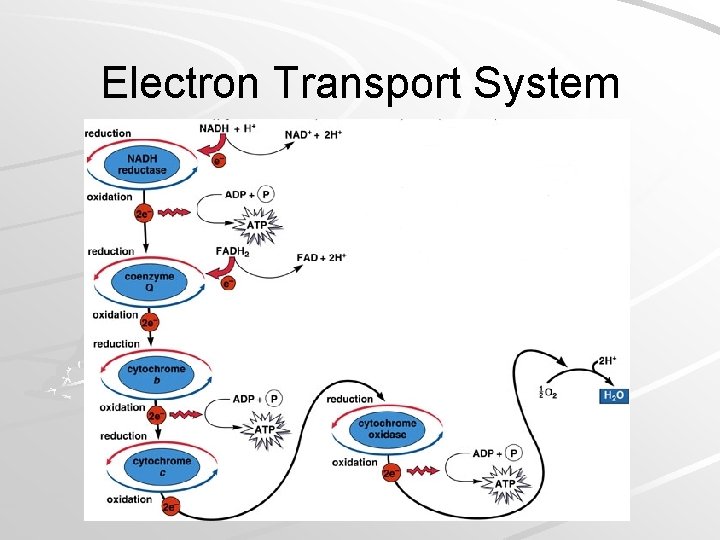
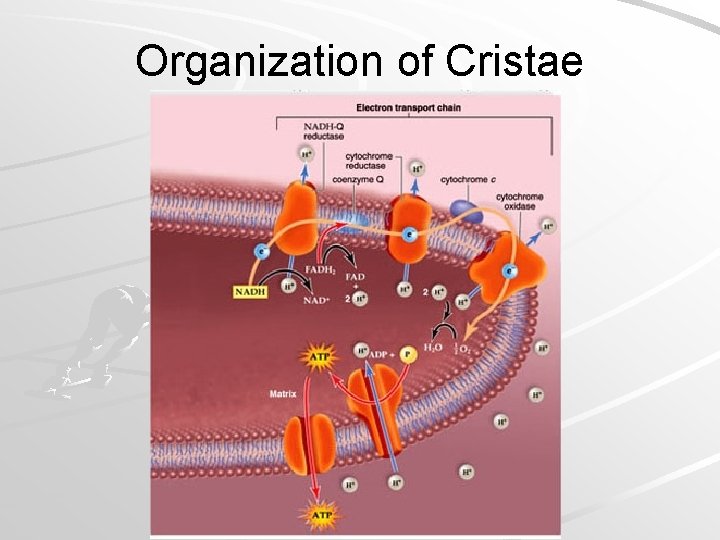
Electron Transport System Located on cristae of mitochondria (in Eukaryotes) – Plasma membrane of aerobic prokaryotes Made up of a series of electron carriers 3 protein complexes 2 protein mobile carriers – Complex arrays of protein and cytochromes Cytochromes are respiratory molecules Complex carbon rings with metal atoms in center Mader; Biology, 9 th Ed.
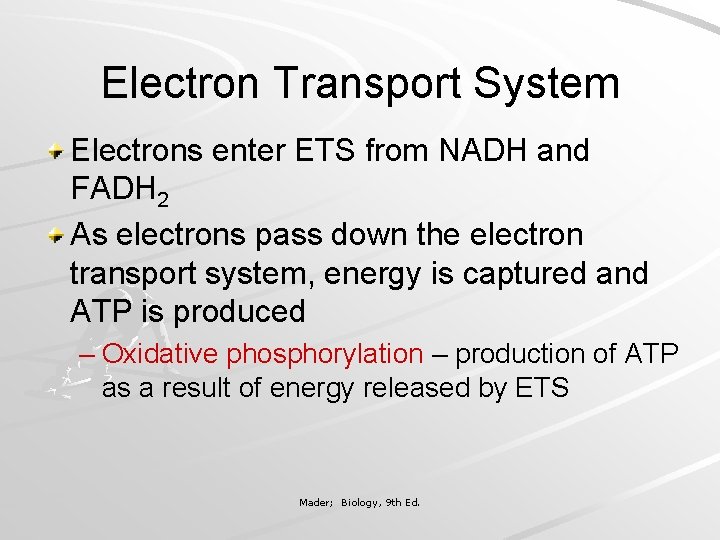
Electron Transport System Electrons enter ETS from NADH and FADH 2 As electrons pass down the electron transport system, energy is captured and ATP is produced – Oxidative phosphorylation – production of ATP as a result of energy released by ETS Mader; Biology, 9 th Ed.
Electron Transport System Mader; Biology, 9 th Ed.
Organization of Cristae Mader; Biology, 9 th Ed.
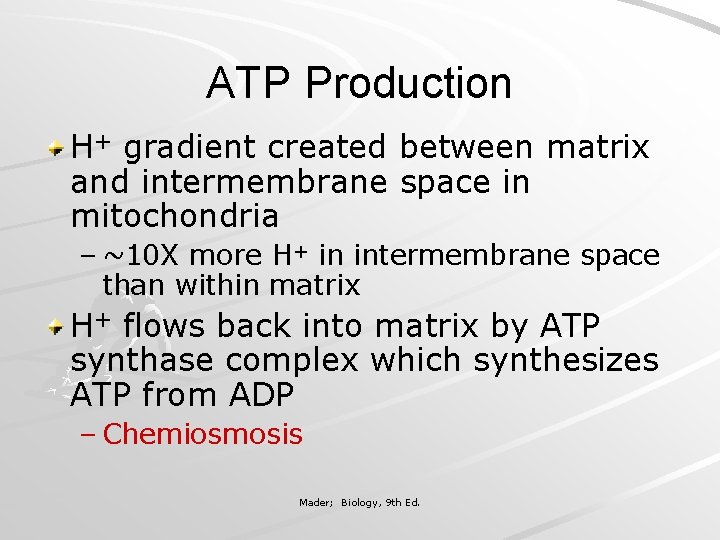
ATP Production H+ gradient created between matrix and intermembrane space in mitochondria – ~10 X more H+ in intermembrane space than within matrix H+ flows back into matrix by ATP synthase complex which synthesizes ATP from ADP – Chemiosmosis Mader; Biology, 9 th Ed.
Mader; Biology, 9 th Ed.
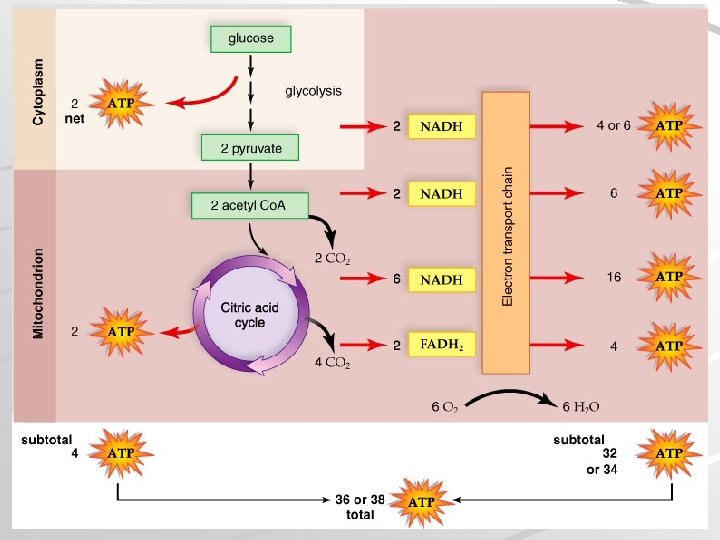
Energy Yield Net energy yield from glucose breakdown is 36 or 38 ATP (263/277 kcal energy) Efficiency of glucose breakdown is 39% (the remaining energy is lost as heat) Mader; Biology, 9 th Ed.
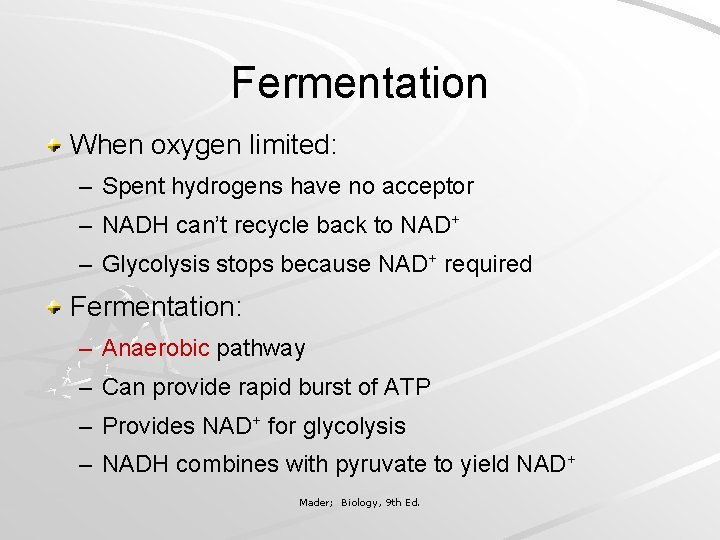
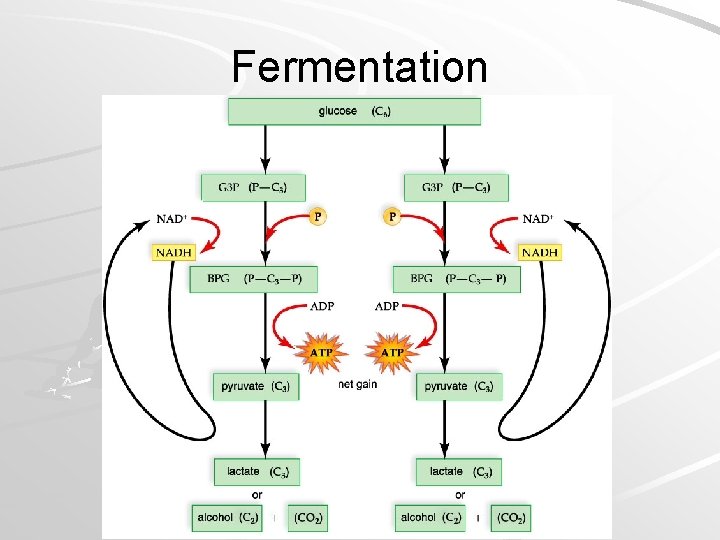
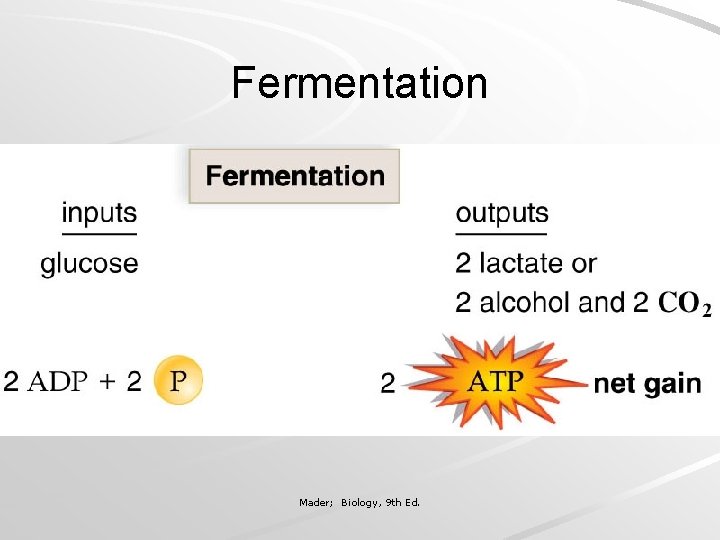
Fermentation When oxygen limited: – Spent hydrogens have no acceptor – NADH can’t recycle back to NAD+ – Glycolysis stops because NAD+ required Fermentation: – Anaerobic pathway – Can provide rapid burst of ATP – Provides NAD+ for glycolysis – NADH combines with pyruvate to yield NAD+ Mader; Biology, 9 th Ed.
Fermentation Mader; Biology, 9 th Ed.
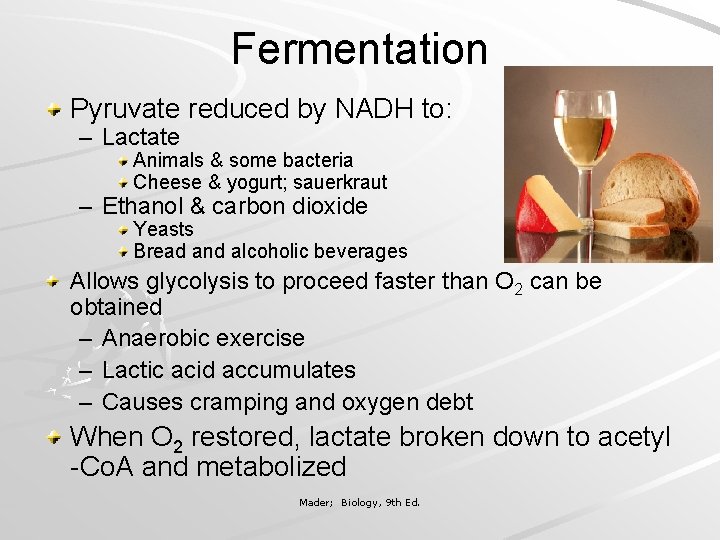
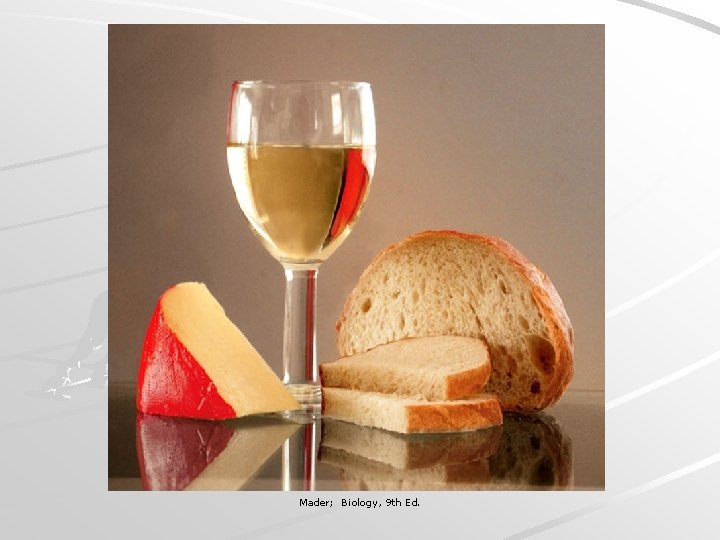
Fermentation Pyruvate reduced by NADH to: – Lactate Animals & some bacteria Cheese & yogurt; sauerkraut – Ethanol & carbon dioxide Yeasts Bread and alcoholic beverages Allows glycolysis to proceed faster than O 2 can be obtained – Anaerobic exercise – Lactic acid accumulates – Causes cramping and oxygen debt When O 2 restored, lactate broken down to acetyl -Co. A and metabolized Mader; Biology, 9 th Ed.
Fermentation Mader; Biology, 9 th Ed.
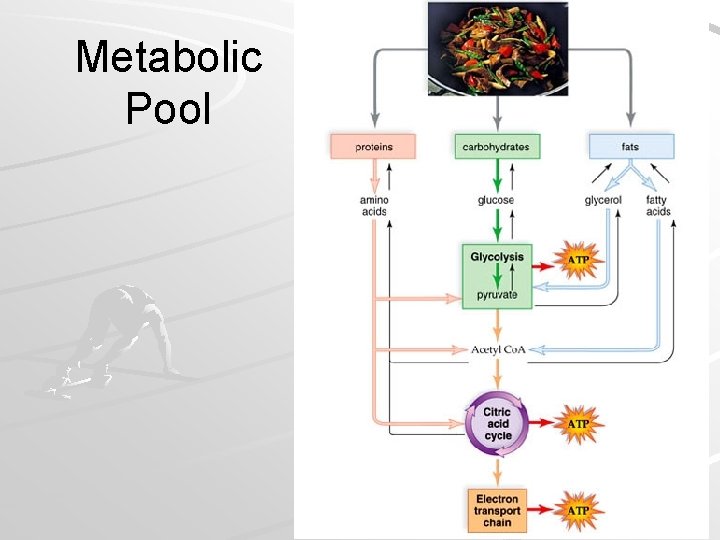
Metabolic Pool Carbohydrates, fats, and proteins in food can be used as energy sources Catabolism – degradative reactions Anabolism – synthetic reactions – All reactions in cellular respiration are part of a metabolic pool, and their substrates can be used for catabolism or anabolism Mader; Biology, 9 th Ed.
Metabolic Pool Mader; Biology, 9 th Ed.
Catabolism Breakdown products enter into respiratory pathways as intermediates – Carbohydrates - converted into glucose Processed via glycolysis… – Proteins - broken into amino acids (AAs) Some AAs used to make other proteins Excess AAs deaminated (NH 2 removed) in liver – Results in poisonous ammonia (NH 3) – Quickly converted to urea Different R-groups from AAs processed differently Fragments enter respiratory pathways at many different points Mader; Biology, 9 th Ed.
Anabolism Intermediates from respiratory pathways can be used for anabolism – Carbs Start with acetyl-Co. A Basically reverses glycolysis (but different pathway) – Fats G 3 P converted to glycerol Acetyls connected in pairs to form fatty acids Note – dietary carbohydrate RARELY converted to fat in humans! – Proteins - Made up of combinations of 20 different amino acids Some amino acids (11) can be synthesized from respiratory intermediates – organic acids in citric acid cycle can make amino acids – Add NH 2 – transamination However, other amino acids (9) cannot be synthesized by humans – Essential amino acids – Must be present in diet Mader; Biology, 9 th Ed.
Mader; Biology, 9 th Ed.