
Cellular Respiration Chapter 8 3 Introduction 1 2
- Slides: 27
Cellular Respiration Chapter 8. 3
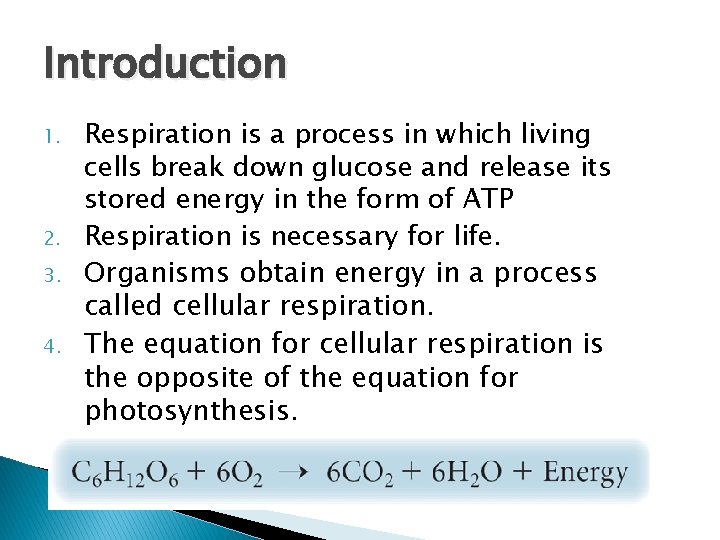
Introduction 1. 2. 3. 4. Respiration is a process in which living cells break down glucose and release its stored energy in the form of ATP Respiration is necessary for life. Organisms obtain energy in a process called cellular respiration. The equation for cellular respiration is the opposite of the equation for photosynthesis.
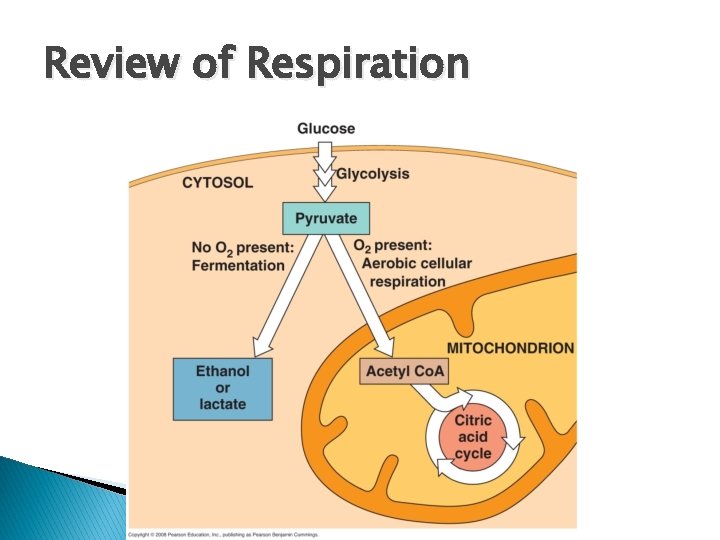
Introduction 6. Cell respiration occurs in ALL cells. 7. It begins with glycolysis, and continues with either anaerobic respiration (AKA fermentation) if oxygen is absent or aerobic respiration if oxygen is present.
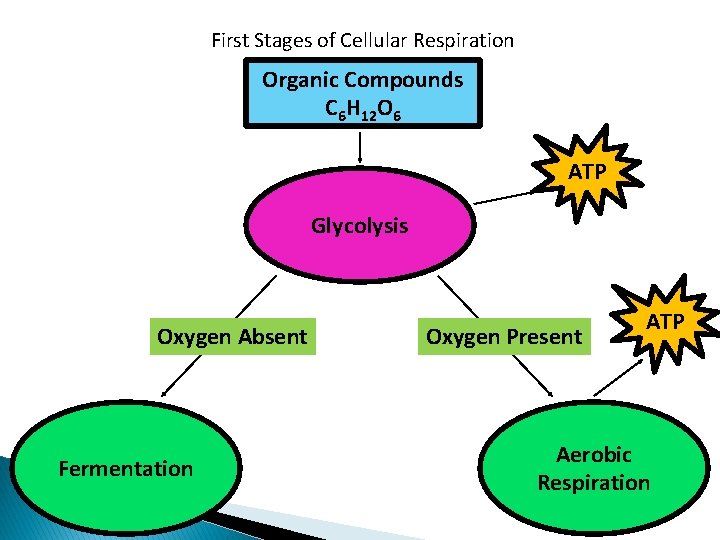
First Stages of Cellular Respiration Organic Compounds C 6 H 12 O 6 ATP Glycolysis Oxygen Absent Fermentation Oxygen Present ATP Aerobic Respiration
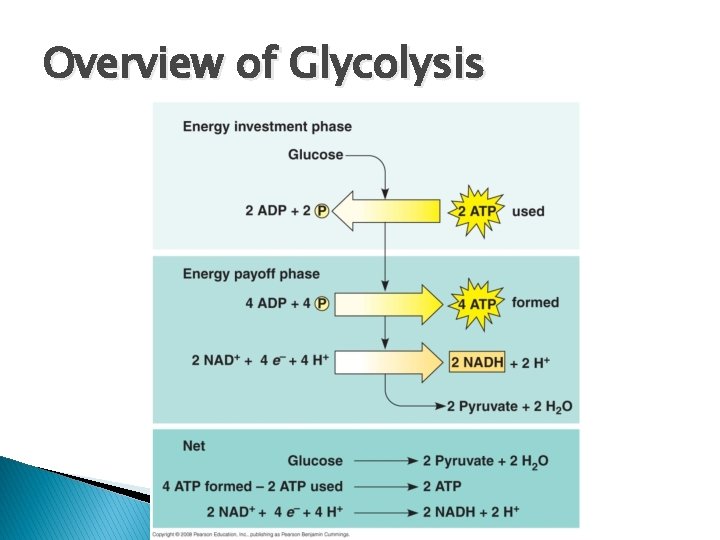
Glycolysis 1. 2. 3. 4. Occurs in the cytoplasm Can occur with or without oxygen Glucose is split into 2 molecules of pyruvic acid (which is a 3 carbon compound) In addition to pyruvic acid, 2 molecules of ATP and 2 molecules of NADH are formed for each molecule of glucose that is broken down.
Glycolysis 5. End products of glycolysis a. 2 ATP (makes 4 but uses 2 ATP) b. 2 molecules of pyruvic acid c. 2 NADH d. 2 H 2 O 6. What happens to the pyruvic acid depends on: a. The organism involved b. presence or absence of oxygen
Overview of Glycolysis
Fermentation 1. 2. 3. 4. 5. Defined as the process of breaking down pyruvic acid without the use of oxygen Also called anaerobic respiration Does not produce ATP Does produce NAD+ which is reused during glycolysis 2 forms of fermentation: a. Lactic acid fermentation b. alcoholic fermentation
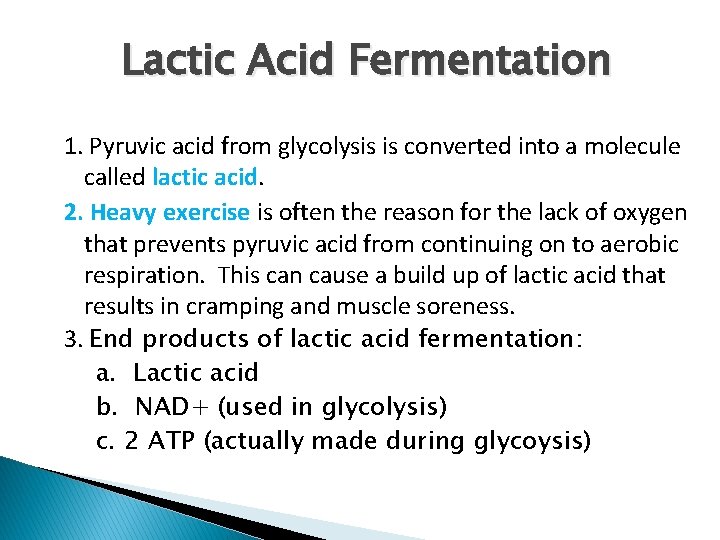
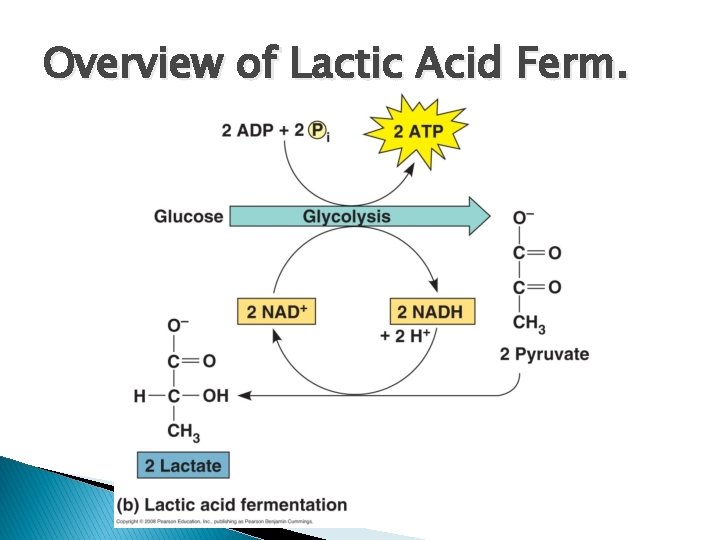
Lactic Acid Fermentation 1. Pyruvic acid from glycolysis is converted into a molecule called lactic acid. 2. Heavy exercise is often the reason for the lack of oxygen that prevents pyruvic acid from continuing on to aerobic respiration. This can cause a build up of lactic acid that results in cramping and muscle soreness. 3. End products of lactic acid fermentation: a. Lactic acid b. NAD+ (used in glycolysis) c. 2 ATP (actually made during glycoysis)
Overview of Lactic Acid Ferm.
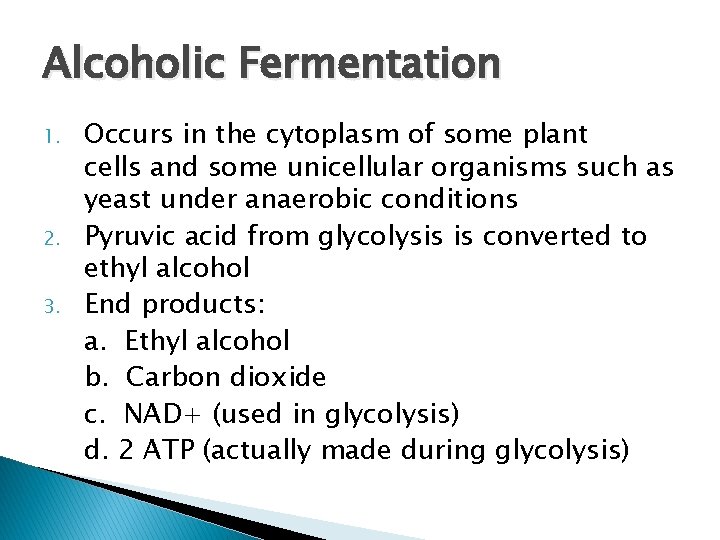
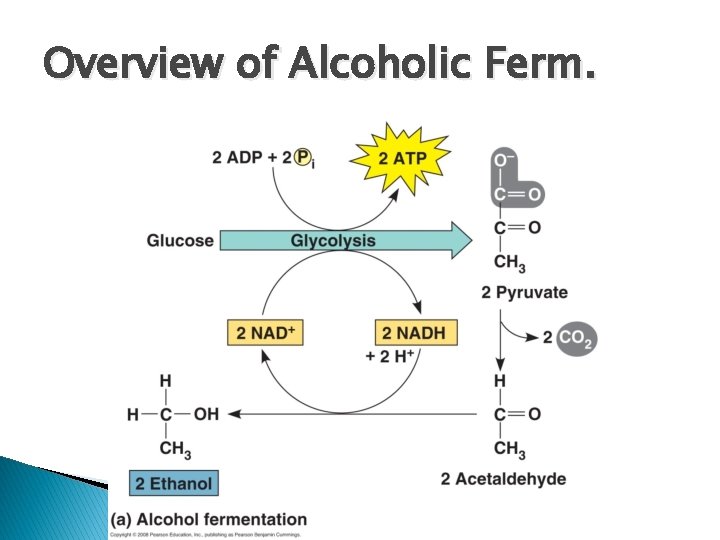
Alcoholic Fermentation 1. 2. 3. Occurs in the cytoplasm of some plant cells and some unicellular organisms such as yeast under anaerobic conditions Pyruvic acid from glycolysis is converted to ethyl alcohol End products: a. Ethyl alcohol b. Carbon dioxide c. NAD+ (used in glycolysis) d. 2 ATP (actually made during glycolysis)
Overview of Alcoholic Ferm.
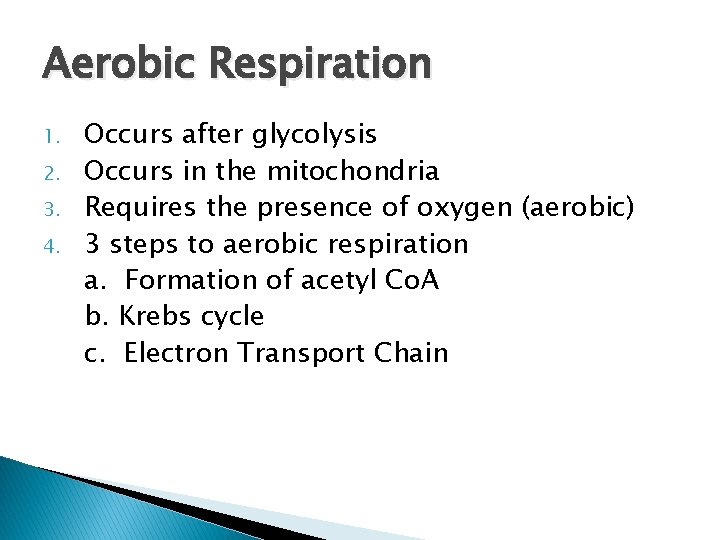
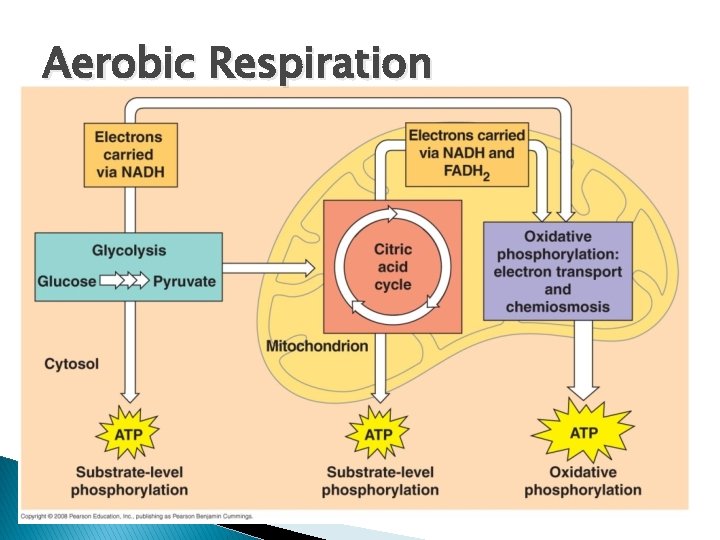
Aerobic Respiration 1. 2. 3. 4. Occurs after glycolysis Occurs in the mitochondria Requires the presence of oxygen (aerobic) 3 steps to aerobic respiration a. Formation of acetyl Co. A b. Krebs cycle c. Electron Transport Chain
Aerobic Respiration
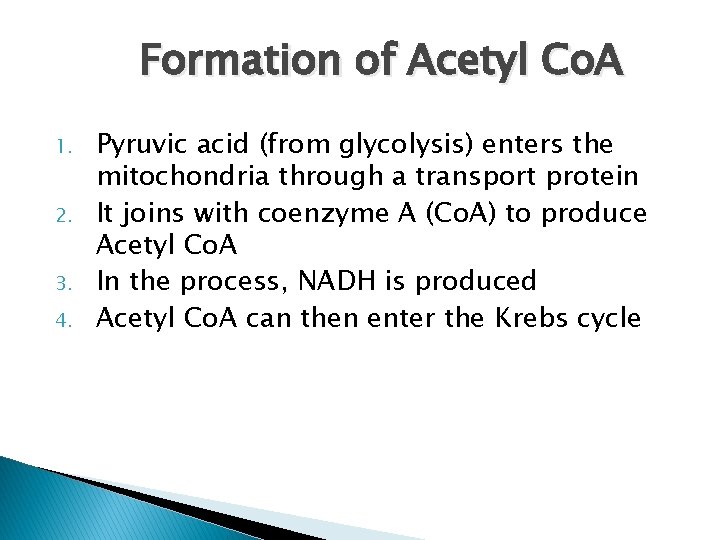
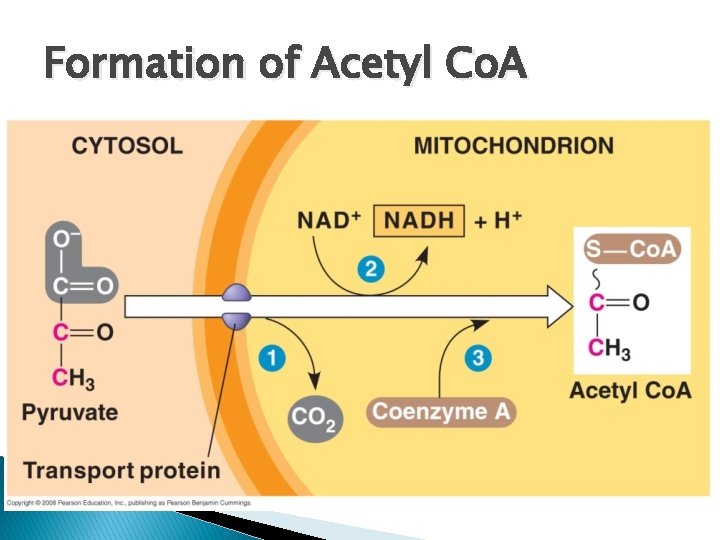
Formation of Acetyl Co. A 1. 2. 3. 4. Pyruvic acid (from glycolysis) enters the mitochondria through a transport protein It joins with coenzyme A (Co. A) to produce Acetyl Co. A In the process, NADH is produced Acetyl Co. A can then enter the Krebs cycle
Formation of Acetyl Co. A
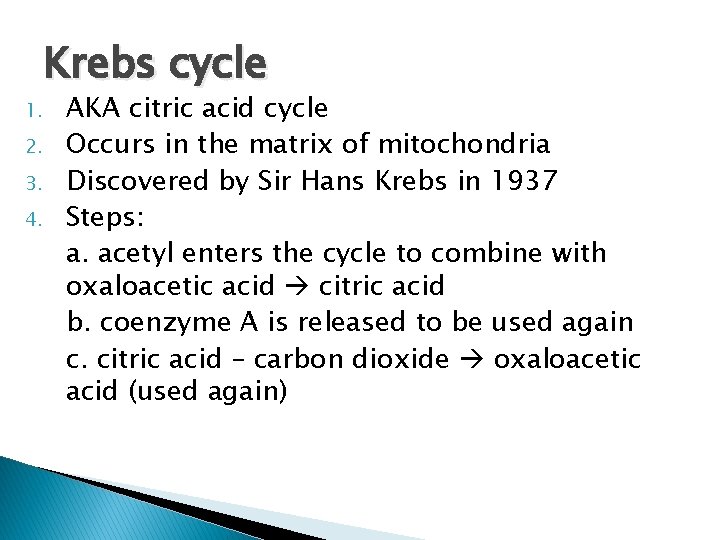
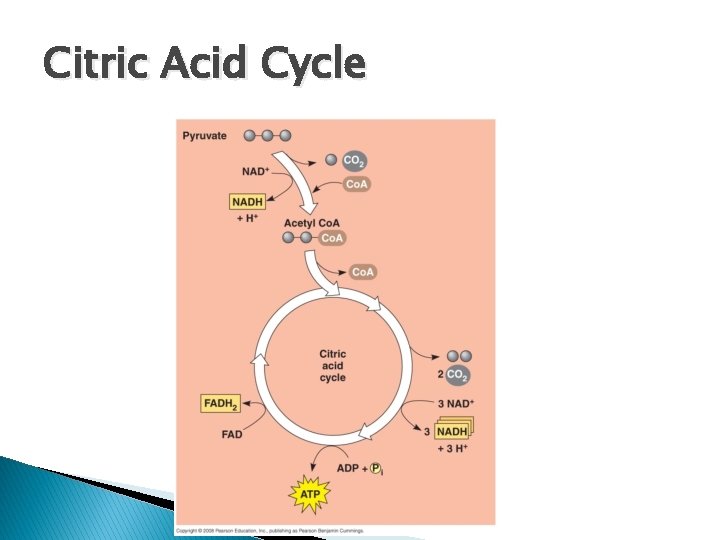
1. 2. 3. 4. Krebs cycle AKA citric acid cycle Occurs in the matrix of mitochondria Discovered by Sir Hans Krebs in 1937 Steps: a. acetyl enters the cycle to combine with oxaloacetic acid citric acid b. coenzyme A is released to be used again c. citric acid – carbon dioxide oxaloacetic acid (used again)
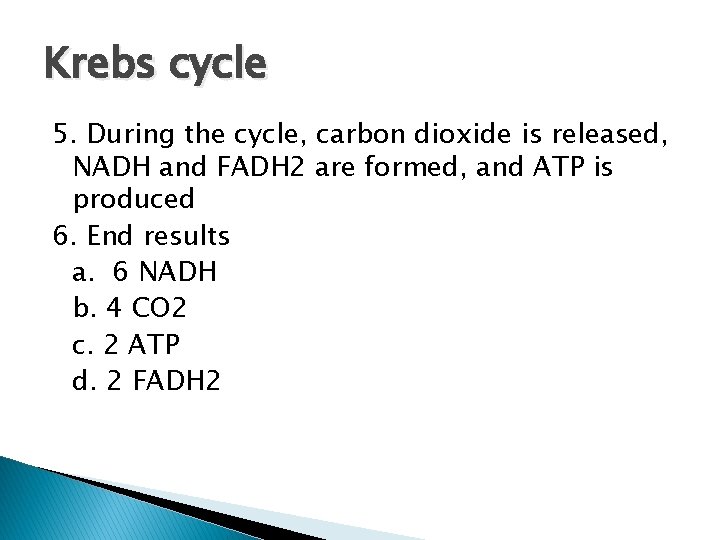
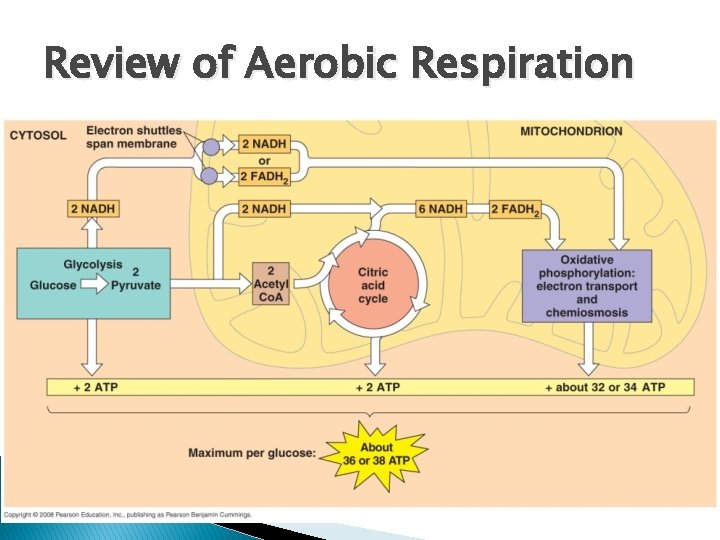
Krebs cycle 5. During the cycle, carbon dioxide is released, NADH and FADH 2 are formed, and ATP is produced 6. End results a. 6 NADH b. 4 CO 2 c. 2 ATP d. 2 FADH 2
Citric Acid Cycle
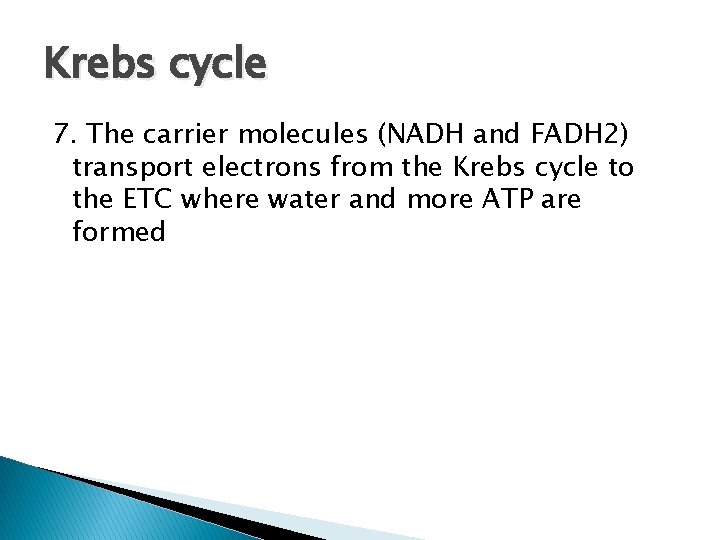
Krebs cycle 7. The carrier molecules (NADH and FADH 2) transport electrons from the Krebs cycle to the ETC where water and more ATP are formed
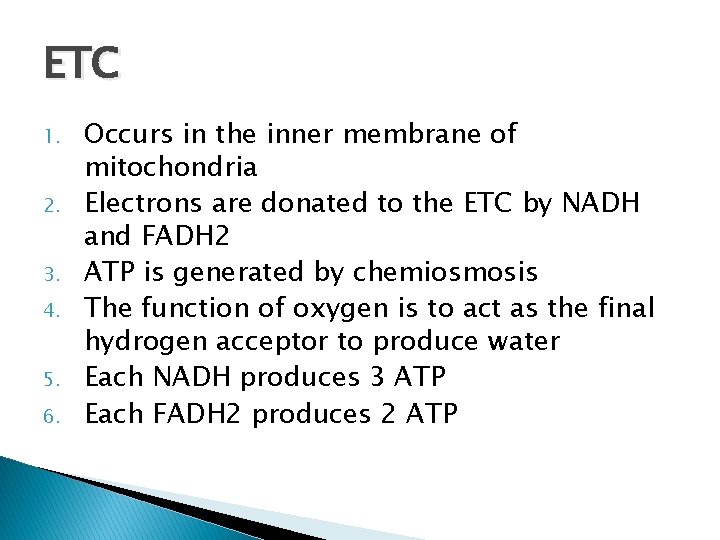
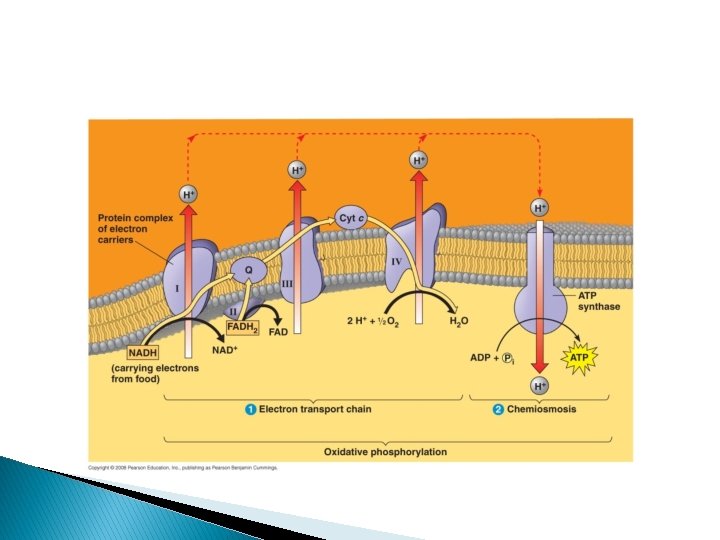
ETC 1. 2. 3. 4. 5. 6. Occurs in the inner membrane of mitochondria Electrons are donated to the ETC by NADH and FADH 2 ATP is generated by chemiosmosis The function of oxygen is to act as the final hydrogen acceptor to produce water Each NADH produces 3 ATP Each FADH 2 produces 2 ATP
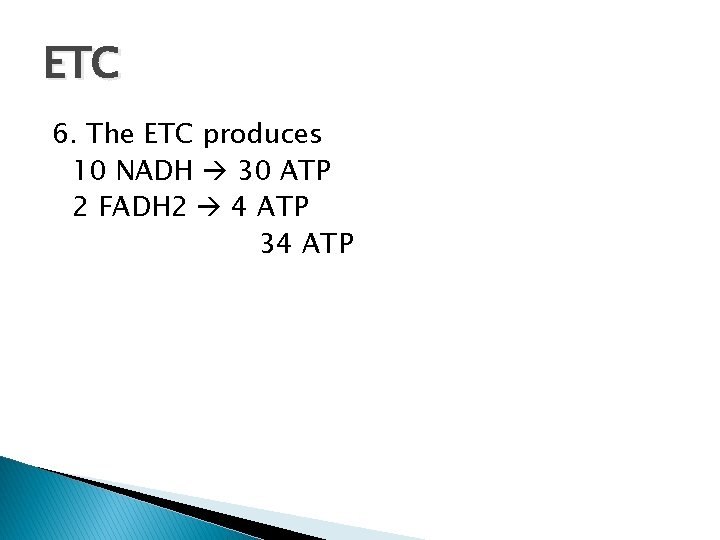
ETC 6. The ETC produces 10 NADH 30 ATP 2 FADH 2 4 ATP 34 ATP
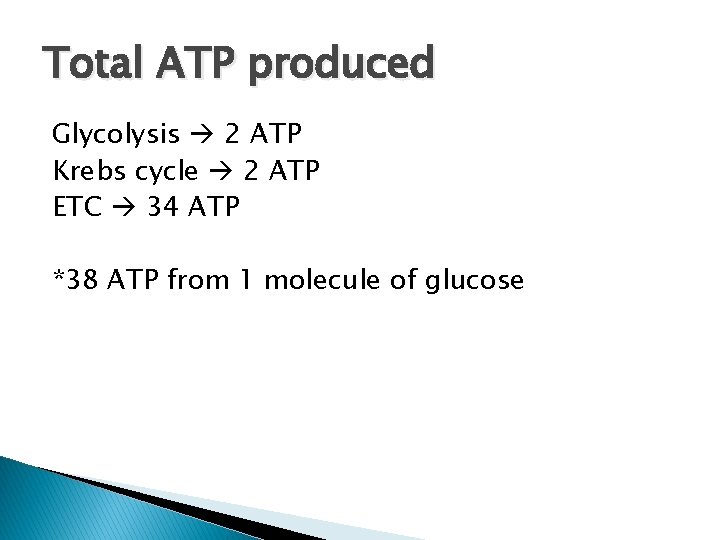
Total ATP produced Glycolysis 2 ATP Krebs cycle 2 ATP ETC 34 ATP *38 ATP from 1 molecule of glucose
Review of Aerobic Respiration
Respiration -Aerobic respiration is important because it produces way more ATP than anaerobic respiration (38 ATP to 2 ATP)
Review of Respiration