
CELLULAR RESPIRATION CHAPTER 6 Sunlight energy ECOSYSTEM Photosynthesis
- Slides: 31
CELLULAR RESPIRATION CHAPTER 6
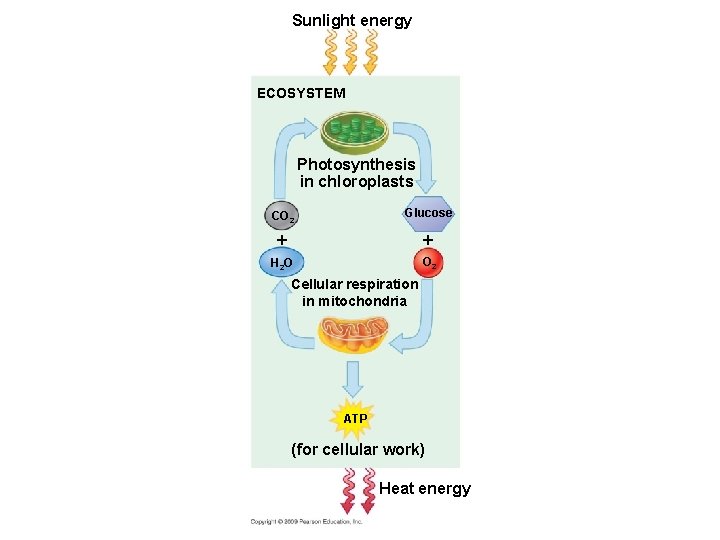
Sunlight energy ECOSYSTEM Photosynthesis in chloroplasts CO 2 Glucose H 2 O O 2 Cellular respiration in mitochondria ATP (for cellular work) Heat energy
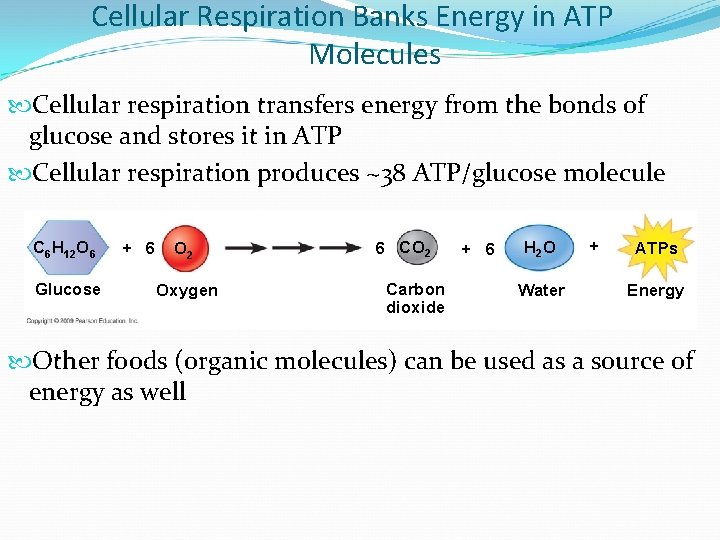
Cellular Respiration Banks Energy in ATP Molecules Cellular respiration transfers energy from the bonds of glucose and stores it in ATP Cellular respiration produces ~38 ATP/glucose molecule C 6 H 12 O 6 Glucose + 6 O 2 Oxygen 6 CO 2 Carbon dioxide + 6 H 2 O Water + ATPs Energy Other foods (organic molecules) can be used as a source of energy as well
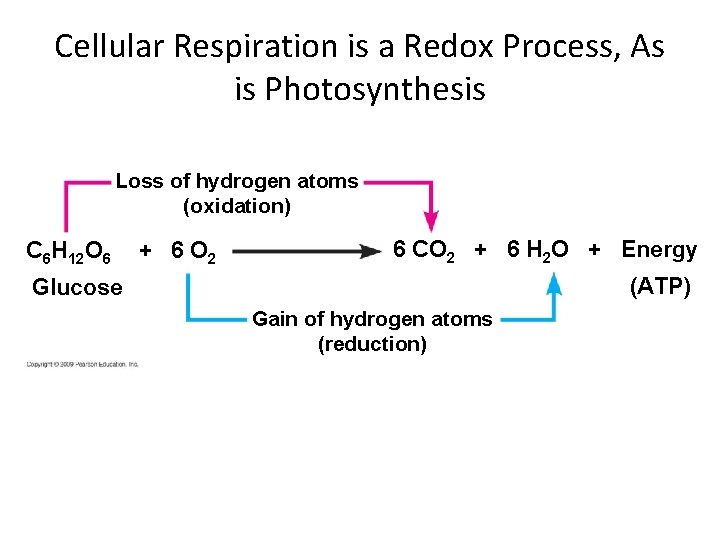
Cellular Respiration is a Redox Process, As is Photosynthesis Loss of hydrogen atoms (oxidation) C 6 H 12 O 6 + 6 O 2 6 CO 2 + 6 H 2 O + Energy (ATP) Glucose Gain of hydrogen atoms (reduction)
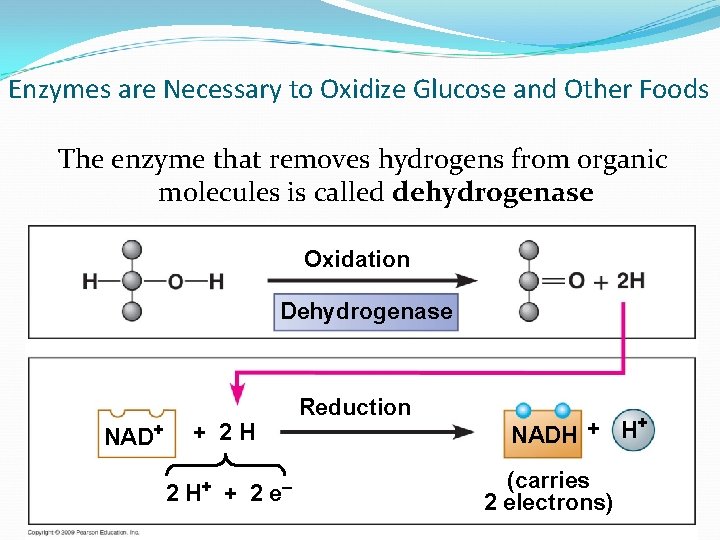
Enzymes are Necessary to Oxidize Glucose and Other Foods The enzyme that removes hydrogens from organic molecules is called dehydrogenase Oxidation Dehydrogenase NAD+ + 2 H 2 H+ + 2 e – Reduction + NADH + H (carries 2 electrons)
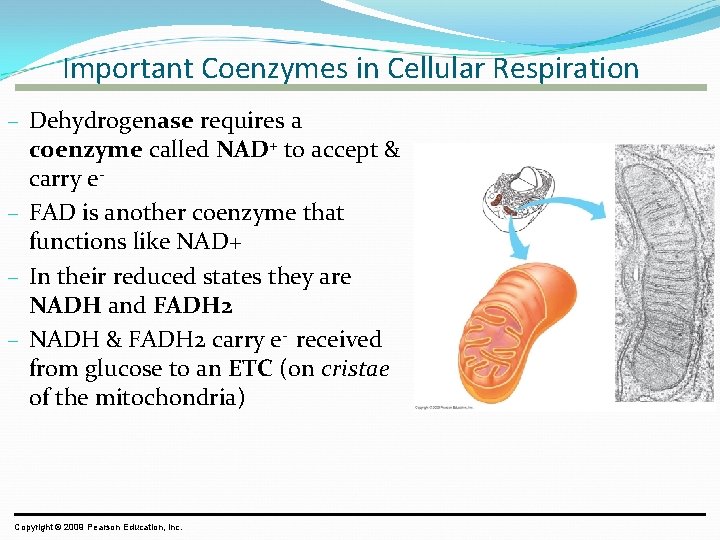
Important Coenzymes in Cellular Respiration – Dehydrogenase requires a coenzyme called NAD+ to accept & carry e– FAD is another coenzyme that functions like NAD+ – In their reduced states they are NADH and FADH 2 – NADH & FADH 2 carry e- received from glucose to an ETC (on cristae of the mitochondria) Copyright © 2009 Pearson Education, Inc.
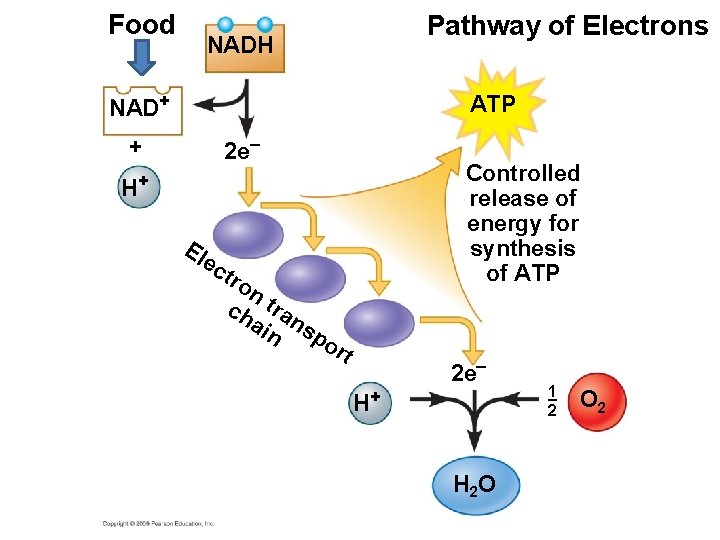
Cells Tap Energy From Electrons “falling” From Organic Fuels to Oxygen When the bonds of glucose are broken, electrons are transferred in a series of steps but ultimately “fall” to oxygen As electrons “fall” from glucose to oxygen, energy is released in small amounts and stored in an H+ gradient that is used to synthesize ATP
Food Pathway of Electrons NADH NAD+ ATP + 2 e– Controlled release of energy for synthesis of ATP H+ El ec tro nt ch ra ain ns po rt 2 e– H+ H 2 O 1 2 O 2
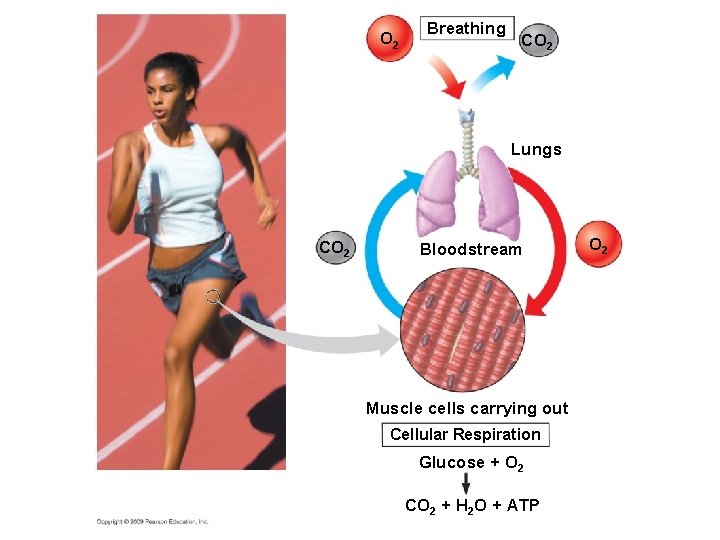
Breathing Supplies Oxygen to Our Cells For Use in Cellular Respiration and Removes Carbon Dioxide Breathing and cellular respiration are closely related – Breathing is necessary to bring in atmospheric O 2 while removing CO 2 produced during cellular respiration
O 2 Breathing CO 2 Lungs CO 2 Bloodstream Muscle cells carrying out Cellular Respiration Glucose + O 2 CO 2 + H 2 O + ATP O 2
THREE STAGES OF CELLULAR RESPIRATION
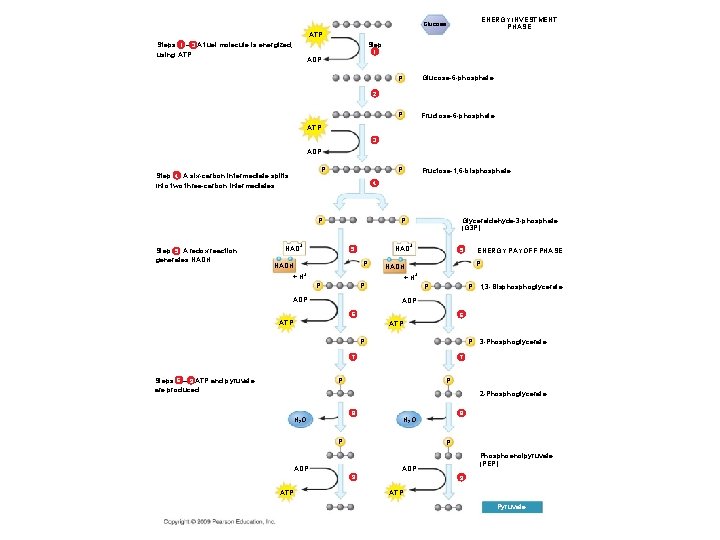
Cellular Respiration Occurs in Three Main Stages Stage 1: Glycolysis – Location: cytoplasm – Purpose: to breakdown glucose – What happens: A single molecule of glucose is enzymatically cut in half through a series of steps producing two molecules of pyruvate – Redox reactions produce NADH – Substrate-level phosphorylation produces ATP – Products/glucose : 2 pyruvate, 2 NADH, 2 ATP
ENERGY INVESTMENT PHASE Glucose ATP Steps 1 – 3 A fuel molecule is energized, using ATP. 1 ADP P Glucose-6 -phosphate P Fructose-1, 6 -bisphosphate 2 ATP 3 ADP P Step 4 A six-carbon intermediate splits Into two three-carbon intermediates. 4 P Step 5 A redox reaction generates NADH. Glyceraldehyde-3 -phosphate (G 3 P) P NAD+ 5 P NADH 5 NADH + H+ ENERGY PAYOFF PHASE P + H+ P P ADP P P 1, 3 -Bisphoglycerate ADP 6 6 ATP P P 3 -Phosphoglycerate 7 7 P Steps 6 – 9 ATP and pyruvate are produced. P 2 -Phosphoglycerate 8 H 2 O P P ADP Phosphoenolpyruvate (PEP) ADP 9 ATP 8 H 2 O 9 ATP Pyruvate
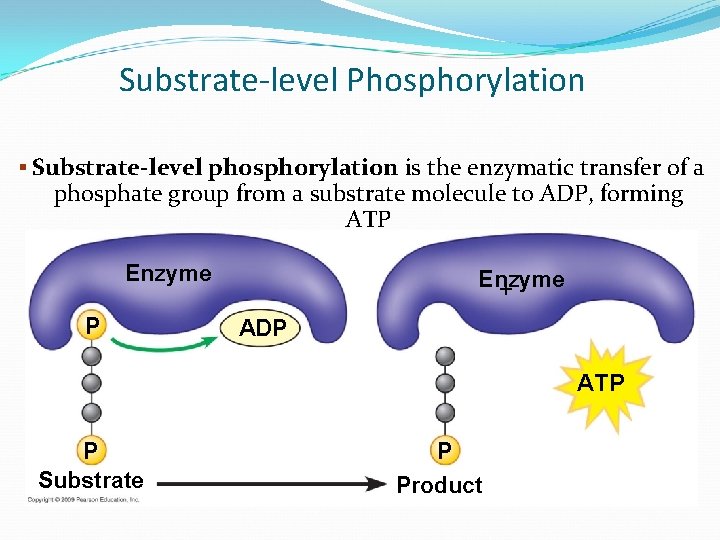
Substrate-level Phosphorylation § Substrate-level phosphorylation is the enzymatic transfer of a phosphate group from a substrate molecule to ADP, forming ATP Enzyme ADP ATP P Substrate P Product
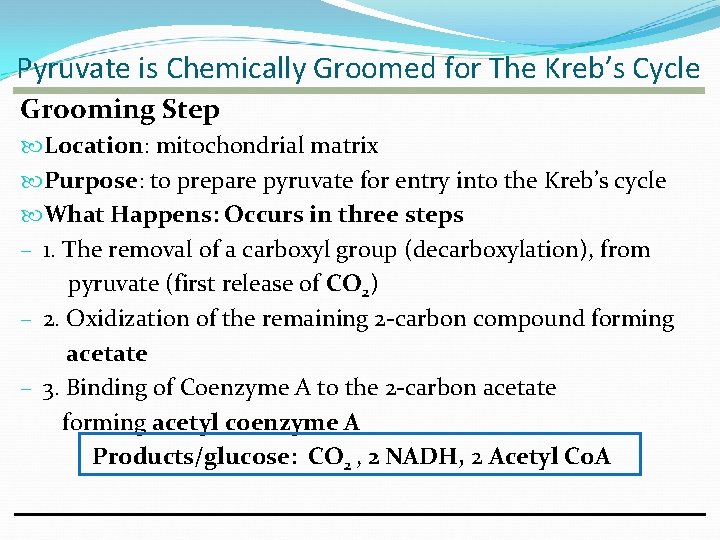
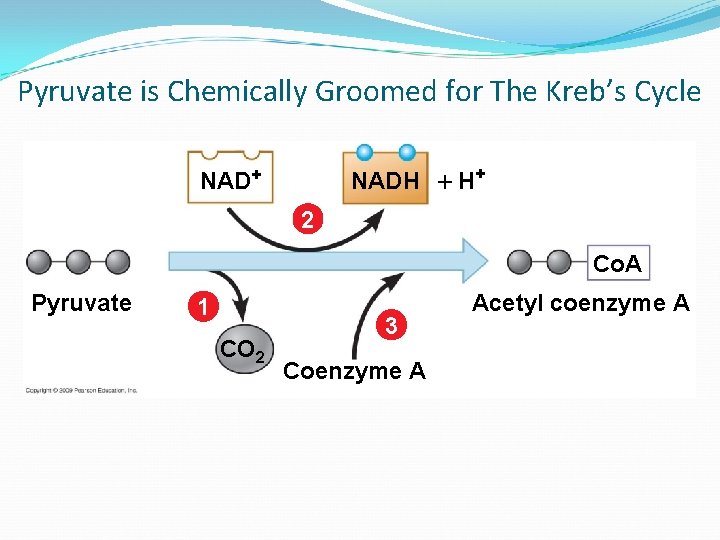
Pyruvate is Chemically Groomed for The Kreb’s Cycle Grooming Step Location: mitochondrial matrix Purpose: to prepare pyruvate for entry into the Kreb’s cycle What Happens: Occurs in three steps – 1. The removal of a carboxyl group (decarboxylation), from pyruvate (first release of CO 2) – 2. Oxidization of the remaining 2 -carbon compound forming acetate – 3. Binding of Coenzyme A to the 2 -carbon acetate forming acetyl coenzyme A Products/glucose: CO 2 , 2 NADH, 2 Acetyl Co. A
Pyruvate is Chemically Groomed for The Kreb’s Cycle NADH H+ NAD+ 2 Co. A Pyruvate 1 CO 2 3 Coenzyme A Acetyl coenzyme A
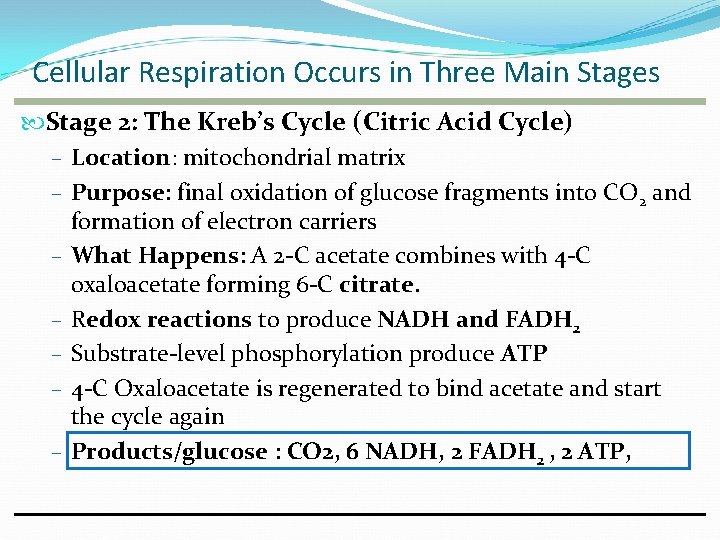
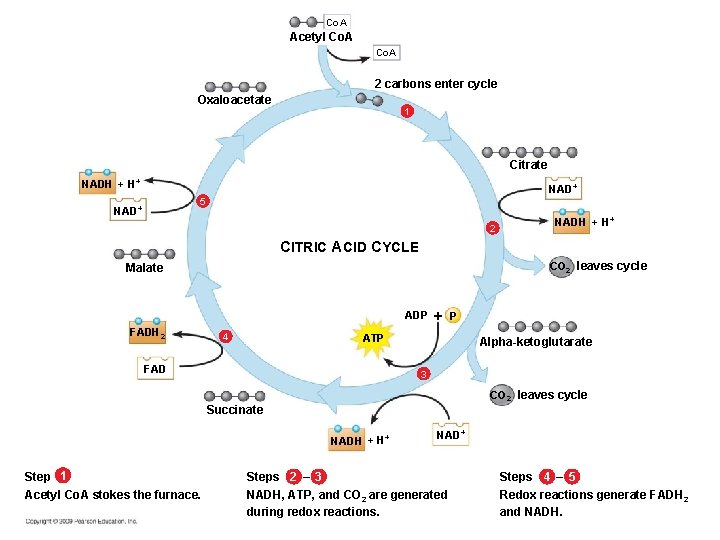
Cellular Respiration Occurs in Three Main Stages Stage 2: The Kreb’s Cycle (Citric Acid Cycle) – Location: mitochondrial matrix – Purpose: final oxidation of glucose fragments into CO 2 and formation of electron carriers – What Happens: A 2 -C acetate combines with 4 -C oxaloacetate forming 6 -C citrate. – Redox reactions to produce NADH and FADH 2 – Substrate-level phosphorylation produce ATP – 4 -C Oxaloacetate is regenerated to bind acetate and start the cycle again – Products/glucose : CO 2, 6 NADH, 2 FADH 2 , 2 ATP,
Co. A Acetyl Co. A 2 carbons enter cycle Oxaloacetate 1 Citrate NADH + H+ NAD+ 5 NAD+ 2 NADH + H+ CITRIC ACID CYCLE CO 2 leaves cycle Malate ADP P FADH 2 4 ATP FAD Alpha-ketoglutarate 3 CO 2 leaves cycle Succinate NADH + H+ Step 1 Acetyl Co. A stokes the furnace. NAD+ Steps 2 – 3 NADH, ATP, and CO 2 are generated during redox reactions. Steps 4 – 5 Redox reactions generate FADH 2 and NADH.
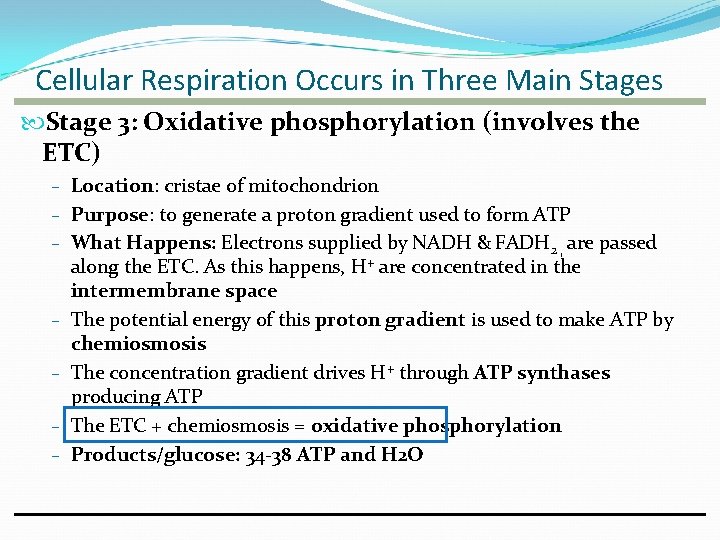
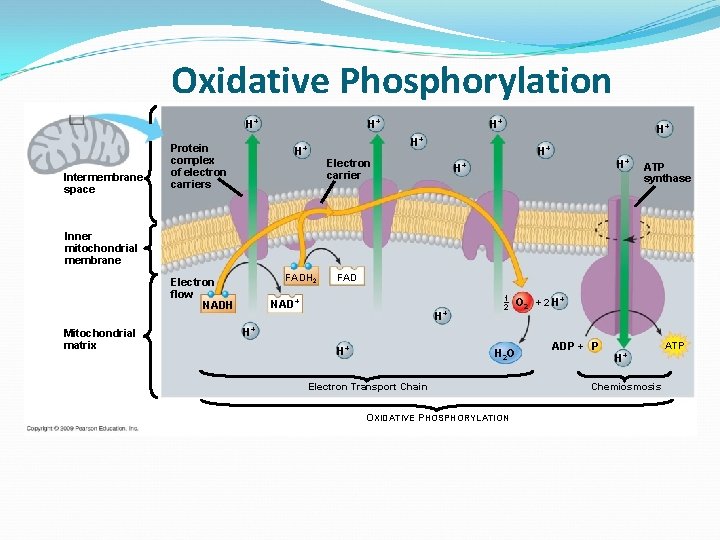
Cellular Respiration Occurs in Three Main Stages Stage 3: Oxidative phosphorylation (involves the ETC) – Location: cristae of mitochondrion – Purpose: to generate a proton gradient used to form ATP – What Happens: Electrons supplied by NADH & FADH 2 , are passed – – along the ETC. As this happens, H+ are concentrated in the intermembrane space The potential energy of this proton gradient is used to make ATP by chemiosmosis The concentration gradient drives H+ through ATP synthases producing ATP The ETC + chemiosmosis = oxidative phosphorylation Products/glucose: 34 -38 ATP and H 2 O
Oxidative Phosphorylation Intermembrane space Protein complex of electron carriers H+ H+ Electron carrier H+ H+ ATP synthase Inner mitochondrial membrane FADH 2 Electron flow NADH Mitochondrial matrix FAD NAD+ H+ 1 2 O 2 + 2 H+ H+ H+ H 2 O Electron Transport Chain OXIDATIVE PHOSPHORYLATION ADP + P H+ Chemiosmosis ATP
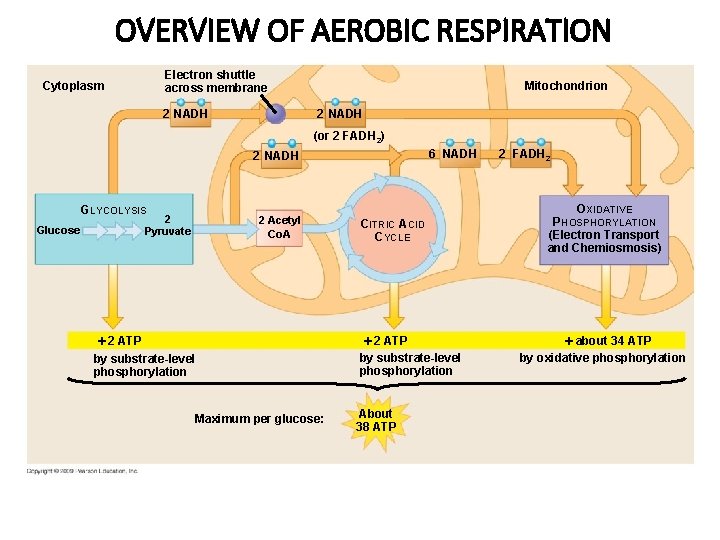
OVERVIEW OF AEROBIC RESPIRATION Electron shuttle across membrane Cytoplasm 2 NADH Mitochondrion 2 NADH (or 2 FADH 2) 6 NADH 2 NADH GLYCOLYSIS Glucose 2 Pyruvate 2 Acetyl Co. A 2 ATP by substrate-level phosphorylation Maximum per glucose: CITRIC ACID CYCLE 2 ATP by substrate-level phosphorylation About 38 ATP 2 FADH 2 OXIDATIVE PHOSPHORYLATION (Electron Transport and Chemiosmosis) about 34 ATP by oxidative phosphorylation
Overview of Cellular Respiration
Fermentation Enables Cells to Produce ATP Without Oxygen Fermentation is an anaerobic energy-generating process – Location: cytoplasm – Purpose: to produce ATP in the absence of oxygen – What Happens? : Glycolysis, and regeneration of NAD+ – Pyruvate accepts electrons generated by redox reactions in glycolysis – Your muscle cells and certain bacteria can oxidize NADH through lactic acid fermentation Copyright © 2009 Pearson Education, Inc.
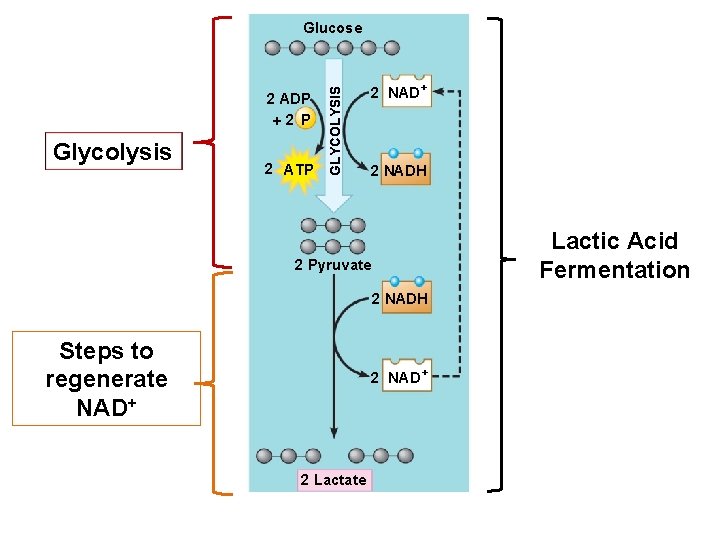
2 ADP 2 P Glycolysis 2 ATP GLYCOLYSIS Glucose 2 NAD+ 2 NADH Lactic Acid Fermentation 2 Pyruvate 2 NADH Steps to regenerate NAD+ 2 Lactate Lactic acid fermentation
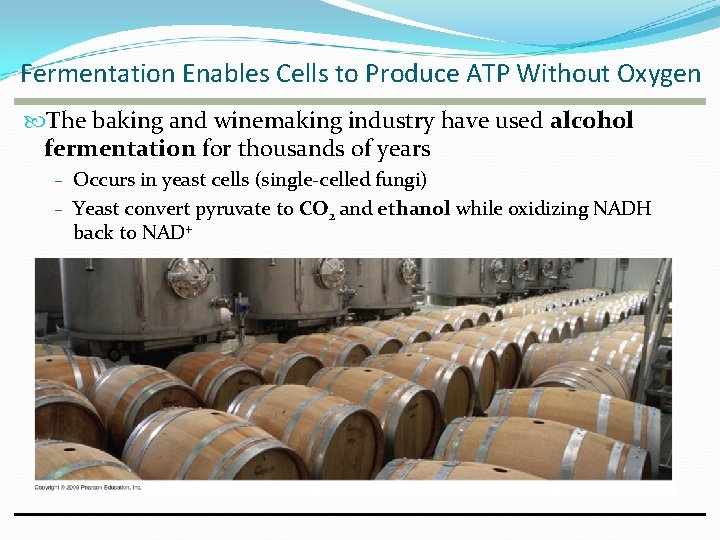
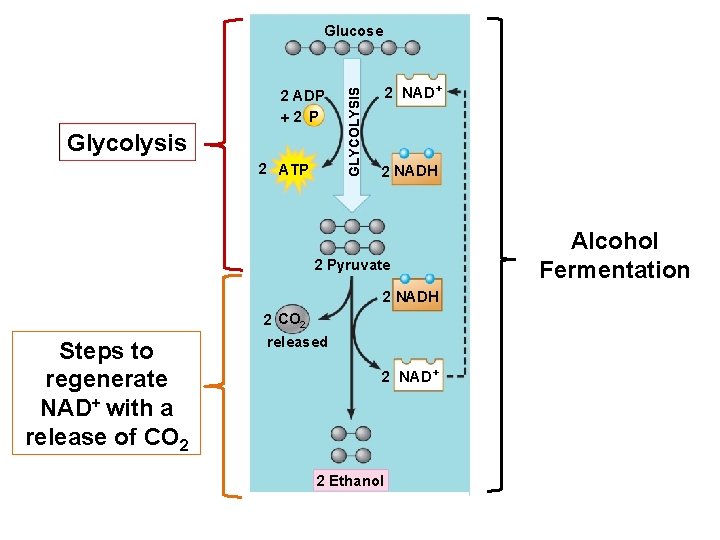
Fermentation Enables Cells to Produce ATP Without Oxygen The baking and winemaking industry have used alcohol fermentation for thousands of years – Occurs in yeast cells (single-celled fungi) – Yeast convert pyruvate to CO 2 and ethanol while oxidizing NADH back to NAD+
2 ADP 2 P Glycolysis 2 ATP GLYCOLYSIS Glucose 2 NAD+ 2 NADH 2 Pyruvate 2 NADH Steps to regenerate NAD+ with a release of CO 2 2 CO 2 released 2 NAD+ 2 Ethanol Alcohol fermentation Alcohol Fermentation
INTERCONNECTIONS BETWEEN MOLECULAR BREAKDOWN AND SYNTHESIS
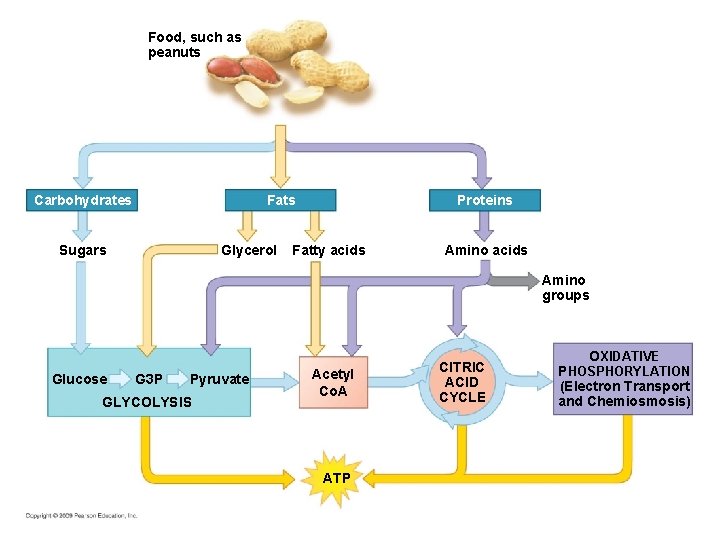
Cells Use Many Kinds of Organic Molecules as Fuel for Cellular Respiration Although glucose is considered the primary source of sugar for respiration and fermentation, three molecules can serve as substrates for generating ATP – Carbohydrates (disaccharides) – Proteins (after conversion to amino acids) – Fats
Food, such as peanuts Carbohydrates Fats Glycerol Sugars Proteins Fatty acids Amino groups Glucose G 3 P Pyruvate GLYCOLYSIS Acetyl Co. A ATP CITRIC ACID CYCLE OXIDATIVE PHOSPHORYLATION (Electron Transport and Chemiosmosis)
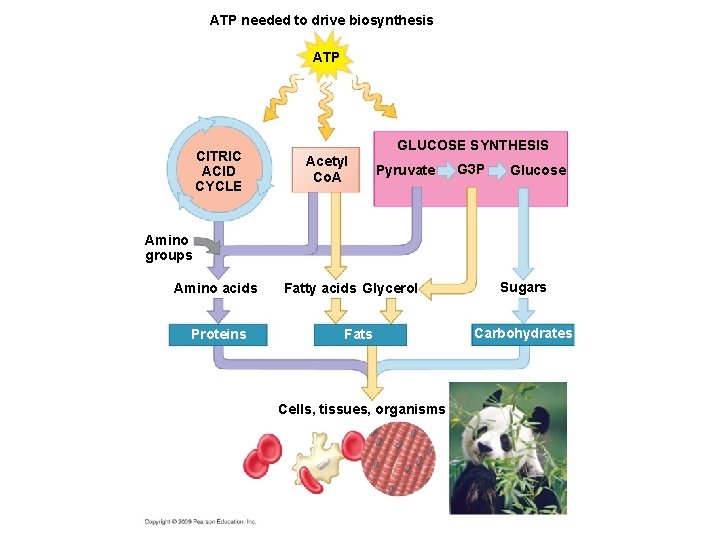
ATP needed to drive biosynthesis ATP CITRIC ACID CYCLE Acetyl Co. A GLUCOSE SYNTHESIS Pyruvate G 3 P Glucose Amino groups Amino acids Proteins Fatty acids Glycerol Fats Cells, tissues, organisms Sugars Carbohydrates
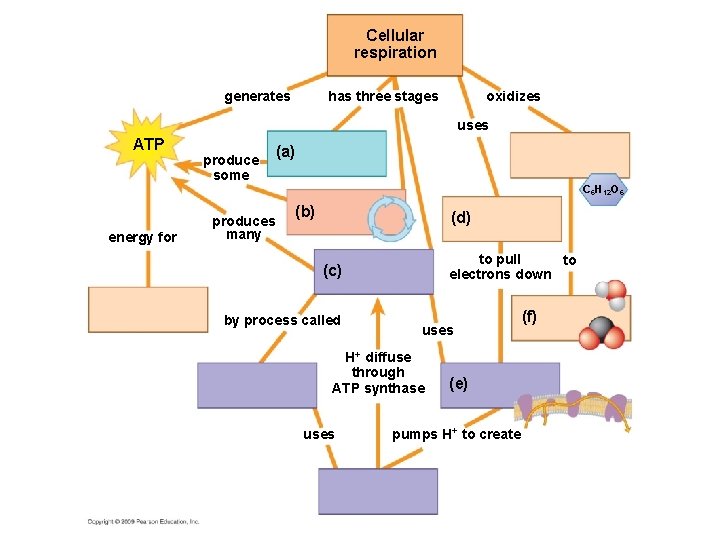
Cellular respiration generates has three stages oxidizes uses ATP produce some (a) C 6 H 12 O 6 energy for produces many (b) (d) to pull to electrons down (c) by process called uses H+ diffuse through ATP synthase uses (e) pumps H+ to create (f)