
CELLULAR RESPIRATION CELLULAR RESPIRATION Objectives Where cell respiration
CELLULAR RESPIRATION
CELLULAR RESPIRATION • Objectives ● Where cell respiration takes place ● When cell respiration takes place ● How cell respiration takes place ● Why cell respiration takes place ● What is produced by cell respiration
AUTOTROPHS AND HETEROTROPHS • Organisms can be classified into two groups according to how they obtain their energy: ● Autotrophs- or organisms that are able to produce their own food • ● Examples: plants, algae and some protists Heterotrophs- organisms that depend on other organisms for their energy • Examples: Humans, animals, fungi and most bacteria
METABOLISM • Metabolism - is a set of chemical reactions that happen in the cells of living organisms to maintain life • The speed of metabolism (or metabolic rate) influences how much food an organism will require, and also affects how it is able to obtain that food
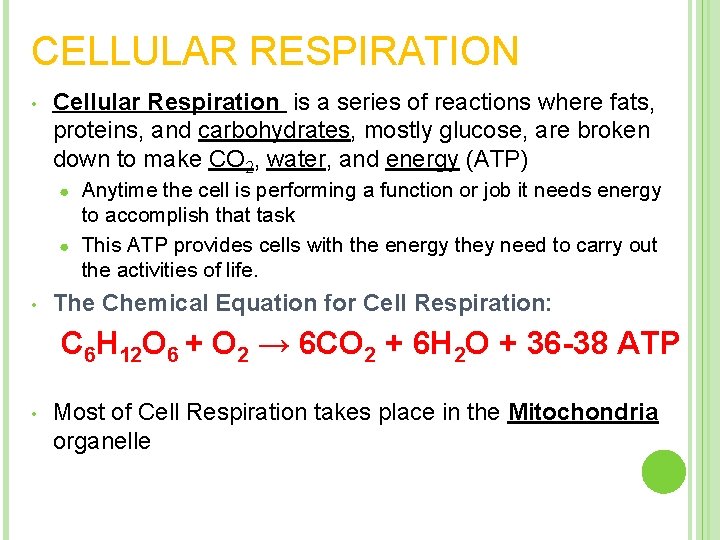
CELLULAR RESPIRATION • Cellular Respiration is a series of reactions where fats, proteins, and carbohydrates, mostly glucose, are broken down to make CO 2, water, and energy (ATP) Anytime the cell is performing a function or job it needs energy to accomplish that task ● This ATP provides cells with the energy they need to carry out the activities of life. ● • The Chemical Equation for Cell Respiration: C 6 H 12 O 6 + O 2 → 6 CO 2 + 6 H 2 O + 36 -38 ATP • Most of Cell Respiration takes place in the Mitochondria organelle
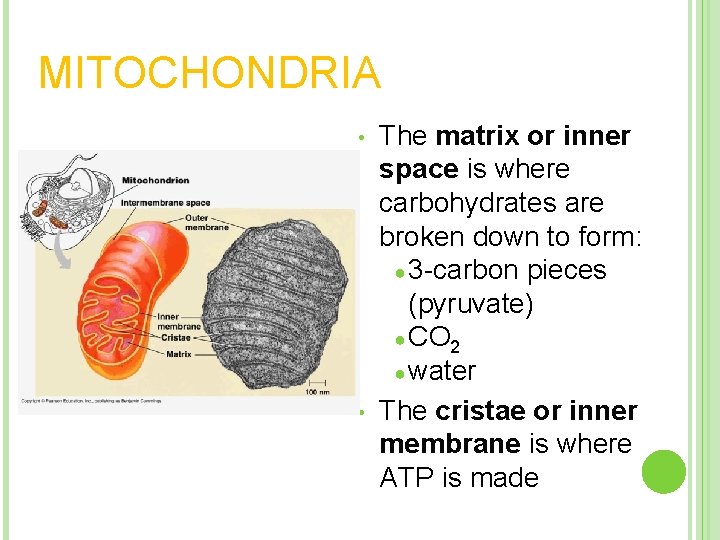
MITOCHONDRIA • • The matrix or inner space is where carbohydrates are broken down to form: ● 3 -carbon pieces (pyruvate) ● CO 2 ● water The cristae or inner membrane is where ATP is made
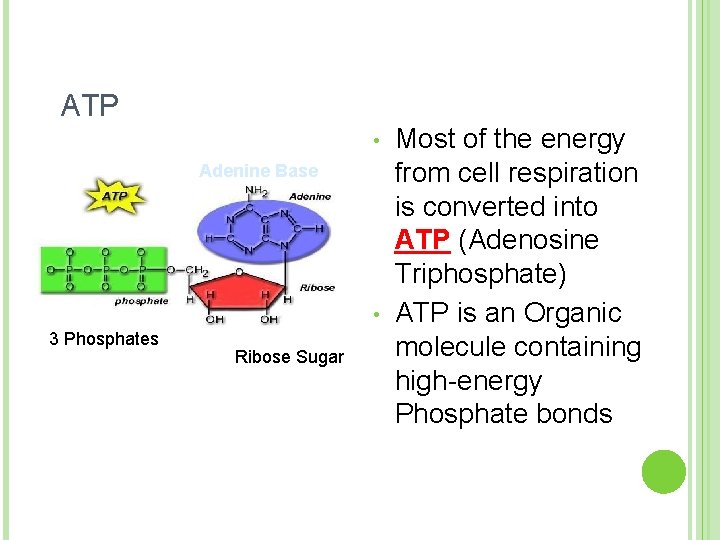
ATP • Adenine Base • 3 Phosphates Ribose Sugar Most of the energy from cell respiration is converted into ATP (Adenosine Triphosphate) ATP is an Organic molecule containing high-energy Phosphate bonds
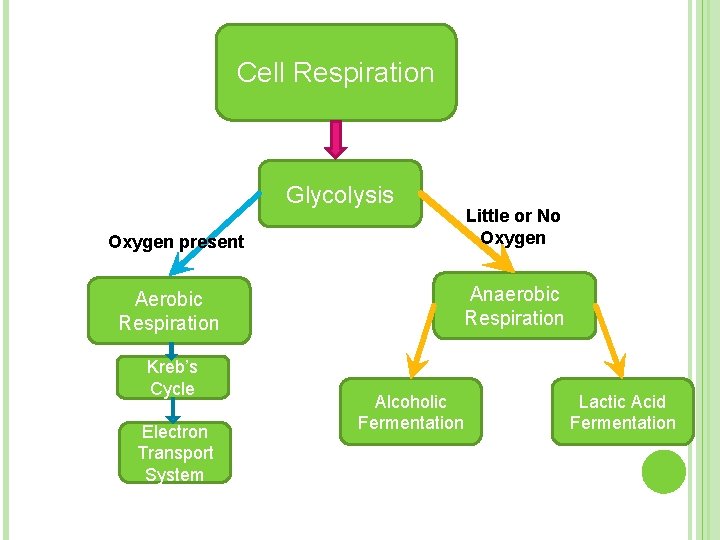
Cell Respiration Glycolysis Oxygen present Anaerobic Respiration Aerobic Respiration Kreb’s Cycle Electron Transport System Little or No Oxygen Alcoholic Fermentation Lactic Acid Fermentation
CELLULAR RESPIRATION • The Stages of Cellular Respiration: 1. Glycolysis 2. Either: • Aerobic - in the presence of oxygen or • Anaerobic Respiration - in the absence of oxygen
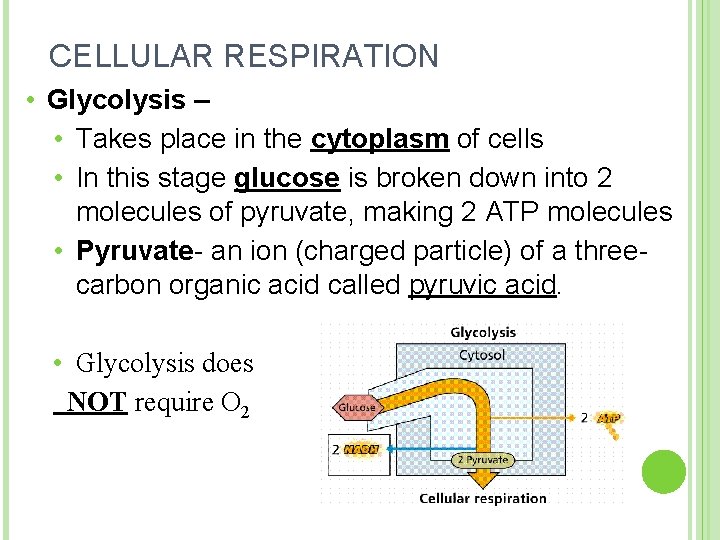
CELLULAR RESPIRATION • Glycolysis – • Takes place in the cytoplasm of cells • In this stage glucose is broken down into 2 molecules of pyruvate, making 2 ATP molecules • Pyruvate- an ion (charged particle) of a threecarbon organic acid called pyruvic acid. • Glycolysis does NOT require O 2
CELLULAR RESPIRATION • When oxygen is present Aerobic respiration occurs in the mitochondria in 2 phases: • Krebs Cycle (citric acid cycle)- The Krebs cycle is a series of reactions that produce energy-storing molecules (NADH and FADH 2), H+ and CO 2 during aerobic respiration. • Electron Transport Chain - During aerobic respiration, large amounts of ATP are made (36 -38) as H+ are used to turn ATP Synthase • Oxygen binds to the H+ ions as they come through ATP Synthase
CELL RESPIRATION - FERMENTATION • Fermentation – is the breakdown of pyruvate when oxygen is not present • enzymes, bacteria, yeasts, or mold frequently undergo fermentation • After glycolysis, then two different pathways of pyruvic acid breakdown will occur: Alcoholic Fermentation Lactic Acid Fermentation
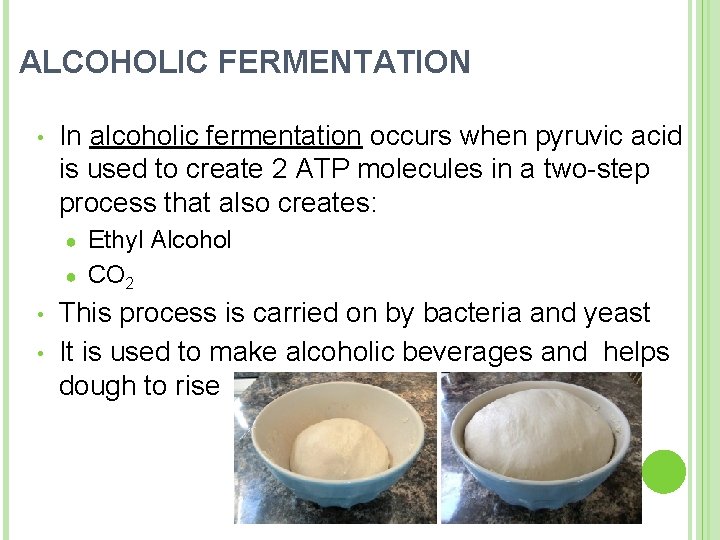
ALCOHOLIC FERMENTATION • In alcoholic fermentation occurs when pyruvic acid is used to create 2 ATP molecules in a two-step process that also creates: Ethyl Alcohol ● CO 2 ● • • This process is carried on by bacteria and yeast It is used to make alcoholic beverages and helps dough to rise
LACTIC ACID FERMENTATION • • • In lactic acid fermentation, pyruvate is converted to lactic acid to produce 2 ATP molecules and CO 2 This occurs in muscle cells that have used up their oxygen supply but still need energy Lactic acid can accumulate in muscle cells making them sore and stiff until it is removed by the bloodstream
REVIEW • When oxygen is present most the ATP made in cellular respiration is produced by: A. aerobic respiration B. Glycolysis C. alcoholic fermentation D. Lactic acid fermentation.
- Slides: 15