
Cellular Respiration Cellular Respiration is the process that
- Slides: 9
Cellular Respiration
Cellular Respiration is the process that releases energy by breaking down food molecules in the presence of oxygen. This takes place in the MITOCHONDRIA of many organisms, including plants and animals. Energy is therefore released by the mitochondria. Which type of body cells would have a lot of mitochondria?
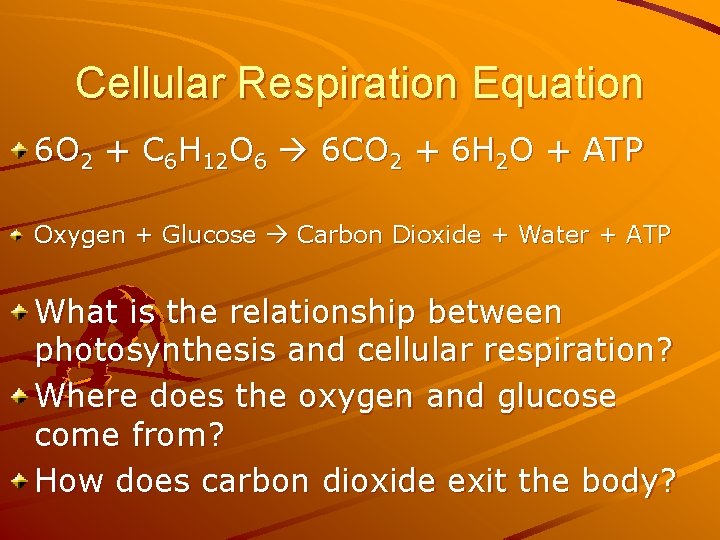
Cellular Respiration Equation 6 O 2 + C 6 H 12 O 6 6 CO 2 + 6 H 2 O + ATP Oxygen + Glucose Carbon Dioxide + Water + ATP What is the relationship between photosynthesis and cellular respiration? Where does the oxygen and glucose come from? How does carbon dioxide exit the body?
Glycolysis is the process in which one molecule of glucose is broken in half, producing two molecules of pyruvic acid. 2 ATP needed to start reaction, 4 ATP are produced thus the net gain is 2 ATP.
The Krebs Cycle During the Krebs Cycle, pyruvic acid is broken down into carbon dioxide in a series of energy-extracting reactions. Citric Acid is created in this cycle thus giving it the nickname Citric Acid cycle. Net ATP Production is 2 ATP.
Electron Transport Chain The electron transport chain uses the high-energy electrons from the Krebs Cycle to convert ADP to ATP. Total ATP 32.
Totals Gycolysis 2 ATP Krebs Cycle 2 ATP Electron Transport Chain 32 ATP Total = 36 ATP
Anaerobic Respiration AKA Fermentation Releases energy from glucose without the presence of oxygen. There are two types of fermentation: alcoholic and lactic acid. Alcoholic fermentation is done by yeasts and some microorganisms. It produces alcohol & Carbon Dioxide Lactic Acid is produced by muscles during rapid exercise when the body cannot supply enough oxygen.
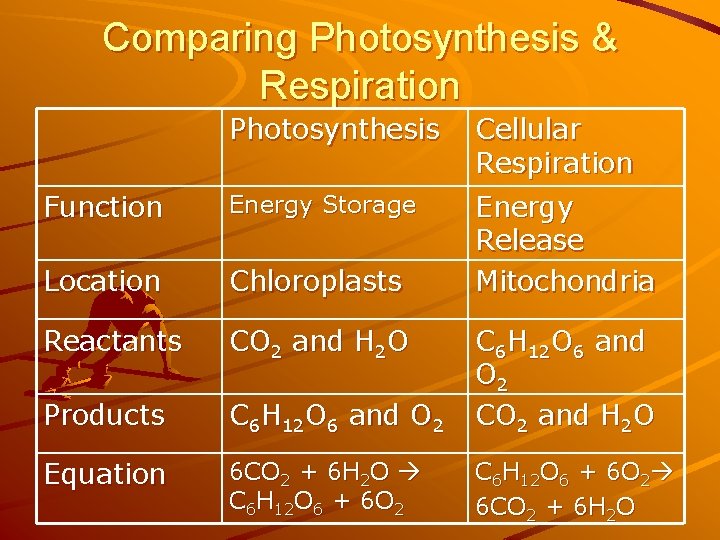
Comparing Photosynthesis & Respiration Photosynthesis Cellular Respiration Function Energy Storage Location Chloroplasts Energy Release Mitochondria Reactants CO 2 and H 2 O Products C 6 H 12 O 6 and O 2 CO 2 and H 2 O Equation 6 CO 2 + 6 H 2 O C 6 H 12 O 6 + 6 O 2 6 CO 2 + 6 H 2 O