
Cellular Respiration and Photosynthesis Chapter 10 Lesson 2

- Slides: 9
Cellular Respiration and Photosynthesis Chapter 10 Lesson 2 Pgs 314 -320
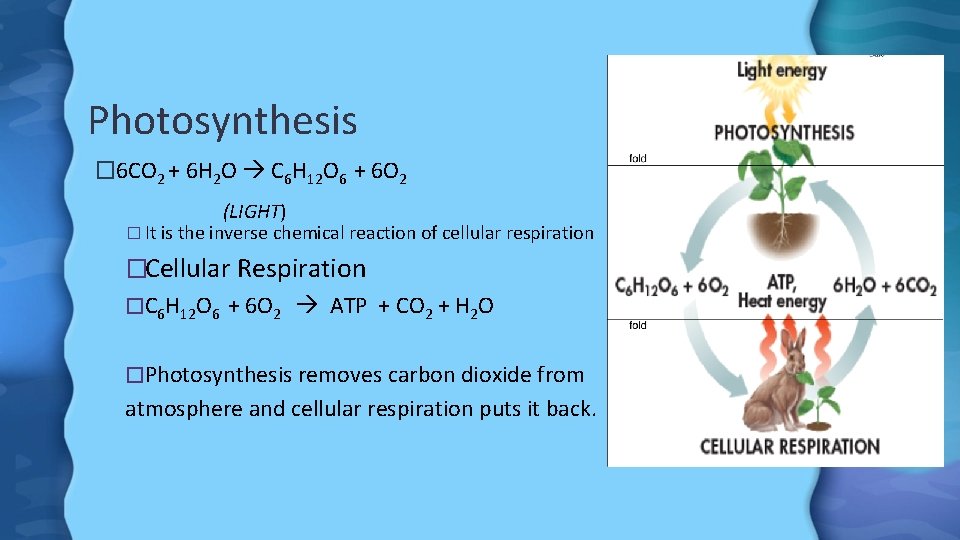
Photosynthesis � 6 CO 2 + 6 H 2 O C 6 H 12 O 6 + 6 O 2 (LIGHT) � It is the inverse chemical reaction of cellular respiration �Cellular Respiration �C 6 H 12 O 6 + 6 O 2 ATP + CO 2 + H 2 O �Photosynthesis removes carbon dioxide from atmosphere and cellular respiration puts it back.
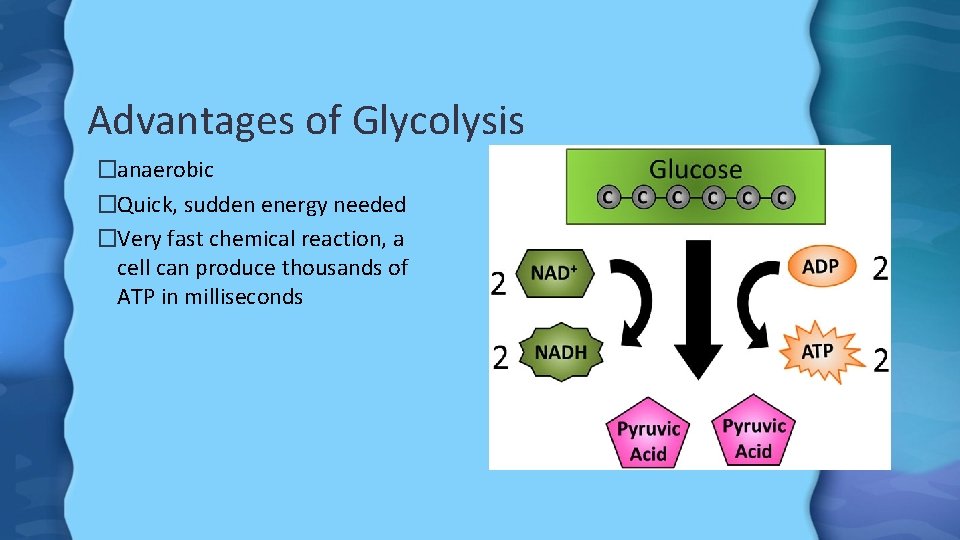
Glycolysis �Occurs in cytoplasm. �One glucose molecule is broken down into 2 Pyruvic Acid (Carbon compound) �Some energy is released and captured by other molecules in cytoplasm. �Cell need to put in and invest 2 ATP to actually begin the process. �During glycolysis creates 4 ATP but with a net gain of just 2 ATP �When glucose is broken down, the electrons that are removed from the breaking of the bonds, are released and passed to an electron carrier, NAD. �NAD is like an uber that holds and transports the extra electrons until needed later.
Advantages of Glycolysis �anaerobic �Quick, sudden energy needed �Very fast chemical reaction, a cell can produce thousands of ATP in milliseconds
The Krebs Cycle--- aka - Citric Acid Cycle �In the presence of Oxygen, the Pyruvic Acid passes to the mitochondria. �In the Mitochondria, the Pyruvic Acid is broken down into CO 2 �Pyruvic acid passes through the membrane of the mitochondria into the MATRIX, innermost compartment of the mitochondria. �Pyruvic Acid is changed in Citric Acid and CO 2 is released. �Everytime bonds are broken the extra electrons are taken up by the NAD and the FAD (electron carriers) taken to the Electron Transport Chain. � 2 more ATP is produced
Electron Transport Chain �The ETC uses the high-energy electrons from glycolysis and the Krebs Cycle to synthesize ATP from ADP. �NAD and FAD- become NADH and FADH 2 when they are transporting electrons. �The electrons are taken into the deepest membrane of the mitochondria and then pass along the membrane to combine with O, creating H 2 O. �O accepts low energy electrons, so that is why O has to be present, with O, the ETC cannot function.
Electron Transport Chain �Production of ATP �In the inner membranes of the mitochondria, has enzymes called ATP synthase. �The Hydrogen ions moves through the membrane causing ATP synthase to spin, with each spin, the enzyme grabs an ADP molecule and attaches an additional phosphate creating ATP. � 32 ATP are made for each glucose molecule. �Grand total of 36 ATP
Glycolysis- 2 ATP Krebs Cycle- 2 ATP Electron Transport Chain- 32 ATP
Classwork- Use your textbook �Page 320 �Questions 1 -4 �Page 332 �Questions 1 -6 �Questions 9 -15 (SKIP 10)