
Cellular Respiration An Overview Principles of Energy Harvest




- Slides: 11
Cellular Respiration An Overview
Principles of Energy Harvest • Catabolic pathway √ Fermentation √Cellular Respiration C 6 H 12 O 6 + 6 O 2 ---> 6 CO 2 + 6 H 2 O + E (ATP + heat)
Redox reactions • Oxidation-reduction • LEO the lion says GER – Lose Electrons, OXIDATION – Gain Electrons, REDUCTION • Reducing agent: e- donor • Oxidizing agent: e- acceptor
Oxidizing Agent in Respiration • NAD+ (nicotinamide adenine dinucleotide) • Removes electrons from food (series of reactions) • NAD+ is reduced to NADH • Enzyme action: Dehydrogenase • Oxygen is the eventual eacceptor
Electron Transport Chain • Electron carrier molecules found in membrane proteins • Shuttle electrons that release energy used to make ATP • Sequence of reactions needed to prevent energy release in 1 explosive step • Electron route: food---> NADH ---> electron transport chain ---> oxygen
Cellular respiration • Glycolysis: happens in cytosol; degrades glucose into pyruvate • Kreb’s Cycle: happens in mitochondrial matrix; pyruvate changes form with a release of carbon dioxide • Electron Transport Chain: happens at inner membrane of mitochondrion; electrons eventually passed to oxygen
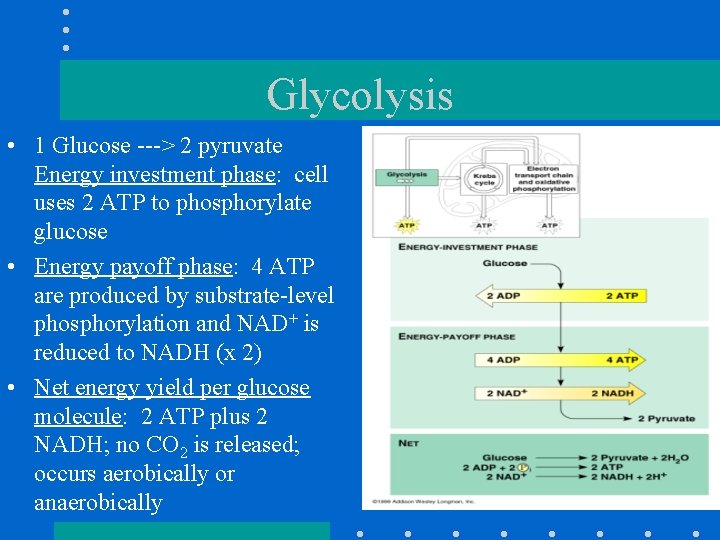
Glycolysis • 1 Glucose ---> 2 pyruvate Energy investment phase: cell uses 2 ATP to phosphorylate glucose • Energy payoff phase: 4 ATP are produced by substrate-level phosphorylation and NAD+ is reduced to NADH (x 2) • Net energy yield per glucose molecule: 2 ATP plus 2 NADH; no CO 2 is released; occurs aerobically or anaerobically
Kreb’s Cycle If oxygen is present……. • Each pyruvate is changed to acetyl Co. A: CO 2 is released; NAD+ ---> NADH; coenzyme A (from vitamin B), makes molecule very reactive • From this point: each turn of cycle, 2 C atoms enter (acetyl Co. A) and 2 exit (CO 2) • acetyl Co. A (2 C’s) joins with oxaloacetate (4 C’s) • For each pyruvate that enters: 3 NAD+ reduced to NADH; 1 FAD 2+ reduced to FADH 2 (riboflavin, B vitamin); 1 ATP made
Electron transport chain • Cytochromes: carry electron carrier molecules (NADH & FADH 2) down to oxygen • Chemiosmosis: energy coupling mechanism; works using diffusion gradient • ATP synthase: produces ATP by using the H+ gradient pumped into the inner membrane space from the electron transport chain; this enzyme harnesses the flow of H+ back into the matrix to phosphorylate ADP to ATP (oxidative phosphorylation)
Review: Cellular Respiration • Glycolysis: 2 ATP (substrate-level phosphorylation) • Acetyl Co. A formation: 2 ATP (substrate-level phosphorylation) • Electron transport & oxidative phosphorylation: 2 NADH (glycolysis) = 4 ATP 2 NADH (acetyl Co. A) = 6 ATP 6 NADH (Kreb’s) = 18 ATP 2 FADH 2 (Kreb’s) = 4 ATP • 36 NET TOTAL ATP/glucose
Related metabolic processes • Fermentation: alcohol~ pyruvate to ethanol lactic acid~ pyruvate to lactate • Facultative anaerobes (yeast/bacteria) • Beta-oxidation lipid catabolism