
Cellular Reproduction Mitosis Biology Rainier JuniorSenior High School
Cellular Reproduction & Mitosis Biology Rainier Junior/Senior High School Mr. Taylor
Cellular Reproduction Remember that ORGANISMS reproduce to: n n produce new individual organisms prevent extinction CELLS reproduce to: n n continue the existence of an organism through growth and repair form gametes (sex cells: sperm (♂) and ovum/egg (♀)
Cellular Reproduction Growth: Cells must maintain a favorable surface area : volume ratio. If they are too large, they can’t get enough nutrients or get rid of waste products quickly enough. Repair: n n Cells can become damaged or worn out. Some live short lives and need to be replaced often (skin, blood cells, digestive tract cells)
Cellular Reproduction Growth: Cells must maintain a favorable surface area : volume ratio. If they are too large, they can’t get enough nutrients or get rid of waste products quickly enough. Repair: n n Cells can become damaged or worn out. Some live long lives and are seldom if ever replaced (brain, spinal cord, and other nerve cells)
Reproductive Methods By convention: n Parent cells produce daughter cells. This has nothing to do with gender! It’s just how biologists have chosen to name the original cell and the two cells that are created.
Reproductive Methods Two styles of reproduction n Asexual: One parent, daughter cells are exact genetic replicas of the parent cell. We say that the offspring are exactly like the parents. There at least 5 different kinds of asexual reproduction. n Sexual: usually requires two parents, daughter cells are a blending of traits of the parents. We say that the offspring are similar to the parents.
Asexual Reproduction 1. Binary Fission: The cell simply splits into two equal-sized cells after the chromosomes have replicated. n (Most cells do this. ) 2. Budding: A small cell ‘buds’ off the larger parent cell. The small daughter cell will grow in size to equal the original parent cell. n (Yeast cells do this. )
Asexual Reproduction 3. Spores: Small reproductive cells that are formed with a tough outer covering and very little cytoplasm. n n n These are resistant to heat, cold, dryness, or other harsh conditions. They will begin to grow again when the conditions are good for growth. (Anthrax uses this method of reproduction. )
Asexual Reproduction 4. Vegetative propagation: “Runners” originally attached to a parent plant can become separate plants. n Strawberries, grass, hens & chicks (a plant) do this. 5. Regeneration/fragmentation: Regrowth of body parts lost for a variety of reasons. n Most sea stars can regenerate arms and SOME lizards can regrow lost tails.
Sexual Reproduction Two specialized sex cells – called gametes – unite in the process of fertilization to form a zygote. n There are only two kinds of gametes: Sperm: the male gamete Ovum or egg: the female gamete. (Ovum is singular, ova is plural) The zygote will mature into an embryo.
Mitosis Chromosome: A strand of DNA and structural proteins containing numerous genes. Gene: A portion of a DNA molecule that codes for a single protein or RNA molecule.
Mitosis Homologous chromosomes: Two chromosomes that are the same length and shape, and contain genes for the same traits in the same locations. One comes from the father, one comes from the mother. n Diploid: For each type of chromosome, one chromosome from each parent is present. n Haploid: For each type of chromosome, only one parent’s chromosome is present.
Mitosis Autosomal chromosomes: Have nothing to do with gender determination. Sex chromosomes: Only one pair in each cell. These do determine gender. n Two forms, X and Y XX = female XY = male
Mitosis Karyotype: A picture of the cell is taken while it is dividing and used to make a chromosome map of that cell. Sex cells: gametes (as noted before) Somatic cells: “normal” body cells, any cell that is not a gamete.
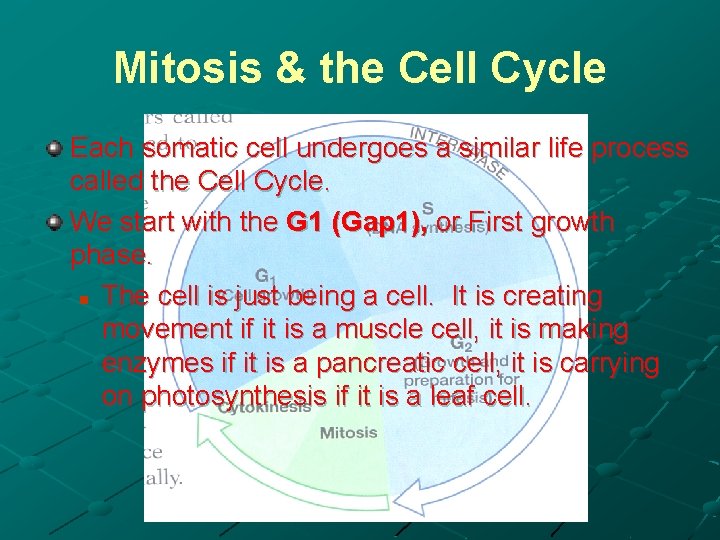
Mitosis & the Cell Cycle Each somatic cell undergoes a similar life process called the Cell Cycle. We start with the G 1 (Gap 1), or First growth phase. n The cell is just being a cell. It is creating movement if it is a muscle cell, it is making enzymes if it is a pancreatic cell, it is carrying on photosynthesis if it is a leaf cell.
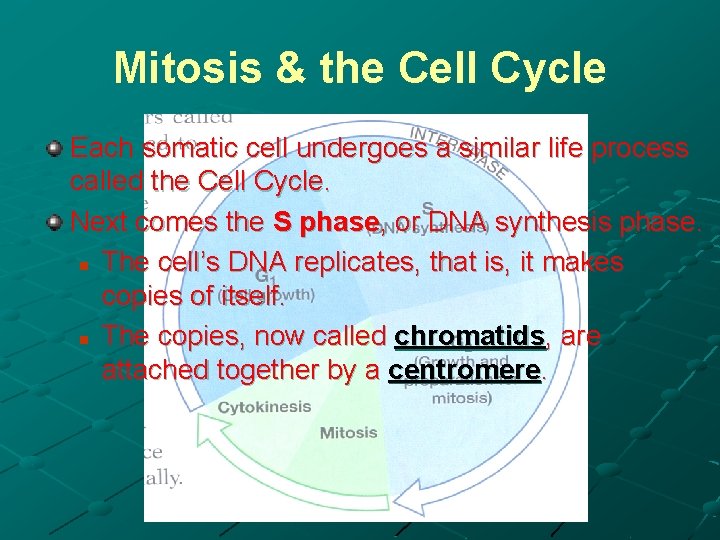
Mitosis & the Cell Cycle Each somatic cell undergoes a similar life process called the Cell Cycle. Next comes the S phase, or DNA synthesis phase. n The cell’s DNA replicates, that is, it makes copies of itself. n The copies, now called chromatids, are attached together by a centromere.
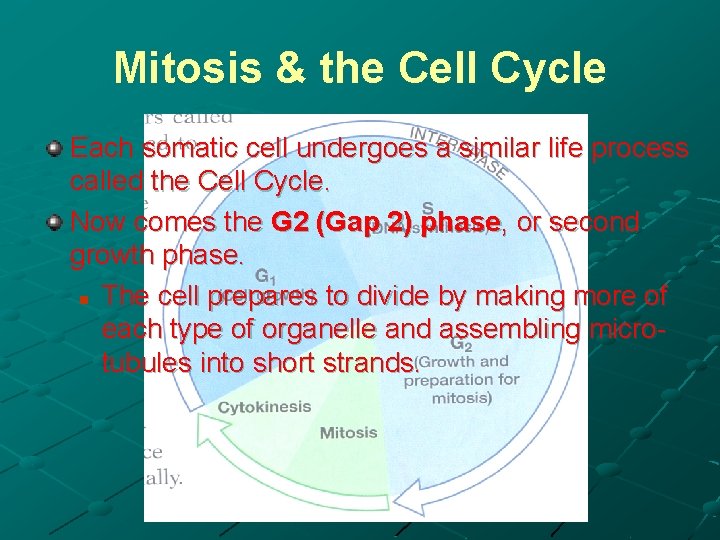
Mitosis & the Cell Cycle Each somatic cell undergoes a similar life process called the Cell Cycle. Now comes the G 2 (Gap 2) phase, or second growth phase. n The cell prepares to divide by making more of each type of organelle and assembling microtubules into short strands.
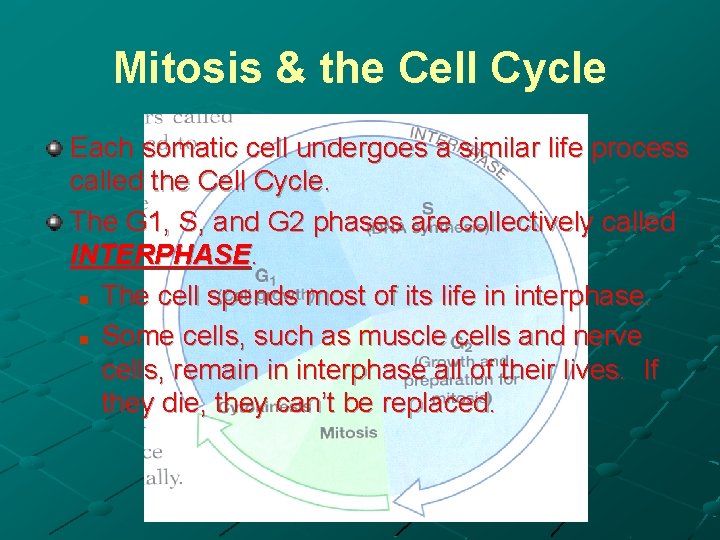
Mitosis & the Cell Cycle Each somatic cell undergoes a similar life process called the Cell Cycle. The G 1, S, and G 2 phases are collectively called INTERPHASE. n The cell spends most of its life in interphase. n Some cells, such as muscle cells and nerve cells, remain in interphase all of their lives. If they die, they can’t be replaced.
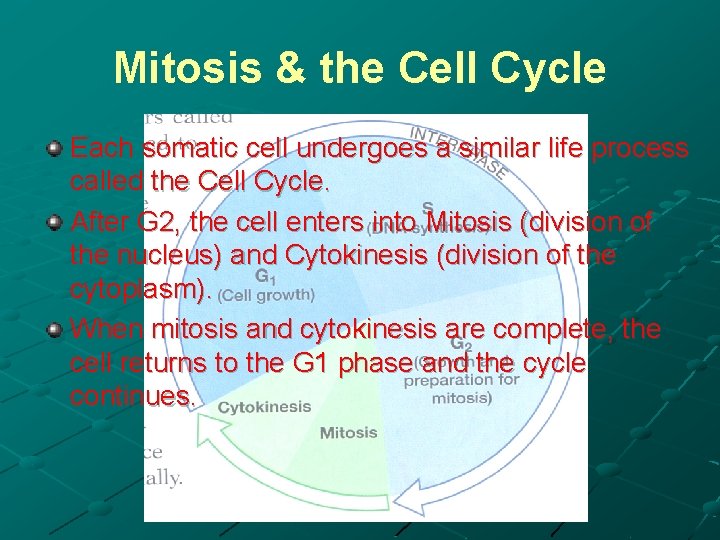
Mitosis & the Cell Cycle Each somatic cell undergoes a similar life process called the Cell Cycle. After G 2, the cell enters into Mitosis (division of the nucleus) and Cytokinesis (division of the cytoplasm). When mitosis and cytokinesis are complete, the cell returns to the G 1 phase and the cycle continues.
Mitosis 1. 2. 3. 4. Mitosis, the division of the nucleus, is broken down into 4 phases. Prophase Metaphase Anaphase Telophase
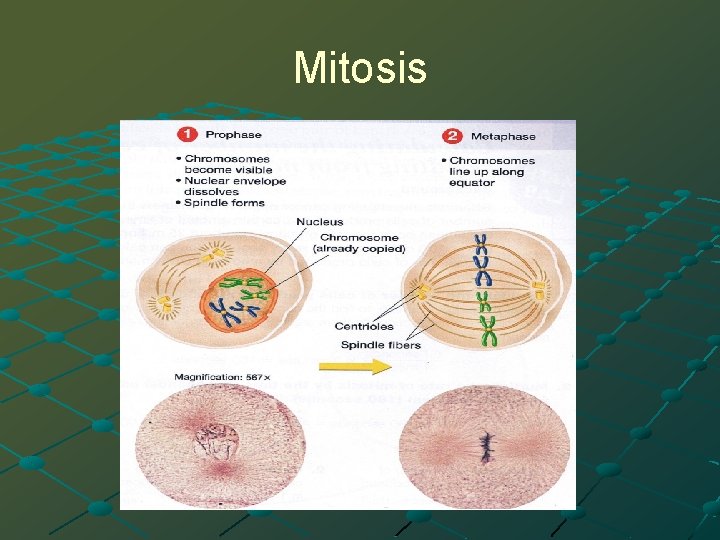
Mitosis: Prophase Mitosis, the division of the nucleus, is broken down into 4 phases. Ø In prophase the chromatids coil up and become visible as separate structures. Ø The nuclear membrane breaks down and the nucleus disappears. Ø The spindle forms. Ø The centromeres attach to a spindle fiber
Mitosis: Metaphase Mitosis, the division of the nucleus, is broken down into 4 phases. Ø In metaphase the chromatids align along the equator (the MIDDLE) of the cell.
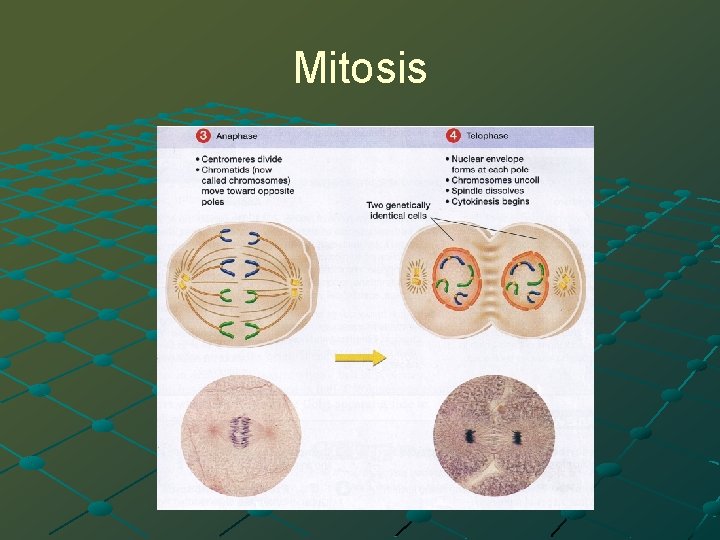
Mitosis: Anaphase Mitosis, the division of the nucleus, is broken down into 4 phases. Ø In Anaphase the centromeres divide and the chromatids (now called chromosomes again) are pulled to opposite ends (the poles) of the cell by the spindle fibers.
Mitosis: Telophase Mitosis, the division of the nucleus, is broken down into 4 phases. Ø Telophase is the opposite of Prophase; Ø Ø Ø The nuclear membrane reforms The chromosomes uncoil and are no longer visible as separate things (they look like tangled spaghetti) The spindle breaks down
Mitosis: Cytokinesis Our textbook separates cytokinesis from mitosis, others include it with telophase. n n n Cytokinesis is the division of the cytoplasm and organelles and it occurs almost simultaneously with telophase. In animal cells, a belt of proteins pinches the cell membrane and divides the cell in two. In plant cells, a cell plate begins to form between the two nuclei. It will eventually mature into the cell wall.
Mitosis
Mitosis
- Slides: 28