
Cellular Biology Cell Theory Hierarchy Chart Study of
Cellular Biology
Cell Theory �Hierarchy Chart
Study of? �Biology – living organisms �Morphology – structure in organisms �Physiology – function in organisms �Ecology – populations, communities, ecosystems �Zoology – animals �Botany – plants �Cytology - cells
Microscopy �Advances in discovery of cells was preceded by technological advances in microscopy and preparation of study materials
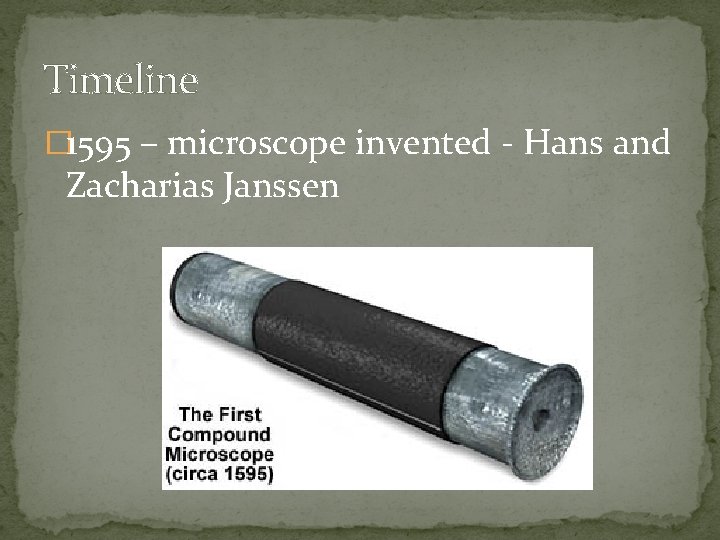
Timeline � 1595 – microscope invented - Hans and Zacharias Janssen

� 1665 – cork examined by Robert Hooke, invents the term cells
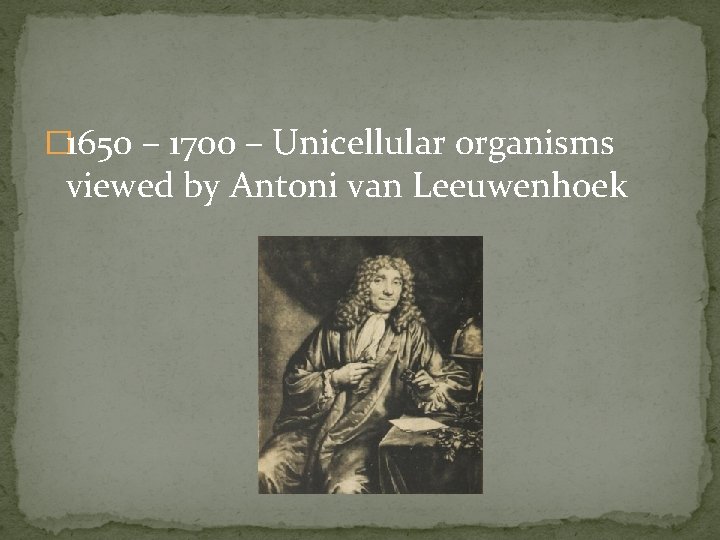
� 1650 – 1700 – Unicellular organisms viewed by Antoni van Leeuwenhoek
� 1833 – Robert Brown identifies the nucleus � 1838 – Schleiden concludes all plants are made of cells � 1839 – Schwann concludes all animals and plants are made from cells � 1855 – Virchow concludes all cells arise from pre-existing cells
Modern Cell Theory � 1. All living organisms are composed of cells � 2. Chemical reactions of living organisms(both energy consuming and producing) occur in cells � 3. Cells arise from other cells � 4. Cells contain hereditary information and pass this on from parent to daughter cell
Unicellular organisms �Carry out all the functions of life �Metabolism, response, homeostasis, growth, reproduction and nutrition
Surface Area to Volume ratio �Rate of heat and waste production as well as resource consumption is a function of volume �The bigger the more stuff produced and used �Rate of exchange of materials and energy is a function of surface area �More surface area more exchange �Limits cell size
Emergent properties �Multicellular organisms show emergent properties �What does that mean? �Increasing levels of complexity, new characteristics emerge which are not present at the lower levels.
Multicellular organisms �Cells differentiate to carry out specialized functions by expressing some of their genes but not others �Brain cell does not express same genes as skin cells
Stem Cells �Retain the capacity to divide and have the ability to differentiate along different pathways �Can make all types of cells in an organism
Microscopes and Staining �Staining allows structures to be seen that normally would not be seen. �Provide magnified image that increases our ability to see small objects �Types �Light microscope – light must pass through the object �Electron Microscopes
Transport in Cells
Reason for Transport �Maintain optimal internal environment inside cell �Some materials not allowed in �Some pass freely through membrane (passive transport) �Some actively moved through membrane (active transport)
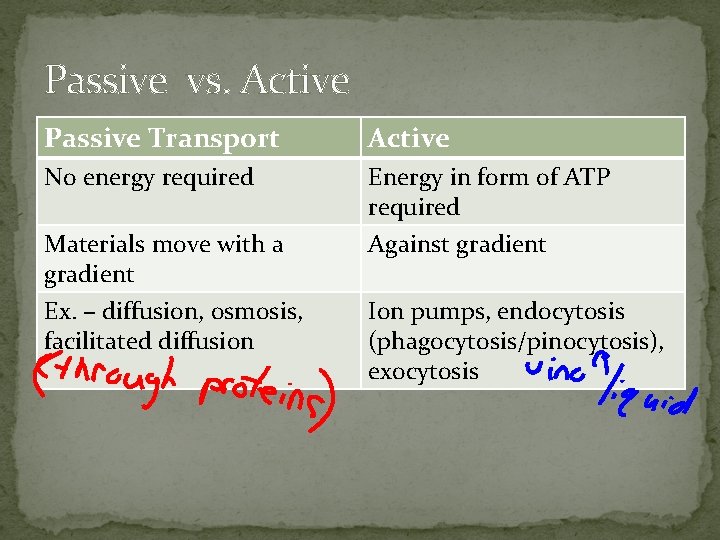
Passive vs. Active Passive Transport Active No energy required Energy in form of ATP required Against gradient Materials move with a gradient Ex. – diffusion, osmosis, facilitated diffusion Ion pumps, endocytosis (phagocytosis/pinocytosis), exocytosis
Passive transport �Diffusion �Random movement of molecules that results in equal distribution �Move “down” or “with” concentration gradient �Diagram
Diffusion cont. �Results in equal concentration, molecules keep moving �Types of molecules move independently �Tea and sugar diffuse independently through hot mug �Cells depend on diffusion for movement of O 2 and CO 2 (small particles, easily through membrane)
Diffusion rates � 1. strength of conc. gradient – greater strength=greater rate of diffusion � 2. temperature: higher temp. = greater rate � 3. stirring: increased movement=greater rate �DEMO!
Facilitated Diffusion �Diffusion across membrane that requires helper molecules �Still follows conc. Gradient �No energy input �“carrier-mediated” transport �Eg. Transport proteins in cell membrane
Osmosis
Osmosis! �Diffusion of water across membrane - Water moves across semipermeable membrane from high water concentration to low - Net movement of water is from hypotonic to hypertonic regions.
terms �Solution, solvent, solute, permeable membrane, semi-permeable membrane, water potential, hypertonic solution, isotonic solution, hypotonic solution
- Slides: 25