
Cellular Automaton Evacuation Model Coupled with a Spatial






- Slides: 13
Cellular Automaton Evacuation Model Coupled with a Spatial Game Anton von Schantz, Harri Ehtamo anton. von. schantz@aalto. fi, harri. ehtamo@aalto. fi The document can be stored and made available to the public on the open internet pages of Aalto University. All other rights are reserved.
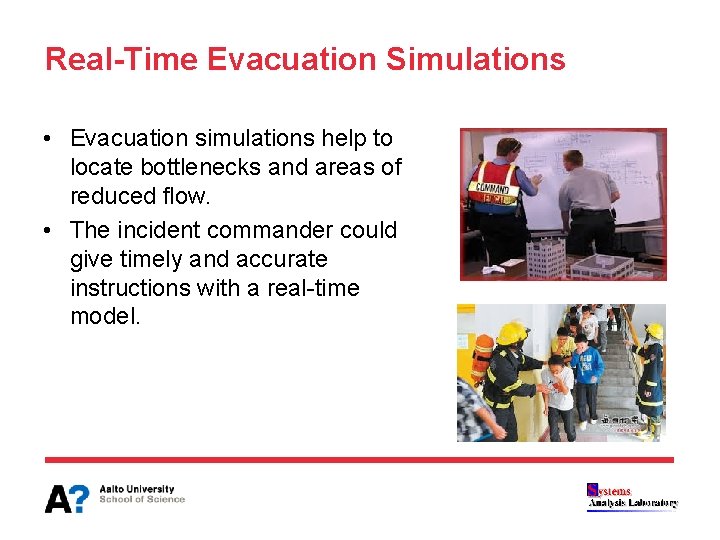
Real-Time Evacuation Simulations • Evacuation simulations help to locate bottlenecks and areas of reduced flow. • The incident commander could give timely and accurate instructions with a real-time model.
Cellular Automaton Evacuation Model • In a Cellular Automaton (CA) model, the agents move in a discrete square grid towards the exit. • The agents leave a virtual trace, which other agents can follow. • Computationaly light enough for-real time simulations. • Agents lack individualistic decision-making abilities, i. e. , their behavior is static (not very realistic? ) • OUR AIM: to provide the agents in a CA with decision-making abilities.
Game Theory in Evacuation Modeling 1/2 • In contrary to popular belief, people in evacuation situations behave most of the time RATIONALLY. • Evacuees decision-making can be modelled with game theory • Game theory is a theory of rational agents in an interactive decision-making situation.
Game Theory in Evacuation Modeling 2/2 • Hawk-Dove and Prisoners-Dilemma are used to model social dilemmas, and are thus suitable in modeling evacuation situations.
CA Coupled with a Spatial Game 1/2 • In our model, a spatial game is coupled to a CA. • The game is Hawk-Dove or Prisoner’s Dilemma depending on where the agent is located. • In a spatial game the agents play against their immediate neighbours. • Agents observe their surroundings and choose strategy. • The agent can play either Impatient or Patient. • The choice of strategy, results in the agent moving individualistically or following the footsteps of others in the CA.
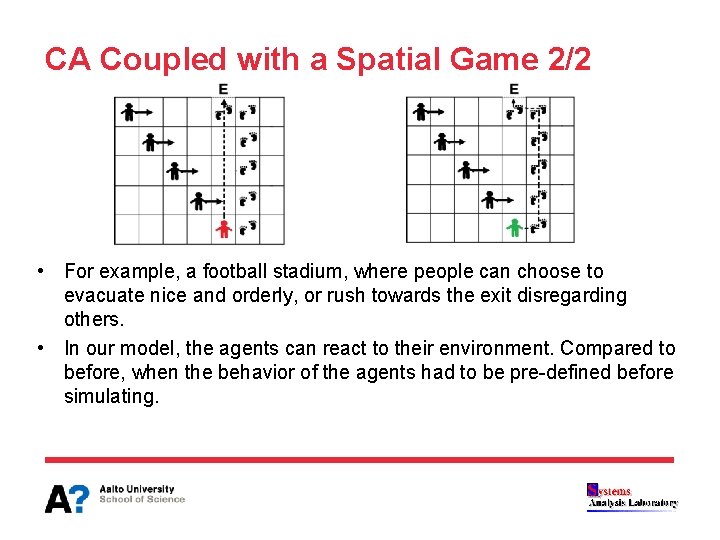
CA Coupled with a Spatial Game 2/2 • For example, a football stadium, where people can choose to evacuate nice and orderly, or rush towards the exit disregarding others. • In our model, the agents can react to their environment. Compared to before, when the behavior of the agents had to be pre-defined before simulating.
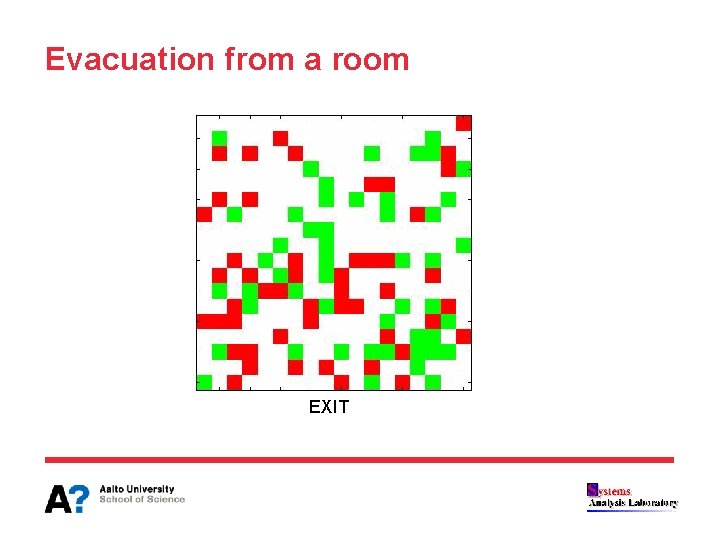
Performance on an individual level • Impatient agents rushing towards the exit results in that the impatient agents will evacuate faster than patient agents
Evacuation from a room EXIT
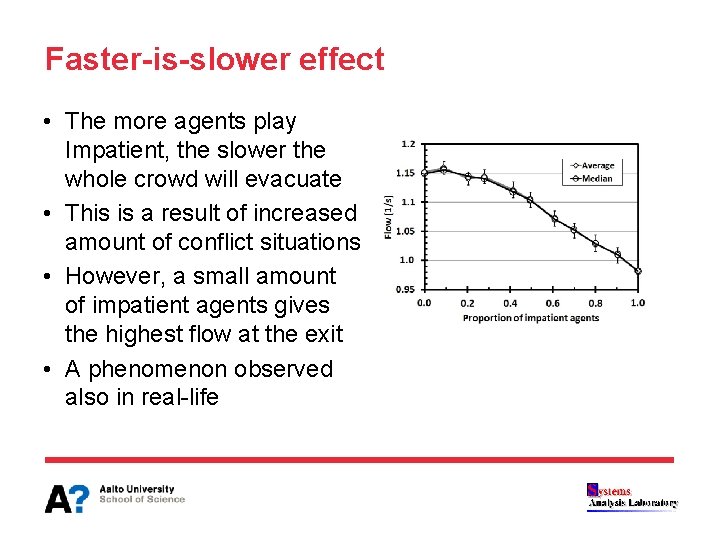
Faster-is-slower effect • The more agents play Impatient, the slower the whole crowd will evacuate • This is a result of increased amount of conflict situations • However, a small amount of impatient agents gives the highest flow at the exit • A phenomenon observed also in real-life
Future Steps • Validation of the model • Comparing the performance to other softwares
References • • von Schantz, A. : Modeling Egress Congestion Using a Cellular Automaton Approach. Master's Thesis (2014) (available from http: //sal. aalto. fi/fi/julkaisut/opinnaytetyot/mas) Ehtamo, H. , Heliövaara, S. , Korhonen, T. , Hostikka, S. : Game Theoretic Best-Response Dynamics for Evacuees' Exit Selection. Advances in Complex Systems 13, 113 -134 (2010) Heliövaara, S. , Korhonen, T. , Hostikka, S. , Ehtamo, H. : Counterow Model for Agent-Based Simulation of Crowd Dynamics. Building and Environment 48, 89 -100 (2012) Heliövaara, S. , Kuusinen, J. -M. , Rinne, T. , Korhonen, T. , Ehtamo, H. : Pedestrian Behavior and Exit Selection in Evacuation of a Corridor - an Experimental Study. Safety Science 50, 221 -227 (2012) Heliövaara, S. , Ehtamo, H. , Helbing, D. , Korhonen, T. : Patient and Impatient Pedestrians in a Spatial Game for Egress Congestion. Physical Review E 87, 012802 (2013) Korhonen, T. , Hostikka, S. : Fire Dynamics Simulator with Evacuation: Fds+Evac. Tech. rep. , VTT Technical Research Centre of Finland (2009) Burstedde, C. , Klauck, K. , Schadschneider, A. , Zittartz, J. : Simulation of Pedestrian Dynamics Using a Two-Dimensional Cellular Automaton. Physica A: Statistical Mechanics and its Applications 295, 507 -525 (2001) Kirchner, A. , Schadschneider, A. : Simulation of Evacuation Processes Using a Bionics-Inspired Cellular Automaton Model for Pedestrian Dynamics. Physica A: Statistical Mechanics and its Applications 312, 260 -276 (2002)
References • • Kirchner, A. , Nishinari, K. , Schadschneider, A. : Friction Eects and Clogging in a Cellular Automaton Model for Pedestrian Dynamics. Physical Review E 67, 056122 (2003) Helbing, D. , Farkas, I. , Vicsek, T. : Simulating Dynamical Features of Escape Panic. Nature 407, 487 -490 (2000) Zheng, X. , Cheng, Y. : Conict Game in Evacuation Process: A Study Combining Cellular Automata Model. Physica A: Statistical Mechanics and its Applications 390, 1024 -1050 (2011) Zheng, X. , Cheng, Y. : Modeling Cooperative and Competitive Behaviors in Emergency Evacuation: A Game-Theoretical Approach. Computers & Mathematics with Applications 62, 4627 -4634 (2011) Hao, Q. Y. , Jiang, R. , Hu, M. B. , Jia, B. , Wu, Q. S. : Pedestrian Flow Dynamics in a Lattice Gas Model Coupled with an Evolutionary Game. Physical Review E 84, 036107 (2011) Shi, D. M. , Wang, B. H. Evacuation of Pedestrians from a Single Room by Using Snowdrift Game Theories. Physical Review E 87, 022802 (2013) Bouzat, S. , Kuperman, M. N. : Game Theory in Models of Pedestrian Room Evacuation. Physical Review E 89, 032806 (2014) Sysi-Aho, M. , Saram aki, J. , Kertesz, J. , Kaski, K. : Spatial Snowdrift Game with Myopic Agents. The European Physical Journal B 44, 129 -135 (2005)