
CELLS What you need to know to identify

- Slides: 13
CELLS What you need to know to identify the different types of cells. By Sandy Sultana
What you need to know about cells. • • • Video Properties of cells Anatomy of cells Prokaryotic cells Eukaryotic cells Similarities between Prokaryotic and Eukaryotic cells • Differences between Prokaryotic and Eukaryotic cells • References
What is a cell? • A cell is a triple unit or compartment, enclosed by a border, wall or membrane. • As a term, cell has become general-purpose metaphor for building blocks which serve to compose larger structures.
What are the properties of a cell? • Each cell is at least somewhat selfcontained and self-maintaining: it can take in nutrients, convert these nutrients into energy, carry out specialized functions, and reproduce as necessary. • Each cell stores its own set of instructions for carrying out each of these activities
The anatomy of a cell: • There are two types of cells: Eukaryotic and Prokaryotic. • Eukaryotic cells are found in muticellular organisms • Prokaryotic cells are found in singletons. • The major difference between prokaryotes and eukaryotes is that eukaryotic cells contain membrane-bound compartments in which specific metabolic activities take place.
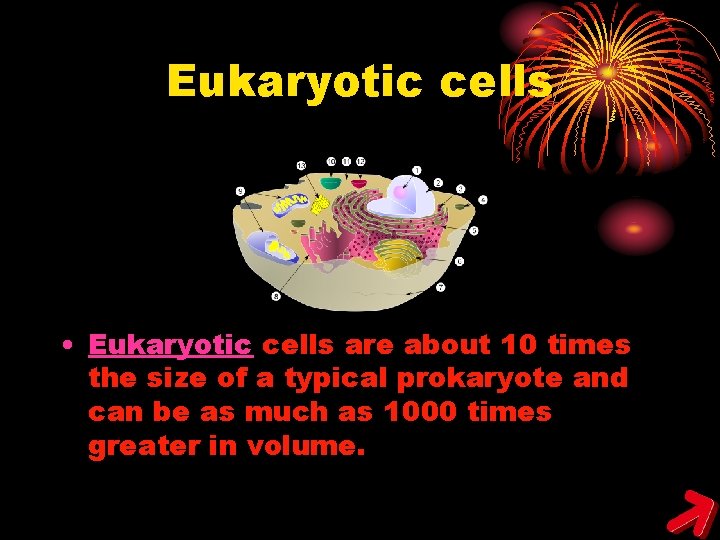
Eukaryotic cells • Eukaryotic cells are about 10 times the size of a typical prokaryote and can be as much as 1000 times greater in volume.
Components of Eukaryotic cells • • • • Nucleolus Nucleus Ribosome Vesicle Rough endoplasmic reticulum Golgi apparatus Cytoskeleton Smooth endoplasmic reticulum Mitochondria Vacuole Cytoplasm Lysosome Centrioles
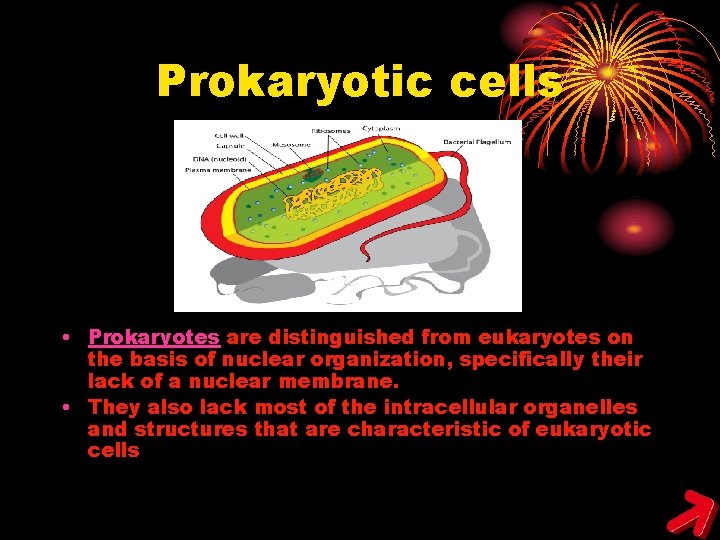
Prokaryotic cells • Prokaryotes are distinguished from eukaryotes on the basis of nuclear organization, specifically their lack of a nuclear membrane. • They also lack most of the intracellular organelles and structures that are characteristic of eukaryotic cells
Components of Prokaryotic cells • • Plasma membrane DNA (nucleoid) Capsule Cell Wall Mesosome Ribosome Cytoplasm Bacterial Flagellum
Similarities between Prokaryotic and Eukaryotic cells • Both the mesosomes and the cristae are used for the same function: the aerobic part of aerobic cellular respiration. • Both cells have cell membranes that contain the organization within the cell from the outside of the cell. • Both cells regulate the flow of nutrients and wastes that leave and enter the cell.
Differences between Prokaryotic and Eukaryotic cells • Eukaryotic cells have a true nucleus, bound by a double membrane. Prokaryotic cells have no nucleus. • Eukaryotic DNA is linear; prokaryotic DNA is circular (it has no ends). • Both cell types have many, many ribosomes, but the ribosomes of the eukaryotic cells are larger and more complex than those of the prokaryotic cell. • The cytoplasm of eukaryotic cells is filled with a large, complex collection of organelles, many of them enclosed in their own membranes; the prokaryotic cell contains no membrane-bound organelles which are independent of the plasma membrane.
References • http: //en. wikipedia. org/wiki/Cell_ (biology) • http: //web. jjay. cuny. edu/~acarpi/ NSC/13 -cells. htm • http: //www. cod. edu/people/facul ty/fancher/Prok. Euk. htm