
CELLS The Characteristics of Life REMEMBER ALL living
CELLS
The Characteristics of Life § REMEMBER…. - ALL living things are made up of cells § The cell is the basic unit of structure and function of living things much like an atom is the basic unit of matter
Cell History Dates to Remember in Cell History…. § 1666 – the microscope was invented - credit for the invention is shared between Anton von Leeweenhoek & Robert Hooke § 1833 Robert Brown discovered the nucleus § 1834 Matthias Schleidan discovered that plants are made of cells
§ 1835 Mr. Schwann observed & described animal cells § 1855 R. Virchaw observed & described cell division
The Cell Theory § All living things are composed of cells § All cells come from preexisting cells § Cells are the basic unit of structure and function in living things
CELL BASICS
Cell Sizes & Shapes § Cells vary in size from 0. 2 micrometers to the biggest, which is the yolk of a bird egg § There are two types of cells… - PROKARYOTIC = no true nucleus, no membrane bound organelles - EUKARYOTIC = true nucleus
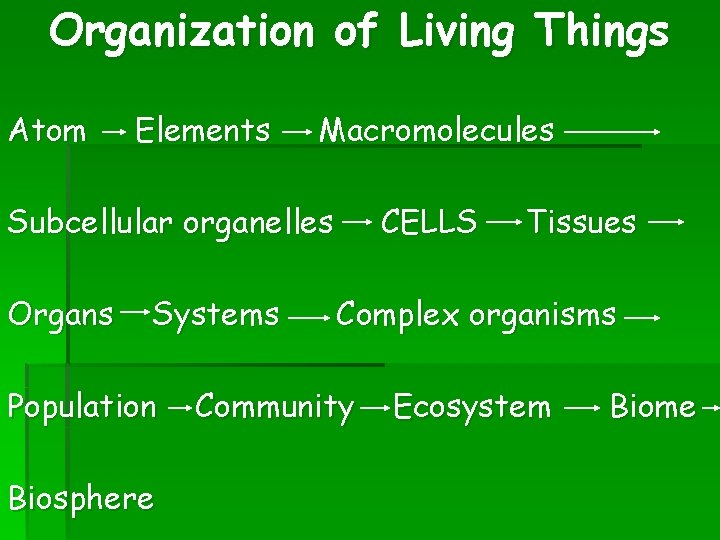
Organization of Living Things Atom Elements Macromolecules Subcellular organelles Organs Systems Population Biosphere CELLS Tissues Complex organisms Community Ecosystem Biome
Cellular Organelles Cell membrane Nucleus Cytoplasm Mitochondria Ribosomes Endoplasmic Reticulum - smooth ER & rough ER § Cilia (only in animal cells) § Flagella (only in animal cells) § § §
Cellular Organelles Cont’d § Golgi Apparatus § Lysosomes § Vacuoles § Cytoskeleton § Cell Wall (only in plant cells) § Plastids (only in plant cells) § Chloroplasts (only in plant cells)
Cell Organelles & Function § Cell Membrane - phospholipid bilayer that serves as a boundary § Nucleus - brain/control center of the cell location of chromosomes (genetic material) contains the Nucleolus, which makes ribosomes § Cytoplasm - cell substance; the material between the nucleus and the membrane
§ Mitochondria - powerhouse of the cell location of cellular of respiration converts food into usable energy § Ribosomes - location of protein synthesis § Endoplasmic Reticulum - transport system Smooth ER = no ribosomes/proteins on the outside Rough ER = ribosomes on the outside
§ Golgi Apparatus - modifies, collects, packages and distributes molecules § Lysosomes - cell digestion and clean-up - location of phagocytosis, pinocytosis, and receptor mediated endocytosis § Vacuoles - stores water, salts, proteins, and carbohydrates
§ Cytoskeleton - Cell framework or microtubules, microfilaments, and intermediate filaments § Cell Walls (plants, algae, and some bacteria) - surrounds the cell membrane made of pectin and cellulose prevents water loss § Plastids (plant cells) - stores food and pigments § Chloroplasts (plant cells) - traps energy from sunlight and converts it into cell energy - location of photosynthesis
- Slides: 14