
Cells The Basic Units of Life By Mr
Cells: The Basic Units of Life By: Mr. Hunter
Elodea
Microscope
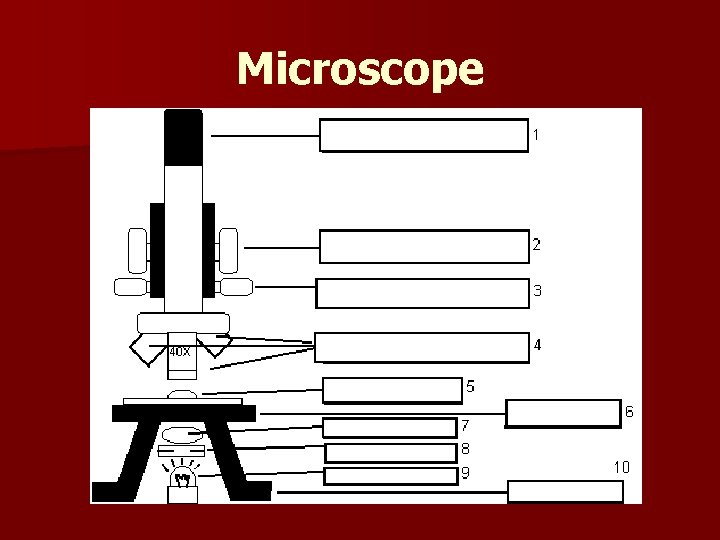
Microscope
Robert Hooke n Invented the microscope n Viewed cork under the microscope; assigned the name cells to the “little rooms” he saw n Thought animals were not made of cells
Anton van Leeuwenhoek made microscopes n Looked at pond scum n Saw protists n
Cell Theory n All organisms are made of one or more cells. n The n All cell is the basic unit of all living things. cells come from existing cells.
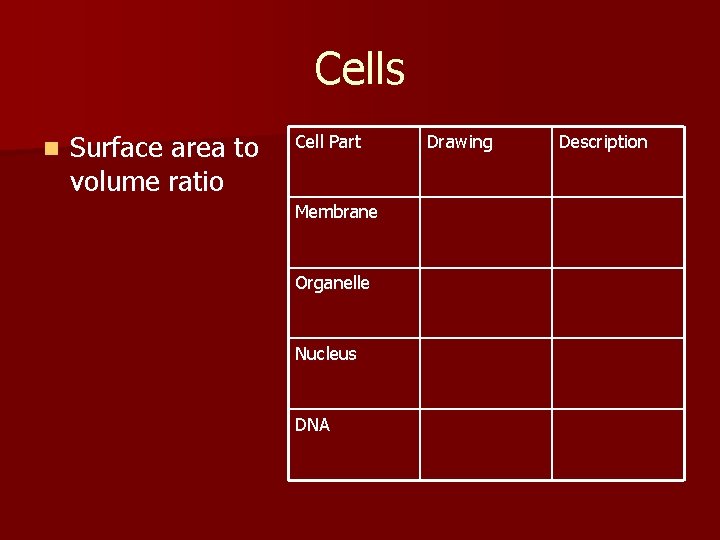
Cells n Surface area to volume ratio Cell Part Membrane Organelle Nucleus DNA Drawing Description
Kinds of cells Compare/contrast each of the following. n Prokaryotes n Eukaryotes n Archaebacteria n Eubacteria
Organelles Cell Part Ribosome ER Mitochondria Chloroplast Golgi Complex Vacuole Lysosome Drawing Description of function
Draw and Trade n Choose either a plant or animal cell. Draw it! n DO NOT LABEL THE ORGANELLES! n Include each of the following organelles in your cell drawing:
n n n n Nucleus Cell wall or cell membrane Ribosomes Nucleolus Smooth ER Rough ER Cytoplasm Mitochondria Chloroplasts Golgi Complex Vesicles Lysosomes Vacuoles
Cells Cell City Analogy In a far away city called Grant City, the main export and production product is the steel widget. Everyone in the town has something to do with steel widget making and the entire town is designed to build and export widgets. The town hall has the instructions for widget making, widgets come in all shapes and sizes and any citizen of Grant can get the instructions and begin making their own widgets. Widgets are generally produced in small shops around the city, these small shops can be built by the carpenter's union (whose headquarters are in town hall). After the widget is constructed, they are placed on special carts which can deliver the widget anywhere in the city. In order for a widget to be exported, the carts take the widget to the postal office, where the widgets are packaged and labeled for export. Sometimes widgets don't turn out right, and the "rejects" are sent to the scrap yard where they are broken down for parts or destroyed altogether. The town powers the widget shops and carts from a hydraulic dam that is in the city. The entire city is enclosed by a large wooden fence, only the postal trucks (and citizens with proper passports) are allowed outside the city. n
A cell is like a school… n n n n Nucleus Cell wall or cell membrane Ribosomes Nucleolus Smooth ER Rough ER Cytoplasm Mitochondria Chloroplasts Golgi Complex Vesicles Lysosomes Vacuoles
Cell BINGO! n n n n Nucleus Cell wall or cell membrane Ribosomes Nucleolus Smooth ER Rough ER Cytoplasm Mitochondria Chloroplasts Golgi Complex Vesicles Lysosomes Vacuoles
Why be multicellular? n. Larger n. Longer size life nspecialization
Organization 1. 2. 3. 4. 5. 6. The smallest, living unit is a _____. A _____ is a group of cells that work together to perform a specific function. What are the different types of tissues? An _____ is an example of tissues working together. An ______ is an example of organs working together to perform a specific function. What are some examples of organ systems?
Drawing Cells Tissues Organs Systems Example Function
Structure/Function n Anatomy: Structure- What is it? n Physiology: Function- Why is it there? How does it function with other systems?
- Slides: 19