
Cells Organelles A Dr Production Two Basic Types
Cells & Organelles A Dr. Production
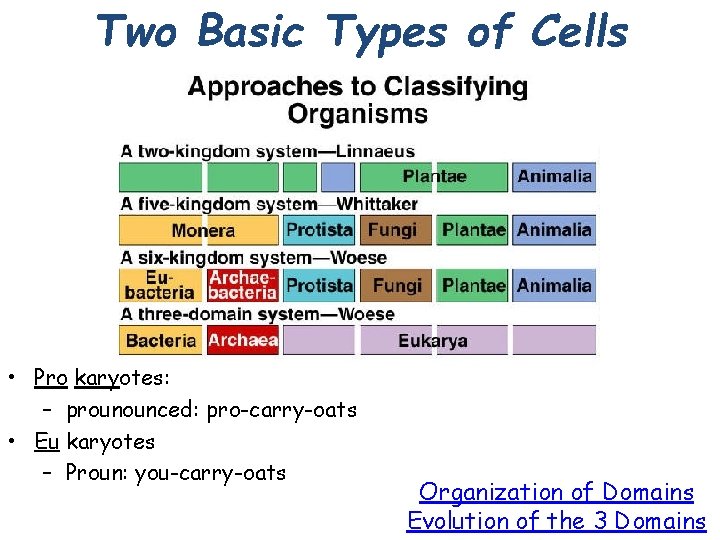
Two Basic Types of Cells • Pro karyotes: – prounounced: pro-carry-oats • Eu karyotes – Proun: you-carry-oats Organization of Domains Evolution of the 3 Domains
Development of the Cell Theory • Hooke (1665) named the cell • Schwann (1800’s) states: -all animals are made of cells • Pasteur (1859) disproved idea of spontaneous generation – living things arise from nonliving matter • Modern cell theory emerged -All organisms composed of cells and cell products. -Cell is the simplest structural and functional unit of life. -Organism’s structure and functions are due to the activities of its cells. -Cells come only from preexisting cells. -Cells of all species have many fundamental similarities.
A. Prokaryotes • • • Small, simple cells (relative to eukaryotes) Size: about 1 µm (1 micron) No internal membrane-bounded organelles No nucleus Simple cell division Single linear chromosome Contain the domains; 1. True (Eu)bacteria & 2. Archaebacteria
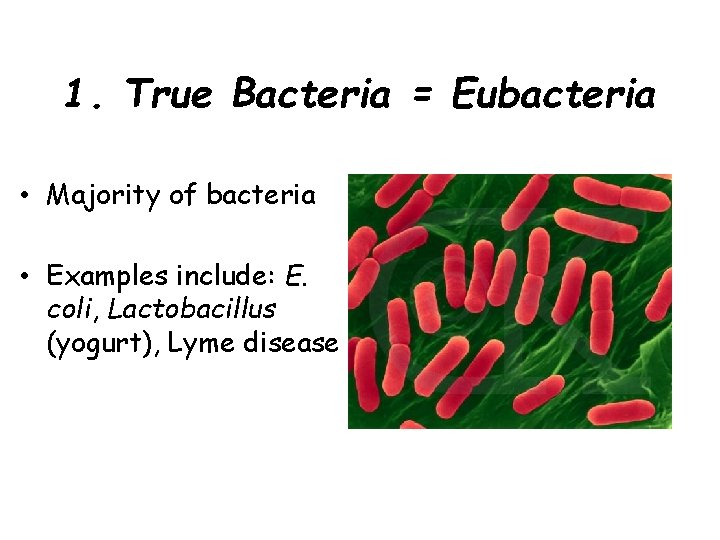
1. True Bacteria = Eubacteria • Majority of bacteria • Examples include: E. coli, Lactobacillus (yogurt), Lyme disease
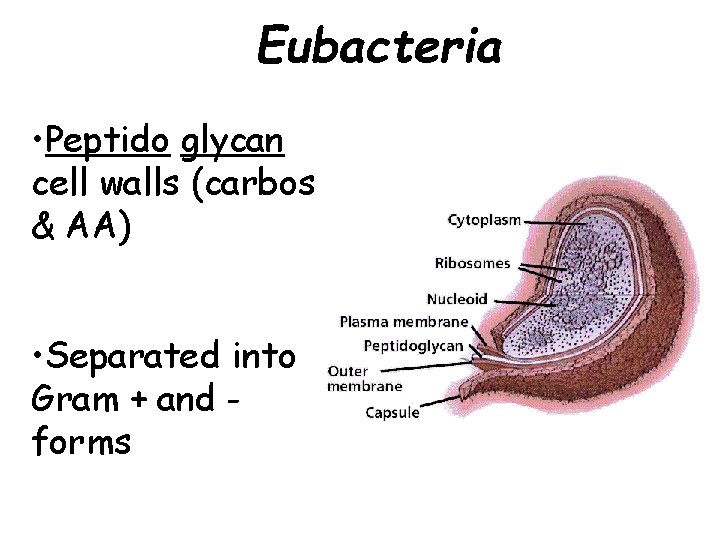
Eubacteria • Peptido glycan cell walls (carbos & AA) • Separated into Gram + and forms
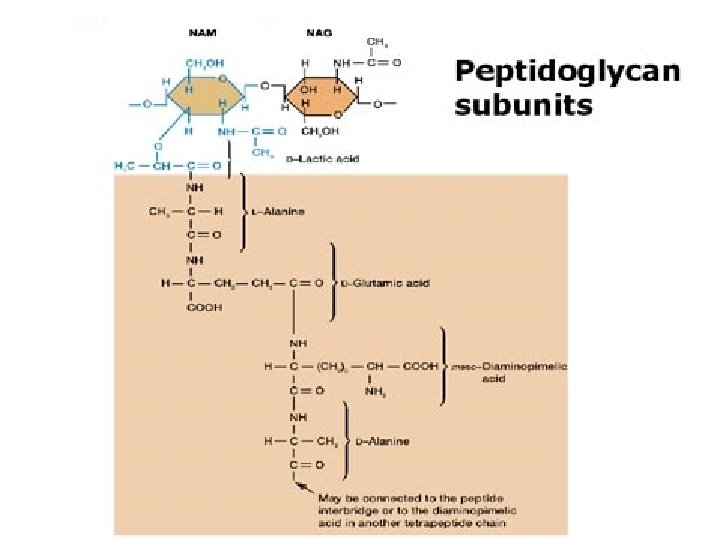
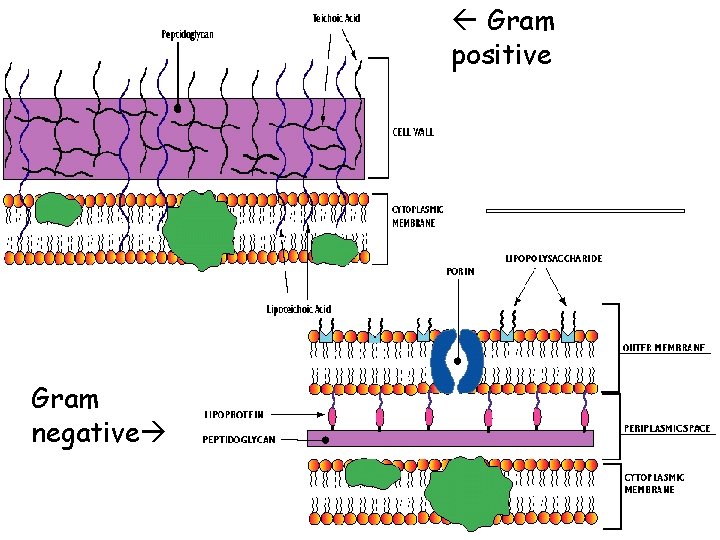
Gram positive Gram negative
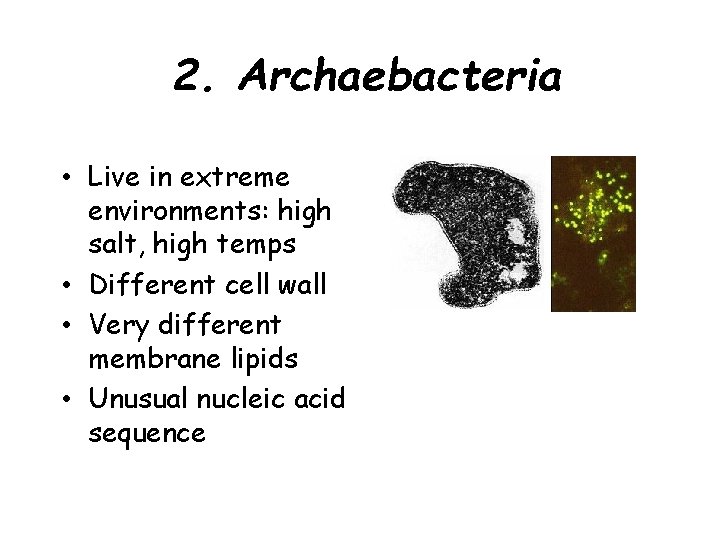
2. Archaebacteria • Live in extreme environments: high salt, high temps • Different cell wall • Very different membrane lipids • Unusual nucleic acid sequence
Archaea = Extremophiles Methanogens (prokaryotes that produce methane); Extreme halophiles (prokaryotes that live at very high concentrations of salt (Na. Cl); Extreme (hyper) thermophiles (prokaryotes that live at very high temperatures). All archaea have features that distinguish them from Bacteria (i. e. , no murein in cell wall, etherlinked membrane lipids, etc. ). And, these prokaryotes exhibit unique structural or biochemical attributes which adapt them to their particular habitats.
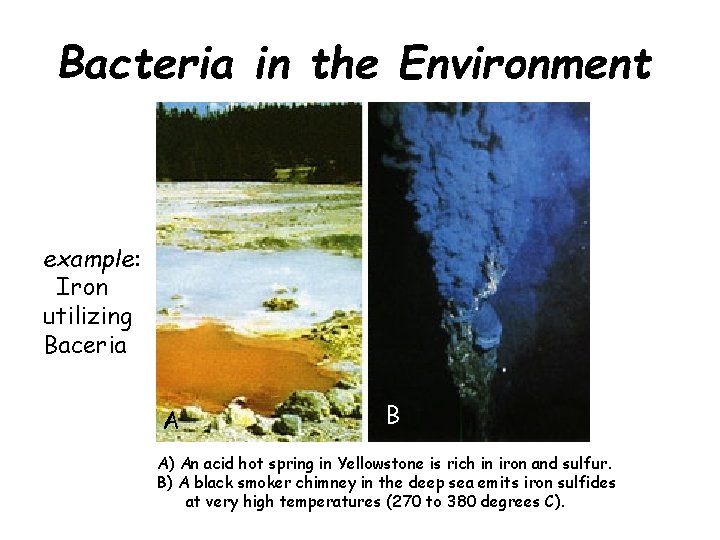
Bacteria in the Environment example: Iron utilizing Baceria A B A) An acid hot spring in Yellowstone is rich in iron and sulfur. B) A black smoker chimney in the deep sea emits iron sulfides at very high temperatures (270 to 380 degrees C).
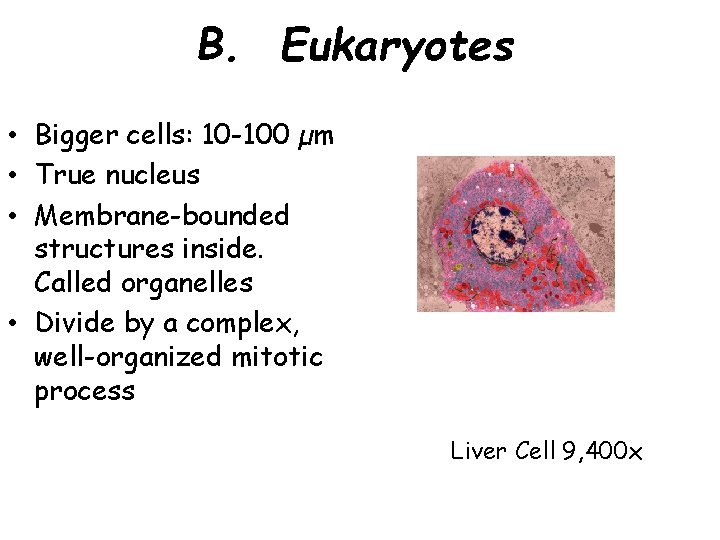
B. Eukaryotes • Bigger cells: 10 -100 µm • True nucleus • Membrane-bounded structures inside. Called organelles • Divide by a complex, well-organized mitotic process Liver Cell 9, 400 x
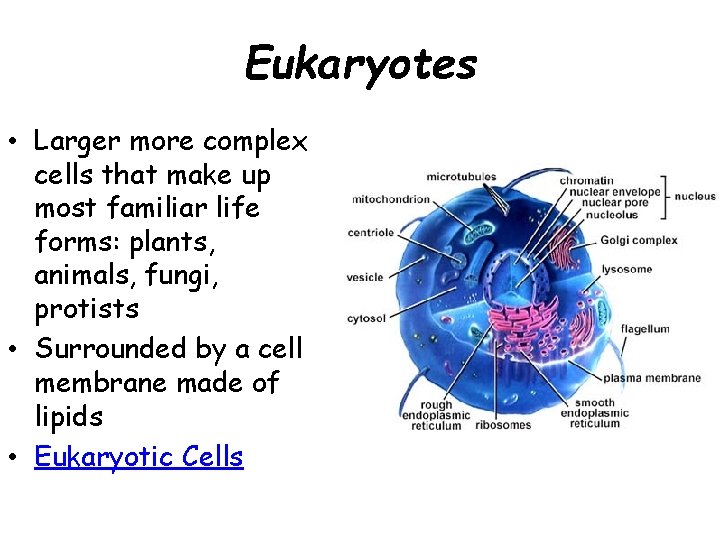
Eukaryotes • Larger more complex cells that make up most familiar life forms: plants, animals, fungi, protists • Surrounded by a cell membrane made of lipids • Eukaryotic Cells
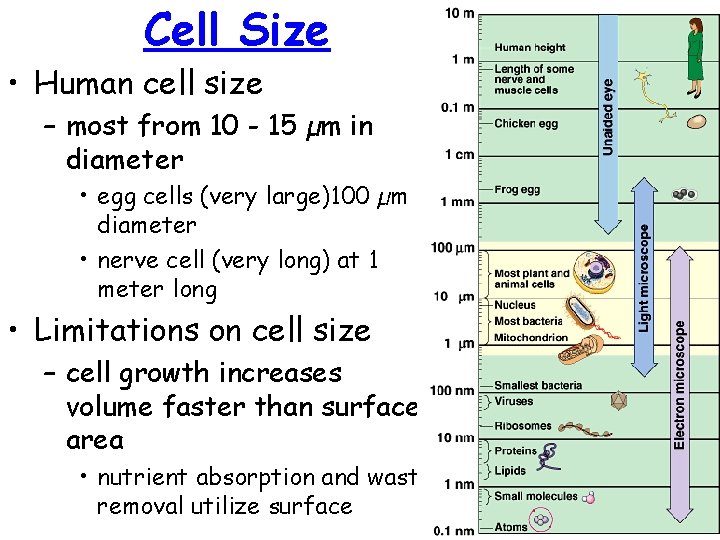
Cell Size • Human cell size – most from 10 - 15 µm in diameter • egg cells (very large)100 µm diameter • nerve cell (very long) at 1 meter long • Limitations on cell size – cell growth increases volume faster than surface area • nutrient absorption and waste removal utilize surface
Why are Cells Small? • Cells must exchange gases & other molecules with environment… • Nutrients in, Wastes out • As size increases, the rate of diffusion exchange slows down…. • This is due to the ratio of surface area to volume • Cell surface area is important in taking in nutrients • Surface area increases as the square of cell diameter • But… entire cell volume needs to be fed • And, cell volume increases as the cube of cell diameter
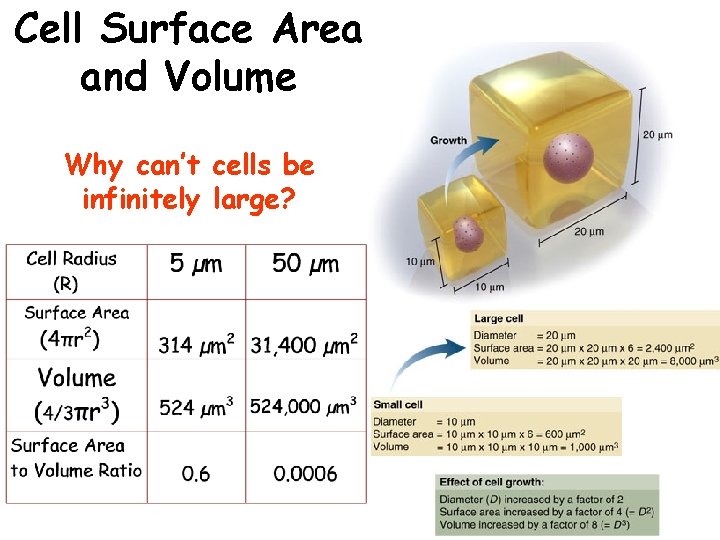
Cell Surface Area and Volume Why can’t cells be infinitely large?
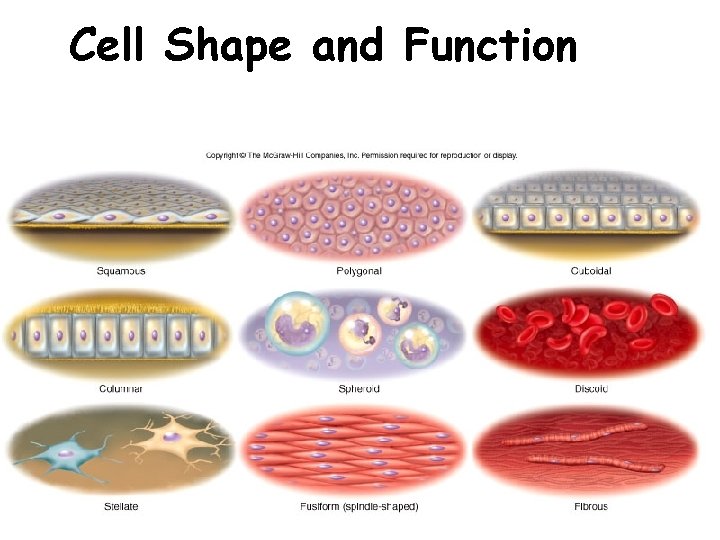
Cell Shape and Function
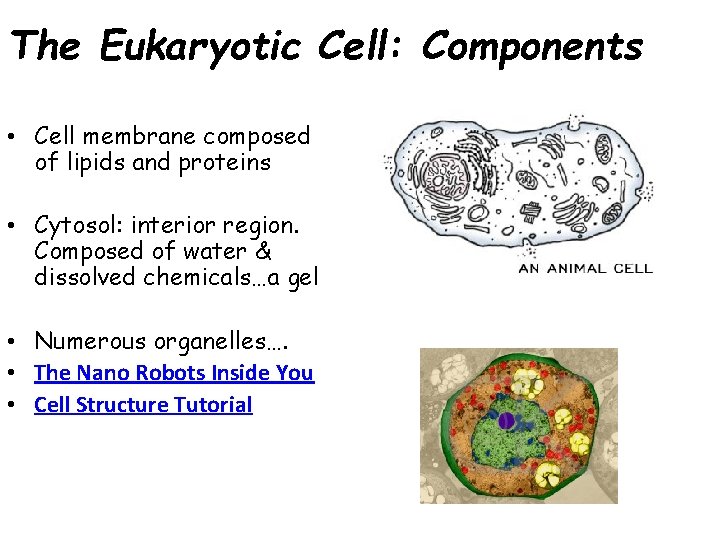
The Eukaryotic Cell: Components • Cell membrane composed of lipids and proteins • Cytosol: interior region. Composed of water & dissolved chemicals…a gel • Numerous organelles…. • The Nano Robots Inside You • Cell Structure Tutorial
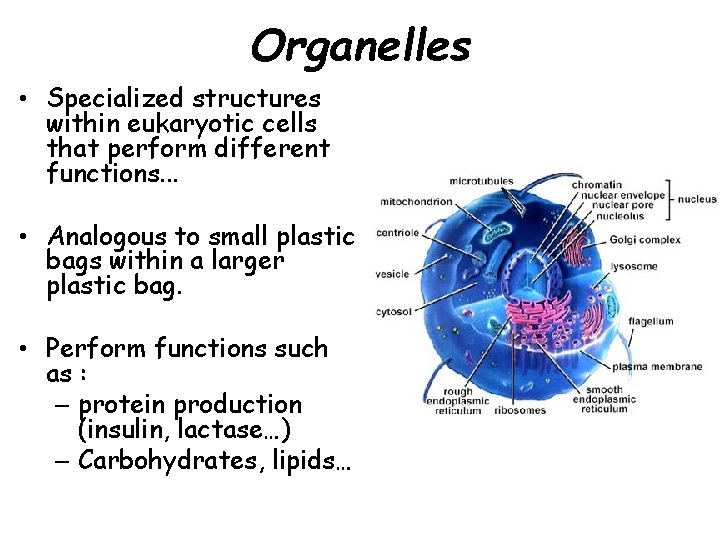
Organelles • Specialized structures within eukaryotic cells that perform different functions. . . • Analogous to small plastic bags within a larger plastic bag. • Perform functions such as : – protein production (insulin, lactase…) – Carbohydrates, lipids…
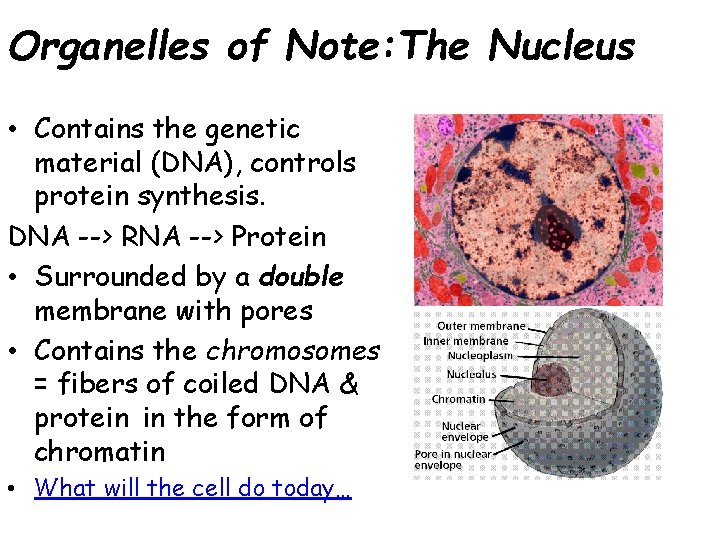
Organelles of Note: The Nucleus • Contains the genetic material (DNA), controls protein synthesis. DNA --> RNA --> Protein • Surrounded by a double membrane with pores • Contains the chromosomes = fibers of coiled DNA & protein in the form of chromatin • What will the cell do today…
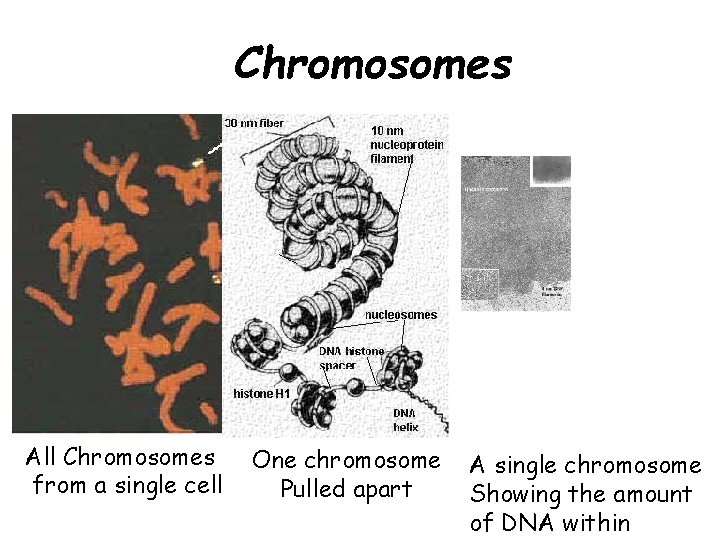
Chromosomes All Chromosomes from a single cell One chromosome Pulled apart A single chromosome Showing the amount of DNA within
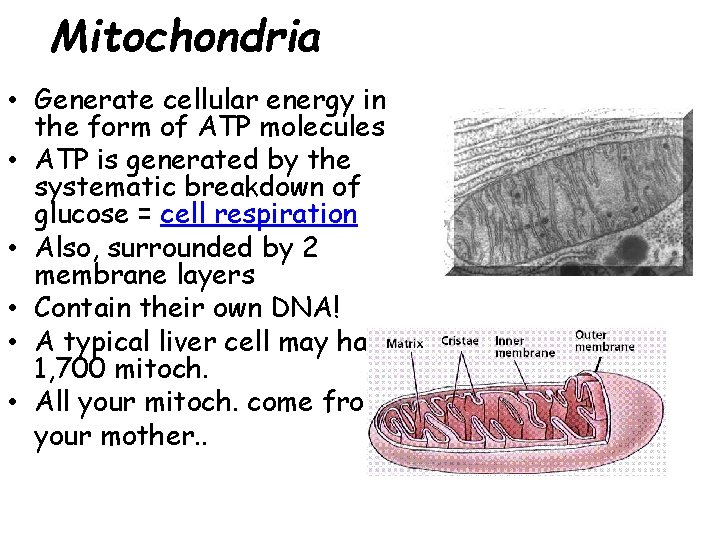
Mitochondria • Generate cellular energy in the form of ATP molecules • ATP is generated by the systematic breakdown of glucose = cell respiration • Also, surrounded by 2 membrane layers • Contain their own DNA! • A typical liver cell may have 1, 700 mitoch. • All your mitoch. come from your mother. .
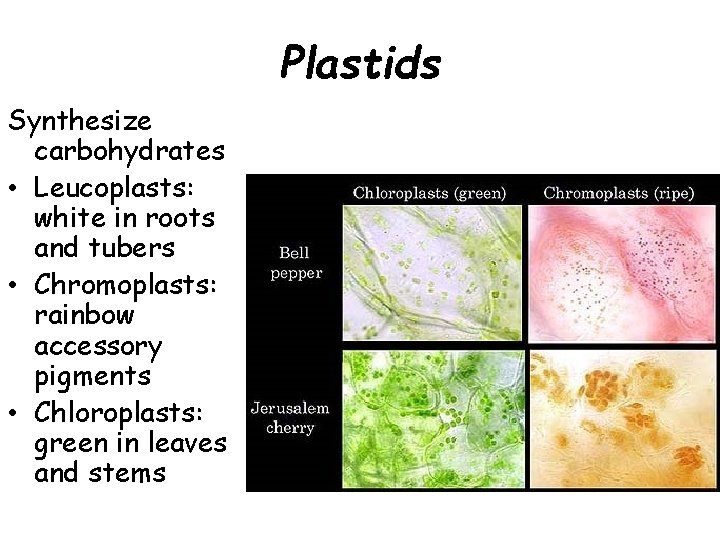
Plastids Synthesize carbohydrates • Leucoplasts: white in roots and tubers • Chromoplasts: rainbow accessory pigments • Chloroplasts: green in leaves and stems
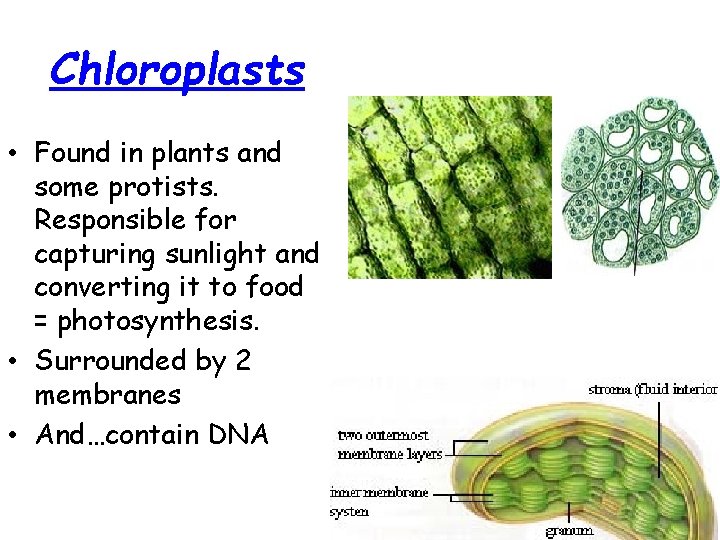
Chloroplasts • Found in plants and some protists. Responsible for capturing sunlight and converting it to food = photosynthesis. • Surrounded by 2 membranes • And…contain DNA
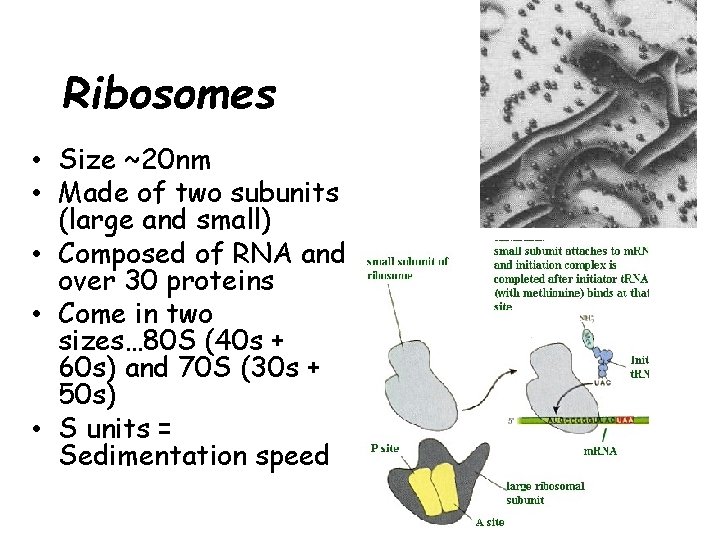
Ribosomes • Size ~20 nm • Made of two subunits (large and small) • Composed of RNA and over 30 proteins • Come in two sizes… 80 S (40 s + 60 s) and 70 S (30 s + 50 s) • S units = Sedimentation speed
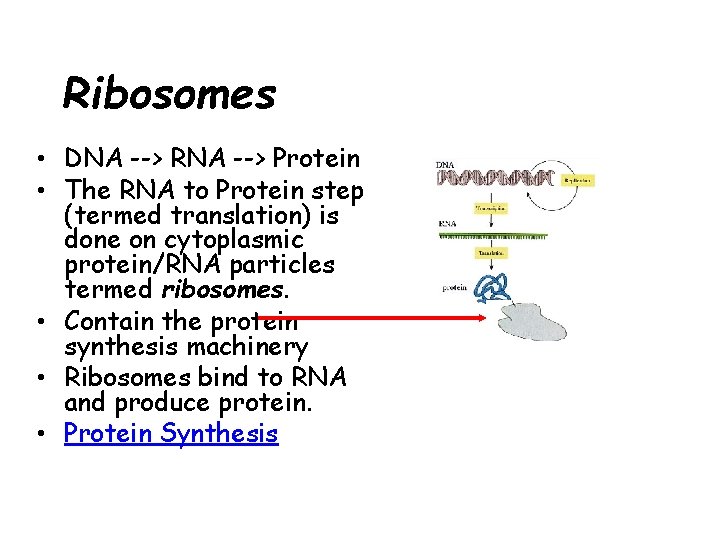
Ribosomes • DNA --> RNA --> Protein • The RNA to Protein step (termed translation) is done on cytoplasmic protein/RNA particles termed ribosomes. • Contain the protein synthesis machinery • Ribosomes bind to RNA and produce protein. • Protein Synthesis
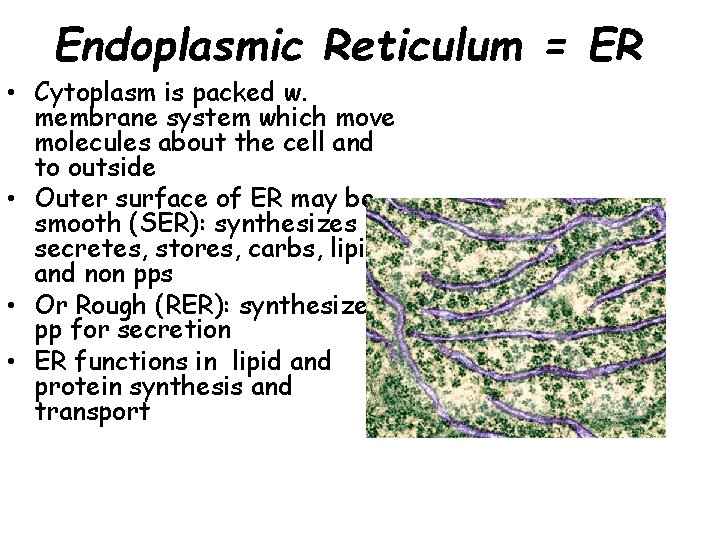
Endoplasmic Reticulum = ER • Cytoplasm is packed w. membrane system which move molecules about the cell and to outside • Outer surface of ER may be smooth (SER): synthesizes secretes, stores, carbs, lipids and non pps • Or Rough (RER): synthesizes pp for secretion • ER functions in lipid and protein synthesis and transport
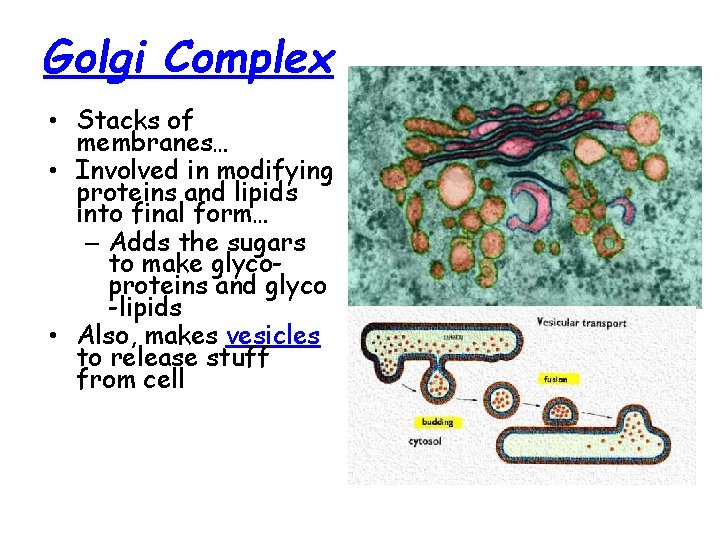
Golgi Complex • Stacks of membranes… • Involved in modifying proteins and lipids into final form… – Adds the sugars to make glycoproteins and glyco -lipids • Also, makes vesicles to release stuff from cell
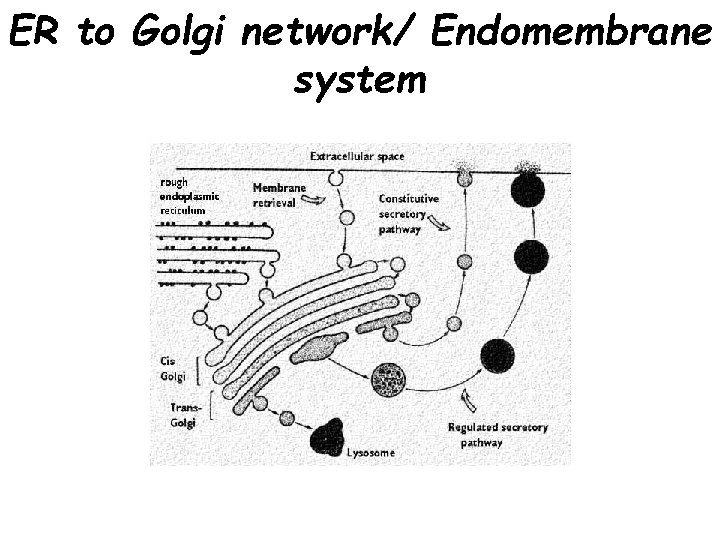
ER to Golgi network/ Endomembrane system
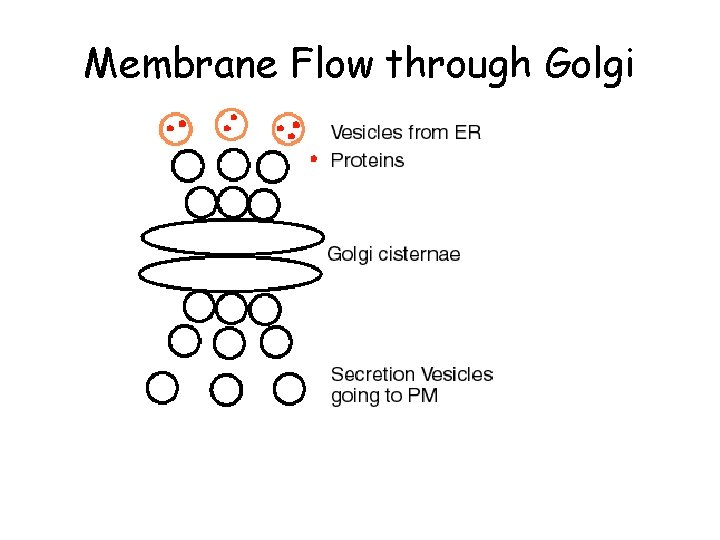
Membrane Flow through Golgi
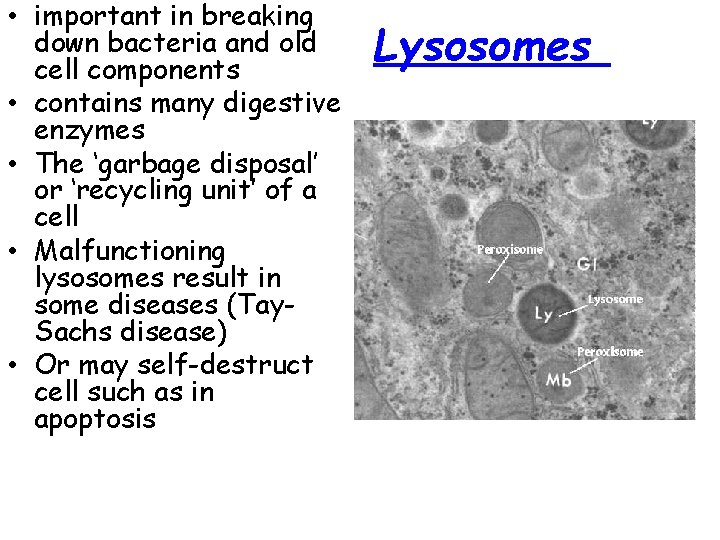
• important in breaking down bacteria and old cell components • contains many digestive enzymes • The ‘garbage disposal’ or ‘recycling unit’ of a cell • Malfunctioning lysosomes result in some diseases (Tay. Sachs disease) • Or may self-destruct cell such as in apoptosis Lysosomes
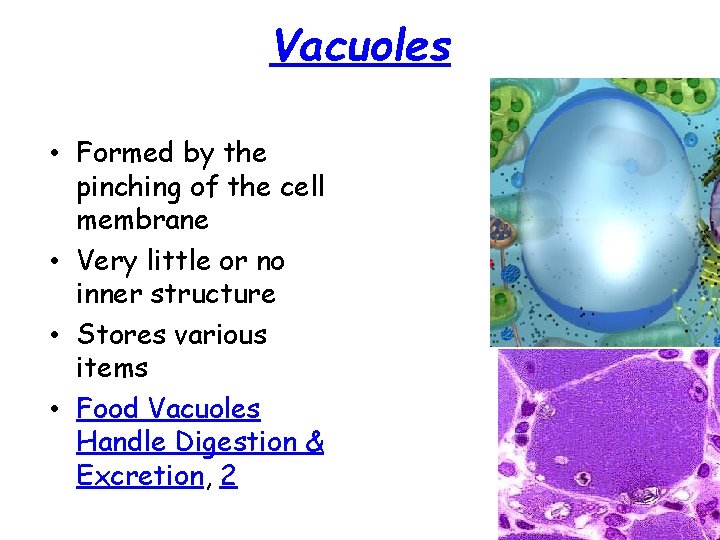
Vacuoles • Formed by the pinching of the cell membrane • Very little or no inner structure • Stores various items • Food Vacuoles Handle Digestion & Excretion, 2
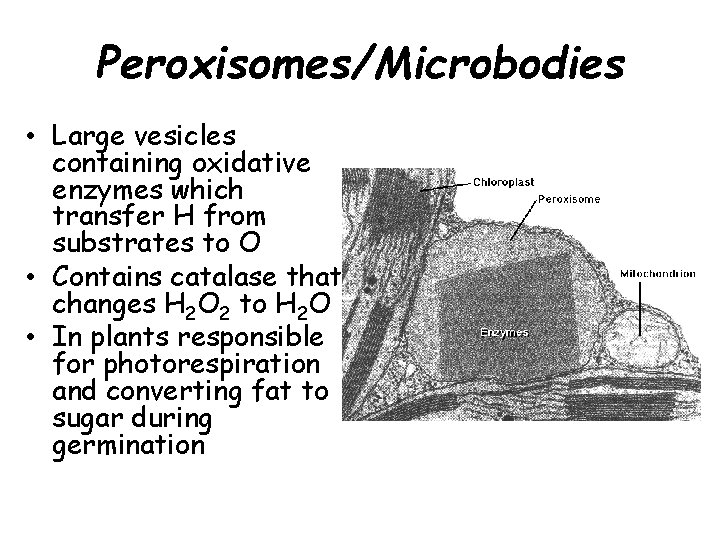
Peroxisomes/Microbodies • Large vesicles containing oxidative enzymes which transfer H from substrates to O • Contains catalase that changes H 2 O 2 to H 2 O • In plants responsible for photorespiration and converting fat to sugar during germination
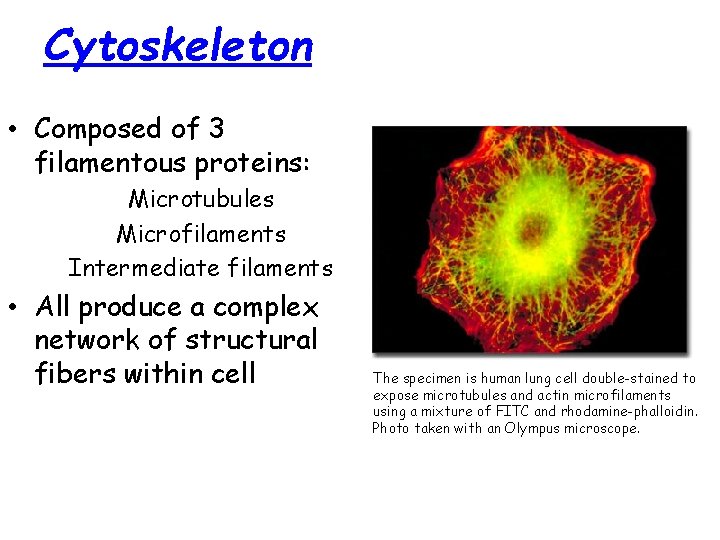
Cytoskeleton • Composed of 3 filamentous proteins: Microtubules Microfilaments Intermediate filaments • All produce a complex network of structural fibers within cell The specimen is human lung cell double-stained to expose microtubules and actin microfilaments using a mixture of FITC and rhodamine-phalloidin. Photo taken with an Olympus microscope.
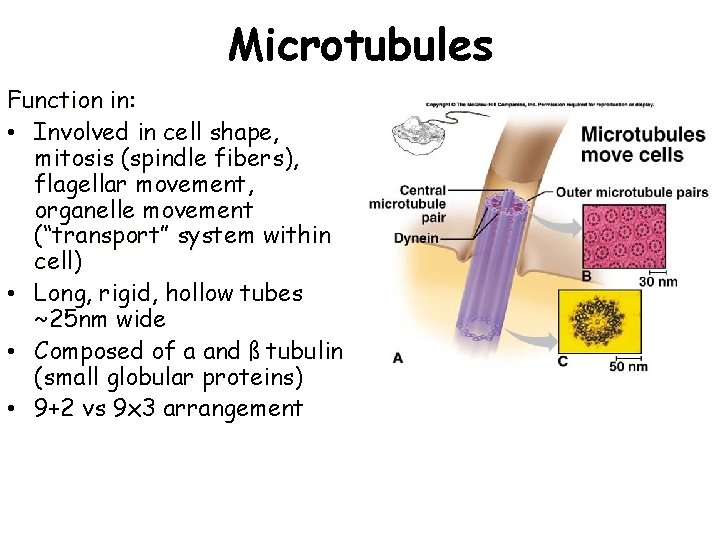
Microtubules Function in: • Involved in cell shape, mitosis (spindle fibers), flagellar movement, organelle movement (“transport” system within cell) cell • Long, rigid, hollow tubes ~25 nm wide • Composed of a and ß tubulin (small globular proteins) • 9+2 vs 9 x 3 arrangement
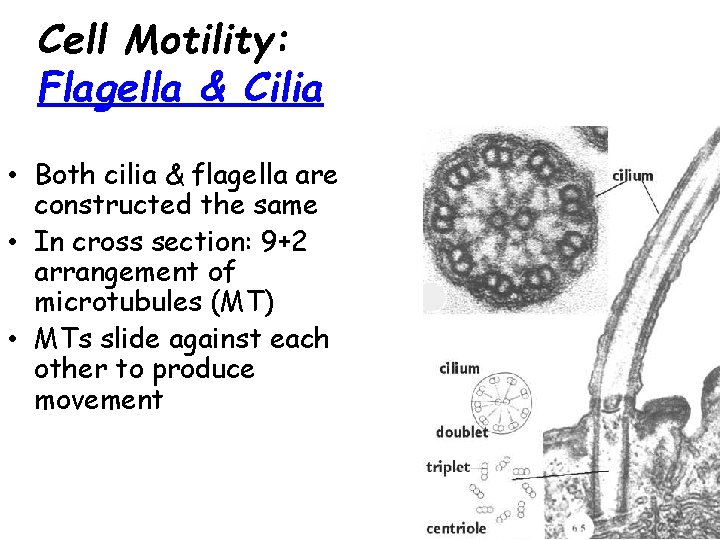
Cell Motility: Flagella & Cilia • Both cilia & flagella are constructed the same • In cross section: 9+2 arrangement of microtubules (MT) • MTs slide against each other to produce movement
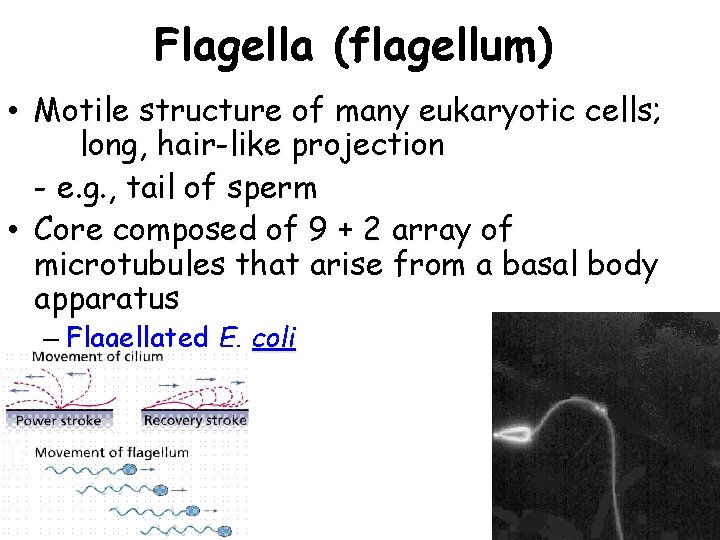
Flagella (flagellum) • Motile structure of many eukaryotic cells; long, hair-like projection - e. g. , tail of sperm • Core composed of 9 + 2 array of microtubules that arise from a basal body apparatus – Flagellated E. coli
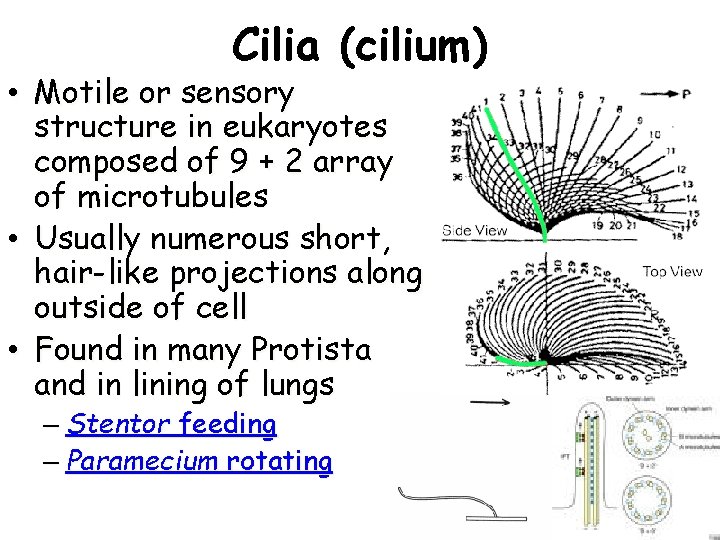
Cilia (cilium) • Motile or sensory structure in eukaryotes composed of 9 + 2 array of microtubules • Usually numerous short, hair-like projections along outside of cell • Found in many Protista and in lining of lungs – Stentor feeding – Paramecium rotating
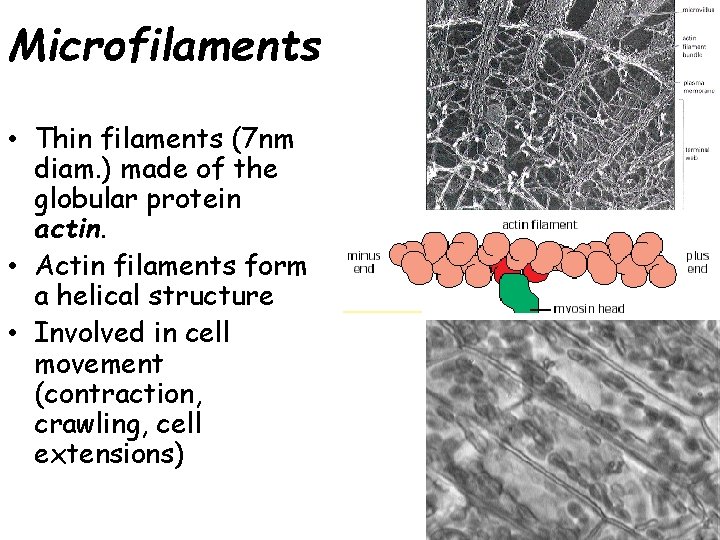
Microfilaments • Thin filaments (7 nm diam. ) made of the globular protein actin. • Actin filaments form a helical structure • Involved in cell movement (contraction, crawling, cell extensions)
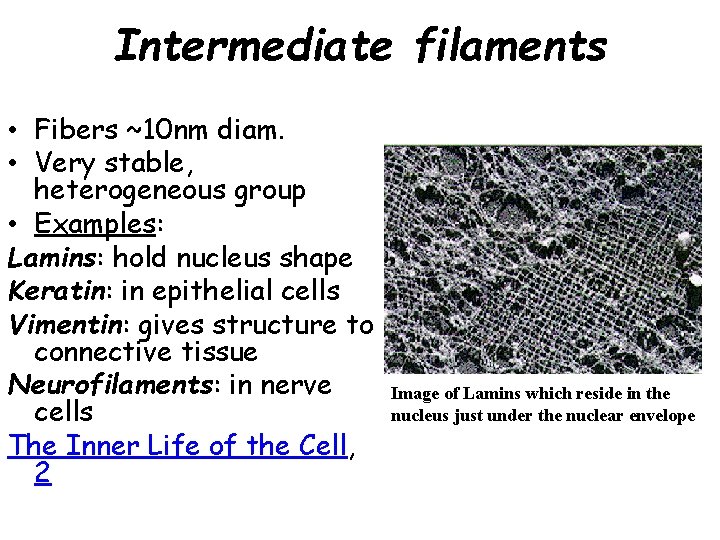
Intermediate filaments • Fibers ~10 nm diam. • Very stable, heterogeneous group • Examples: Lamins: hold nucleus shape Keratin: in epithelial cells Vimentin: gives structure to connective tissue Neurofilaments: in nerve cells The Inner Life of the Cell, 2 Image of Lamins which reside in the nucleus just under the nuclear envelope
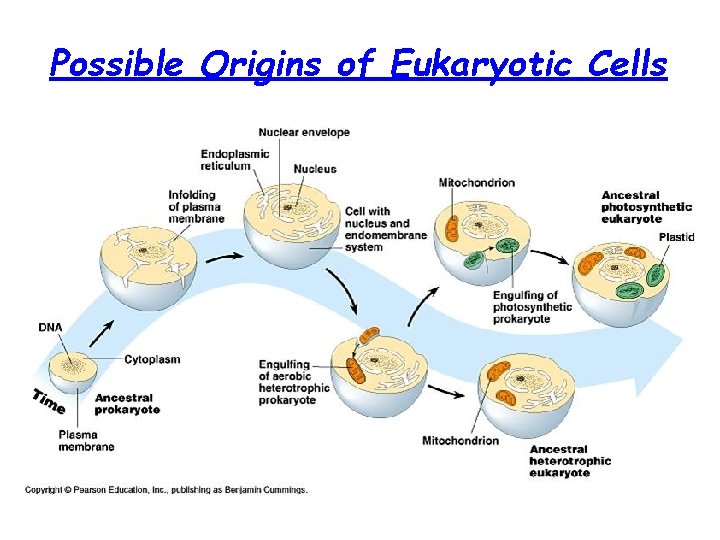
Possible Origins of Eukaryotic Cells
Support for this Theory: • Eg. of this type of symbiosis are found today. Sponges harbor photosyn. algae within their tissues, allowing them to photosynthesize. • The organelles (chloroplasts and mitochondria) resemble bacteria in size and structure. • These organelles each contain a small amount of DNA but lack a nuclear membrane. • Each has the capability of self-replication. They reproduce by binary fission. • They make their own proteins. • During protein synthesis, these organelles use the same control codes and initial amino acid as prokaryotes. • They contain and make their own ribosomes, which resemble prokaryote’s. • The enzymes that replicate DNA and RNA (polymerases) of the organelles are similar to those in prokaryotes but different from those of eukaryotes. • The organelles have a double membrane that might be derived from a prokaryote’s plasma membrane and the membrane of a vesicle.
Cellular Level Technology • Nanotechnology for cancer treatment • Dean of Invention- Nanobots Fight Cancer and Kill Tumors • Nano-Motors First Ever Testing On Live Human Cells, Nanobots Invade Human Cells. • DNA Repair Nanobot
Resources • • • Rediscovering Biology Animation Guide Cell Signaling and Cell Cycle Animations Molecular Movies Apoptosis Animation Bacterial Animations Cell Songs – – – Apoptosis Song Sweet Home Apparatus Nucleus Song Call Me Golgi Mr. W’s Cell Song
- Slides: 44