
Cells Communication and Molecular Biology Review 1 Sign
Cells, Communication and Molecular Biology Review 1) Sign in 2) Make a Venn Diagram comparing prokaryote, plant and animal cells
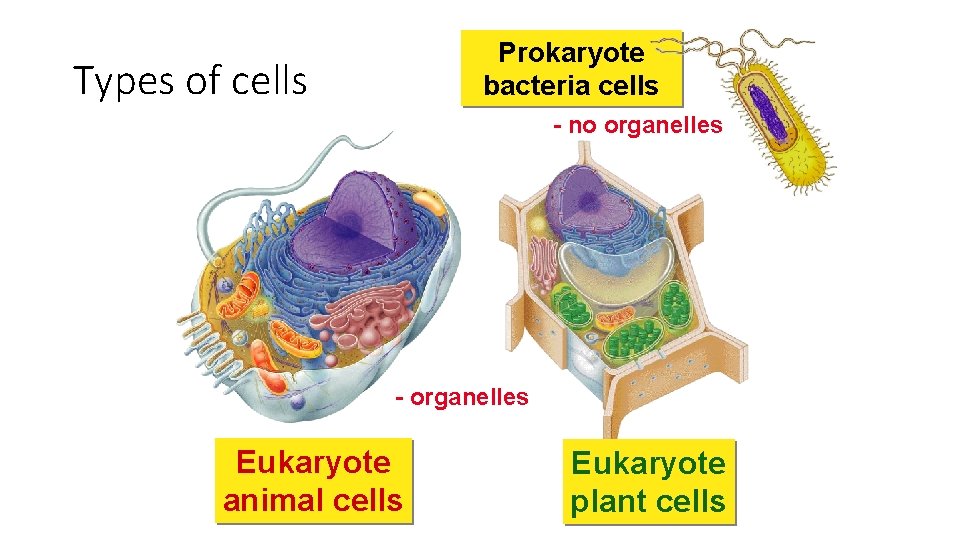
Prokaryote bacteria cells Types of cells - no organelles - organelles Eukaryote animal cells Eukaryote plant cells

Bacterial Cell=Prokaryote -have ribosomes, DNA loop + plasmid, cell wall, cell membrane, flagella or cilia
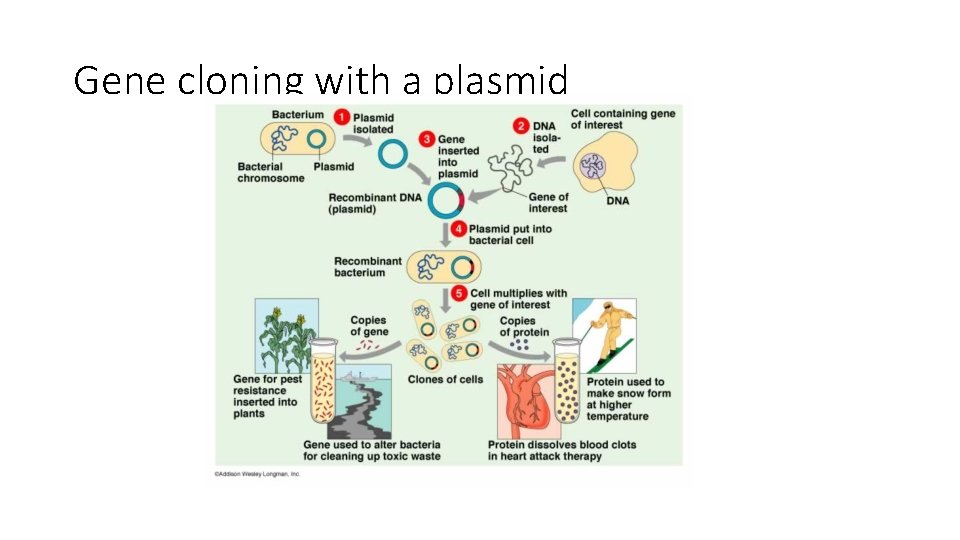
Gene cloning with a plasmid
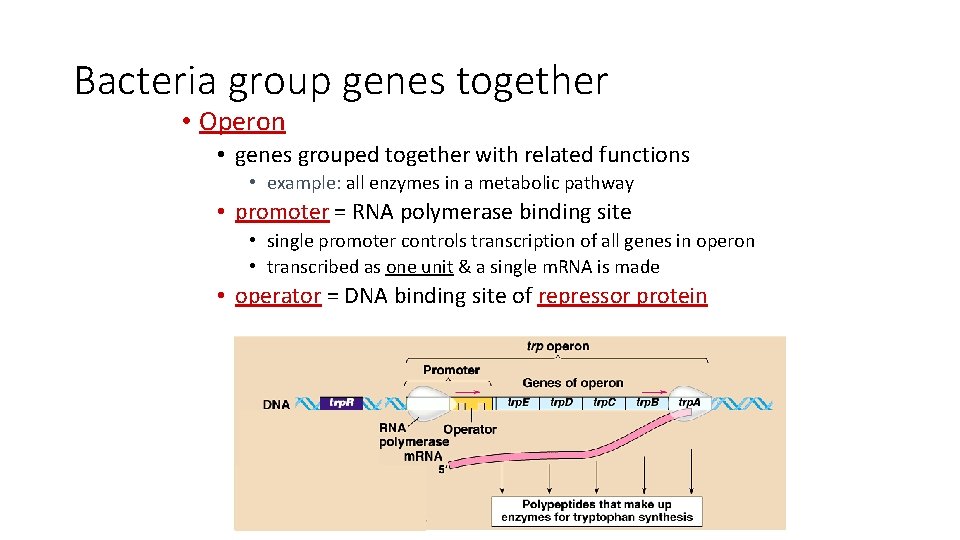
Bacteria group genes together • Operon • genes grouped together with related functions • example: all enzymes in a metabolic pathway • promoter = RNA polymerase binding site • single promoter controls transcription of all genes in operon • transcribed as one unit & a single m. RNA is made • operator = DNA binding site of repressor protein
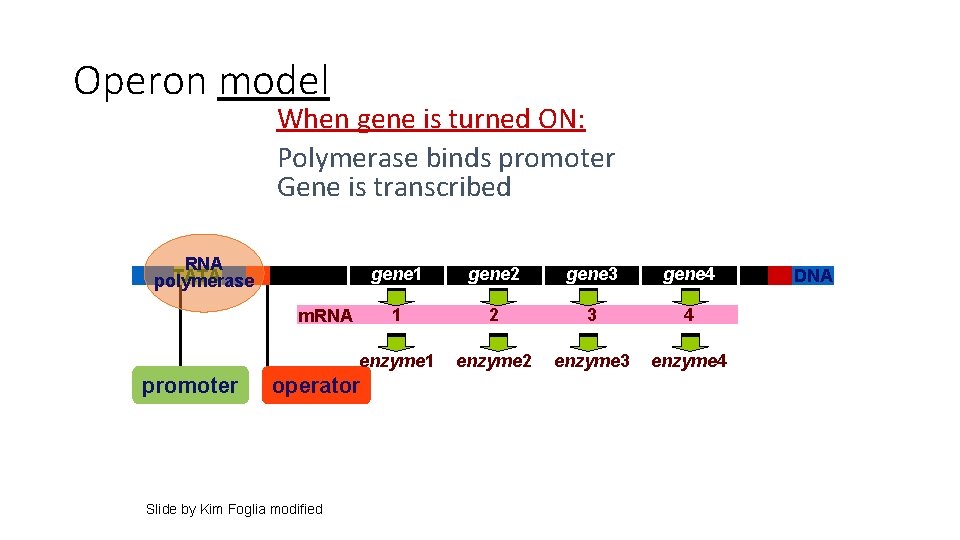
Operon model When gene is turned ON: Polymerase binds promoter Gene is transcribed RNA TATA polymerase gene 1 gene 2 gene 3 gene 4 1 2 3 4 enzyme 1 enzyme 2 enzyme 3 enzyme 4 m. RNA promoter operator Slide by Kim Foglia modified DNA
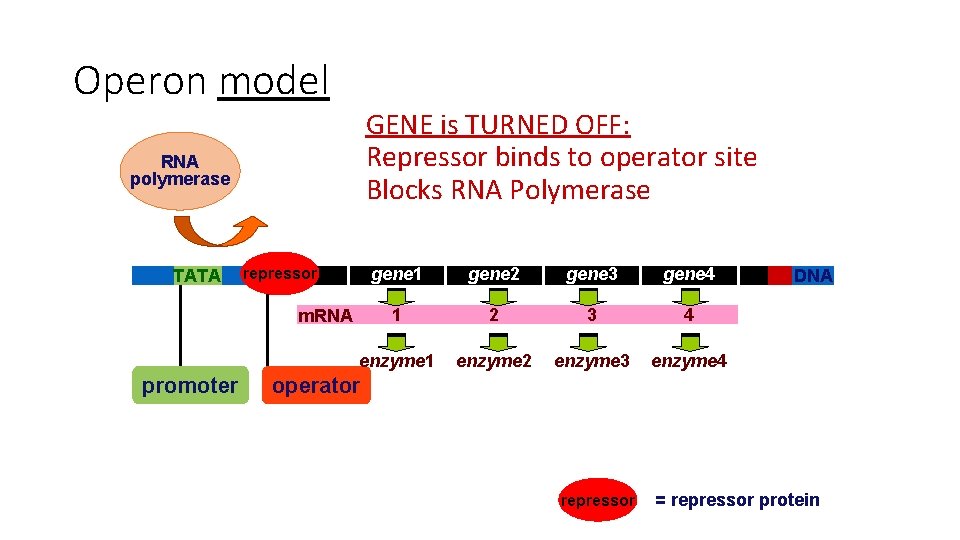
Operon model GENE is TURNED OFF: Repressor binds to operator site Blocks RNA Polymerase RNA polymerase TATA gene 1 gene 2 gene 3 gene 4 1 2 3 4 enzyme 1 enzyme 2 enzyme 3 enzyme 4 repressor m. RNA promoter DNA operator repressor = repressor protein
• REPRESSIBLE OPERONS are ON Can be turned off EX: trp operon--makes enzymes used in tryptophan synthesis • INDUCIBLE OPERONS are OFF Can be turned on EX: lac operon--makes enzymes used in lactose digestion
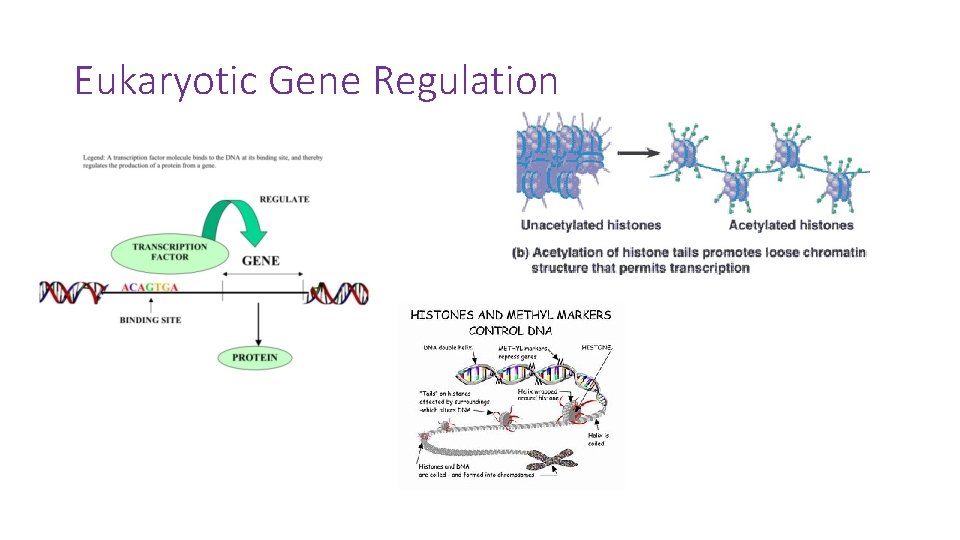
Eukaryotic Gene Regulation
Question 1: Which of the following is true regarding spherical cells? A. As the diameter decreases, the surface area remains the same. B. As the diameter decreases, the surface area increases. C. As the diameter decreases, the surface-to-volume ratio increases. D. As the diameter increases, the volume decreases. E. The surface-to-volume ratio is independent of diameter. Red book #53
Question 1: Which of the following is true regarding spherical cells? A. As the diameter decreases, the surface area remains the same. B. As the diameter decreases, the surface area increases. C. As the diameter decreases, the surface-to-volume ratio increases. D. As the diameter increases, the volume decreases. E. The surface-to-volume ratio is independent of diameter. Red book #53
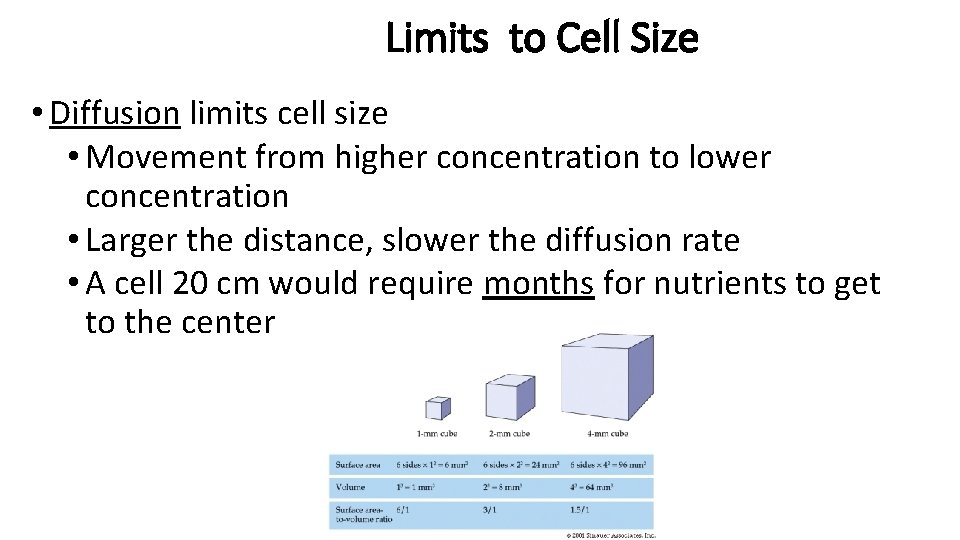
Limits to Cell Size • Diffusion limits cell size • Movement from higher concentration to lower concentration • Larger the distance, slower the diffusion rate • A cell 20 cm would require months for nutrients to get to the center
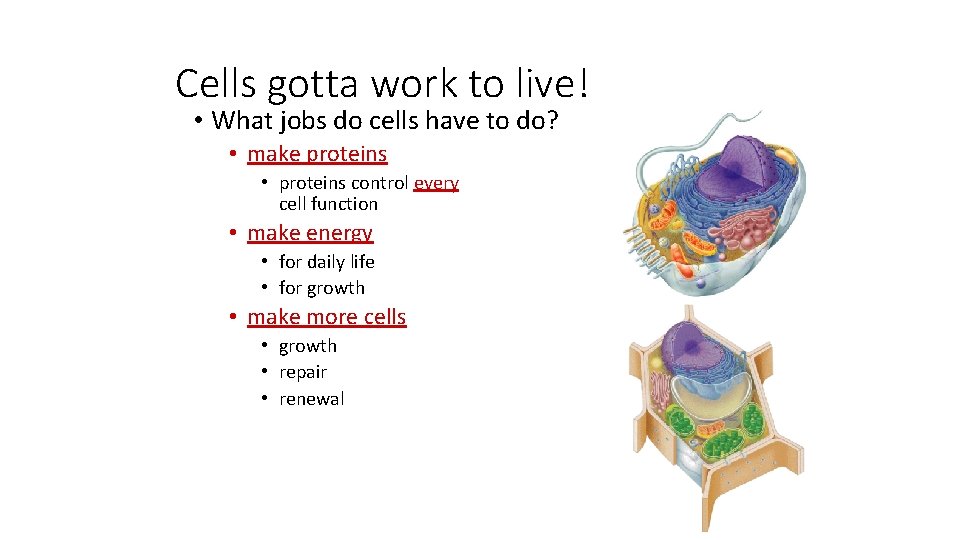
Cells gotta work to live! • What jobs do cells have to do? • make proteins • proteins control every cell function • make energy • for daily life • for growth • make more cells • growth • repair • renewal
Question 2: Which of the following components of the cell membrane is responsible for active transport? (A) (B) (C) (D) (E) Phospholipid Protein Lipid Phosphate Cholesterol
Question 2: Which of the following components of the cell membrane is responsible for active transport? (A) (B) (C) (D) (E) Phospholipid Protein Lipid Phosphate Cholesterol
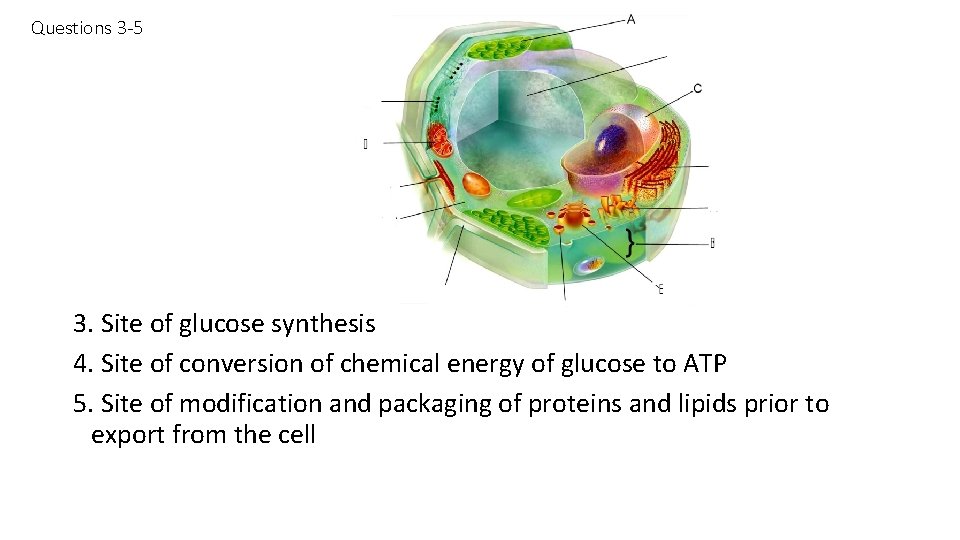
Questions 3 -5 3. Site of glucose synthesis 4. Site of conversion of chemical energy of glucose to ATP 5. Site of modification and packaging of proteins and lipids prior to export from the cell
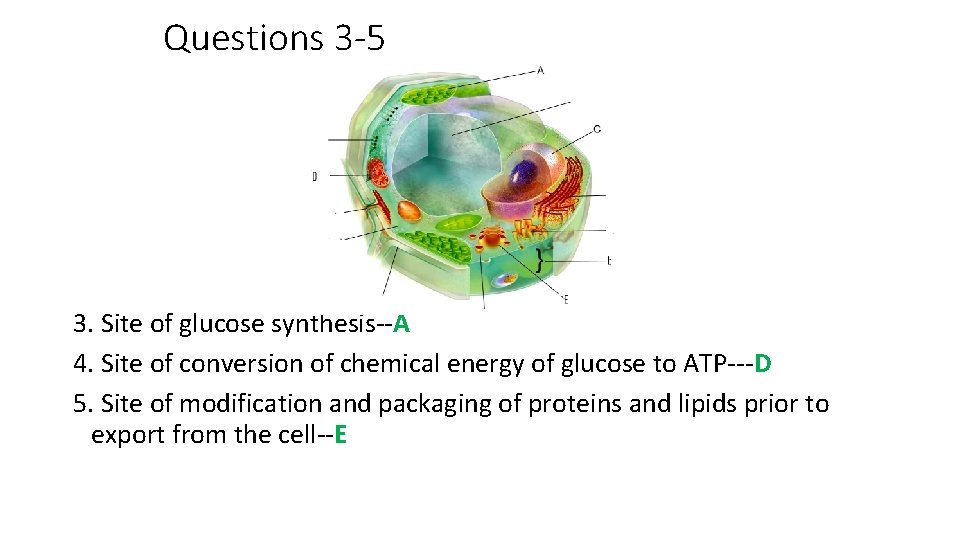
Questions 3 -5 3. Site of glucose synthesis--A 4. Site of conversion of chemical energy of glucose to ATP---D 5. Site of modification and packaging of proteins and lipids prior to export from the cell--E
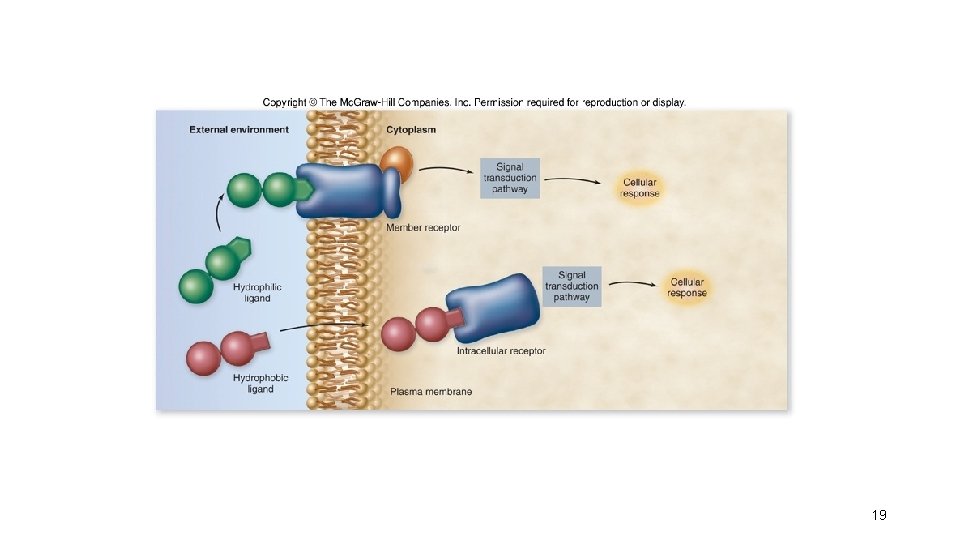
Cell Communication between cells requires: ligand: the signaling molecule receptor protein: the molecule to which the receptor binds -may be on the plasma membrane or within the cell 18
19
Cell Communication There are four basic mechanisms for cellular communication: 1. direct contact 2. paracrine signaling 3. endocrine signaling 4. synaptic signaling 20
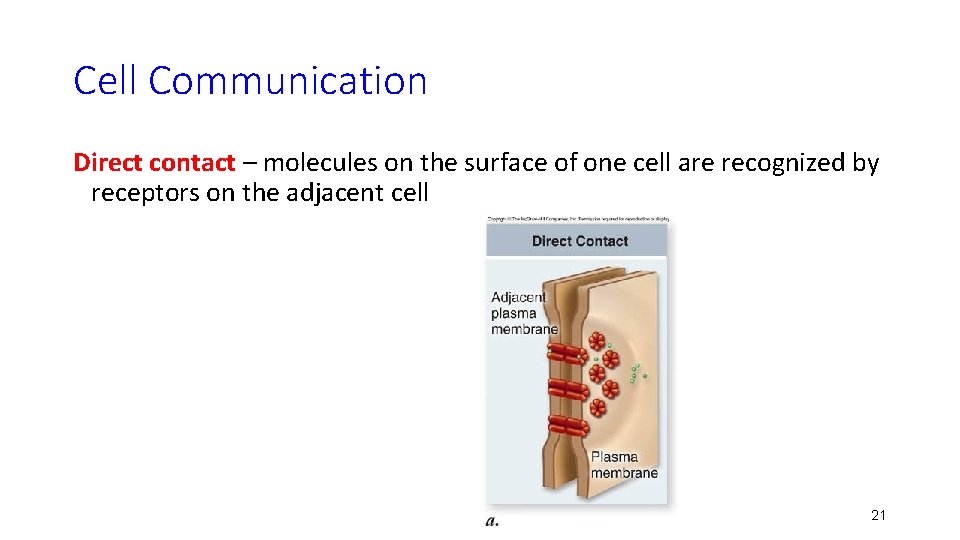
Cell Communication Direct contact – molecules on the surface of one cell are recognized by receptors on the adjacent cell 21
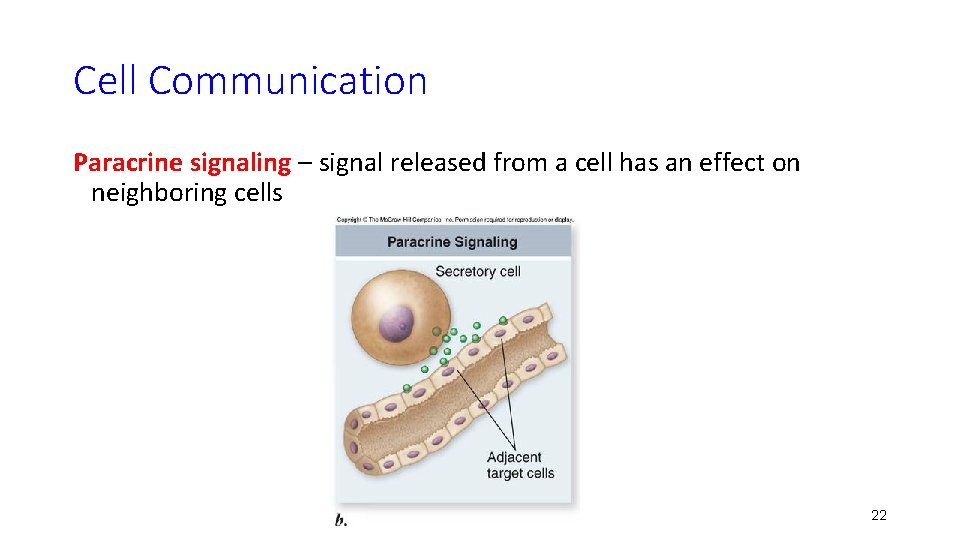
Cell Communication Paracrine signaling – signal released from a cell has an effect on neighboring cells 22
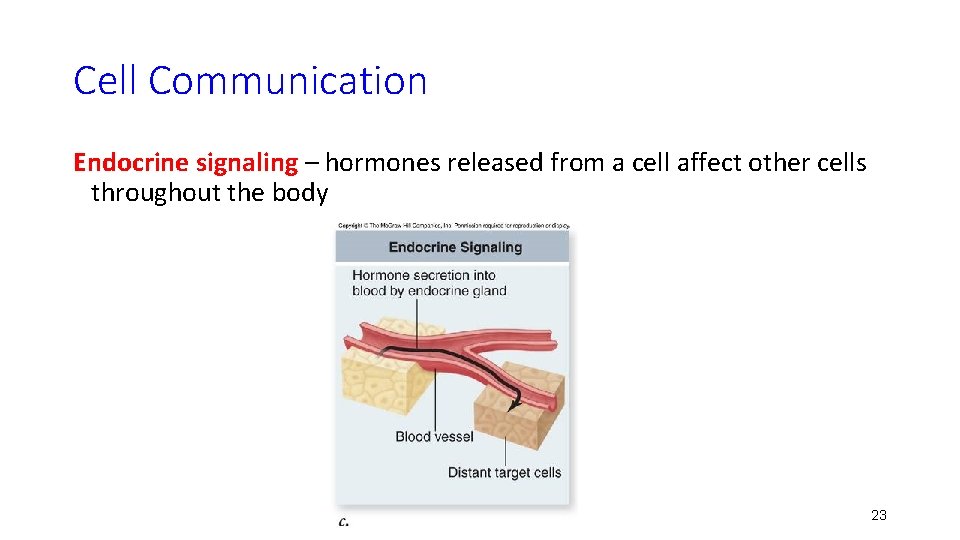
Cell Communication Endocrine signaling – hormones released from a cell affect other cells throughout the body 23
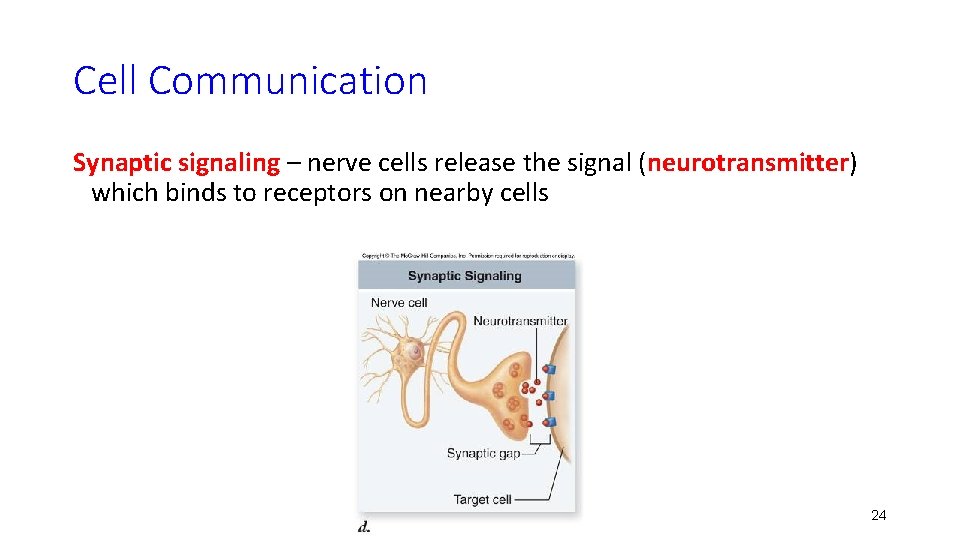
Cell Communication Synaptic signaling – nerve cells release the signal (neurotransmitter) which binds to receptors on nearby cells 24
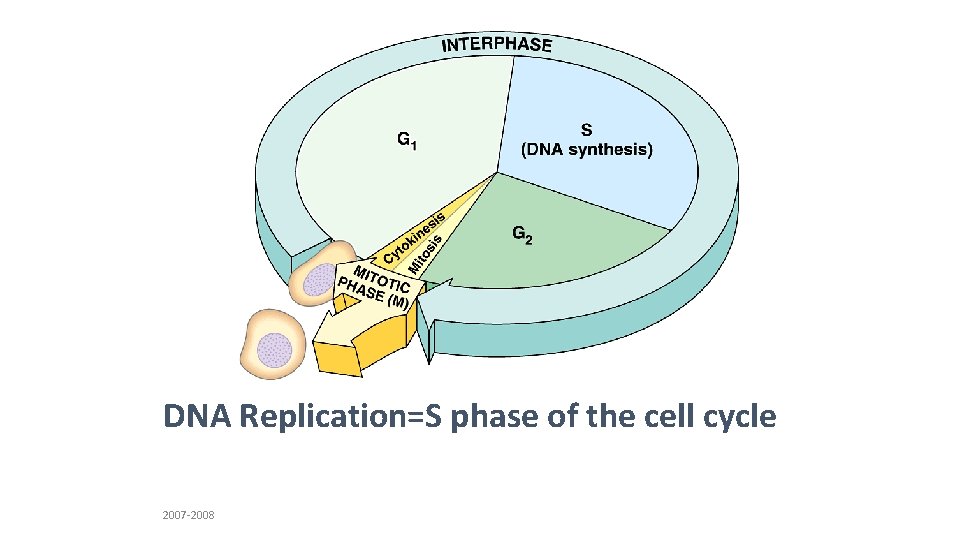
DNA Replication=S phase of the cell cycle 2007 -2008
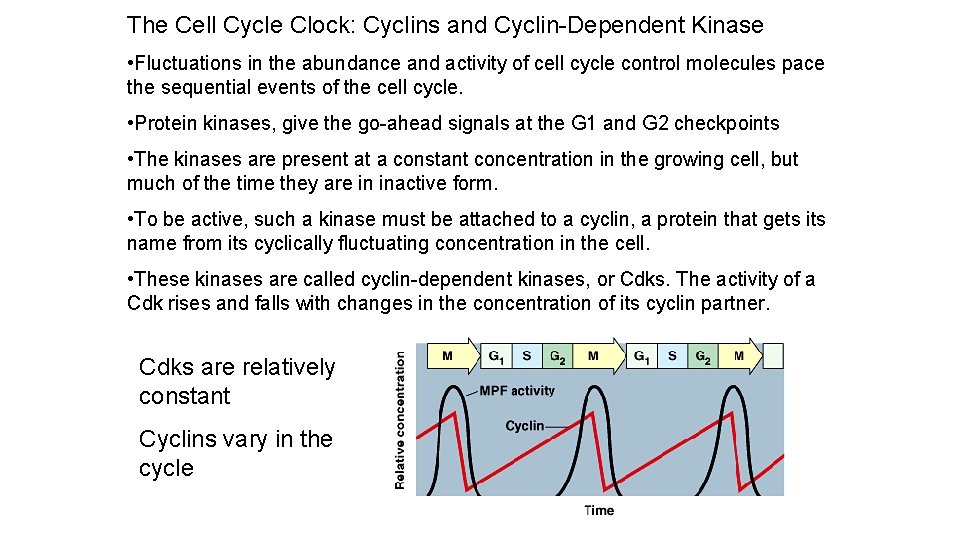
The Cell Cycle Clock: Cyclins and Cyclin-Dependent Kinase • Fluctuations in the abundance and activity of cell cycle control molecules pace the sequential events of the cell cycle. • Protein kinases, give the go-ahead signals at the G 1 and G 2 checkpoints • The kinases are present at a constant concentration in the growing cell, but much of the time they are in inactive form. • To be active, such a kinase must be attached to a cyclin, a protein that gets its name from its cyclically fluctuating concentration in the cell. • These kinases are called cyclin-dependent kinases, or Cdks. The activity of a Cdk rises and falls with changes in the concentration of its cyclin partner. Cdks are relatively constant Cyclins vary in the cycle
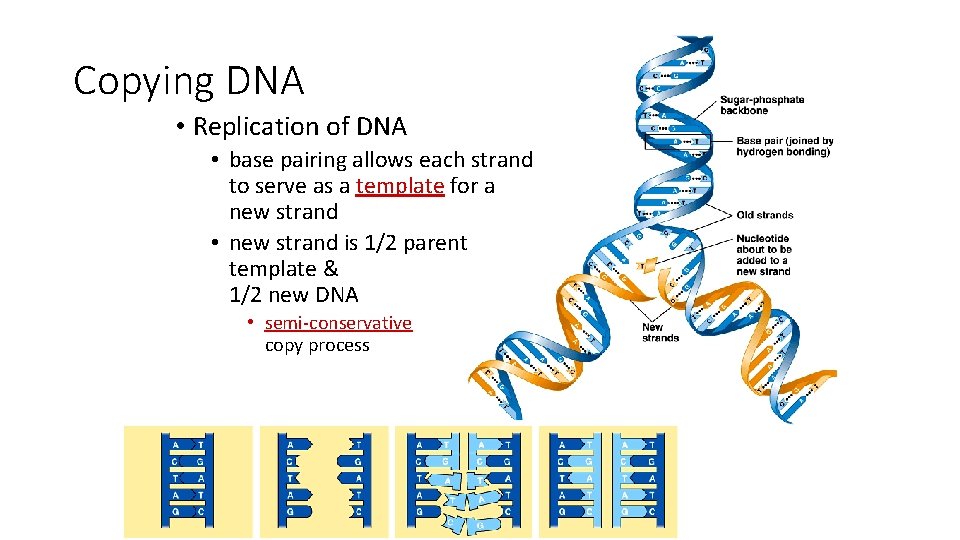
Copying DNA • Replication of DNA • base pairing allows each strand to serve as a template for a new strand • new strand is 1/2 parent template & 1/2 new DNA • semi-conservative copy process
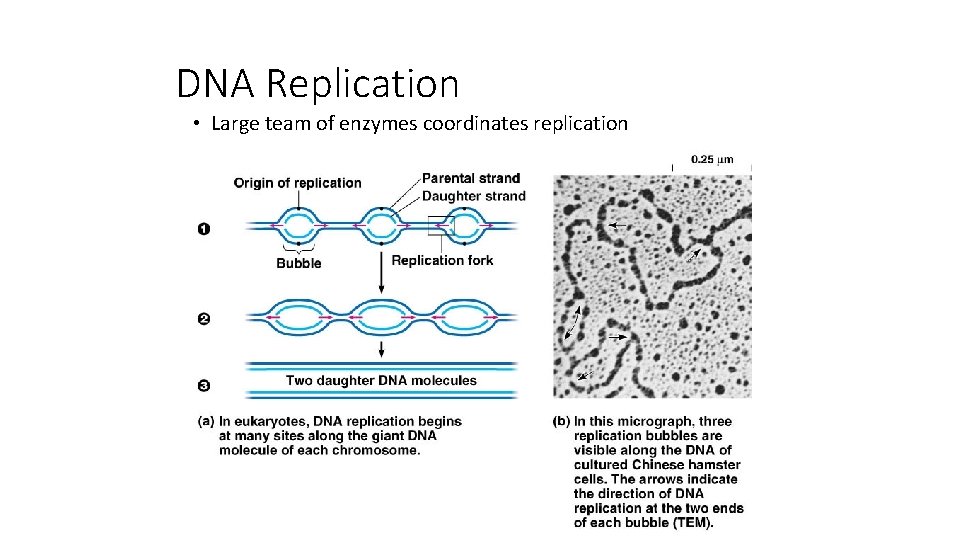
DNA Replication • Large team of enzymes coordinates replication
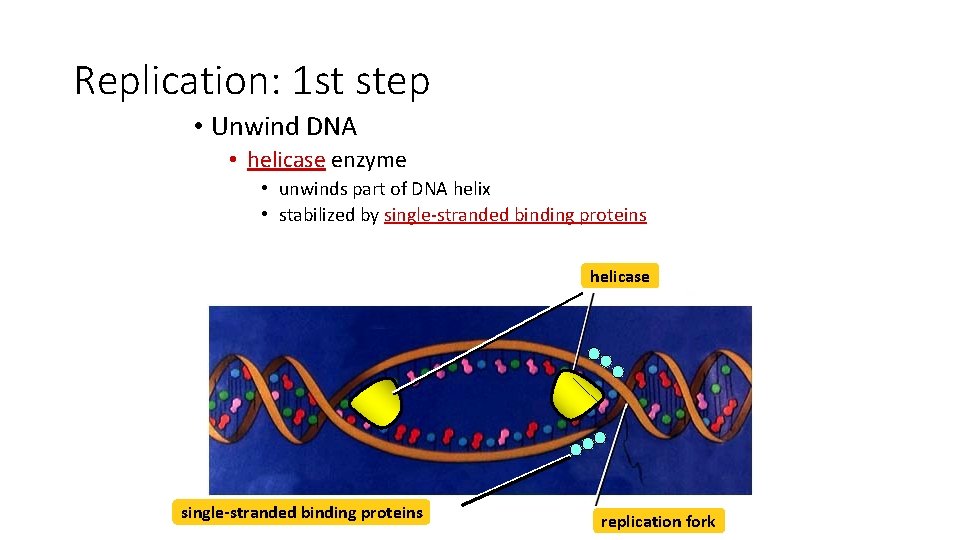
Replication: 1 st step • Unwind DNA • helicase enzyme • unwinds part of DNA helix • stabilized by single-stranded binding proteins helicase single-stranded binding proteins replication fork
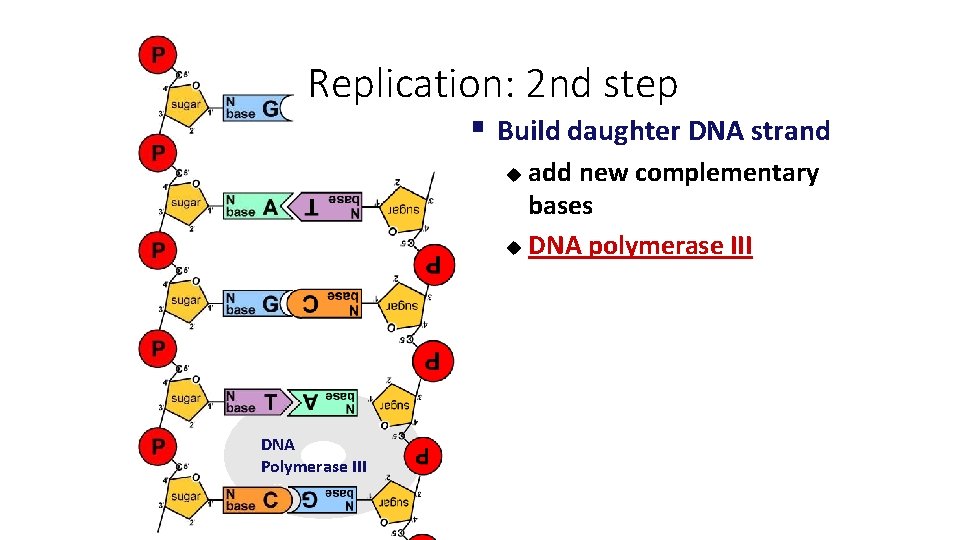
Replication: 2 nd step § Build daughter DNA strand add new complementary bases u DNA polymerase III u DNA Polymerase III
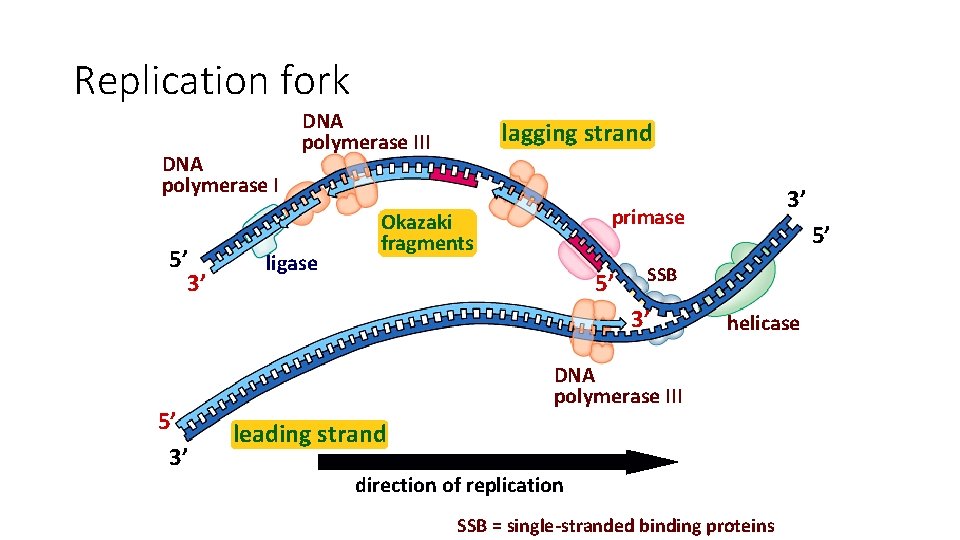
Replication fork DNA polymerase I 5’ 3’ DNA polymerase III ligase lagging strand primase Okazaki fragments 5’ 5’ SSB 3’ 5’ 3’ 3’ helicase DNA polymerase III leading strand direction of replication SSB = single-stranded binding proteins
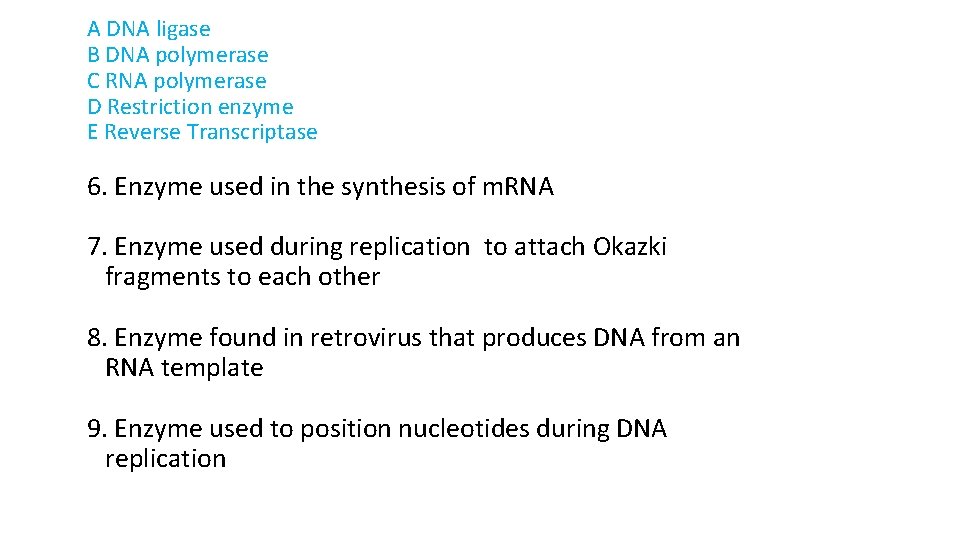
A DNA ligase B DNA polymerase C RNA polymerase D Restriction enzyme E Reverse Transcriptase 6. Enzyme used in the synthesis of m. RNA 7. Enzyme used during replication to attach Okazki fragments to each other 8. Enzyme found in retrovirus that produces DNA from an RNA template 9. Enzyme used to position nucleotides during DNA replication
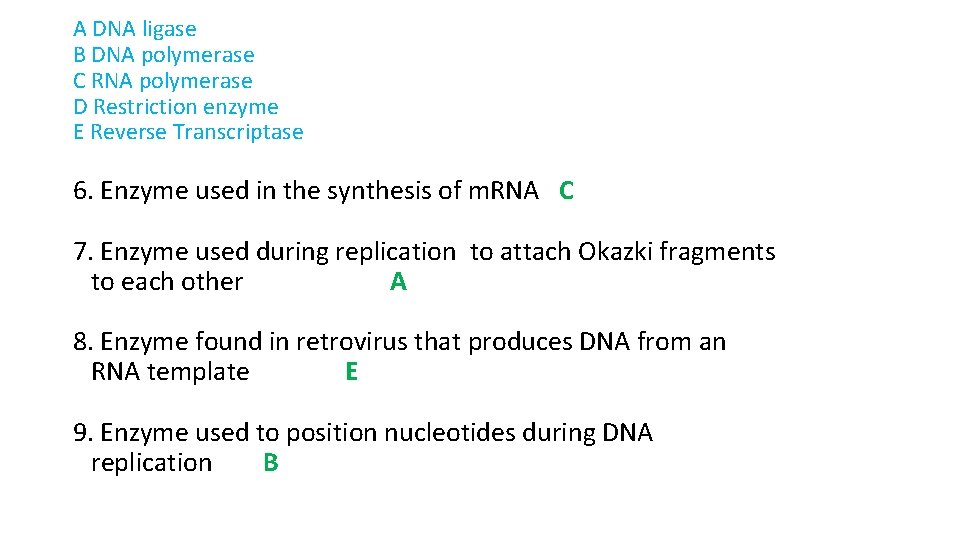
A DNA ligase B DNA polymerase C RNA polymerase D Restriction enzyme E Reverse Transcriptase 6. Enzyme used in the synthesis of m. RNA C 7. Enzyme used during replication to attach Okazki fragments to each other A 8. Enzyme found in retrovirus that produces DNA from an RNA template E 9. Enzyme used to position nucleotides during DNA replication B
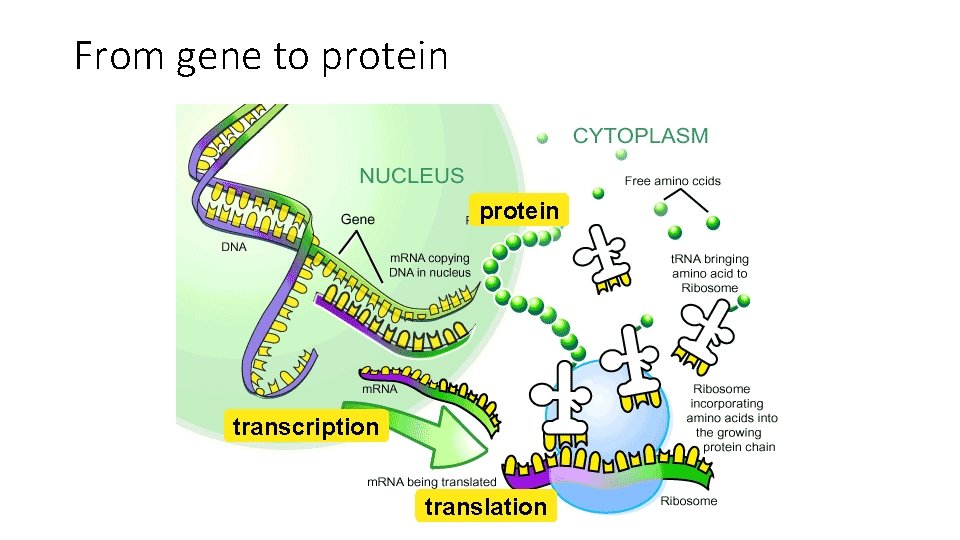
From gene to protein transcription translation
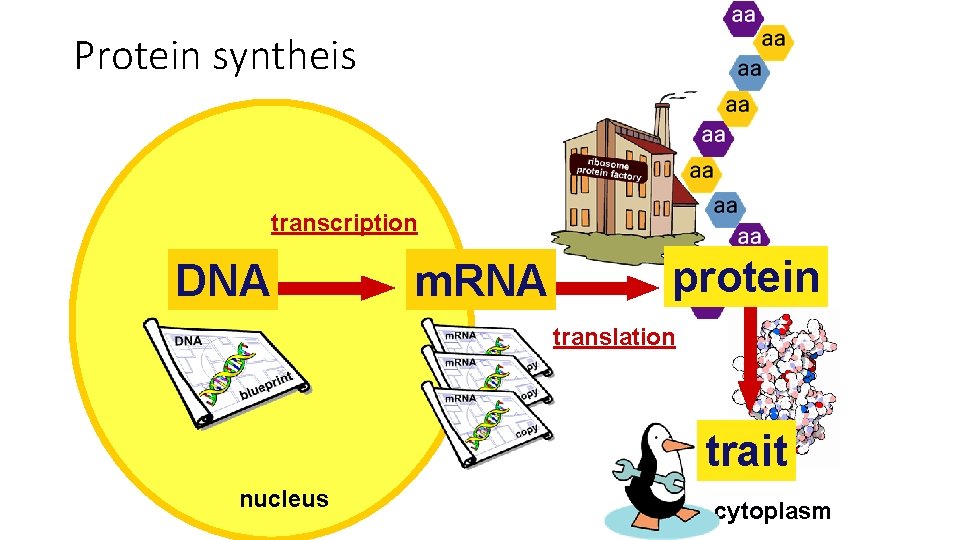
Protein syntheis transcription DNA m. RNA protein translation trait nucleus cytoplasm
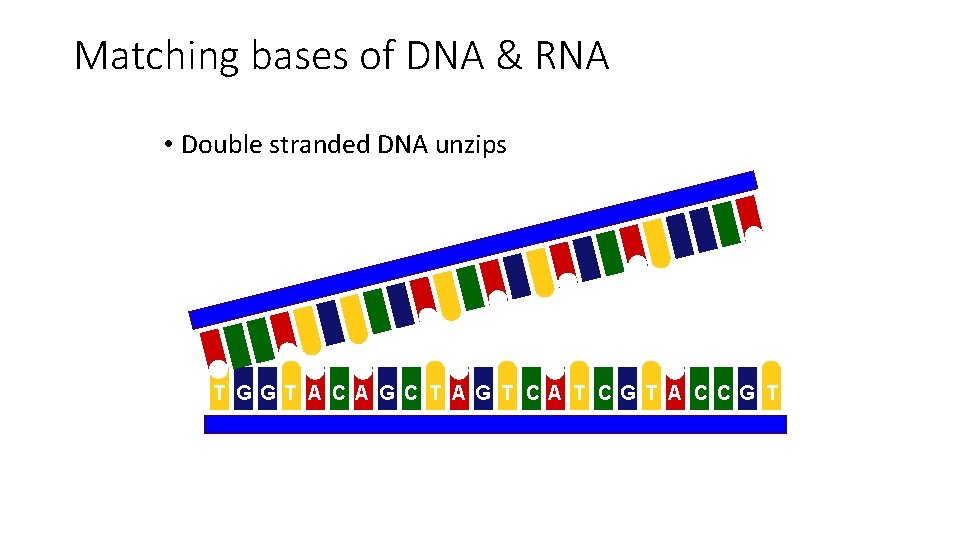
Matching bases of DNA & RNA • Double stranded DNA unzips T G G T A C A G C T A G T C A T CG T A C CG T
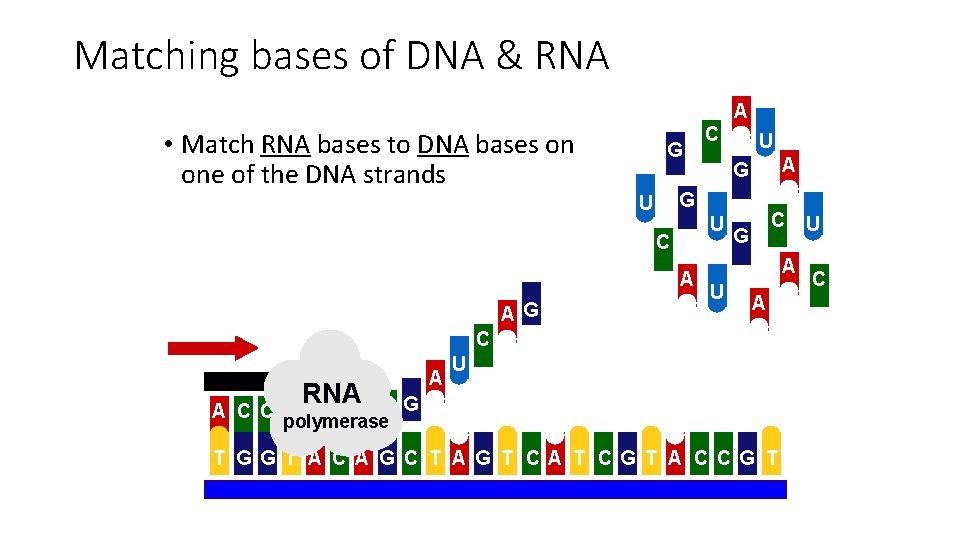
Matching bases of DNA & RNA A • Match RNA bases to DNA bases on one of the DNA strands G U A G G U U C A AG C C G A U A C C RNA polymerase A U G T G G T A C A G C T A G T C A T CG T A C CG T U C
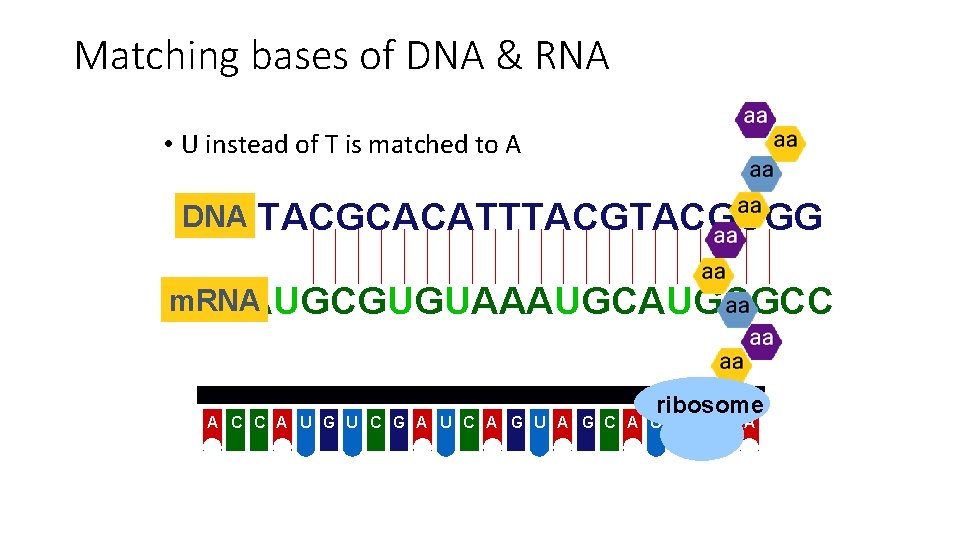
Matching bases of DNA & RNA • U instead of T is matched to A DNA TACGCACATTTACGCGG m. RNA AUGCGUGUAAAUGCGCC ribosome A C C A U G U C G A U C A G U A G C A U G G C A
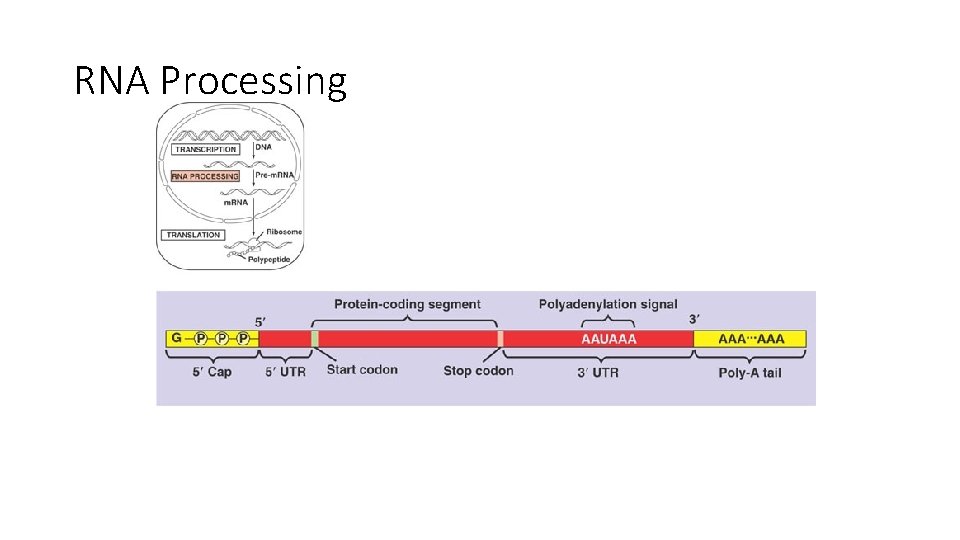
RNA Processing
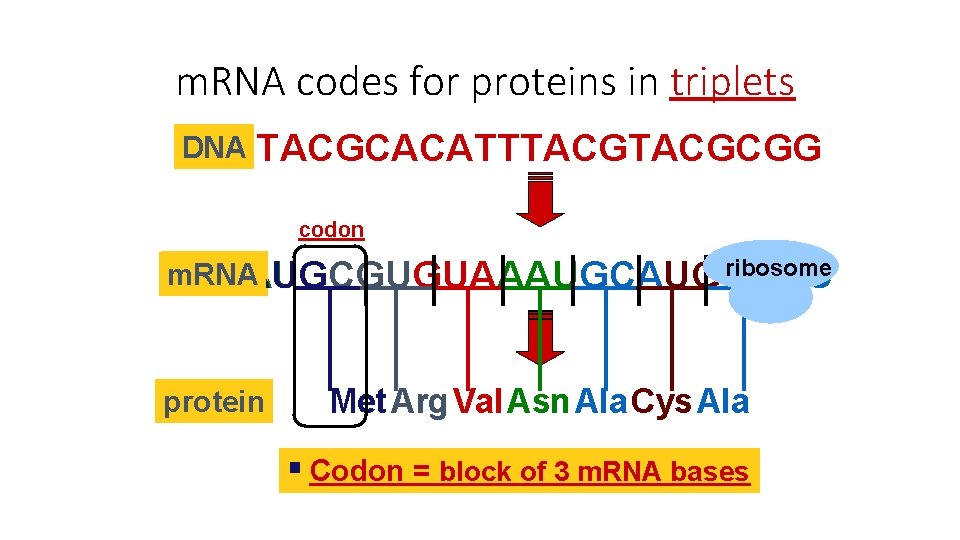
m. RNA codes for proteins in triplets DNA TACGCACATTTACGCGG codon ribosome m. RNA AUGCGUGUAAAUGCGCC ? protein Met Arg Val Asn Ala Cys Ala § Codon = block of 3 m. RNA bases
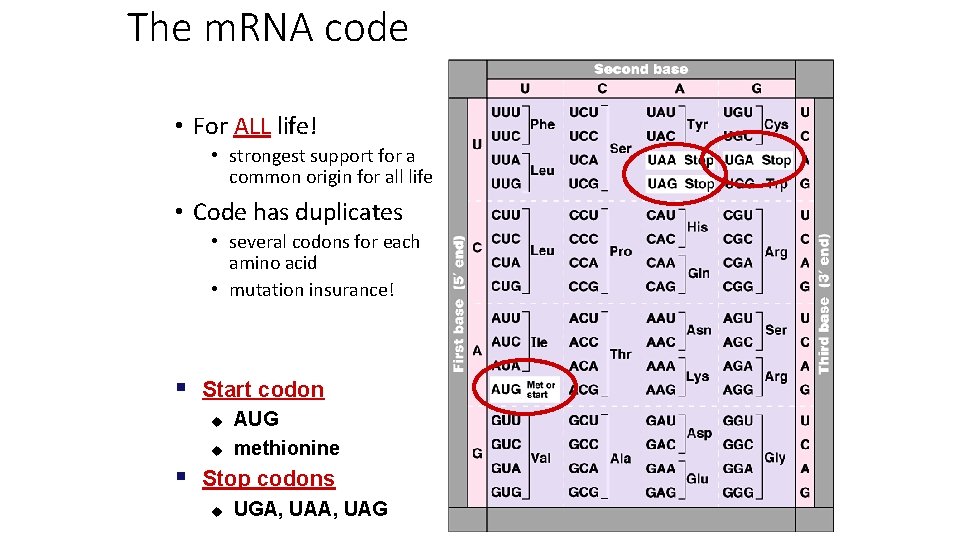
The m. RNA code • For ALL life! • strongest support for a common origin for all life • Code has duplicates • several codons for each amino acid • mutation insurance! § Start codon u u AUG methionine § Stop codons u UGA, UAG
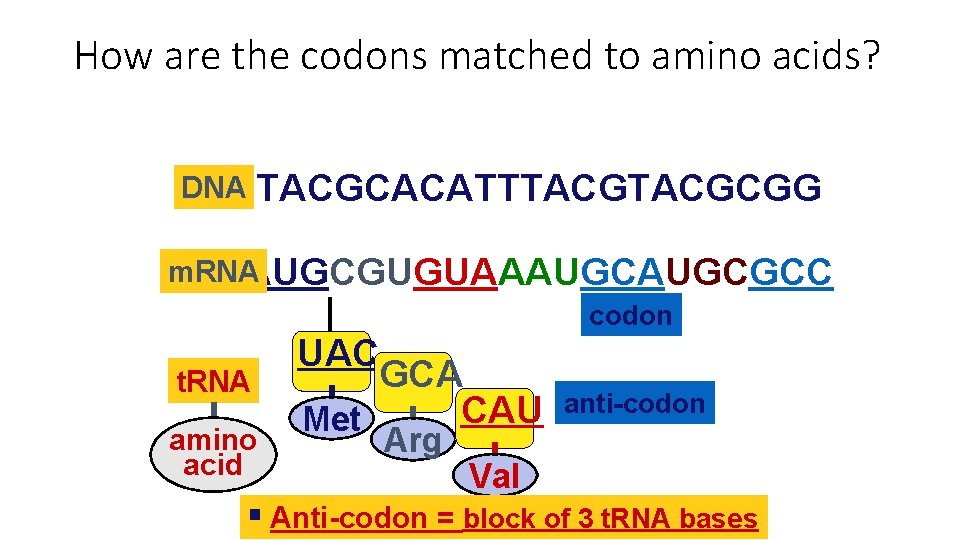
How are the codons matched to amino acids? TACGCACATTTACGCGG DNA m. RNA AUGCGUGUAAAUGCGCC codon t. RNA amino acid UAC GCA CAU Met Arg anti-codon Val § Anti-codon = block of 3 t. RNA bases
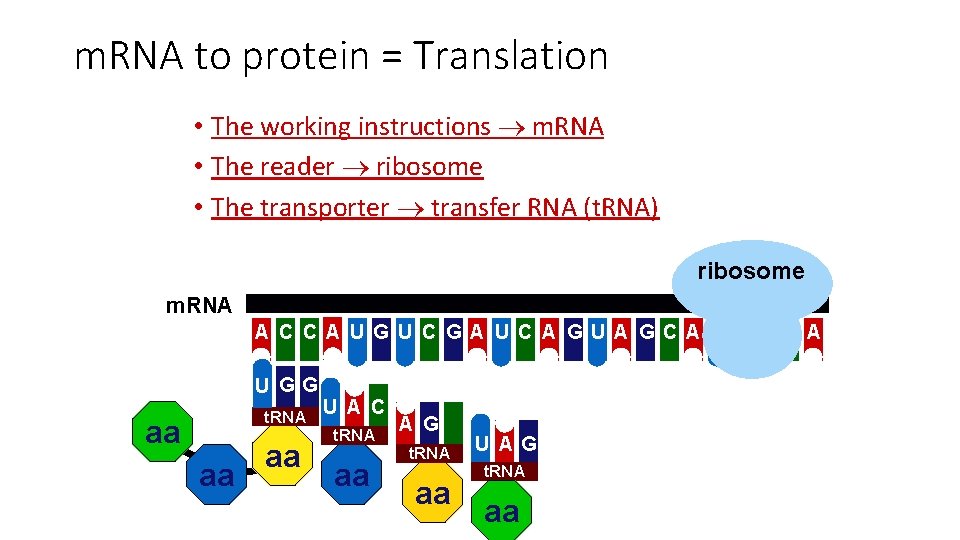
m. RNA to protein = Translation • The working instructions m. RNA • The reader ribosome • The transporter transfer RNA (t. RNA) ribosome m. RNA A C C A U G U C G A U C A GU A GC A U GG t. RNA aa aa aa U A C t. RNA aa A G C t. RNA U A G aa t. RNA aa
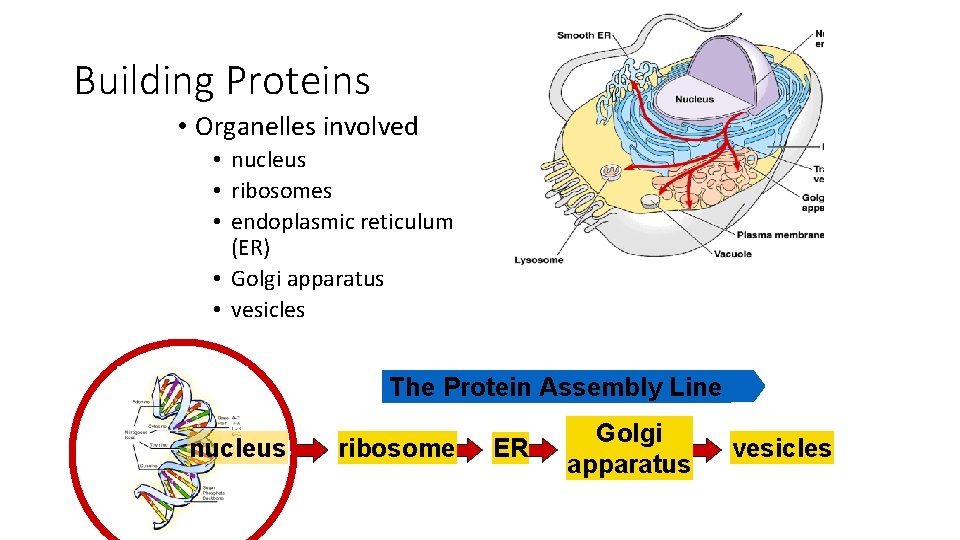
Building Proteins • Organelles involved • nucleus • ribosomes • endoplasmic reticulum (ER) • Golgi apparatus • vesicles The Protein Assembly Line nucleus ribosome ER Golgi apparatus vesicles
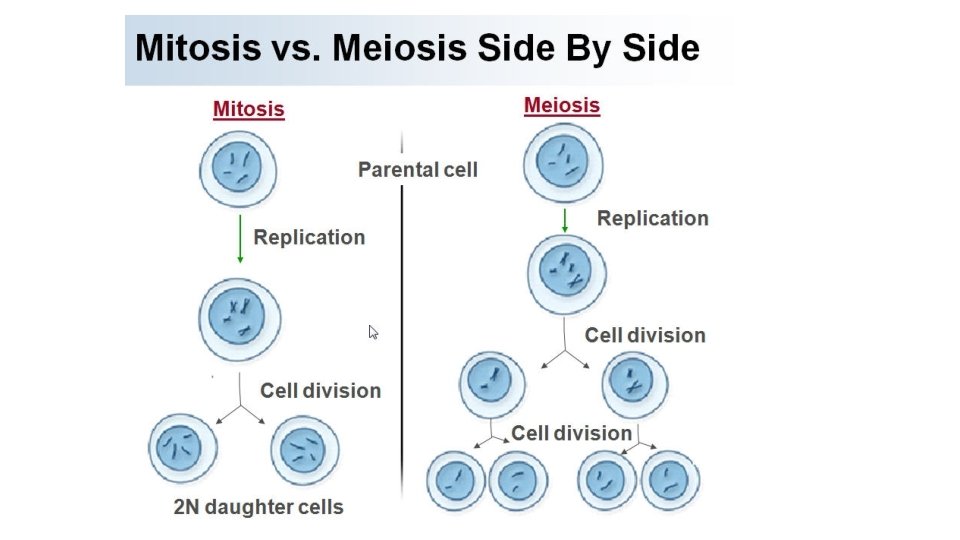
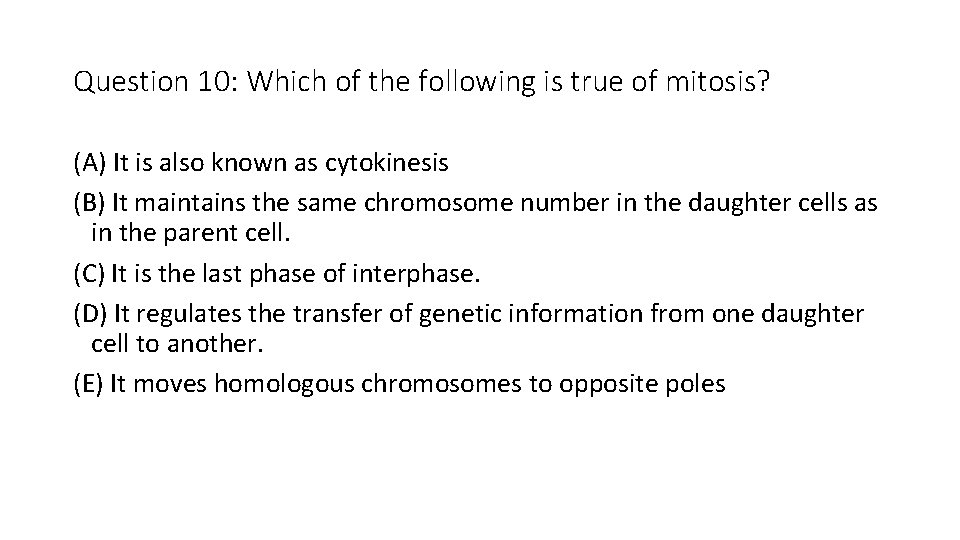
Question 10: Which of the following is true of mitosis? (A) It is also known as cytokinesis (B) It maintains the same chromosome number in the daughter cells as in the parent cell. (C) It is the last phase of interphase. (D) It regulates the transfer of genetic information from one daughter cell to another. (E) It moves homologous chromosomes to opposite poles
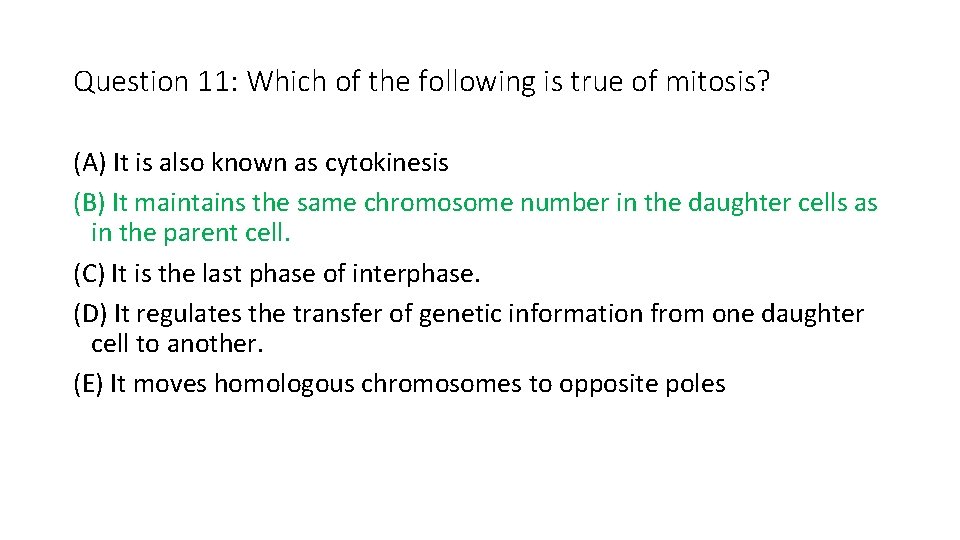
Question 11: Which of the following is true of mitosis? (A) It is also known as cytokinesis (B) It maintains the same chromosome number in the daughter cells as in the parent cell. (C) It is the last phase of interphase. (D) It regulates the transfer of genetic information from one daughter cell to another. (E) It moves homologous chromosomes to opposite poles
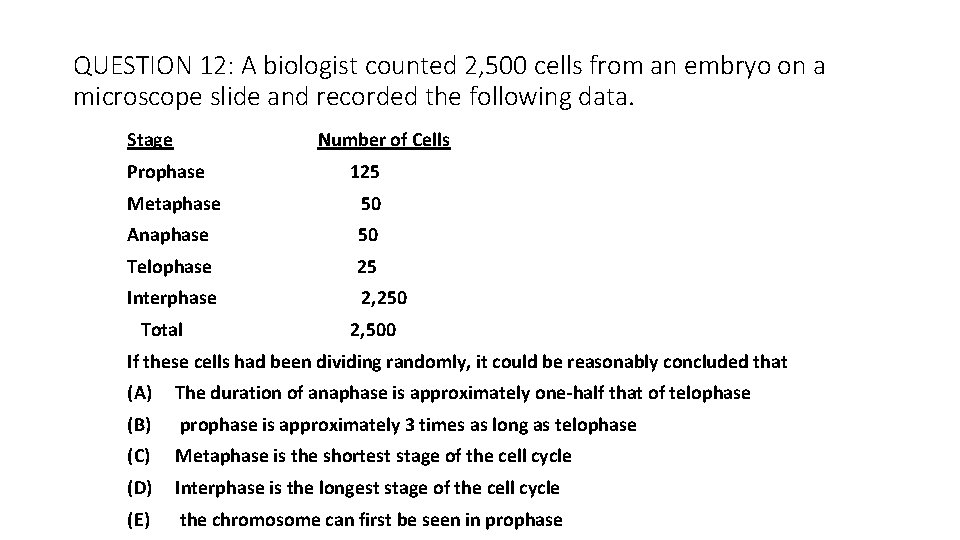
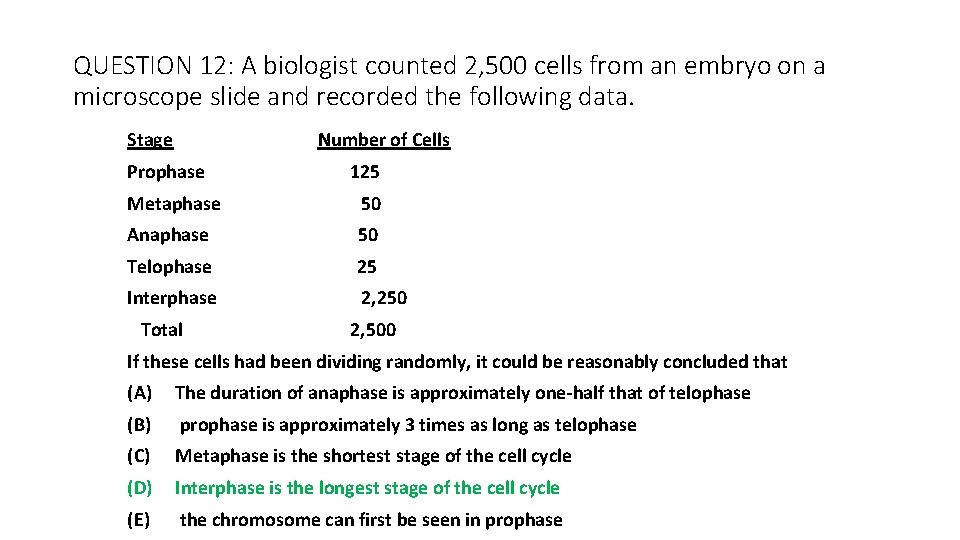
QUESTION 12: A biologist counted 2, 500 cells from an embryo on a microscope slide and recorded the following data. Stage Number of Cells Prophase 125 Metaphase 50 Anaphase 50 Telophase 25 Interphase 2, 250 Total 2, 500 If these cells had been dividing randomly, it could be reasonably concluded that (A) The duration of anaphase is approximately one-half that of telophase (B) prophase is approximately 3 times as long as telophase (C) Metaphase is the shortest stage of the cell cycle (D) Interphase is the longest stage of the cell cycle (E) the chromosome can first be seen in prophase
QUESTION 12: A biologist counted 2, 500 cells from an embryo on a microscope slide and recorded the following data. Stage Number of Cells Prophase 125 Metaphase 50 Anaphase 50 Telophase 25 Interphase 2, 250 Total 2, 500 If these cells had been dividing randomly, it could be reasonably concluded that (A) The duration of anaphase is approximately one-half that of telophase (B) prophase is approximately 3 times as long as telophase (C) Metaphase is the shortest stage of the cell cycle (D) Interphase is the longest stage of the cell cycle (E) the chromosome can first be seen in prophase
- Slides: 50