
CELLS Chapter 3 Cell MembraneSemipermeable Cell Transport Simple
CELLS Chapter 3 Cell Membrane-Semi-permeable, Cell Transport, Simple Diffusion, Concentration Gradients Slide 84 -105 THE BUILDING BLOCKS OF LIFE
What Cells Need to Move Substances l Cells need certain things to function: l l Proteins, carbohydrates, lipids-energy, building blocks, enzymes, etc Ions-messengers for brain, nerves, and muscles O 2, H 20, CO 2 -ingredients for respiration and photosynthesis After cells use these things they create waste products: l O 2, CO 2, H 202 Lactic Acid, etc 2
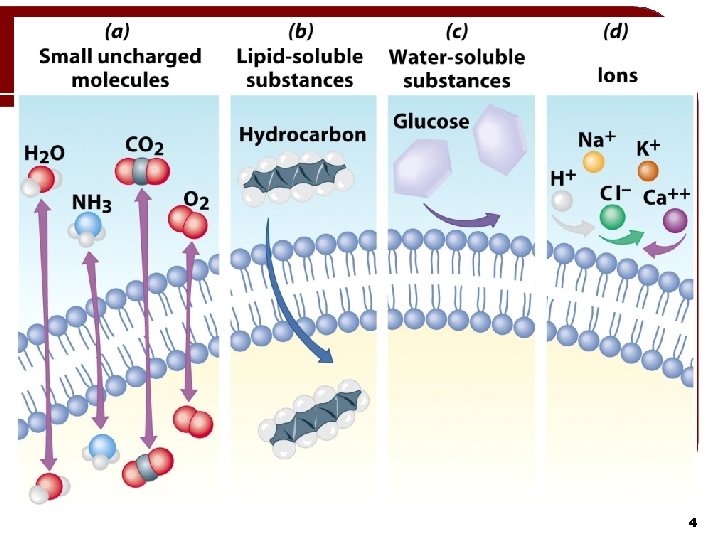
Movement Across the Plasma Membrane l. A l few molecules move freely Water, Carbon dioxide, Ammonia, Oxygen l Carrier proteins transport some molecules Proteins embedded in lipid bilayer l Fluid mosaic model – describes fluid nature of a lipid bilayer with proteins l 3
4
Semipermeable Membrane l A semipermeable membrane, also termed a selectively permeable membrane, a partially permeable membrane or a differentially permeable membrane, is a type of biological membrane that will allow certain molecules or ions to pass through it freely while blocking the passage of others. by diffusion and occasionally specialized "facilitated diffusion". 5
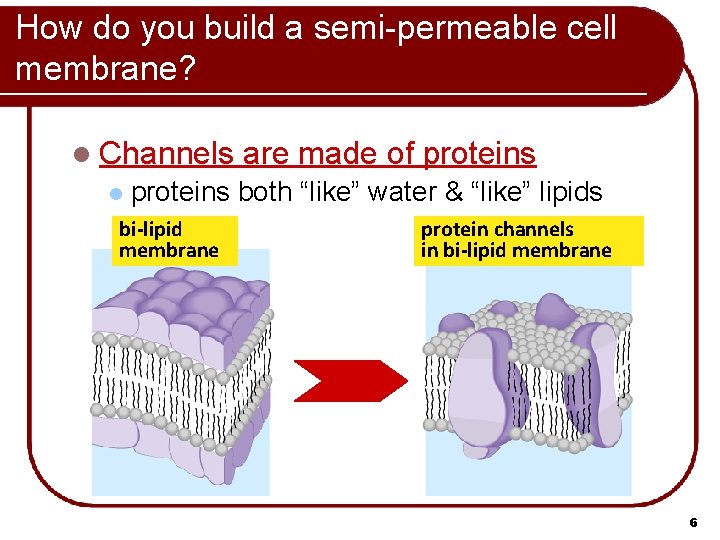
How do you build a semi-permeable cell membrane? l Channels l are made of proteins both “like” water & “like” lipids bi-lipid membrane protein channels in bi-lipid membrane 6
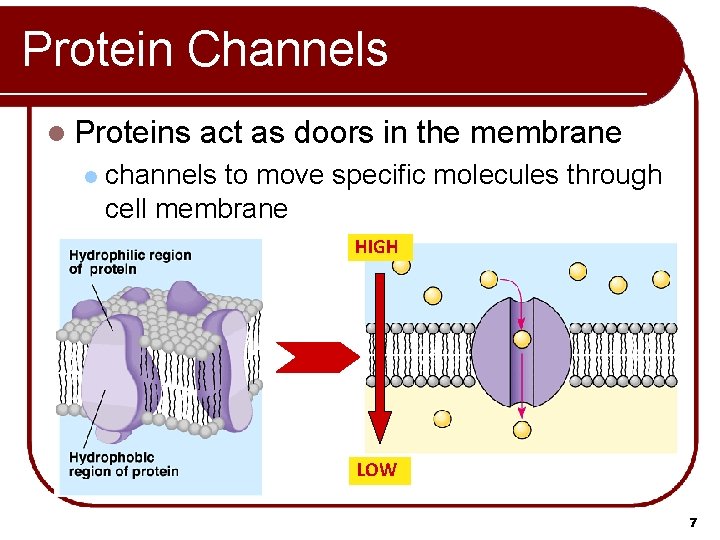
Protein Channels l Proteins l act as doors in the membrane channels to move specific molecules through cell membrane HIGH LOW 7
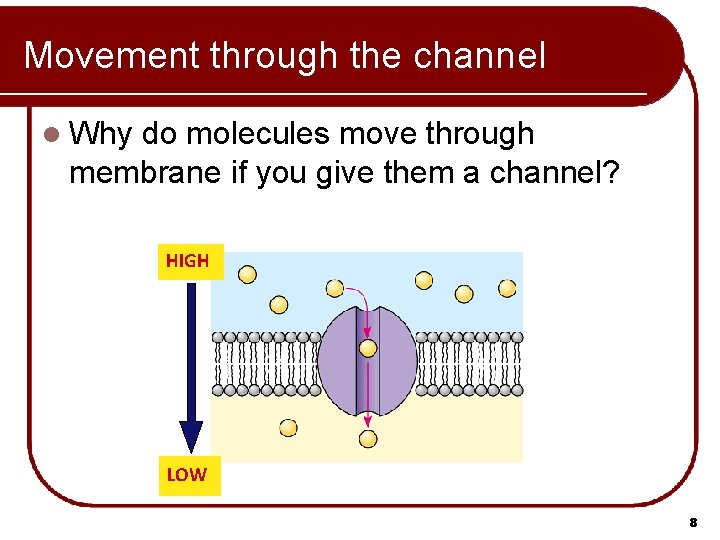
Movement through the channel l Why do molecules move through membrane if you give them a channel? HIGH ? LOW ? 8
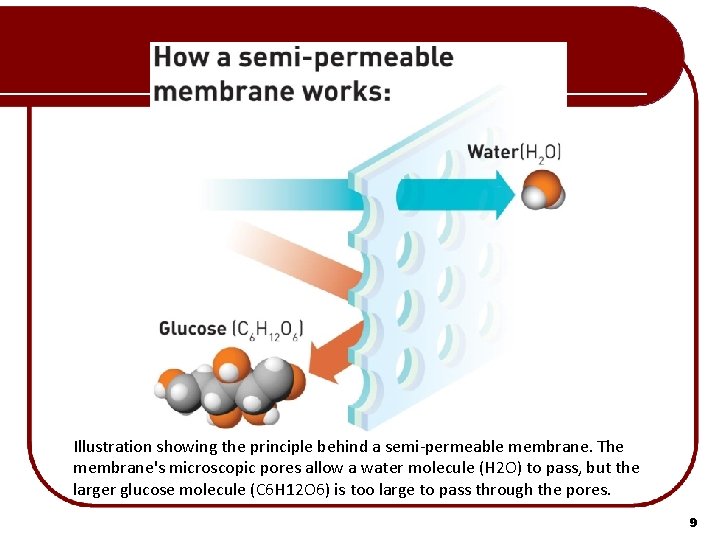
Illustration showing the principle behind a semi-permeable membrane. The membrane's microscopic pores allow a water molecule (H 2 O) to pass, but the larger glucose molecule (C 6 H 12 O 6) is too large to pass through the pores. 9
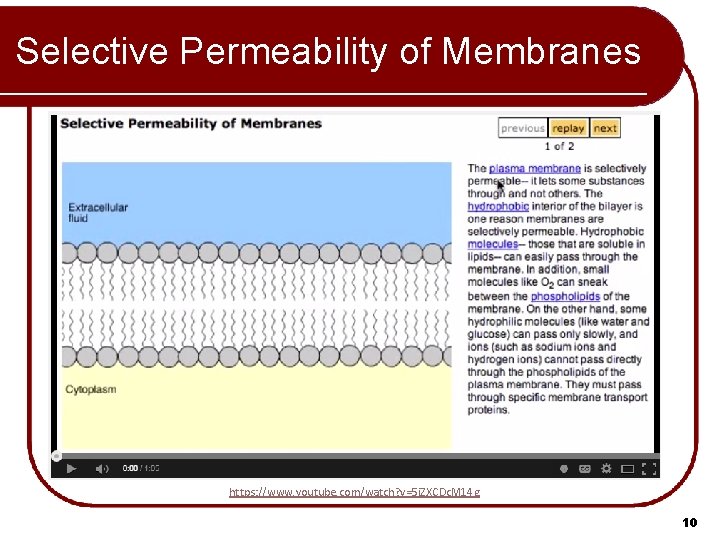
Selective Permeability of Membranes https: //www. youtube. com/watch? v=5 j. ZXCDc. M 14 g 10
Passive Transport For either form of transport to bring about a net movement of materials into or out of a cell, a concentration gradient must exist. l Substances diffuse down their concentration gradient, the region along which the density of a chemical substance increases or decreases l No work must be done to move substances down the concentration gradient l The diffusion of a substance across a biological membrane is passive transport because no energy is expended by the cell to make it happen l 11
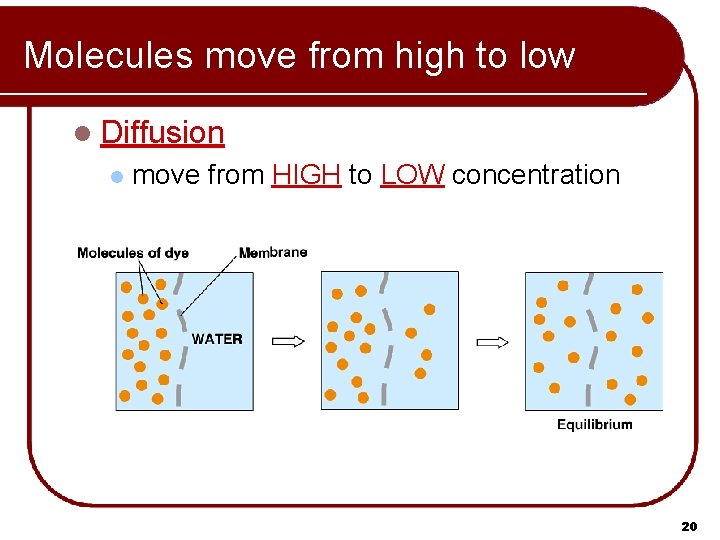
Concentration Gradient l. A concentration gradient defines the difference between the highest and lowest concentrations of a solute within a given medium. l Through diffusion, compounds naturally move from higher to lower concentrations, meaning down their concentration gradients. 12
Concentration Gradient l Substances diffuse down their concentration gradient, the region along which the density of a chemical substance increases or decreases l No work must be done to move substances down the concentration gradient l The diffusion of a substance across a biological membrane is passive transport because no energy is expended by the cell to make it happen 13

Concentration Gradient 14
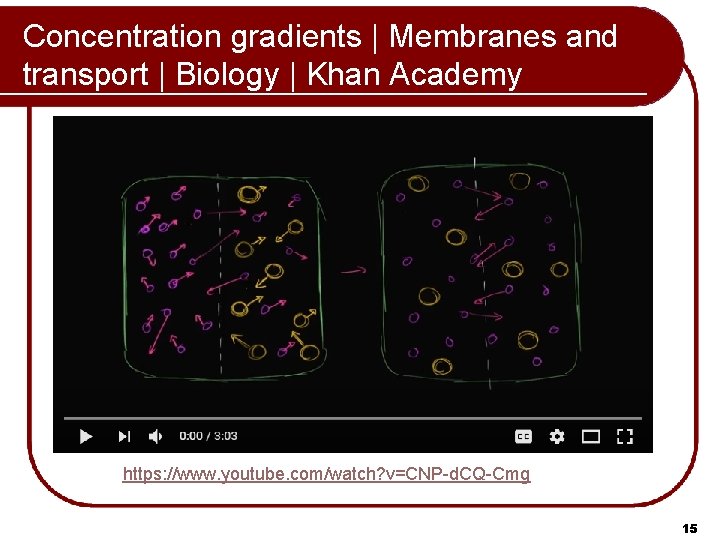
Concentration gradients | Membranes and transport | Biology | Khan Academy https: //www. youtube. com/watch? v=CNP-d. CQ-Cmg 15
Transport through Cytoplasmic Membrane l The cytoplasmic/plasma/cell membrane l In Eukaryotes l l Cytoplasmic membrane is a semipermeable membrane that determines what goes in and out of the cell. Substances may cross the cytoplasmic membrane of eukaryotic cells by: l l l Some compounds are able to cross the plasma membrane strictly through diffusion; others require diffusion and special protein channels; still others require protein channels and the expenditure of cellular energy. Passive transport l Simple diffusion l Facilitated diffusion l Osmosis Active transport Endocytosis Exocytosis 16
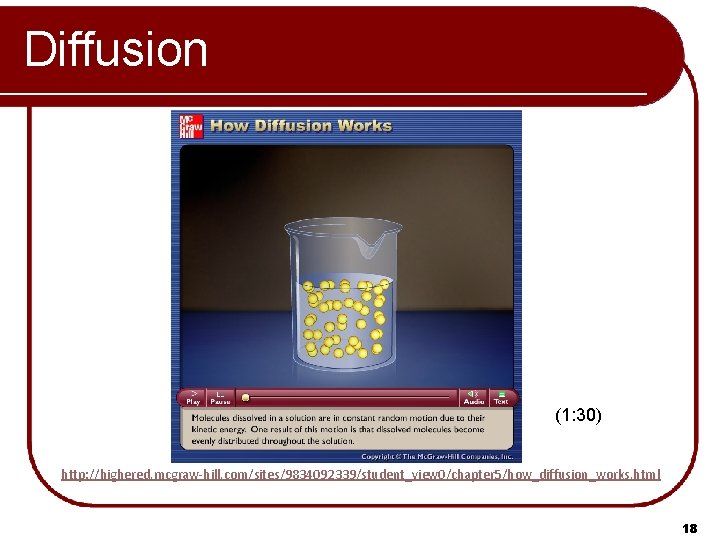
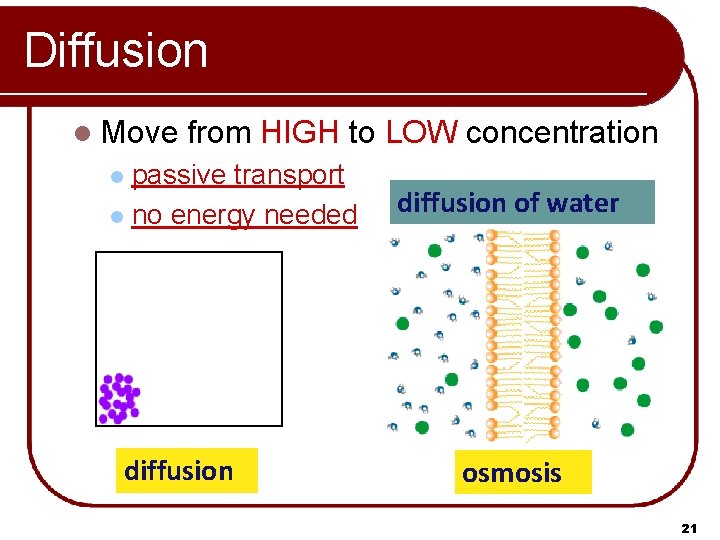
Passive Transport l No energy spent by the cell! Substances move from high to low concentration. l Diffusion l l l Movement of molecules or ions from a region of their higher concentration to a region of their lower concentration. A concentration gradient is all that is required for simple diffusion to operate. Osmosis l Diffusion of certain particles across a semi-permeable membrane. l l Facilitated Diffusion l l Diffusion of certain particles through a carrier protein in the cell membrane. Requires both a concentration gradient and a protein channel. l l O 2, CO 2, H 20 Glucose, amino acids, etc. -too big or are polar molecules Can be in or out of the cell. 17
Diffusion (1: 30) http: //highered. mcgraw-hill. com/sites/9834092339/student_view 0/chapter 5/how_diffusion_works. html 18
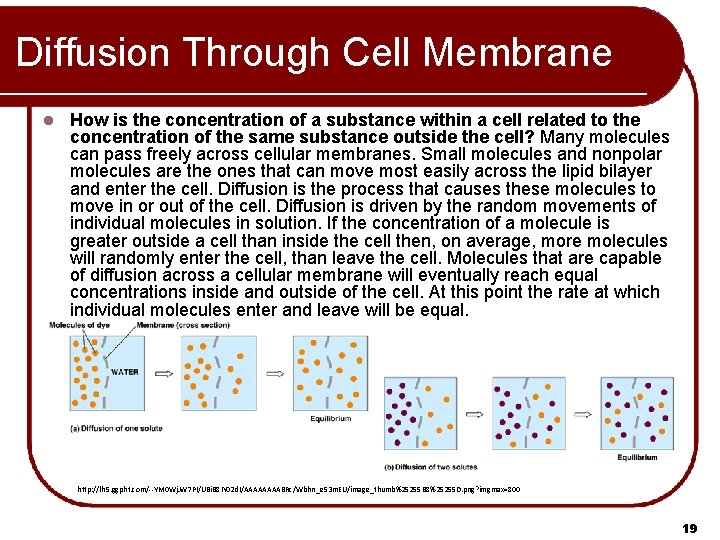
Diffusion Through Cell Membrane l How is the concentration of a substance within a cell related to the concentration of the same substance outside the cell? Many molecules can pass freely across cellular membranes. Small molecules and nonpolar molecules are the ones that can move most easily across the lipid bilayer and enter the cell. Diffusion is the process that causes these molecules to move in or out of the cell. Diffusion is driven by the random movements of individual molecules in solution. If the concentration of a molecule is greater outside a cell than inside the cell then, on average, more molecules will randomly enter the cell, than leave the cell. Molecules that are capable of diffusion across a cellular membrane will eventually reach equal concentrations inside and outside of the cell. At this point the rate at which individual molecules enter and leave will be equal. http: //lh 5. ggpht. com/--YM 0 Wj. JW 7 PI/UBi. B 8 IY 02 d. I/AAAABRc/Wbhn_e 53 m. EU/image_thumb%25255 B 8%25255 D. png? imgmax=800 19
Molecules move from high to low l Diffusion l move from HIGH to LOW concentration 20
Diffusion l Move from HIGH to LOW concentration passive transport l no energy needed l diffusion of water osmosis 21
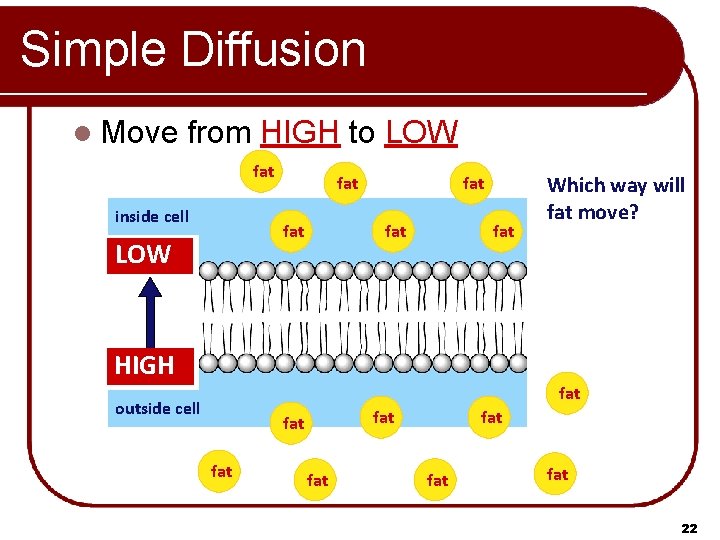
Simple Diffusion l Move from HIGH to LOW fat inside cell fat LOW fat fat Which way will fat move? HIGH fat outside cell fat fat 22
Simple Diffusion https: //www. youtube. com/watch? v=6 y. MPp. De. Nwq. Q 23
- Slides: 23