
CELLS ALL ORGANISMS ARE MADE UP OF ONE






- Slides: 63
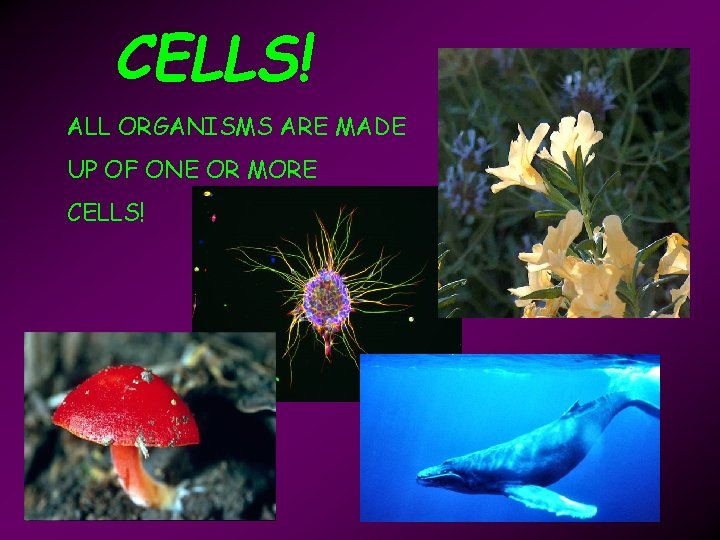
CELLS! ALL ORGANISMS ARE MADE UP OF ONE OR MORE CELLS!
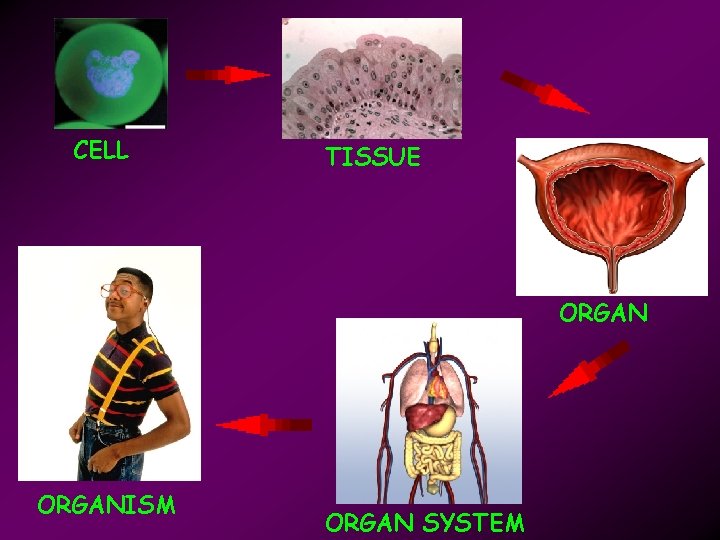
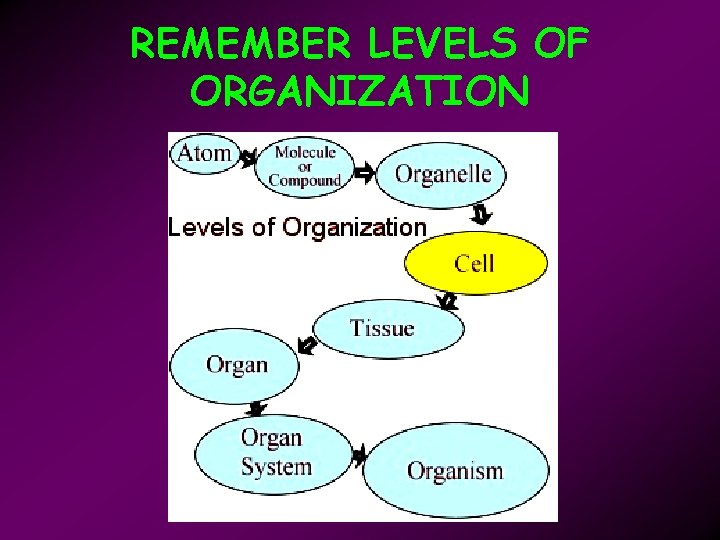
CELL TISSUE ORGANISM ORGAN SYSTEM
What does the INSIDE of a cell look like?
Cells • There are two types of cells. • In today’s lecture, we will distinguish and identify the two different cell types.
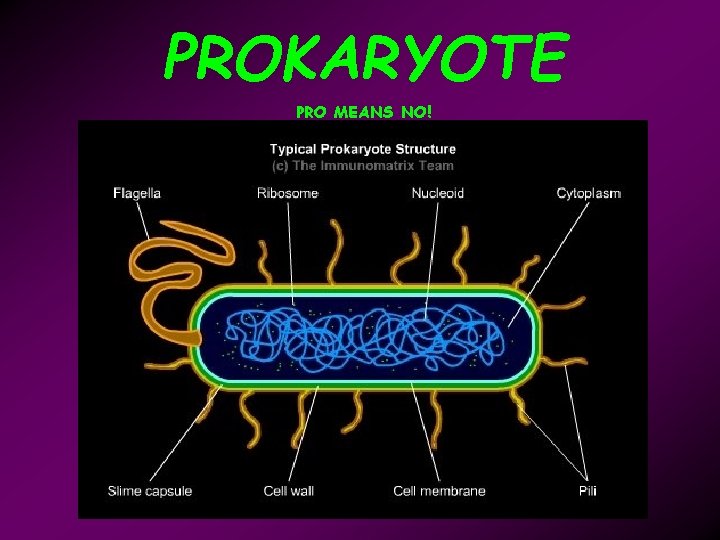
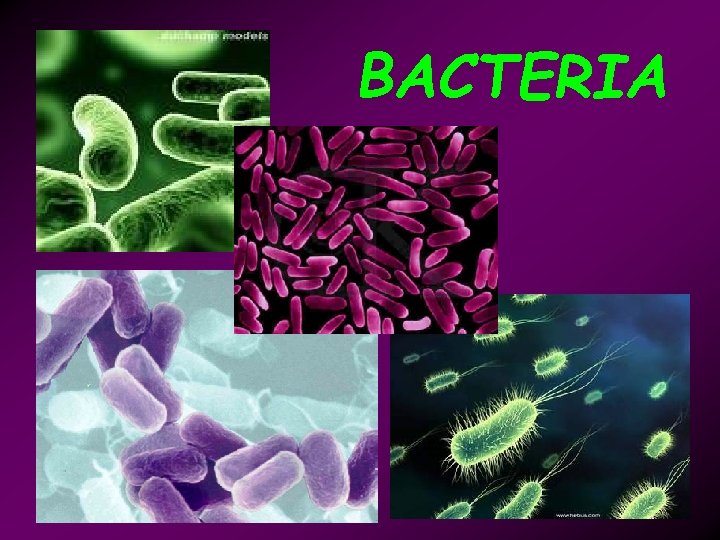
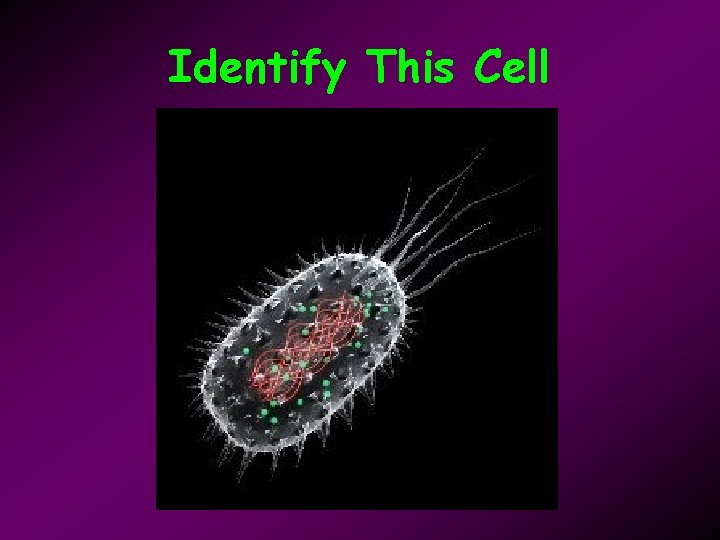
Notes… 1. Prokaryotic cells: • lack membrane bound structures inside the cells…. • These cells are only found in one-celled organisms, like bacteria.
What’s a Membrane? • In class demo…
PROKARYOTE PRO MEANS NO!
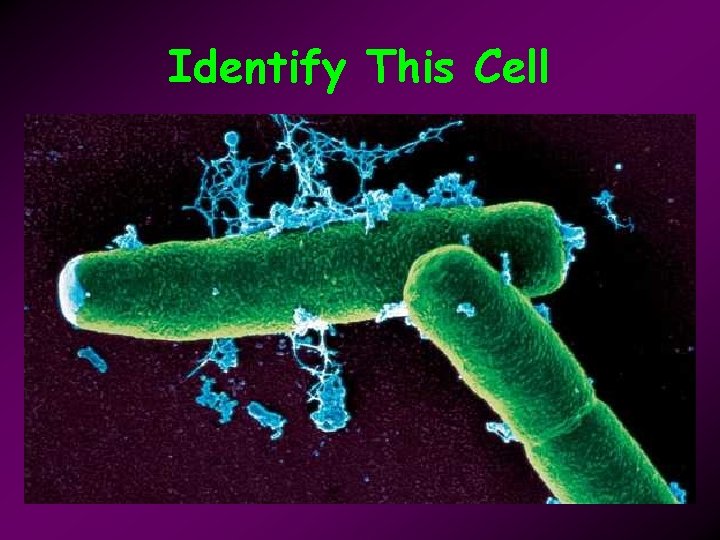
BACTERIA
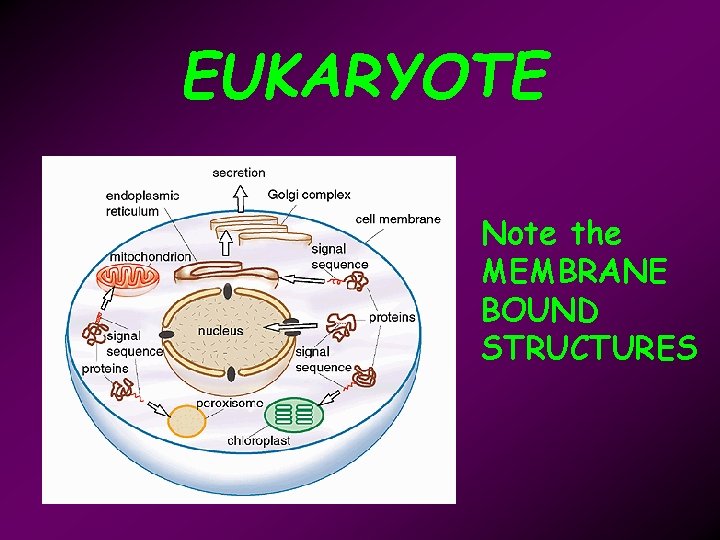
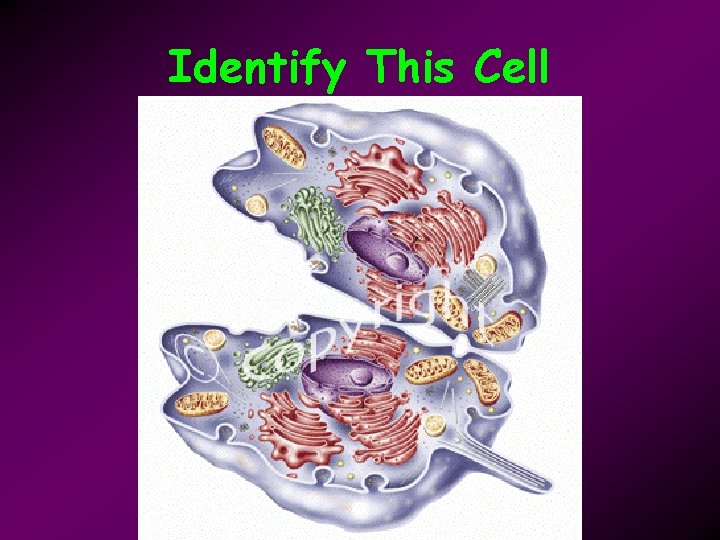
Notes… 2. Eukaryotic cells – • contain membrane bound structures… • Protists, fungi, plants, and animals are made of eukaryotic cells.
EUKARYOTE Note the MEMBRANE BOUND STRUCTURES
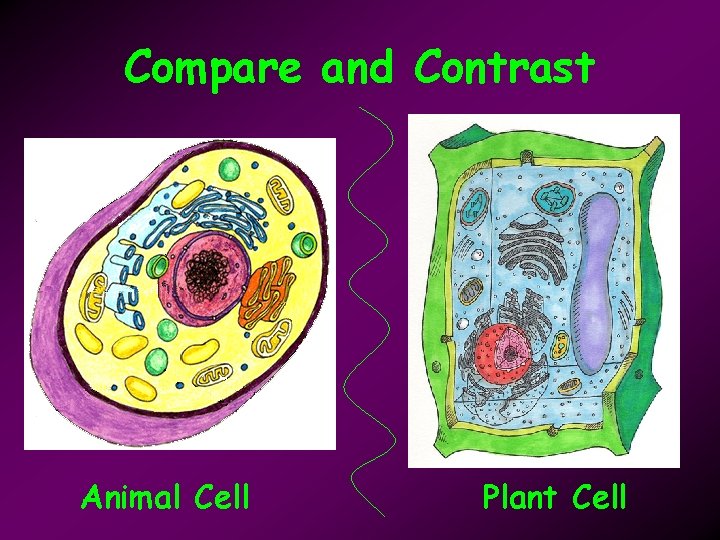
Compare and Contrast Animal Cell Plant Cell
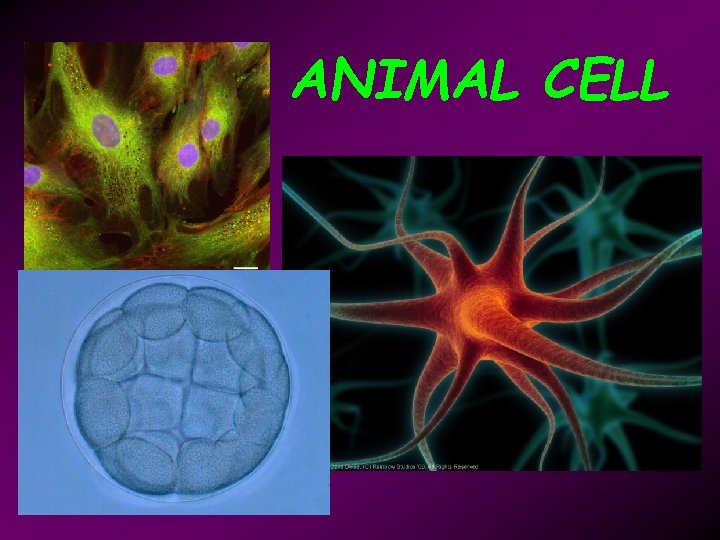
ANIMAL CELL
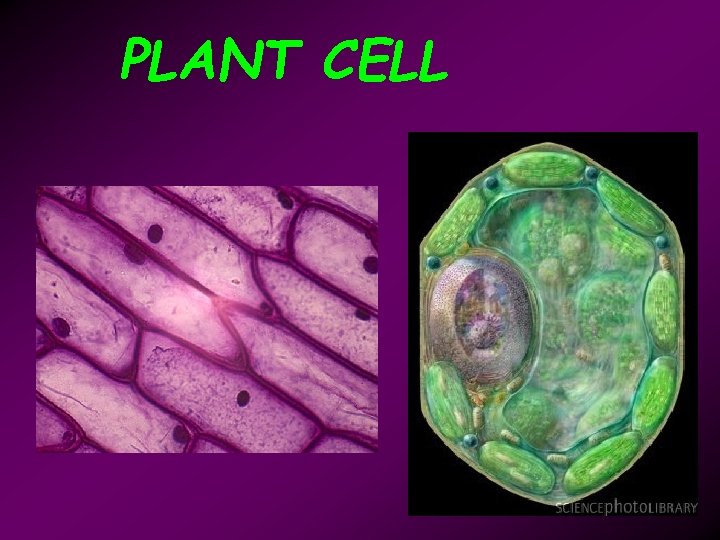
PLANT CELL
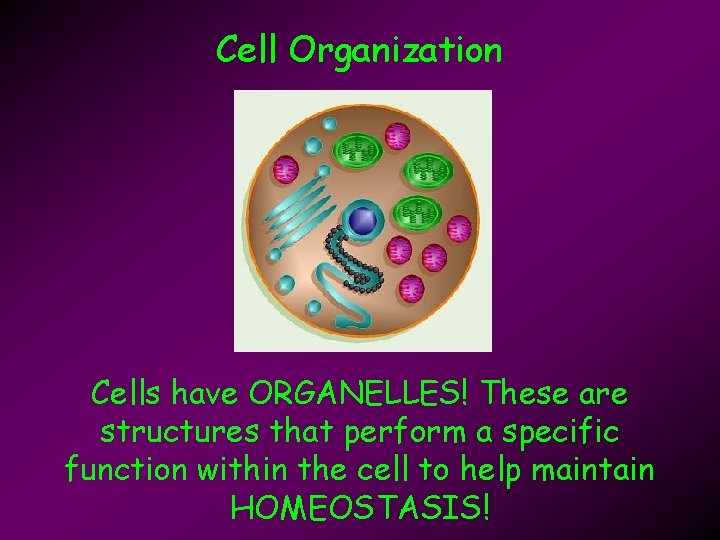
Cell Organization Cells have ORGANELLES! These are structures that perform a specific function within the cell to help maintain HOMEOSTASIS!
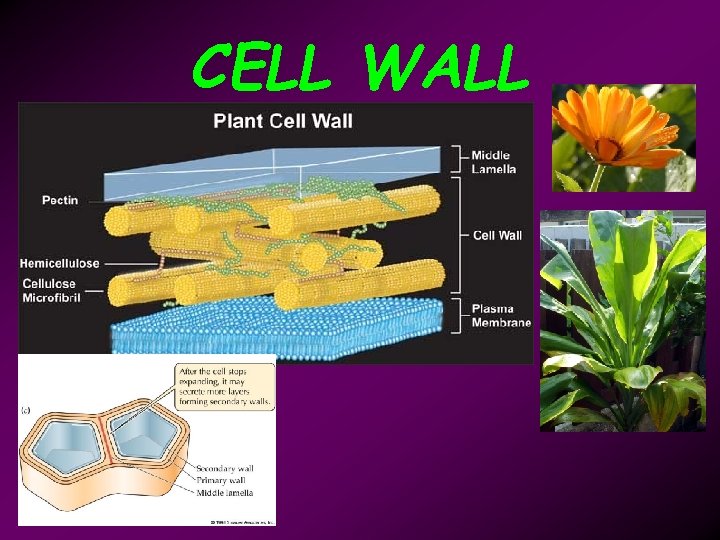
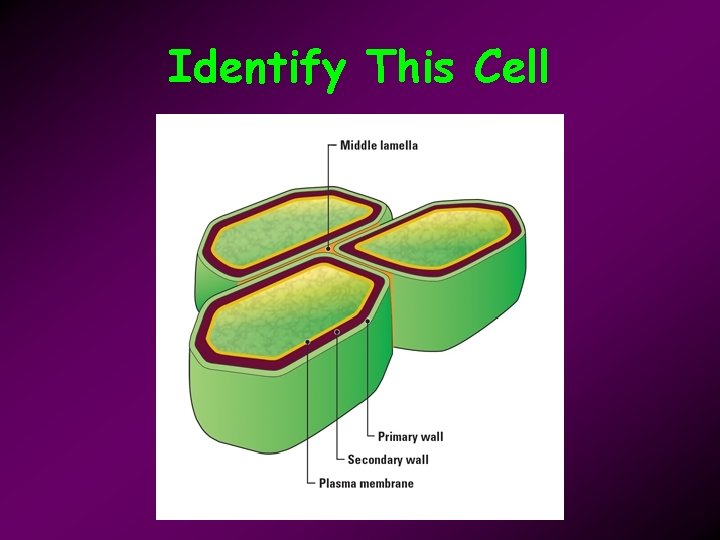
Cell Organization Notes… 1. Cell Wall – • Composed of cellulose (carbohydrate). • Tough, rigid outer coverings that protects the cell and give it shape! Found in plants, algae, fungi, and some bacteria. •
CELL WALL
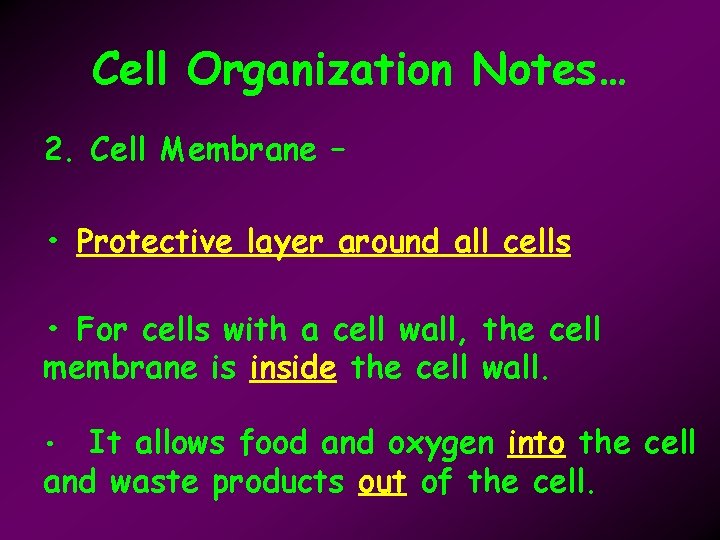
Cell Organization Notes… 2. Cell Membrane – • Protective layer around all cells • For cells with a cell wall, the cell membrane is inside the cell wall. It allows food and oxygen into the cell and waste products out of the cell. •
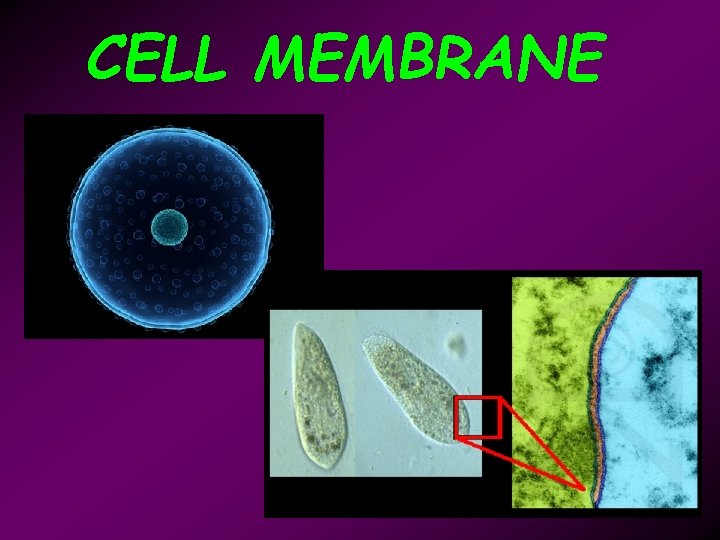
CELL MEMBRANE
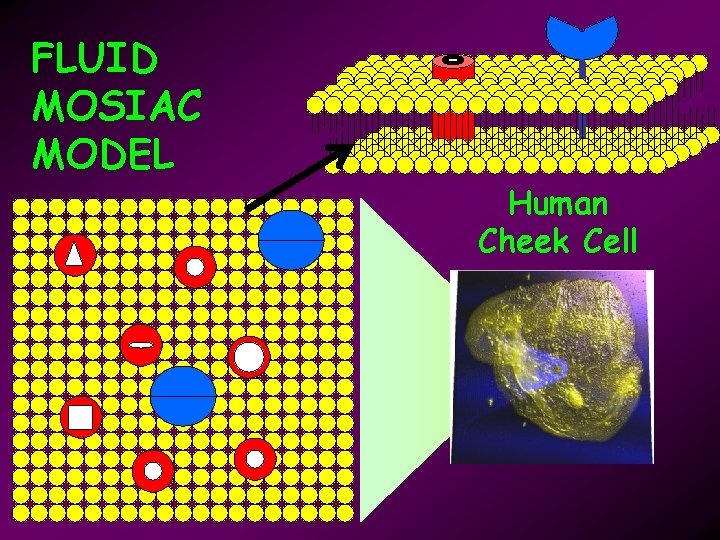
FLUID MOSIAC MODEL Human Cheek Cell
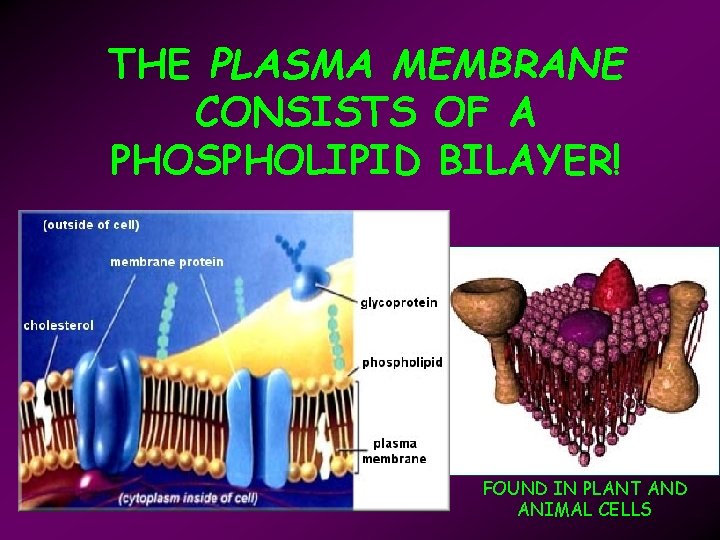
THE PLASMA MEMBRANE CONSISTS OF A PHOSPHOLIPID BILAYER! FOUND IN PLANT AND ANIMAL CELLS
PLASMA (Cell) MEMBRANE The pink structure indicates a protein in the phospholipid bilayer
Plasma Membrane Video
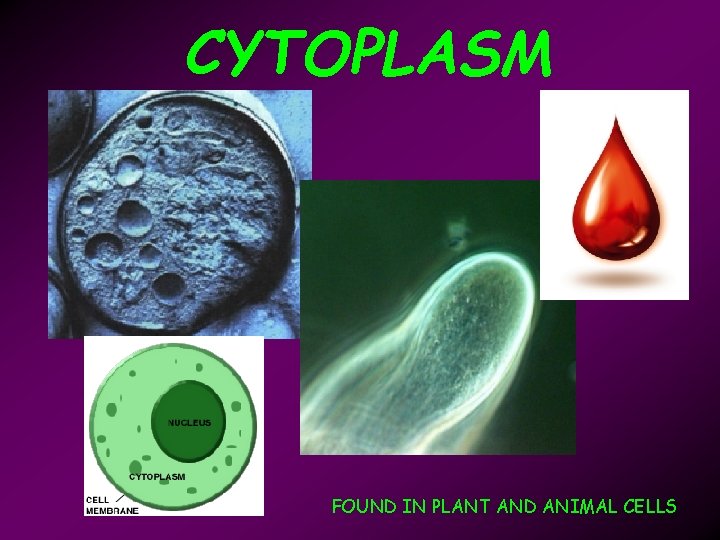
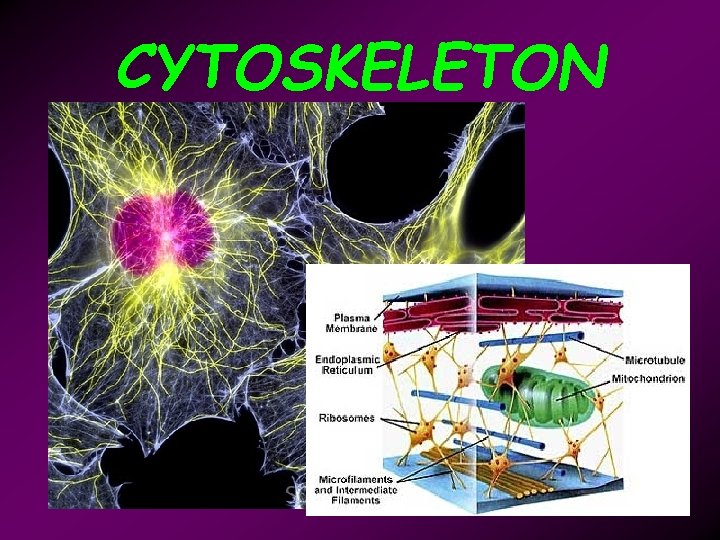
Cell Organization Notes… 3. Cytoplasm – • Gelatinlike substance inside the cell membrane • Chemical reactions occur within the cytoplasm • Cytoskeleton, a network of fibers in the cytoplasm, give cells structure and helps maintain shape. • Contains organelles
CYTOPLASM FOUND IN PLANT AND ANIMAL CELLS
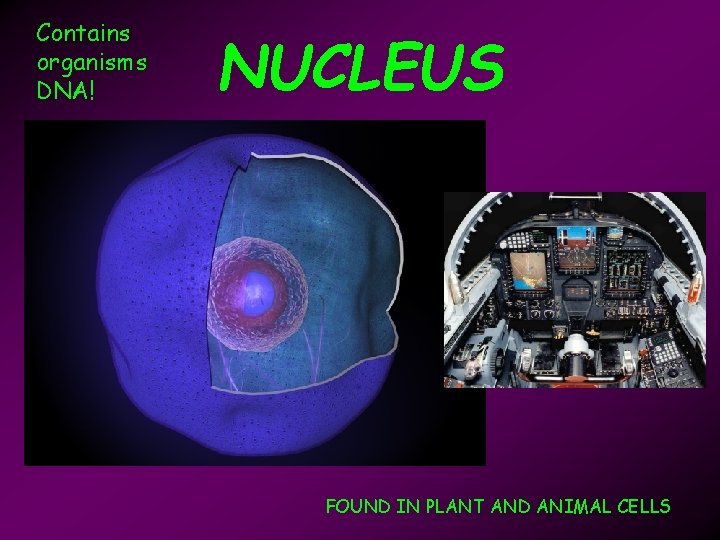
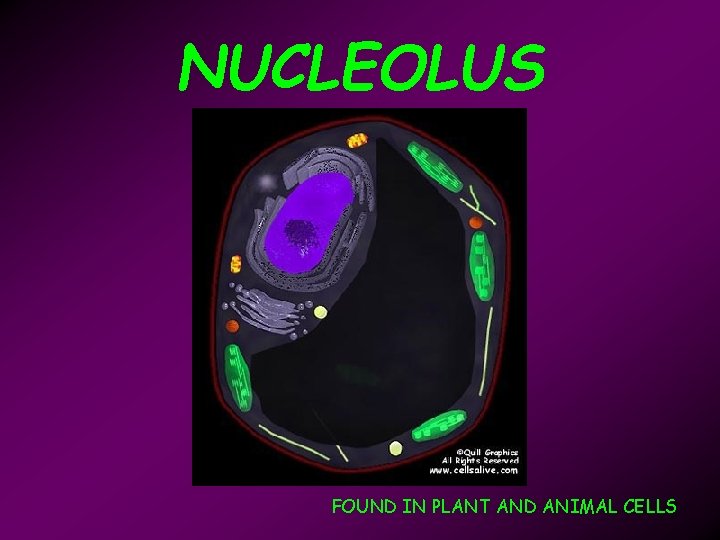
Cell Organization Notes… 4. Nucleus – • Contains instructions for everything a cell does. • Instructions are found in DNA • Separated from the cytoplasm by a membrane • Contains a nucleolus
Contains organisms DNA! NUCLEUS FOUND IN PLANT AND ANIMAL CELLS
NUCLEOLUS FOUND IN PLANT AND ANIMAL CELLS
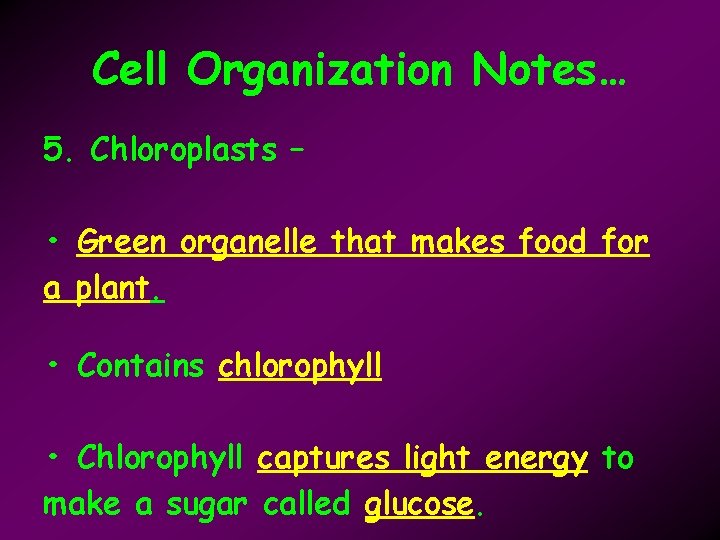
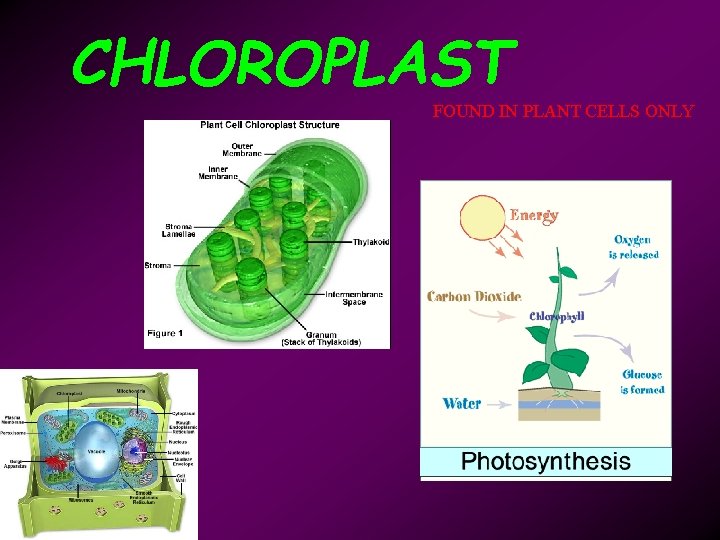
Cell Organization Notes… 5. Chloroplasts – • Green organelle that makes food for a plant. • Contains chlorophyll • Chlorophyll captures light energy to make a sugar called glucose.
CHLOROPLAST FOUND IN PLANT CELLS ONLY
CHLOROPLAST CO 2 + H 20 Glucose +O 2 Inorganic Organic +O 2
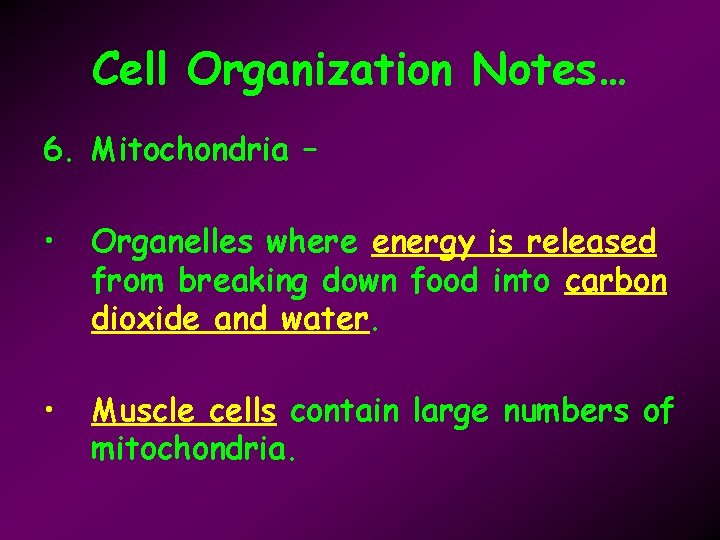
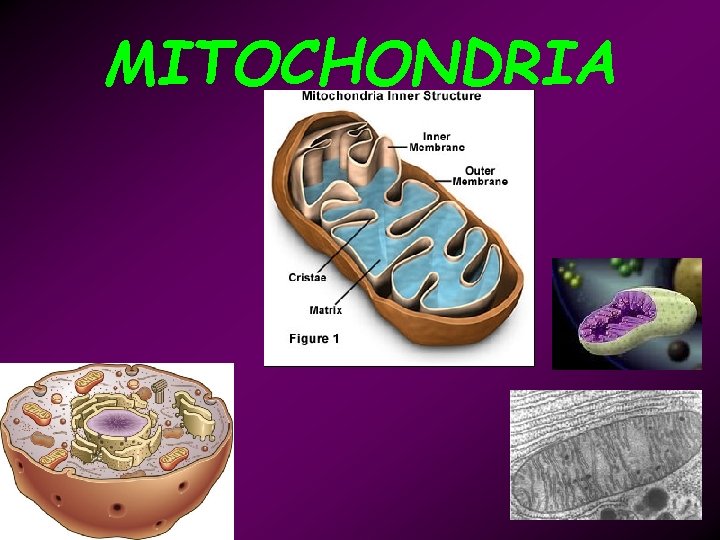
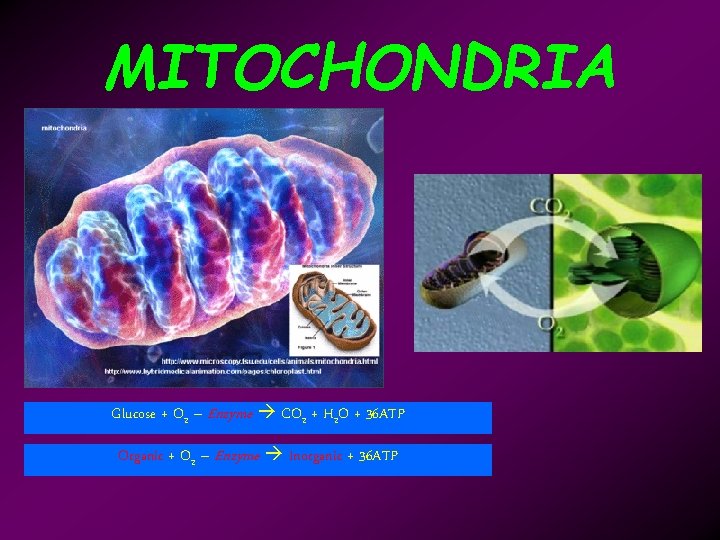
Cell Organization Notes… 6. Mitochondria – • Organelles where energy is released from breaking down food into carbon dioxide and water. • Muscle cells contain large numbers of mitochondria.
MITOCHONDRIA
MITOCHONDRIA Glucose + O 2 – Enzyme CO 2 + H 2 O + 36 ATP Organic + O 2 – Enzyme Inorganic + 36 ATP
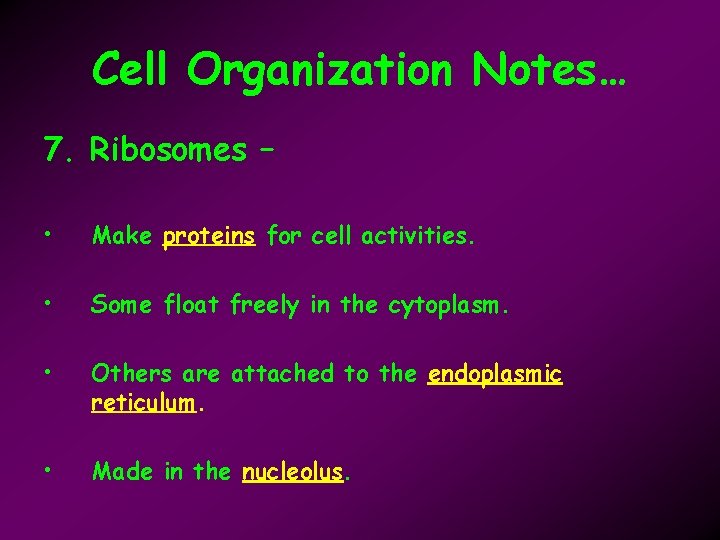
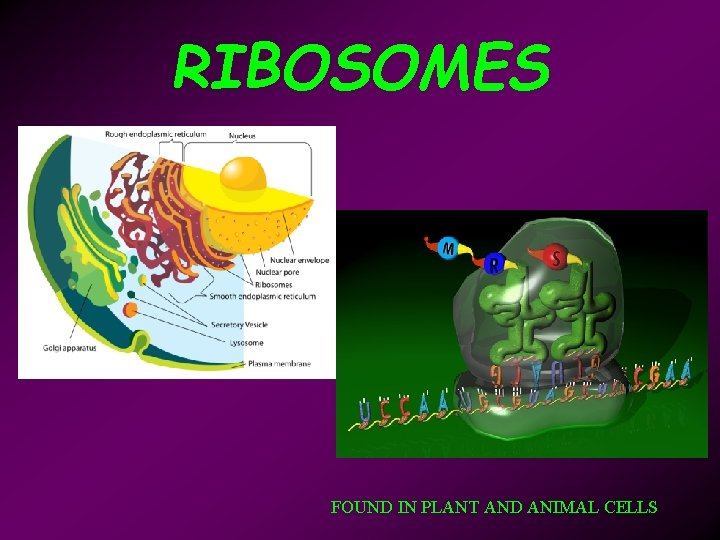
Cell Organization Notes… 7. Ribosomes – • Make proteins for cell activities. • Some float freely in the cytoplasm. • Others are attached to the endoplasmic reticulum. • Made in the nucleolus.
RIBOSOMES FOUND IN PLANT AND ANIMAL CELLS
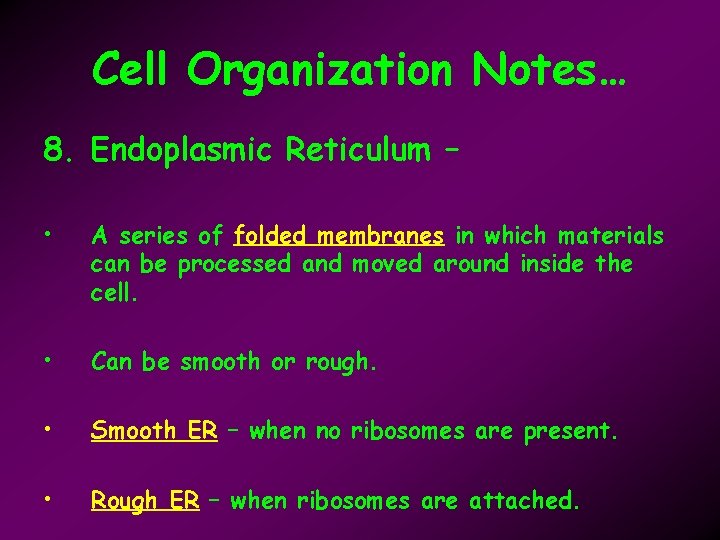
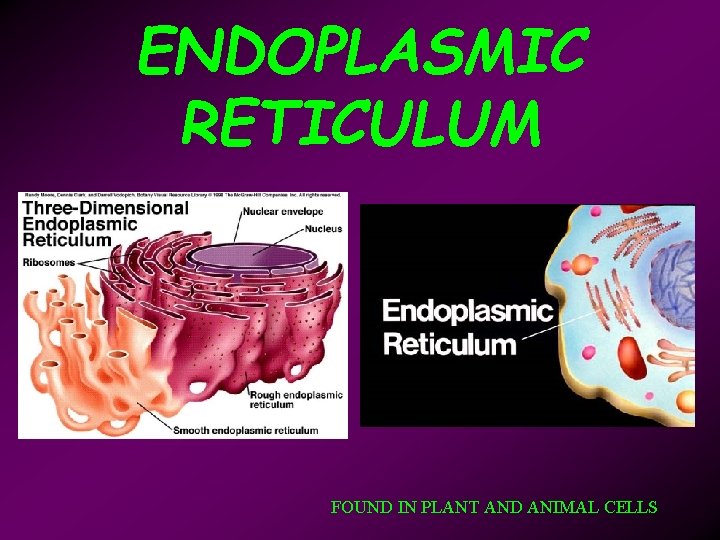
Cell Organization Notes… 8. Endoplasmic Reticulum – • A series of folded membranes in which materials can be processed and moved around inside the cell. • Can be smooth or rough. • Smooth ER – when no ribosomes are present. • Rough ER – when ribosomes are attached.
ENDOPLASMIC RETICULUM FOUND IN PLANT AND ANIMAL CELLS
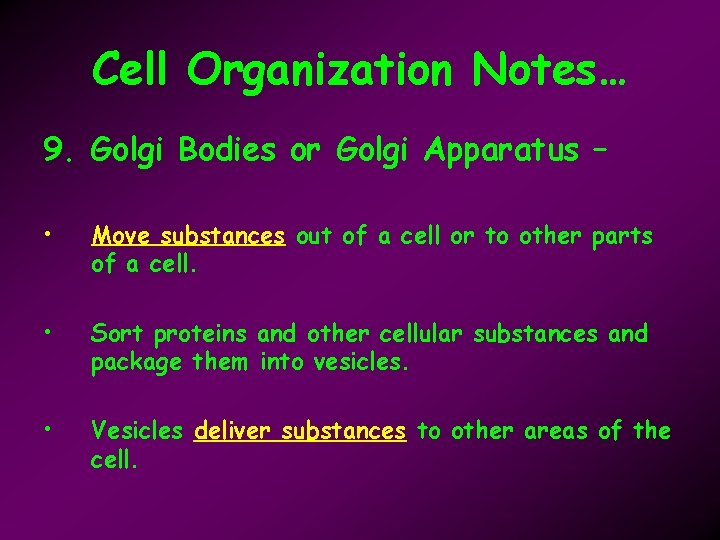
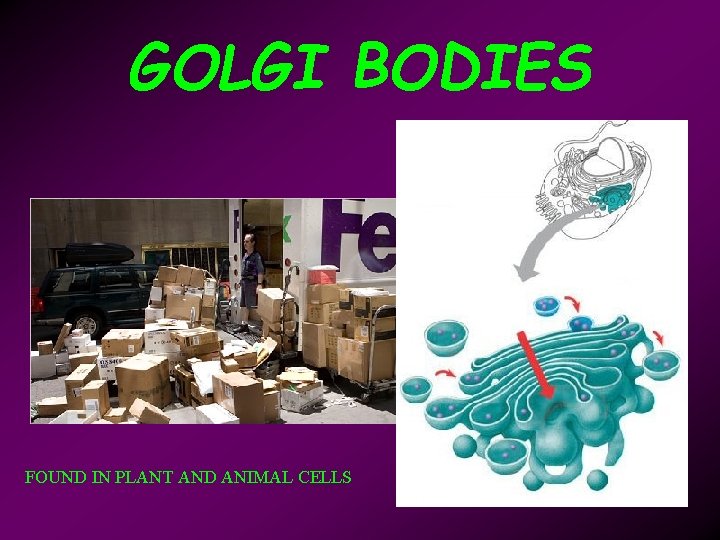
Cell Organization Notes… 9. Golgi Bodies or Golgi Apparatus – • Move substances out of a cell or to other parts of a cell. • Sort proteins and other cellular substances and package them into vesicles. • Vesicles deliver substances to other areas of the cell.
GOLGI BODIES FOUND IN PLANT AND ANIMAL CELLS
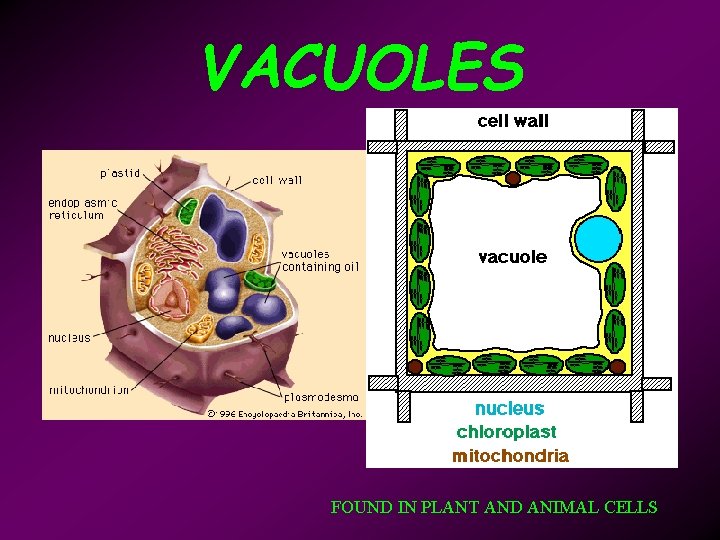
Cell Organization Notes… 10. Vacuoles – • Membrane-bound temporary storage space. • Stores water, waste products, food, and other cellular material. • In a plant cell, a vacuole can take up most of the cell’s space.
VACUOLES FOUND IN PLANT AND ANIMAL CELLS
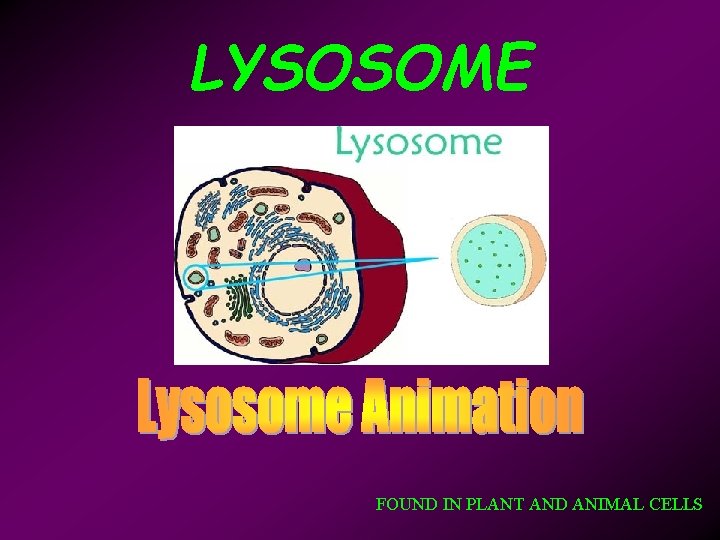
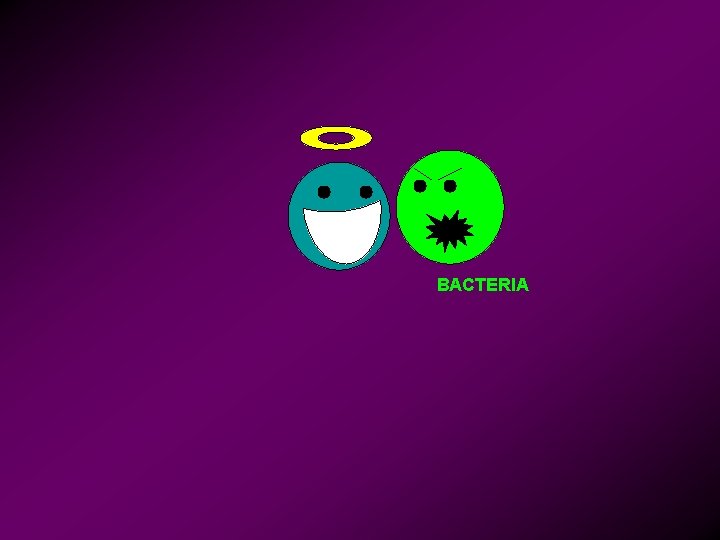
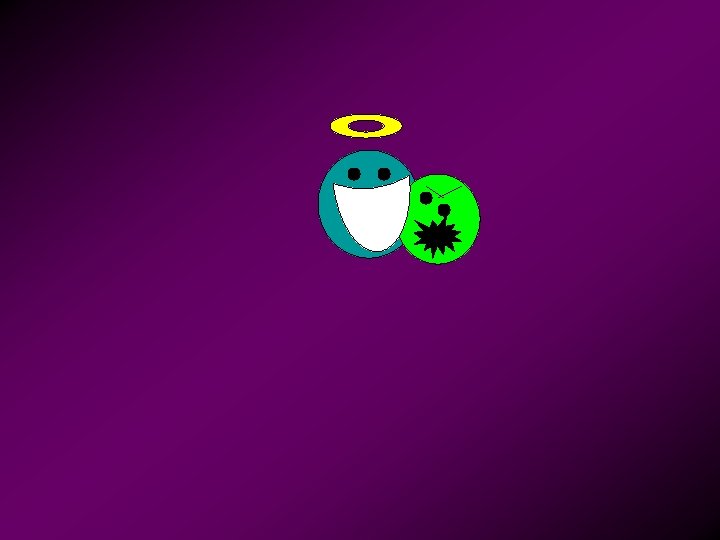
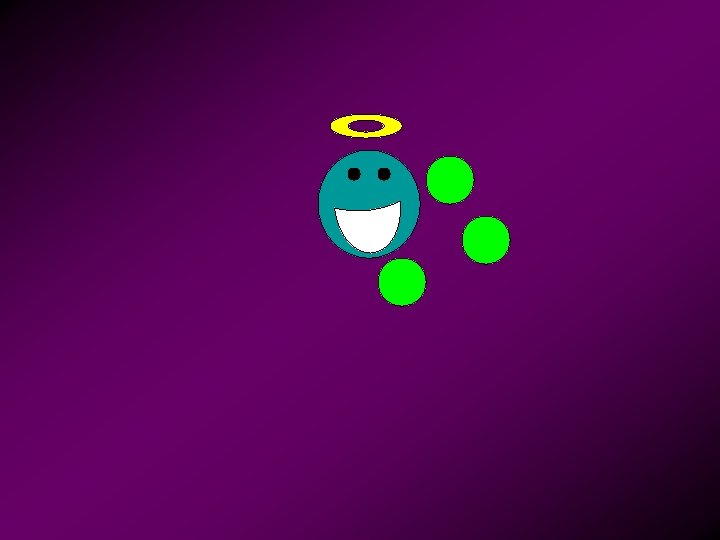
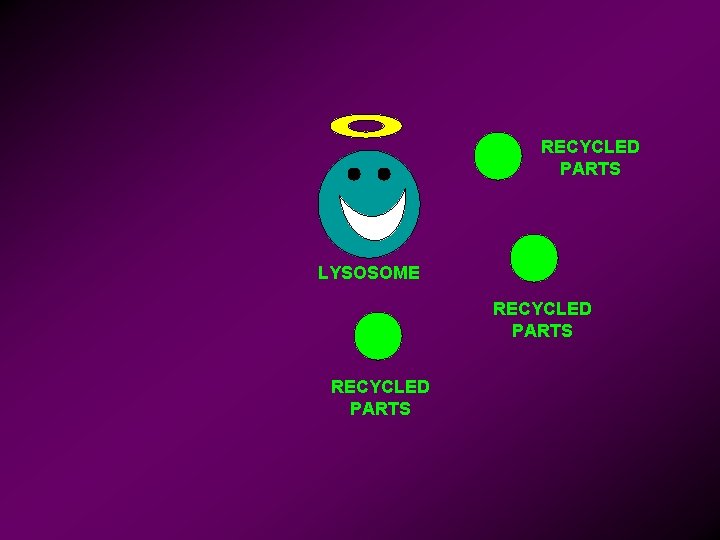
Cell Organization Notes… 11. Lysosomes – • Breaks down food molecules and cellular waste products
LYSOSOME FOUND IN PLANT AND ANIMAL CELLS
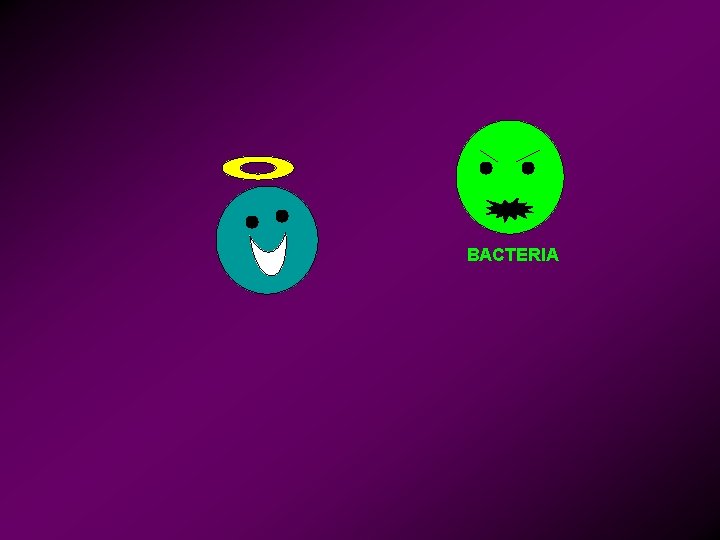
BACTERIA LYSOSOME
BACTERIA
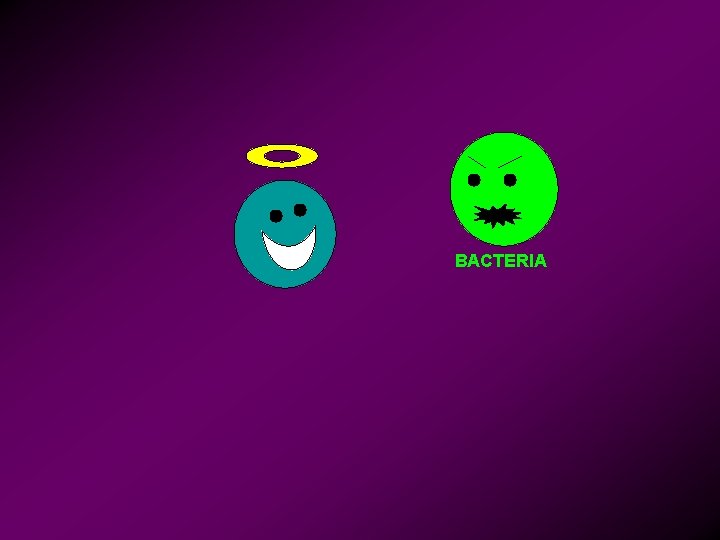
BACTERIA
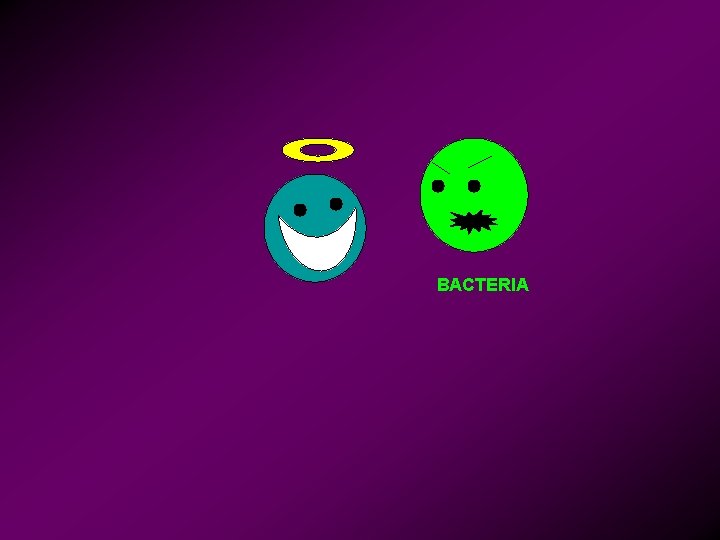
BACTERIA
BACTERIA
RECYCLED PARTS LYSOSOME RECYCLED PARTS
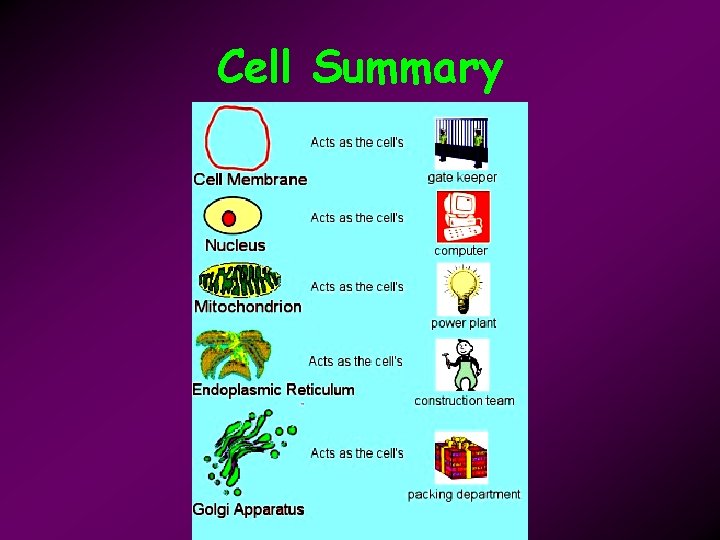
Cell Summary
REMEMBER LEVELS OF ORGANIZATION
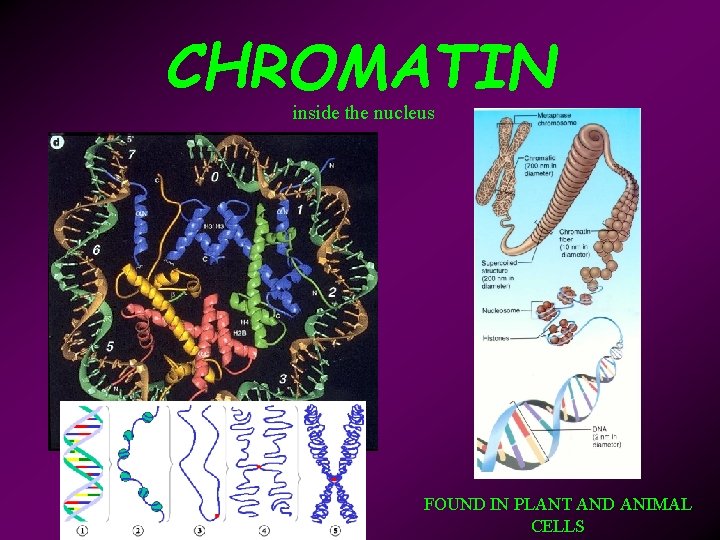
CHROMATIN inside the nucleus FOUND IN PLANT AND ANIMAL CELLS
CYTOSKELETON
CILIA
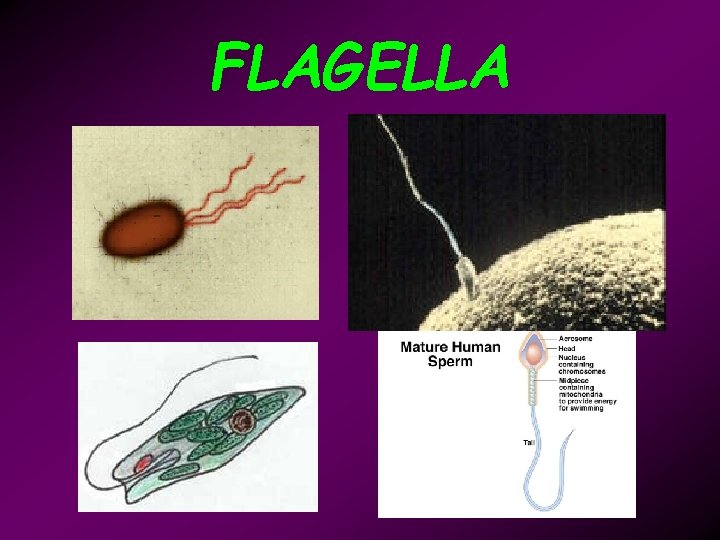
FLAGELLA
Identify This Cell
Identify This Cell
Identify This Cell
Identify This Cell