
Cells All living things are made of cells








- Slides: 16
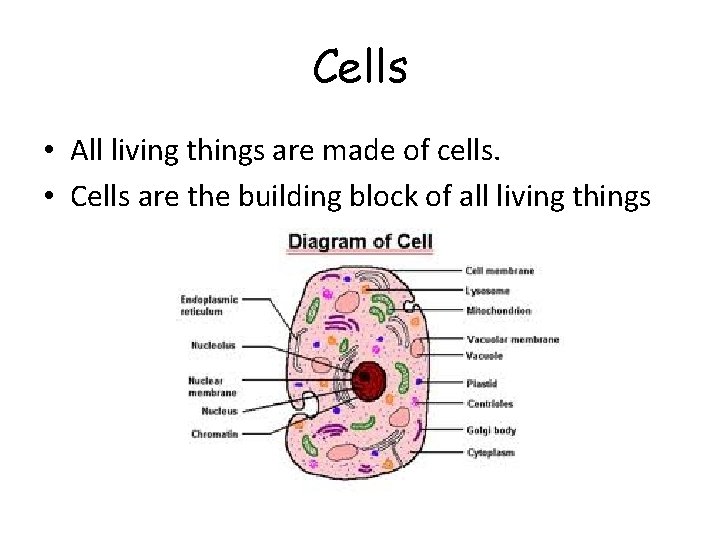
Cells • All living things are made of cells. • Cells are the building block of all living things
Cells at Work • • • A cell is like a tiny factory. One part gets food & water. Another part keeps the cell clean. Other parts are in charge of reproduction. Like all parts of a factory, all cell parts must work together to run smoothly and for the organism to survive.
Cell Structures and their Functions • Nucleus – control center of the cell • Cell Membrane – outer covering of the cell. Water and food enter through the membrane • Vacuoles - storage • Mitochondria – provides energy
Cell Types Plant Cells Animal Cells • Plant cells have a cell wall and chloroplasts • Chloroplasts use the energy of sunlight to make food for the cell (Photosynthesis) • Cell wall is the rigid structure which provides support to the cell • Like plant cells, animal cells have a cell membrane, a nucleus, cytoplasm, vacuoles and mitochondrion
Cell Division • Your body is made up of trillions of cells. Yet you began as a single cell. • Cells copy themselves with a process called cell division
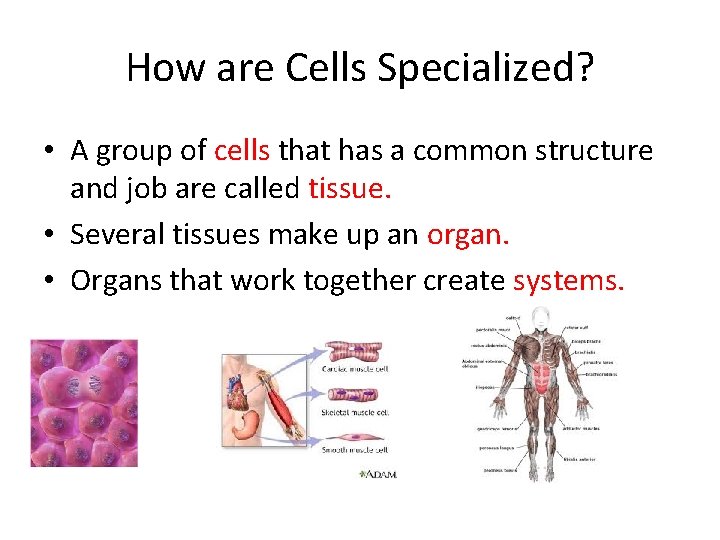
How are Cells Specialized? • A group of cells that has a common structure and job are called tissue. • Several tissues make up an organ. • Organs that work together create systems.
Cell Specialization
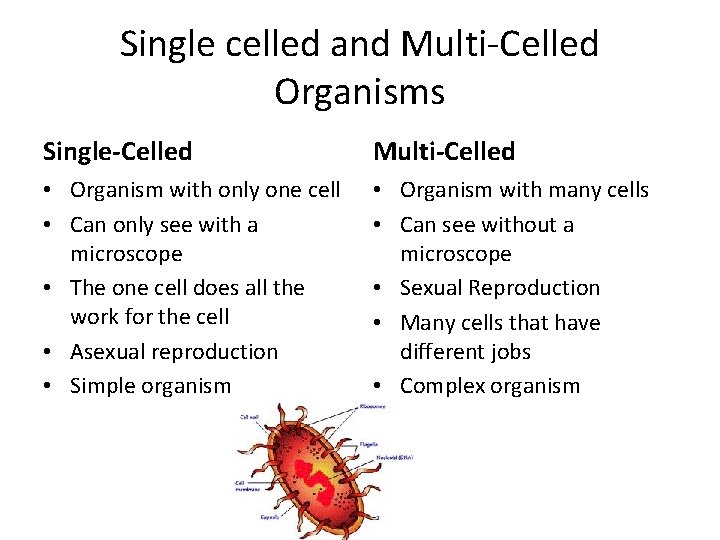
Single celled and Multi-Celled Organisms Single-Celled Multi-Celled • Organism with only one cell • Can only see with a microscope • The one cell does all the work for the cell • Asexual reproduction • Simple organism • Organism with many cells • Can see without a microscope • Sexual Reproduction • Many cells that have different jobs • Complex organism
Inherited Traits • Living things get or inherit traits, such as, eye color or face shape from their parents. • Heredity is the process through which traits are passed from parents to their offspring • Inherited traits include hair color, height etc…
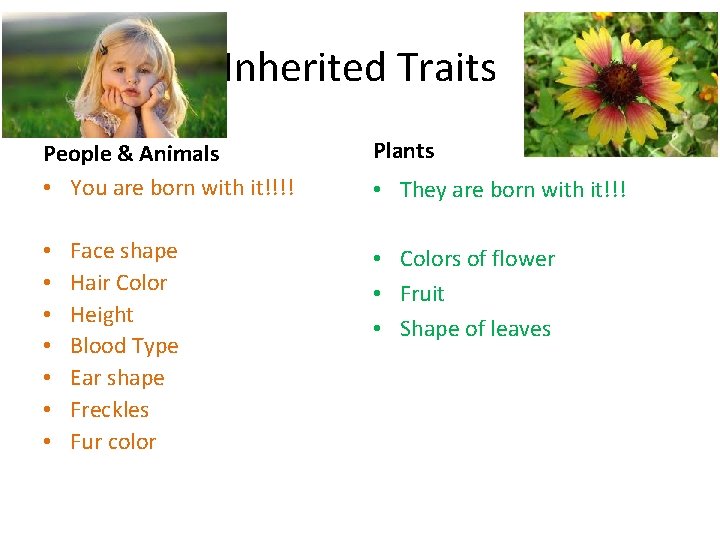
Inherited Traits People & Animals • You are born with it!!!! • • Face shape Hair Color Height Blood Type Ear shape Freckles Fur color Plants • They are born with it!!! • Colors of flower • Fruit • Shape of leaves
Learned Traits You were NOT born with it!! People Animals • How to ride a bike • How to read • How to play basketball • • How to sit How to beg How to be house-broken How to roll over
Chromosomes – Determine Inherited Traits • Chromosomes are located in the nucleus of the cell • Chromosomes are rod-shaped structures which carry all the traits of an organism. They are made up of thousands of genes. • Human cells have 23 pairs (46) chromosomes. • A child gets one-half his/her chromosomes from his mother and one-half his/her chromosomes from his father.
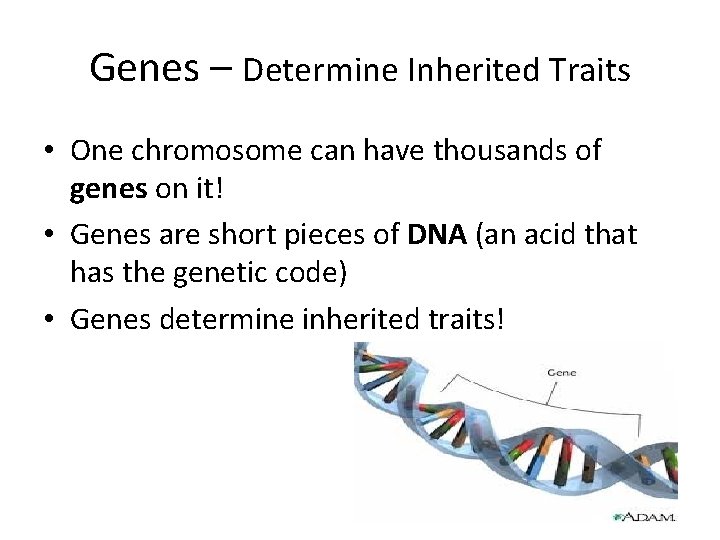
Genes – Determine Inherited Traits • One chromosome can have thousands of genes on it! • Genes are short pieces of DNA (an acid that has the genetic code) • Genes determine inherited traits!
Alleles • Alelles are different forms of genes • For example: brown eye color and blue eye color
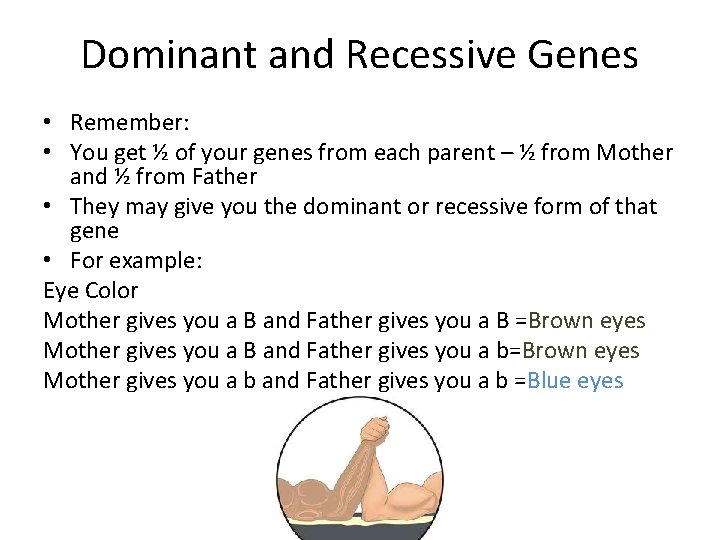
Types of Genes • Dominant Genes – strong genes, show up most often, represented by a capital letter • Recessive Genes – weak genes, show up less often, represented by a lower case letter • For example: • Brown eyes are dominant and appear more often (BB) • Blue eyes are recessive, and appear less often (bb)
Dominant and Recessive Genes • Remember: • You get ½ of your genes from each parent – ½ from Mother and ½ from Father • They may give you the dominant or recessive form of that gene • For example: Eye Color Mother gives you a B and Father gives you a B =Brown eyes Mother gives you a B and Father gives you a b=Brown eyes Mother gives you a b and Father gives you a b =Blue eyes