
Cellcell interactions in immune responses Teaching objectives To
Cell-cell interactions in immune responses
Teaching objectives • To discuss the central role of Th cells in immune responses • To describe the cell-cell interactions which occur in 1) Ab responses to T-dependent Ag, 2) generation of CTL, 3) activation of macrophages and NK cells • To discuss responses to T-independent Ag • To discuss mechanisms of killing by CTL and macrophages
Cell-cell interactions • Immune cells interact in two ways – Direct contact between cells – Cytokine signaling acting in autocrine or paracrine fashion
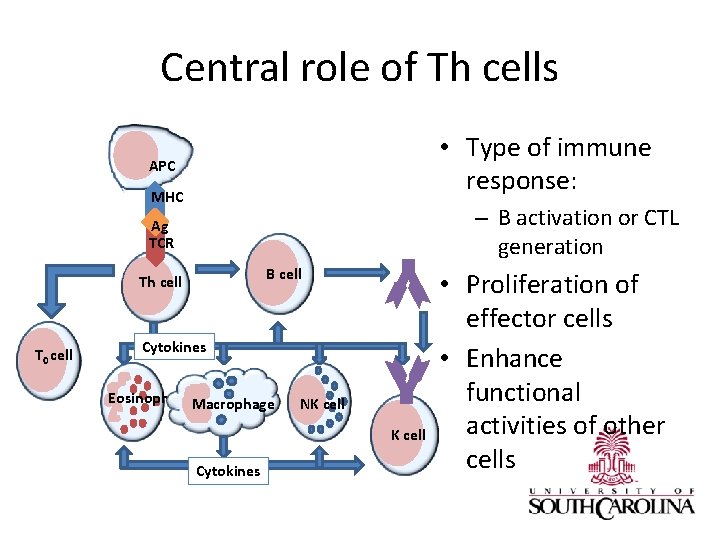
Central role of Th cells • Type of immune response: APC MHC – B activation or CTL generation Ag TCR B cell Th cell T 0 cell Cytokines Eosinophil Macrophage NK cell Cytokines • Proliferation of effector cells • Enhance functional activities of other cells

Subpopulations of Th cells • Subpopulations based on cytokine profiles – Th 0, Th 1, Th 2, Th 17 • Differentiation determined by cytokines pre. Th Th 0 IL-12 IL 4 IL-2 IFN-γ, IL-2, IL-4, IL-5, IL-10 IL- 1, 6, Th 1 IFN-γ, IL-2 Th 2 IL-4, IL-5, IL-6, IL-10 Th 17 IL-17 23
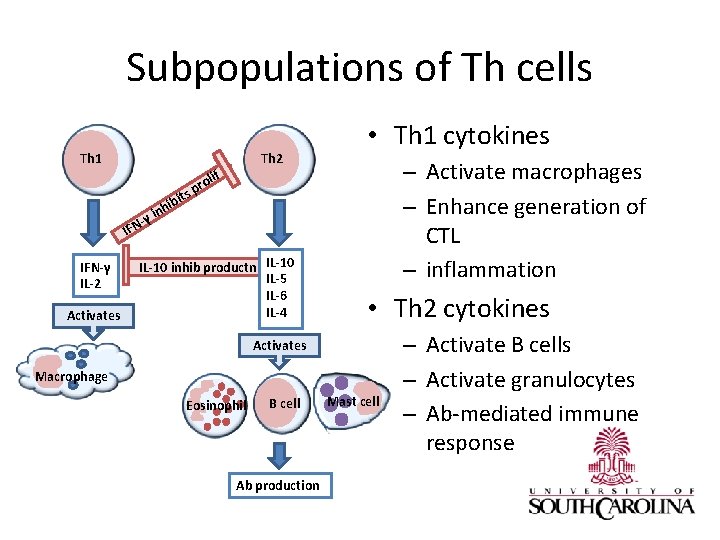
Subpopulations of Th cells Th 1 Th 2 ts -γ IFN-γ IL-2 Activates ibi h in • Th 1 cytokines – Activate macrophages – Enhance generation of CTL – inflammation lif o r p IL-10 inhib productn IL-10 IL-5 IL-6 IL-4 • Th 2 cytokines Activates Macrophage Eosinophil B cell Ab production Mast cell – Activate B cells – Activate granulocytes – Ab-mediated immune response
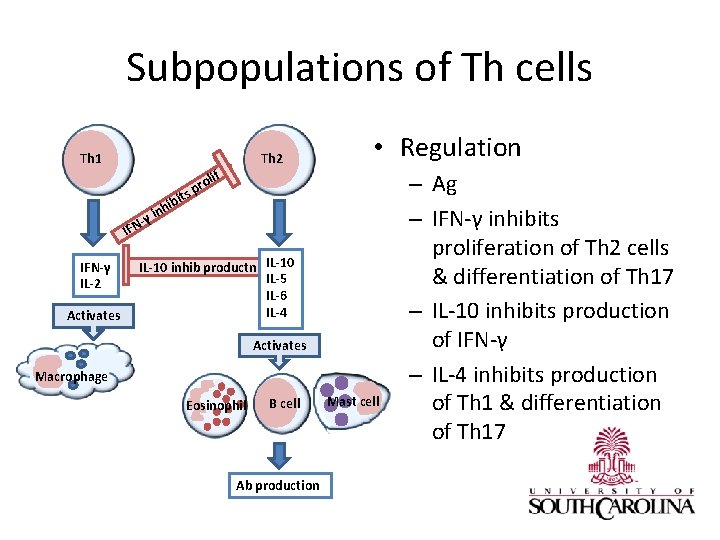
Subpopulations of Th cells Th 1 Th 2 -γ IFN-γ IL-2 Activates its b i inh • Regulation lif o r p IL-10 inhib productn IL-10 IL-5 IL-6 IL-4 Activates Macrophage Eosinophil B cell Ab production Mast cell – Ag – IFN-γ inhibits proliferation of Th 2 cells & differentiation of Th 17 – IL-10 inhibits production of IFN-γ – IL-4 inhibits production of Th 1 & differentiation of Th 17
Cell-cell interactions in Ab responses Responses to exogenous Ag T-dependent Ag
Hapten-carrier effect • Studies on Ab response to hapten-carrier conjugates show – Both Ts and Bs required for Ab production • • Th cells recognize carrier determinants Bs recognize haptenic determinants Interactions are class II self MHC restricted Bs function in Ag recognition and presentation
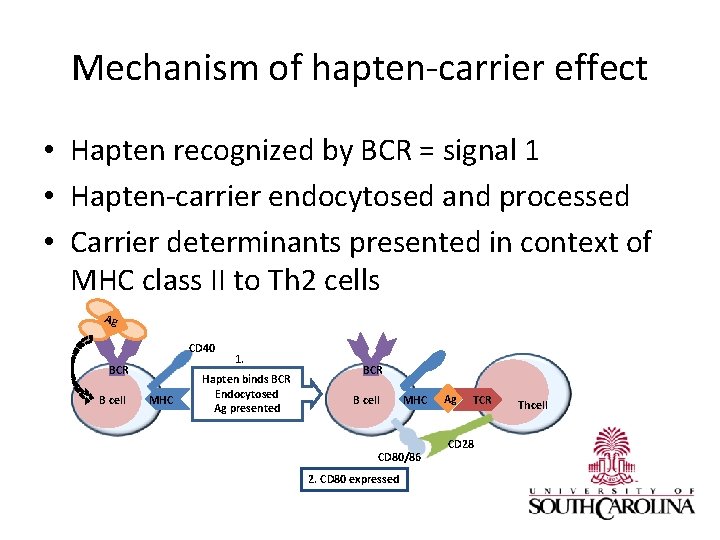
Mechanism of hapten-carrier effect • Hapten recognized by BCR = signal 1 • Hapten-carrier endocytosed and processed • Carrier determinants presented in context of MHC class II to Th 2 cells Ag CD 40 BCR B cell MHC 1. Hapten binds BCR Endocytosed Ag presented BCR B cell MHC CD 80/86 2. CD 80 expressed Ag TCR CD 28 Thcell
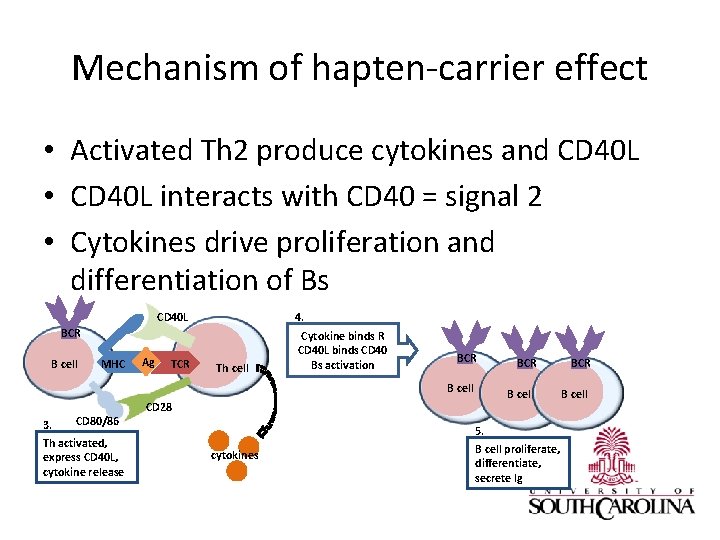
Mechanism of hapten-carrier effect • Activated Th 2 produce cytokines and CD 40 L • CD 40 L interacts with CD 40 = signal 2 • Cytokines drive proliferation and differentiation of Bs CD 40 L 4. BCR B cell MHC CD 80/86 3. Th activated, express CD 40 L, cytokine release Ag TCR Th cell CD 28 cytokines Cytokine binds R CD 40 L binds CD 40 Bs activation BCR BCR B cell 5. B cell proliferate, differentiate, secrete Ig
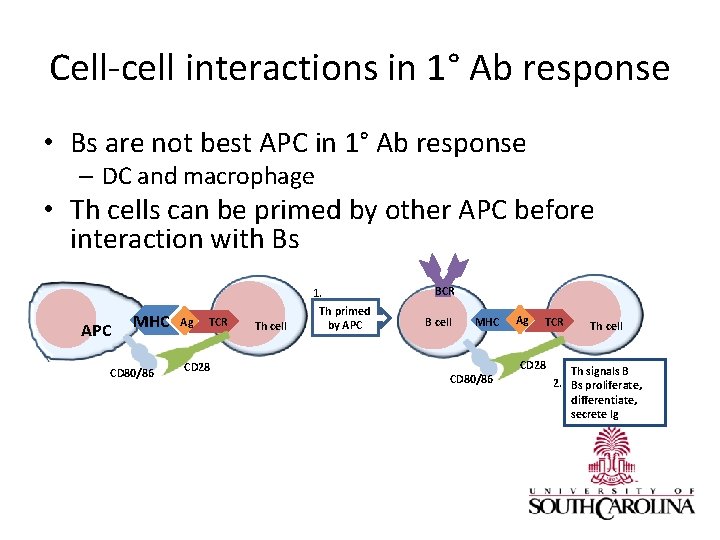
Cell-cell interactions in 1° Ab response • Bs are not best APC in 1° Ab response – DC and macrophage • Th cells can be primed by other APC before interaction with Bs APC MHC CD 80/86 Ag TCR CD 28 Th cell 1. Th primed by APC BCR B cell MHC CD 80/86 Ag TCR CD 28 Th cell Th signals B 2. Bs proliferate, differentiate, secrete Ig
Cell-cell interactions in 2° Ab response • Memory Bs and memory Ts created during 1° response • Bs have high affinity Ig receptor – Can take up Ag at lower concentrations than other APCs that lack Ig R • Memory Ts more easily activated than naïve • B-T interaction is sufficient to generate 2° Ab response
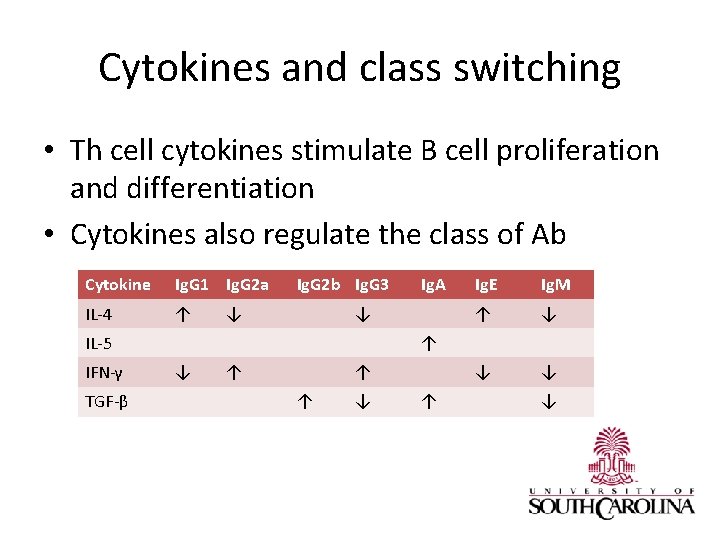
Cytokines and class switching • Th cell cytokines stimulate B cell proliferation and differentiation • Cytokines also regulate the class of Ab Cytokine Ig. G 1 Ig. G 2 a IL-4 ↑ Ig. G 2 b Ig. G 3 ↓ ↓ IL-5 IFN-γ TGF-β Ig. A Ig. E Ig. M ↑ ↓ ↓ ↓ ↑ ↑ ↑ ↓
Cell-cell interactions in Ab responses Responses to exogenous Ag T-independent Ag
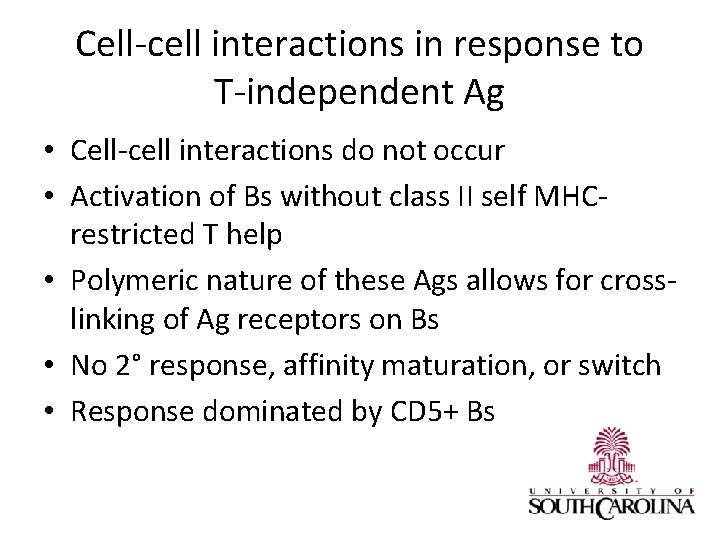
Cell-cell interactions in response to T-independent Ag • Cell-cell interactions do not occur • Activation of Bs without class II self MHCrestricted T help • Polymeric nature of these Ags allows for crosslinking of Ag receptors on Bs • No 2° response, affinity maturation, or switch • Response dominated by CD 5+ Bs
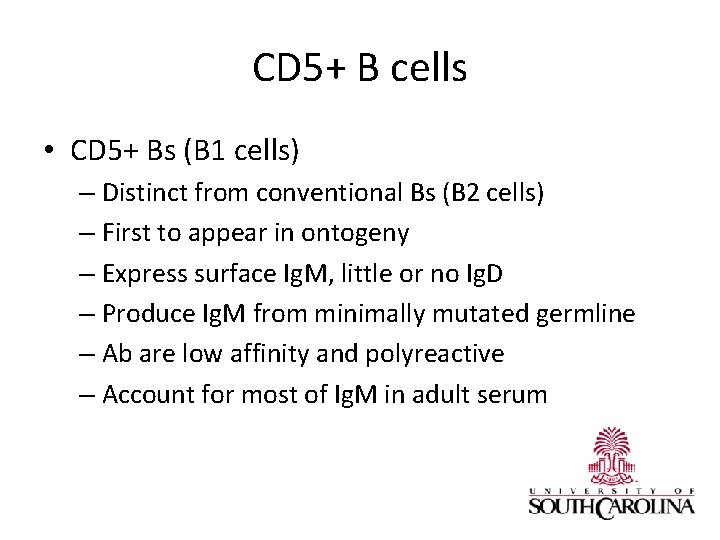
CD 5+ B cells • CD 5+ Bs (B 1 cells) – Distinct from conventional Bs (B 2 cells) – First to appear in ontogeny – Express surface Ig. M, little or no Ig. D – Produce Ig. M from minimally mutated germline – Ab are low affinity and polyreactive – Account for most of Ig. M in adult serum
CD 5+ B cells • Properties (continued) – Do not develop into memory Bs – Self-renewing: do not continue to arise from bone marrow like conventional Bs – reside in peripheral tissues – Predominant Bs in peritoneal cavity • Significance – Major defense against pathogens with polysaccharide in cell wall – Individuals with T defects can still resist many bacterial infections
Cell-cell interactions in cell-mediated immune response: Generation of CTL Responses to endogenous Ag in cytosol Killing of virus-infected and transformed cells
Cytotoxic T cells • CTLs are not fully mature when exit thymus – TCR recognizes Ag in MHC context – Cannot kill – Must differentiate to fully active CTL – Therefore, are “pre-CTL”
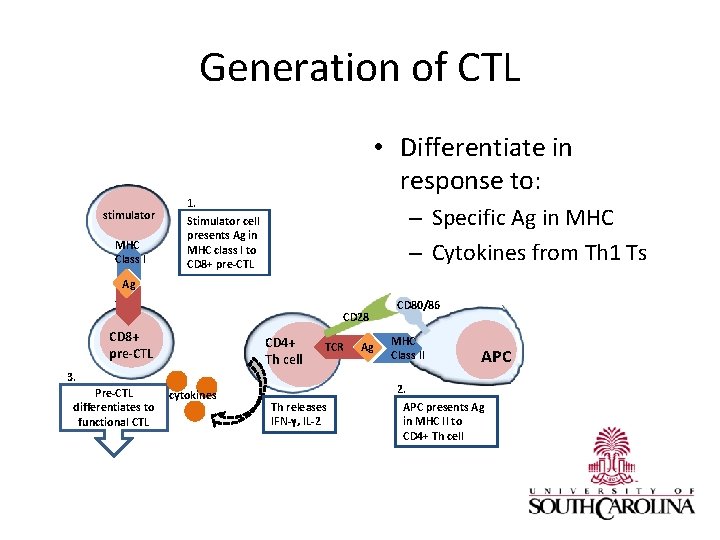
Generation of CTL stimulator MHC Class I • Differentiate in response to: 1. Stimulator cell presents Ag in MHC class I to CD 8+ pre-CTL – Specific Ag in MHC – Cytokines from Th 1 Ts Ag TCR CD 28 CD 8+ pre-CTL CD 4+ Th cell TCR 3. Pre-CTL differentiates to functional CTL cytokines Th releases IFN-γ, IL-2 Ag CD 80/86 MHC Class II APC 2. APC presents Ag in MHC II to CD 4+ Th cell
Features of CTL • Ag specific – Target must bear the same Ag in MHC class I as the stimulator cell • Requires cell contact – Ensures that nearby cells are not killed • CTLs are capable of killing many targets – They are not “damaged” when they kill a target
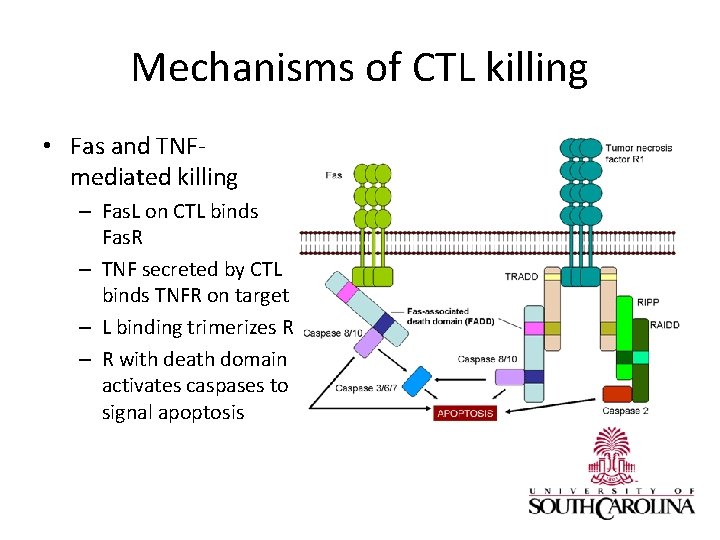
Mechanisms of CTL killing • Fas and TNFmediated killing – Fas. L on CTL binds Fas. R – TNF secreted by CTL binds TNFR on target – L binding trimerizes R – R with death domain activates caspases to signal apoptosis
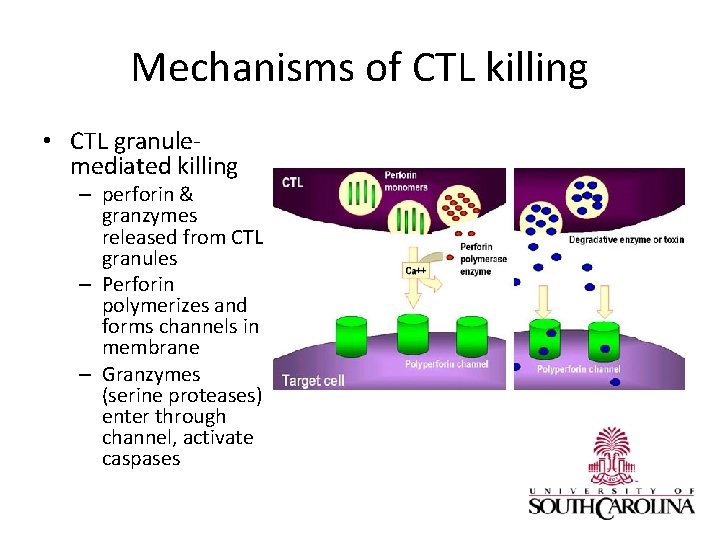
Mechanisms of CTL killing • CTL granulemediated killing – perforin & granzymes released from CTL granules – Perforin polymerizes and forms channels in membrane – Granzymes (serine proteases) enter through channel, activate caspases
Cell-cell interactions in cellmediated immune response: activation of macrophages Responses to endogenous Ag in vesicles Killing of intracellular pathogens in vesicles
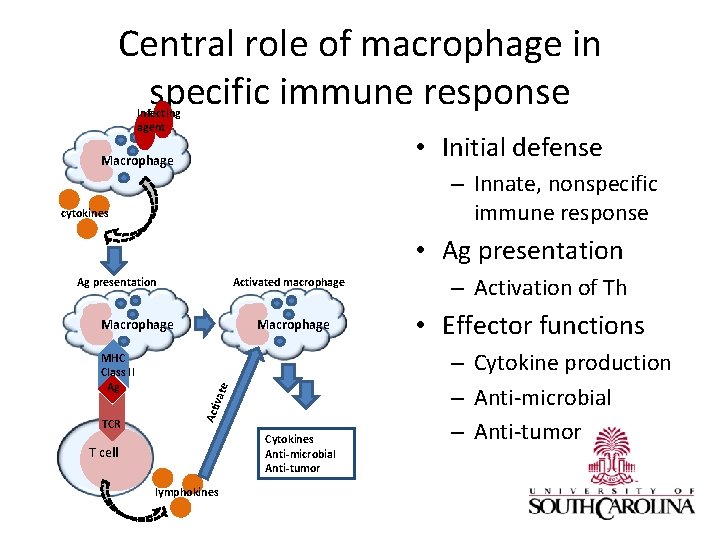
Central role of macrophage in specific immune response Infecting agent • Initial defense Macrophage – Innate, nonspecific immune response cytokines • Ag presentation Activated macrophage TCR ivat Act MHC Class II Ag Macrophage e Macrophage Cytokines Anti-microbial Anti-tumor T cell lymphokines – Activation of Th • Effector functions – Cytokine production – Anti-microbial – Anti-tumor
Effector function of activated macrophages • Pneumocystis carinii – Extracellular fungal pathogen – Controlled by activated macrophage – In AIDS patients infection commonly causes death • Mycobacterium tuberculosis – Intracellular pathogen, resides in vesicles – Not killed unless macrophages are activated – Again, problem for AIDS patients
- Slides: 27