
Cell vs Organism GAS EXCHANGE Gas exchange Gas









- Slides: 40
Cell vs. Organism
GAS EXCHANGE
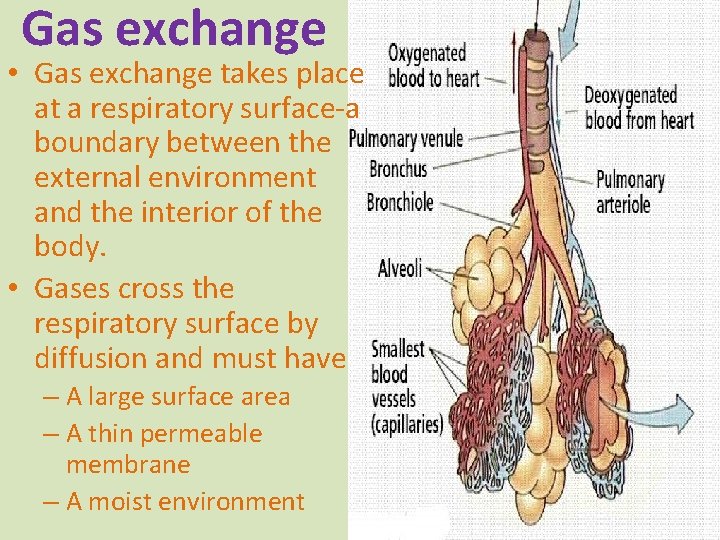
Gas exchange • Gas exchange takes place at a respiratory surface-a boundary between the external environment and the interior of the body. • Gases cross the respiratory surface by diffusion and must have – A large surface area – A thin permeable membrane – A moist environment
Gas exchange-organism • In plants, gas is exchanged through the leaves.
Gas exchange-cells • In plants, gas exchange usually takes place through their stomata. • Stomata are small openings present on the epidermis of the leaves.
Gas exchange-cells • These stomata open into spongy parenchyma and the gas exchange takes place between the cell and the gas filled in the air space. • Gas exchange is needed for both respiration and photosynthesis.
Gas exchange-organism • Alveoli are structures present in the lungs (the well-developed organ system for the effective exchange of gases between atmosphere and the blood present in terrestrial organism). • Lungs are elastic sacs that allow the animal to pump air in and out of the body.
Gas exchange-organism • The trachea of the lungs divide into two branches, which in turn divide into many sub-branches known as bronchioles. • Bronchioles end in small, thin-walled sacs known as alveoli. The presence of alveoli increases the effected surface area for gaseous exchange. • Alveoli have a rich supply of fine blood vessels with very thin walls through which gas can easily diffuse into and out.
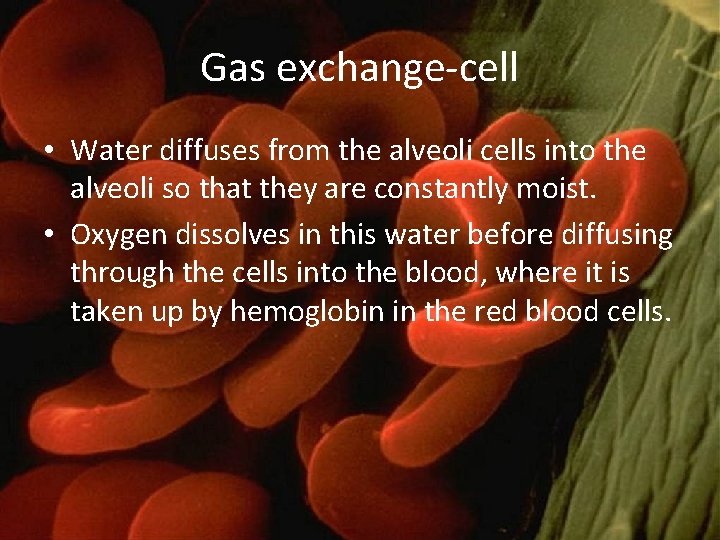
Gas exchange-cell • Water diffuses from the alveoli cells into the alveoli so that they are constantly moist. • Oxygen dissolves in this water before diffusing through the cells into the blood, where it is taken up by hemoglobin in the red blood cells.
NUTRIENT UPTAKE AND PROCESSING
Nutrient uptake and processingorganism • Plants get nutrients from photosynthesis (the process by which plant leaves take in carbon dioxide from the air for nourishment, as well as absorbing available sunlight for food).
Nutrient uptake and processing-organism • Carbon dioxide is absorbed into the leaves through the stomata, which then goes into the cells that contain chlorophyll (the pigment that gives plants their green color and is capable of converting the energy gained from sunlight into food for the plant). • Plants also get nutrients and water form the soil through their root systems.
Nutrient uptake and processing-cell • The plasma membrane of the plant cell is a selectively permeable barrier that ensures the entry of essential ions and metabolites into the cell.
Nutrient uptake and processingorganism • Animals are heterotrophs (organisms that cannot make their own organic compounds). In order to get the organic compounds they need they have to eat other living things. • Herbivores get their nutrients from plants, carnivores from other animals and the digested plant material in those animals, and omnivores can get it from plants or animals.
Nutrient uptake and processingorganism • The process in which an animal changes nutrients to energy is complex. • A substance enters the mouth first and is broken down by saliva and other acids into smaller units that can be swallowed. • The substance then travels down into the throat and into the esophagus which leads to the stomach.
Nutrient uptake and processing-organism • In the stomach, the substance is broken down even more before being subjected to more breaking down from other organs. • It finally reaches the intestines where the nutrients are absorbed.
Nutrient uptake and processing-cell • Hemoglobin carry oxygen from the lungs and heart to the muscle cells in the body. • Within the innermost region of the cell are the mitochondria (the powerhouse of the cell). The nutrients are converted to energy here.
WASTE EXCRETION
Waste excretion-organism • Oxygen produced in plants is diffused out through the stomata or through the cell walls of roots and other plant structures. • Excess water passes to the exterior via similar routes and is eliminated by process of droplet exudation (the act or an instance of oozing forth) and transpiration (evaporation of water from plant surfaces).
Waste excretionorganism • Green plants in darkness or plants without chlorophyll have water and carbon dioxide as waste products. Carbon dioxide is secreted in the same manner as oxygen (diffusion through stomata) • Some plants exude resins, saps, or latexes which are forced from the interior of the plant by hydrostatic pressures inside the plant and by absorptive forces of plant cells.
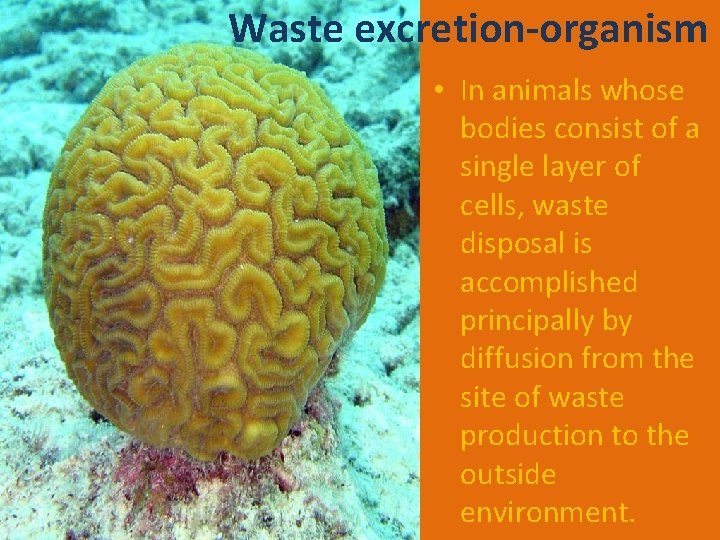
Waste excretion-organism • In animals whose bodies consist of a single layer of cells, waste disposal is accomplished principally by diffusion from the site of waste production to the outside environment.
Waste excretion-organism • The kidney and its associated ducts are the excretory system of the mammal, and, as already noted, most of the nitrogenous waste arising in the mammalian body is excreted as urea. • Other nitrogenous compounds regularly present in the urine of smaller amounts are uric acid and creatine; both of these arise mainly as byproducts of the renewal and repair of tissues.
Waste excretion-organism • In birds, reptiles, and amphibians the kidneys are compact organs, as they are in mammals, but in fishes they are narrow bands of tissue running the length of the body. • In amphibians, as in mammals, the main excretory product is urea. • In birds and reptiles it is uric acid. • In most fishes the main excretory product is ammonia.
Waste excretion-cell • The cell gets rid of waste by bringing it close to the cell membrane and then it closes the membrane around the waste, isolating it from the rest of the cell. • The cell will then open the membrane on the outside of the cell, letting the garbage out without losing any cytoplasm or letting anything else in.
Waste excretion-cell • Lysosomes also get rid of waste in cells. Old, worn-out parts, excess mitochondria, or poisons are surrounded by the lysosome in a membrane bubble. • The enzymes inside the lysosome break down the waste into small molecules that can fit through the cell membrane. • Then the lysosome floats through the cytoplasm to the cell membrane where it is released from the cell like previously described.
NERVOUS AND HORMONAL REGULATION
Nervous and hormonal regulation • Neural regulation of hormone release is when neuronal input to an endocrine cell increases or decreases hormonal secretion.
Nervous and hormonal regulation • A type of neural regulation concerns endocrine cells that are found in the brain. • These cells are called neurosecretory cells, and like typical neurons, they have dendrites, axons, and terminals. The only difference is that their terminals are adjacent to capillaries. • The regulatory molecules they secrete enter the circulation and act as hormones. • Hormone secretion is regulated by neurons that form synapses with the dendrites of the neurosecretory cell.
Nervous and hormonal regulation • Auxin, a hormone in plants, has been found to promote cell elongation. • Auxin causes the small, square, and densely packed new cells to pump hydrogen into their cell walls. • The higher p. H activates enzymes to break cross linkages in the wall allowing the ever present turgor pressure to elongate these cells.
REPRODUCTION
Reproduction-cell • Cells reproduce and replicate through mitosis and meiosis.
Reproduction-cell • Mitosis is a process of cellular division that is unique to eukaryotic cells. • When mitosis is complete, each cell will have the same genetic material that the original cell had before replication. • Each of the new cells are also identical to each other. • Once telophase is complete, the cell returns to interphase.
Reproduction-cell • The stages of mitosis are: – Interphase • Time between divisions, protein synthesis carried out, chromatin present, nucleolus present, DNA replicated towards division time. – Prophase • Chromatin thickens into chromosomes, nuclear membrane disintegrates, centriole pairs move to opposite ends of the cell, spindle fibers begin to form. – Metaphase • Guided by the spindle fibers, the chromosomes pairs line up along the center of the spindle structure. – Anaphase • The chromosome pairs begin to pull apart, once separated, they are called daughter chromosomes, due to pull, many chromosomes bend, groove in plasma membrane present, – Telophase • Chromosomes return to chromatin, spindle disintegrates, nuclear membrane takes shape again, centrioles replicate, membrane continues to pinch inward (in plant cells a new cell wall is laid)
Reproduction-cell • In Meiosis, all gametes have half the number of chromosomes that regular cells have. Gametes are created through the process of meiosis. Meiosis involves two division which create four haploid cells. • In phase I the stages are interphase I, prophase I, metaphase I, and telophase I. • In phase II, the stages are interphase II, prophase II, metaphase II, and telophase II.
Reproduction-organism • Reproduction is the creation of anew individual or individuals from previously existing individuals. • In animals there are two primary ways that this can occur: asexual reproduction and sexual reproduction.
Reproduction-organism • In asexual reproduction, one individual produces offspring that are genetically identical to itself. • These offspring are produced by mitosis.
Reproduction-organism • Common forms of asexual reproduction include: – Budding, where the offspring grows out of the body of the parent. – Gemmules, where the parent releases a specialized mass of cells that can develop into offspring. – Fragmentation, where the body of the parent breaks into distinct pieces, each of which can produce an offspring. – Regeneration, where a detached piece of the parent can grow and develop into a completely new individual. – Parthenogenesis is the development of an egg that has not been fertilized into an individual.
Reproduction-organism • During sexual reproduction, two individuals produce offspring that have genetic characteristics from both parents. • Sexual reproduction introduces new gene combinations in a population.
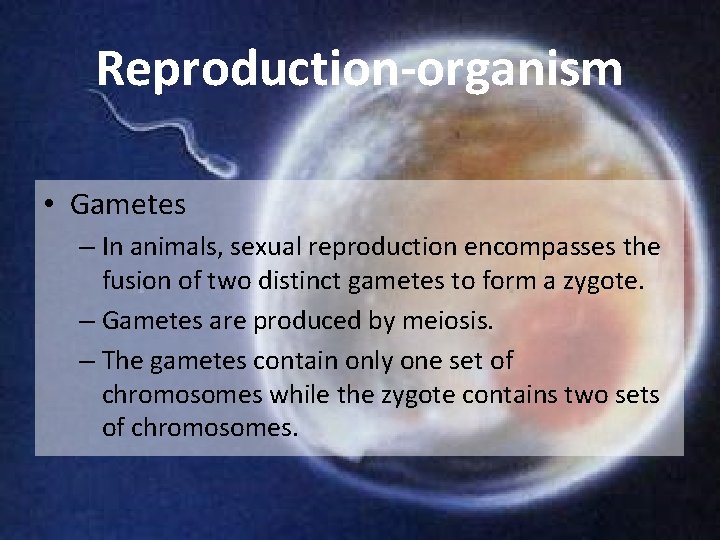
Reproduction-organism • Gametes – In animals, sexual reproduction encompasses the fusion of two distinct gametes to form a zygote. – Gametes are produced by meiosis. – The gametes contain only one set of chromosomes while the zygote contains two sets of chromosomes.
Reproduction-organism • There are two mechanisms by which fertilization can take place. – The first is external, where the eggs are fertilized outside of the body. – The second is internal, where the eggs are fertilized within the female reproductive tract.