
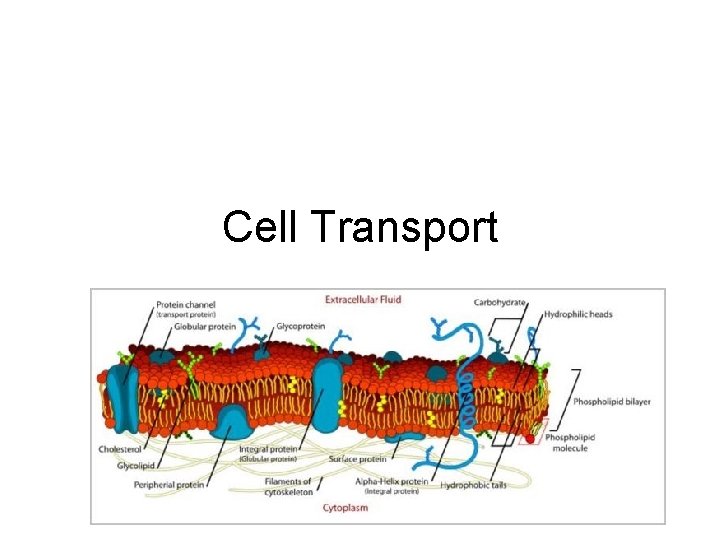
Cell Transport Cell Transport movement of materials CO
- Slides: 24
Cell Transport
Cell Transport • movement of materials (CO 2, H 2 O, glucose, proteins, etc) into or out of cell via cell membrane
2 Types of Cell Transport 1. Active Transport- requires energy 2. Passive Transport- No energy required
Why is Cell Transport Important? • Homeostasis- maintaining a steady state • Metabolism- chemical reactions that convert “food” into energy Helps cells achieve equilibrium- when concentrations of molecules of a substance are the same everywhere
Brownian Motion • All matter is made up of atoms or molecules and these particles are constantly moving. These atoms move in a straight line until they collide with another atom or some barrier then they reflect and move in a straight line until they collide with something else. This movement of atoms and molecules is called Brownian motion.
3 Types of Passive Transport 1. Diffusion 2. Osmosis 3. Facilitated Diffusion
1. Diffusion • movement of molecules from areas of higher concentration to areas of lower concentration • requires no energy expenditure by cell
Key components of cell that function in cell transport • Cell membrane- phospholipids bilayer • Cytoplasm- aqueous solution that contains materials • Mitochondria- powerhouse of cell (glucose ATP) • RBC- carries protein hemoglobin that transports oxygen and carbon dioxide to and from cells
Example of Cellular Diffusion
Review • Solution= Solute + Solvent • Solute • Solvent Ex: Sugar water Salt water
3 Prefixes for SOLUTES • Hypo = Low hypoglycemic Ex: Hypothermia, • Hyper = High hyperglycemic Ex: Hyperactive, • Iso = Equal
Solution Types 1. Hypotonic Solution- concentration of solute molecules outside the cell is lower than the concentration in cytosol (water moves into cell until equilibrium is reached)
Solution Types 2. Hypertonic Solution- concentration of solute molecules outside the cell is higher than the concentration in cytosol (water moves out of cell until equilibrium is reached) • water tends to diffuse from hypo- to hypertonic solutions
Solution Types 3. Isotonic Solution- concentration of solute molecules outside and inside the cell are equal ( water moves in and out of cell but at equal rates)
2. Osmosis • process by which water molecules diffuse across a cell membrane from an area of higher concentration to an area of lower concentration • Requires no energy expenditure by cell Passive Transport
Extreme Osmosis • Concentration gradient is so far from equilibrium that even after moving water or solutes, equilibrium still will not be reached, and this may result in DEATH of cell 1. Crenation- dehydration of an animal cell 2. Plasmolysis- dehydration of a plant cell 3. Cytolysis- cell bursting, usually occurs in animal cells
Plant Cells and Osmosis • Plant cells- usually in a hypotonic environment • Water moves into cell via osmosis • Cell expands until it presses against cell wall, creating a pressure called turgor pressure
3. Facilitated Diffusion • Proteins embedded in cell membrane help molecules that can’t move across membrane rapidly enough, into or out of cell • Carrier proteins are specific for one type of molecule • Protein changes shape protecting molecule from hydrophobic interior of membrane, then releases molecule on other side
Ion Channels • similar to carrier proteins, but are specific for certain ions • Examples of ions: Na+, Cl-, K+, Ca+2 • These ions are important for many cell functions, but are not soluble in lipids so need to pass through these ion channels • Some channels are always open, others close
Active Transport • movement of materials up concentration gradient from areas of lower concentration to areas of higher concentration • requires cells to use energy • works like proteins in facilitated diffusion (bind to specific molecule, changes shape to protect, and releases molecule on other side)
• Ex: Sodium/Potassium Pump • Many animal cells need higher Sodium concentration outside of cell and higher Potassium concentration inside cell • Splits molecule of ATP to change shape of protein to allow this
2 Types of Active Transport 1. Endocytosis-process by which cells ingest external fluid, macromolecules, and large particles, including other cells • enclosed by portion of cell that folds in on itself creating a pouch called a vesicle
2 Types of Endocytosis A. Pinocytosis- “cell drinking” –involves transport of solutes or fluids B. Phagocytosis- “cell eating” –movement of large molecules or whole cells into a cell *animal cells ingest bacteria and destroy them via phagocytosis
• 2. Exocytosis-vesicles in cytoplasm fuse with cell membrane releasing contents into external environment • *Remember this is how proteins leave cell • Nervous and endocrine systems use exocytosis to release small molecules that control activities of other cells