
Cell Transport Cell Membrane Recall that the cell

Cell Transport
Cell Membrane § Recall that the cell membrane controls what enters and what leaves the cell § Also provides protection and support
Composition of the Cell Membrane § Also called the “Fluid Mosaic Model” § Outer membrane is a lipid bilayer (FLUID movement) two layers of fat. Lipid provides a flexible structure and barrier between the cell and its surroundings. § Also have proteins embedded in membrane (MOSAIC – multiple molecules) to act as channels to bring substances into and out from the cell.
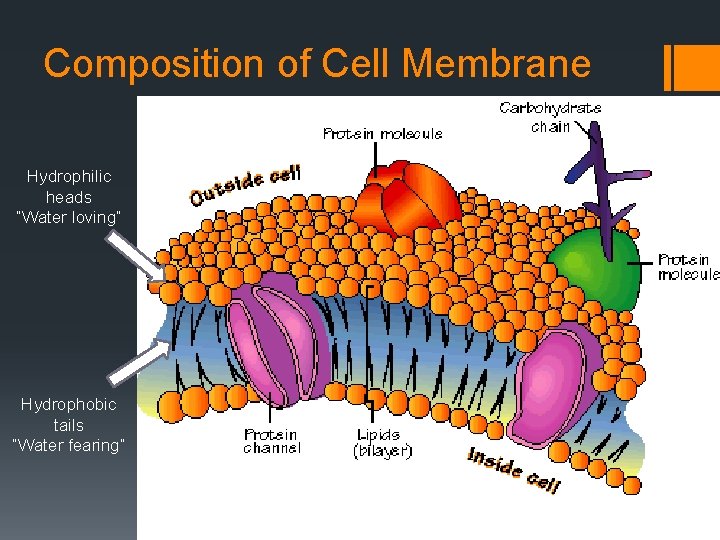
Composition of Cell Membrane Hydrophilic heads “Water loving” Hydrophobic tails “Water fearing”
Cell Transport § All cells must remain in a state of homeostasis. Cells must constantly bring substances into and out of the cell to maintain a dynamic equilibrium with the environment they live in!! § If a substance can pass through the membrane, it is said to be PERMEABLE § If a substance cannot pass through the membrane, it is said to be IMPERMEABLE § Most biological membranes are SELECTIVELY PERMEABLE, this means some substances can pass through and some cannot
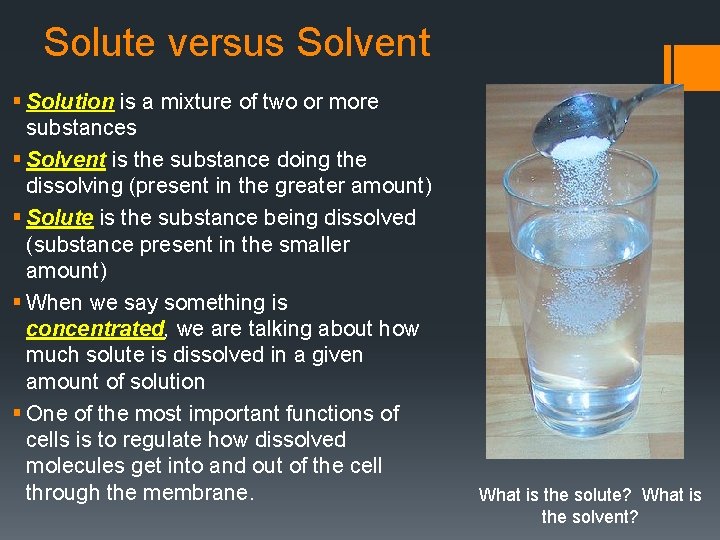
Solute versus Solvent § Solution is a mixture of two or more substances § Solvent is the substance doing the dissolving (present in the greater amount) § Solute is the substance being dissolved (substance present in the smaller amount) § When we say something is concentrated, we are talking about how much solute is dissolved in a given amount of solution § One of the most important functions of cells is to regulate how dissolved molecules get into and out of the cell through the membrane. What is the solute? What is the solvent?
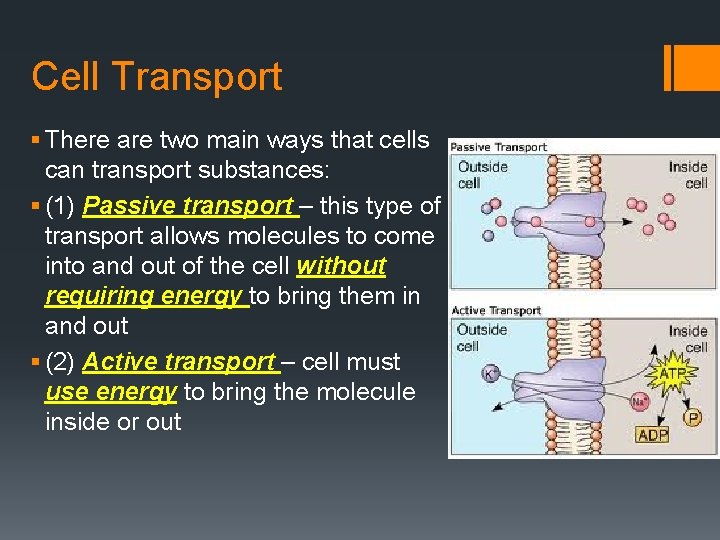
Cell Transport § There are two main ways that cells can transport substances: § (1) Passive transport – this type of transport allows molecules to come into and out of the cell without requiring energy to bring them in and out § (2) Active transport – cell must use energy to bring the molecule inside or out
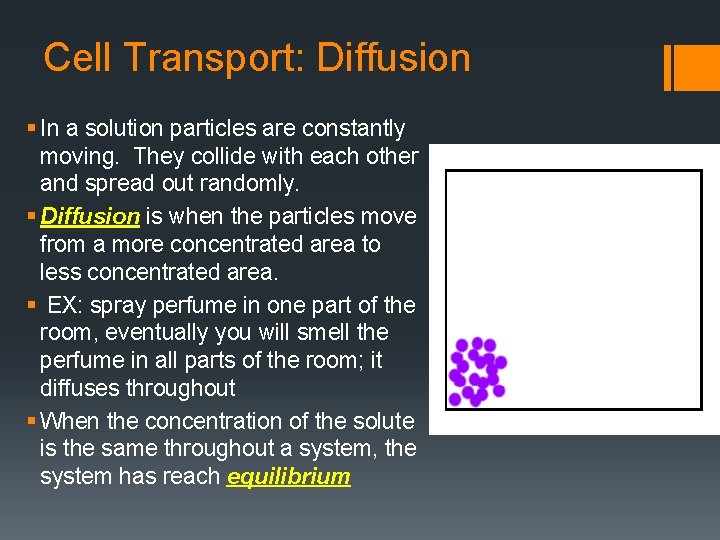
Cell Transport: Diffusion § In a solution particles are constantly moving. They collide with each other and spread out randomly. § Diffusion is when the particles move from a more concentrated area to less concentrated area. § EX: spray perfume in one part of the room, eventually you will smell the perfume in all parts of the room; it diffuses throughout § When the concentration of the solute is the same throughout a system, the system has reach equilibrium
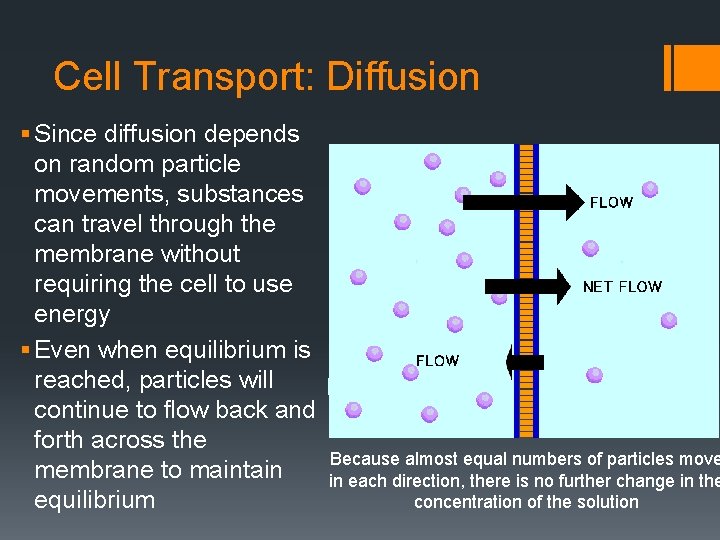
Cell Transport: Diffusion § Since diffusion depends on random particle movements, substances can travel through the membrane without requiring the cell to use energy § Even when equilibrium is reached, particles will continue to flow back and forth across the membrane to maintain equilibrium Because almost equal numbers of particles move in each direction, there is no further change in the concentration of the solution
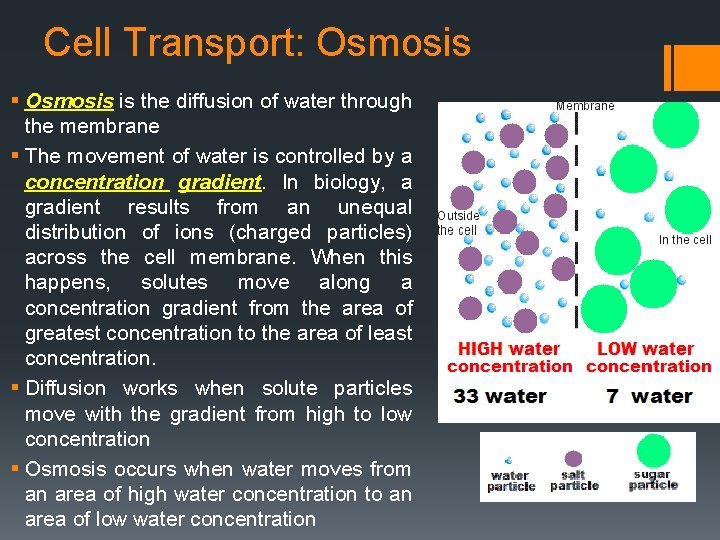
Cell Transport: Osmosis § Osmosis is the diffusion of water through the membrane § The movement of water is controlled by a concentration gradient. In biology, a gradient results from an unequal distribution of ions (charged particles) across the cell membrane. When this happens, solutes move along a concentration gradient from the area of greatest concentration to the area of least concentration. § Diffusion works when solute particles move with the gradient from high to low concentration § Osmosis occurs when water moves from an area of high water concentration to an area of low water concentration
Solutions § We can predict where water will move in three types of solutions: § (1) hypertonic solution § (2) hypotonic solution § (3) isotonic solution
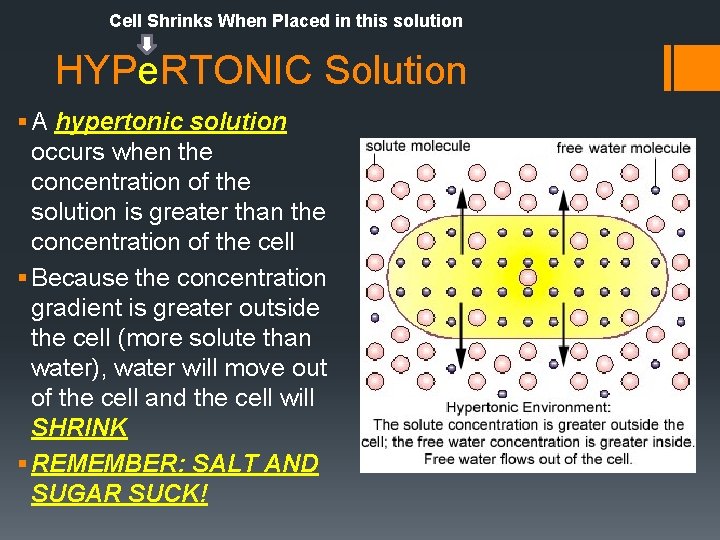
Cell Shrinks When Placed in this solution HYPe. RTONIC Solution § A hypertonic solution occurs when the concentration of the solution is greater than the concentration of the cell § Because the concentration gradient is greater outside the cell (more solute than water), water will move out of the cell and the cell will SHRINK § REMEMBER: SALT AND SUGAR SUCK!
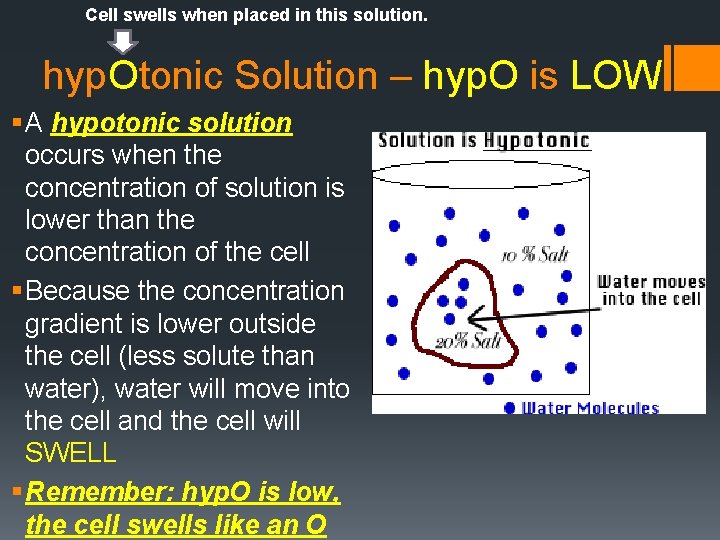
Cell swells when placed in this solution. hyp. Otonic Solution – hyp. O is LOW § A hypotonic solution occurs when the concentration of solution is lower than the concentration of the cell § Because the concentration gradient is lower outside the cell (less solute than water), water will move into the cell and the cell will SWELL § Remember: hyp. O is low, the cell swells like an O
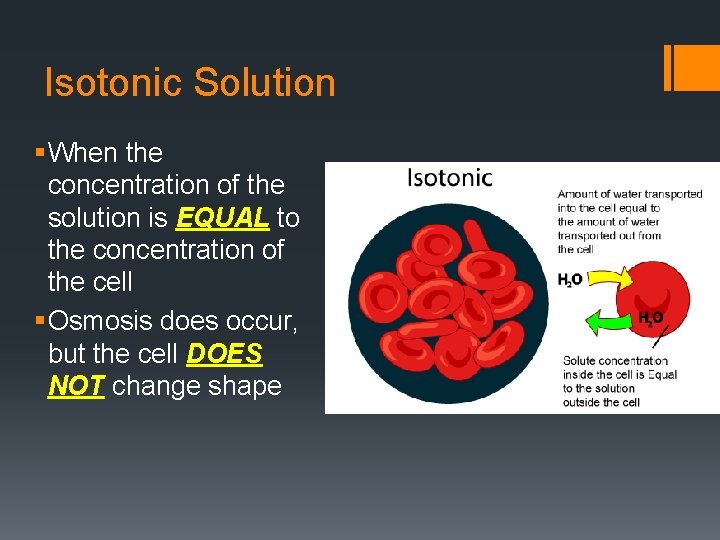
Isotonic Solution § When the concentration of the solution is EQUAL to the concentration of the cell § Osmosis does occur, but the cell DOES NOT change shape
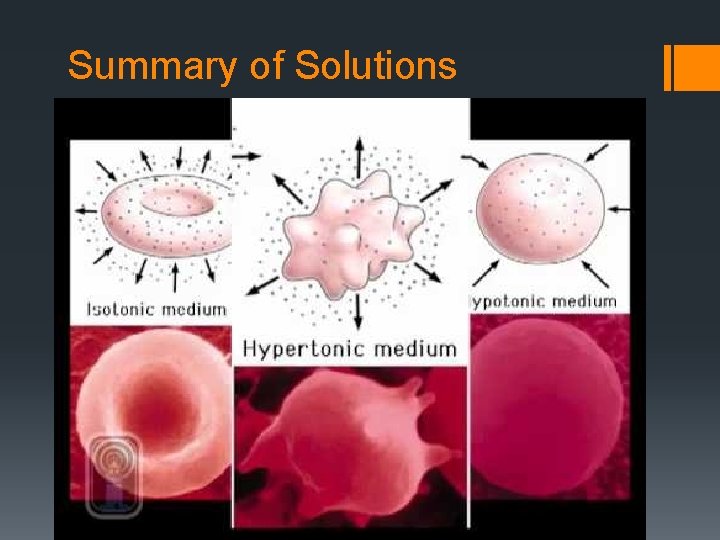
Summary of Solutions
You Practice! § Predict what happens when: § (1) A salt water plant is placed in a gallon bucket of freshwater. What will happen to the plant cell? § (2) A person is stranded out at sea. Thirsty, she drinks ocean water that has a high salt concentration. What will happen to her cells? § (3) A cell contains 5% solute and is placed in a 17% solution. What will happen to the cell?
Passive Transport § There are three types of passive transport: § 1. Diffusion § 2. Osmosis § 3. Facilitated Diffusion § All move substances WITH the gradient from HIGH to LOW concentration WITHOUT USING ENERGY!
- Slides: 17