
CELL THEORY Topic 2 1 IB Biology Miss
CELL THEORY Topic 2. 1 IB Biology Miss Werba
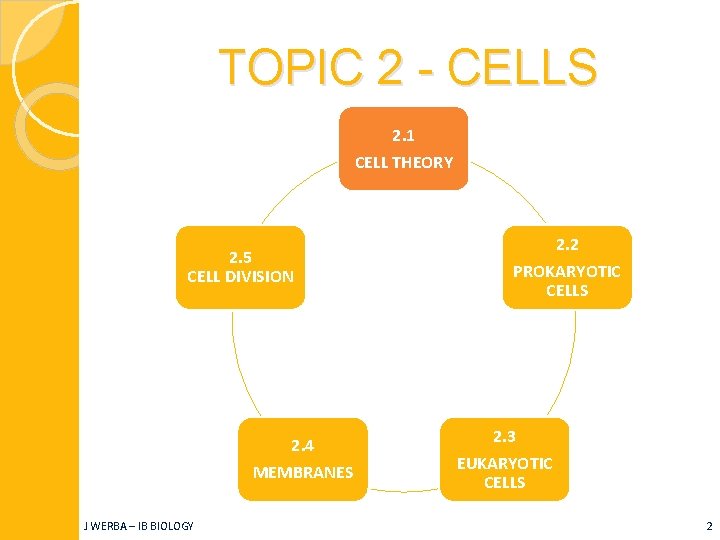
TOPIC 2 - CELLS 2. 1 CELL THEORY 2. 5 CELL DIVISION 2. 4 MEMBRANES J WERBA – IB BIOLOGY 2. 2 PROKARYOTIC CELLS 2. 3 EUKARYOTIC CELLS 2
THINGS TO COVER � Outline of cell theory � Evidence for the cell theory � Unicellular organisms � Relative sizes of cells � Magnification � Surface area: Volume ratios and cell size � Emergent properties � Cell differentiation � Stem cells � Therapeutic use of stem cells J WERBA – IB BIOLOGY 3
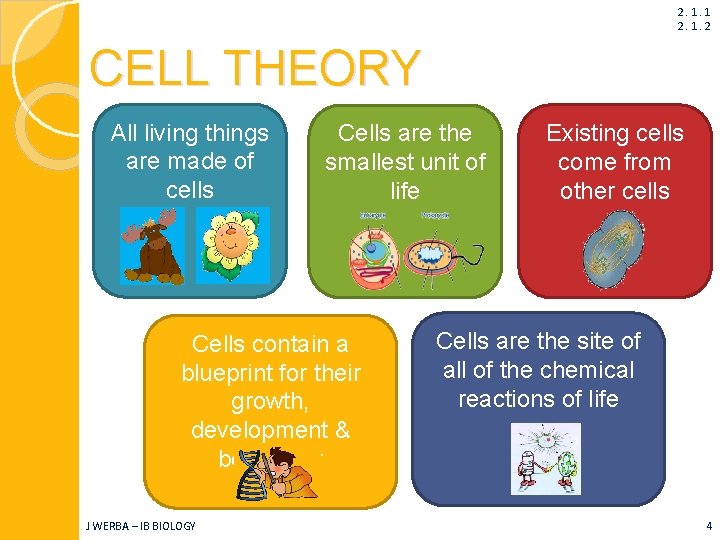
2. 1. 1 2. 1. 2 CELL THEORY All living things are made of cells Cells are the smallest unit of life Cells contain a blueprint for their growth, development & behaviour J WERBA – IB BIOLOGY Existing cells come from other cells Cells are the site of all of the chemical reactions of life 4
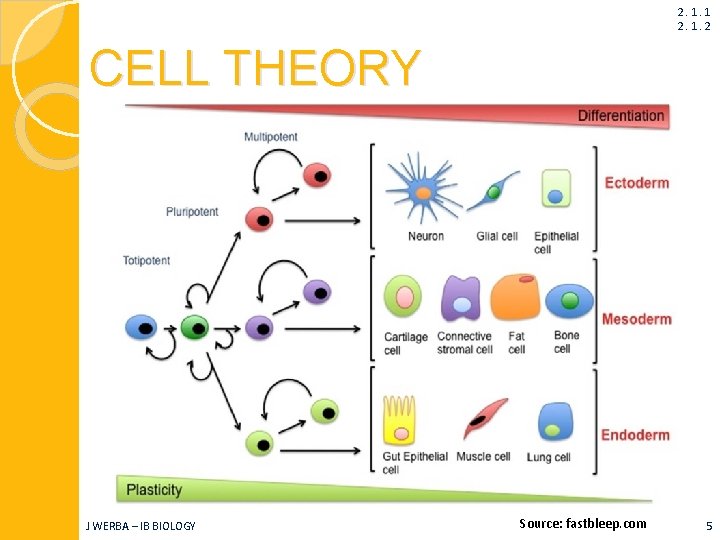
2. 1. 1 2. 1. 2 CELL THEORY J WERBA – IB BIOLOGY Source: fastbleep. com 5
2. 1. 1 2. 1. 2 CELL THEORY � Evidence: ◦ With the invention of microscopes (Janssen) scientists could see cells (Hooke, Leeuwenhoek) ◦ Pasteur demonstrated that cells couldn’t grow in sterile conditions (disproved abiogenesis) ◦ Organelles and viruses cannot carry out all of the characteristics of other living things ◦ Cell division is visible under a microscope J WERBA – IB BIOLOGY 6
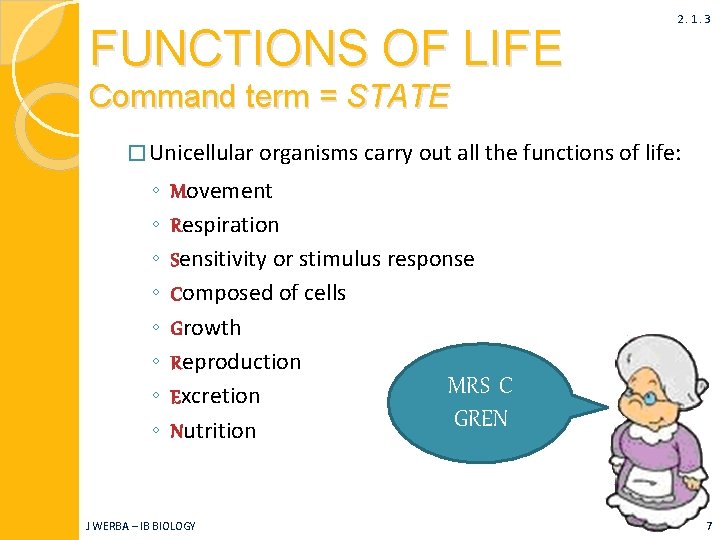
FUNCTIONS OF LIFE 2. 1. 3 Command term = STATE � Unicellular organisms carry out all the functions of life: ◦ ◦ ◦ ◦ Movement Respiration Sensitivity or stimulus response Composed of cells Growth Reproduction MRS C Excretion GREN Nutrition J WERBA – IB BIOLOGY 7
CELL SIZE 2. 1. 4 Use your logic to put these in the correct order! �Bacteria �Cell membrane thickness �Cells �Molecules �Organelles �Virus J WERBA – IB BIOLOGY 8
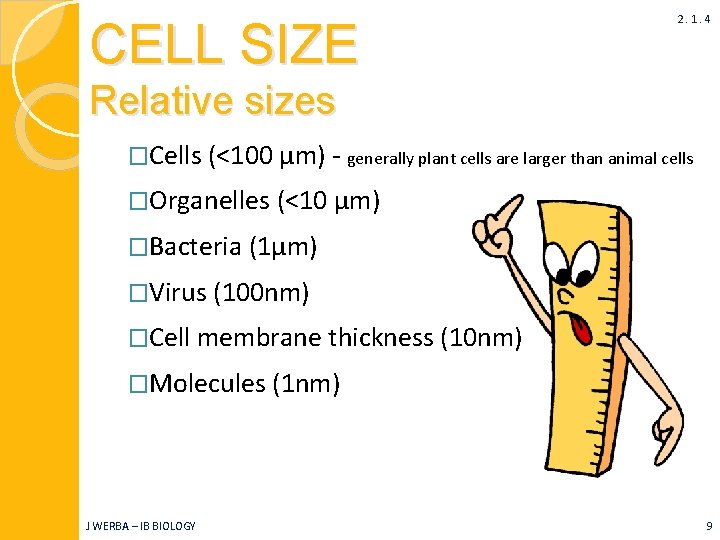
CELL SIZE 2. 1. 4 Relative sizes �Cells (<100 μm) - generally plant cells are larger than animal cells �Organelles (<10 μm) �Bacteria (1μm) �Virus (100 nm) �Cell membrane thickness (10 nm) �Molecules (1 nm) J WERBA – IB BIOLOGY 9

CELL SIZE 2. 1. 4 Relative sizes J WERBA – IB BIOLOGY 10
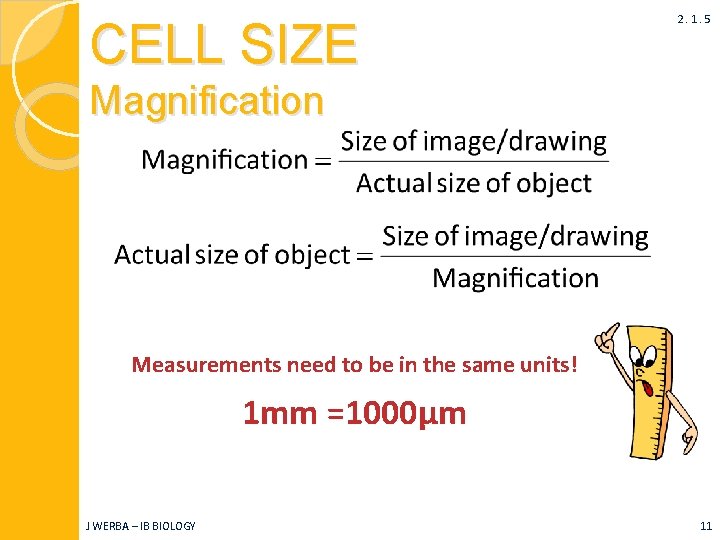
CELL SIZE 2. 1. 5 Magnification Measurements need to be in the same units! 1 mm =1000μm J WERBA – IB BIOLOGY 11
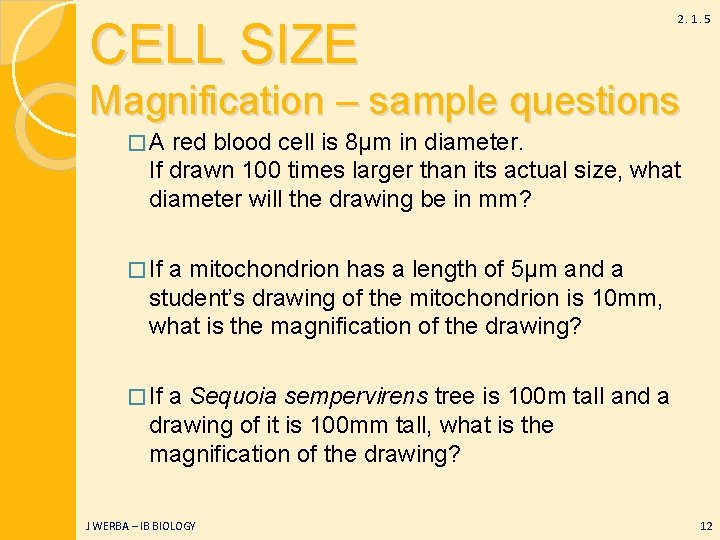
CELL SIZE 2. 1. 5 Magnification – sample questions �A red blood cell is 8μm in diameter. If drawn 100 times larger than its actual size, what diameter will the drawing be in mm? � If a mitochondrion has a length of 5µm and a student’s drawing of the mitochondrion is 10 mm, what is the magnification of the drawing? � If a Sequoia sempervirens tree is 100 m tall and a drawing of it is 100 mm tall, what is the magnification of the drawing? J WERBA – IB BIOLOGY 12
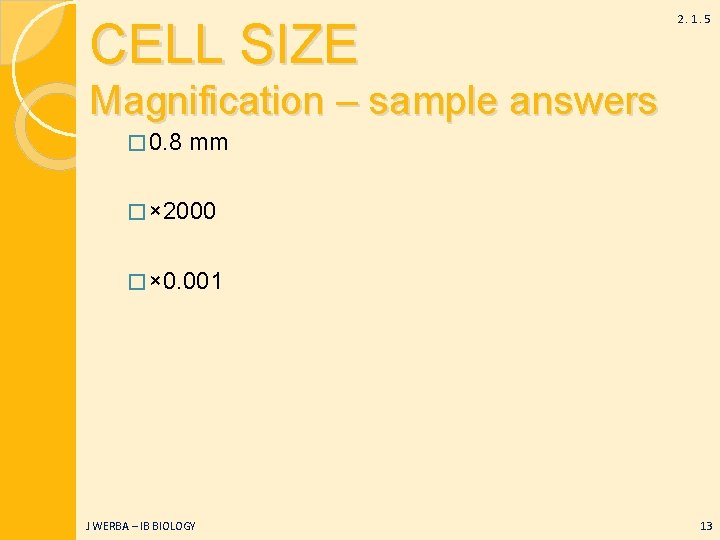
CELL SIZE 2. 1. 5 Magnification – sample answers � 0. 8 mm � × 2000 � × 0. 001 J WERBA – IB BIOLOGY 13
CELL SIZE 2. 1. 6 Limitations � Cells cannot grow indefinitely. � They reach a maximum size and then they may divide. � If a cell becomes too large, it would develop problems. � These problems may include…. ? J WERBA – IB BIOLOGY 14
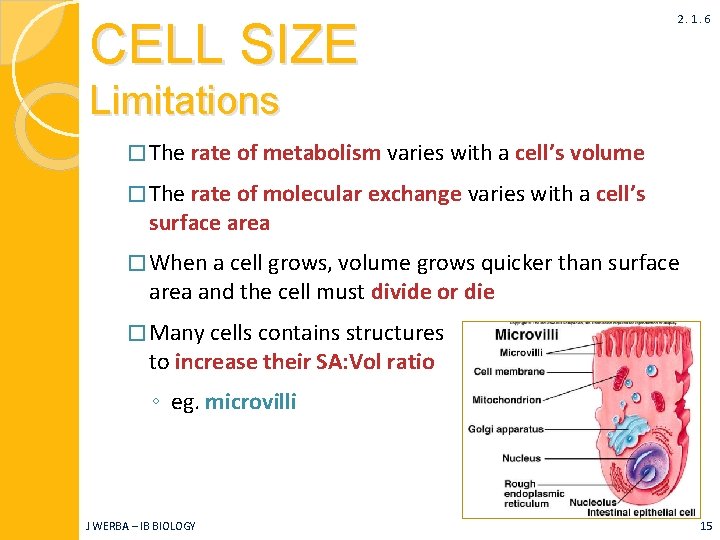
CELL SIZE 2. 1. 6 Limitations � The rate of metabolism varies with a cell’s volume � The rate of molecular exchange varies with a cell’s surface area � When a cell grows, volume grows quicker than surface area and the cell must divide or die � Many cells contains structures to increase their SA: Vol ratio ◦ eg. microvilli J WERBA – IB BIOLOGY 15
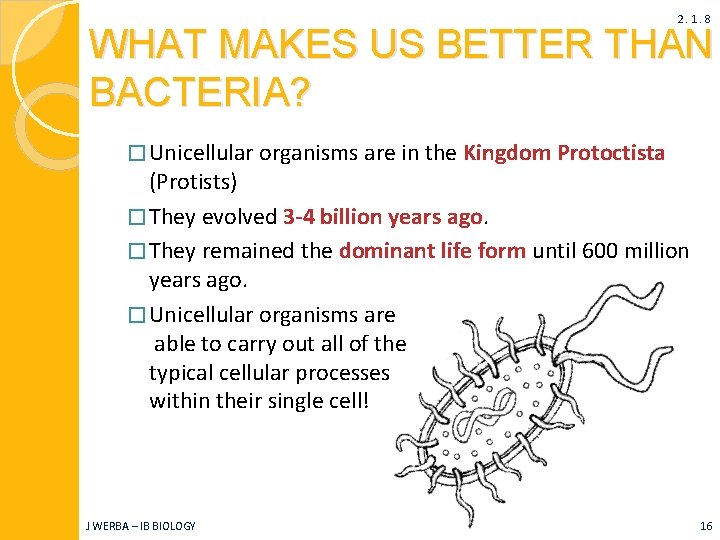
2. 1. 8 WHAT MAKES US BETTER THAN BACTERIA? � Unicellular organisms are in the Kingdom Protoctista (Protists) � They evolved 3 -4 billion years ago. � They remained the dominant life form until 600 million years ago. � Unicellular organisms are able to carry out all of the typical cellular processes within their single cell! J WERBA – IB BIOLOGY 16
2. 1. 8 WHAT MAKES US BETTER THAN BACTERIA? � Kingdom Plantae, Animalia and Fungi are all composed of eukaryotic cells � They are multicellular organisms – made up of many cells together. � These cells specialise so that all energy in the cell is not taken up by performing all cellular functions. � These cells group into tissues, organs and systems making us far more capable than a single bacterial cell. J WERBA – IB BIOLOGY 17
2. 1. 8 CELL DIFFERENTIATION � Differentiation: process by which newly-formed cells specialize as they mature � Cells in multicellular organisms share the same genetic info (cf. cell division, reproduction, formation of blastocyst) � What is different between cells is gene expression � Chemical signals lead to differential gene expression and thus specialization of cells J WERBA – IB BIOLOGY 18
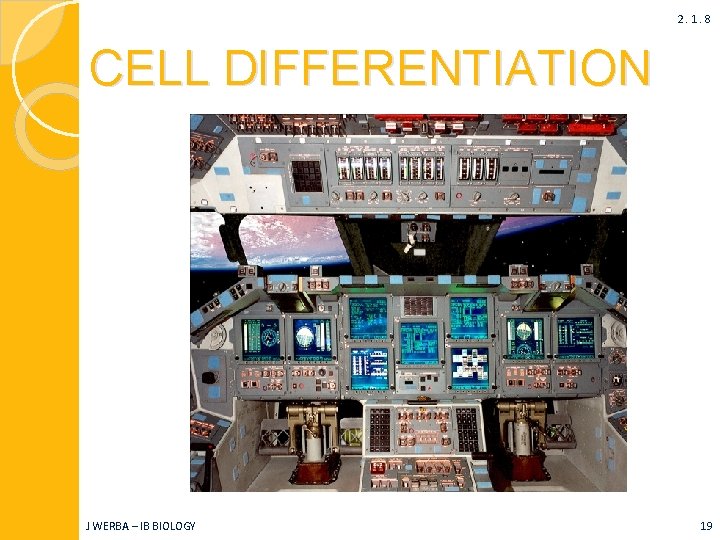
2. 1. 8 CELL DIFFERENTIATION J WERBA – IB BIOLOGY 19
EMERGENT PROPERTIES 2. 1. 7 Command term = STATE � The combination of different cell types can give rise to emergent properties in multicellular organisms � Means that the whole organism is greater than the sum of its parts: ◦ b/c of the varied gene expression ◦ b/c of the complex interactions between cells J WERBA – IB BIOLOGY 20
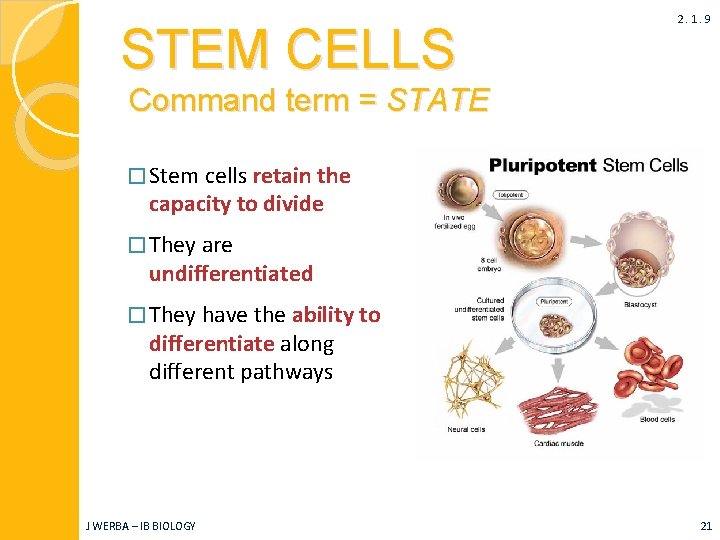
STEM CELLS 2. 1. 9 Command term = STATE � Stem cells retain the capacity to divide � They are undifferentiated � They have the ability to differentiate along different pathways J WERBA – IB BIOLOGY 21
THERAPEUTIC USE OF STEM CELLS 2. 1. 10 � Stem cells have the potential for tissue repair and can theoretically treat a variety of degenerative conditions � In 1968, doctors performed the first successful transplant. bone marrow � Bone marrow contains somatic stem cells. It is transplanted routinely to treat a variety of blood and bone marrow diseases, blood cancers, and immune disorders. � More recently, peripheral blood stem cells (from the blood stream) and umbilical cord stem cells have been used to treat some of the same blood-based diseases. J WERBA – IB BIOLOGY 22
THERAPEUTIC USE OF STEM CELLS 2. 1. 10 � eg. Parkinson’s Disease, MS, strokes ◦ all involve loss of neurons or other cells in the nervous system ◦ could potentially use stem cells to replace them J WERBA – IB BIOLOGY 23
THERAPEUTIC USE OF STEM CELLS 2. 1. 10 � eg. Leukaemia ◦ ◦ a cancer of white blood cells or leukocytes chemotherapy is normally used to kill the abnormal cells; however, a bone marrow transplant is needed if it doesn't work. 1. The patient's existing bone marrow and abnormal leukocytes are first killed using chemotherapy and radiation. A sample of donor bone marrow containing healthy, matched stem cells is introduced into the patient's bloodstream. If the transplant is successful, the stem cells will migrate into the patient's bone marrow and begin producing new, healthy leukocytes to replace the abnormal cells. 2. 3. J WERBA – IB BIOLOGY 24
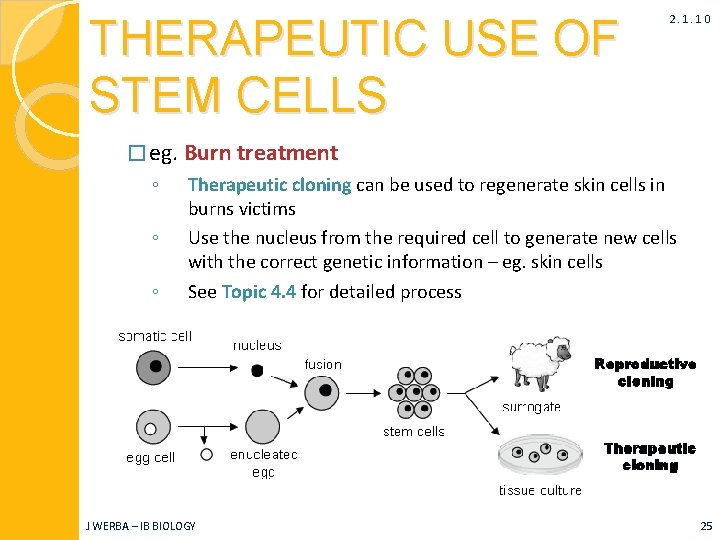
THERAPEUTIC USE OF STEM CELLS 2. 1. 10 � eg. Burn treatment ◦ ◦ ◦ Therapeutic cloning can be used to regenerate skin cells in burns victims Use the nucleus from the required cell to generate new cells with the correct genetic information – eg. skin cells See Topic 4. 4 for detailed process J WERBA – IB BIOLOGY 25
2. 1. 10 J WERBA – IB BIOLOGY 26
2. 1. 10 J WERBA – IB BIOLOGY 27
- Slides: 27