
CELL THEORY MICROSCOPES AND PROKARYOTESEUKARYOTES MICROSCOPES WHAT ARE
- Slides: 31
CELL THEORY, MICROSCOPES AND PROKARYOTES/EUKARYOTES
MICROSCOPES
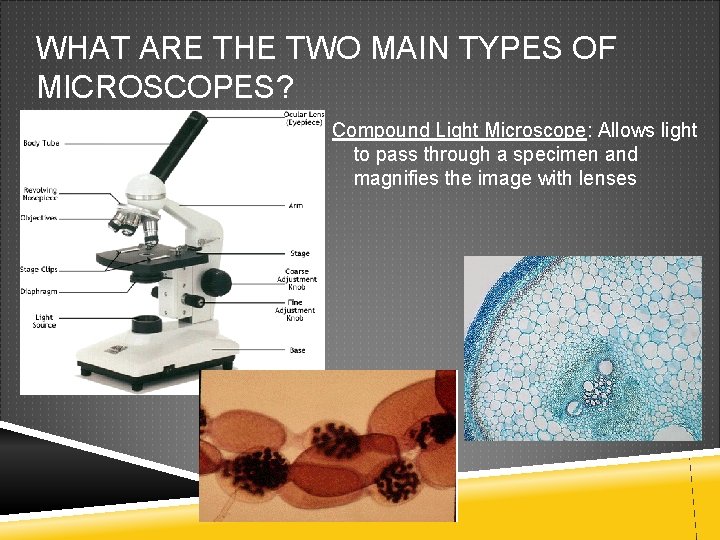
WHAT ARE THE TWO MAIN TYPES OF MICROSCOPES? • Ch. 7 Compound Light Microscope: Allows light to pass through a specimen and magnifies the image with lenses
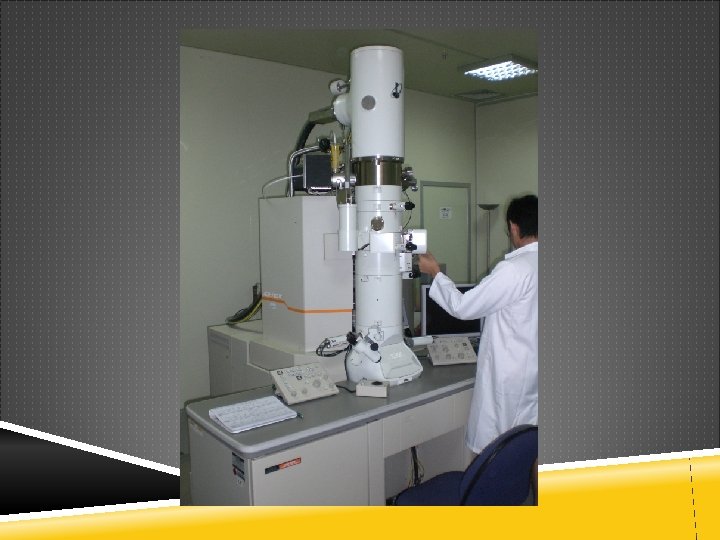
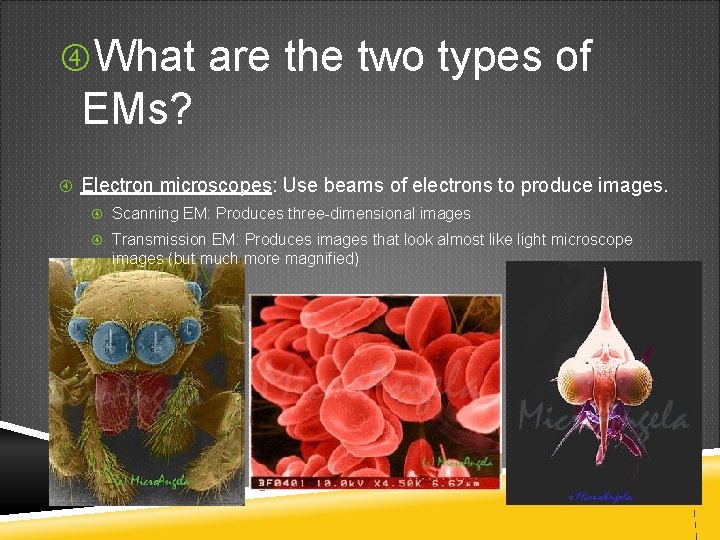
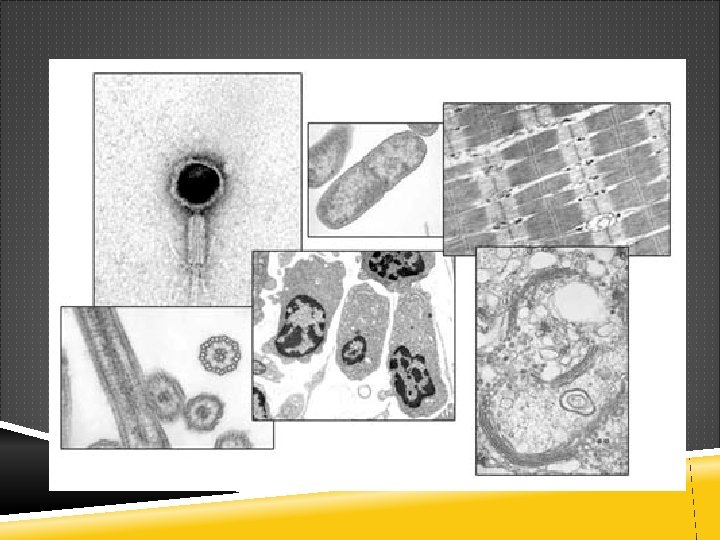
What are the two types of EMs? Electron microscopes: Use beams of electrons to produce images. Scanning EM: Produces three-dimensional images Transmission EM: Produces images that look almost like light microscope images (but much more magnified)
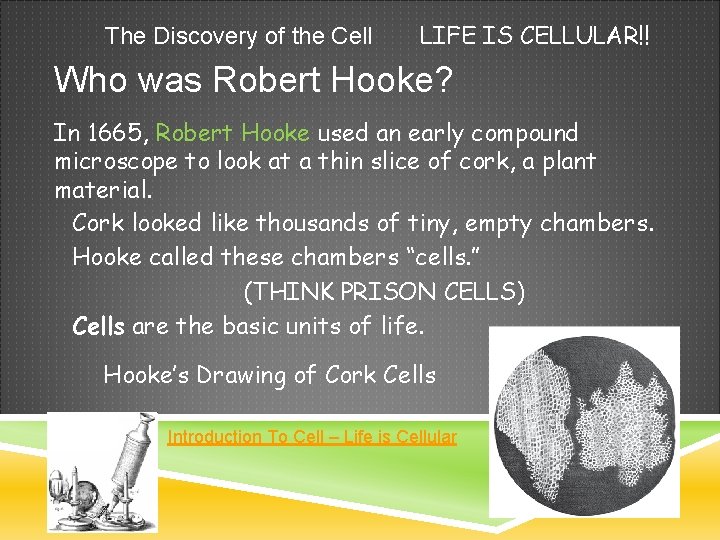
The Discovery of the Cell LIFE IS CELLULAR!! Who was Robert Hooke? In 1665, Robert Hooke used an early compound microscope to look at a thin slice of cork, a plant material. Cork looked like thousands of tiny, empty chambers. Hooke called these chambers “cells. ” (THINK PRISON CELLS) Cells are the basic units of life. Hooke’s Drawing of Cork Cells Introduction To Cell – Life is Cellular
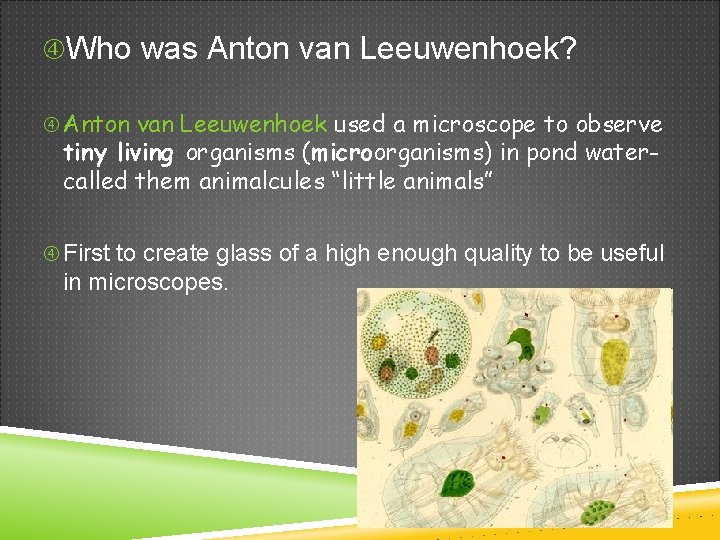
Who was Anton van Leeuwenhoek? Anton van Leeuwenhoek used a microscope to observe tiny living organisms (microorganisms) in pond watercalled them animalcules “little animals” First to create glass of a high enough quality to be useful in microscopes.
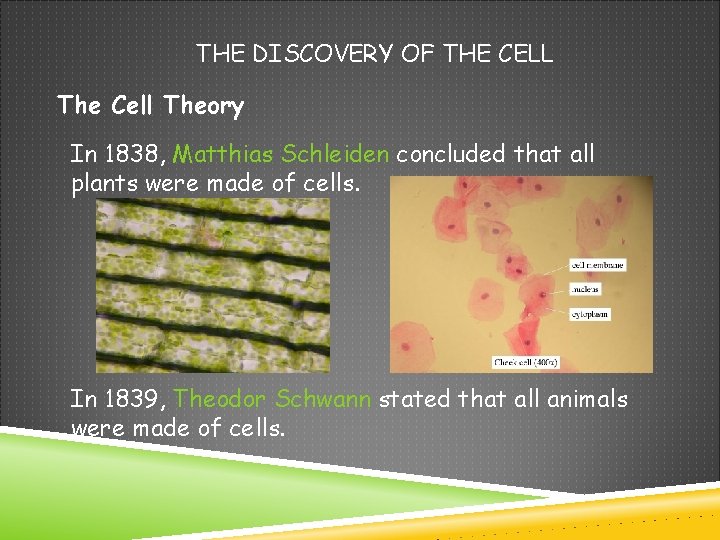
THE DISCOVERY OF THE CELL The Cell Theory In 1838, Matthias Schleiden concluded that all plants were made of cells. In 1839, Theodor Schwann stated that all animals were made of cells.
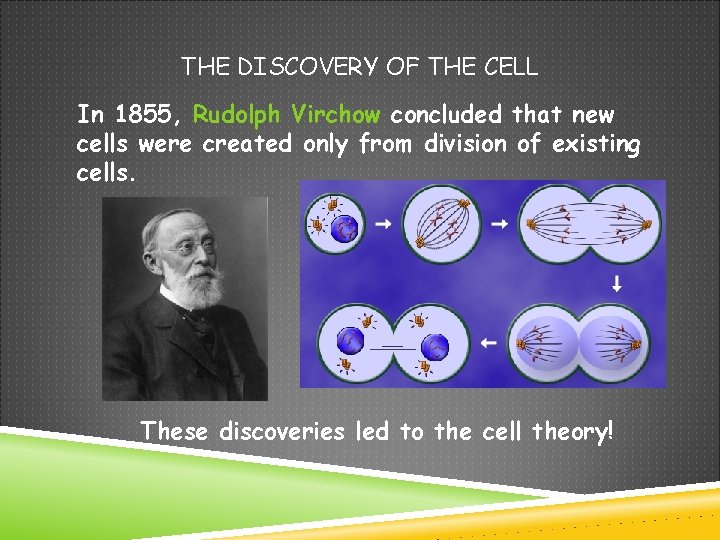
THE DISCOVERY OF THE CELL In 1855, Rudolph Virchow concluded that new cells were created only from division of existing cells. These discoveries led to the cell theory!
THE DISCOVERY OF THE CELL What does the cell theory state? All living things are composed of one or more cells. (you, me, plants, bugs, fish, Spiderman, Colonel Sanders, Jimmy Neutron, Bacteria, Yeast, Jackie Chan) Cells are the basic units of structure and function in living things. (what keeps us upright and helps us live, basically small workers responsible for how we function!) New cells are produced from existing cells. (they can’t just appear out of thin air…cells make new cells by dividing!) Cell Theory
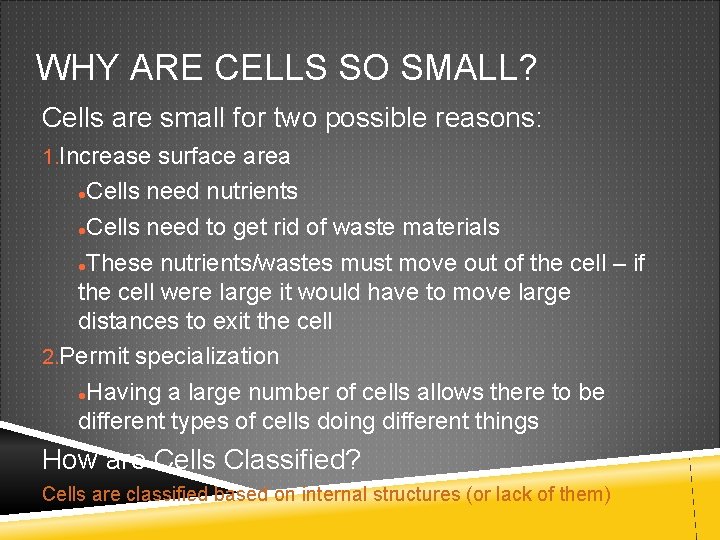
WHY ARE CELLS SO SMALL? Cells are small for two possible reasons: 1. Increase surface area Cells need nutrients Cells need to get rid of waste materials These nutrients/wastes must move out of the cell – if the cell were large it would have to move large distances to exit the cell 2. Permit specialization Having a large number of cells allows there to be different types of cells doing different things How are Cells Classified? Cells are classified based on internal structures (or lack of them)
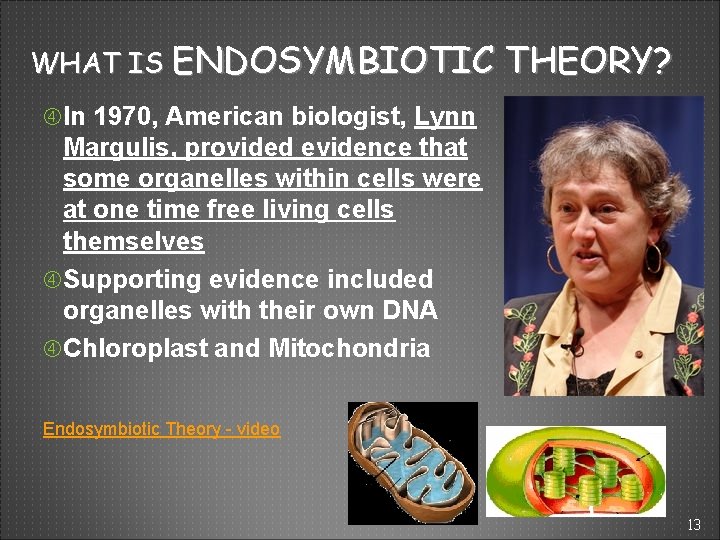
WHAT IS ENDOSYMBIOTIC THEORY? In 1970, American biologist, Lynn Margulis, provided evidence that some organelles within cells were at one time free living cells themselves Supporting evidence included organelles with their own DNA Chloroplast and Mitochondria Endosymbiotic Theory - video 13
WHAT ARE THE TWO TYPES OF CELLS? PROKARYOTES AND EUKARYOTES What are the characteristics of prokaryotes and eukaryotes? Eukaryotes are cells that contain nuclei. Prokaryotes are cells that do not contain nuclei.
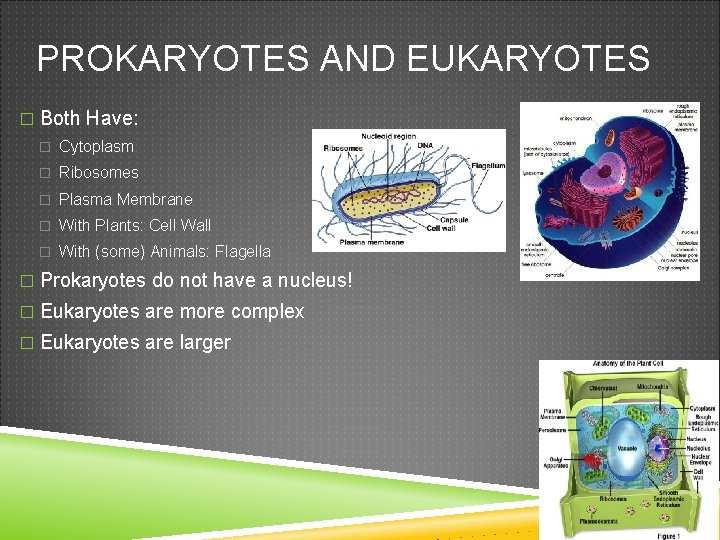
PROKARYOTES AND EUKARYOTES � Both Have: � Cytoplasm � Ribosomes � Plasma Membrane � With Plants: Cell Wall � With (some) Animals: Flagella � Prokaryotes do not have a nucleus! � Eukaryotes are more complex � Eukaryotes are larger
WHY ARE CELLS NAMED THAT WAY? � From Greek words… � EU means TRUE. (YOU HAVE) � PRO means BEFORE. (NO) � KARYON means NUCLEUS. Eukaryote = TRUE NUCLEUS; Prokaryote = BEFORE NUCLEUS. � All cells have DNA, in eukaryotes it is stored in the nucleus. � Prokaryotes don’t have a nucleus, and it floats around in the cytoplasm in an area called the nucleoid. � Only eukaryotes have membrane-bound organelles. Video-Comparing Prokaryote and Eukaryote Cells
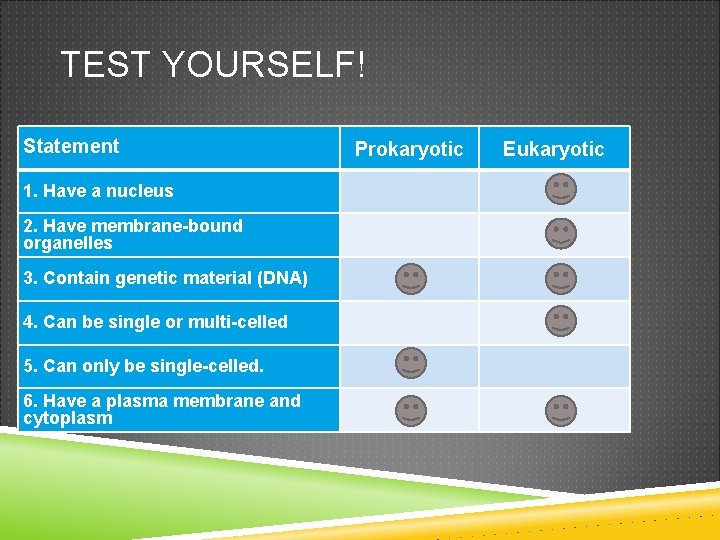
TEST YOURSELF! Statement 1. Have a nucleus 2. Have membrane-bound organelles 3. Contain genetic material (DNA) 4. Can be single or multi-celled 5. Can only be single-celled. 6. Have a plasma membrane and cytoplasm Prokaryotic Eukaryotic
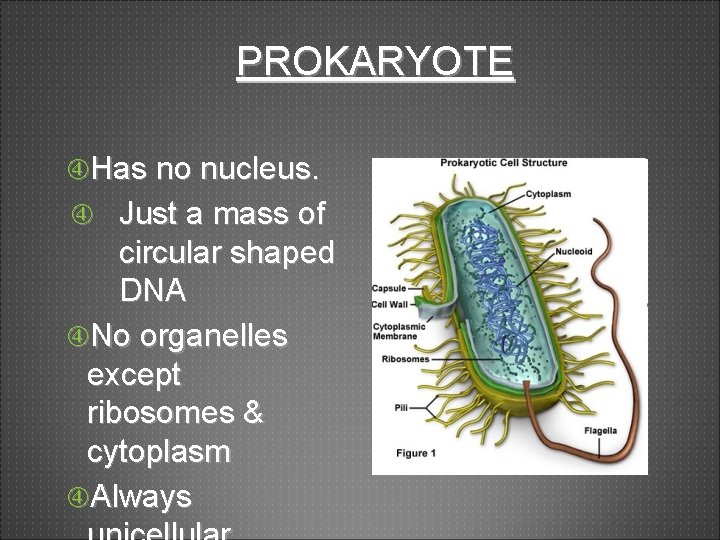
PROKARYOTE Has no nucleus. Just a mass of circular shaped DNA No organelles except ribosomes & cytoplasm Always
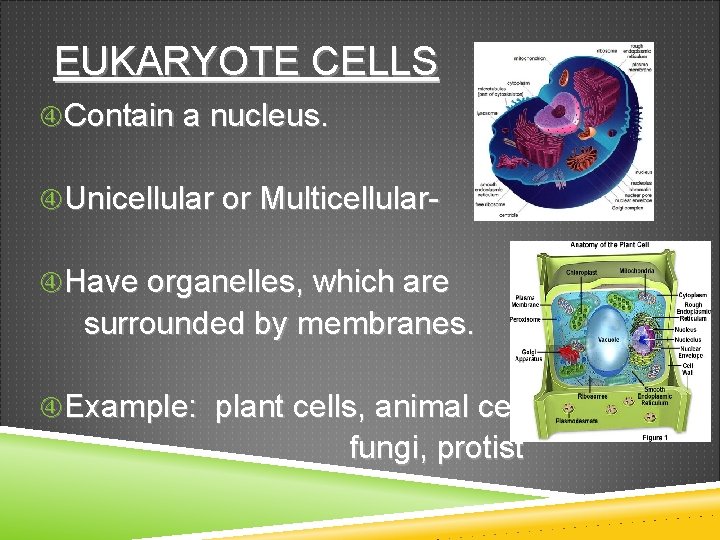
EUKARYOTE CELLS Contain a nucleus. Unicellular or Multicellular Have organelles, which are surrounded by membranes. Example: plant cells, animal cells, fungi, protist
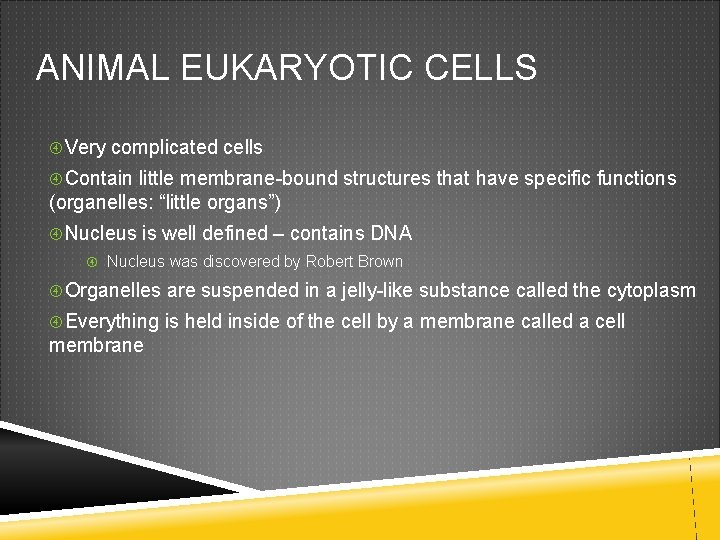
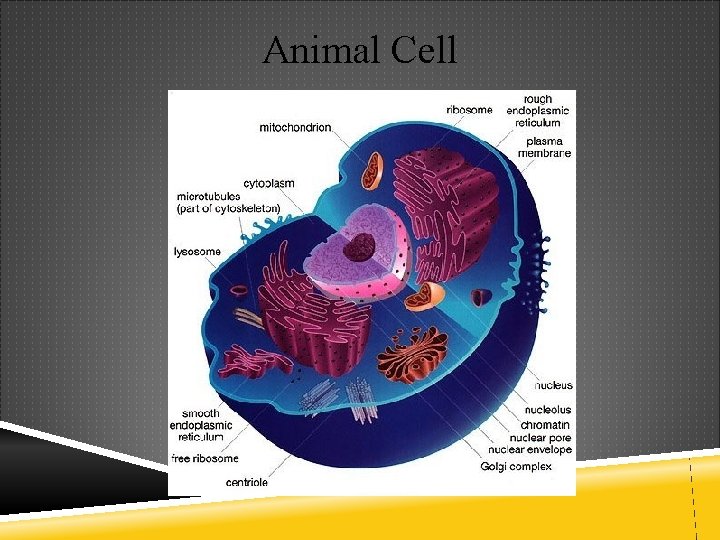
ANIMAL EUKARYOTIC CELLS Very complicated cells Contain little membrane-bound structures that have specific functions (organelles: “little organs”) Nucleus is well defined – contains DNA Nucleus was discovered by Robert Brown Organelles are suspended in a jelly-like substance called the cytoplasm Everything is held inside of the cell by a membrane called a cell membrane
Animal Cell
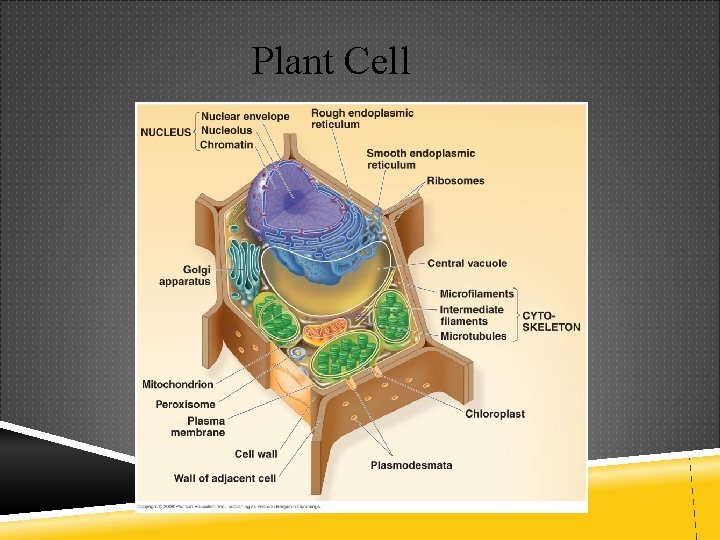
PLANT EUKARYOTIC CELLS Almost identical to animal cells except they have three more organelles than animals cells Cell wall: allows plants to stand upright Chloroplast: where photosynthesis takes place Large Central Vacuole: storage compartment
Plant Cell
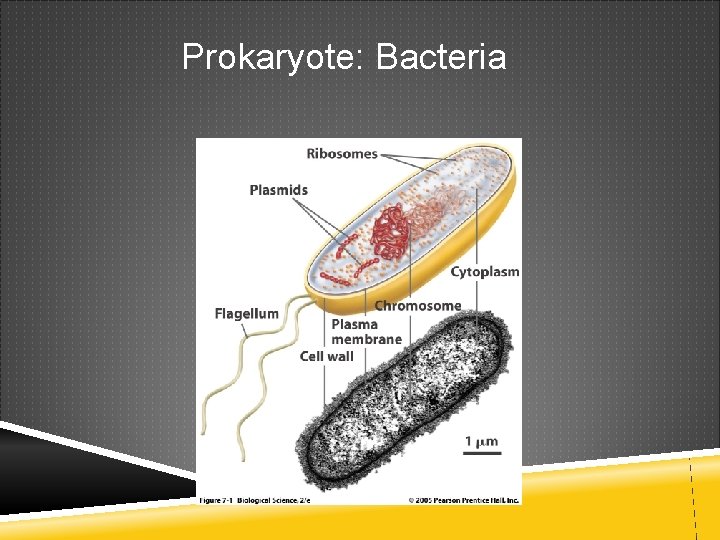
BACTERIAL PROKARYOTIC CELLS Simplest cells The first forms of life were probably bacterial cells (or something like it) Lack membrane-bound organelles Contain cytoplasm (cell jelly) All prokaryotes are unicellular
CHARACTERISTICS OF PROKARYOTES CON'T Do not possess a distinct nucleus Nucleoid: Ill-defined region of the cell where the DNA is usually located. DNA Loop: DNA is a long single fiber that contains almost all of the genetic material of the cell. Plasmid: Small circular loop of DNA that contains the rest of the genetic material Can be transferred between bacterial cells Can contain genes for antibiotic resistance
CHARACTERISTICS CON'T Have ribosomes floating freely in the cytoplasm The ribosome is where proteins are made Certain antibiotics (tetracycline and streptomycin) prevent prokaryotic ribosomes from working Most prokaryotes have a cell wall Some can develop a capsule Many prokaryotes have a flagellum (or multiple flagella, plural) for movement
Prokaryote: Bacteria
CELL WALL Functions: Give the cell shape Protects the cell from hostile environmental conditions Made up of peptidoglycans (mesh of sugars and proteins) Two types Gram-positive cell wall Gram-negative cell wall Penicillin and Lysozyme
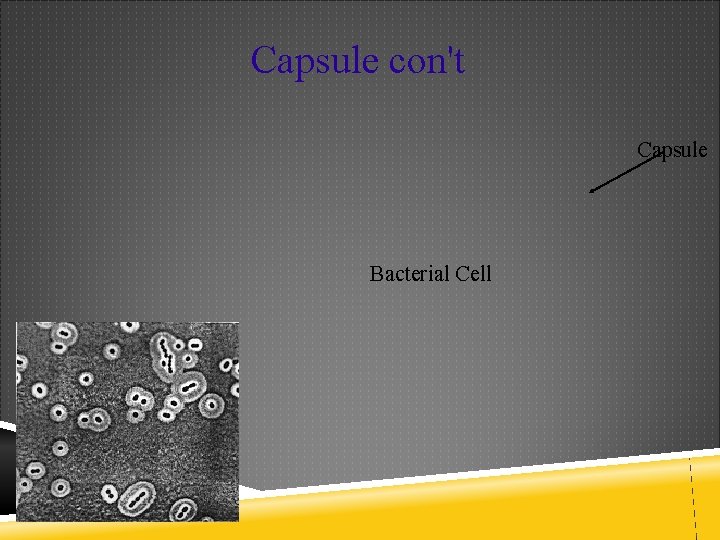
CAPSULE Jelly-like coating that surrounds the cell wall Composed of carbohydrates More common in gram-negative bacteria Four functions: Prevent dessication (drying out) Help bacterial cells stick to each other or to other surfaces (e. g. , tissues of other organisms) Protect bacteria from antibiotics Prevent bacteria from being phagocytized.
Capsule con't Capsule Bacterial Cell
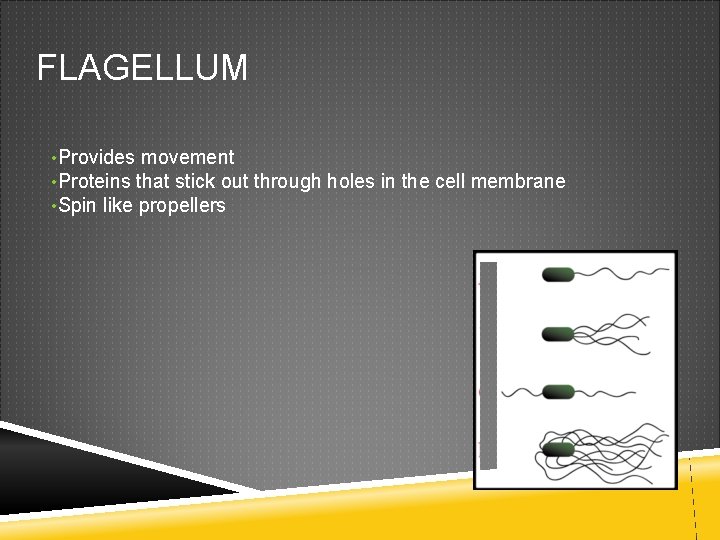
FLAGELLUM • Provides movement • Proteins that stick out through holes in the cell membrane • Spin like propellers