
Cell Theory Introduction to Cell Structure Adapted from
- Slides: 20
Cell Theory & Introduction to Cell Structure Adapted from Yam NB, 2012
Recall… What is the smallest unit of life? What is Biogenesis? What is Spontaneous Generation?
Recall… What is the smallest unit of life? Cells What is Biogenesis? – the idea that living organisms can only come from other living organisms What is Spontaneous Generation? – the idea that living organisms could “spontaneously” come from non-living things.
I. Cell Theory • The Cell Theory began with the development of the microscope in the 1600 s! • The current cell theory consists of six parts.
Modern Cell Theory – Six Parts 1. 2. 3. 4. 5. 6. All living things are composed of one or more cells. Cells are the basic unit of structure & function of all living things. All cells come from pre-existing cells & contain DNA that is passed from cell to cell during cell division. Cells contain specialized structures to perform functions necessary for life. Cells have the same basic chemical composition in organisms of similar species. Energy flow occurs within cells.
II. Individual Contributions to the Cell theory Francesco Redi ◦ Performed experiment with meat in jars. ◦ Showed that meat can’t generate maggots. Lazzaro Spallanzani Performed experiment with meat broth in flasks. Showed that broth can’t generate microbes (bacteria). Showed that if meat broth in flasks were boiled and then sealed, no microbes would appear unless you reopened the flask and exposed it to open air.
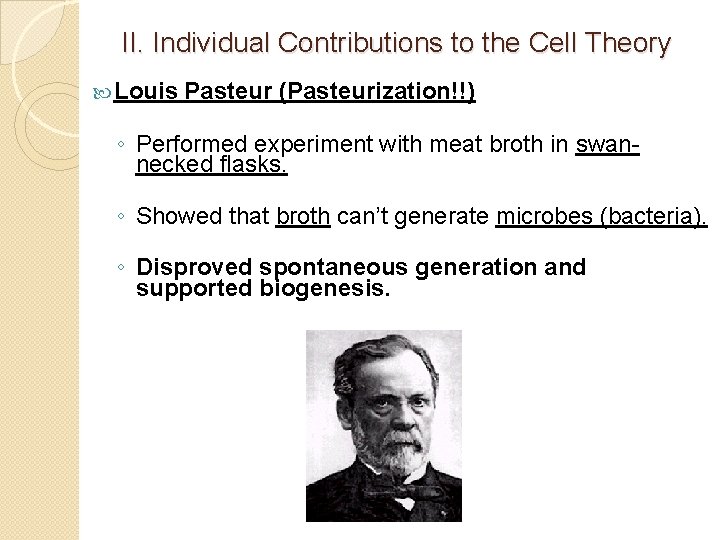
II. Individual Contributions to the Cell Theory Louis Pasteur (Pasteurization!!) ◦ Performed experiment with meat broth in swannecked flasks. ◦ Showed that broth can’t generate microbes (bacteria). ◦ Disproved spontaneous generation and supported biogenesis.
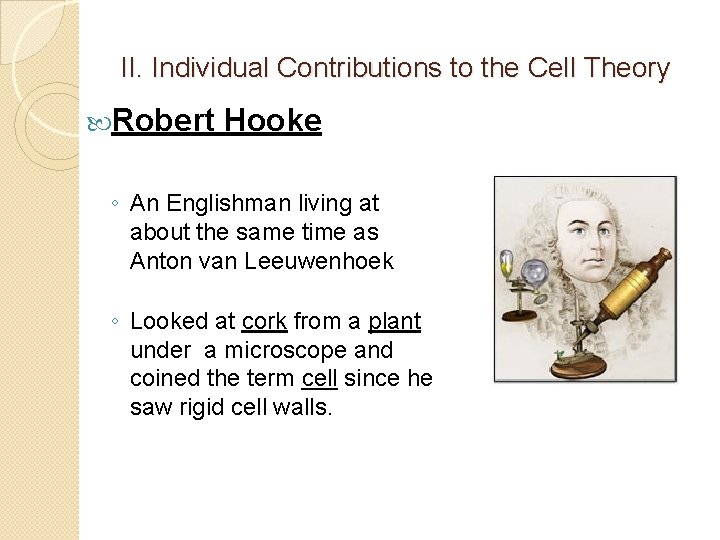
II. Individual Contributions to the Cell Theory Robert Hooke ◦ An Englishman living at about the same time as Anton van Leeuwenhoek ◦ Looked at cork from a plant under a microscope and coined the term cell since he saw rigid cell walls.
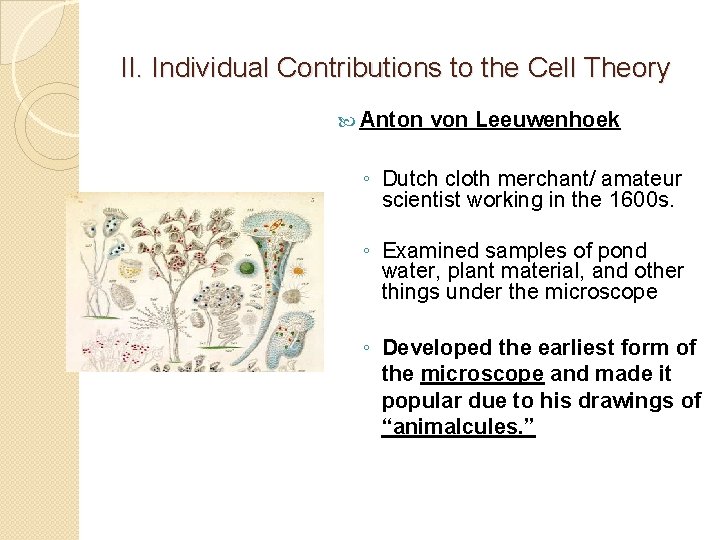
II. Individual Contributions to the Cell Theory Anton von Leeuwenhoek ◦ Dutch cloth merchant/ amateur scientist working in the 1600 s. ◦ Examined samples of pond water, plant material, and other things under the microscope ◦ Developed the earliest form of the microscope and made it popular due to his drawings of “animalcules. ”
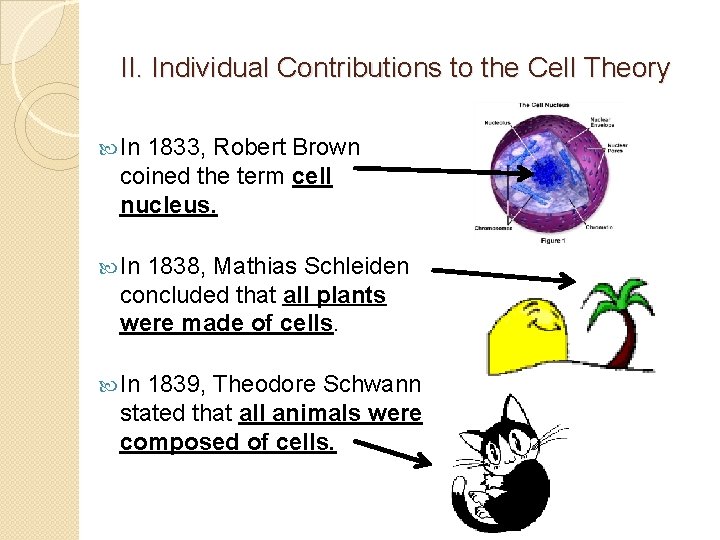
II. Individual Contributions to the Cell Theory In 1833, Robert Brown coined the term cell nucleus. In 1838, Mathias Schleiden concluded that all plants were made of cells. In 1839, Theodore Schwann stated that all animals were composed of cells.
We would not be able to see cells without microscopes!!!
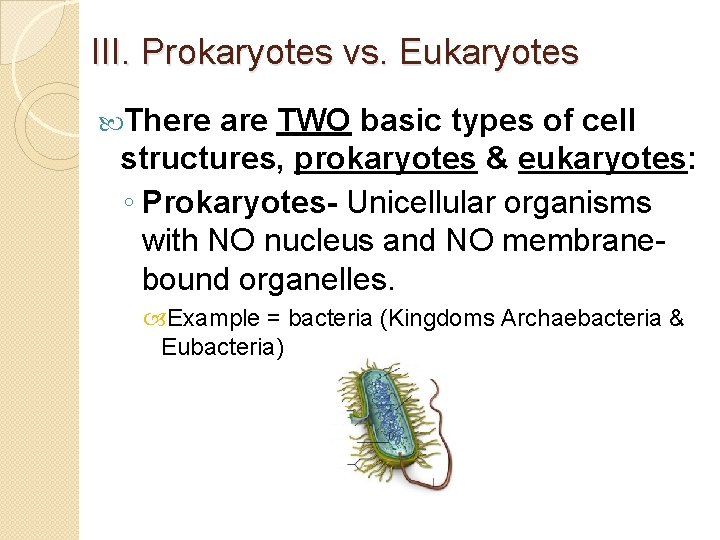
III. Prokaryotes vs. Eukaryotes There are TWO basic types of cell structures, prokaryotes & eukaryotes: ◦ Prokaryotes- Unicellular organisms with NO nucleus and NO membranebound organelles. Example = bacteria (Kingdoms Archaebacteria & Eubacteria)
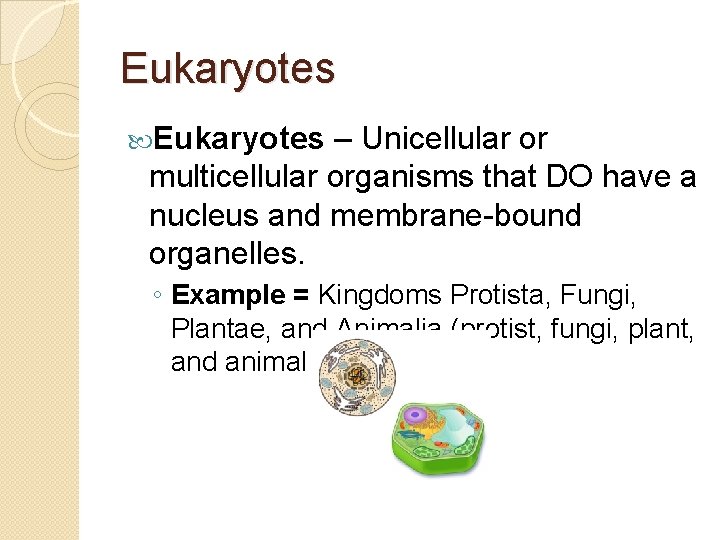
Eukaryotes – Unicellular or multicellular organisms that DO have a nucleus and membrane-bound organelles. ◦ Example = Kingdoms Protista, Fungi, Plantae, and Animalia (protist, fungi, plant, and animal cells)
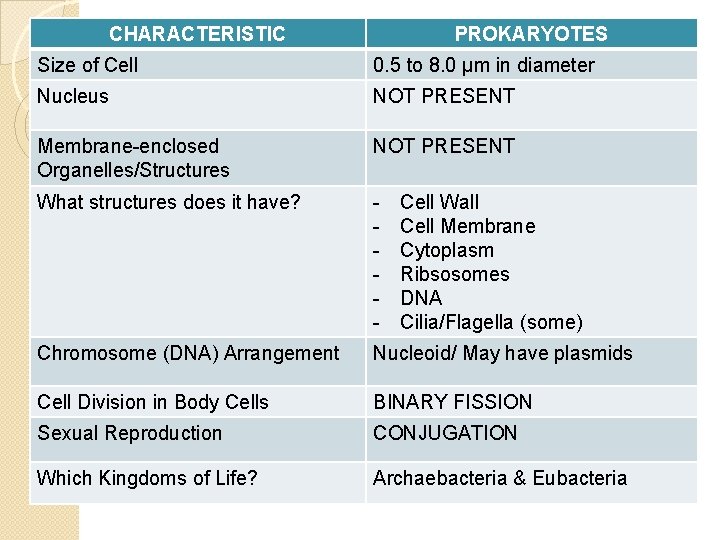
CHARACTERISTIC PROKARYOTES Size of Cell 0. 5 to 8. 0 µm in diameter Nucleus NOT PRESENT Membrane-enclosed Organelles/Structures NOT PRESENT What structures does it have? - Chromosome (DNA) Arrangement Nucleoid/ May have plasmids Cell Division in Body Cells BINARY FISSION Sexual Reproduction CONJUGATION Which Kingdoms of Life? Archaebacteria & Eubacteria Cell Wall Cell Membrane Cytoplasm Ribsosomes DNA Cilia/Flagella (some)
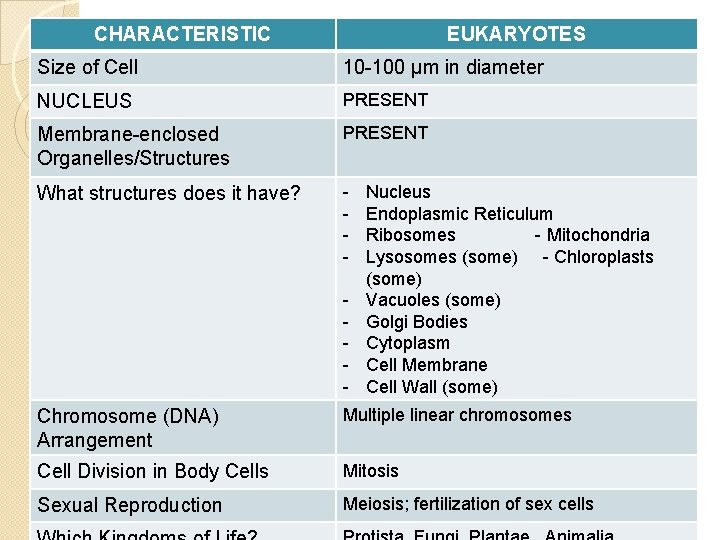
CHARACTERISTIC EUKARYOTES Size of Cell 10 -100 µm in diameter NUCLEUS PRESENT Membrane-enclosed Organelles/Structures PRESENT What structures does it have? - Nucleus Endoplasmic Reticulum Ribosomes - Mitochondria Lysosomes (some) - Chloroplasts (some) Vacuoles (some) Golgi Bodies Cytoplasm Cell Membrane Cell Wall (some) Chromosome (DNA) Arrangement Multiple linear chromosomes Cell Division in Body Cells Mitosis Sexual Reproduction Meiosis; fertilization of sex cells
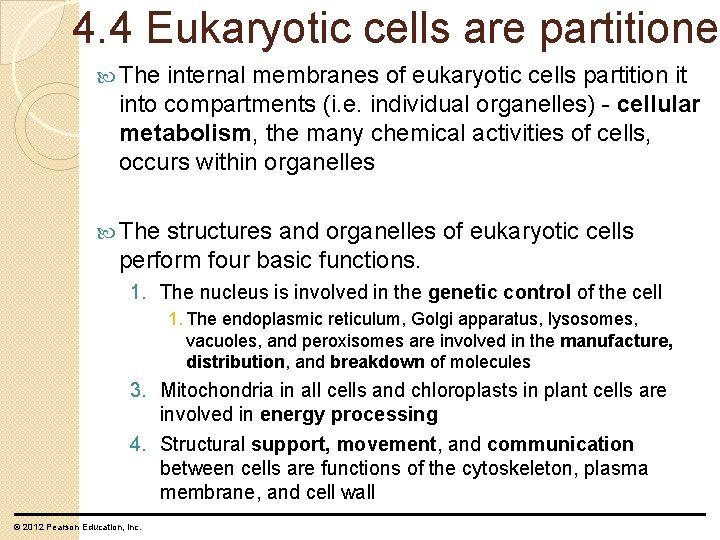
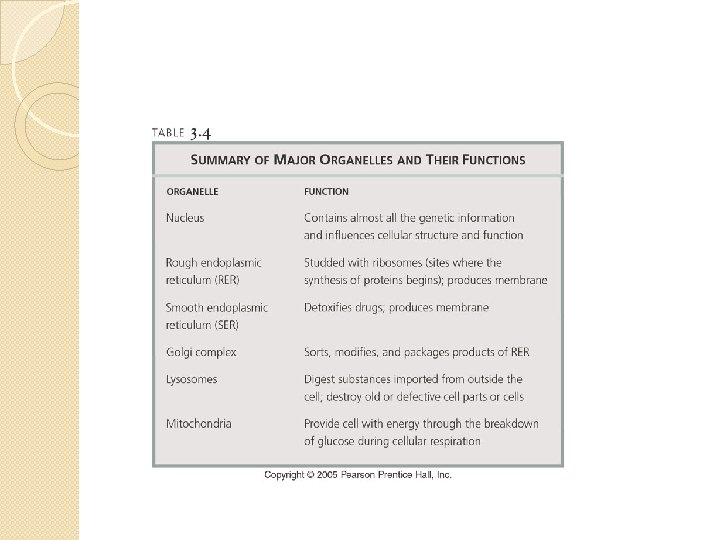
4. 4 Eukaryotic cells are partitioned The internal membranes of eukaryotic cells partition it into compartments (i. e. individual organelles) - cellular metabolism, the many chemical activities of cells, occurs within organelles The structures and organelles of eukaryotic cells perform four basic functions. 1. The nucleus is involved in the genetic control of the cell 1. The endoplasmic reticulum, Golgi apparatus, lysosomes, vacuoles, and peroxisomes are involved in the manufacture, distribution, and breakdown of molecules 3. Mitochondria in all cells and chloroplasts in plant cells are involved in energy processing 4. Structural support, movement, and communication between cells are functions of the cytoskeleton, plasma membrane, and cell wall © 2012 Pearson Education, Inc.
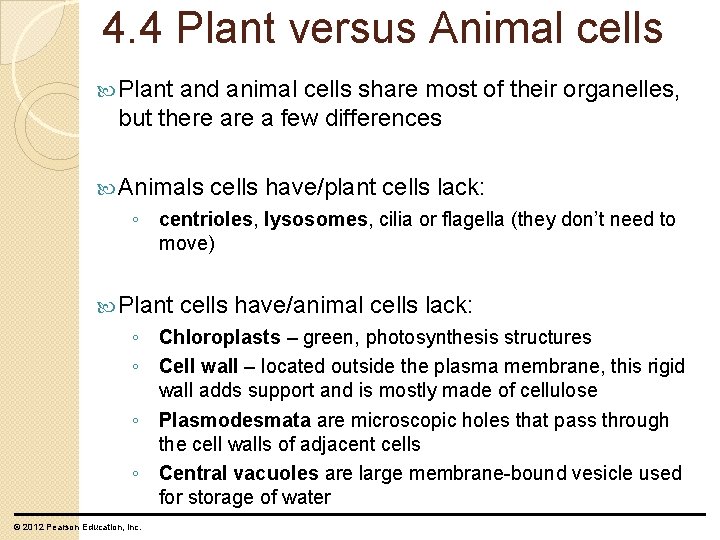
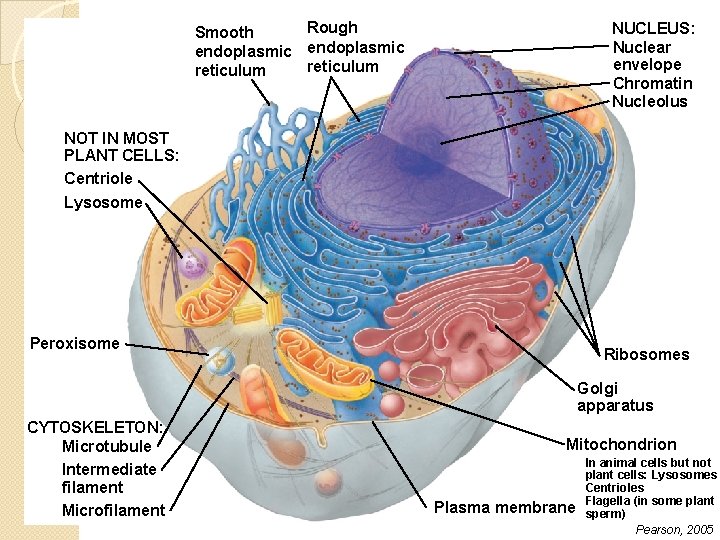
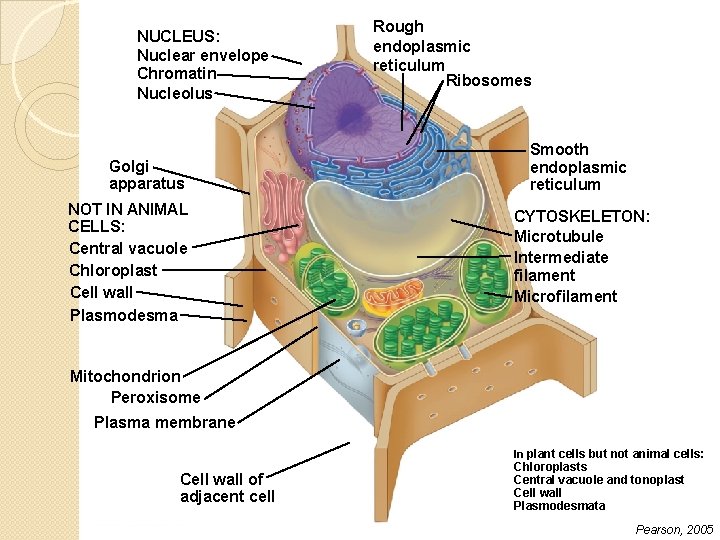
4. 4 Plant versus Animal cells Plant and animal cells share most of their organelles, but there a few differences Animals cells have/plant cells lack: ◦ centrioles, lysosomes, cilia or flagella (they don’t need to move) Plant cells have/animal cells lack: ◦ Chloroplasts – green, photosynthesis structures ◦ Cell wall – located outside the plasma membrane, this rigid wall adds support and is mostly made of cellulose ◦ Plasmodesmata are microscopic holes that pass through the cell walls of adjacent cells ◦ Central vacuoles are large membrane-bound vesicle used for storage of water © 2012 Pearson Education, Inc.
Rough Smooth endoplasmic reticulum NUCLEUS: Nuclear envelope Chromatin Nucleolus NOT IN MOST PLANT CELLS: Centriole Lysosome Peroxisome Ribosomes Golgi apparatus CYTOSKELETON: Microtubule Intermediate filament Microfilament Mitochondrion Plasma membrane In animal cells but not plant cells: Lysosomes Centrioles Flagella (in some plant sperm) Pearson, 2005
NUCLEUS: Nuclear envelope Chromatin Nucleolus Golgi apparatus NOT IN ANIMAL CELLS: Central vacuole Chloroplast Cell wall Plasmodesma Rough endoplasmic reticulum Ribosomes Smooth endoplasmic reticulum CYTOSKELETON: Microtubule Intermediate filament Microfilament Mitochondrion Peroxisome Plasma membrane In plant cells but not animal cells: Cell wall of adjacent cell Chloroplasts Central vacuole and tonoplast Cell wall Plasmodesmata Pearson, 2005