
Cell Theory Cell The basic building block of

Cell Theory • Cell – The basic building block of life. • All living organisms are made up of cells. • Cells can be different shapes and sizes depending on their function: Sperm Cells White Blood Cell Nerve Cell Red Blood Cells Muscle Cell Egg Cell
Cell Theory • In order for something to be alive, it must do 5 things. It must: • 1) grow • 2) reproduce • 3) respond to stimuli (heat, touch, sound, etc) • 4) require energy • 5) produce wastes
Cell Theory • We now know that living organisms must reproduce in order to produce a new generation of organisms. • However, this was not always the case. • From roman times to the 19 th century, scientists believed that life could spontaneously emerge from non-living matter. – In other words, people thought that there was a “life force” in the air that could make living things by blowing on the table in front of you!
Cell Theory • This idea was known as Spontaneous Generation • In 1668, 1668 Francesco Redi completed an experiment that showed spontaneous generation was a false hypothesis. • His experiment was to take pieces of meat and place them in jars. If spontaneous generation was true, maggots would appear. • Redi’s manipulated variable was access of flies to the meat. • Some containers were sealed, some were open, and some were covered in gauze.
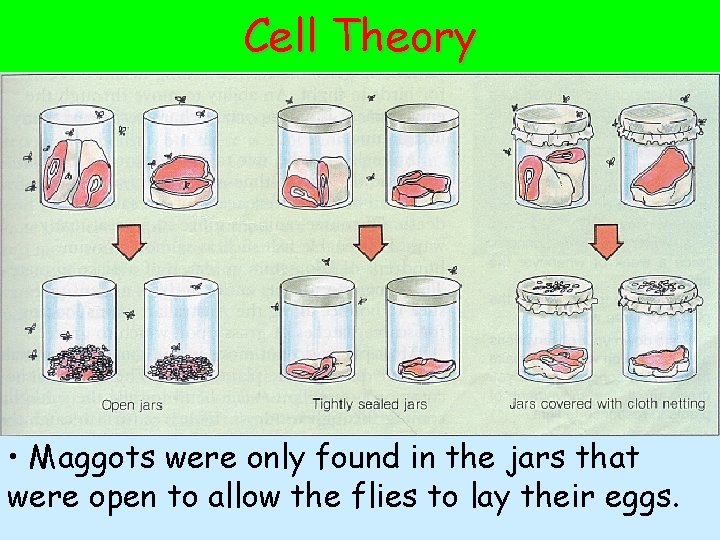
Cell Theory • Maggots were only found in the jars that were open to allow the flies to lay their eggs.
Cell Theory • Redi’s experiment disproved the idea of spontaneous generation, yet scientists still believed in theory. • In 1745, 1745 John Needham conducted another experiment which proved spontaneous generation existed. (His experiment was flawed and uncontrolled). • It wasn’t until 1864, 1864 and a scientist by the name of Louis Pasteur, that spontaneous generation was finally refuted.
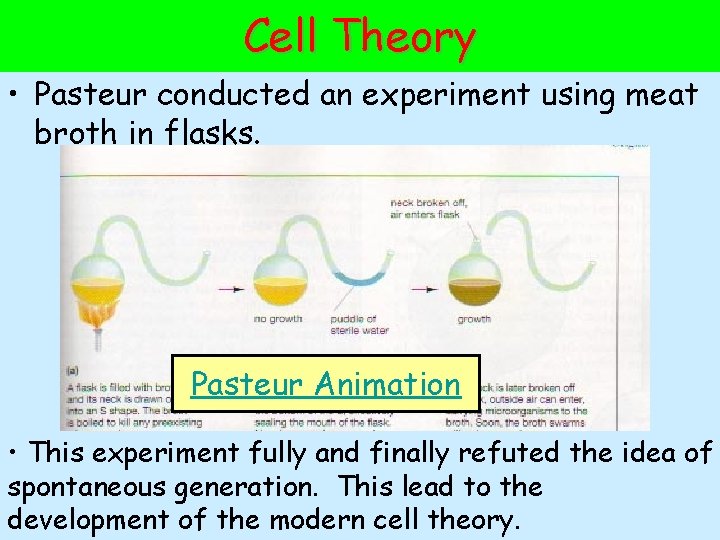
Cell Theory • Pasteur conducted an experiment using meat broth in flasks. Pasteur Animation • This experiment fully and finally refuted the idea of spontaneous generation. This lead to the development of the modern cell theory.

• https: //www. youtube. com/watch? v=Z 7 o. LUW Deq 7 w

Cell Theory • Cell Theory states: • 1) All living things are made up of one or more cells. • 2) Cells are the smallest unit of life. • 3) All cells are produced from pre-existing cells through the process of cell division. https: //www. youtube. com/watc h? v=BLTc. VNy. Oh. Uc
Cell Theory • The modern cell theory is largely based upon the development of modern microscopes. • A brief history of the microscope: • 4 th century B. C. – Ancient Greeks (lead by Aristotle) used water droplets to observe objects under magnification. • 1595 – Hans & Zach Janssen – developed the first compound microscope (microscope with 2 lenses). Magnification up to 20 X.
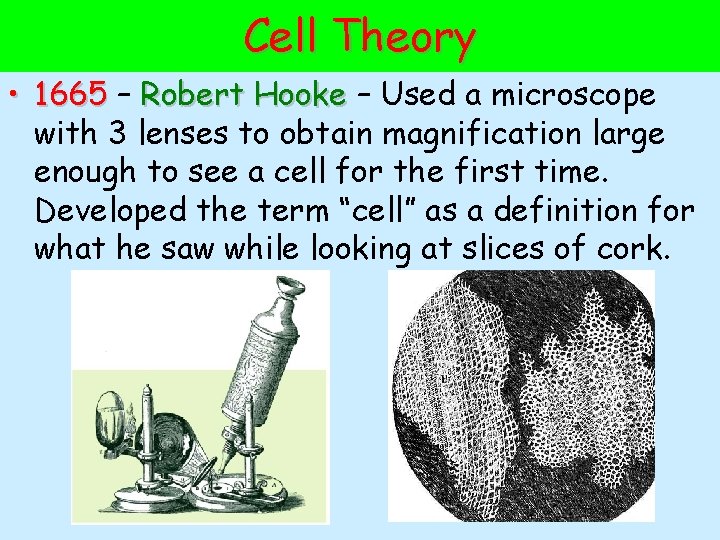
Cell Theory • 1665 – Robert Hooke – Used a microscope with 3 lenses to obtain magnification large enough to see a cell for the first time. Developed the term “cell” as a definition for what he saw while looking at slices of cork.
Cell Theory • ~1675 – Anton Van Leeuwenhoek – Developed a microscope capable of magnifying 275 X, and was the first to discover single-celled living organisms, which he called “animalcules”. • 1833 – Robert Brown – Identified the nucleus of the cell, and suggested its importance in the cell’s functioning. • 1838 – Schleiden & Schwann – Developed the modern cell theory.
Cell Theory • A quick look at today’s microscopes: • Modern light microscopes can magnify up to 2000 X. • Light microscopes use two techniques to increase the visibility of the cells. • 1. Contrast – Limiting the amount of light that enters the field of view. • 2. Staining – cells are stained with a dye to increase the contrast of the cells.
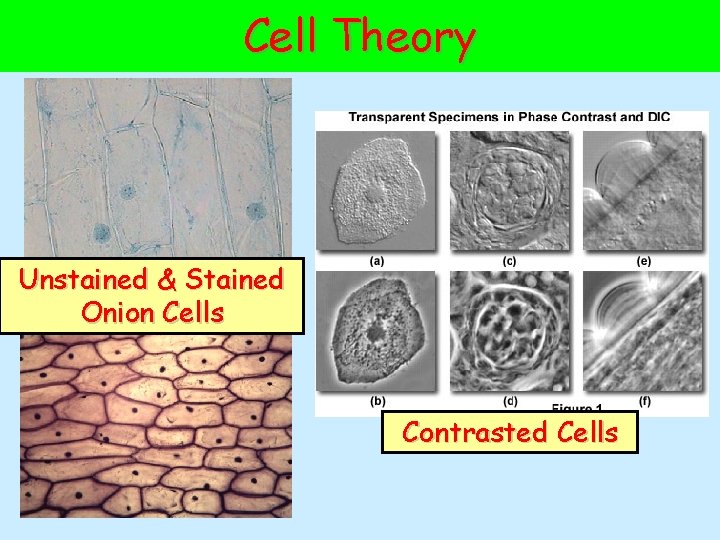
Cell Theory Unstained & Stained Onion Cells Contrasted Cells

Cell Theory • Electron Microscopes – Developed by Hillier & Prebus in the 1930 s • http: //www. youtube. com/watch? v=f. To. TFjw. Uc 5 M&safety_mode=true&persist_safety_mode=1&safe=ac tive
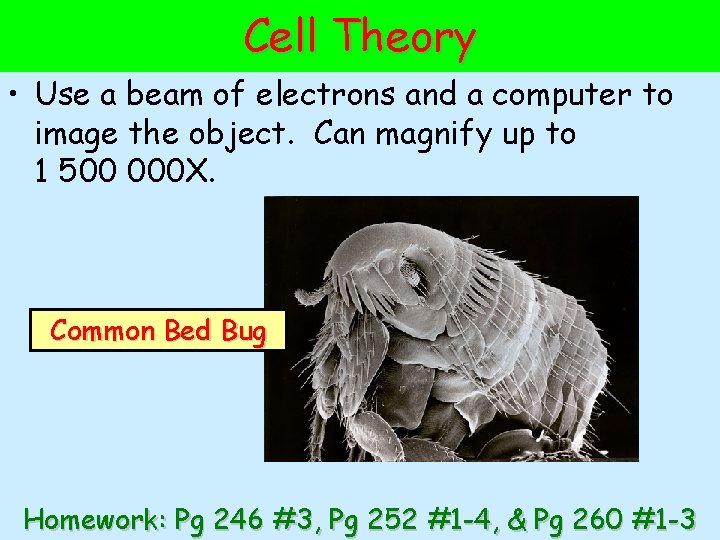
Cell Theory • Use a beam of electrons and a computer to image the object. Can magnify up to 1 500 000 X. Common Bed Bug Homework: Pg 246 #3, Pg 252 #1 -4, & Pg 260 #1 -3

Cell Model Project HOMEWORK ASSIGNMENT • Complete the Cell Model Project as described in the handout. • This project will be due on…

Organelles • The cell is an open system; it can exchange matter and energy with its surroundings. • Organelle – a structure within a cell that performs a specific function. • We are going to look at the organelles of two types of cells: plant cells and animal cells. Hand out plant & animal cell diagrams
Organelles • Cell Membrane – A protective barrier for the cell. Allows the transport of needed materials into the cell, and waste materials out of the cell. It is like the skin of the cell. • Nucleus – Contains the DNA (genetic material), and directs all cellular activity. Is surrounded by the nuclear membrane, which has pores that allow the transport of materials in and out of the nucleus. It is like the brain of the cell.
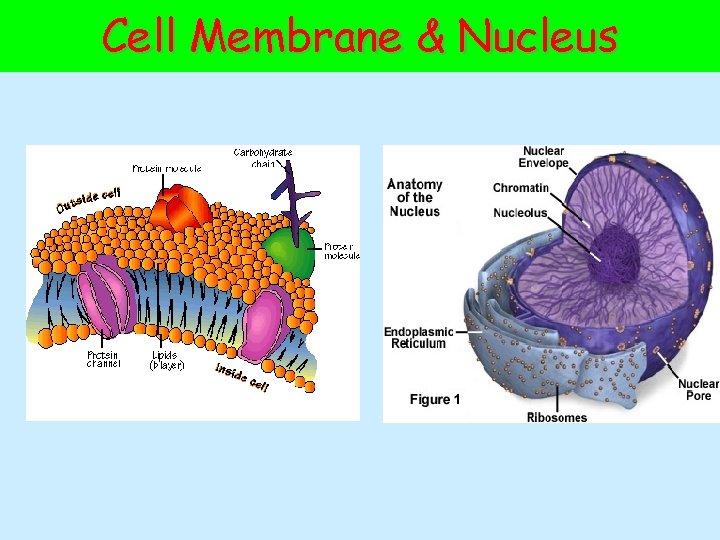
Cell Membrane & Nucleus

Organelles • Cytoplasm – A gel-like substance inside the cell membrane. Organelles are suspended in the cytoplasm. It contains nutrients for the cell, and allows movement of organelles and nutrients. It is like a bowl of Jello. • Cell Wall – Found in PLANT cells only A rigid frame around the cell that provides strength and support. The cell membrane is found between the cell wall and the cytoplasm. It is like the bones/skeleton of the cell.

Cytoplasm & Cell Wall

Organelles • Chloroplasts – Found in PLANT cells only The site of photosynthesis. Contain chlorophyll – a chemical responsible for photosynthesis, and produces the green colour of the plant. • Vesicles/Vacuoles – Membrane bound sacs used for storage of nutrients, fats, water, and wastes. Vacuoles are large vesicles. They are like storage containers of the cell.
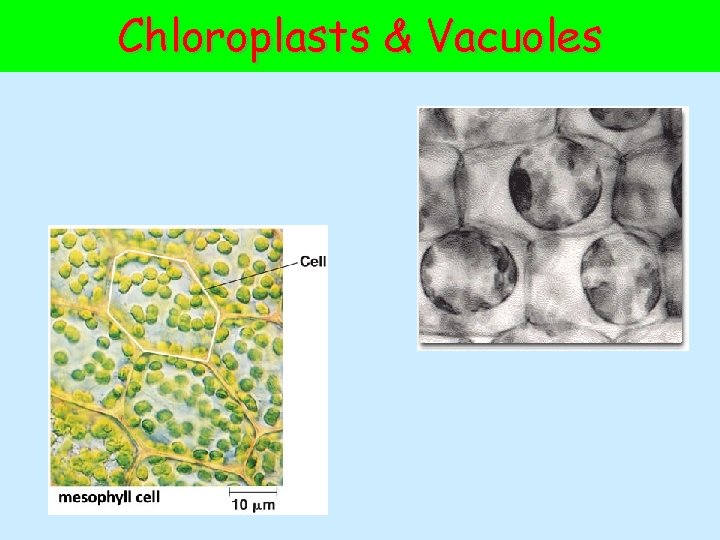
Chloroplasts & Vacuoles
Organelles • Lysosomes – Found in ANIMAL cells only Sacs that contain strong chemicals that are responsible for digestion of food molecules. They are like the stomach of the cell. • Endoplasmic Reticulum – Folded tubes extending from the nuclear membrane, and surrounding the nucleus. Two types of ER: Rough ER – associated with protein synthesis; Smooth ER – associated with lipid synthesis. It is like the factory of the cell.
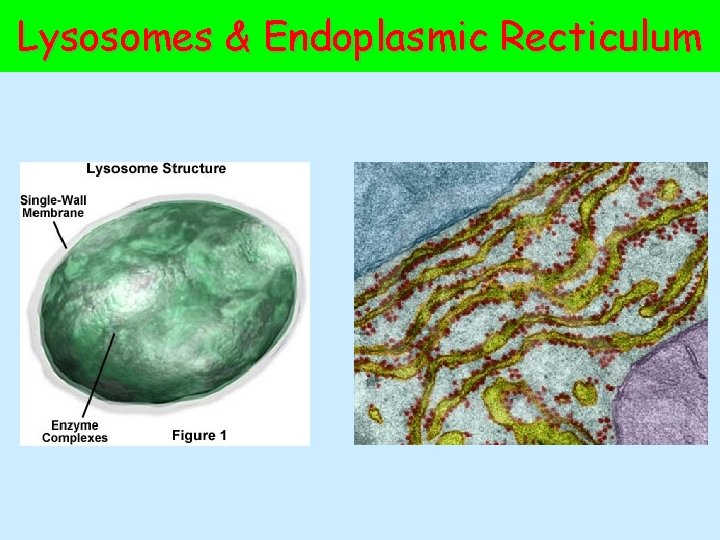
Lysosomes & Endoplasmic Recticulum
Organelles • Ribosomes – Granules attached to the rough ER that are sites of protein synthesis. They are like the factory workers of the cell. • Golgi Apparatus – Flat, disc-shaped sacs that receive materials from the ER, and repackage/redistribute them to the rest of the cell, or out of the cell. It is like the post office of the cell.
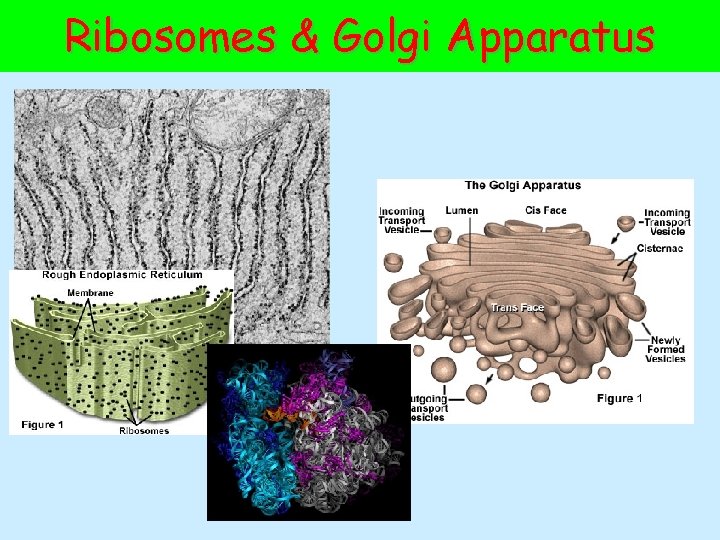
Ribosomes & Golgi Apparatus
Organelles • Mitochondria – Rod-like structures that are the site for cellular respiration. They convert chemical energy (glucose) into energy that the cell can use (ATP). It is like the power plant of the cell. • Note: Note These are only some of the main organelles of the cell. There are other organelles that perform other functions.
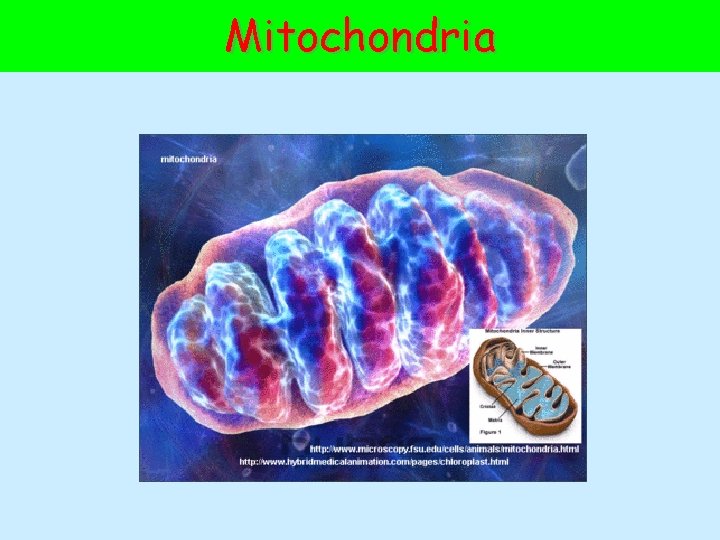
Mitochondria
Organelles • VIDEO: VIDEO Cells: An Introduction – (VC 574. 87 CEL – 20 min) • Handout worksheet to be filled out during film. Homework: Pg 273 #2, 4, 5, & complete plant cell diagram
Chemicals in the Cell • • • 4 major elements found in cells: carbon, hydrogen, oxygen, nitrogen These 4 major elements produce 4 major compounds found in cells: Carbohydrates – sugar, starch, cellulose Lipids – fats and oils Proteins – muscle fibre Nucleic Acids – genetic material, DNA There also trace elements: eg. Mg, Zn, Mn, Fe
Cell Membrane • CELL MEMBRANE aka – plasma membrane • Protective barrier of the cell. • Allows some substances in, and keeps others out. • Moves nutrients, gases, and wastes into and out of the cell. • Described as a “Fluid Mosaic Model” Model • Made of phospholipids and proteins.
Cell Membrane • Phospholipids formed out of 2 parts: phosphates, and lipids. • Phosphates face out – hydrophilic (“waterloving”) • Lipids face in – hydrophobic (“water-fearing”) • Pairs of phospholipids form a phospholipid bilayer • Proteins are found on outside, inside, or through the phospholipid bilayer.
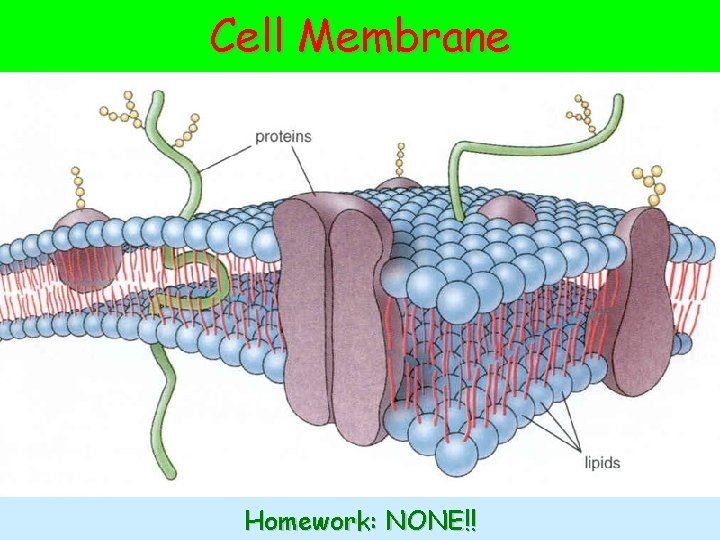
Cell Membrane Homework: NONE!!
Cell Transport • In order to survive, the cell must transport gases, nutrients, and wastes into and out of the cell through the cell membrane. • There are several different ways to complete this, depending on what is being transported. • All types of transport can be grouped into one of two types: Passive Transport or Active Transport.
Cell Transport • Passive Transport – Movement of substances along the concentration gradient (from HIGH concentration to LOW concentration). • Passive transport does NOT require additional energy. • 3 types of passive transport:
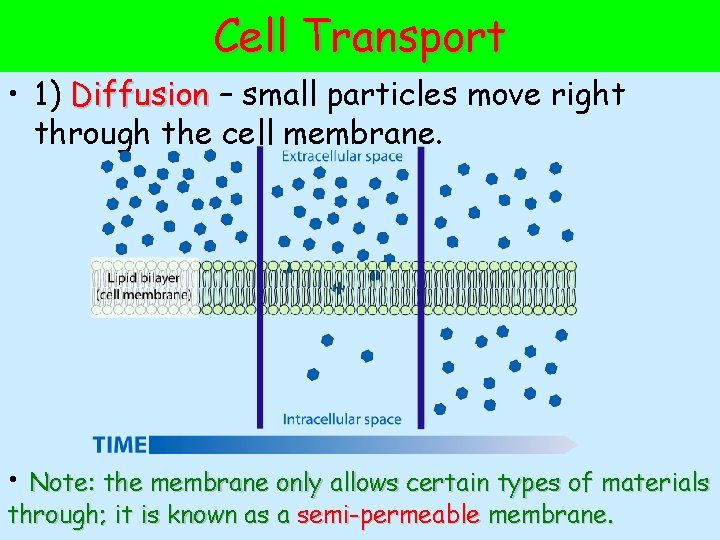
Cell Transport • 1) Diffusion – small particles move right through the cell membrane. • Note: the membrane only allows certain types of materials through; it is known as a semi-permeable membrane.
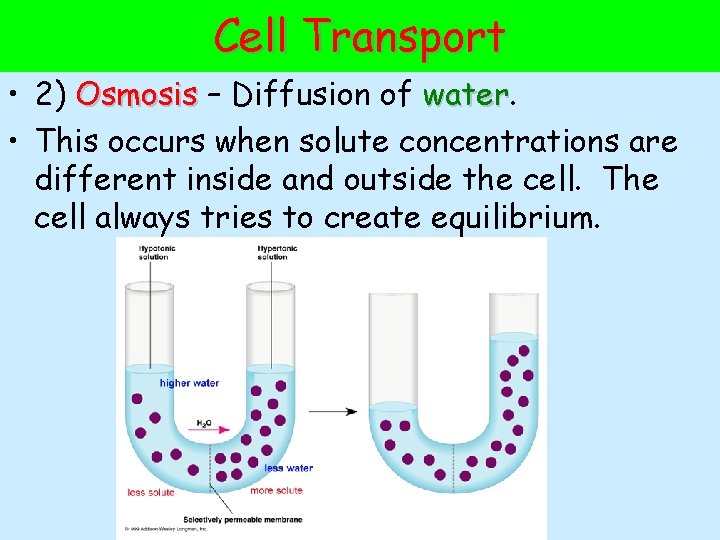
Cell Transport • 2) Osmosis – Diffusion of water • This occurs when solute concentrations are different inside and outside the cell. The cell always tries to create equilibrium.
Cell Transport • Osmosis occurs when the solute concentration is different inside and outside the cell. – Hypotonic solution – concentration of solutes outside of cell is LOWER than inside the cell. This causes the cell to take in water, & swell. – Hypertonic solution – concentration of solutes outside the cell is HIGHER than inside the cell. This causes the cell to expel water & shrivel. – Isotonic solution – concentration of solutes outside the cell is EQUAL to inside the cell. The cell is happy! Osmosis Video
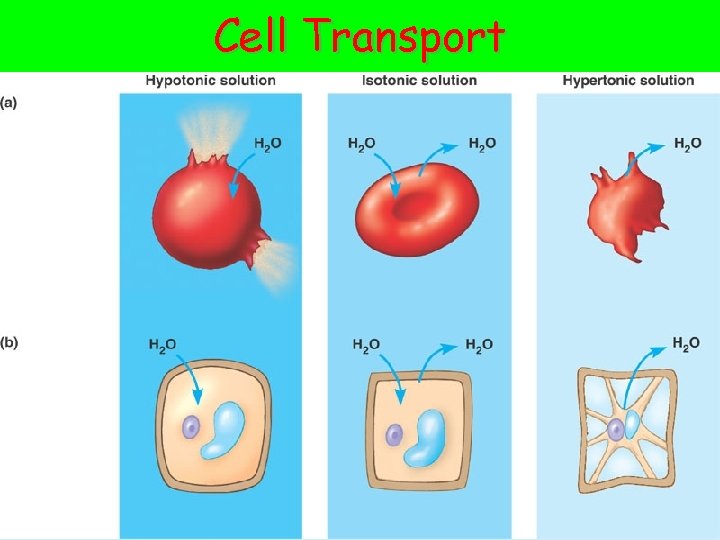
Cell Transport
Cell Transport • 3) Facilitated Diffusion – Movement of larger molecules across the membrane. • These molecules are too large to simply pass through the membrane, and require channel proteins or carrier proteins to act as a gate to allow movement. Facilitated Diffusion Video
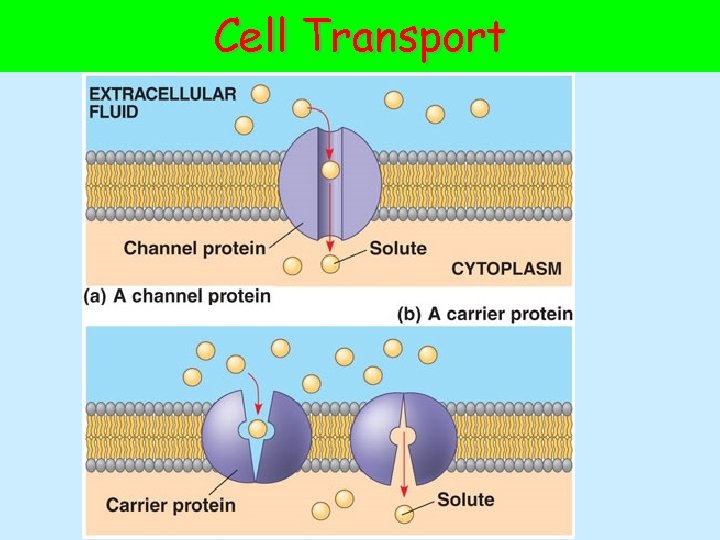
Cell Transport
Cell Transport • Active Transport – Movement of substances against the concentration gradient (from LOW concentration to HIGH concentration). • Active transport requires additional energy (ATP). Active Transport Video • 3 types of active transport:
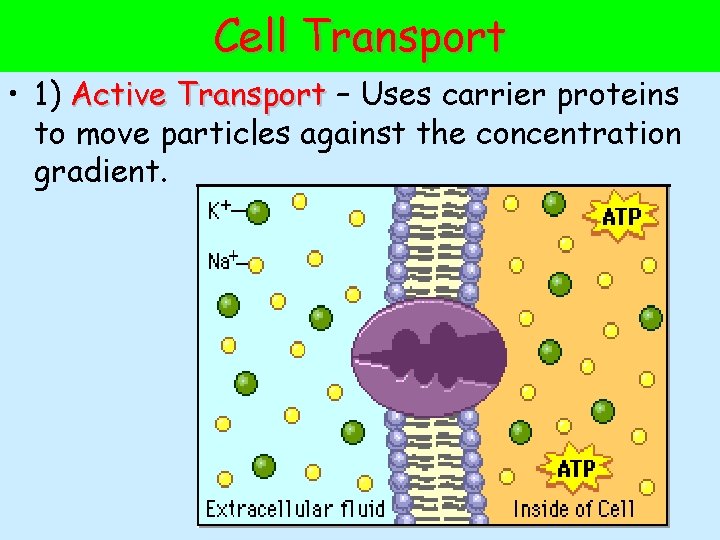
Cell Transport • 1) Active Transport – Uses carrier proteins to move particles against the concentration gradient.

Cell Transport • 2) Endocytosis – The membrane engulfs material & creates a vesicle around the material. • 2 types of endocytosis: – Phagocytosis – large chunks of materials engulfed. – Pinocytosis – lots of small materials engulfed.
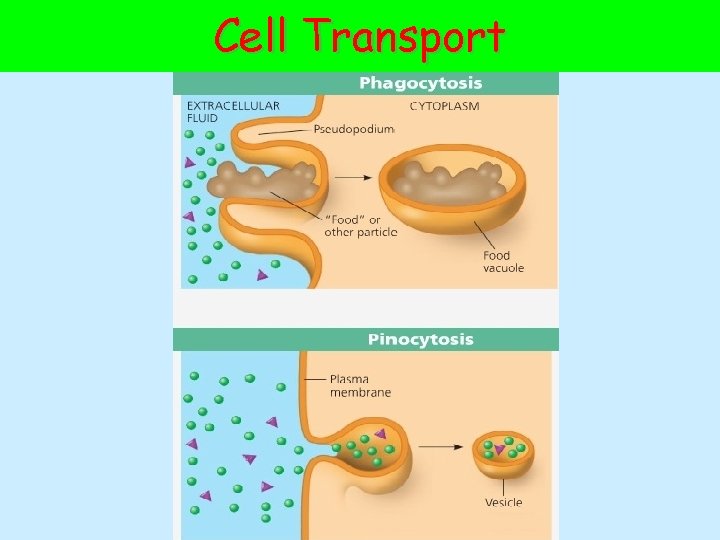
Cell Transport
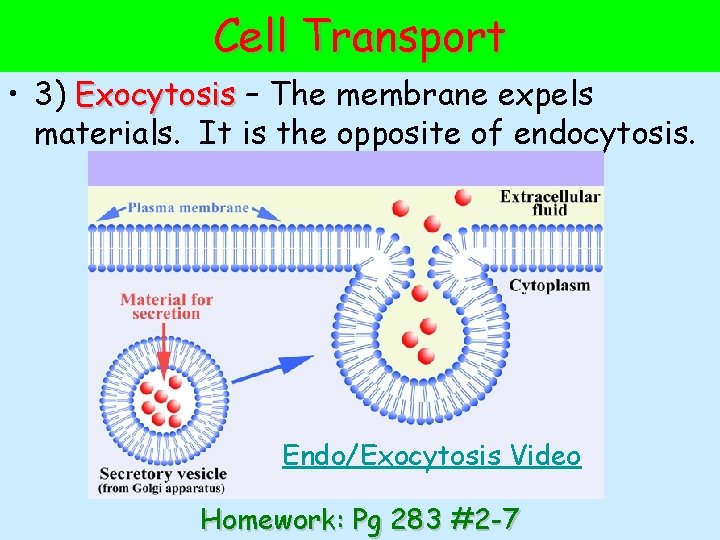
Cell Transport • 3) Exocytosis – The membrane expels materials. It is the opposite of endocytosis. Endo/Exocytosis Video Homework: Pg 283 #2 -7
Textbook Questions • Do these now (and for homework if you don’t get done), and I will call each of you to do your five week assessment • Page 283, questions: 2, 3, 5, 6, and 7.
Surface Area to Volume Ratio • In order to maximize efficiency, cells must have the greatest possible surface area in relation to volume. (SA: V = maximum) – This is due to the fact that it takes less energy to move materials in and out of the cell when the membrane is close to all areas of the cell. • Should cells be large, or small?

Surface Area to Volume Ratio • EX: Imagine 3 cells. Cell A is a cube with side lengths of 2μm, Cell B is a cube with side lengths of 3μm, and Cell C is a rectangular prism with side lengths of 1. 5μm, 2μm and 3. 5μm. Which cell is most efficient?
Surface Area to Volume Ratio • Since efficient cells want a large surface area to volume ratio, cells want to be as SMALL as possible. • This is why large organisms are multi-cellular, and why unicellular organisms are very small. Homework: Pg 289 #1 & Pg 293 #2, 3, & 8

Cell Review • Work block for Pg 294 #1 -4, 6 -9, 16 -19, 21, 25, 26, 29, 31, 35.
Cell Test
Plant Systems • Hand out plant diagram & leaf cross section & fill out while discussing. (Diagrams on pg 298 -301) • A plant is broken into 2 main systems: • Shoot System – Everything above ground; stems, leaves, terminal buds, lateral buds, flowers, fruits, etc. • Root System – Everything below ground; roots & root hairs. Also includes roots above ground. – Both systems are made of specialized tissues for gas exchange, transport of materials, and photosynthesis.
Plant Tissues • We are going to look at different tissues in the leaf of the plant. Keep in mind that these tissues are found in other parts of the plants as well. • Epidermis (aka Dermal Tissue) Tissue – outer layer of leaf cells. It is the “skin” of the leaf, & is found on top and bottom. They allow the exchange of gas and matter. • Cuticle – A waxy substance found on top of the upper epidermis. Helps to protect the leaf, and helps to reduce water loss.

Plant Tissues • Mesophyll (aka Ground Tissue) Tissue – Layer of cells between the upper and lower epidermis. Contains 2 types of cells: • Palisade Tissue – Long, rigid cells tightly packed just below the upper epidermis. These cells contain chlorophyll, and is where photosynthesis occurs. • Spongy Mesophyll Tissue – Loosely packed cells located under the palisade layer. Many air spaces between cells that allow for easy movement of materials & gases.

Plant Tissues • Vascular Tissue (aka Vascular Bundle or Vein) Vein – Allows movement of water and nutrients throughout the plant. Contains 2 types of tissues: • Xylem – Non-living ducts that move water and minerals from the roots to the leaves. Thick walled tubes that are made of cellulose and lignin that fuse together then die. • Phloem – Ducts that transport sugars from the leaves to the rest of the plant. Phloem tissue consists of 2 types of cells:
Plant Tissues • Sieve Tube Cells – Long tubes with perforated ends which allow the movement of materials. Sieve tube cells are alive, but lose their nuclei. • Companion Cells – Small cells found adjacent to the sieve tube cells that direct sieve tube cell activities. • Guard Cells – Located on the lower epidermis. Can open/close to allow gases into the cell. • Stomata – small pores behind guard cells. Homework: Pg 314 #1, 2, 7, 8
Gas Production in Plants • Two important reactions – Photosynthesis and Cellular Respiration. • Photosynthesis: Photosynthesis – Occurs in the chloroplasts (organelle), which contain chlorophyll (chemical) – Cells for photosynthesis are found mainly in the palisade layer of leaves (some found in the stem). – Chemical reaction that requires carbon dioxide and water as reactants.
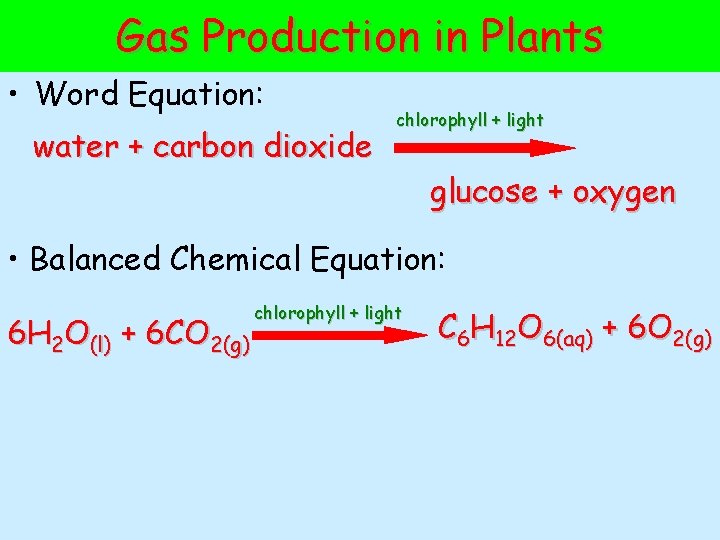
Gas Production in Plants • Word Equation: water + carbon dioxide chlorophyll + light glucose + oxygen • Balanced Chemical Equation: 6 H 2 O(l) + 6 CO 2(g) chlorophyll + light C 6 H 12 O 6(aq) + 6 O 2(g)
Gas Production in Plants • Photosynthesis is the energy conversion from sunlight to chemical potential (in the form of glucose) • The cell stores the light energy in glucose until needed (the cell’s battery). • Chloroplasts have the ability to move in the cytoplasm to receive more light. This is known as “cytoplasmic streaming”, streaming and was discovered by Robert Brown • Photosynthesis occurs only during the day!
Gas Production in Plants • Cellular Respiration: Respiration – Begins in the cytoplasm, but completed in the mitochondria. – Chemical reaction in which the bonds glucose are broken to release energy. – Requires glucose and oxygen as reactants
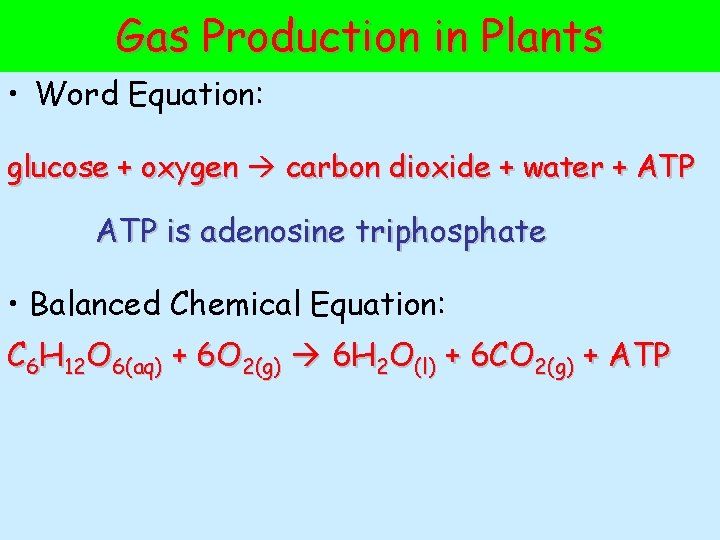
Gas Production in Plants • Word Equation: glucose + oxygen carbon dioxide + water + ATP is adenosine triphosphate • Balanced Chemical Equation: C 6 H 12 O 6(aq) + 6 O 2(g) 6 H 2 O(l) + 6 CO 2(g) + ATP
Gas Production in Plants • Cellular respiration is the conversion of the stored energy in glucose into ATP, energy the cell can use for cellular functions. • Cellular respiration occurs in plants & animals, however, plants respire at a much lower rate. • Cellular respiration occurs ALL THE TIME!! TIME (day or night) Homework: Pg 308 #1 -3, 5, 7
Transport of Water in Plants • Plants obtain water through their roots, and must move it up to the leaves to allow for photosynthesis. Here’s how… • Starting at the roots… • Dissolved minerals are brought into the root cells from the ground through active transport. This increases the solute concentration. • The root cells try to equalize the concentration by drawing water in through osmosis.
Transport of Water in Plants • As water gets pulled into the roots, there is an increase in root pressure that forces the water up the xylem towards the leaves. • The root pressure can only push the water up the xylem a few meters. Many plants are taller than this, so there must be other factors.

Transport of Water in Plants • Water molecules themselves help to move up the xylem towards the leaves. • Cohesion – Attraction of water molecules to other water molecules. This is due to the fact that water molecules are polar (have a slight charge). – This is why you can fill a glass of water above the lip of the glass. It’s also why small bugs can walk on water. • Cohesion helps pull each successive water molecule up the xylem.

Transport of Water in Plants • Adhesion – Attraction of water molecules to molecules of other substances. Again, this is due to the polar nature of water. – This is why when you fill a glass partially, the water along the glass can climb up the sides of the glass (meniscus). • Adhesion helps the water molecules climb up cohesion the xylem. meniscus
Transport of Water in Plants • Looking at the leaves… • The water’s ultimate destination is the leaf. Here, the water disappears one of two ways: – 1) it’s used in photosynthesis. – 2) it’s lost through transpiration. • Transpiration is the loss of water through the stomata and lenticels (on the stem). • As the stomata and lenticels open, water can evaporate. This creates transpiration pull – As each water molecule evaporates, cohesion causes the next molecule to be pulled upwards.
Transport of Water in Plants • Transpiration pull is strong enough to overcome gravity and cause the water to move up the xylem from the roots to the leaves.
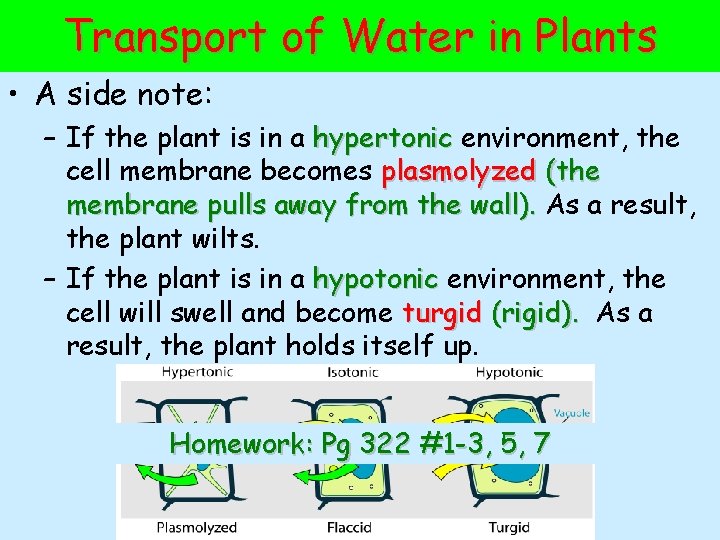
Transport of Water in Plants • A side note: – If the plant is in a hypertonic environment, the cell membrane becomes plasmolyzed (the membrane pulls away from the wall). As a result, the plant wilts. – If the plant is in a hypotonic environment, the cell will swell and become turgid (rigid). As a result, the plant holds itself up. Homework: Pg 322 #1 -3, 5, 7
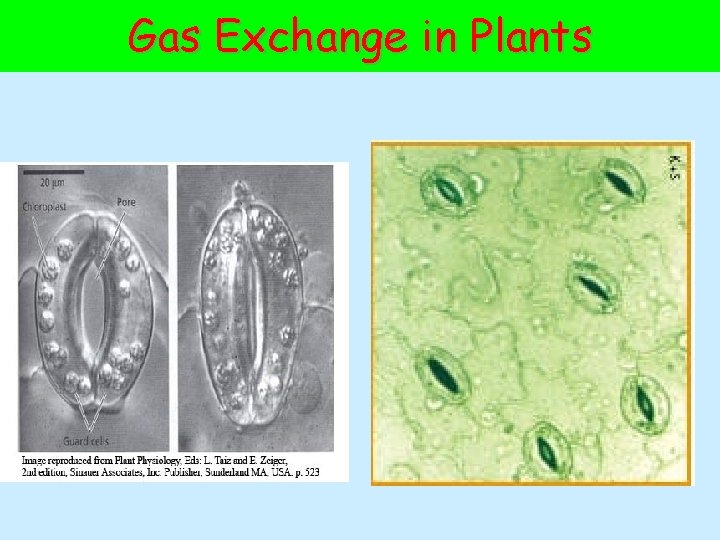
Gas Exchange in Plants • Plants must exchange gases that are necessary for, and are produced by photosynthesis. • We must first get carbon dioxide into the plant and up to the palisade layer to allow for photosynthesis. Here’s how… • CO 2 enters the leaf through the stomata on the underside of the leaf. – Recall that the stomata are controlled by the guard cells
Gas Exchange in Plants • When gas is needed in the leaf, the guard cells develop a high ion concentration which causes water to move into the cells through osmosis. • This water causes the guard cells to swell, and open the stoma. • When gas has moved in, the water pressure decreases, and the guard cells close the stoma.
Gas Exchange in Plants
Gas Exchange in Plants • Once in the stomata, CO 2 moves through the air gaps in the spongy mesophyll up to the palisade layer by diffusion. • Once at the palisade layer, layer cells take in the CO 2, and it is taken to the chloroplasts. • Through cytoplasmic streaming, streaming the CO 2 rich chloroplasts move in a circular motion towards the sunlight, where the CO 2 is used in photosynthesis.
Gas Exchange in Plants • Photosynthesis produces oxygen, oxygen which is a waste product of the plant, and needs to be expelled. • O 2 is released from the palisade layer, diffused through the spongy mesophyll, and out the stomata. • The glucose (sugar) sugar that is produced in photosynthesis must be stored. It is transported from the palisade layer, through the spongy mesophyll, to the phloem
Gas Exchange in Plants • Water and sugar are transported through the phloem to storage sites around the plant. These sites are called “sinks” sinks and are found in: leaves, roots, stems, fruits, etc • This process is known as “Source to Sink” Sink (from leaves to storage spaces). spaces • The glucose is then stored until needed. • Used either in cellular respiration, respiration or used in growth of roots, meristems, fruits, etc. Homework: Pg 314 #3 -6 Pg 322 #4, 8
Control Systems • Like all living organisms, plants respond to stimuli. They do this to meet the specific needs of the plant. • 2 main Control Systems (Tropisms): Tropisms • 1) Gravitropism: Gravitropism response to gravitational force. – Positive: Positive plant grows WITH the gravitational force (eg: ROOTS grow down) – Negative: Negative plant grows AGAINST the gravitational force (eg: STEMS grow up)
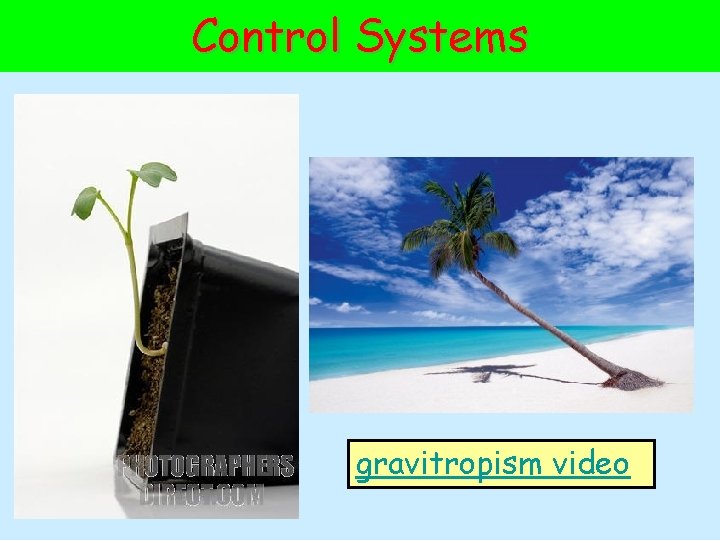
Control Systems gravitropism video
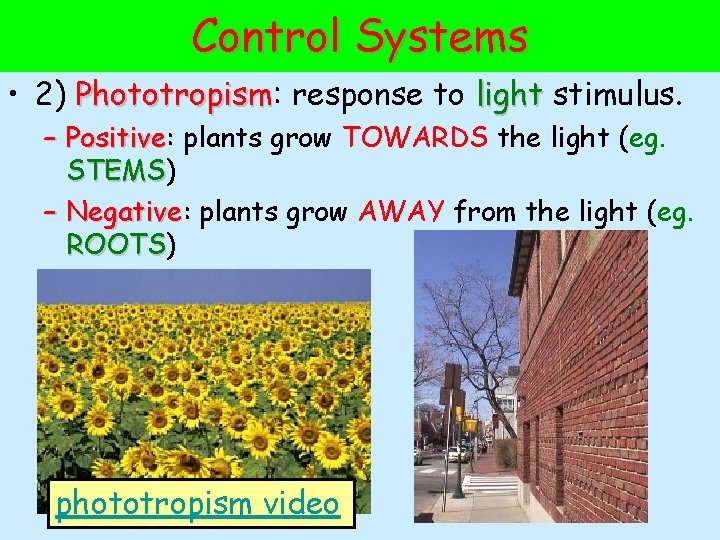
Control Systems • 2) Phototropism: Phototropism response to light stimulus. – Positive: Positive plants grow TOWARDS the light (eg. STEMS) STEMS – Negative: Negative plants grow AWAY from the light (eg. ROOTS) ROOTS phototropism video
Control Systems • There are other control systems: • Mechanical (touch) touch – Venus Fly-trap closes its leaf when an insect lands on it. Also, vines or pea plants attach to the wall/fence. • Amount of light – Certain flowers bloom in response to length of darkness. • Climate change – Blooming in some plants occur due to change in climate. Homework: Pg 328 #1 -3, 6

Plant Review • Work block for Pg 330 #1, 3 -8, 10 -12, 14 -23
Plant Test
Climate • There is a VERY BIG difference between weather and climate! • Weather – Conditions of temperature, air pressure, cloud cover, precipitation and humidity that occur at a particular place at a particular time. – It’s the day to day conditions. • Climate – Average weather conditions that occur in a region over a long period of time. – Usually accepted to be a minimum of 30 years.
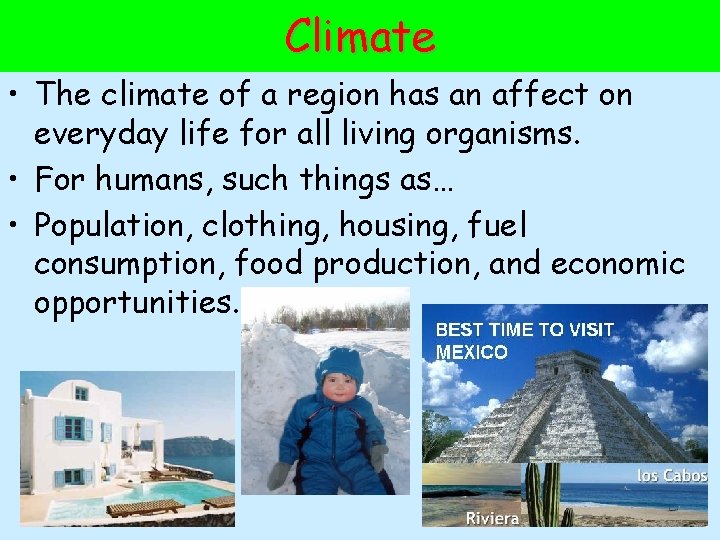
Climate • The climate of a region has an affect on everyday life for all living organisms. • For humans, such things as… • Population, clothing, housing, fuel consumption, food production, and economic opportunities.
Climate • Other organisms also adapt to their climate. – Trees in cold regions shed their leaves & go dormant in the winter to minimize freezing. – Plants in desert regions adapt to require minimal water. – Grizzly bears put on up to 200 kg of fat in the summer & hibernate in the winter to avoid the cold and low food availability. Frog Adaptation Video
Climate • There is lots of talk about climate change How can we tell if it is changing? • There must be evidence to support theory. • 2 types of evidence: • 1) Scientific – data collected using the scientific method, and using precise instruments. • Information is often graphed to allow for interpretation.
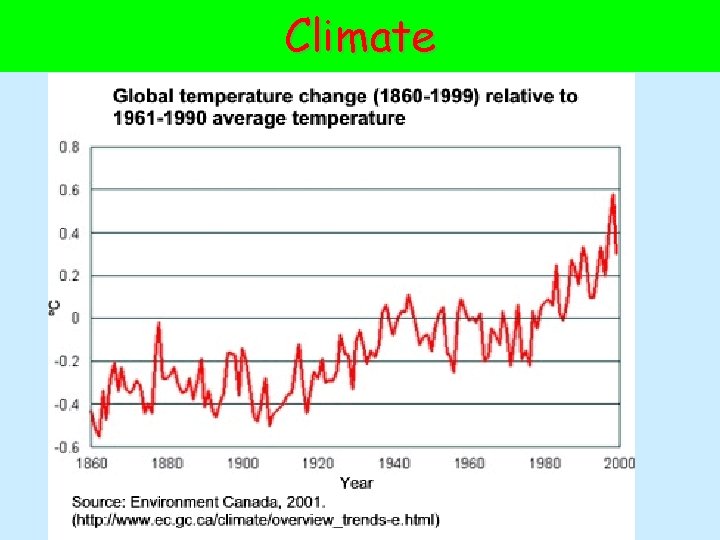
Climate

Climate • 2) Anecdotal – Relies on reports from people and their interpretations of weather events. – Farmers telling about growing seasons, or aboriginals comparing first frost to previous years. Not very scientific! • These types of evidence are only good for relatively recent climate changes. • What about looking at climate change over thousands of years?
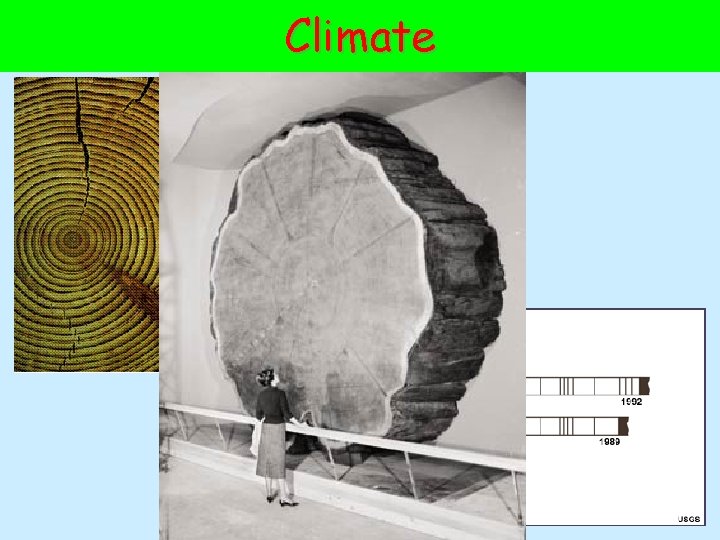
Climate • Scientists have developed different ways to look at the climate for long periods of time. • One way is dendrochronology (the study of tree growth rings). rings • In the spring, trees produce lighter coloured wood than in the summer. As a result, rings appear. • Wider rings form in good growing seasons (cool, wet conditions), and narrow rings appear in poor growing seasons (hot, dry conditions).
Climate
Climate • Tree ring growth is also affected by droughts, forest fires, floods, insect attacks, even earthquakes! • Dendrochronology is only good for the age of the tree (~100 years). • To look at climate change farther in the past, scientists can look at ice cores. • Ice cores work similar to tree rings; each year, new snow falls on glaciers, and builds up the snow pack. Weather patterns for the year can be interpreted from the layers.
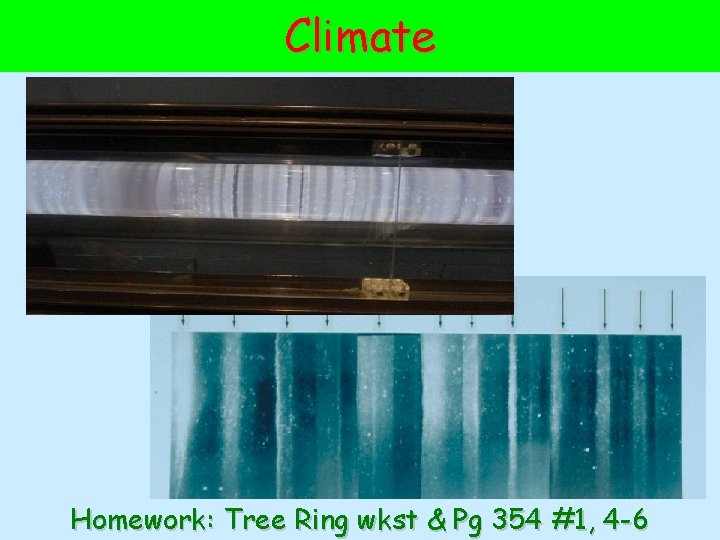
Climate Homework: Tree Ring wkst & Pg 354 #1, 4 -6
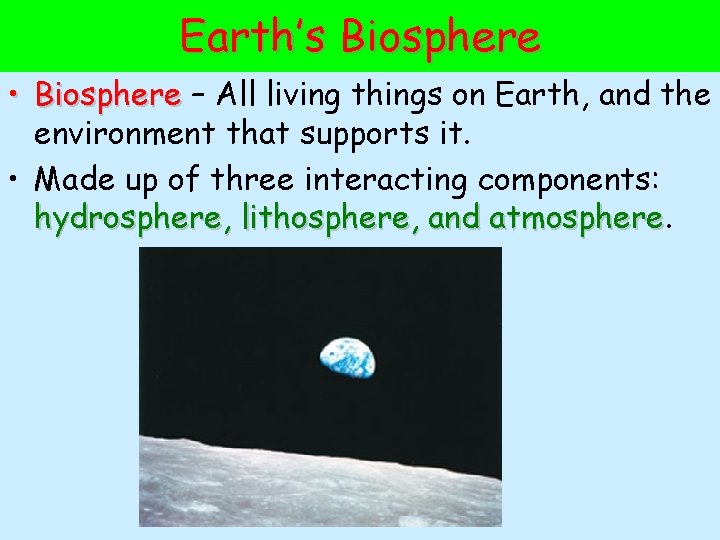
Earth’s Biosphere • Biosphere – All living things on Earth, and the environment that supports it. • Made up of three interacting components: hydrosphere, lithosphere, and atmosphere
Earth’s Biosphere • Hydrosphere – All water on Earth. • 97% of all water is salt water in the oceans. • 3% is fresh water in lakes, rivers, glaciers. • Lithosphere – Solid Earth (the ground). ground • Section that floats above the semi-fluid upper mantle. • Extends ~100 km below the Earth’s surface. • Home to many living organisms.

Earth’s Biosphere • Atmosphere – Layer of gases that surround the Earth (the air). air • Main components of air are nitrogen (78%), and oxygen (21%). • The other 1% is trace chemicals (argon, carbon dioxide, etc. ) • It also contains suspended particles (dust). • The atmosphere rises over 500 km above the surface of the Earth! (That’s a ridiculously long way folks!)
Earth’s Biosphere • The atmosphere is divided into 4 layers according to the average air temperature. • Troposphere – 0 -10 km above the Earth. – Temperature from 15°C (at the surface) to -60°C (farthest from Earth). Temp drops with altitude. – Contains 80% of the gas in the atmosphere, and all the dust. – Weather occurs here
Earth’s Biosphere • Stratosphere – 10 -50 km above the Earth. – Temperature range is -60°C to 0°C. (Yes, the temp actually goes up!!) – Contains the ozone layer which traps harmful UV light from the Sun. (This is why it gets warmer!) • Mesosphere – 50 -80 km above the Earth. – Temperature range is 0°C to -100°C. • Thermosphere – 80 -500 km above the Earth. – Temperature range is -100°C to 1500°C. – Temp increase due to absorption of gamma ray light from the Sun.
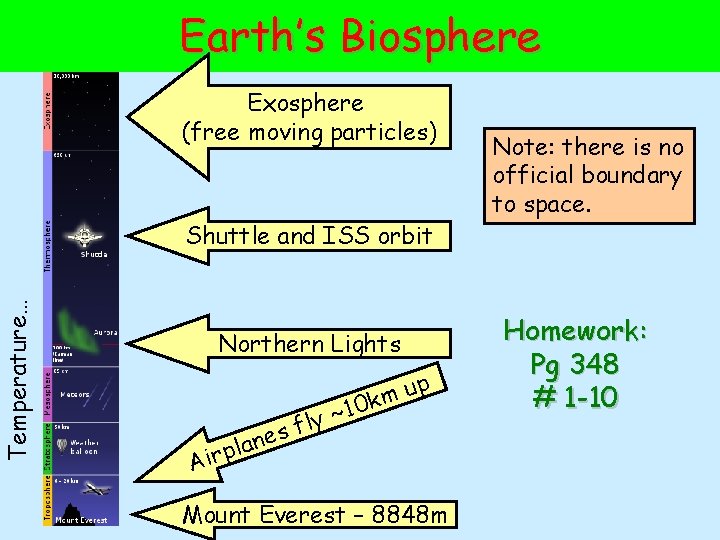
Temperature… Earth’s Biosphere Exosphere (free moving particles) Shuttle and ISS orbit Northern Lights ~1 y l sf e an l p r Ai up m 0 k Mount Everest – 8848 m Note: there is no official boundary to space. Homework: Pg 348 # 1 -10
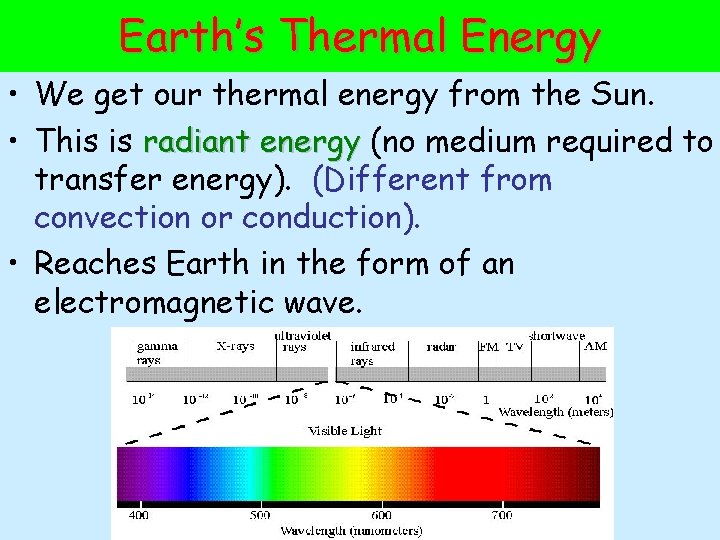
Earth’s Thermal Energy • We get our thermal energy from the Sun. • This is radiant energy (no medium required to transfer energy). (Different from convection or conduction). • Reaches Earth in the form of an electromagnetic wave.
Earth’s Thermal Energy • Insolation – Amount of solar energy received by a region of the Earth’s surface. • This is different at different locations. • Two things affect insolation: • 1) Angle of Inclination • Degree by which the Earth’s poles are tilted from the perpendicular of the plane of its orbit. • The angle of inclination for Earth is 23. 5°. – Note: this angle is the same everywhere on Earth.
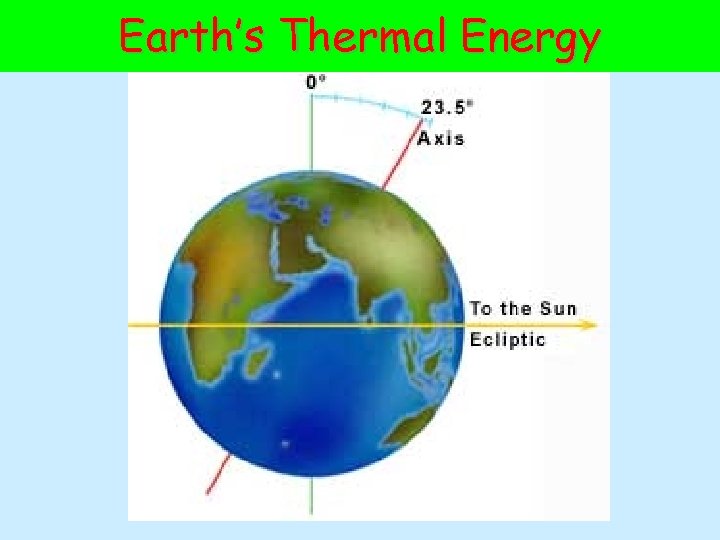
Earth’s Thermal Energy
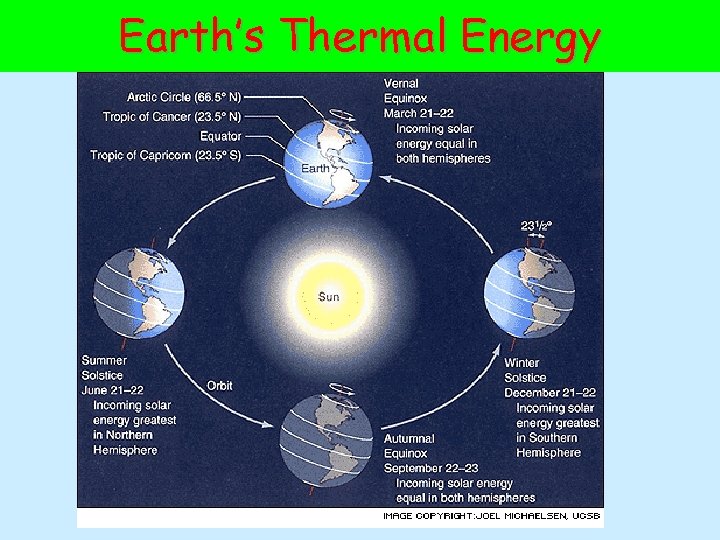
Earth’s Thermal Energy • It is the angle of inclination that causes the seasons. • When a region is tilted towards the Sun, it receives more insolation, and it is summer. • When tilted away, it is winter. • Note: Northern and southern hemispheres have opposite seasons.
Earth’s Thermal Energy
Earth’s Thermal Energy • From the previous diagram, there a few key terms: • Latitudes: Latitudes Imaginary lines that run parallel to the equator. Poles are 90°N and 90°S. – Note: latitude of tropics and arctic circle. • Solstice: Solstice One of 2 times a year that the poles are tilted most towards or most away from the Sun. Gives longest & shortest days of the year. • Equinox: Equinox One of 2 times a year when daylight hours equal nighttime hours.
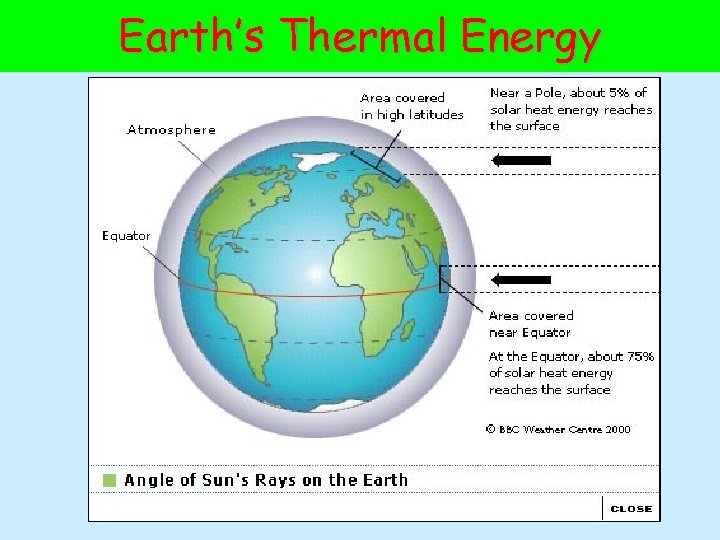
Earth’s Thermal Energy • 2) Angle of Incidence • Angle between a ray of sunlight and a line that is perpendicular to the Earth’s surface. • Because of Earth’s spherical shape, the angle of incidence is different for different latitudes.
Earth’s Thermal Energy

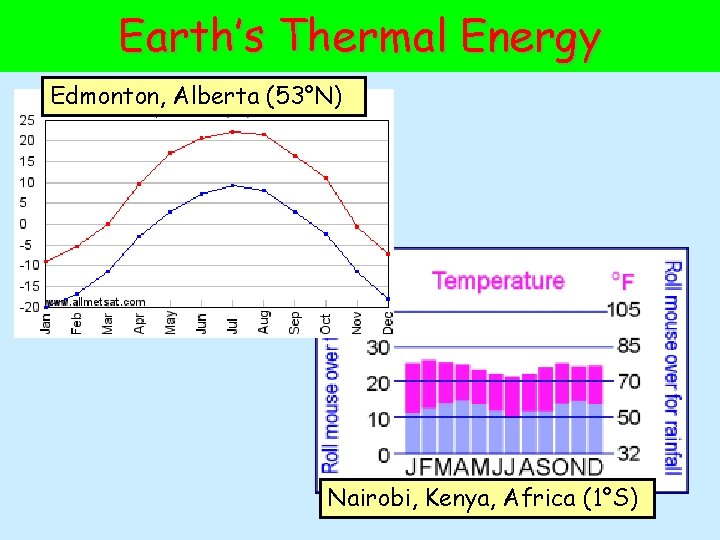
Earth’s Thermal Energy • As the angle of incidence increases, the same amount of solar radiation is spread out over a larger area. This means less radiation per square kilometer. (flashlight demo) • This is why the poles are colder than the equator. • The angle of incidence is also responsible for the number of daylight hours. • The larger the variation in daylight hours, the larger the variation in daily temperature.
Earth’s Thermal Energy Edmonton, Alberta (53°N) Nairobi, Kenya, Africa (1°S)

Earth’s Thermal Energy • Solar radiation that reaches Earth is either absorbed or reflected by the biosphere. • Cloud cover and dust both reflect and absorb incoming radiation, as well as absorb thermal energy that is emitted from the Earth’s surface. • The solar radiation that reaches the Earth’s surface is either absorbed or reflected.
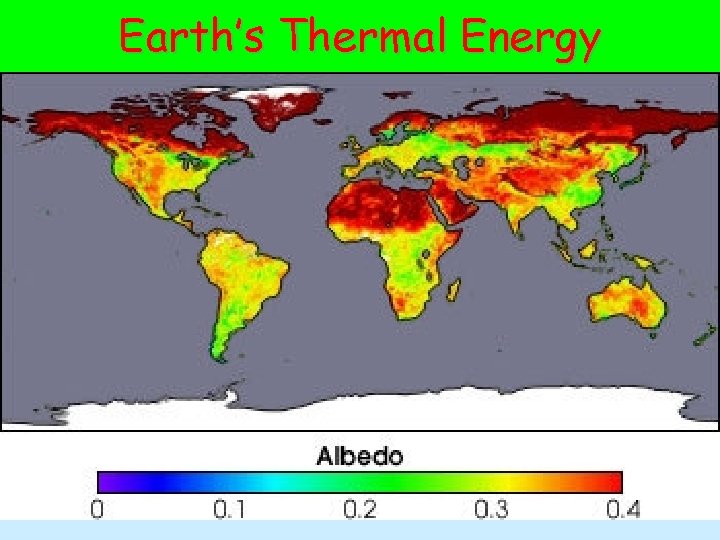
Earth’s Thermal Energy • Albedo – the percent of solar radiation that is reflected by a surface. • Light, shiny surfaces (like snow) have a high albedo. • Dark, dull surfaces (like forests or soil) have a low albedo. • Earth’s average albedo is 30%
Earth’s Thermal Energy
Earth’s Thermal Energy • Some of the energy that is absorbed by the Earth’s surface is re-emitted as thermal energy. • Most of this energy is absorbed by H 2 O, CO 2, CH 4, and N 20 in the atmosphere. • This absorption is known as the Natural Greenhouse Effect • The natural greenhouse effect is a GOOD thing for the Earth. • Without it the Earth would be 33°C colder!
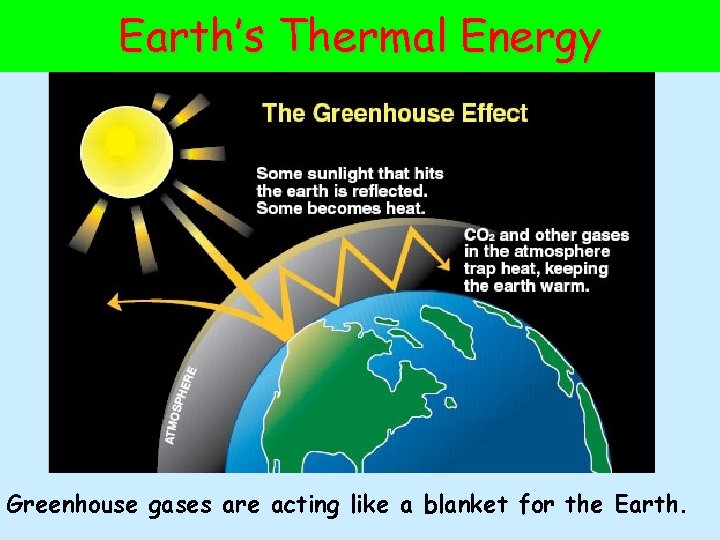
Earth’s Thermal Energy Greenhouse gases are acting like a blanket for the Earth.
Earth’s Thermal Energy • Net Radiation Budget – The difference between incoming radiation and outgoing radiation. Net radiation = incoming radiation – outgoing radiation • Average net radiation for the Earth is ZERO • A change would result in an increase or decrease in Earth’s temperature. • Note: polar regions have a net radiation deficit, and equatorial regions have a net radiation surplus.
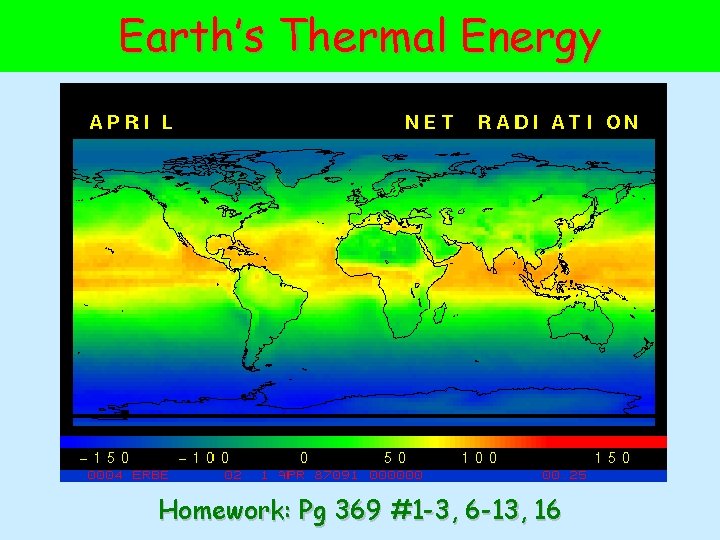
Earth’s Thermal Energy Homework: Pg 369 #1 -3, 6 -13, 16
Energy Transfer in the Atmosphere • Thermal Energy Transfer – Movement of thermal energy from high to low temperature. 3 ways: • Radiation – Energy transmitted as a wave. A hot object will emit radiant energy. • Conduction – Energy transferred through direct contact of surfaces. • Convection – Energy transferred through the movement of particles from one location to another. Happens in liquids and gases.
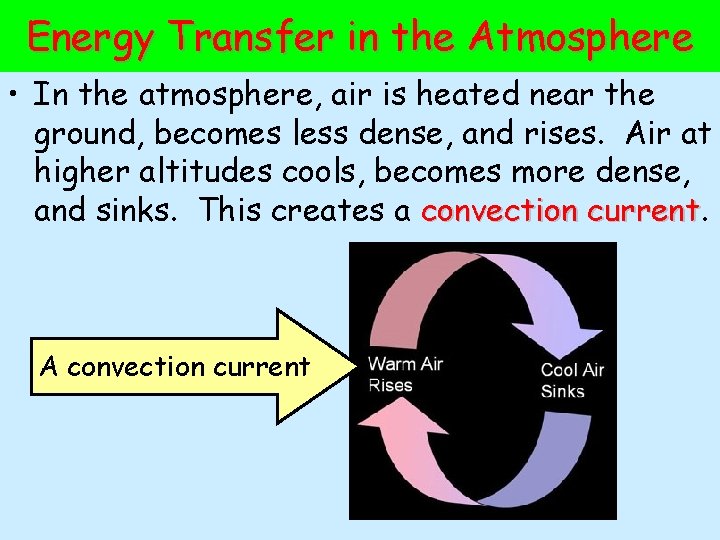
Energy Transfer in the Atmosphere • In the atmosphere, air is heated near the ground, becomes less dense, and rises. Air at higher altitudes cools, becomes more dense, and sinks. This creates a convection current A convection current
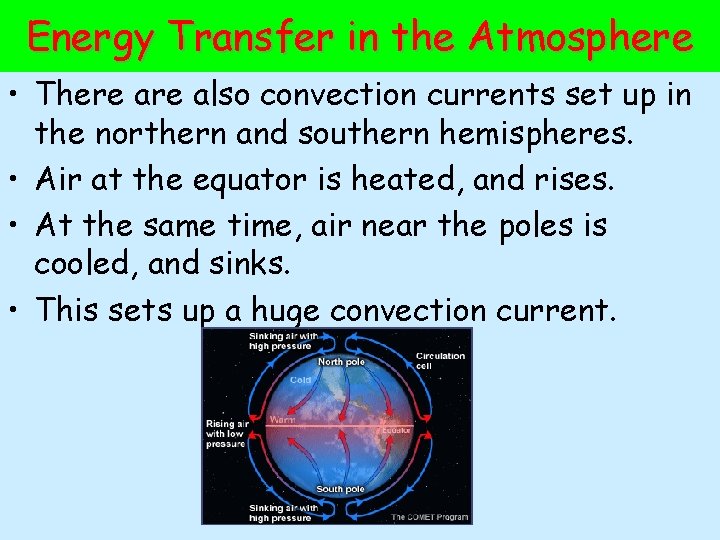
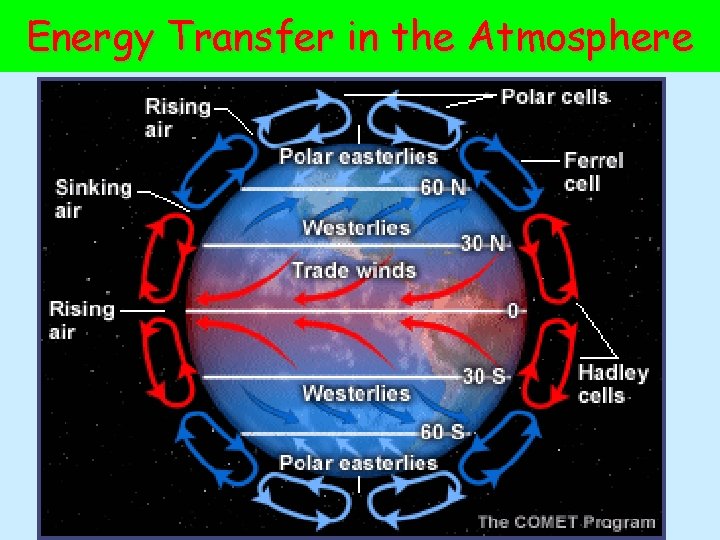
Energy Transfer in the Atmosphere • There also convection currents set up in the northern and southern hemispheres. • Air at the equator is heated, and rises. • At the same time, air near the poles is cooled, and sinks. • This sets up a huge convection current.
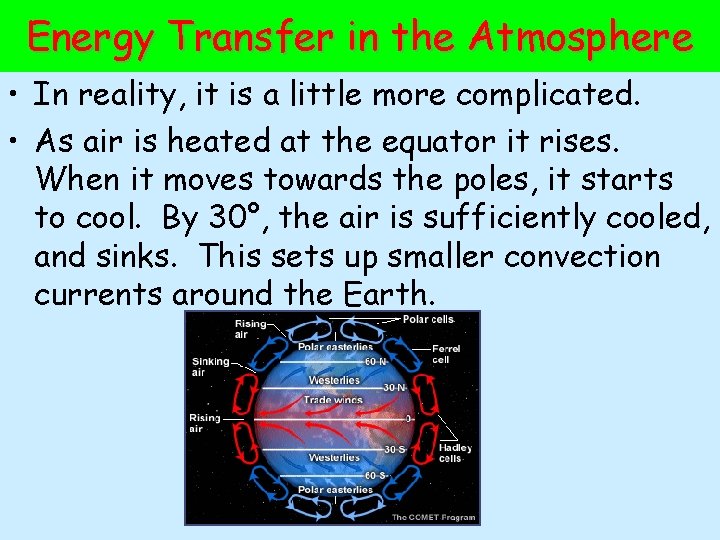
Energy Transfer in the Atmosphere • In reality, it is a little more complicated. • As air is heated at the equator it rises. When it moves towards the poles, it starts to cool. By 30°, the air is sufficiently cooled, and sinks. This sets up smaller convection currents around the Earth.
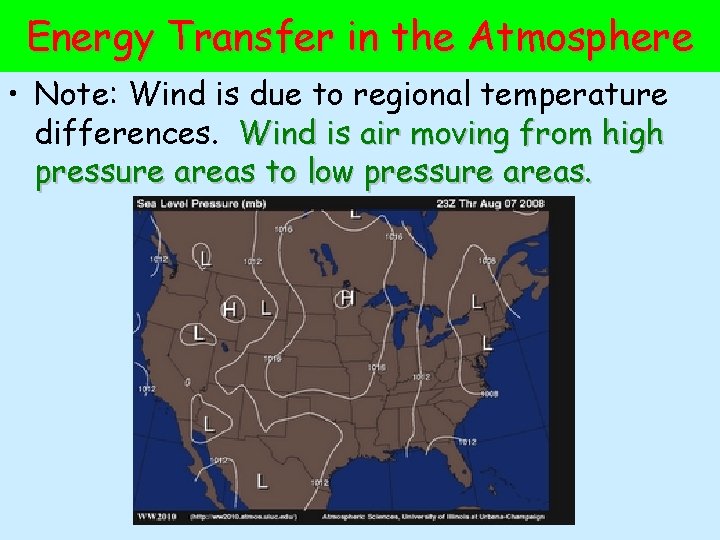
Energy Transfer in the Atmosphere • Note: Wind is due to regional temperature differences. Wind is air moving from high pressure areas to low pressure areas.
Energy Transfer in the Atmosphere • Coriolis Effect – The deflection of an object due to a rotation. Coriolis Effect Video • The convection currents of air on the Earth are deflected due to the fact that the Earth is rotating underneath it. • As a result, we get global wind patterns as follows: https: //www. youtube. com/ watch? v=i 2 mec 3 vgea. I
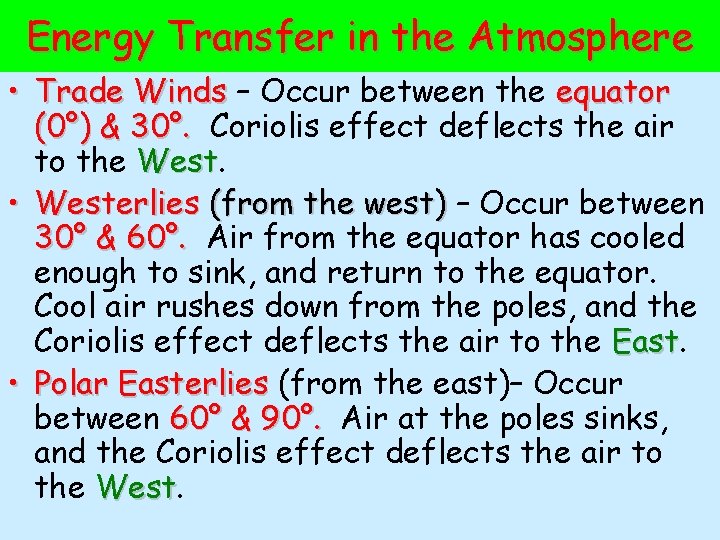
Energy Transfer in the Atmosphere • Trade Winds – Occur between the equator (0°) & 30°. Coriolis effect deflects the air to the West • Westerlies (from the west) – Occur between 30° & 60°. Air from the equator has cooled enough to sink, and return to the equator. Cool air rushes down from the poles, and the Coriolis effect deflects the air to the East • Polar Easterlies (from the east)– Occur between 60° & 90°. Air at the poles sinks, and the Coriolis effect deflects the air to the West
Energy Transfer in the Atmosphere
Energy Transfer in the Atmosphere • Note: Note Jet Streams – Bands of fast moving air found in the stratosphere. (Can move at ~750 km/h!) • There are several jet streams found on Earth, and they play a role in weather patterns (especially severe weather). Homework: Pg 375 #2, 4 -9, 13
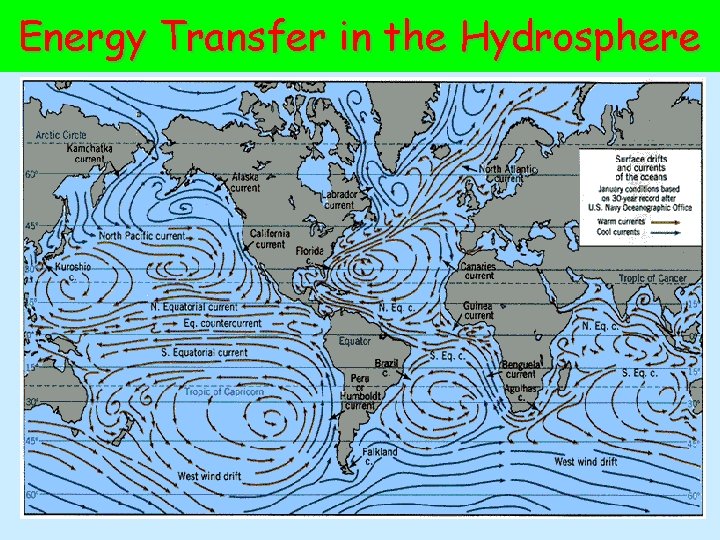
Energy Transfer in the Hydrosphere • The hydrosphere transfers thermal energy from warmer latitudes to cooler ones through the action of global winds. • Global winds drive the surface currents of the Earth’s oceans. • Note: Thermal energy is also transferred vertically through convection currents. Warm water rises, and cool water sinks.
Energy Transfer in the Hydrosphere
Energy Transfer in the Hydrosphere • The hydrosphere can also explain why cities located at similar latitudes can have very different climates. • Take Vancouver and Lethbridge for example: • Vancouver has mild winters, with little snow. Lethbridge has cold winters with lots of snow. Why the difference?
Energy Transfer in the Hydrosphere • Recall that water has a VERY high specific heat capacity (can absorb/emit lots of heat). • Vancouver is close to a VERY large body of water (the Pacific ocean). • As a result, in the winter, the ocean releases a tremendous amount of energy by cooling a few degrees. • This energy release keeps Vancouver warm. • Lethbridge is not close to any large bodies of water, and does not get this extra winter heating.
Energy Transfer in the Hydrosphere • This is true everywhere in the world. Cities on a coast will have a more moderate temperature due to the presence of the water. • Note: The Earth is 70% covered in water! Homework: Pg 390 # 1, 6, 12, 13
Biomes • Biome – Large geographical region with a particular range of temperatures and precipitation levels. • Biomes are considered open systems because both energy (heat) and matter (plants & animals) can move in and out of a biome. • The Earth has six major biomes…
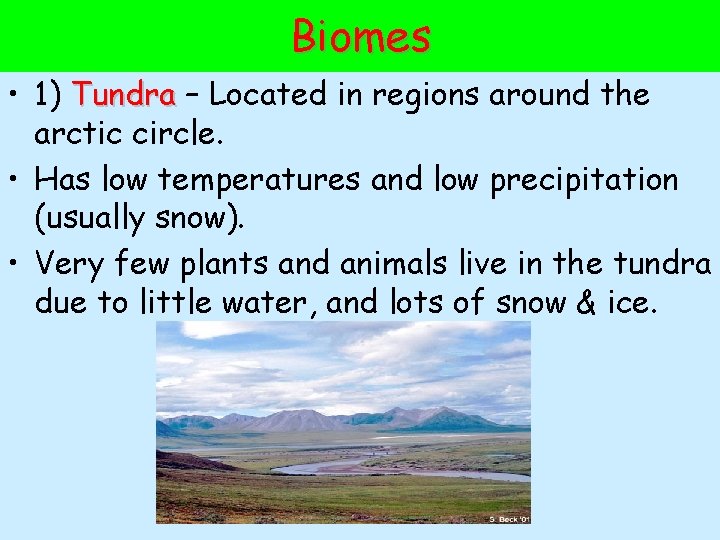
Biomes • 1) Tundra – Located in regions around the arctic circle. • Has low temperatures and low precipitation (usually snow). • Very few plants and animals live in the tundra due to little water, and lots of snow & ice.
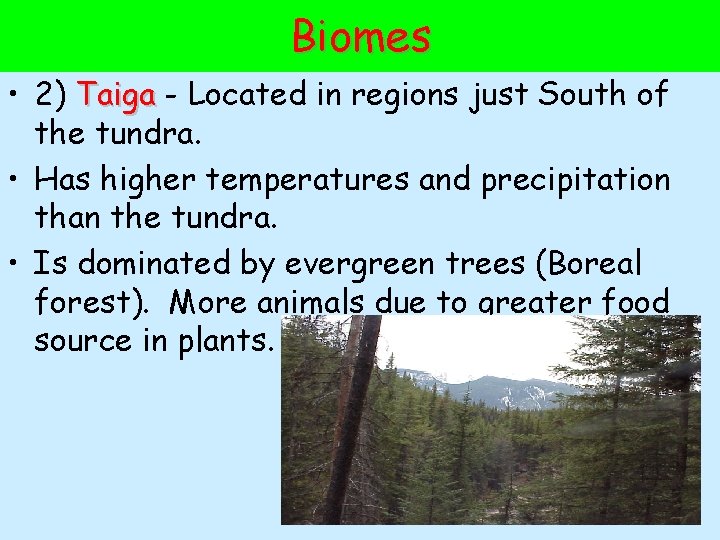
Biomes • 2) Taiga - Located in regions just South of the tundra. • Has higher temperatures and precipitation than the tundra. • Is dominated by evergreen trees (Boreal forest). More animals due to greater food source in plants.
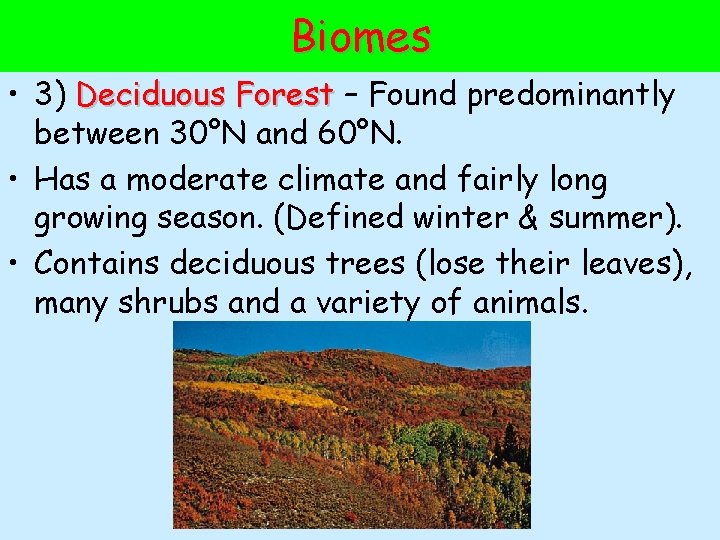
Biomes • 3) Deciduous Forest – Found predominantly between 30°N and 60°N. • Has a moderate climate and fairly long growing season. (Defined winter & summer). • Contains deciduous trees (lose their leaves), many shrubs and a variety of animals.
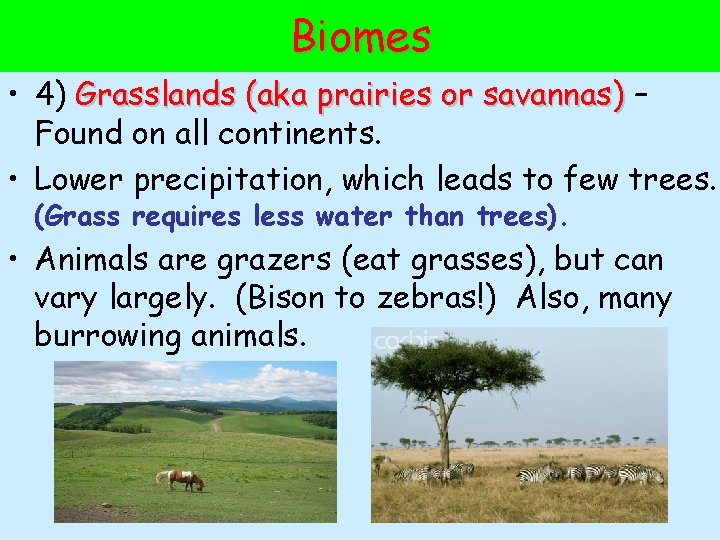
Biomes • 4) Grasslands (aka prairies or savannas) – Found on all continents. • Lower precipitation, which leads to few trees. (Grass requires less water than trees). • Animals are grazers (eat grasses), but can vary largely. (Bison to zebras!) Also, many burrowing animals.
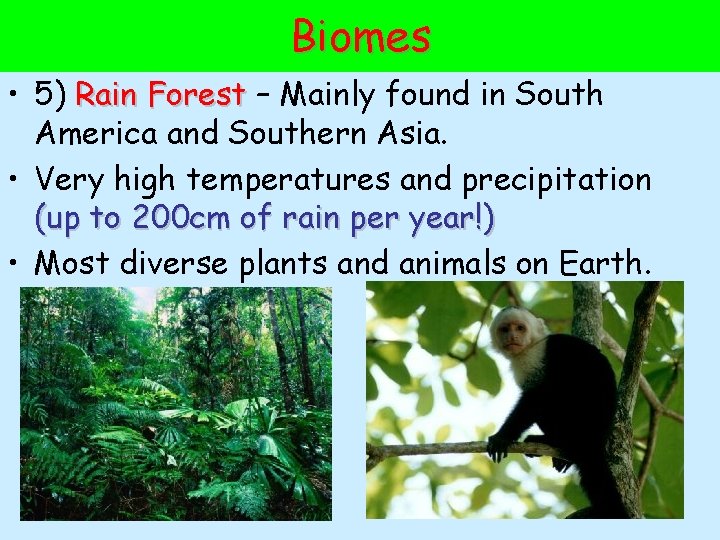
Biomes • 5) Rain Forest – Mainly found in South America and Southern Asia. • Very high temperatures and precipitation (up to 200 cm of rain per year!) • Most diverse plants and animals on Earth.
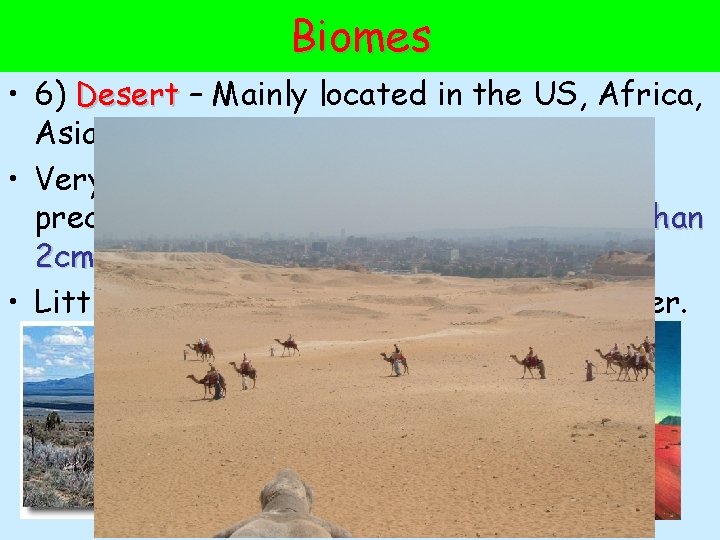
Biomes • 6) Desert – Mainly located in the US, Africa, Asia, and Australia. • Very high temperatures, and very little precipitation. (Areas in Sahara get less than 2 cm of rain per year!) • Little plant/animal life due to lack of water.
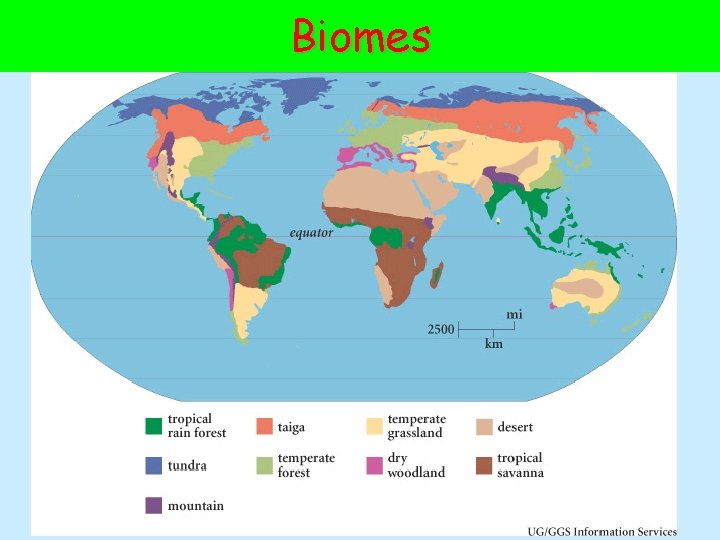
Biomes
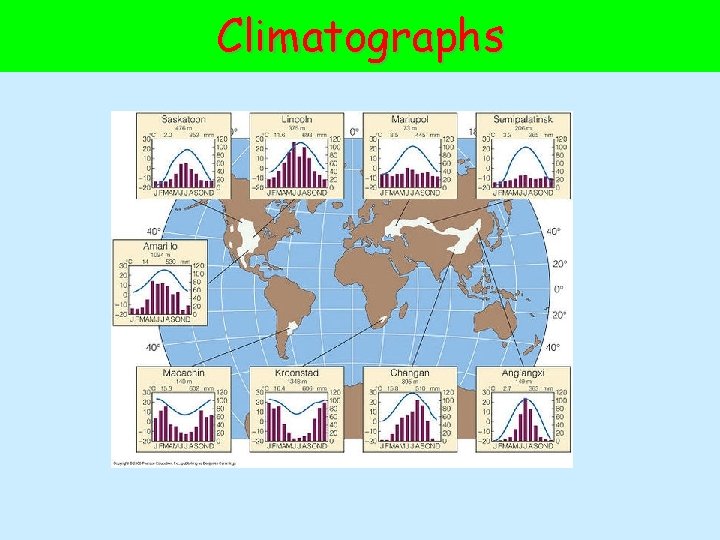
Climatographs
Biomes • Note: Canada has 4 biomes: Tundra, Taiga, Deciduous Forests, and Grasslands. • Alberta has 2 biomes: Taiga & Grasslands. Read pages 391 -402 Homework: Pg 402 #1, 2, 5 -8
Climate Change • Climate change is due to greenhouse gases. • Recall the natural greenhouse effect is a good thing for the Earth. It keeps the planet warm by absorbing thermal energy that is radiated from the surface. • The 4 greenhouse gases are: water vapour, carbon dioxide, methane, and nitrous oxide • The problem facing society today is that human activity is significantly increasing the concentration of these gases in the air.
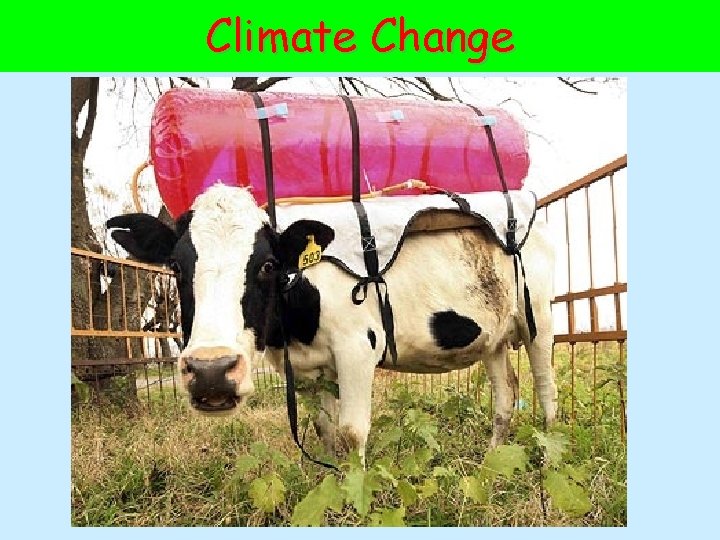
Climate Change • The increase in greenhouse gases began with the Industrial Revolution of the late 1700 s. • Since then, there have been many sources of extra greenhouse gases: – The main source is burning of fossil fuels This releases CO 2, CH 4, and N 2 O. – Logging and clearing of forests increases CO 2 levels because there are fewer trees removing CO 2 from the atmosphere. – Agriculture releases N 2 O through fertilizers and manure. Animals release CH 4.
Climate Change
Climate Change – Production of halocarbons (chemicals) absorb large amounts of energy. Eg. CFCs used as coolants in refrigerators and air conditioners. • These gases have contributed to global warming – an increase in Earth’s average temperature. – Warming has been seen in all regions of the Earth. • As climate change is still relatively new, there is still much debate in the topic.
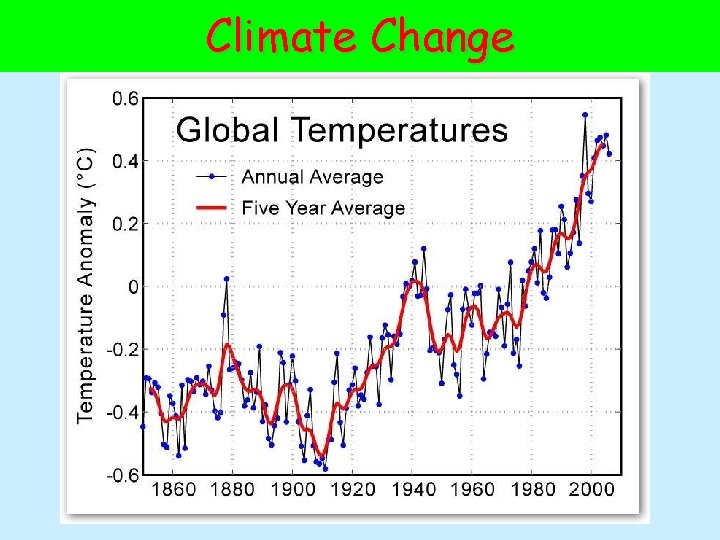
Climate Change
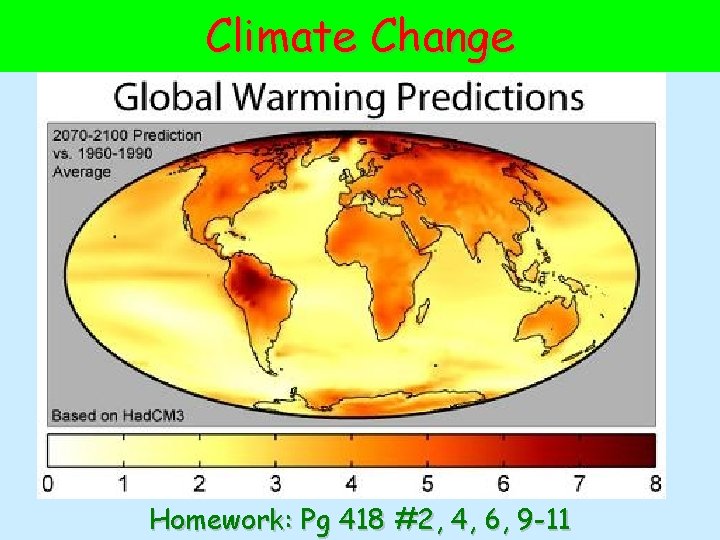
Climate Change Homework: Pg 418 #2, 4, 6, 9 -11
Collaboration on Climate Change • Scientific Collaboration – Scientists around the world are pooling their resources, technology, and knowledge together in order to better understand global climate, and global climate change. • Political Collaboration – Governments around the world are creating treaties that limit/reduce greenhouse gas emissions in order to combat climate change.
Collaboration on Climate Change • The Canadian Government has entered various agreements to reduce global warming. • Montreal Protocol – 1987 – Agreement to phase out use of chemicals that cause depletion of the ozone layer (CFCs). 194 countries have signed so far • United Nations Framework Convention on Climate Change (UNFCCC) – 1992 – International treaty to create international agreements on future actions related to climate change.
Collaboration on Climate Change • Kyoto Protocol – 1998 – Agreement (created by UNFCCC) that aims to reduce the production of greenhouse gases. 183 countries have signed so far.
Collaboration on Climate Change • Copenhagan Accord – 2009 – Climate Change summit hosted in Denmark by the United Nations. Recognizes the scientific need to hold global temperature increases to 2 degrees Celsius or less this century. Ratified by China, South Africa, India, Brazil and the US.
Collaboration on Climate Change • Canada’s plan to reduce greenhouse gas emissions: • Transportation – Fuel efficient cars, electric/hydrogen fueled cars, increase public transit. • Energy – Carbon capture, improve efficiency of energy production, renewable resources. • Buildings – Renovations to make buildings (including homes) energy efficient, increase efficiency of household appliances.
Collaboration on Climate Change • Agriculture & Forestry – Promote better practices of fertilizer use, and crop/livestock management, promote tree planting. • Industry – Support use of renewable energy sources, support improvements in energy efficiency.

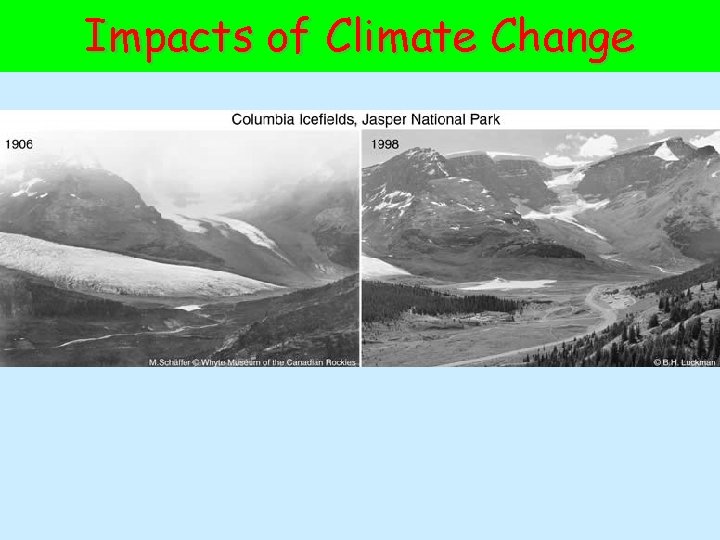
Impacts of Climate Change • Climate change would lead to: • Increase in severe weather (thunderstorms, hurricanes and tornadoes). • Increase in number and intensity of droughts, leading to crop failure and increased forest fires. • Increase in number and intensity of heat waves. • Polar ice cap melting, leading to flooding and erosion of coastal regions/cities. • Acidification of oceans and lower oxygen levels.
Impacts of Climate Change
Impacts of Climate Change • In Alberta, our agriculture would be significantly affected by: – Drought – Increased forest fires – Slowed growth – Increased insect population Read pages 410 - 430 Homework: Pg 425 #2 -6, 8 & Pg 430 #1, 3, 4, 6 -8
Biology Review • Pg 334 #4 -6, 8, 10, 13 -18, 20, 22, 25, 26, 2836, 44, 47 -49, 51, 53 -55 • AND • Pg 435 #2, 3, 5 -7, 10 -18, 20 -28, 30 -33, 3943, 48, 49, 51, 52, 57, 58, 60, 63, 64, 67, 69, 80 -83. • And that’s all folks!

BIOLOGY UNIT EXAM
- Slides: 159