
CELL THEORY Ann Maria George Natural Science Class

- Slides: 12
CELL THEORY Ann Maria George Natural Science Class No: 26
cell is the basic unit of structure in all living organisms and the basic unit of reproduction. v cell was discovered in the 17 th century with microscope. v Cell theory is a scientific theory which describes the properties of cells. v
v discovery is largely attributed to Robert Hook, and the scientific study of cell is known as cell biology. v Most of the debates involved the nature of cellular regeneration, and the cell as a fundamental unit of life. v Cell theory was eventually formulated in 1838. v This is usually credited to Matthias Schleiden and Theodor Schwann. v Scientists like Rudolf Virchow contributed to theory.
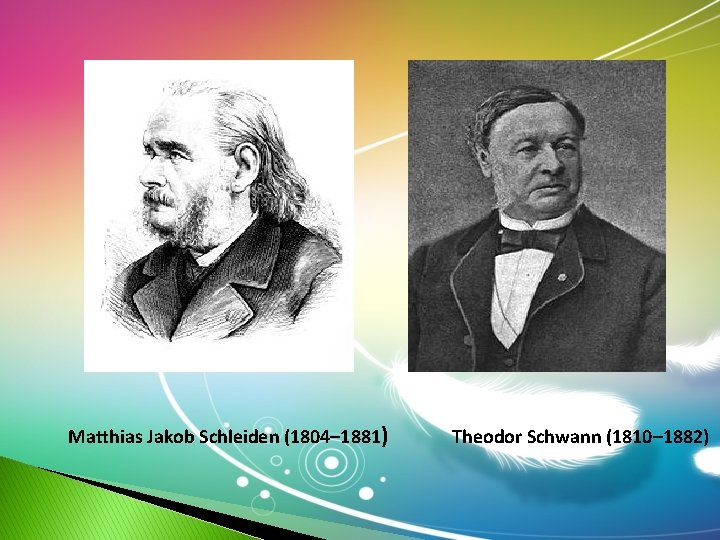
Matthias Jakob Schleiden (1804– 1881) Theodor Schwann (1810– 1882)
v Cell theory is the foundation of biology and is the most widely accepted explanation of the function of cells. v Three tenets to the cell theory are ; 1. All living organisms are composed of one or more cells. 2. The cell is the most basic unit of life. 3. All cells arise from pre-existing, living cells, by biogenesis.
v Cell theory was developed by two scientists: Theodor Schwann and Matthias Jakob Schleiden. v In 1838, Schleiden suggested that every structural part of a plant was made up of cells. v He also suggested that cells were made by a crystallization process either within other cells or from the outside. v The crystallization process is no longer accepted with modern cell theory
v In 1839, Theodor Schwann states that animals are composed of cells. v conclusions about plants and animals, two of the three tenets of cell theory were postulated. 1. All living organisms are composed of one or more cells 2. The cell is the most basic unit of life
v Schleiden's theory of free cell formation through crystallization was refuted in the 1850 s by Robert Remak, Rudolf Virchow, and Albert Kolliker v In 1855, Rudolf Virchow added the third tenet to cell theory. In Latin, this tenet states Omnis cellula e cellula. ü All cells arise only from pre-existing cells
Modern interpretation The generally accepted parts of modern cell theory include: ØAll known living things are made up of one or more cells ØAll living cells arise from preexisting cells by division. ØThe cell is the fundamental unit of structure.
Ø The activity of an organism depends on the total activity of independent cells. Ø Energy flow (metabolism and biochemistry) occurs within cells. Ø Cells contain DNA and RNA found in the cell nucleus and cytoplasm. Ø All cells are basically the same in chemical composition in organisms of similar species.
ØThe modern version of the cell theory includes the ideas that: �Energy flow occurs within cells �Heredity information (DNA) is passed on from cell to cell. � All cells have the same basic chemical composition.
REFERENCE � www. saylor. org � www. biology. arizona � www. bio. miami. edu