
Cell Theory and the Scientists Who Helped Shape
- Slides: 16
Cell Theory and the Scientists Who Helped Shape It
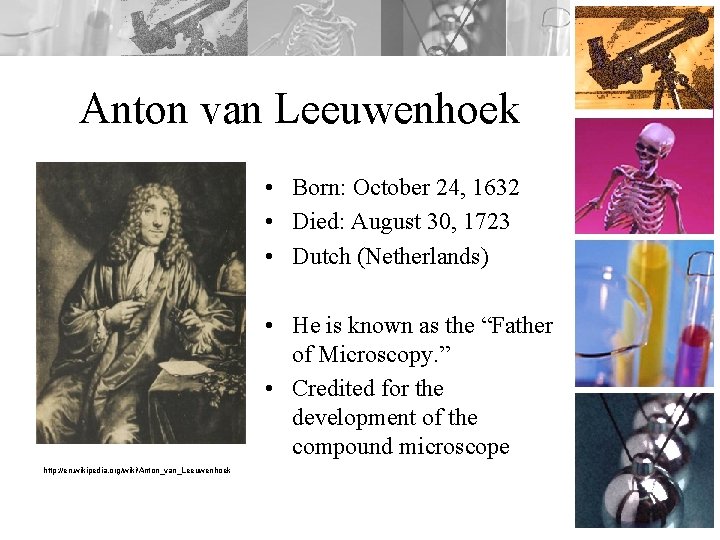
Anton van Leeuwenhoek • Born: October 24, 1632 • Died: August 30, 1723 • Dutch (Netherlands) • He is known as the “Father of Microscopy. ” • Credited for the development of the compound microscope http: //en. wikipedia. org/wiki/Anton_van_Leeuwenhoek
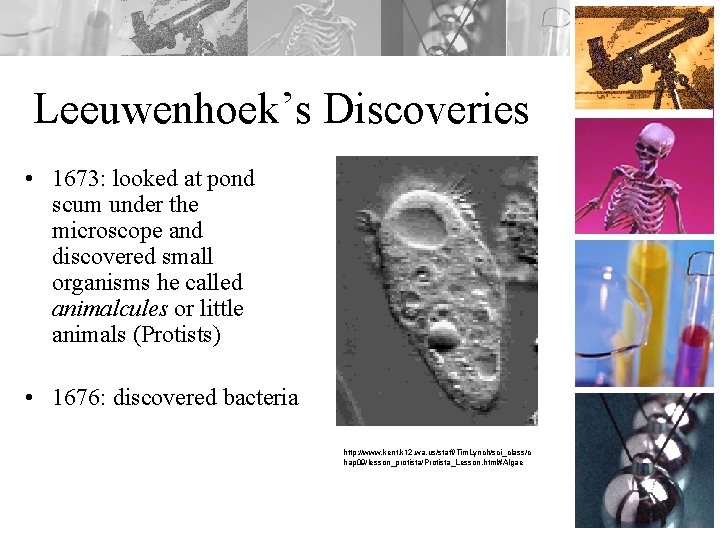
Leeuwenhoek’s Discoveries • 1673: looked at pond scum under the microscope and discovered small organisms he called animalcules or little animals (Protists) • 1676: discovered bacteria http: //www. kent. k 12. wa. us/staff/Tim. Lynch/sci_class/c hap 09/lesson_protista/Protista_Lesson. html#Algae
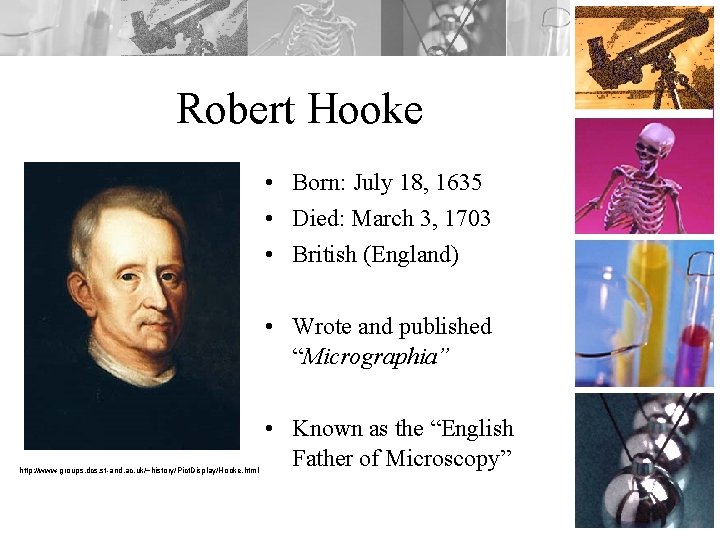
Robert Hooke • Born: July 18, 1635 • Died: March 3, 1703 • British (England) • Wrote and published “Micrographia” http: //www-groups. dcs. st-and. ac. uk/~history/Pict. Display/Hooke. html • Known as the “English Father of Microscopy”
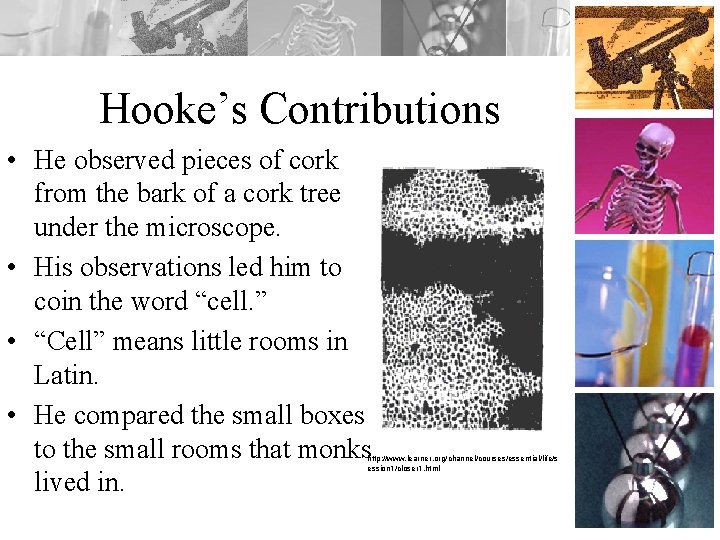
Hooke’s Contributions • He observed pieces of cork from the bark of a cork tree under the microscope. • His observations led him to coin the word “cell. ” • “Cell” means little rooms in Latin. • He compared the small boxes to the small rooms that monks lived in. http: //www. learner. org/channel/courses/essential/life/s ession 1/closer 1. html
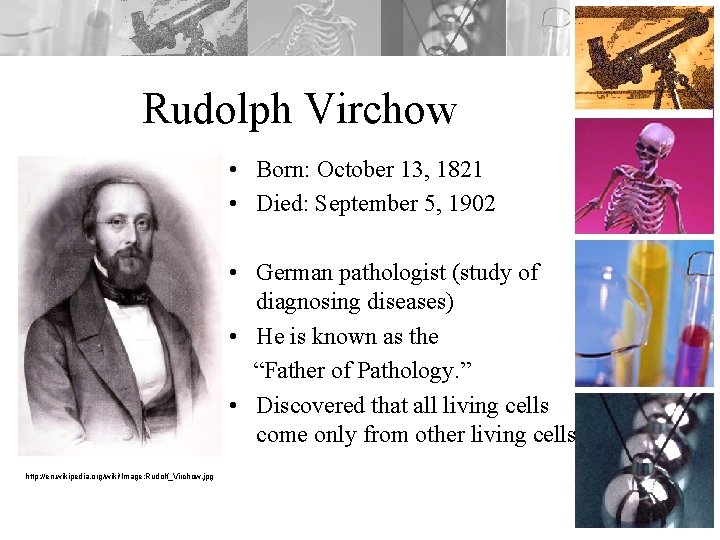
Rudolph Virchow • Born: October 13, 1821 • Died: September 5, 1902 • German pathologist (study of diagnosing diseases) • He is known as the “Father of Pathology. ” • Discovered that all living cells come only from other living cells http: //en. wikipedia. org/wiki/Image: Rudolf_Virchow. jpg
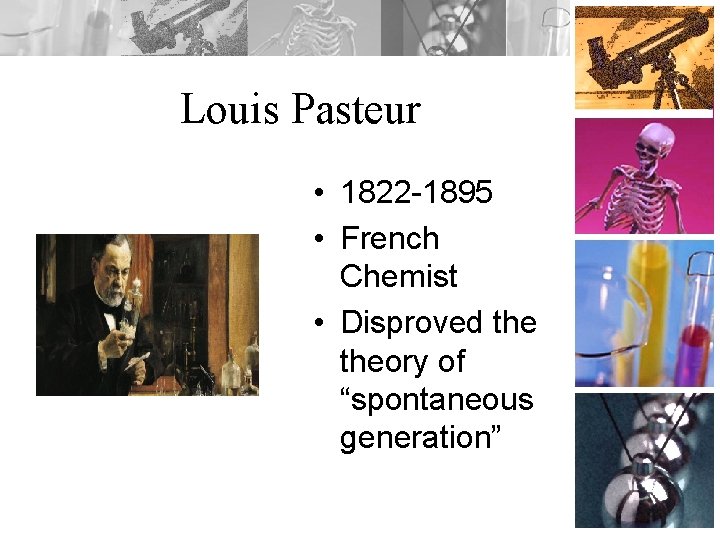
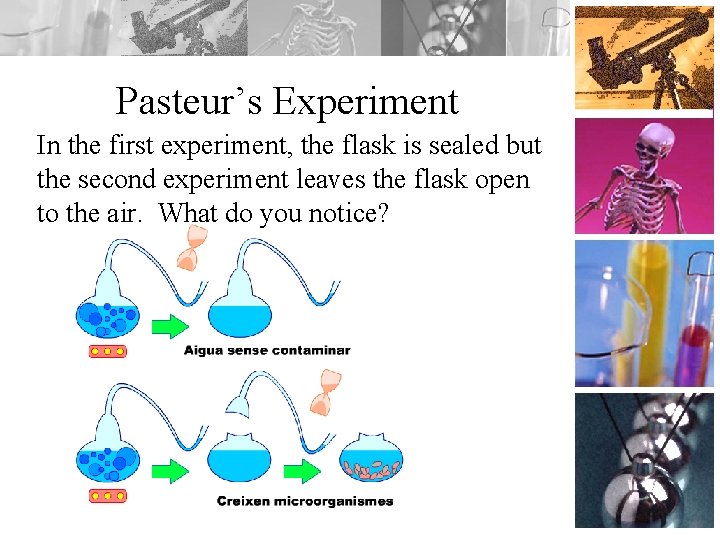
Louis Pasteur • 1822 -1895 • French Chemist • Disproved theory of “spontaneous generation”
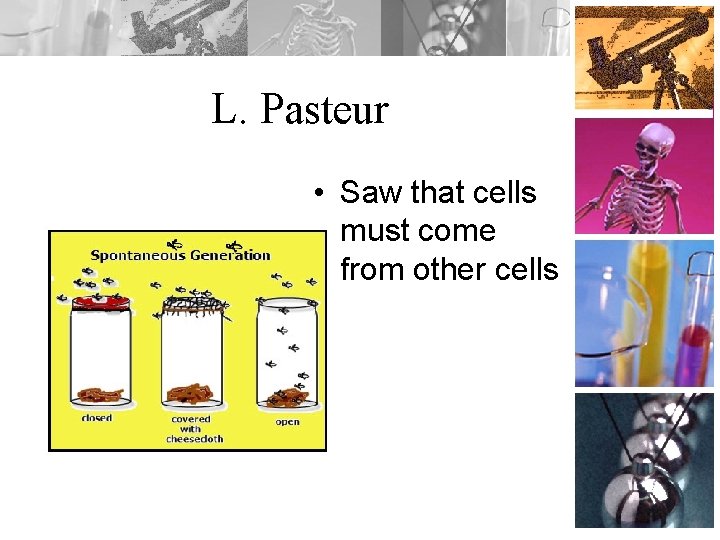
L. Pasteur • Saw that cells must come from other cells
Pasteur’s Experiment In the first experiment, the flask is sealed but the second experiment leaves the flask open to the air. What do you notice?
• Organization: Living things tend to be highly organized and complex compared to nonliving things. • Metabolism (the Greek word for “change”): Living things rely on chemical reactions. (Energy/waste) • Reproduction: Living organisms replicate themselves, but with variation, and generate their own kind.
• Adaptation: Living things have characteristics that support their survival and are shaped by interactions with their environment. • Growth and development: When a living organism reproduces, the offspring start out smaller, and usually much simpler in form, and then increase in size and complexity. • Response to stimuli: An organism responds to its environment in order to preserve itself.
All living things are made of cells • Organism- An individual living thing, made up of one or many cells, that is capable of growing and reproducing. • Unicellular- A term used to describe an organism that is made up of a single cell. • Multicellular- A term used to describe an organism that is made up of many cells.
The Cell Theory 1. All living things are made of cells. 2. Cells are the basic units of structure and function in living things. 3. Living cells come only from other living cells.
Diverse Cells • Eukaryotic Cells- genetic material DNA is found inside a nucleus. (more advanced) • Prokaryotic Cells- no separate nucleus for the DNA. The genetic material is found in the cytoplasm. (primitive) • Cytoplasm– inside the cell membrane – gelatin like or jellylike material – where most work is carried out
Cells in multicellular organisms specialize. • Cell Tissue Organ Systems • Tissue a group of individual cells that are organized for a specific job. • Organs are different tissues working together to perform a particular function. Organs make systems.
The Cell and Complexity Enormous Complexity