
Cell Theory and the Scientists Who Helped Shape
- Slides: 17
Cell Theory and the Scientists Who Helped Shape It
The Cell • The smallest unit that can perform all life processes
Scientists and the Cell Theory
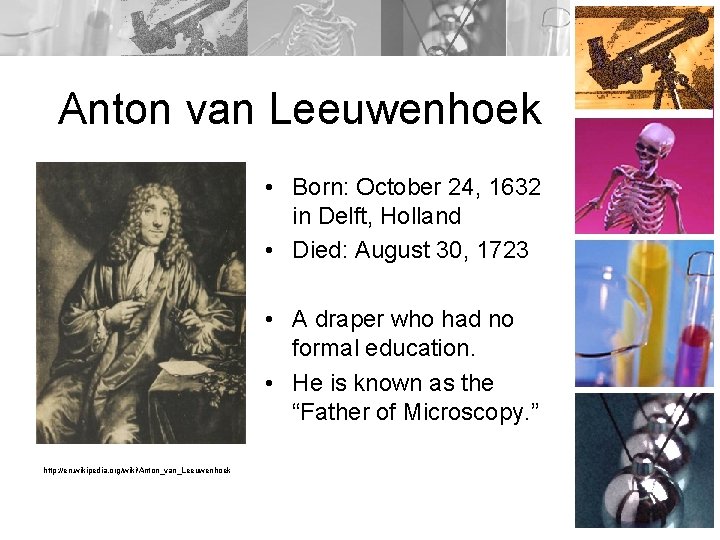
Anton van Leeuwenhoek • Born: October 24, 1632 in Delft, Holland • Died: August 30, 1723 • A draper who had no formal education. • He is known as the “Father of Microscopy. ” http: //en. wikipedia. org/wiki/Anton_van_Leeuwenhoek
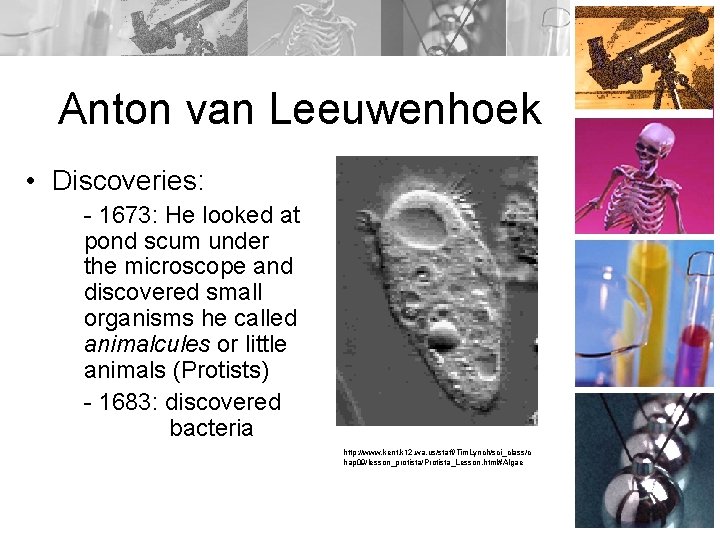
Anton van Leeuwenhoek • Discoveries: - 1673: He looked at pond scum under the microscope and discovered small organisms he called animalcules or little animals (Protists) - 1683: discovered bacteria http: //www. kent. k 12. wa. us/staff/Tim. Lynch/sci_class/c hap 09/lesson_protista/Protista_Lesson. html#Algae
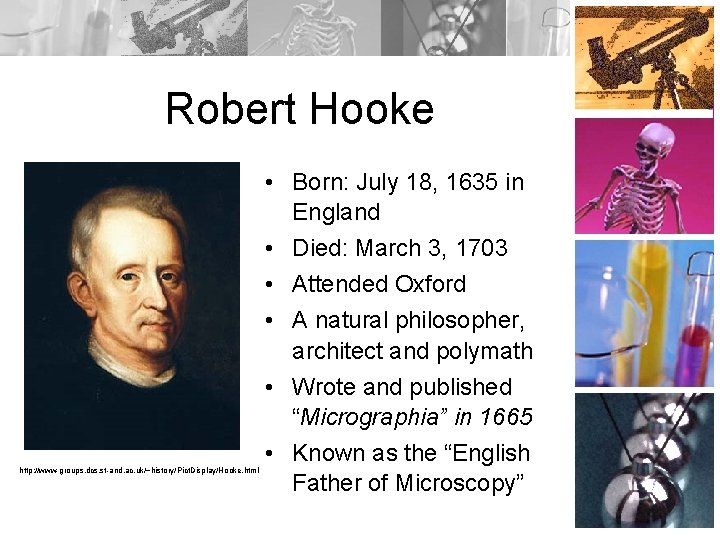
Robert Hooke http: //www-groups. dcs. st-and. ac. uk/~history/Pict. Display/Hooke. html • Born: July 18, 1635 in England • Died: March 3, 1703 • Attended Oxford • A natural philosopher, architect and polymath • Wrote and published “Micrographia” in 1665 • Known as the “English Father of Microscopy”
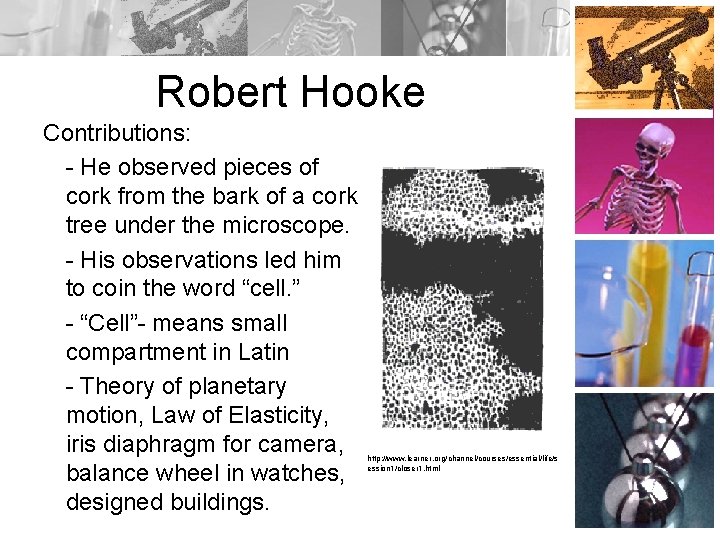
Robert Hooke Contributions: - He observed pieces of cork from the bark of a cork tree under the microscope. - His observations led him to coin the word “cell. ” - “Cell”- means small compartment in Latin - Theory of planetary motion, Law of Elasticity, iris diaphragm for camera, balance wheel in watches, designed buildings. http: //www. learner. org/channel/courses/essential/life/s ession 1/closer 1. html
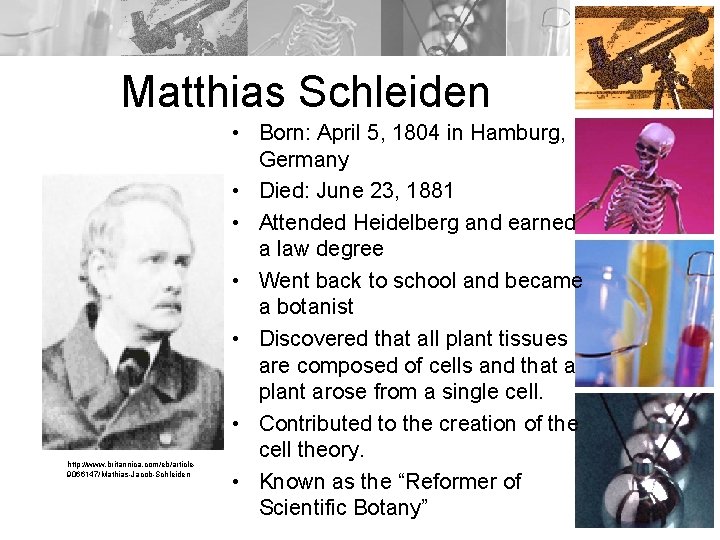
Matthias Schleiden http: //www. britannica. com/eb/article 9066147/Mathias-Jacob-Schleiden • Born: April 5, 1804 in Hamburg, Germany • Died: June 23, 1881 • Attended Heidelberg and earned a law degree • Went back to school and became a botanist • Discovered that all plant tissues are composed of cells and that a plant arose from a single cell. • Contributed to the creation of the cell theory. • Known as the “Reformer of Scientific Botany”
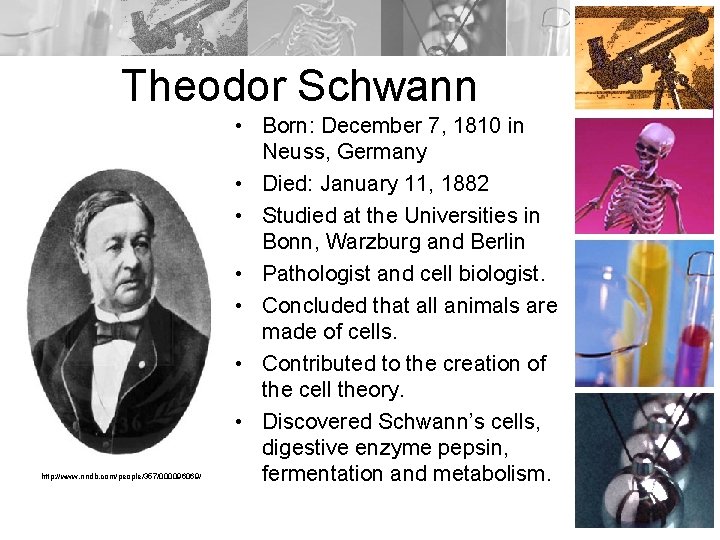
Theodor Schwann http: //www. nndb. com/people/357/000096069/ • Born: December 7, 1810 in Neuss, Germany • Died: January 11, 1882 • Studied at the Universities in Bonn, Warzburg and Berlin • Pathologist and cell biologist. • Concluded that all animals are made of cells. • Contributed to the creation of the cell theory. • Discovered Schwann’s cells, digestive enzyme pepsin, fermentation and metabolism.
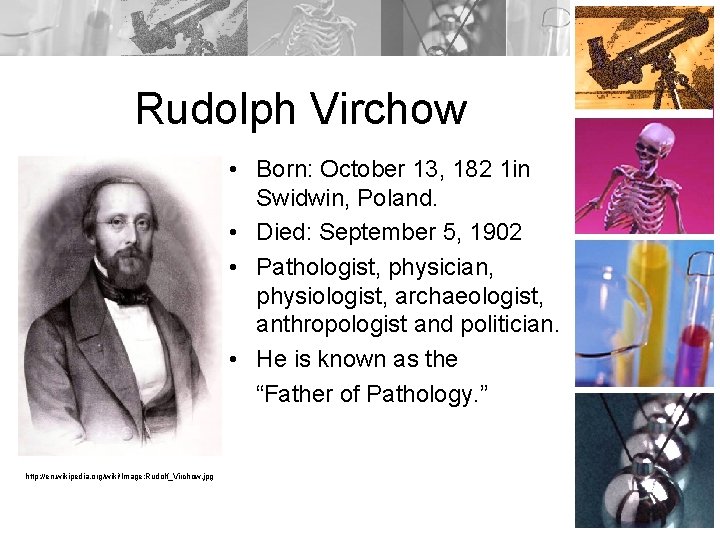
Rudolph Virchow • Born: October 13, 182 1 in Swidwin, Poland. • Died: September 5, 1902 • Pathologist, physician, physiologist, archaeologist, anthropologist and politician. • He is known as the “Father of Pathology. ” http: //en. wikipedia. org/wiki/Image: Rudolf_Virchow. jpg
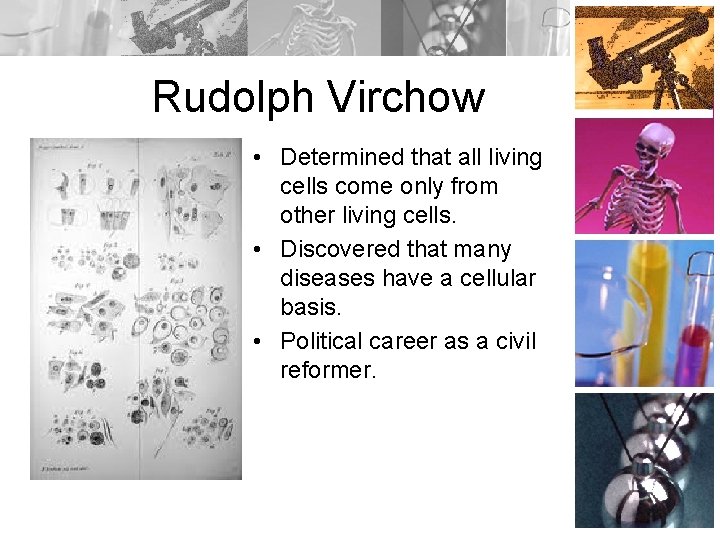
Rudolph Virchow • Determined that all living cells come only from other living cells. • Discovered that many diseases have a cellular basis. • Political career as a civil reformer.
The Cell Theory Major Contributors: • Matthias Schleiden • He declared that the cell is the basic building block of all plant matter. • “All living things are made up of one or more cells. ” • Theodor Schwann • He pulled existing observations together into theory that stated: 1. Cells are organisms and all organisms consist of one or more cells. 2. The cell is the basic unit of structure for all organisms and that plants and animals consist of combinations of these organisms which are arranged in accordance with definite rules. • In other words, “The cell is the basic unit of life. ” • Rudolph Virchow • “All cells develop only from existing cells. ”
Cell Theory Definition • The scientific theory that describes the properties of cells.
The Cell Theory 1. All living things are made of cells. 2. Cells are the basic units of structure and function in living things. 3. Living cells come only from other living cells.
Just a little more…Cell Theory The generally accepted parts of the modern cell theory include: 1. All living cells arise from pre-existing cells by division. 2. The activity of an organism depends on the total activity of independent cells. 3. Energy flow occurs within cells. 4. Cells contain hereditary information (DNA) which is passed from cell to cell during cell division.
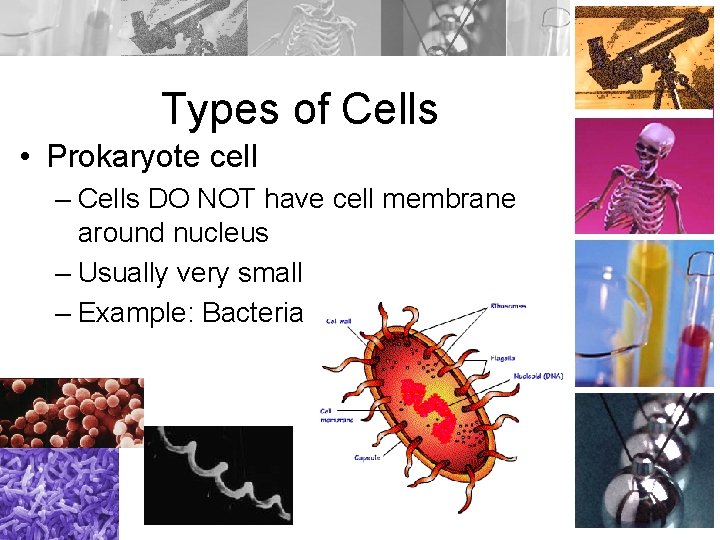
Types of Cells • Prokaryote cell – Cells DO NOT have cell membrane around nucleus – Usually very small – Example: Bacteria
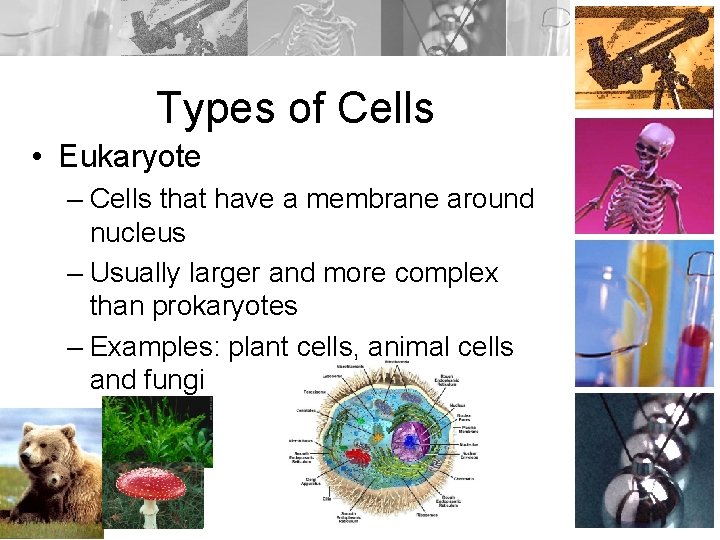
Types of Cells • Eukaryote – Cells that have a membrane around nucleus – Usually larger and more complex than prokaryotes – Examples: plant cells, animal cells and fungi