
Cell Theory and Structure Development of the Light
- Slides: 37
Cell Theory and Structure
• • • Development of the Light Microscope Evolution of the Cell Theory Spontaneous Generation Disproven Histochemistry, Mitosis, and Meiosis Classes of Biochemicals in Cells Electron Microscopy and Ultrastructure
The Microscope • An understanding of cells and the structure of cells had to wait until structures so small could be visualized by magnification.
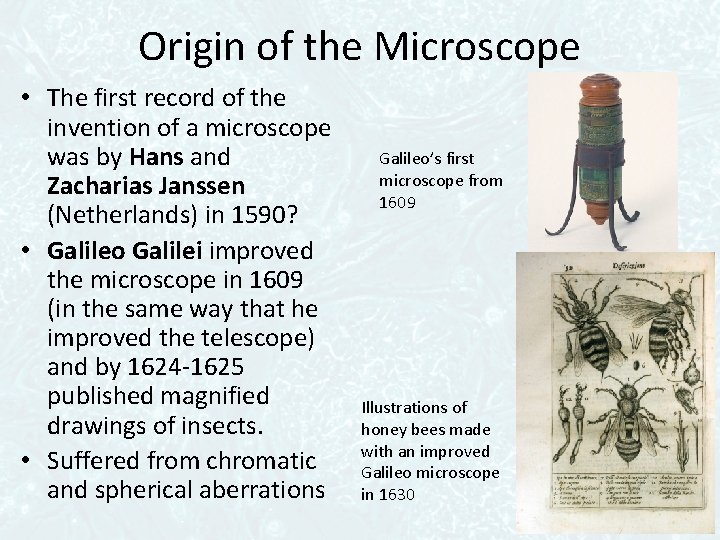
Origin of the Microscope • The first record of the invention of a microscope was by Hans and Zacharias Janssen (Netherlands) in 1590? • Galileo Galilei improved the microscope in 1609 (in the same way that he improved the telescope) and by 1624 -1625 published magnified drawings of insects. • Suffered from chromatic and spherical aberrations Galileo’s first microscope from 1609 Illustrations of honey bees made with an improved Galileo microscope in 1630
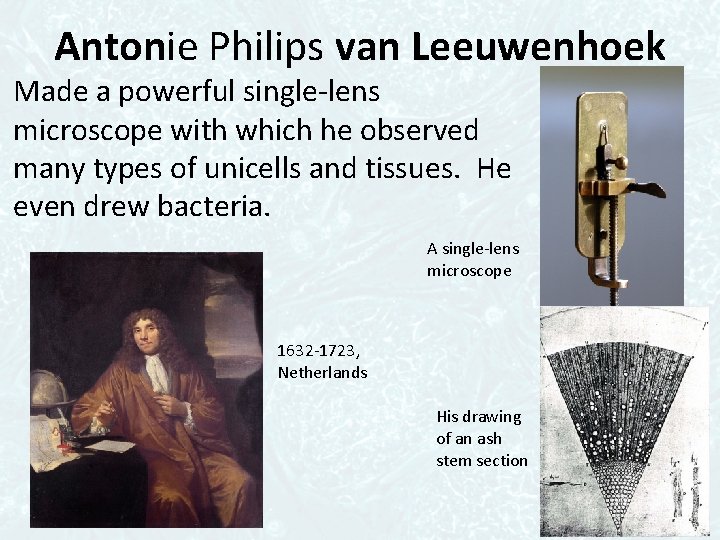
Antonie Philips van Leeuwenhoek Made a powerful single-lens microscope with which he observed many types of unicells and tissues. He even drew bacteria. A single-lens microscope 1632 -1723, Netherlands His drawing of an ash stem section
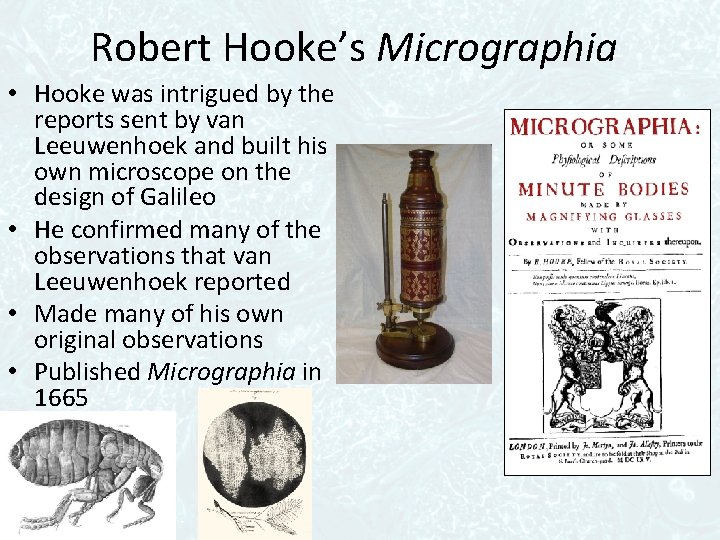
Robert Hooke’s Micrographia • Hooke was intrigued by the reports sent by van Leeuwenhoek and built his own microscope on the design of Galileo • He confirmed many of the observations that van Leeuwenhoek reported • Made many of his own original observations • Published Micrographia in 1665
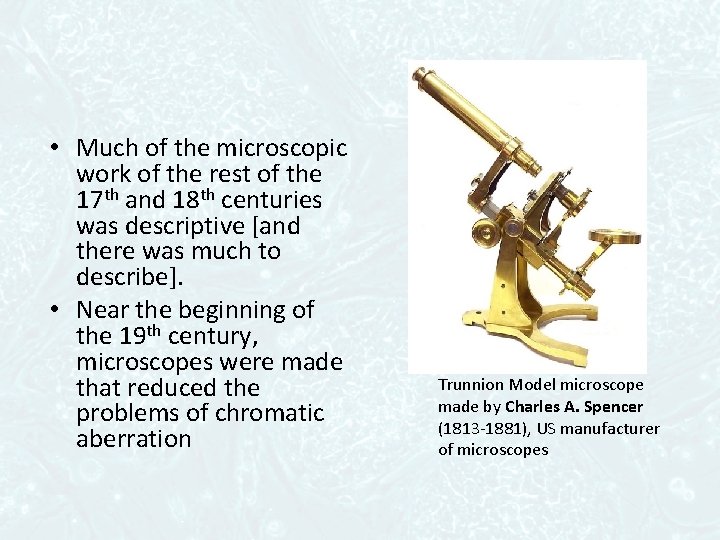
• Much of the microscopic work of the rest of the 17 th and 18 th centuries was descriptive [and there was much to describe]. • Near the beginning of the 19 th century, microscopes were made that reduced the problems of chromatic aberration Trunnion Model microscope made by Charles A. Spencer (1813 -1881), US manufacturer of microscopes
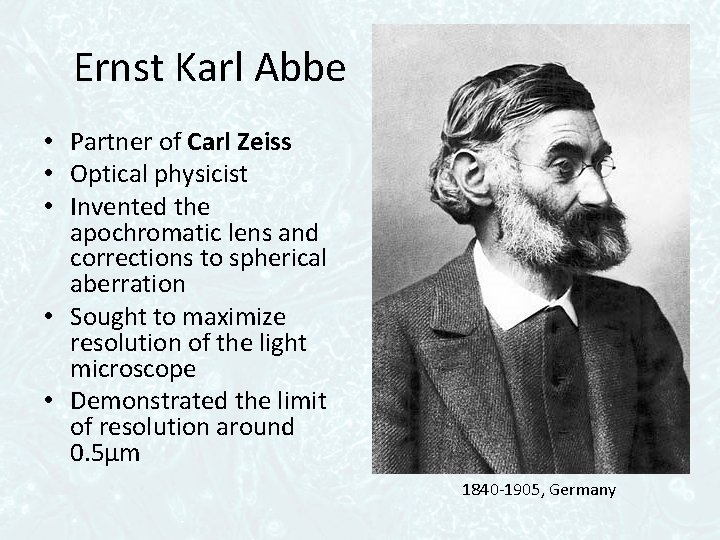
Ernst Karl Abbe • Partner of Carl Zeiss • Optical physicist • Invented the apochromatic lens and corrections to spherical aberration • Sought to maximize resolution of the light microscope • Demonstrated the limit of resolution around 0. 5μm 1840 -1905, Germany
The Cell Theory • …also, by the early part of the 19 th century enough biological material had been observed to begin to make generalizations.
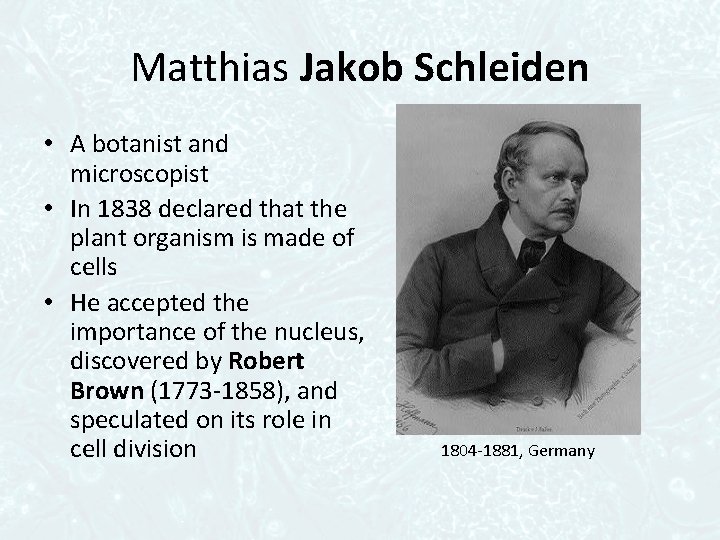
Matthias Jakob Schleiden • A botanist and microscopist • In 1838 declared that the plant organism is made of cells • He accepted the importance of the nucleus, discovered by Robert Brown (1773 -1858), and speculated on its role in cell division 1804 -1881, Germany
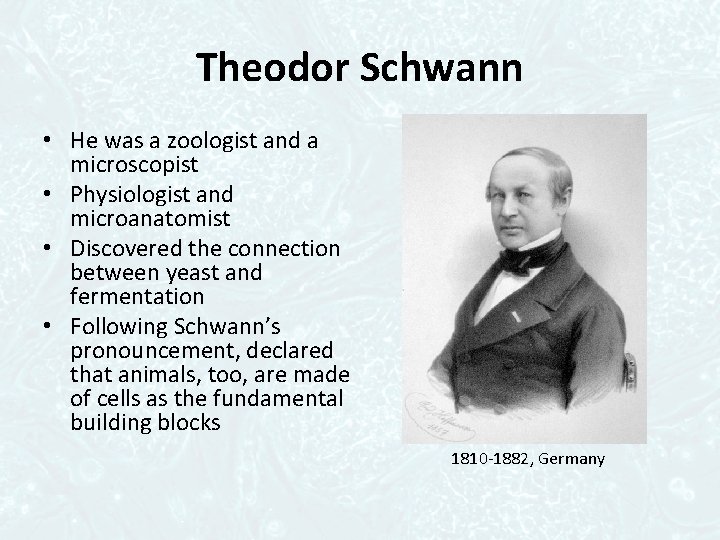
Theodor Schwann • He was a zoologist and a microscopist • Physiologist and microanatomist • Discovered the connection between yeast and fermentation • Following Schwann’s pronouncement, declared that animals, too, are made of cells as the fundamental building blocks 1810 -1882, Germany
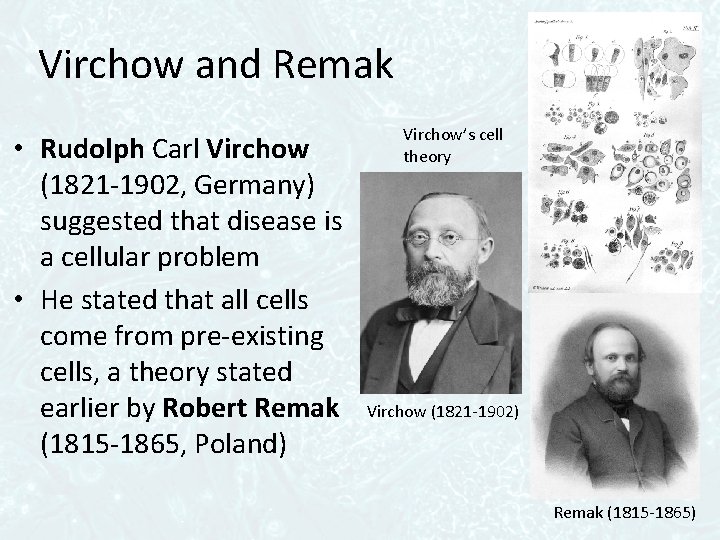
Virchow and Remak • Rudolph Carl Virchow (1821 -1902, Germany) suggested that disease is a cellular problem • He stated that all cells come from pre-existing cells, a theory stated earlier by Robert Remak (1815 -1865, Poland) Virchow’s cell theory Virchow (1821 -1902) Remak (1815 -1865)
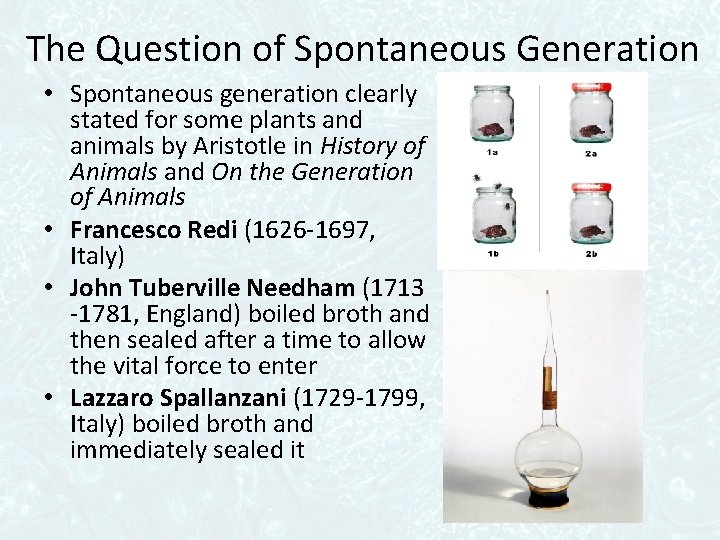
The Question of Spontaneous Generation • Spontaneous generation clearly stated for some plants and animals by Aristotle in History of Animals and On the Generation of Animals • Francesco Redi (1626 -1697, Italy) • John Tuberville Needham (1713 -1781, England) boiled broth and then sealed after a time to allow the vital force to enter • Lazzaro Spallanzani (1729 -1799, Italy) boiled broth and immediately sealed it
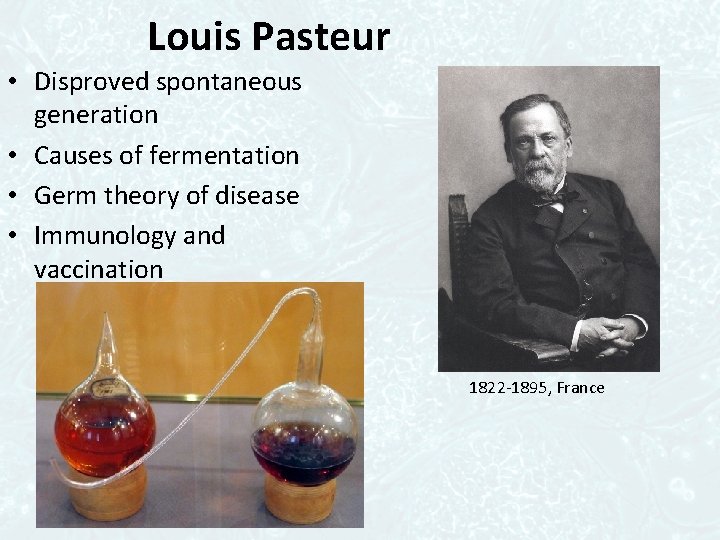
Louis Pasteur • Disproved spontaneous generation • Causes of fermentation • Germ theory of disease • Immunology and vaccination 1822 -1895, France
The Cell Theory by 1858 • All living organisms are composed of one or more cells. • The cell is the most basic unit of structure, function, and organization in all organisms. • All cells come from pre-existing, living cells.
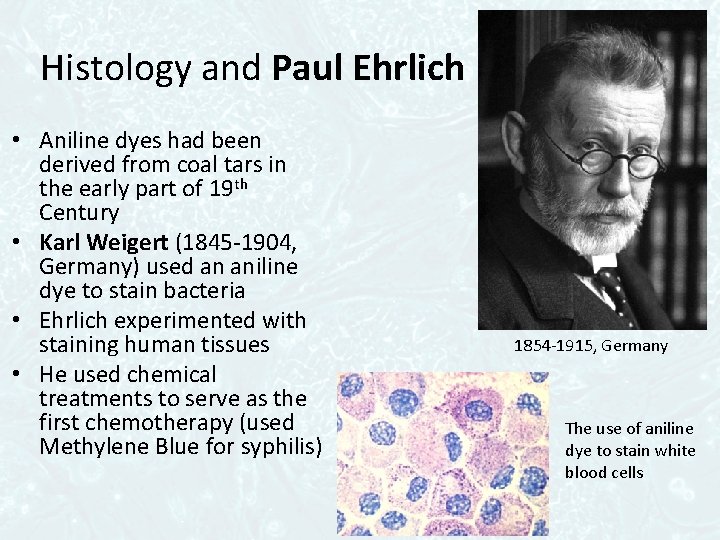
Histology and Paul Ehrlich • Aniline dyes had been derived from coal tars in the early part of 19 th Century • Karl Weigert (1845 -1904, Germany) used an aniline dye to stain bacteria • Ehrlich experimented with staining human tissues • He used chemical treatments to serve as the first chemotherapy (used Methylene Blue for syphilis) 1854 -1915, Germany The use of aniline dye to stain white blood cells
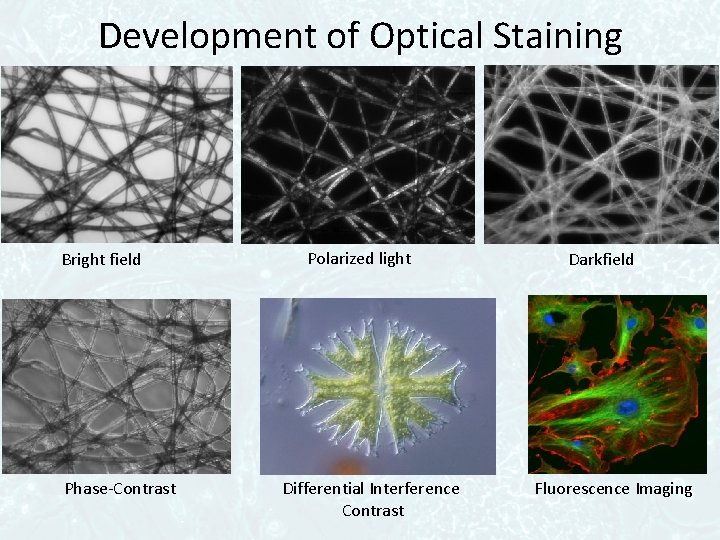
Development of Optical Staining Bright field Phase-Contrast Polarized light Differential Interference Contrast Darkfield Fluorescence Imaging
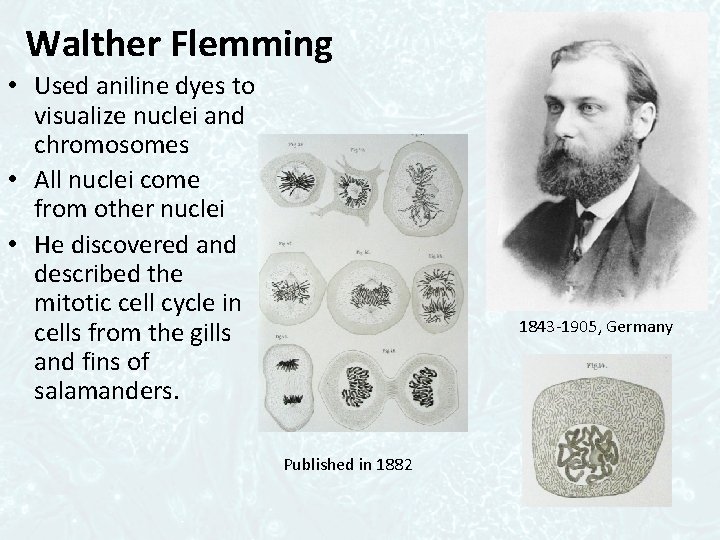
Walther Flemming • Used aniline dyes to visualize nuclei and chromosomes • All nuclei come from other nuclei • He discovered and described the mitotic cell cycle in cells from the gills and fins of salamanders. 1843 -1905, Germany Published in 1882
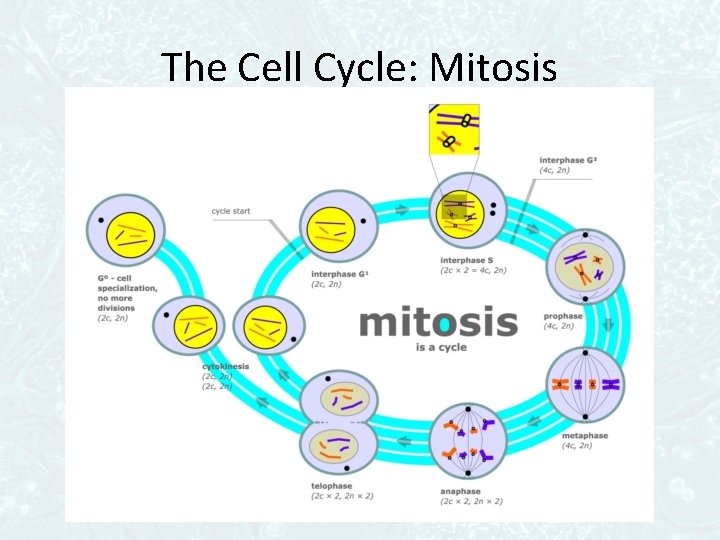
The Cell Cycle: Mitosis
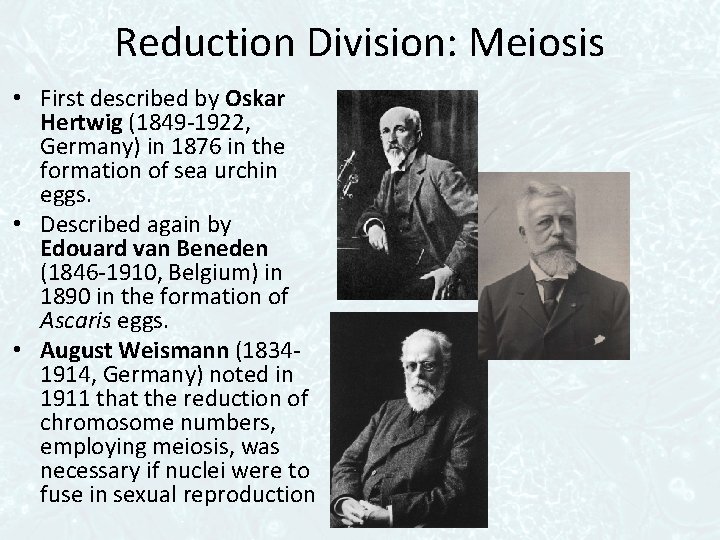
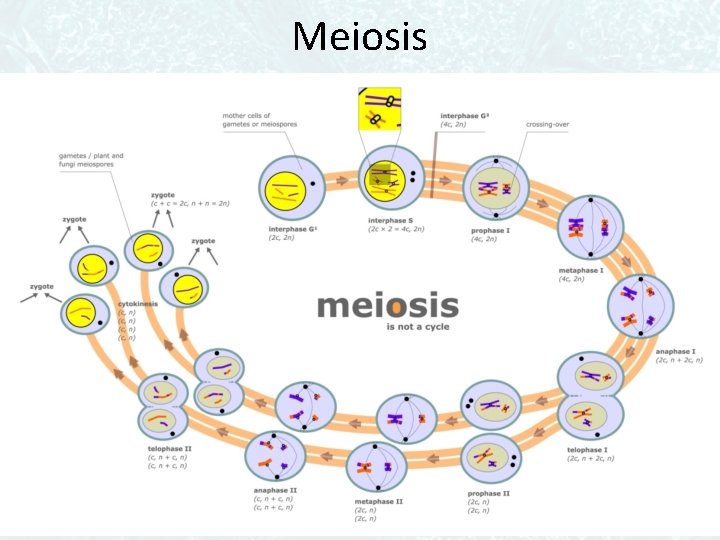
Reduction Division: Meiosis • First described by Oskar Hertwig (1849 -1922, Germany) in 1876 in the formation of sea urchin eggs. • Described again by Edouard van Beneden (1846 -1910, Belgium) in 1890 in the formation of Ascaris eggs. • August Weismann (18341914, Germany) noted in 1911 that the reduction of chromosome numbers, employing meiosis, was necessary if nuclei were to fuse in sexual reproduction
Meiosis
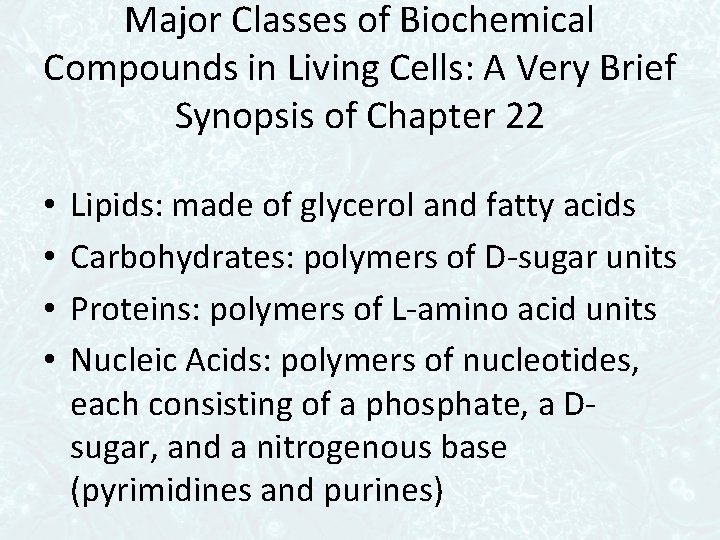
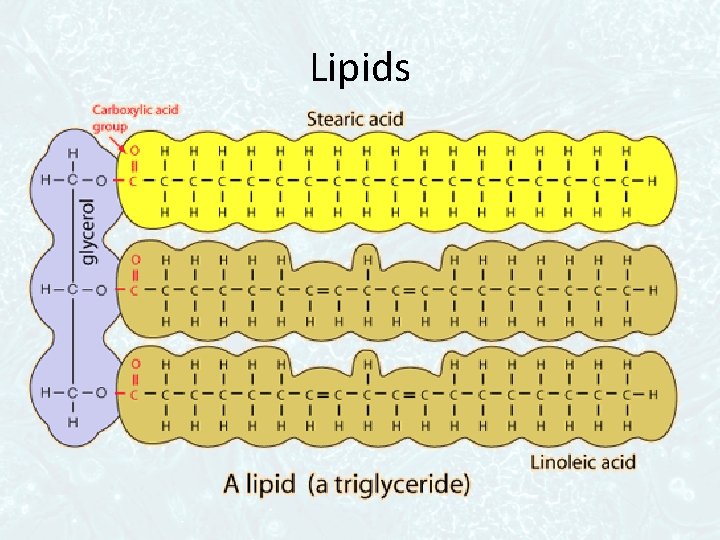
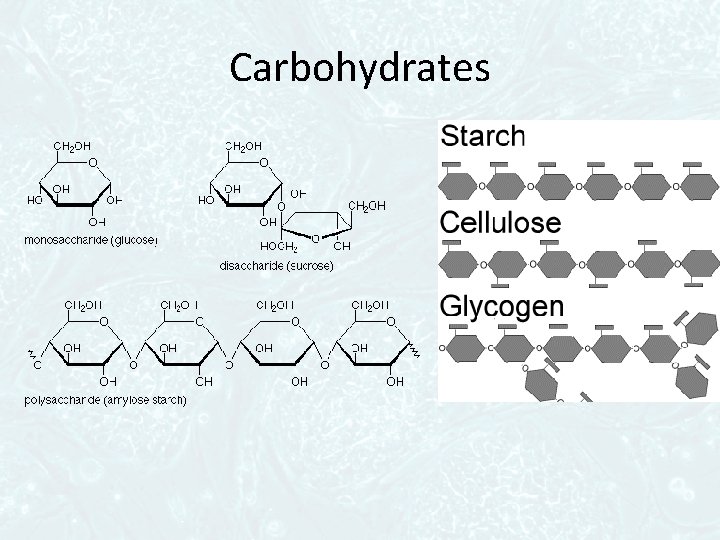
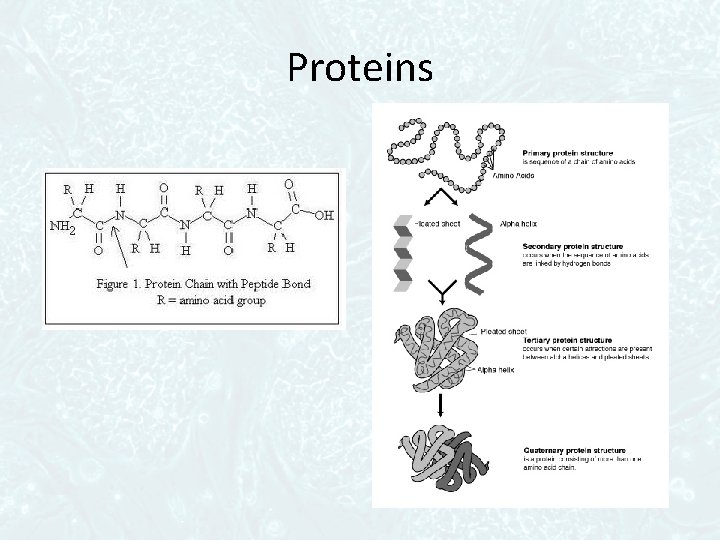
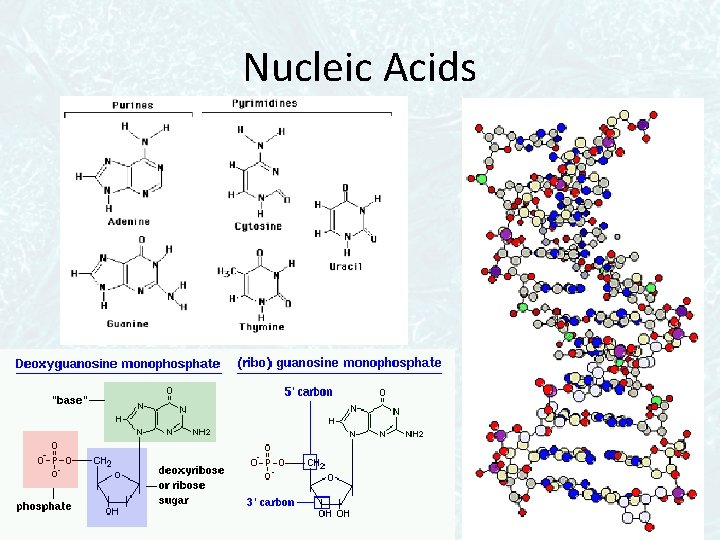
Major Classes of Biochemical Compounds in Living Cells: A Very Brief Synopsis of Chapter 22 • • Lipids: made of glycerol and fatty acids Carbohydrates: polymers of D-sugar units Proteins: polymers of L-amino acid units Nucleic Acids: polymers of nucleotides, each consisting of a phosphate, a Dsugar, and a nitrogenous base (pyrimidines and purines)
Lipids
Carbohydrates
Proteins
Nucleic Acids
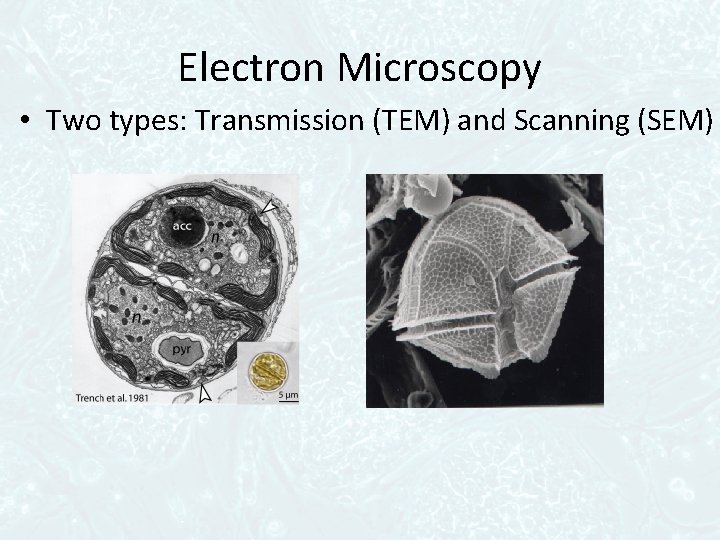
Electron Microscopy • Two types: Transmission (TEM) and Scanning (SEM)
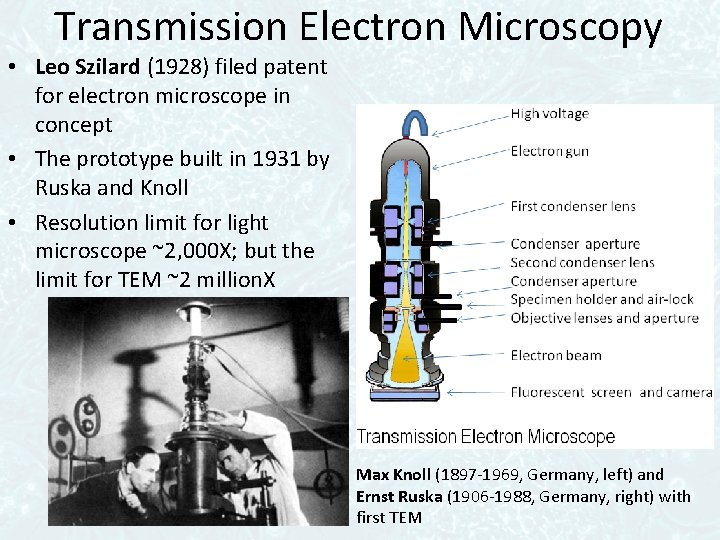
Transmission Electron Microscopy • Leo Szilard (1928) filed patent for electron microscope in concept • The prototype built in 1931 by Ruska and Knoll • Resolution limit for light microscope ~2, 000 X; but the limit for TEM ~2 million. X Max Knoll (1897 -1969, Germany, left) and Ernst Ruska (1906 -1988, Germany, right) with first TEM
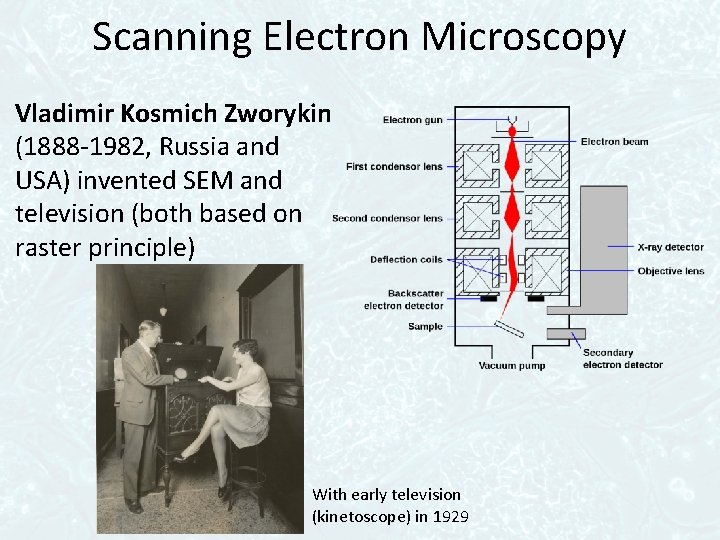
Scanning Electron Microscopy Vladimir Kosmich Zworykin (1888 -1982, Russia and USA) invented SEM and television (both based on raster principle) With early television (kinetoscope) in 1929
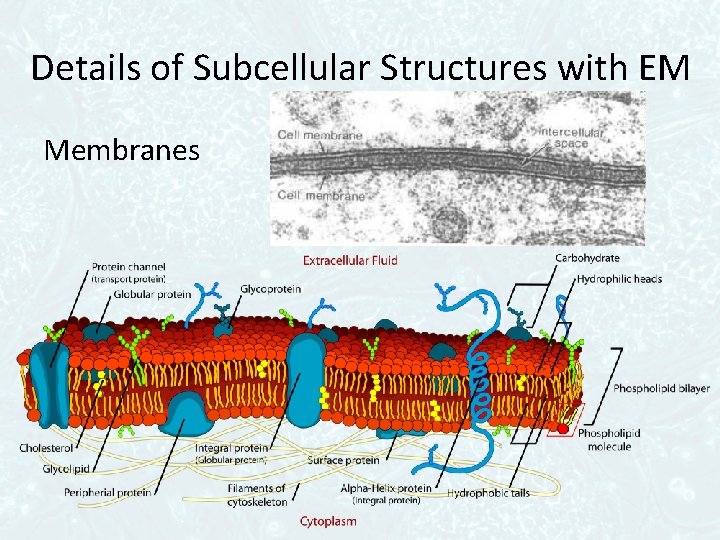
Details of Subcellular Structures with EM Membranes
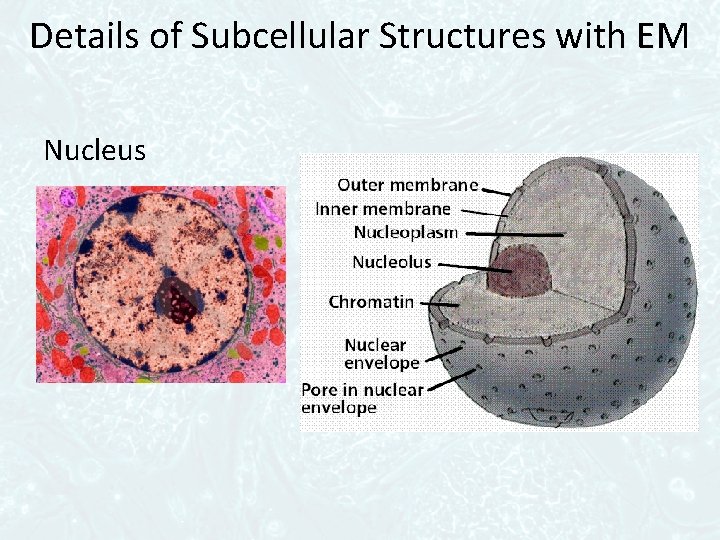
Details of Subcellular Structures with EM Nucleus
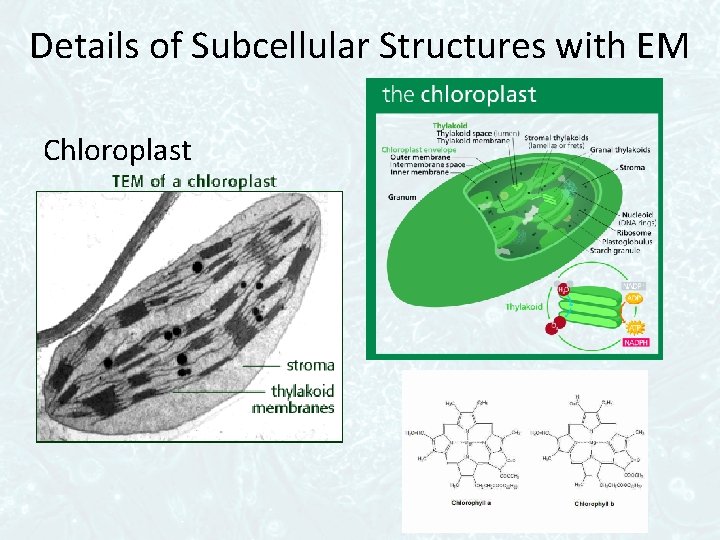
Details of Subcellular Structures with EM Chloroplast
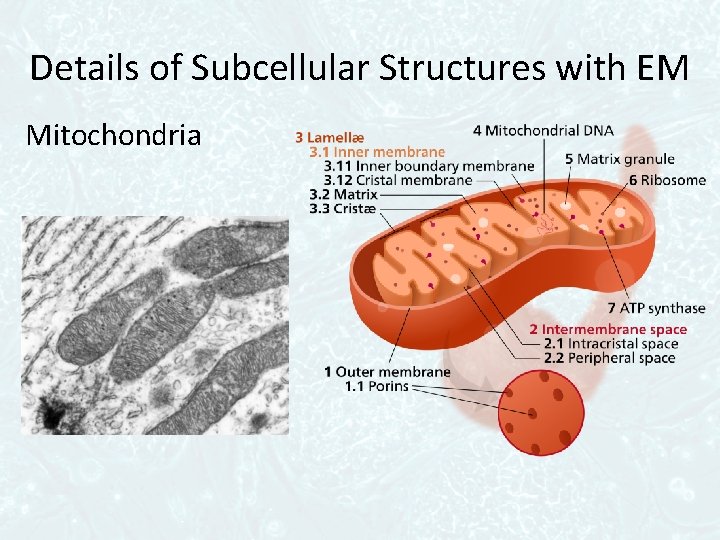
Details of Subcellular Structures with EM Mitochondria
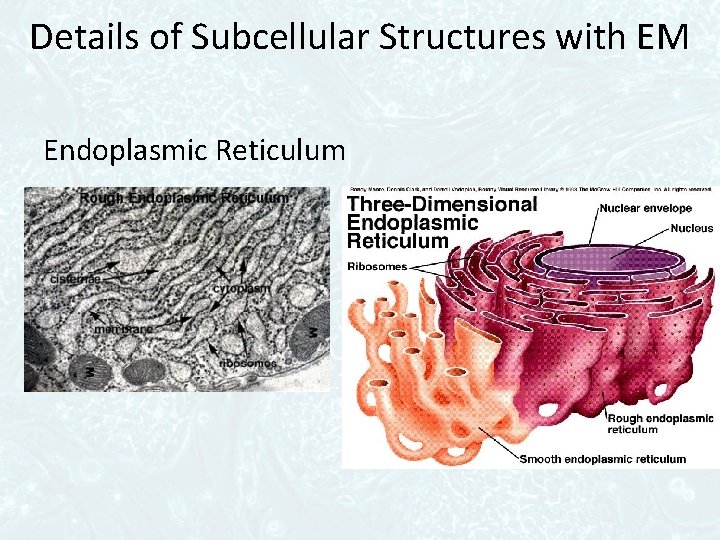
Details of Subcellular Structures with EM Endoplasmic Reticulum
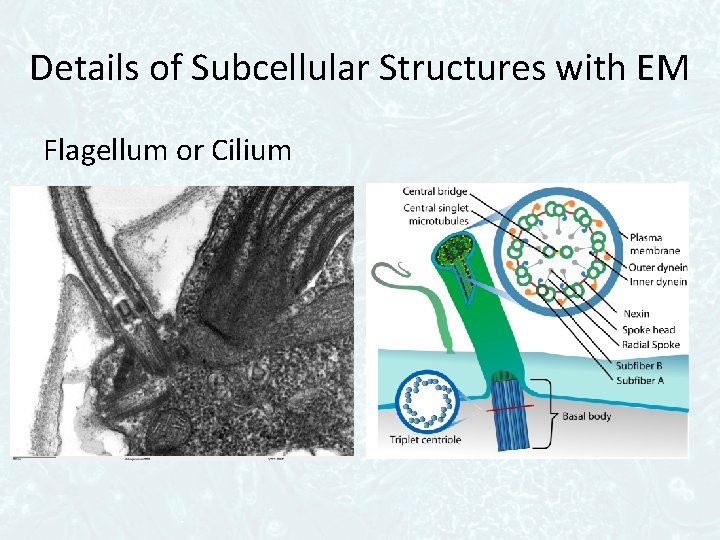
Details of Subcellular Structures with EM Flagellum or Cilium
Current View of the Cell Theory • All known living things are made up of one or more cells. • All living cells arise from pre-existing cells by division. • The cell is the fundamental unit of structure and function in all living organisms. • The activity of an organism depends on the total activity of independent cells. • Energy flow occurs within cells. • Cells contain hereditary information (DNA) which is passed from cell to cell during cell division. • All cells are basically the same in chemical composition in organisms of similar species.