
Cell Switching ATM Connectionoriented packetswitched network Used in
- Slides: 19
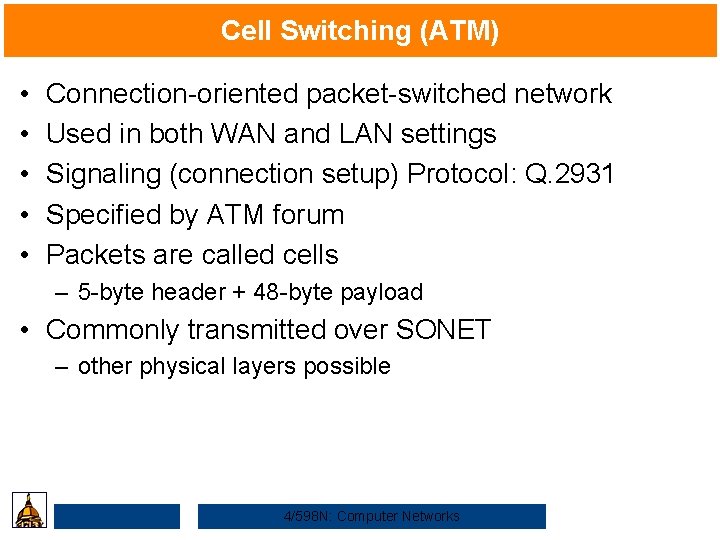
Cell Switching (ATM) • • • Connection-oriented packet-switched network Used in both WAN and LAN settings Signaling (connection setup) Protocol: Q. 2931 Specified by ATM forum Packets are called cells – 5 -byte header + 48 -byte payload • Commonly transmitted over SONET – other physical layers possible 4/598 N: Computer Networks
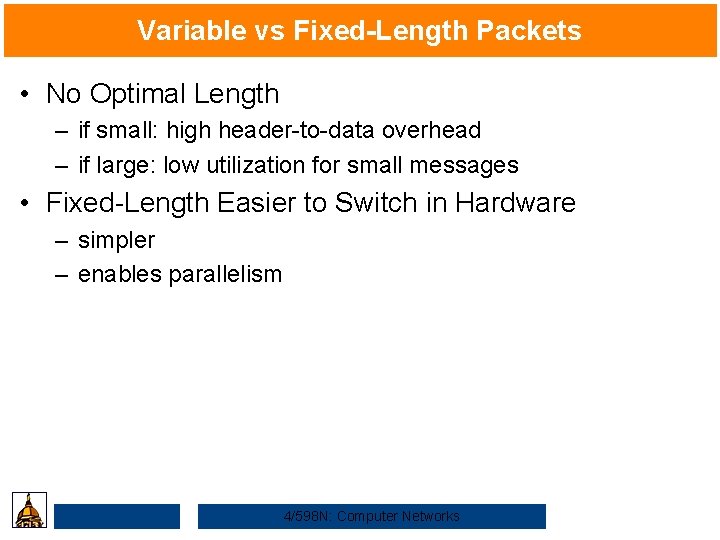
Variable vs Fixed-Length Packets • No Optimal Length – if small: high header-to-data overhead – if large: low utilization for small messages • Fixed-Length Easier to Switch in Hardware – simpler – enables parallelism 4/598 N: Computer Networks
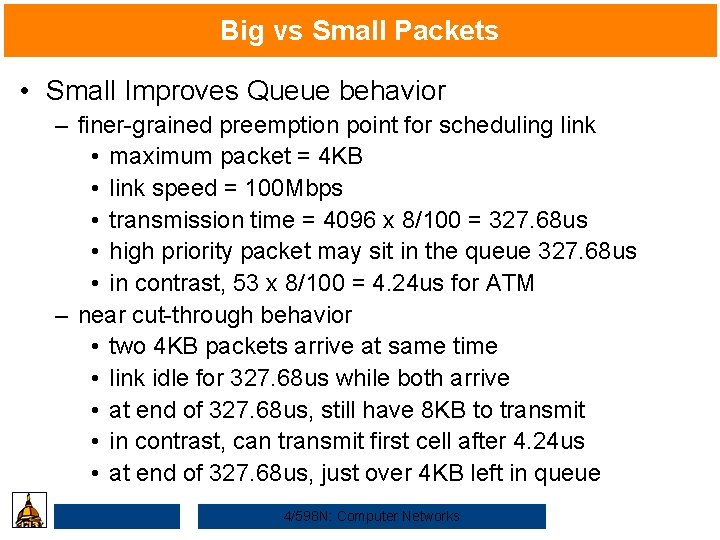
Big vs Small Packets • Small Improves Queue behavior – finer-grained preemption point for scheduling link • maximum packet = 4 KB • link speed = 100 Mbps • transmission time = 4096 x 8/100 = 327. 68 us • high priority packet may sit in the queue 327. 68 us • in contrast, 53 x 8/100 = 4. 24 us for ATM – near cut-through behavior • two 4 KB packets arrive at same time • link idle for 327. 68 us while both arrive • at end of 327. 68 us, still have 8 KB to transmit • in contrast, can transmit first cell after 4. 24 us • at end of 327. 68 us, just over 4 KB left in queue 4/598 N: Computer Networks
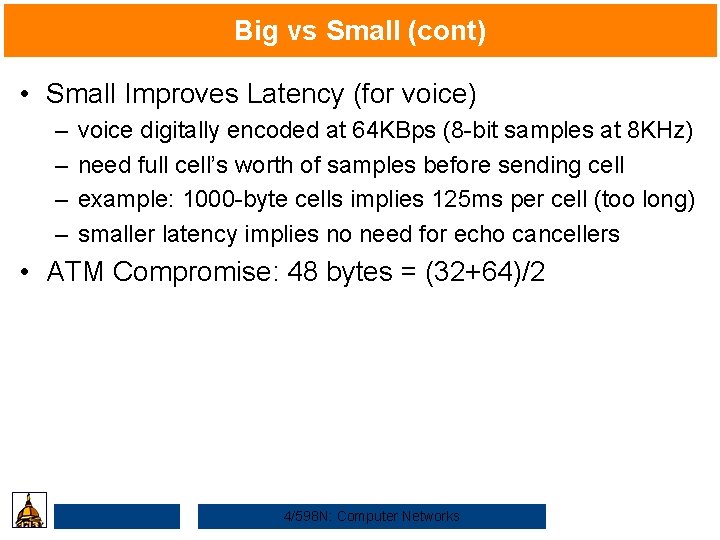
Big vs Small (cont) • Small Improves Latency (for voice) – – voice digitally encoded at 64 KBps (8 -bit samples at 8 KHz) need full cell’s worth of samples before sending cell example: 1000 -byte cells implies 125 ms per cell (too long) smaller latency implies no need for echo cancellers • ATM Compromise: 48 bytes = (32+64)/2 4/598 N: Computer Networks
Cell Format • User-Network Interface (UNI) – – – – host-to-switch format GFC: Generic Flow Control (still being defined) VCI: Virtual Circuit Identifier VPI: Virtual Path Identifier Type: management, congestion control, AAL 5 (later) CLPL Cell Loss Priority HEC: Header Error Check (CRC-8) • Network-Network Interface (NNI) – switch-to-switch format – GFC becomes part of VPI field 4/598 N: Computer Networks
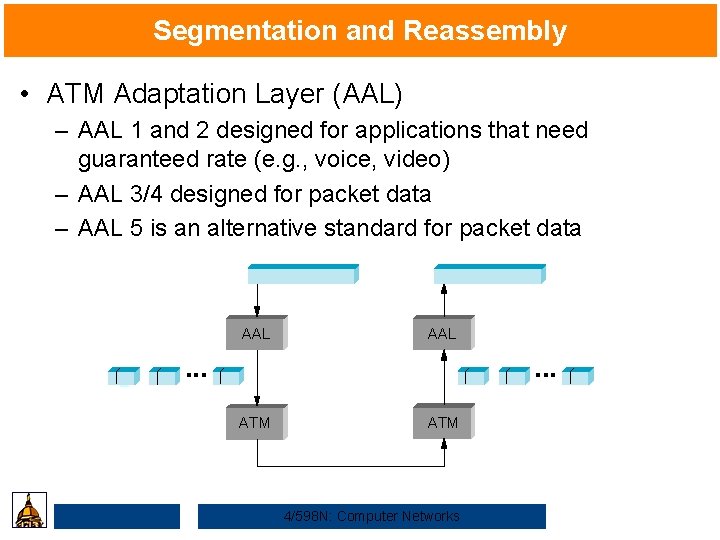
Segmentation and Reassembly • ATM Adaptation Layer (AAL) – AAL 1 and 2 designed for applications that need guaranteed rate (e. g. , voice, video) – AAL 3/4 designed for packet data – AAL 5 is an alternative standard for packet data AAL ■■■ ATM 4/598 N: Computer Networks
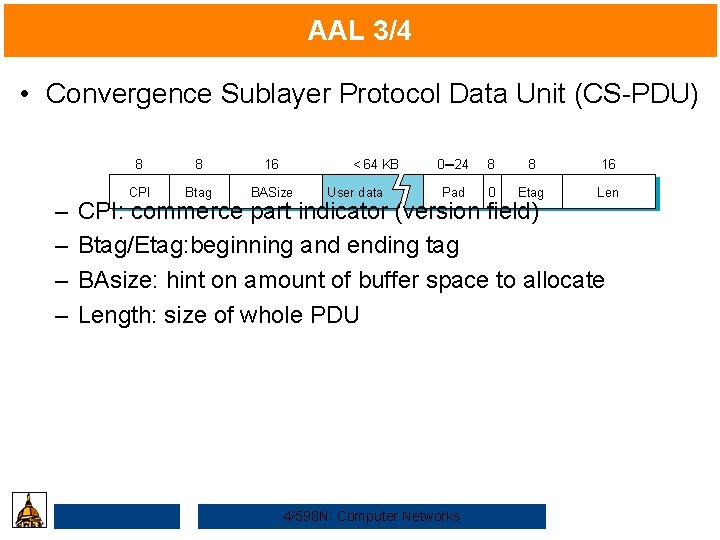
AAL 3/4 • Convergence Sublayer Protocol Data Unit (CS-PDU) – – 8 8 16 < 64 KB CPI Btag BASize User data 0─24 8 8 16 Pad 0 Etag Len CPI: commerce part indicator (version field) Btag/Etag: beginning and ending tag BAsize: hint on amount of buffer space to allocate Length: size of whole PDU 4/598 N: Computer Networks
Cell Format – Type • BOM: beginning of message • COM: continuation of message • EOM end of message – SEQ: sequence of number – MID: message id – Length: number of bytes of PDU in this cell 4/598 N: Computer Networks
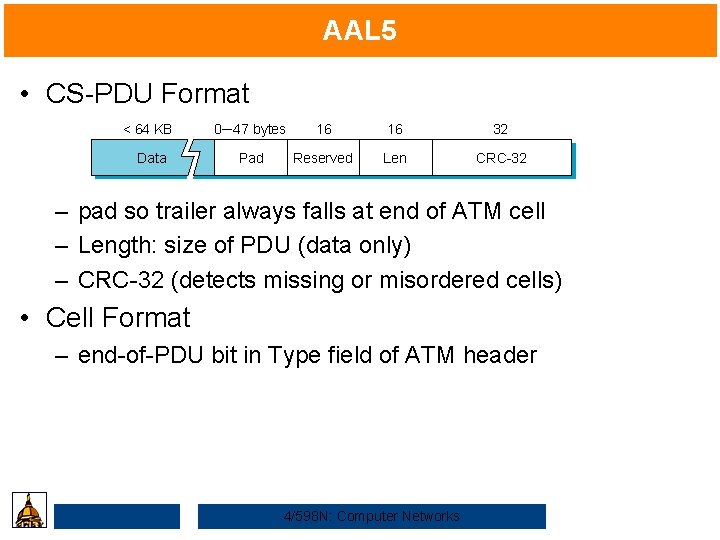
AAL 5 • CS-PDU Format < 64 KB 0─ 47 bytes 16 16 32 Data Pad Reserved Len CRC-32 – pad so trailer always falls at end of ATM cell – Length: size of PDU (data only) – CRC-32 (detects missing or misordered cells) • Cell Format – end-of-PDU bit in Type field of ATM header 4/598 N: Computer Networks
Workstation-Based • Aggregate bandwidth – 1/2 of the I/O bus bandwidth – capacity shared among all hosts connected to switch – example: 1 Gbps bus can support 5 x 100 Mbps ports (in theory) • Packets-per-second – must be able to switch small packets – 300, 000 packets-persecond is achievable – e. g. , 64 -byte packets implies 155 Mbps 4/598 N: Computer Networks
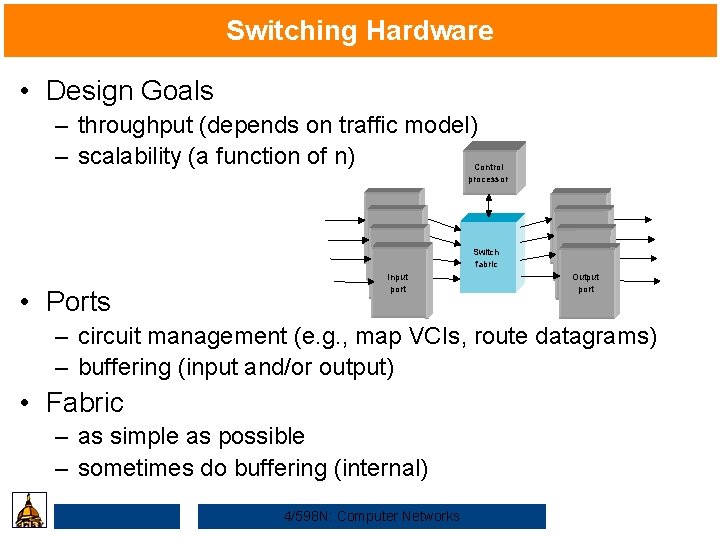
Switching Hardware • Design Goals – throughput (depends on traffic model) – scalability (a function of n) Control processor Switch fabric • Ports Input port Output port – circuit management (e. g. , map VCIs, route datagrams) – buffering (input and/or output) • Fabric – as simple as possible – sometimes do buffering (internal) 4/598 N: Computer Networks
Buffering • Wherever contention is possible – input port (contend for fabric) – internal (contend for output port) – output port (contend for link) • Head-of-Line Blocking – input buffering 4/598 N: Computer Networks
Crossbar Switches 4/598 N: Computer Networks
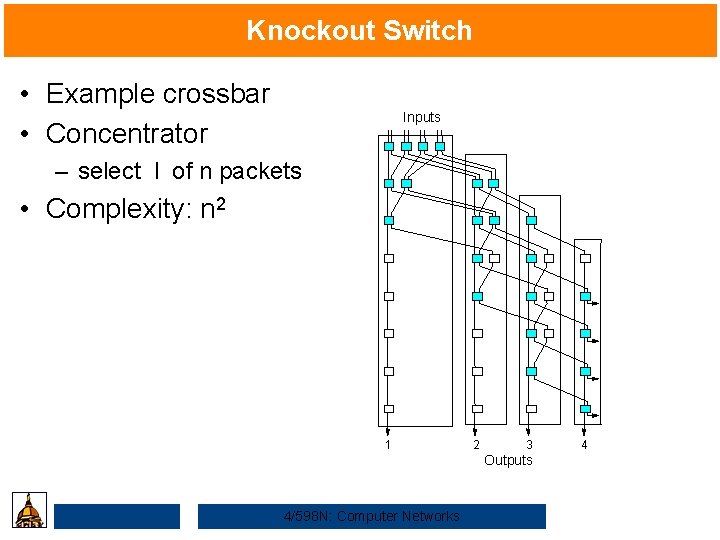
Knockout Switch • Example crossbar • Concentrator Inputs – select l of n packets • Complexity: n 2 1 2 3 Outputs 4/598 N: Computer Networks 4
Self-Routing Fabrics • Banyan Network – – – constructed from simple 2 x 2 switching elements self-routing header attached to each packet elements arranged to route based on this header no collisions if input packets sorted into ascending order complexity: n log 2 n 4/598 N: Computer Networks
Self-Routing Fabrics (cont) • Batcher Network – switching elements sort two numbers • some elements sort into ascending (clear) • some elements sort into descending (shaded) – elements arranged to implement merge sort – complexity: n log 22 n • Common Design: Batcher-Banyan Switch 4/598 N: Computer Networks
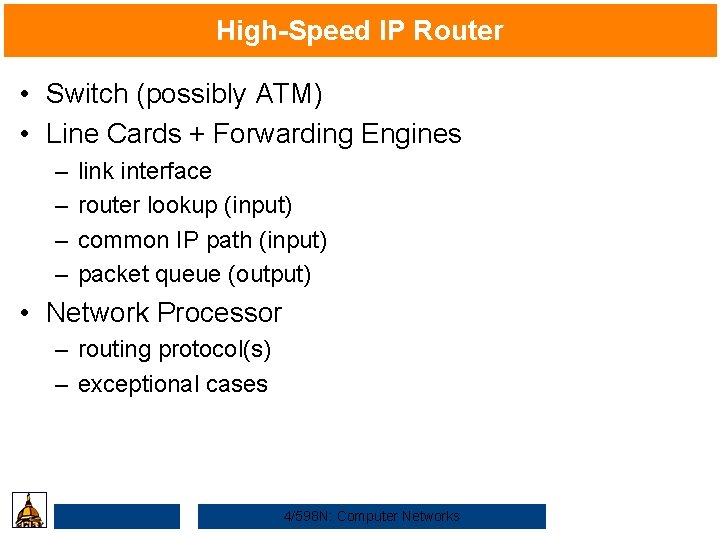
High-Speed IP Router • Switch (possibly ATM) • Line Cards + Forwarding Engines – – link interface router lookup (input) common IP path (input) packet queue (output) • Network Processor – routing protocol(s) – exceptional cases 4/598 N: Computer Networks
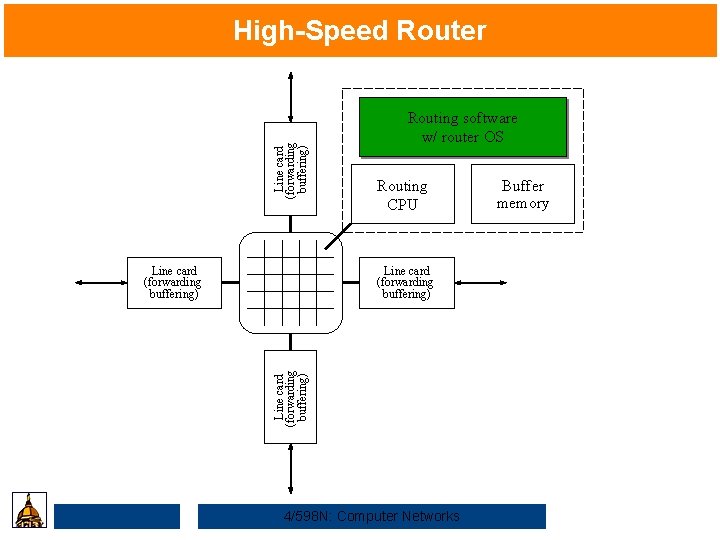
Line card (forwarding buffering) High-Speed Router Routing CPU Line card (forwarding buffering) Routing software w/ router OS 4/598 N: Computer Networks Buffer memory
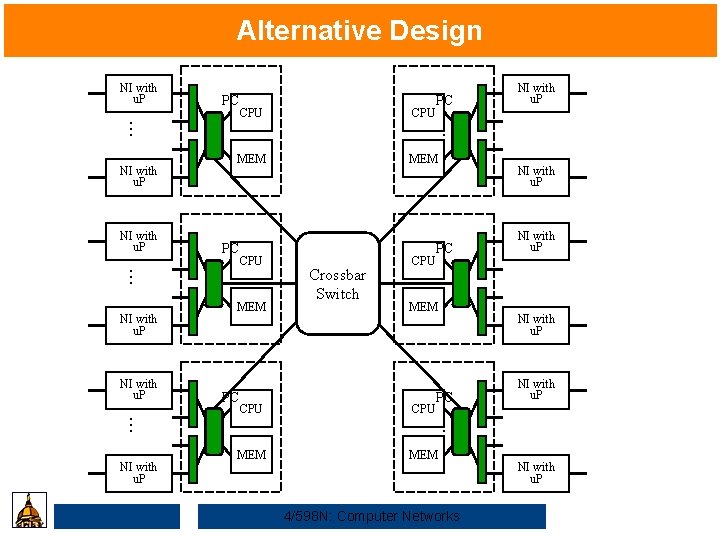
Alternative Design NI with u. P . . . NI with u. P PC PC . . . CPU MEM PC Crossbar Switch CPU NI with u. P PC . . . MEM CPU MEM NI with u. P PC CPU NI with u. P . . . 4/598 N: Computer Networks NI with u. P