
Cell Surface Area and Volume Cells are typically
- Slides: 12
Cell Surface Area and Volume
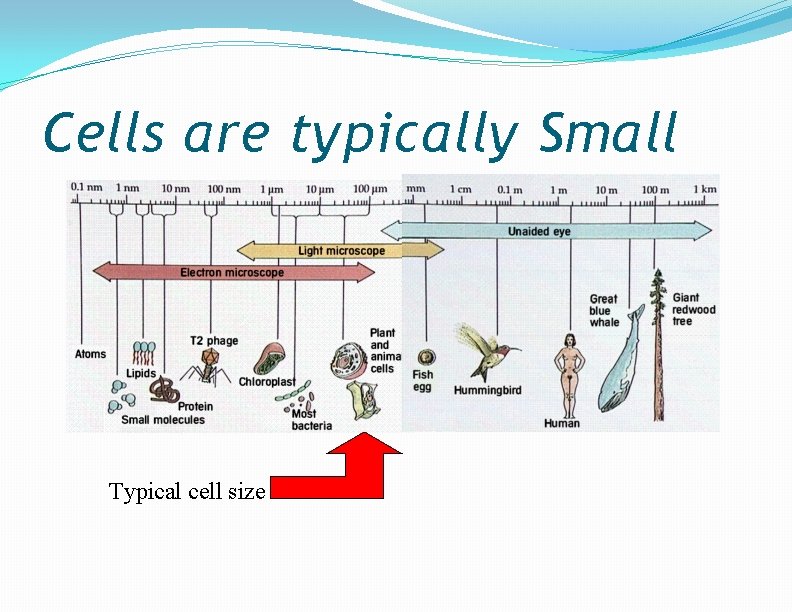
Cells are typically Small Typical cell size
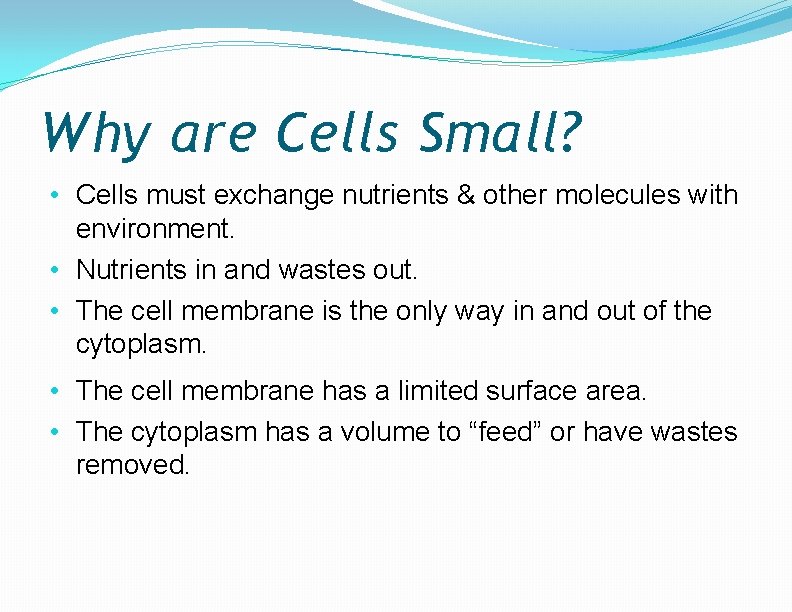
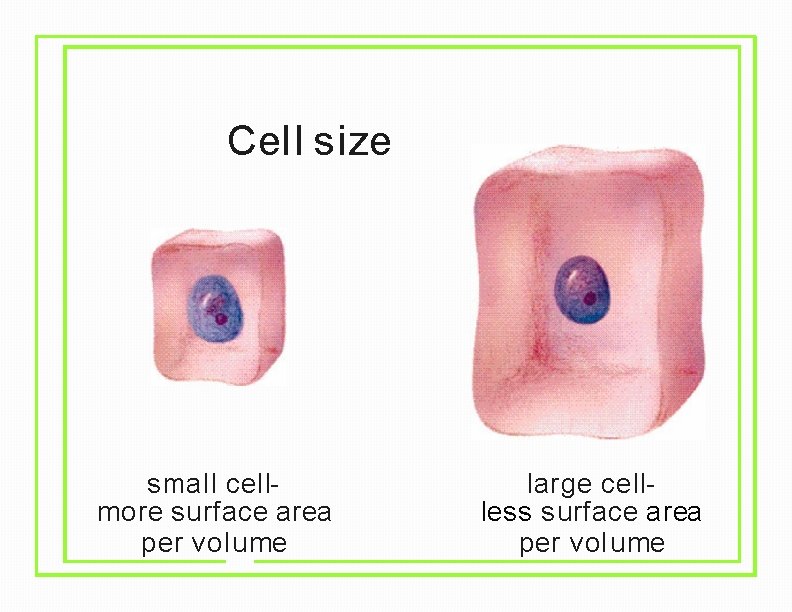
Why are Cells Small? • Cells must exchange nutrients & other molecules with environment. • Nutrients in and wastes out. • The cell membrane is the only way in and out of the cytoplasm. • The cell membrane has a limited surface area. • The cytoplasm has a volume to “feed” or have wastes removed.
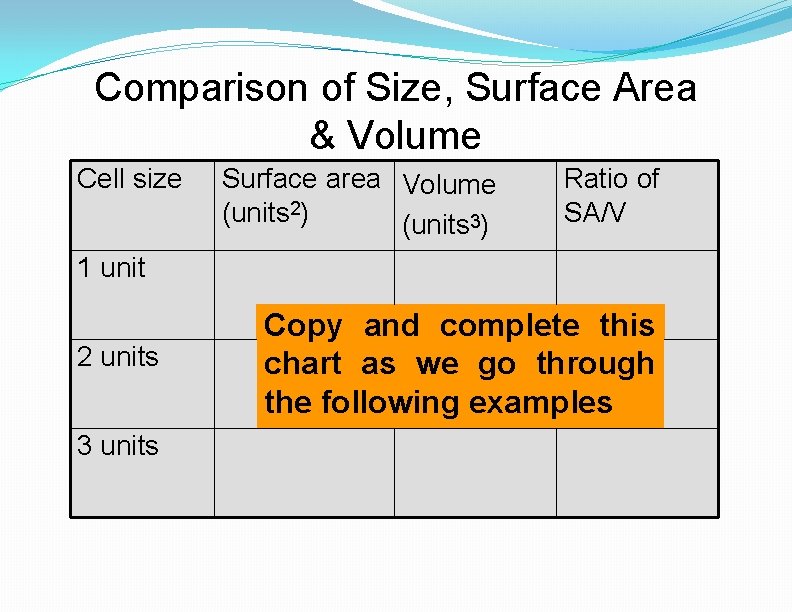
Comparison of Size, Surface Area & Volume Cell size Surface area Volume (units 2) (units 3) Ratio of SA/V 1 unit 2 units 3 units Copy and complete this chart as we go through the following examples
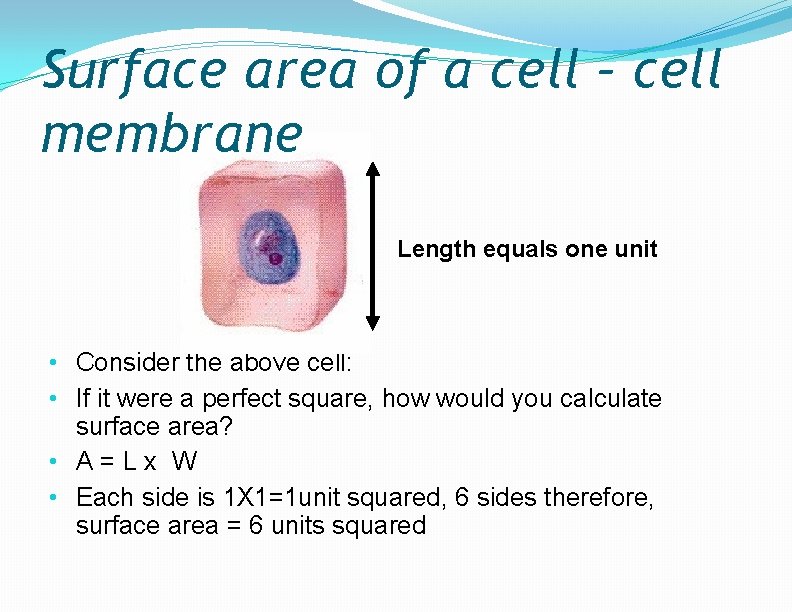
Surface area of a cell – cell membrane Length equals one unit • Consider the above cell: • If it were a perfect square, how would you calculate surface area? • A=Lx W • Each side is 1 X 1=1 unit squared, 6 sides therefore, surface area = 6 units squared
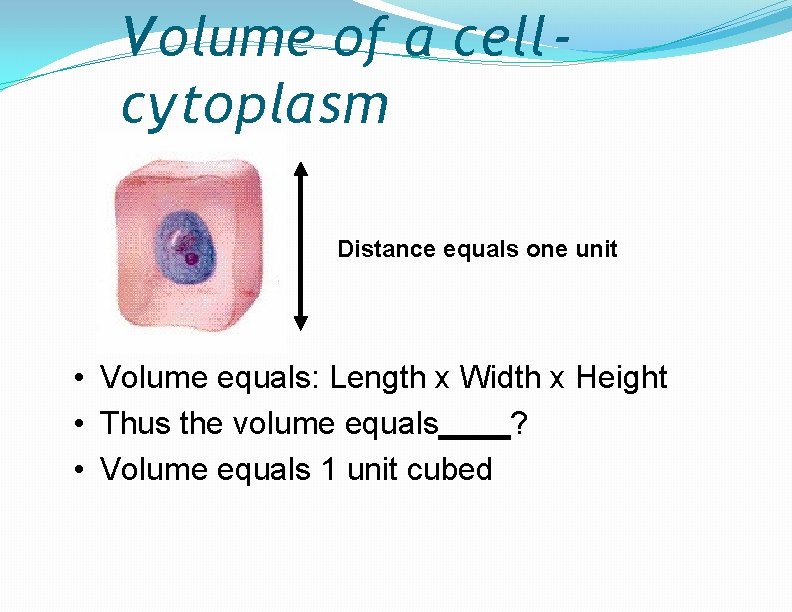
Volume of a cellcytoplasm Distance equals one unit • Volume equals: Length x Width x Height • Thus the volume equals ? • Volume equals 1 unit cubed
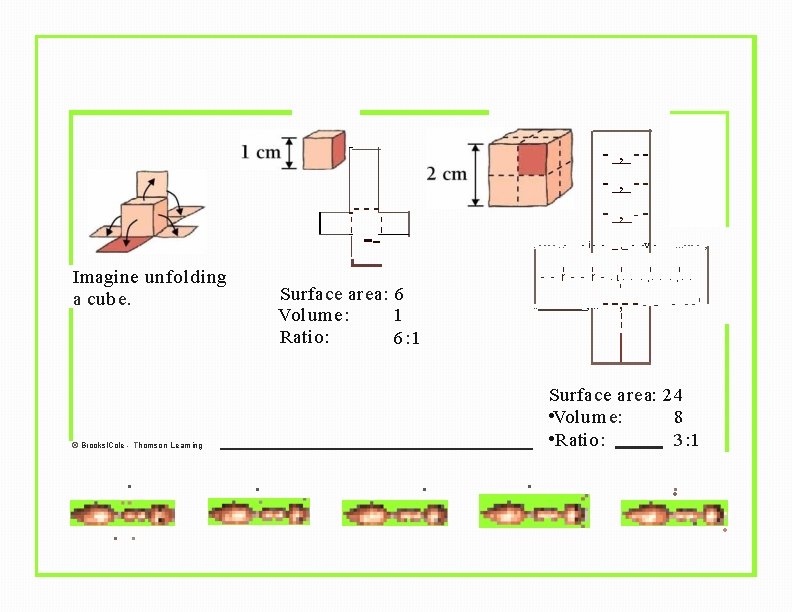
I I --- - _, _ - - I - I . I Imagine unfolding a cube. • • I r r Surface area: 6 Volume : 1 Ratio: 6: 1 . . _, . . . I I . . . --- - , I -1 - - - , - I - , - -. -- - --' I I Surface area: 24 • Volume: 8 • Ratio : 3: 1 © Brooksl. Cole Thomson Leaming • i _ , _ -v - • •
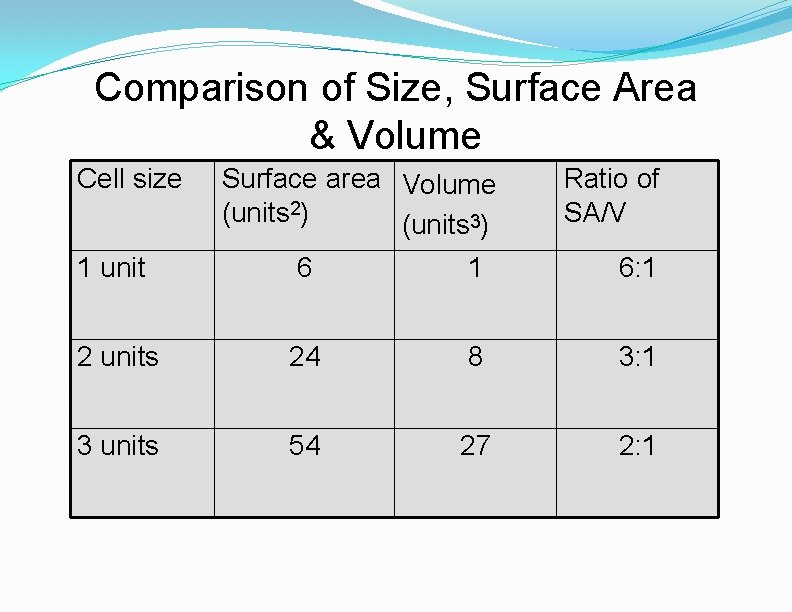
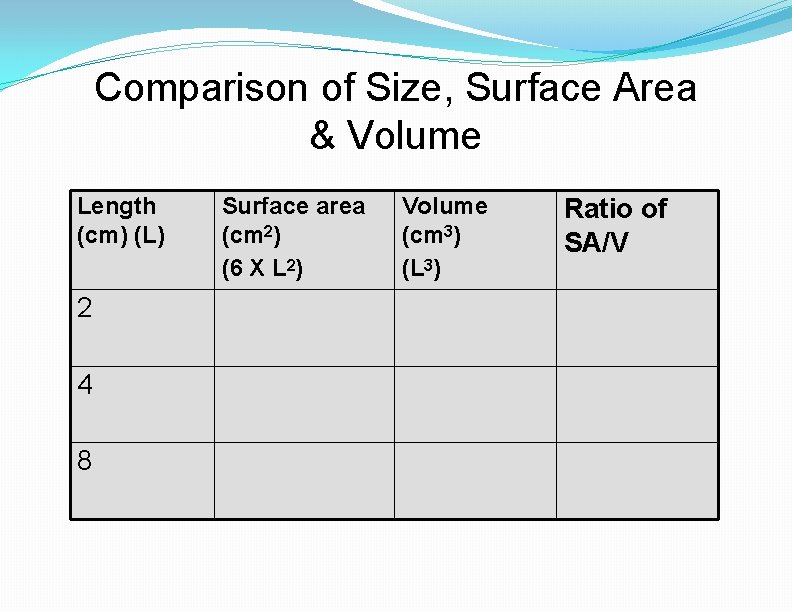
Comparison of Size, Surface Area & Volume Cell size Surface area Volume (units 2) (units 3) Ratio of SA/V 1 unit 6 1 6: 1 2 units 24 8 3: 1 3 units 54 27 2: 1
Conclusion: • As cell size increases ratio of surface area to volume decreases. • Therefore, the rate of diffusion slows down…. • …. . thus a cell cannot get rid of wastes fast enough or get nutrients fast enough • . . . so it will either be poisoned by its wastes or starve.
Cel l size small cell more surface area per volume large cell less surface area per volume
Larger Cells • Smaller surface to volume ratio • Larger cells have less membrane • Larger cells have hard time obtaining nutrients, getting rid of wastes, and regulating internal environment • Once a cell reaches a certain size, it cannot grow any larger so it must divide and form 2 cells • Cell division is called mitosis
Comparison of Size, Surface Area & Volume Length (cm) (L) 2 4 8 Surface area (cm 2) (6 X L 2) Volume (cm 3) (L 3) Ratio of SA/V