
Cell Structures and Processes SUMMARIZE HOW FOOD PROVIDES
- Slides: 40
Cell Structures and Processes SUMMARIZE HOW FOOD PROVIDES THE ENERGY AND THE MOLECULES REQUIRED FOR BUILDING MATERIALS, GROWTH AND SURVIVAL OF ALL ORGANISMS (TO INCLUDE PLANTS)
Cells o Organisms n Living things o Everything is made up of cells n n Some have just one cell Others are made up of trillions p Like humans
Cells o Cells n Basic unit of structure and function in all organisms. n Smallest structure that can carry out the functions of life p Growing p Taking in and using food p Responding to the environment p Reproducing n Also regulate the amount of water they contain and release waste o Cell vs Virus Video
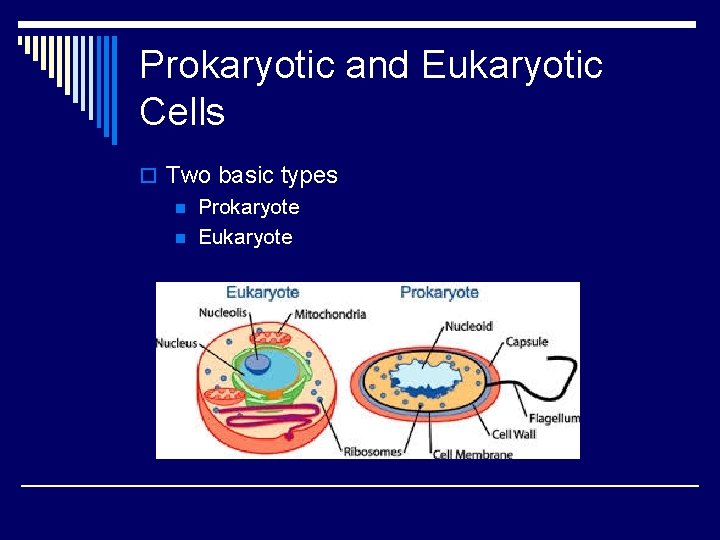
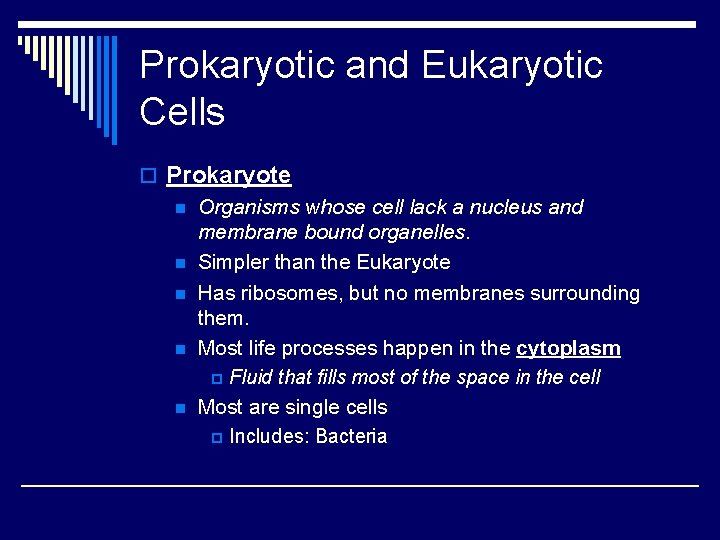
Prokaryotic and Eukaryotic Cells o Two basic types n Prokaryote n Eukaryote
Prokaryotic and Eukaryotic Cells o Prokaryote n Organisms whose cell lack a nucleus and membrane bound organelles. n Simpler than the Eukaryote n Has ribosomes, but no membranes surrounding them. n Most life processes happen in the cytoplasm p Fluid that fills most of the space in the cell n Most are single cells p Includes: Bacteria
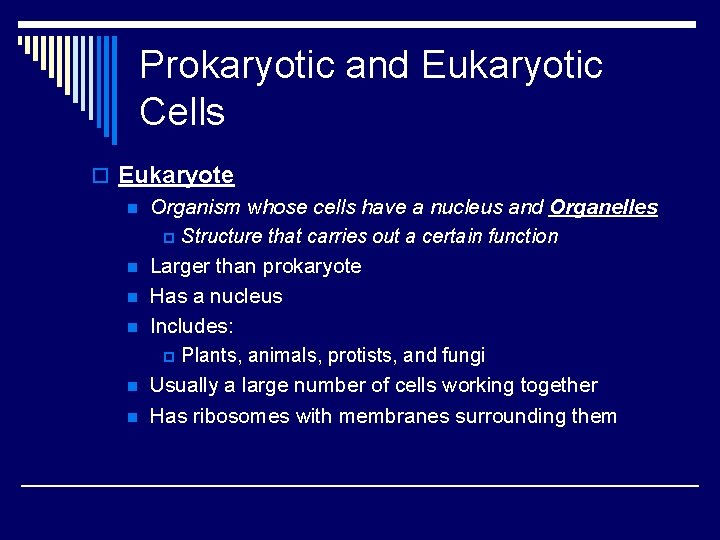
Prokaryotic and Eukaryotic Cells o Eukaryote n Organism whose cells have a nucleus and Organelles p Structure that carries out a certain function n Larger than prokaryote n Has a nucleus n Includes: p Plants, animals, protists, and fungi n Usually a large number of cells working together n Has ribosomes with membranes surrounding them
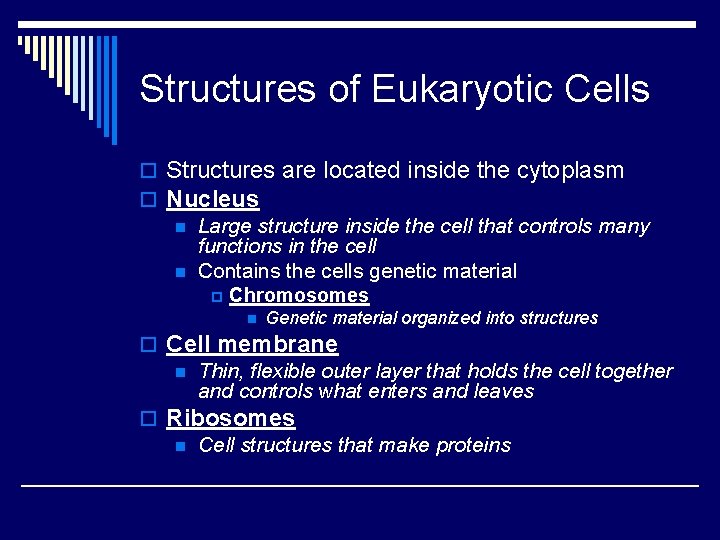
Structures of Eukaryotic Cells o Structures are located inside the cytoplasm o Nucleus n Large structure inside the cell that controls many functions in the cell n Contains the cells genetic material p Chromosomes n Genetic material organized into structures o Cell membrane n Thin, flexible outer layer that holds the cell together and controls what enters and leaves o Ribosomes n Cell structures that make proteins
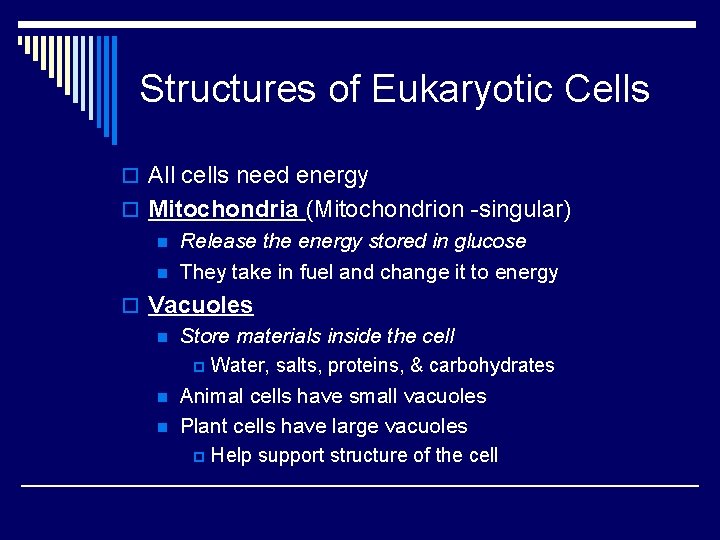
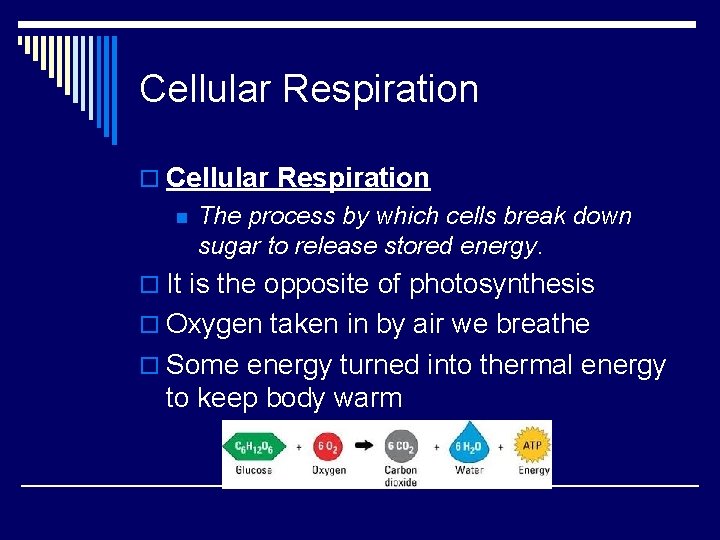
Structures of Eukaryotic Cells o All cells need energy o Mitochondria (Mitochondrion -singular) n Release the energy stored in glucose n They take in fuel and change it to energy o Vacuoles n Store materials inside the cell p Water, salts, proteins, & carbohydrates n Animal cells have small vacuoles n Plant cells have large vacuoles p Help support structure of the cell
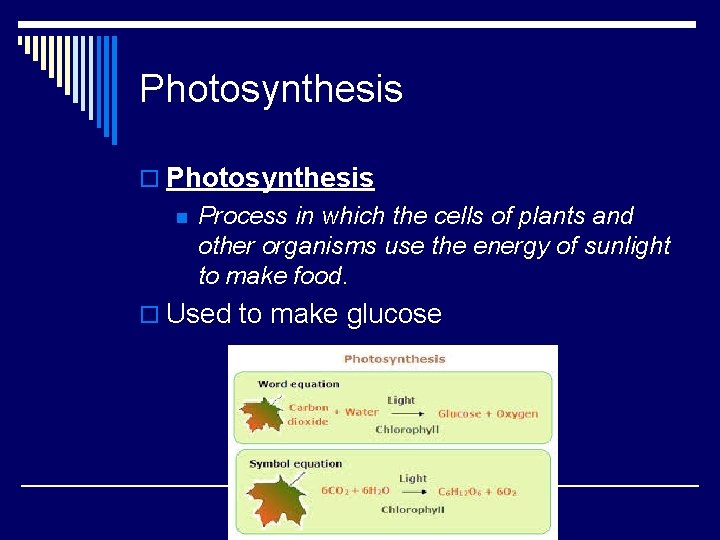
Structures of Eukaryotic Cells o Plant cells have two things animal cells do not: n Chloroplasts p Organelles that make food for cells p Contain chlorophyll which makes the plants green p Converts CO 2 and H 2 O into Glucose and O 2 n Cell Walls p Protective layer that surrounds the cell membrane p Made of cellulose p Rigid to support plant cells p Allows plants to stand upright and support flowers and leaves
Lesson Review How does a prokaryotic cell differ from a eukaryotic cell? 1. 2. 3. 4. A prokaryotic cell does not contain ribosomes. A prokaryotic cell does not contain genetic information. A prokaryotic cell does not have a cell wall. A prokaryotic cell does not have a nucleus.
Lesson Review What cell structure controls which materials enter or leave a cell? 1. 2. 3. 4. Nucleus Cytoplasm Cell membrane Vacuole
Lesson Review What is the function of mitochondria? 1. 2. 3. 4. To make food To make proteins To release energy To store proteins
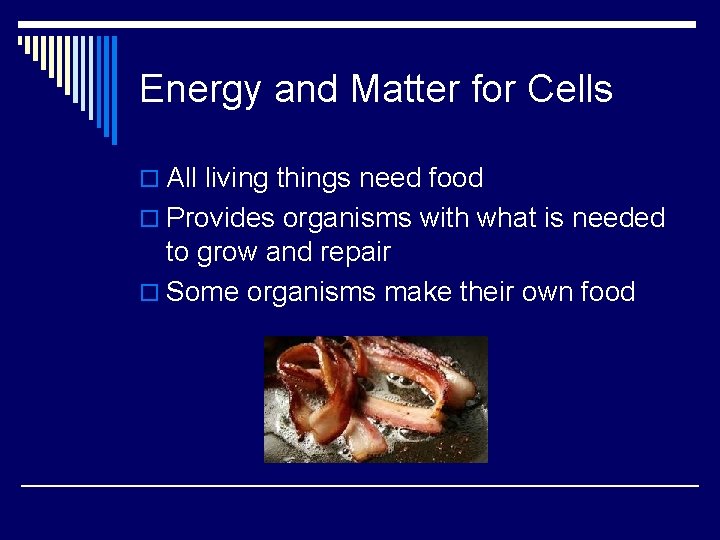
Energy and Matter for Cells o All living things need food o Provides organisms with what is needed to grow and repair o Some organisms make their own food
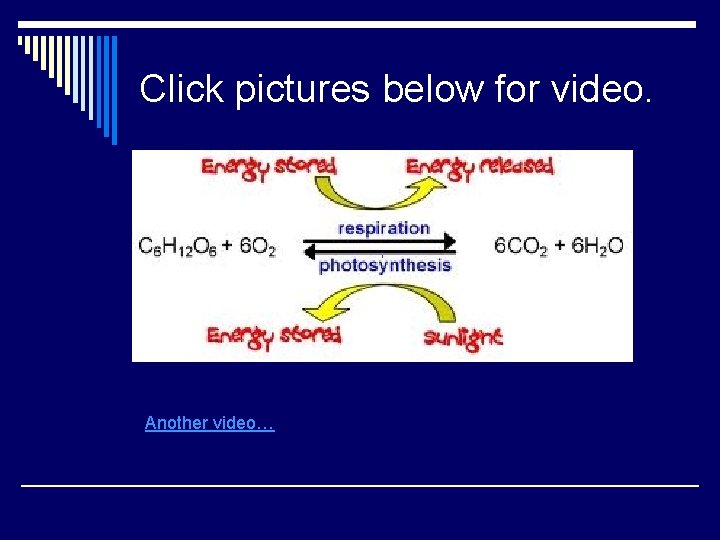
Photosynthesis o Photosynthesis n Process in which the cells of plants and other organisms use the energy of sunlight to make food. o Used to make glucose
Cellular Respiration o Cellular Respiration n The process by which cells break down sugar to release stored energy. o It is the opposite of photosynthesis o Oxygen taken in by air we breathe o Some energy turned into thermal energy to keep body warm
Click pictures below for video. Another video…
Building Cells o Nutrients n The compounds that provide energy and building materials for living things o Carbohydrates n Hydrogen, oxygen, and carbon n Includes glucose made during photosynthesis n Plants use and store glucose n Molecules link together to form cellulose n Cellulose used for plant structure and is what gives vegetables their crunch.
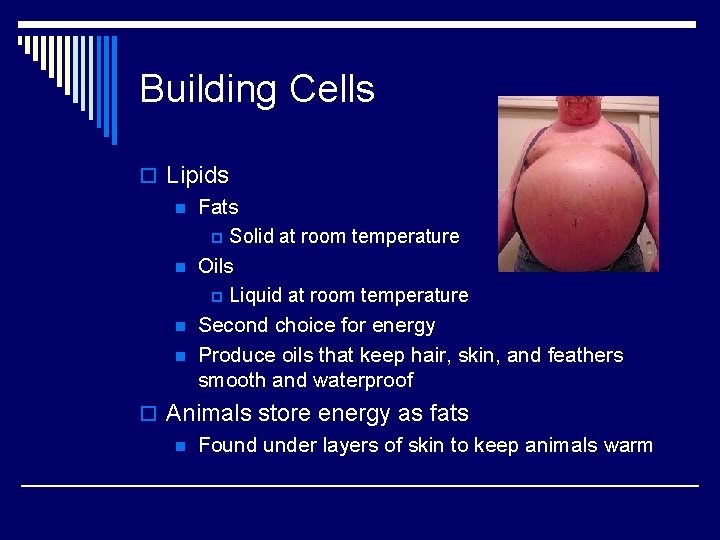
Building Cells o Lipids n Fats p Solid at room temperature n Oils p Liquid at room temperature n Second choice for energy n Produce oils that keep hair, skin, and feathers smooth and waterproof o Animals store energy as fats n Found under layers of skin to keep animals warm
Lesson Review What is the source of energy for photosynthesis? 1. 2. 3. 4. Sunlight Carbon dioxide Glucose Water
Lesson Review What are the products of photosynthesis? 1. 2. 3. 4. Water and glucose Glucose and carbon dioxide Carbon dioxide and water Glucose and oxygen
Lesson Review Which of the following is needed as a reactant for cellular respiration? 1. 2. 3. 4. Carbon dioxide Oxygen Water Chlorophyll
Lesson Review Which form of energy is stored in glucose? 1. 2. 3. 4. Solar energy Chemical energy Mechanical energy Thermal energy
Lesson Review Which of the following is a primary way in which proteins are used in the body? 1. 2. 3. 4. Proteins form a layer of insulation Proteins help the body lose weight Proteins provide the materials for growth and repair Proteins provide a quick energy source
Cell Division and Reproduction o Reproduce n Make more cells like themselves o They do this by dividing n There are two types p Asexual n Mitosis p Sexual n Meiosis
Chromosomes and Cell Division o Chromosomes n Structures in a cells nucleus that contain genes o Gene n Tiny part of a chromosome that gives a living thing a certain trait n Tell a cell how to grow and develop o DNA n Large molecules that make up genes n Deoxyribonucleic acid
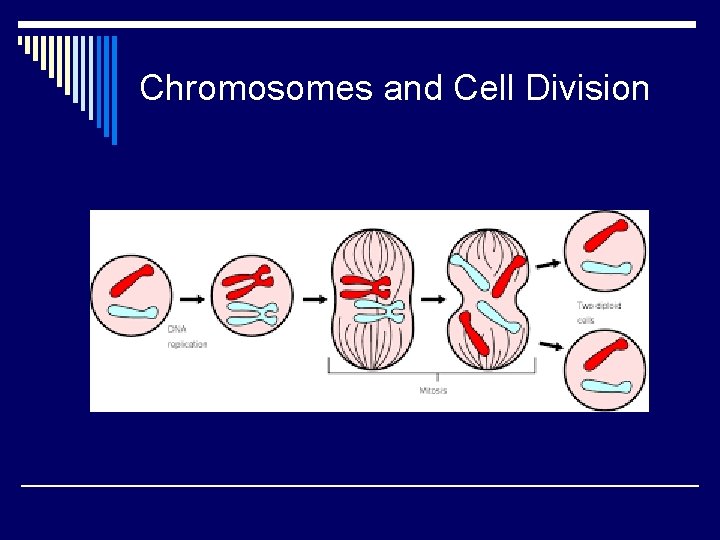
Chromosomes and Cell Division o Mitosis n n n Parent cell divides to form two new cells called daughter cells Each is an exact copy of the parent Before dividing the cell makes exact copies of the chromosomes Each daughter has the same number and kind of chromosomes as the parent This occurs in 4 stages
Chromosomes and Cell Division o Four stages of mitosis 1. Prophase 1. 2. Metaphase 1. 3. Chromosomes are lined up in the center Anaphase 1. 4. Chromosomes cannot be seen Chromatids are pulled apart Telophase 1. Chromosomes separate and a nucleus is formed
Chromosomes and Cell Division
Chromosomes and Cell Division o This is process by which living things grow n n n Muscles Plant roots Flowers o Process by which bodies repair themselves n n Cuts in your skin Limb regeneration in some animals
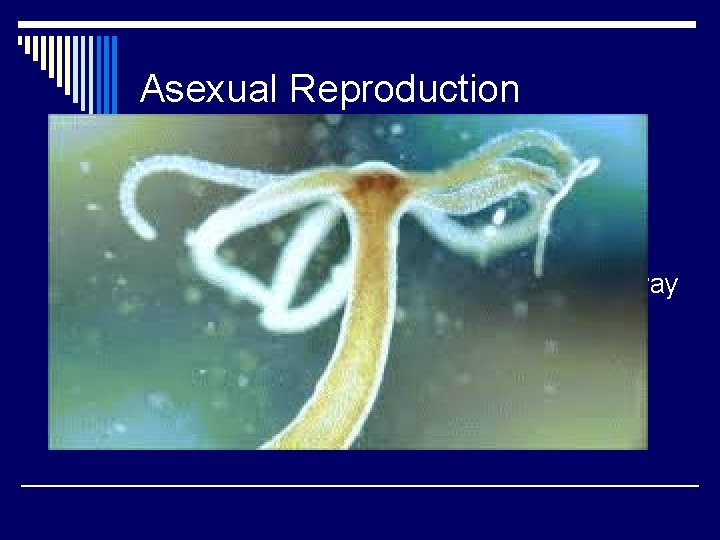
Asexual Reproduction o Asexual Reproduction n Production of a new organism from one parent o One celled organisms reproduce this way n n Bacteria Amoebas o Some animals do as well n Hydras
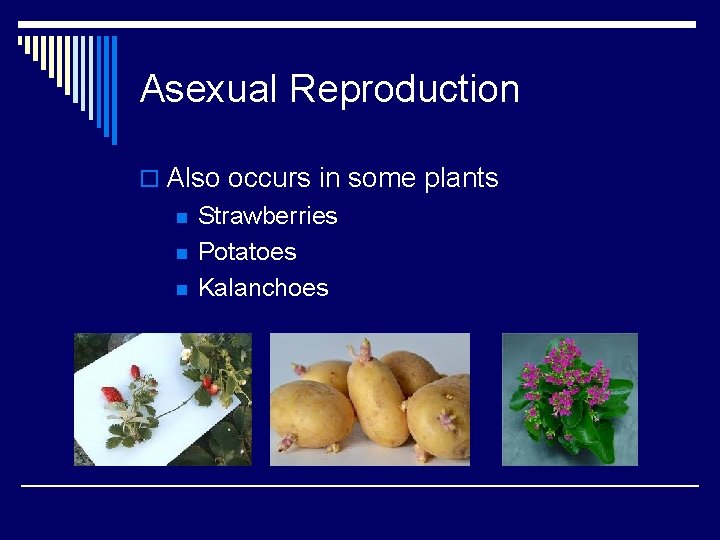
Asexual Reproduction o Also occurs in some plants n n n Strawberries Potatoes Kalanchoes
Sexual Reproduction and Meiosis o Sexual reproduction n Production of new organisms from two parents, male and female o Organisms use gametes for this process n n Only have half the number of chromosomes found in the other body cells Two types p Sperm p Egg
Sexual Reproduction and Meiosis o Fertilization n Male and female gametes combine o Zygote n The resulting cell from fertilization o It is important that each cell only have half the chromosomes to make up the fertilized cell o Meiosis n The process that produces gametes
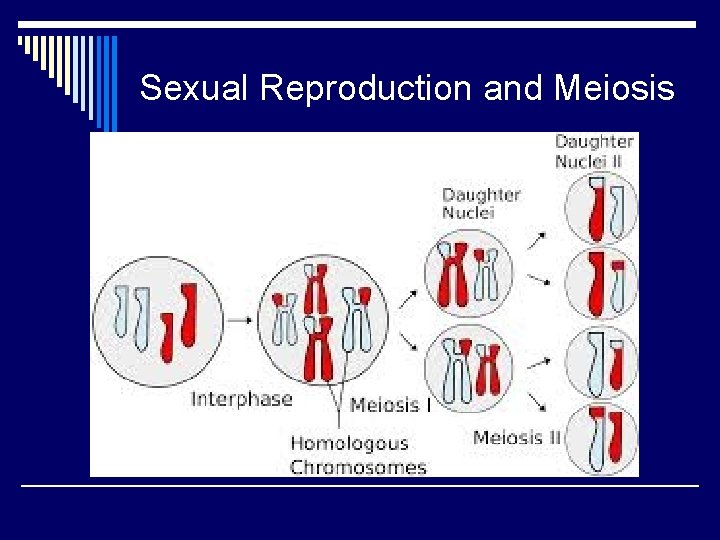
Sexual Reproduction and Meiosis o Involves two sets of divisions n First division p Pairs n separate Second division p Copies separate o One cell produces four gametes n Each has half the chromosomes of the parent
Sexual Reproduction and Meiosis
Sexual Reproduction and Meiosis o In a male it produces sperm cells o In a female it produces egg cells o A single sperm joins with a single egg to produce a fertilized egg (zygote) n Zygote has a complete set of chromosomes o Mitosis is then used to grow and develop into a complete organism. o Video not available…
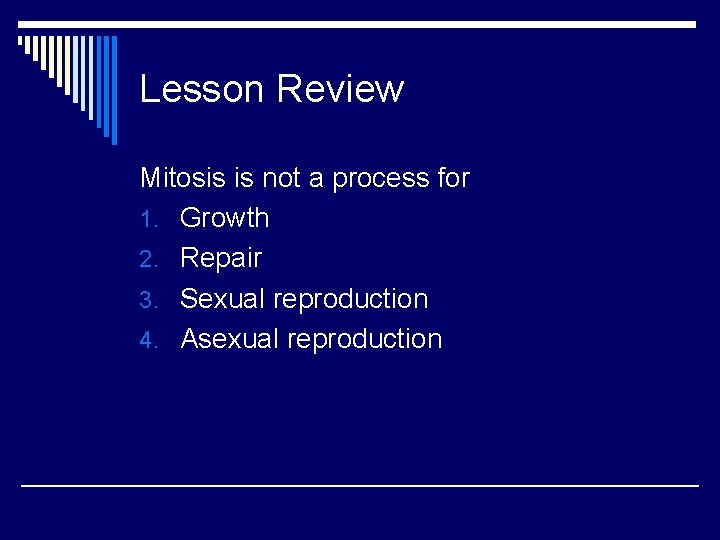
Lesson Review Mitosis is not a process for 1. Growth 2. Repair 3. Sexual reproduction 4. Asexual reproduction
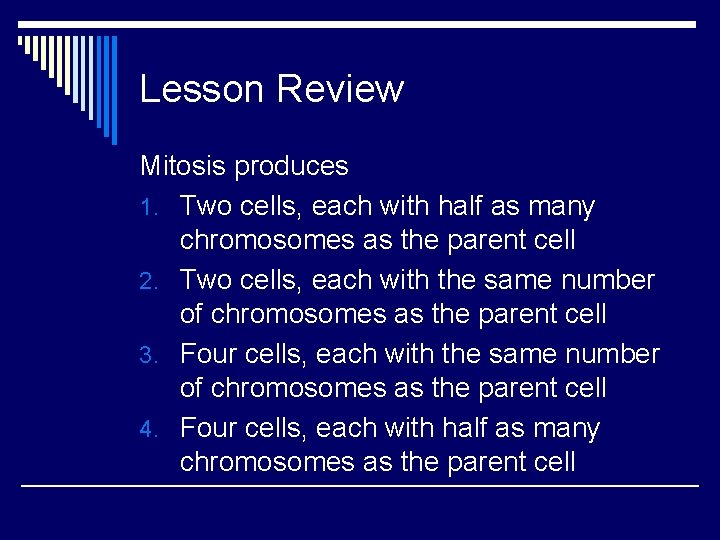
Lesson Review Mitosis produces 1. Two cells, each with half as many chromosomes as the parent cell 2. Two cells, each with the same number of chromosomes as the parent cell 3. Four cells, each with the same number of chromosomes as the parent cell 4. Four cells, each with half as many chromosomes as the parent cell
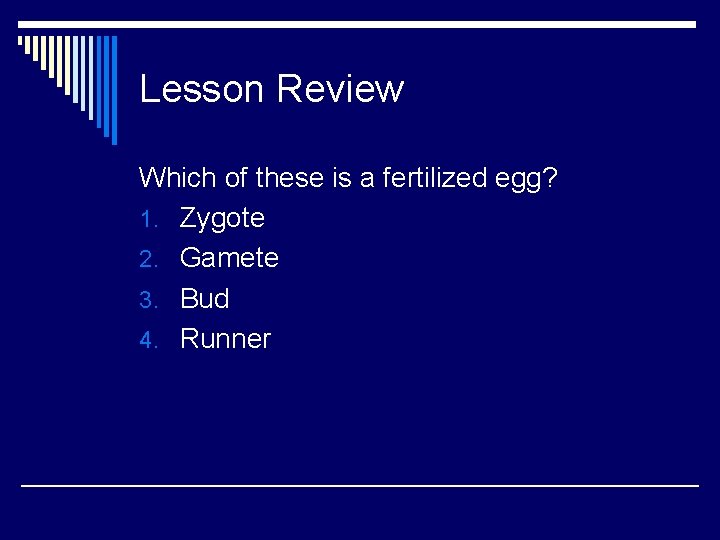
Lesson Review Which of these is a fertilized egg? 1. Zygote 2. Gamete 3. Bud 4. Runner
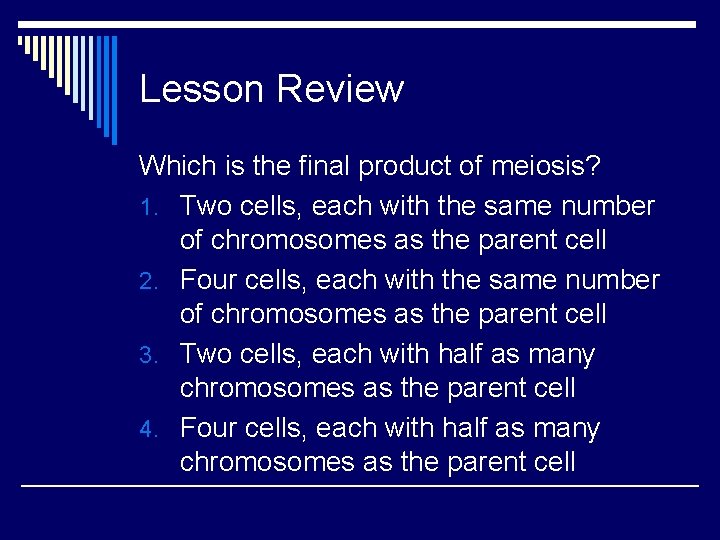
Lesson Review Which is the final product of meiosis? 1. Two cells, each with the same number of chromosomes as the parent cell 2. Four cells, each with the same number of chromosomes as the parent cell 3. Two cells, each with half as many chromosomes as the parent cell 4. Four cells, each with half as many chromosomes as the parent cell