
Cell Structure Metabolic reactions occur in specific sites
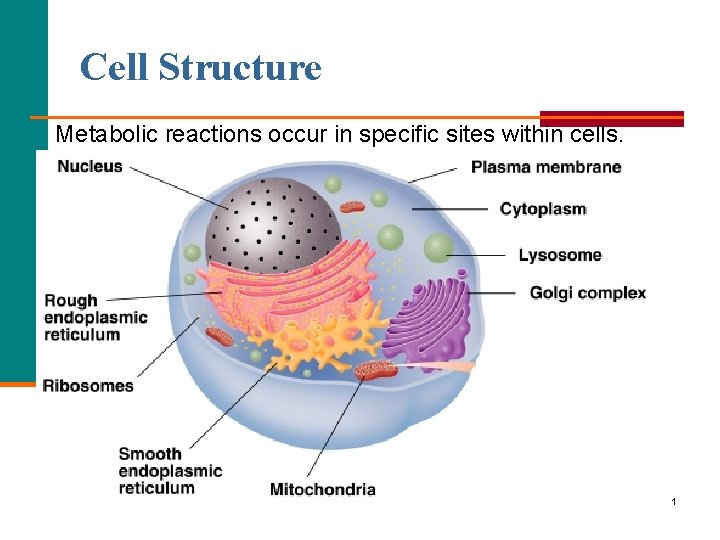
Cell Structure Metabolic reactions occur in specific sites within cells. 1
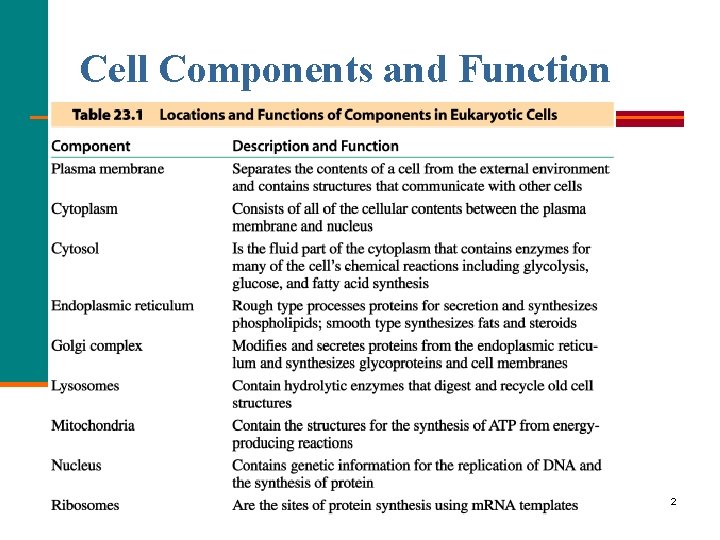
Cell Components and Function 2

ATP and Energy Adenosine triphosphate (ATP) § Is the energy form stored in cells. § Is obtained from the oxidation of food. § Consists of adenine (nitrogen base), a ribose sugar, and three phosphate groups. § Requires 7. 3 (31 k. J) per mole to convert ADP + Pi to ATP. 3
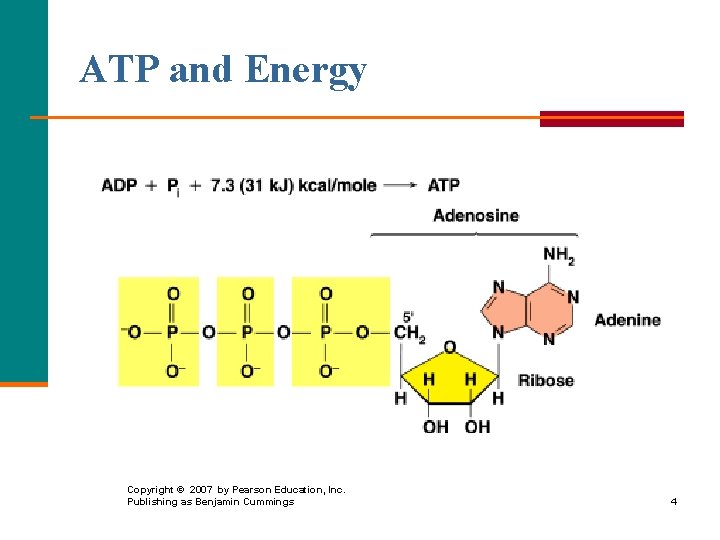
ATP and Energy Copyright © 2007 by Pearson Education, Inc. Publishing as Benjamin Cummings 4
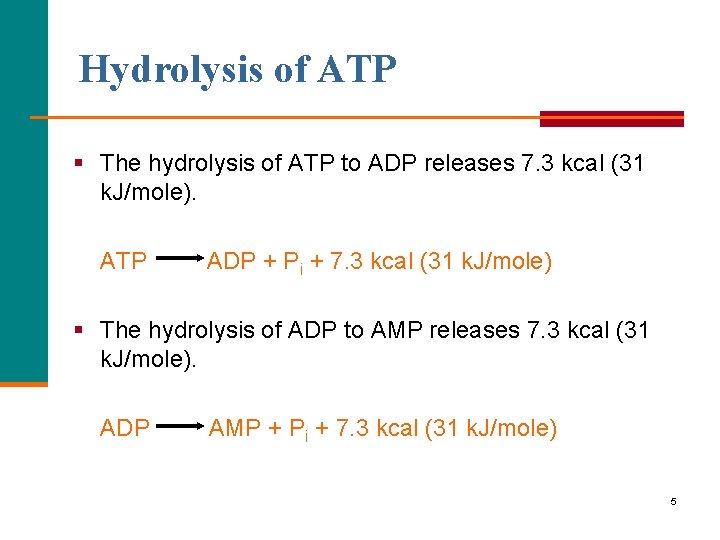
Hydrolysis of ATP § The hydrolysis of ATP to ADP releases 7. 3 kcal (31 k. J/mole). ATP ADP + Pi + 7. 3 kcal (31 k. J/mole) § The hydrolysis of ADP to AMP releases 7. 3 kcal (31 k. J/mole). ADP AMP + Pi + 7. 3 kcal (31 k. J/mole) 5
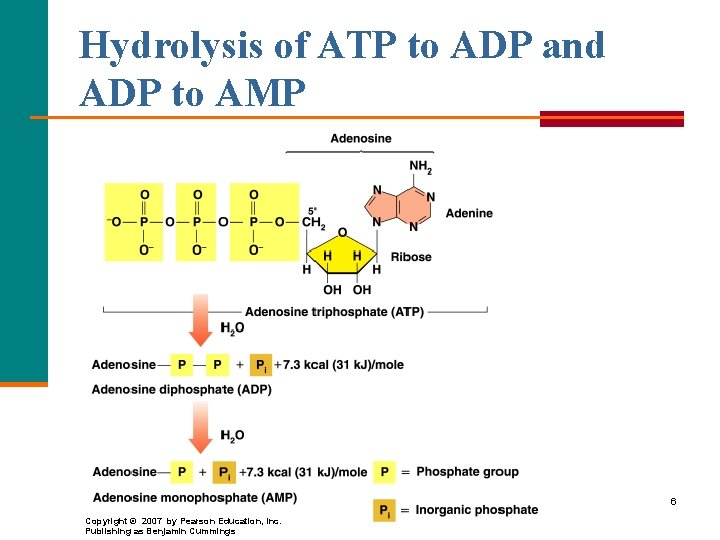
Hydrolysis of ATP to ADP and ADP to AMP 6 Copyright © 2007 by Pearson Education, Inc. Publishing as Benjamin Cummings
ATP and Muscle Contraction Muscle fibers § Contain the protein fibers actin and myosin. § Contract (slide closer together) when a nerve impulse increases Ca 2+. § Obtain the energy for contraction from the hydrolysis of ATP. § Return to the relaxed position as Ca 2+ and ATP decrease. 7
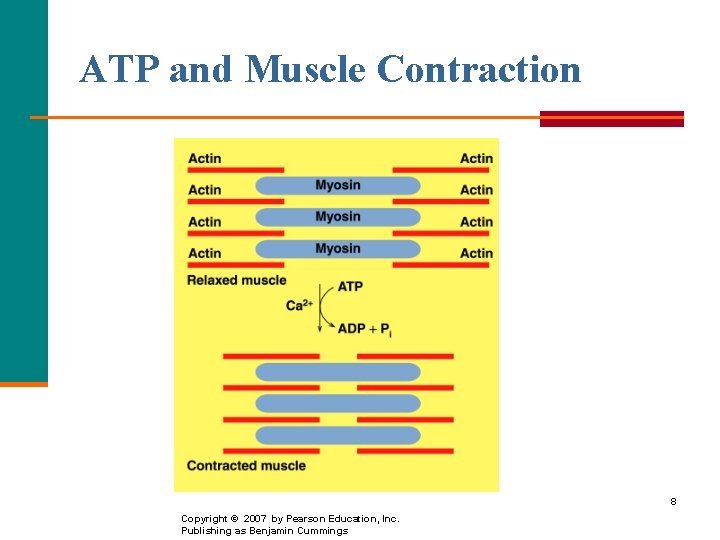
ATP and Muscle Contraction 8 Copyright © 2007 by Pearson Education, Inc. Publishing as Benjamin Cummings
Learning Check Match the following: 1) ATP 2) ADP + Pi A. Used in anabolic reactions. B. The energy-storage molecule. C. Coupled with energy-requiring reactions. D. Hydrolysis products. 9
Solution Match the following: 1) ATP 2) ADP + Pi A. 1 Used in anabolic reactions B. 1 The energy-storage molecule. C. 1 Coupled with energy-requiring reactions. D. 2 Hydrolysis products. 10
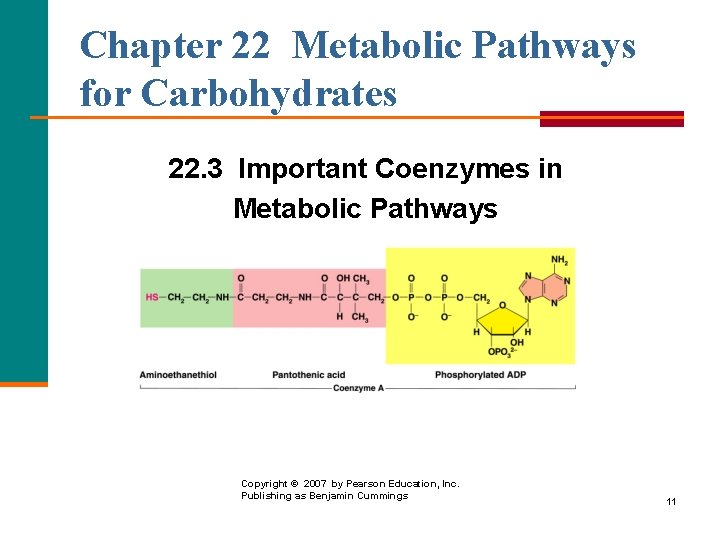
Chapter 22 Metabolic Pathways for Carbohydrates 22. 3 Important Coenzymes in Metabolic Pathways Copyright © 2007 by Pearson Education, Inc. Publishing as Benjamin Cummings 11
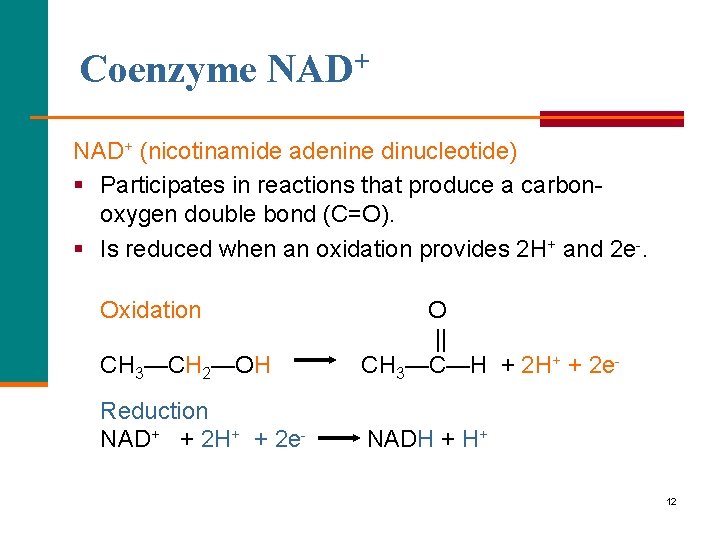
Coenzyme NAD+ (nicotinamide adenine dinucleotide) § Participates in reactions that produce a carbonoxygen double bond (C=O). § Is reduced when an oxidation provides 2 H+ and 2 e-. Oxidation O || CH 3—CH 2—OH CH 3—C—H + 2 H+ + 2 e Reduction NAD+ + 2 H+ + 2 e- NADH + H+ 12
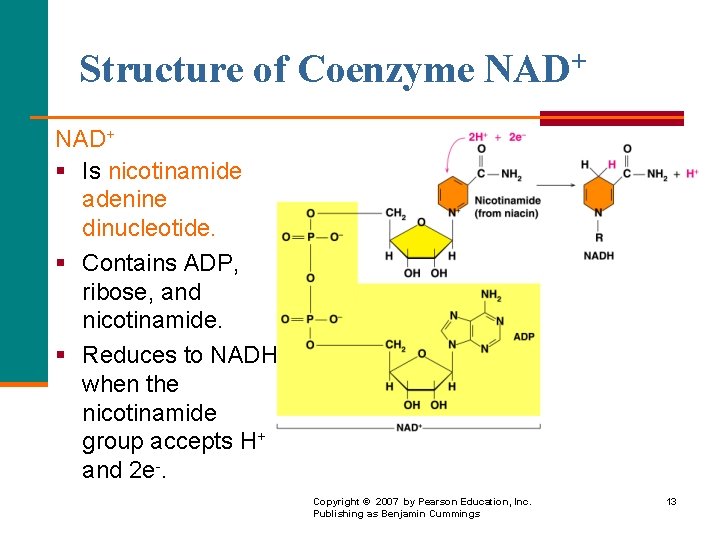
Structure of Coenzyme NAD+ § Is nicotinamide adenine dinucleotide. § Contains ADP, ribose, and nicotinamide. § Reduces to NADH when the nicotinamide group accepts H+ and 2 e-. Copyright © 2007 by Pearson Education, Inc. Publishing as Benjamin Cummings 13
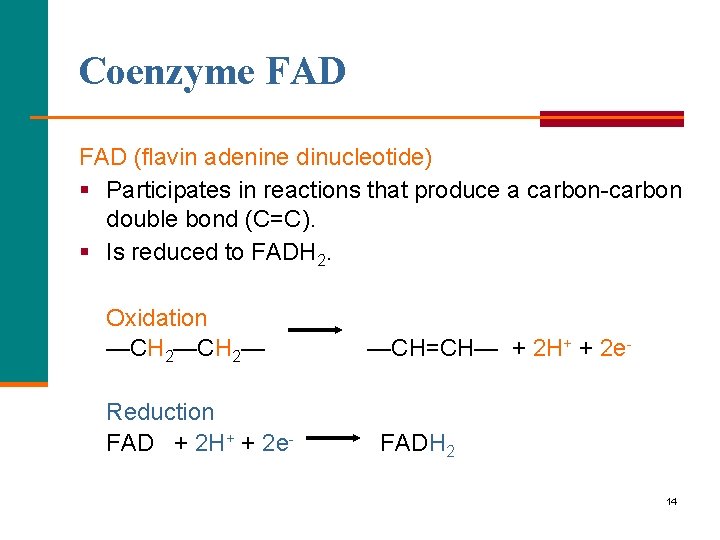
Coenzyme FAD (flavin adenine dinucleotide) § Participates in reactions that produce a carbon-carbon double bond (C=C). § Is reduced to FADH 2. Oxidation —CH 2— Reduction FAD + 2 H+ + 2 e- —CH=CH— + 2 H+ + 2 e- FADH 2 14
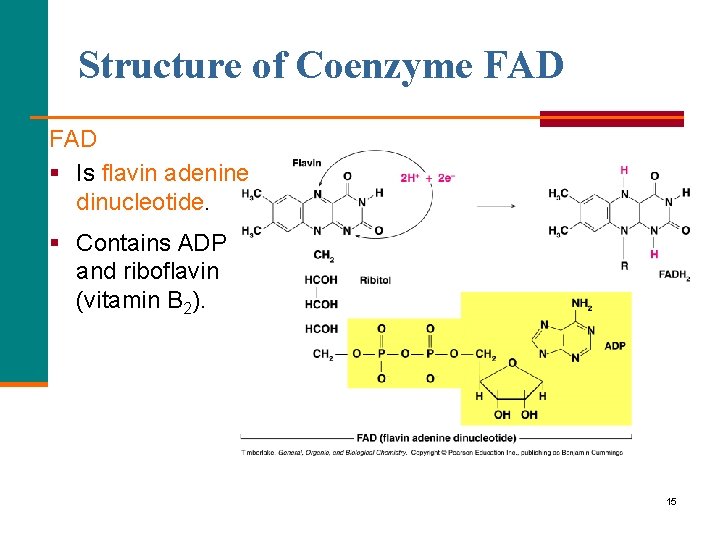
Structure of Coenzyme FAD § Is flavin adenine dinucleotide. § Contains ADP and riboflavin (vitamin B 2). 15
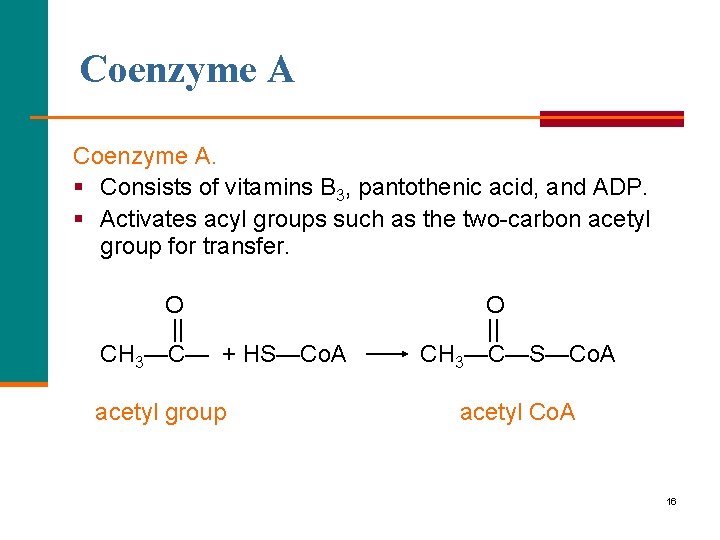
Coenzyme A. § Consists of vitamins B 3, pantothenic acid, and ADP. § Activates acyl groups such as the two-carbon acetyl group for transfer. O O || || CH 3—C— + HS—Co. A CH 3—C—S—Co. A acetyl group acetyl Co. A 16
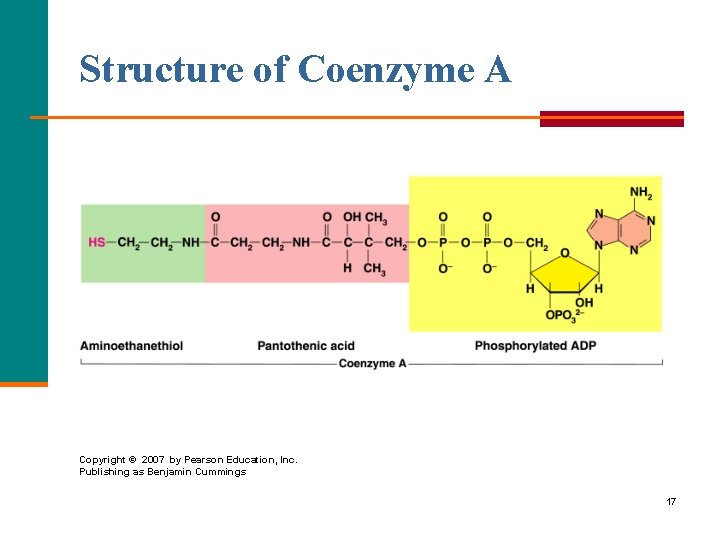
Structure of Coenzyme A Copyright © 2007 by Pearson Education, Inc. Publishing as Benjamin Cummings 17
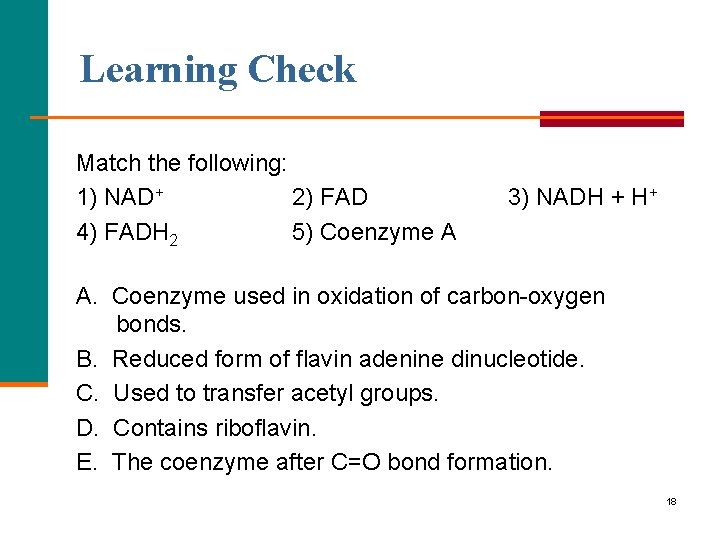
Learning Check Match the following: 1) NAD+ 2) FAD 4) FADH 2 5) Coenzyme A 3) NADH + H+ A. Coenzyme used in oxidation of carbon-oxygen bonds. B. Reduced form of flavin adenine dinucleotide. C. Used to transfer acetyl groups. D. Contains riboflavin. E. The coenzyme after C=O bond formation. 18
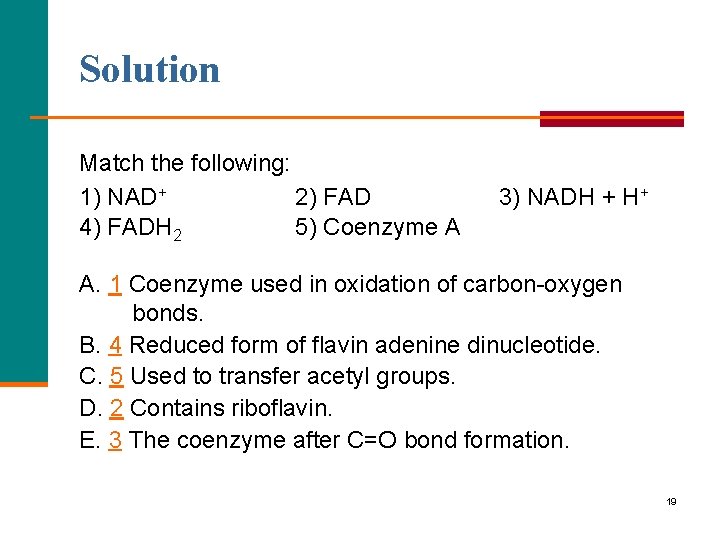
Solution Match the following: 1) NAD+ 2) FAD 3) NADH + H+ 4) FADH 2 5) Coenzyme A A. 1 Coenzyme used in oxidation of carbon-oxygen bonds. B. 4 Reduced form of flavin adenine dinucleotide. C. 5 Used to transfer acetyl groups. D. 2 Contains riboflavin. E. 3 The coenzyme after C=O bond formation. 19
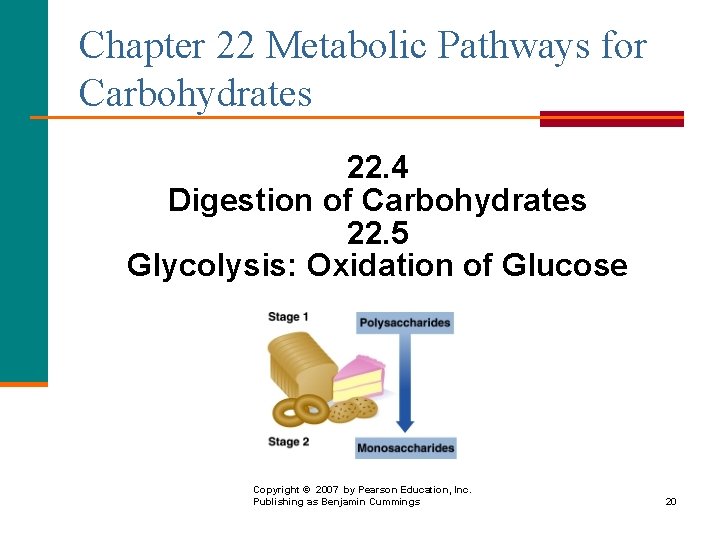
Chapter 22 Metabolic Pathways for Carbohydrates 22. 4 Digestion of Carbohydrates 22. 5 Glycolysis: Oxidation of Glucose Copyright © 2007 by Pearson Education, Inc. Publishing as Benjamin Cummings 20
Stage 1: Digestion of Carbohydrates In Stage 1, the digestion of carbohydrates § Begins in the mouth where salivary amylase breaks down polysaccharides to smaller polysaccharides (dextrins), maltose, and some glucose. § Continues in the small intestine where pancreatic amylase hydrolyzes dextrins to maltose and glucose. § Hydrolyzes maltose, lactose, and sucrose to monosaccharides, mostly glucose, which enter the bloodstream for transport to the cells. 21
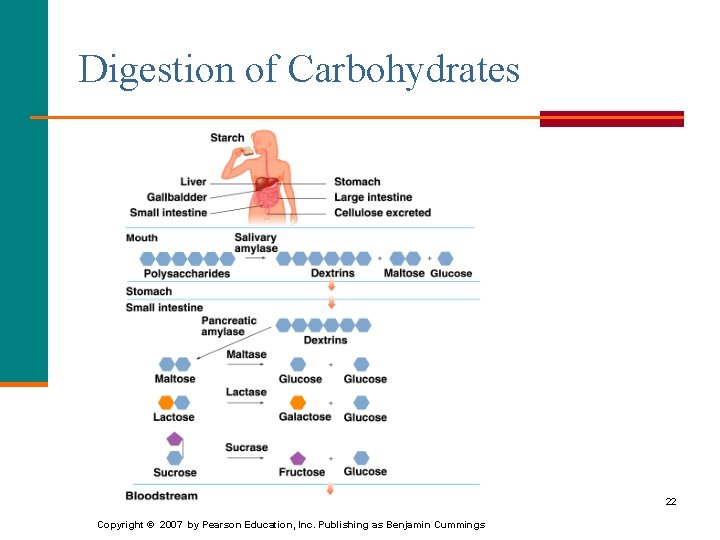
Digestion of Carbohydrates 22 Copyright © 2007 by Pearson Education, Inc. Publishing as Benjamin Cummings
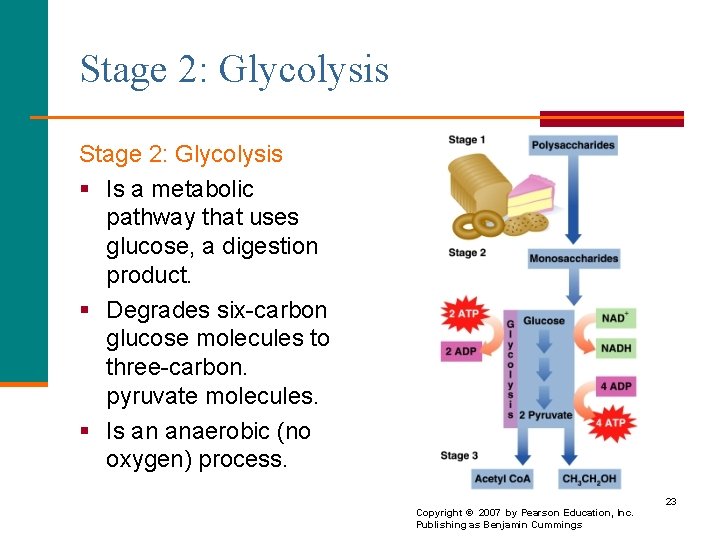
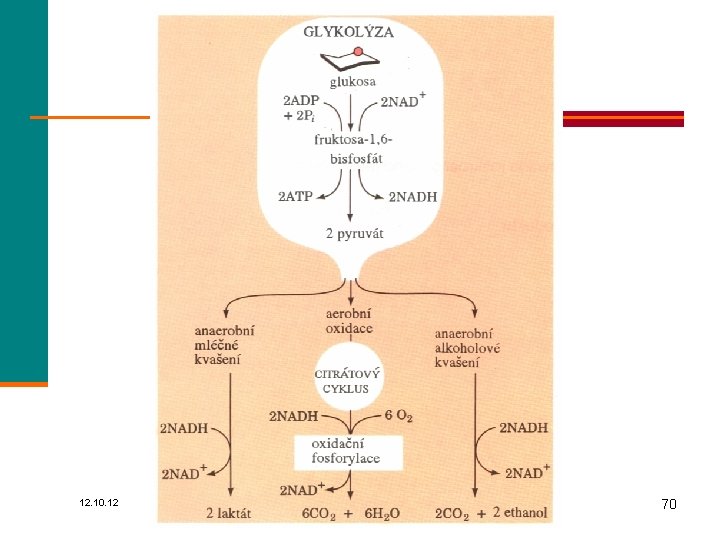
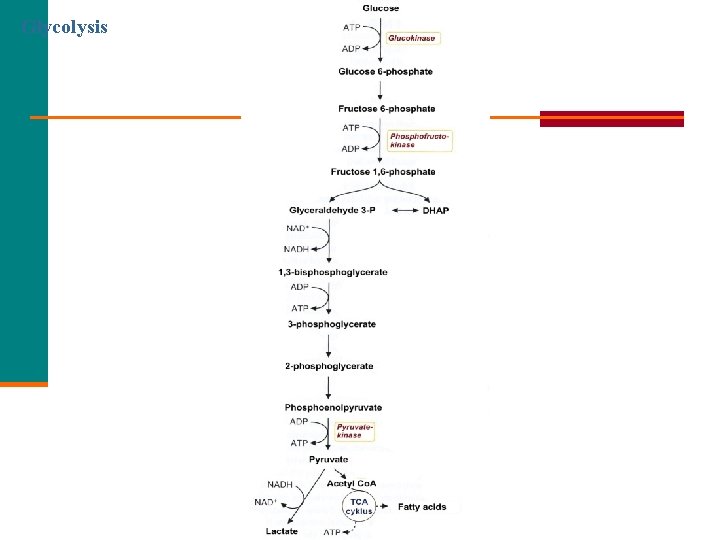
Stage 2: Glycolysis § Is a metabolic pathway that uses glucose, a digestion product. § Degrades six-carbon glucose molecules to three-carbon. pyruvate molecules. § Is an anaerobic (no oxygen) process. Copyright © 2007 by Pearson Education, Inc. Publishing as Benjamin Cummings 23
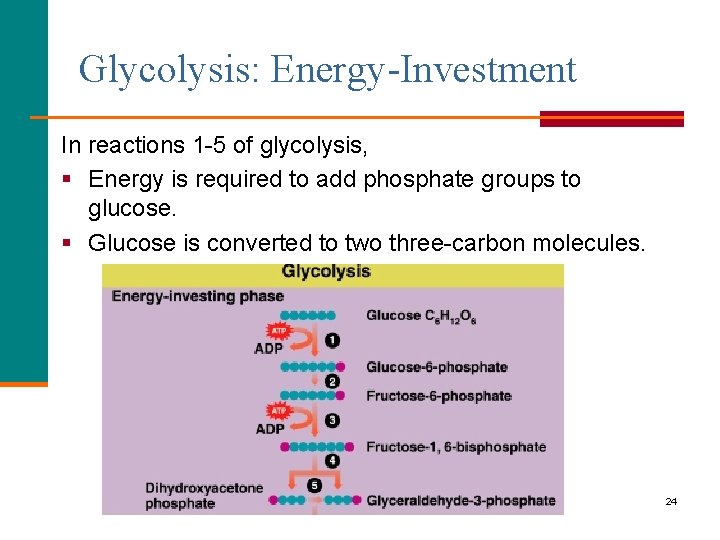
Glycolysis: Energy-Investment In reactions 1 -5 of glycolysis, § Energy is required to add phosphate groups to glucose. § Glucose is converted to two three-carbon molecules. 24
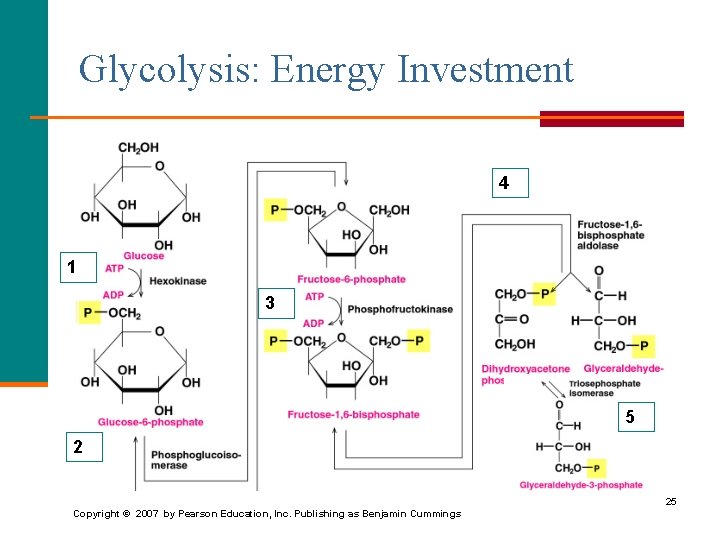
Glycolysis: Energy Investment 4 1 3 5 5 2 25 Copyright © 2007 by Pearson Education, Inc. Publishing as Benjamin Cummings
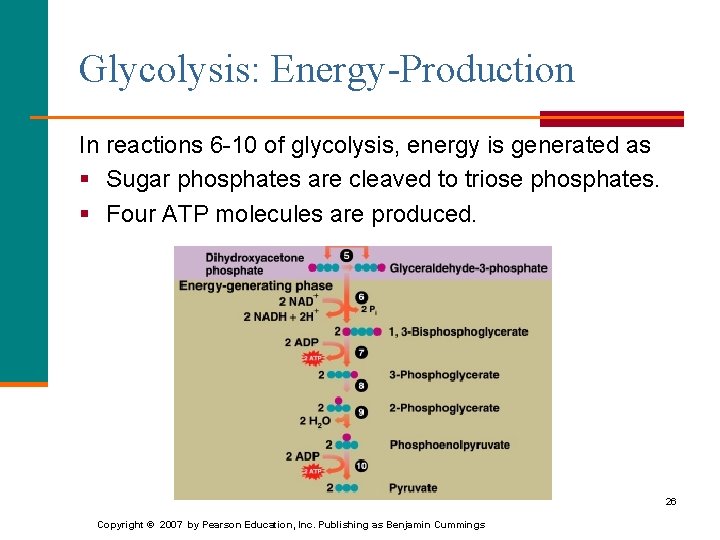
Glycolysis: Energy-Production In reactions 6 -10 of glycolysis, energy is generated as § Sugar phosphates are cleaved to triose phosphates. § Four ATP molecules are produced. 26 Copyright © 2007 by Pearson Education, Inc. Publishing as Benjamin Cummings
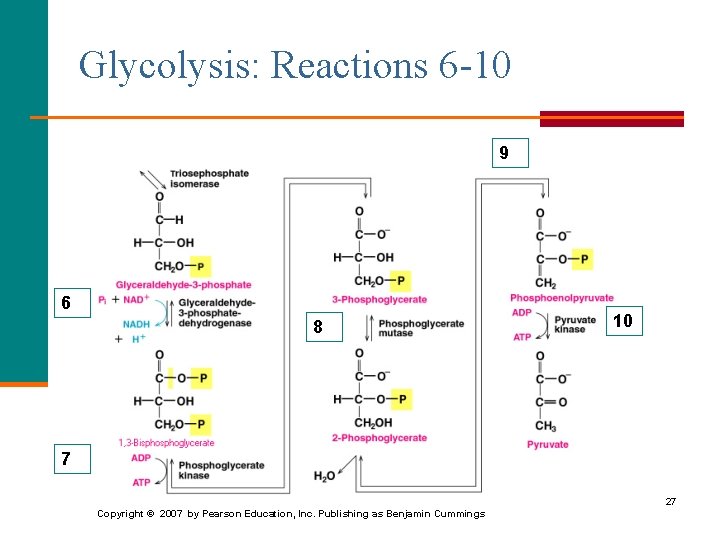
Glycolysis: Reactions 6 -10 9 6 8 10 7 27 Copyright © 2007 by Pearson Education, Inc. Publishing as Benjamin Cummings
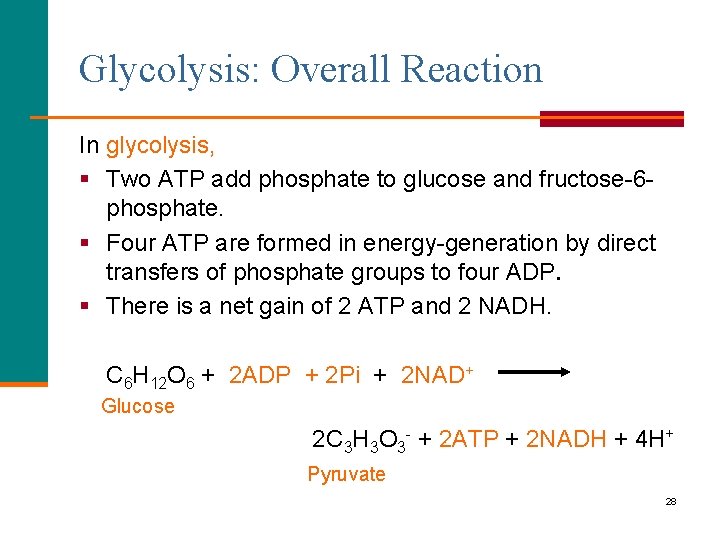
Glycolysis: Overall Reaction In glycolysis, § Two ATP add phosphate to glucose and fructose-6 phosphate. § Four ATP are formed in energy-generation by direct transfers of phosphate groups to four ADP. § There is a net gain of 2 ATP and 2 NADH. C 6 H 12 O 6 + 2 ADP + 2 Pi + 2 NAD+ Glucose 2 C 3 H 3 O 3 - + 2 ATP + 2 NADH + 4 H+ Pyruvate 28
Regulation of Glycolysis is regulated by three enzymes, § Reaction 1 Hexokinase is inhibited by high levels of glucose-6 -phosphate, which prevents the phosphorylation of glucose. § Reaction 3 Phosphofructokinase, an allosteric enzyme, is inhibited by high levels of ATP and activated by high levels of ADP and AMP. § Reaction 10 Pyruvate kinase, another allosteric enzyme is inhibited by high levels of ATP or acetyl Co. A. 29
Learning Check In glycolysis, what compounds provide phosphate groups for the production of ATP? 30
Solution In glycolysis, what compounds provide phosphate groups for the production of ATP? In reaction 7, phosphate groups from two 1, 3 -bisphoglycerate molecules are transferred to ADP to form two ATP. In reaction 10, phosphate groups from two phosphoenolpyruvate molecules are used to form two more ATP. 31
Chapter 22 Metabolic Pathways for Carbohydrates 22. 6 Pathways for Pyruvate Copyright © 2007 by Pearson Education, Inc. Publishing as Benjamin Cummings 32
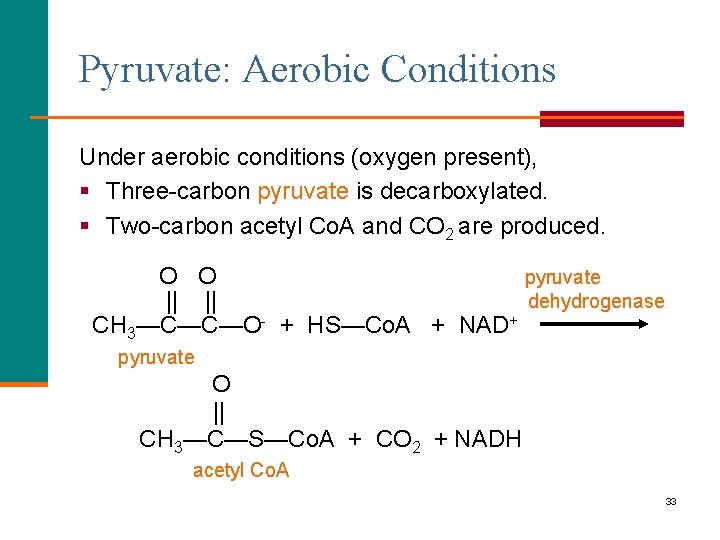
Pyruvate: Aerobic Conditions Under aerobic conditions (oxygen present), § Three-carbon pyruvate is decarboxylated. § Two-carbon acetyl Co. A and CO 2 are produced. O O pyruvate || dehydrogenase CH 3—C—C—O- + HS—Co. A + NAD+ pyruvate O || CH 3—C—S—Co. A + CO 2 + NADH acetyl Co. A 33
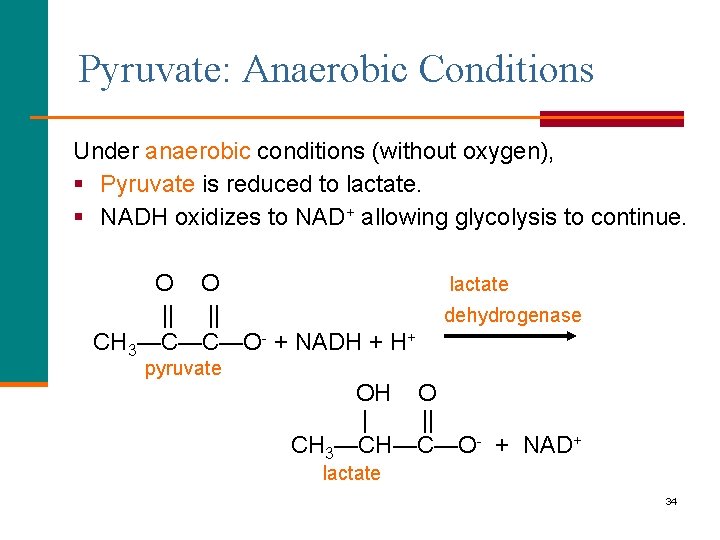
Pyruvate: Anaerobic Conditions Under anaerobic conditions (without oxygen), § Pyruvate is reduced to lactate. § NADH oxidizes to NAD+ allowing glycolysis to continue. O O lactate || || dehydrogenase CH 3—C—C—O- + NADH + H+ pyruvate OH O | || CH 3—CH—C—O- + NAD+ lactate 34
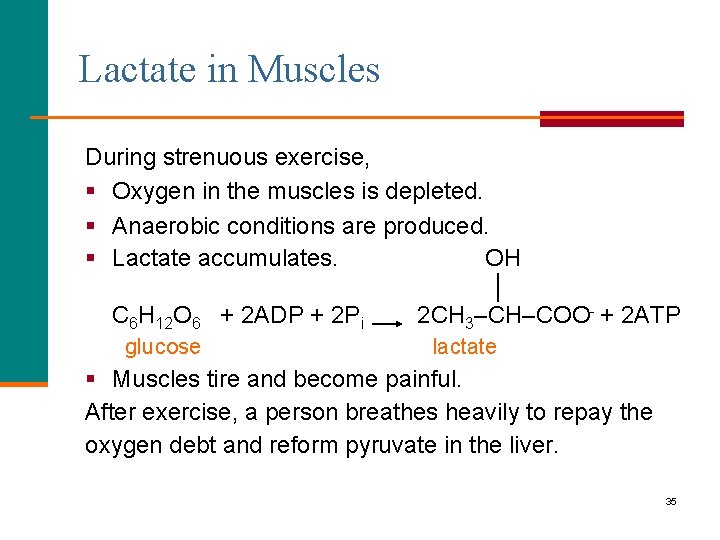
Lactate in Muscles During strenuous exercise, § Oxygen in the muscles is depleted. § Anaerobic conditions are produced. § Lactate accumulates. OH │ C 6 H 12 O 6 + 2 ADP + 2 Pi 2 CH 3–CH–COO- + 2 ATP glucose lactate § Muscles tire and become painful. After exercise, a person breathes heavily to repay the oxygen debt and reform pyruvate in the liver. 35
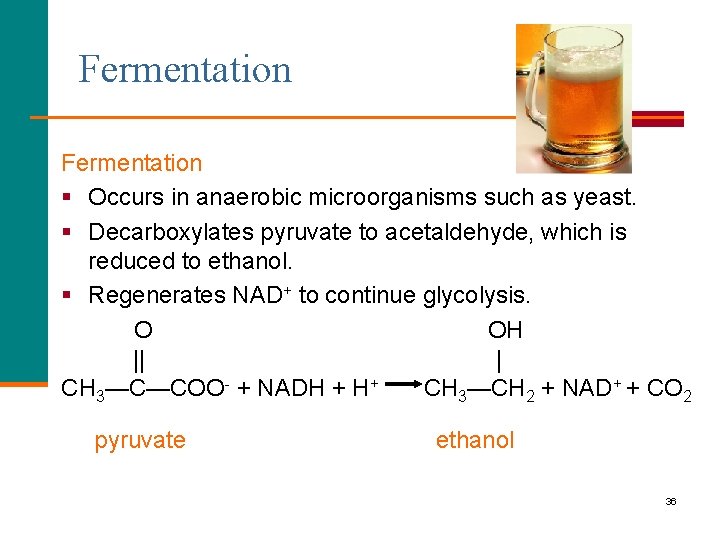
Fermentation § Occurs in anaerobic microorganisms such as yeast. § Decarboxylates pyruvate to acetaldehyde, which is reduced to ethanol. § Regenerates NAD+ to continue glycolysis. O OH || | CH 3—C—COO- + NADH + H+ CH 3—CH 2 + NAD+ + CO 2 pyruvate ethanol 36
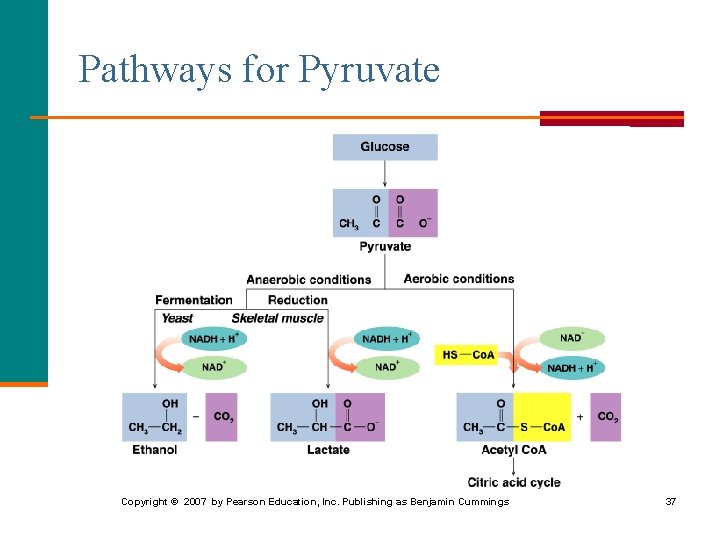
Pathways for Pyruvate Copyright © 2007 by Pearson Education, Inc. Publishing as Benjamin Cummings 37
Learning Check Match the following terms with the descriptions 1) Catabolic reactions 2) Coenzymes 3) Glycolysis 4) Lactate A. Produced during anaerobic conditions. B. Reaction series that converts glucose to pyruvate. C. Metabolic reactions that break down large molecules to smaller molecules + energy. D. Substances that remove or add H atoms in oxidation and reduction reactions. 38
Solution Match the following terms with the descriptions: 1) Catabolic reactions 2) Coenzymes 3) Glycolysis 4) Lactate A. 4 Produced during anaerobic conditions. B. 3 Reaction series that converts glucose to pyruvate. C. 1 Metabolic reactions that break down large molecules to smaller molecules + energy. D. 2 Substances that remove or add H atoms in oxidation and reduction reactions. 39
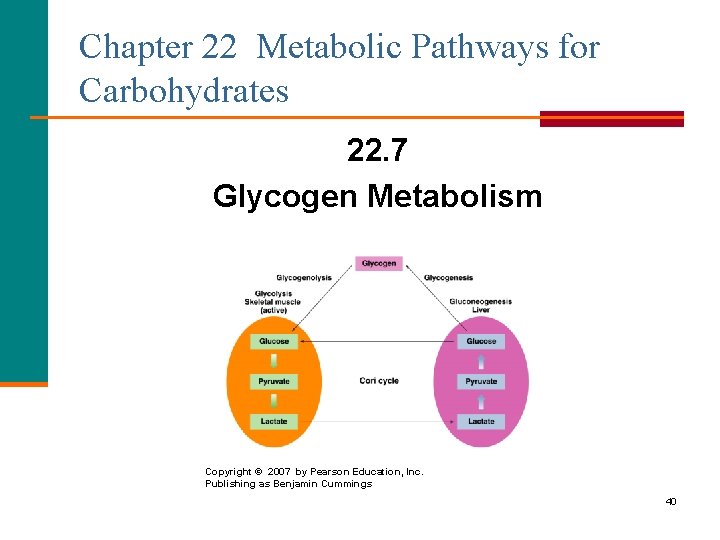
Chapter 22 Metabolic Pathways for Carbohydrates 22. 7 Glycogen Metabolism Copyright © 2007 by Pearson Education, Inc. Publishing as Benjamin Cummings 40
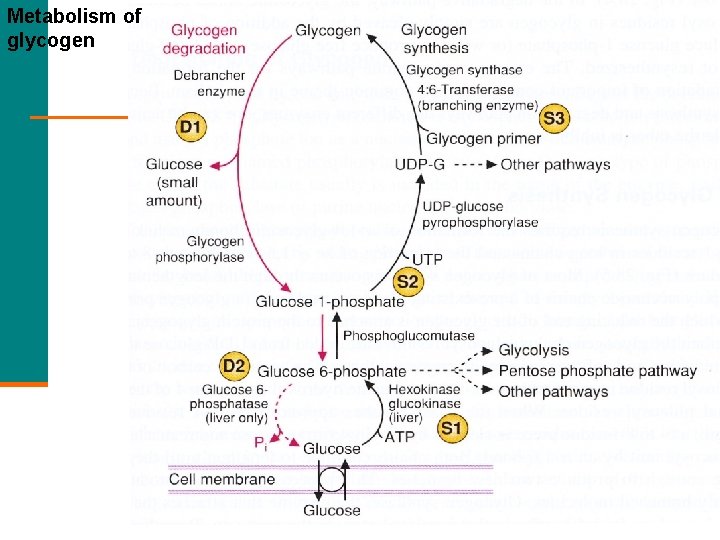
Glycogenesis § Stores glucose by converting glucose to glycogen. § Operates when high levels of glucose-6 -phosphate are formed in the first reaction of glycolysis. § Does not operate when energy stores (glycogen) are full, which means that additional glucose is converted to body fat. 41
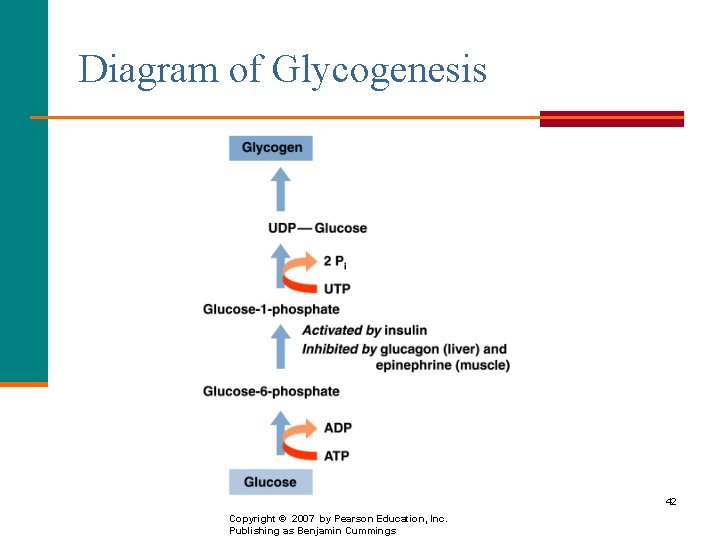
Diagram of Glycogenesis 42 Copyright © 2007 by Pearson Education, Inc. Publishing as Benjamin Cummings
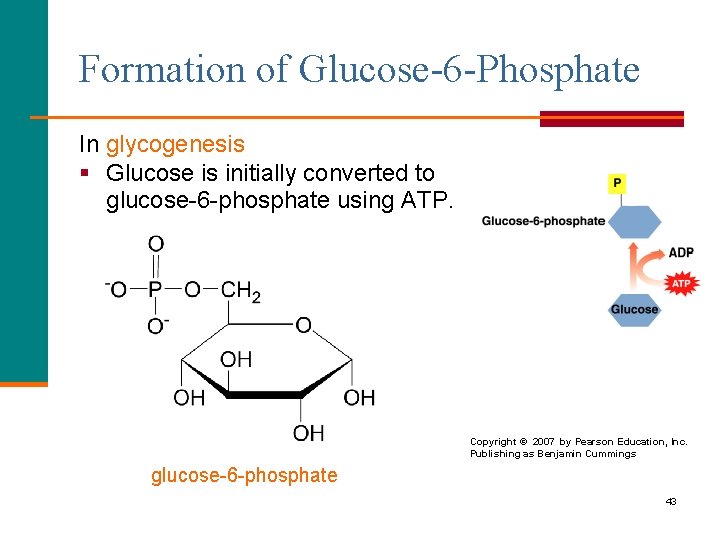
Formation of Glucose-6 -Phosphate In glycogenesis § Glucose is initially converted to glucose-6 -phosphate using ATP. Copyright © 2007 by Pearson Education, Inc. Publishing as Benjamin Cummings glucose-6 -phosphate 43
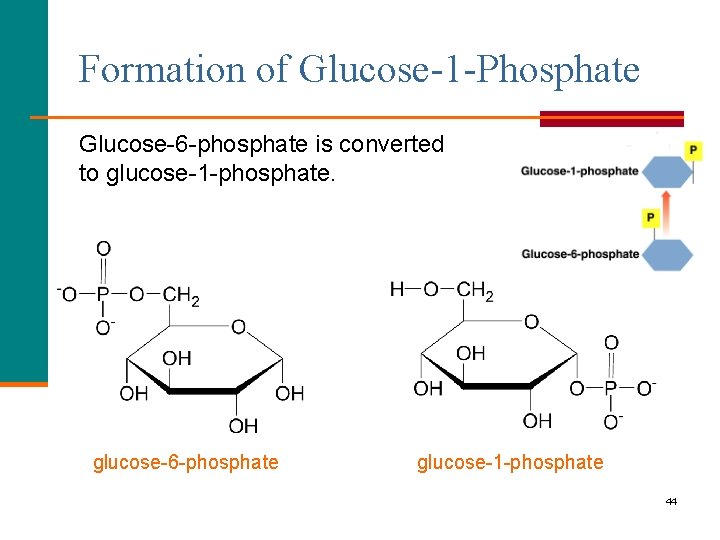
Formation of Glucose-1 -Phosphate Glucose-6 -phosphate is converted to glucose-1 -phosphate. glucose-6 -phosphate glucose-1 -phosphate 44
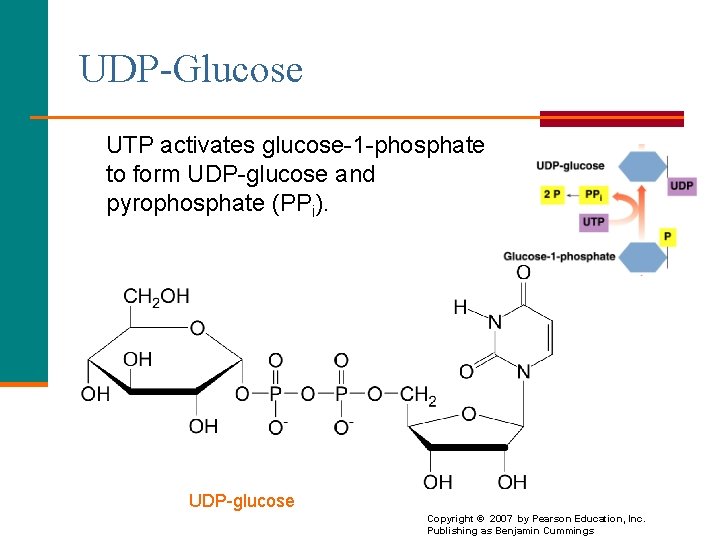
UDP-Glucose UTP activates glucose-1 -phosphate to form UDP-glucose and pyrophosphate (PPi). UDP-glucose 45 Copyright © 2007 by Pearson Education, Inc. Publishing as Benjamin Cummings
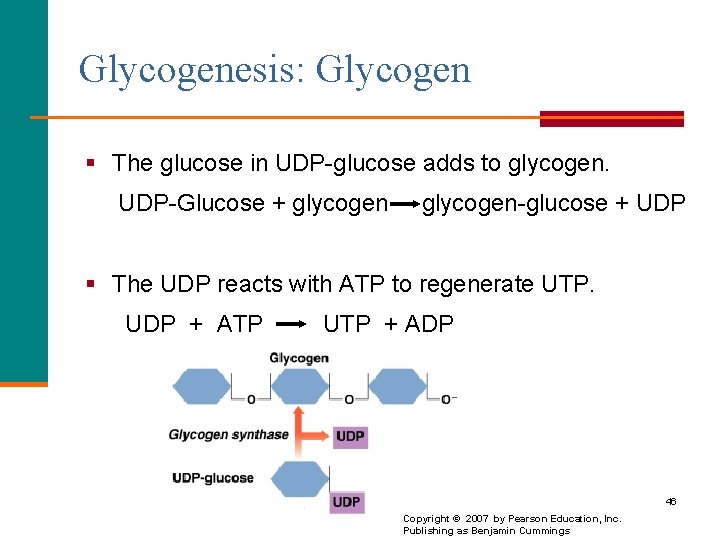
Glycogenesis: Glycogen § The glucose in UDP-glucose adds to glycogen. UDP-Glucose + glycogen-glucose + UDP § The UDP reacts with ATP to regenerate UTP. UDP + ATP UTP + ADP 46 Copyright © 2007 by Pearson Education, Inc. Publishing as Benjamin Cummings
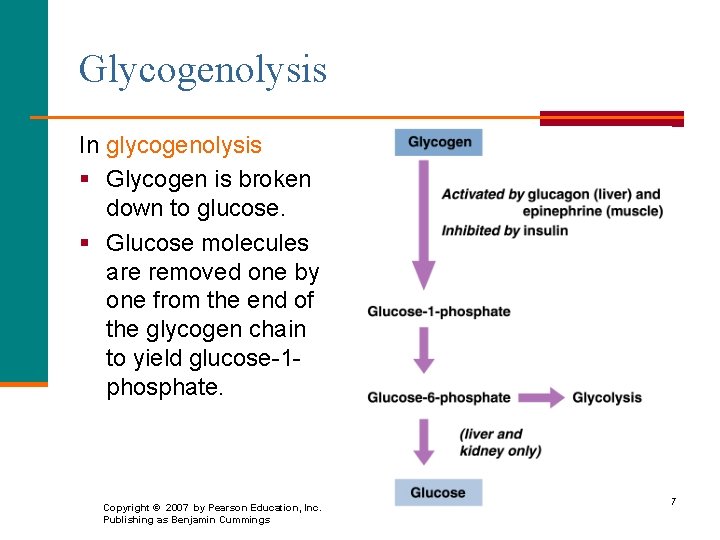
Glycogenolysis In glycogenolysis § Glycogen is broken down to glucose. § Glucose molecules are removed one by one from the end of the glycogen chain to yield glucose-1 phosphate. Copyright © 2007 by Pearson Education, Inc. Publishing as Benjamin Cummings 47
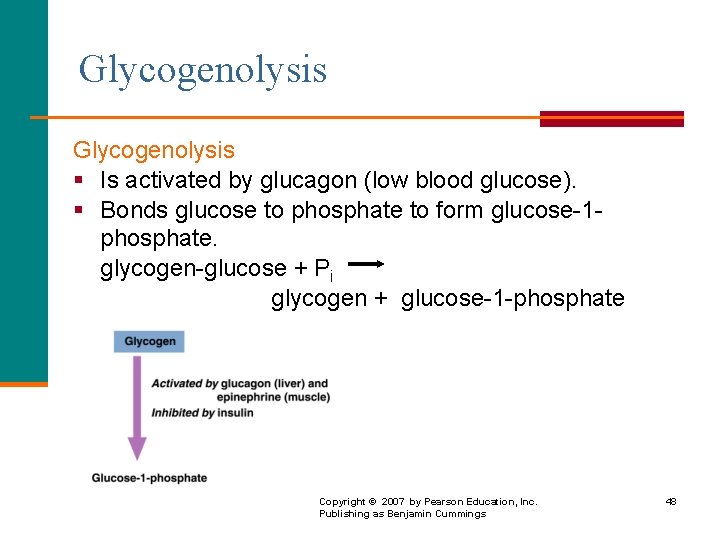
Glycogenolysis § Is activated by glucagon (low blood glucose). § Bonds glucose to phosphate to form glucose-1 phosphate. glycogen-glucose + Pi glycogen + glucose-1 -phosphate Copyright © 2007 by Pearson Education, Inc. Publishing as Benjamin Cummings 48
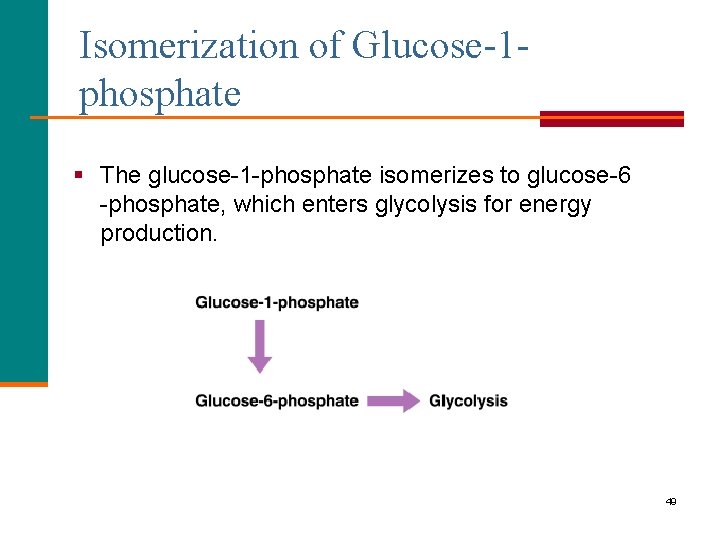
Isomerization of Glucose-1 phosphate § The glucose-1 -phosphate isomerizes to glucose-6 -phosphate, which enters glycolysis for energy production. 49
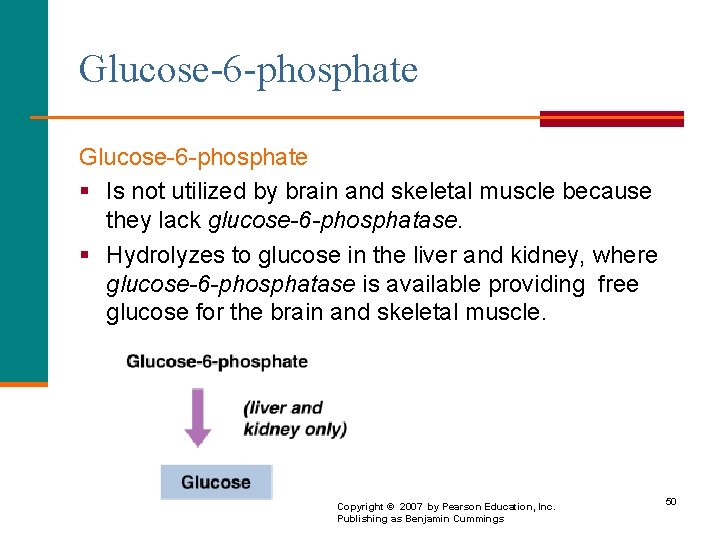
Glucose-6 -phosphate § Is not utilized by brain and skeletal muscle because they lack glucose-6 -phosphatase. § Hydrolyzes to glucose in the liver and kidney, where glucose-6 -phosphatase is available providing free glucose for the brain and skeletal muscle. Copyright © 2007 by Pearson Education, Inc. Publishing as Benjamin Cummings 50
Learning Check Match each description with 1) Glycogenesis 2) Glycogenolysis A. Activated by low levels of blood glucose. B. Converts glucose-1 -phosphate to glucose-6 phosphate. C. Activated by high levels of glucose-6 -phosphate. D. Glucose + UTP UDP-glucose + PPi 51
Solution Match each description with: 1) Glycogenesis 2) Glycogenolysis A. 2 Activated by low levels of blood glucose. B. 2 Converts glucose-1 -phosphate to glucose-6 phosphate. C. 1 Activated by high levels of glucose-6 -phosphate. D. 1 Glucose + UTP UDP-glucose + PPi 52
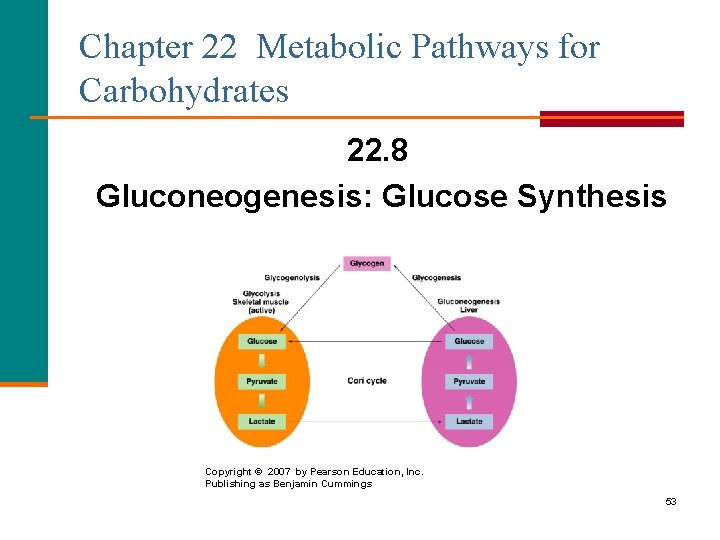
Chapter 22 Metabolic Pathways for Carbohydrates 22. 8 Gluconeogenesis: Glucose Synthesis Copyright © 2007 by Pearson Education, Inc. Publishing as Benjamin Cummings 53
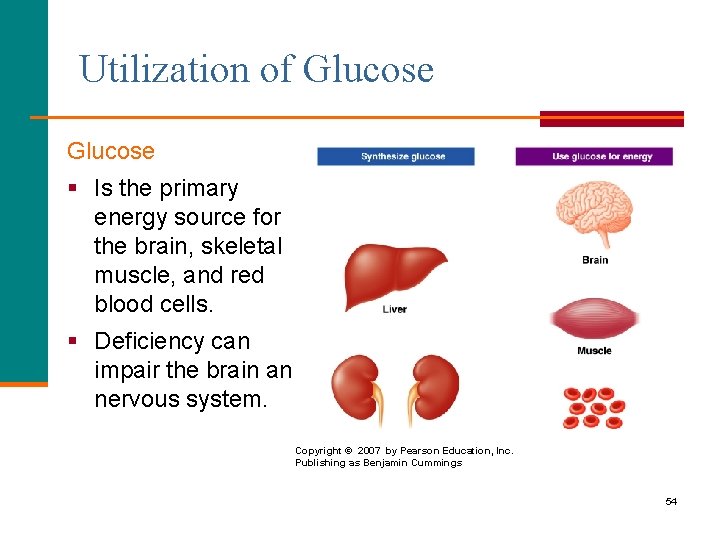
Utilization of Glucose § Is the primary energy source for the brain, skeletal muscle, and red blood cells. § Deficiency can impair the brain and nervous system. Copyright © 2007 by Pearson Education, Inc. Publishing as Benjamin Cummings 54
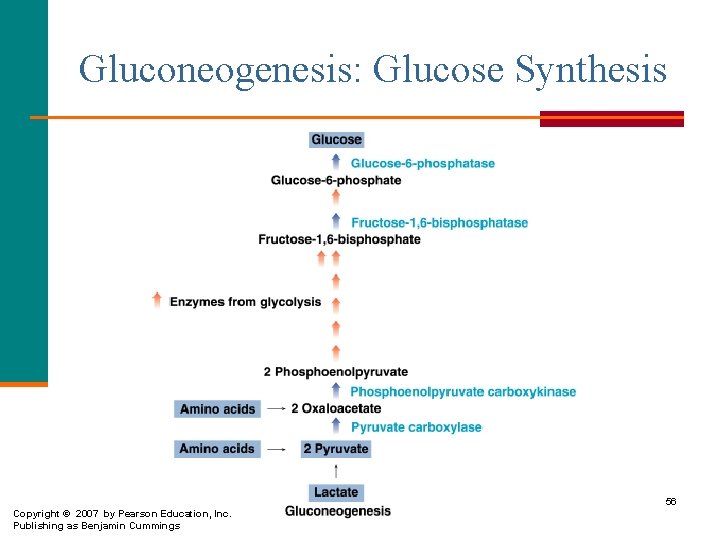
Gluconeogenesis: Glucose Synthesis Gluconeogenesis is § The synthesis of glucose from carbon atoms of noncarbohydrate compounds. § Required when glycogen stores are depleted. 55
Gluconeogenesis: Glucose Synthesis 56 Copyright © 2007 by Pearson Education, Inc. Publishing as Benjamin Cummings
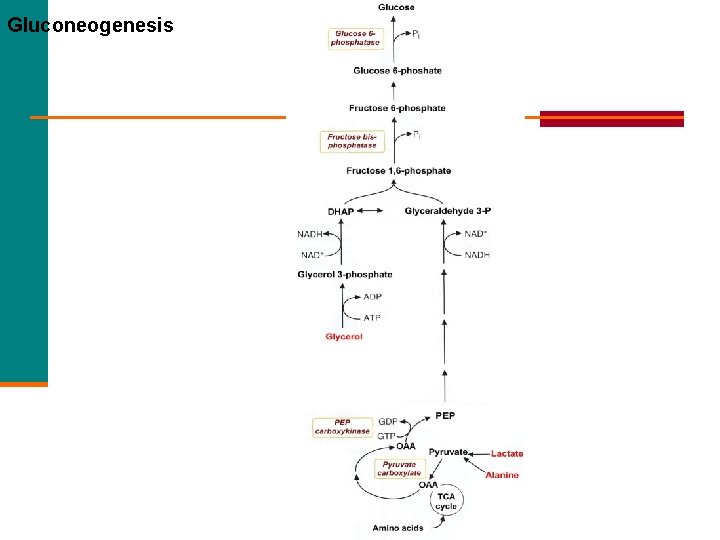
Gluconeogenesis: Glucose Synthesis In gluconeogenesis, § Glucose is synthesized from noncarbohydrates such as lactate, some amino acids, and glycerol after they are converted to pyruvate or other intermediates. § Seven reactions are the reverse of glycolysis and use the same enzymes. § Three reactions are not reversible. Reaction 1 Hexokinase Reaction 3 Phosphofructokinase Reaction 10 Pyruvate kinase 57
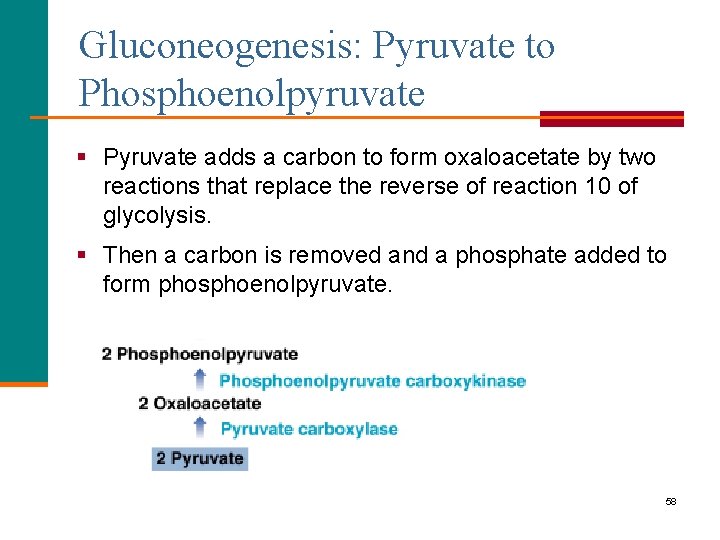
Gluconeogenesis: Pyruvate to Phosphoenolpyruvate § Pyruvate adds a carbon to form oxaloacetate by two reactions that replace the reverse of reaction 10 of glycolysis. § Then a carbon is removed and a phosphate added to form phosphoenolpyruvate. 58
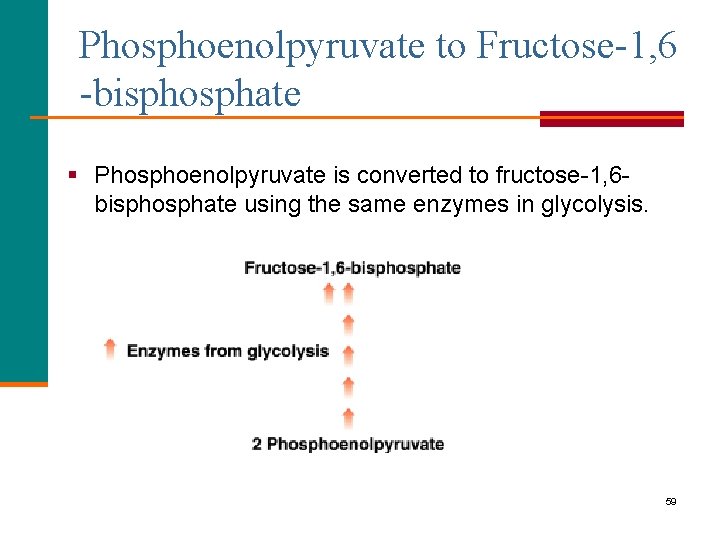
Phosphoenolpyruvate to Fructose-1, 6 -bisphosphate § Phosphoenolpyruvate is converted to fructose-1, 6 bisphosphate using the same enzymes in glycolysis. 59
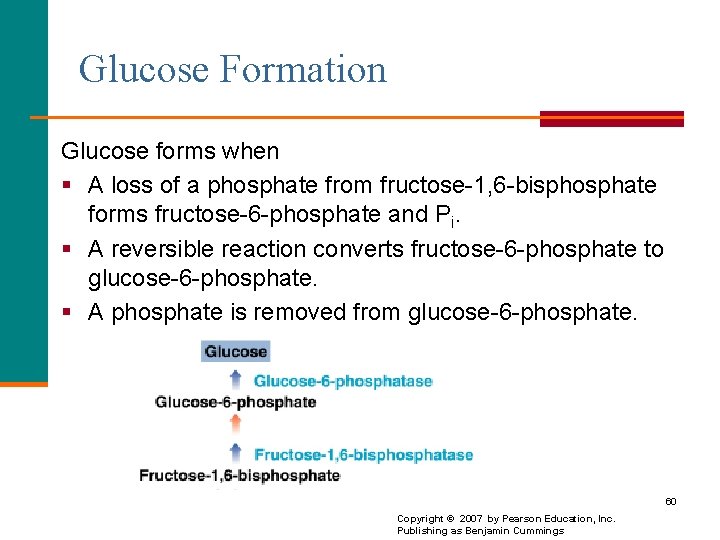
Glucose Formation Glucose forms when § A loss of a phosphate from fructose-1, 6 -bisphosphate forms fructose-6 -phosphate and Pi. § A reversible reaction converts fructose-6 -phosphate to glucose-6 -phosphate. § A phosphate is removed from glucose-6 -phosphate. 60 Copyright © 2007 by Pearson Education, Inc. Publishing as Benjamin Cummings
Cori Cycle The Cori cycle § Is the flow of lactate and glucose between the muscles and the liver. § Occurs when anaerobic conditions occur in active muscle and glycolysis produces lactate. § Operates when lactate moves through the blood stream to the liver, where it is oxidized back to pyruvate. § Converts pyruvate to glucose, which is carried back to the muscles. 61
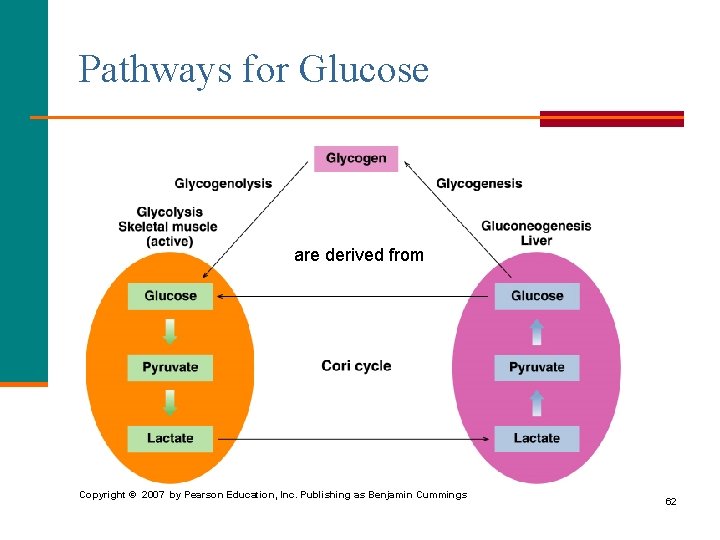
Pathways for Glucose are derived from Copyright © 2007 by Pearson Education, Inc. Publishing as Benjamin Cummings 62
Regulation of Glycolysis and Gluconeogenesis Regulation occurs as § High glucose levels and insulin promote glycolysis. § Low glucose levels and glucagon promote gluconeogenesis. 63
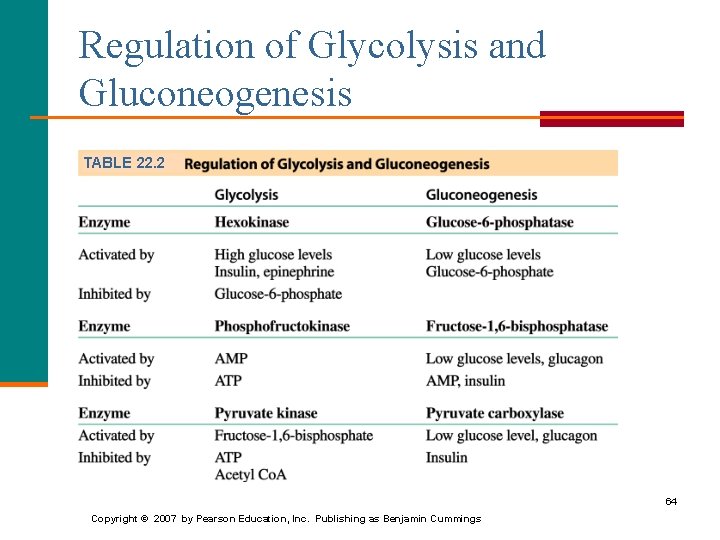
Regulation of Glycolysis and Gluconeogenesis TABLE 22. 2 64 Copyright © 2007 by Pearson Education, Inc. Publishing as Benjamin Cummings
Learning Check Identify each process as: 1) glycolysis 2) glycogenesis 3) glycogenolysis 4) gluconeogenesis A. The synthesis of glucose from noncarbohydrates. B. The breakdown of glycogen into glucose. C. The oxidation of glucose to two pyruvate. D. The synthesis of glycogen from glucose. 65
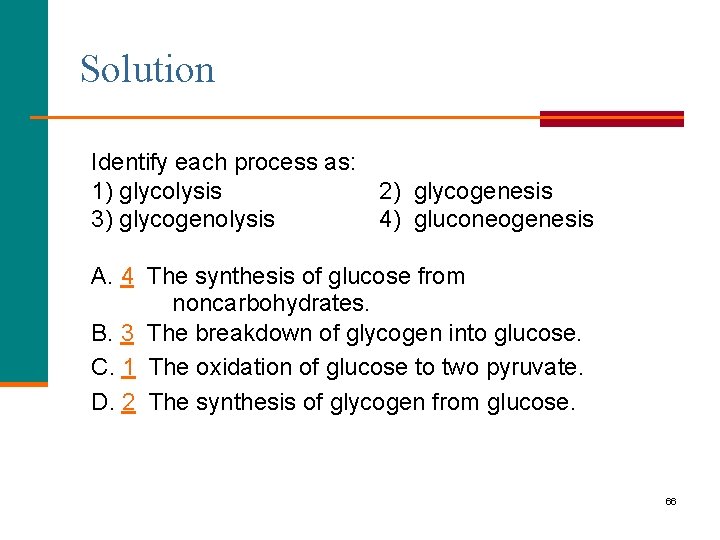
Solution Identify each process as: 1) glycolysis 2) glycogenesis 3) glycogenolysis 4) gluconeogenesis A. 4 The synthesis of glucose from noncarbohydrates. B. 3 The breakdown of glycogen into glucose. C. 1 The oxidation of glucose to two pyruvate. D. 2 The synthesis of glycogen from glucose. 66
METABOLISM OF GLUCOSE AND ITS DISTURBANCES, GLYOGENOSES 67
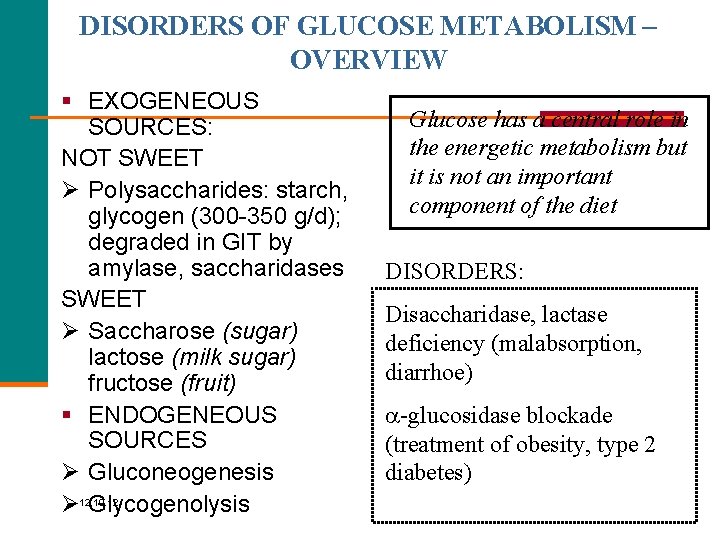
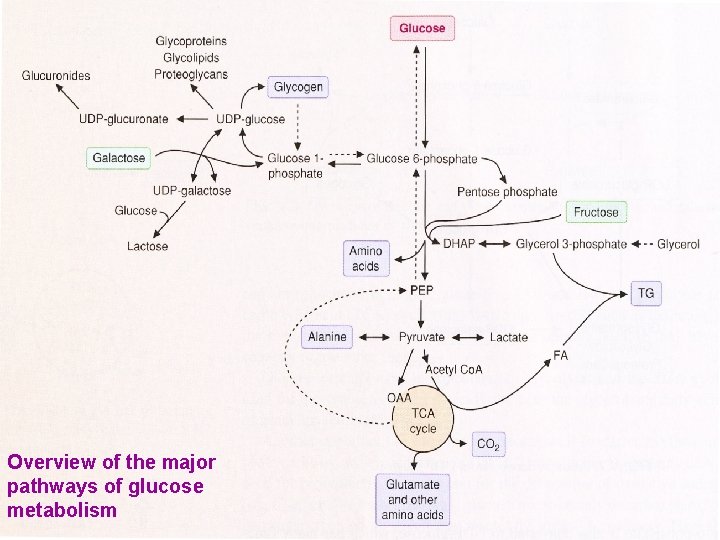
DISORDERS OF GLUCOSE METABOLISM – OVERVIEW § EXOGENEOUS SOURCES: NOT SWEET Ø Polysaccharides: starch, glycogen (300 -350 g/d); degraded in GIT by amylase, saccharidases SWEET Ø Saccharose (sugar) lactose (milk sugar) fructose (fruit) § ENDOGENEOUS SOURCES Ø Gluconeogenesis Ø 12. 10. 12 Glycogenolysis Glucose has a central role in the energetic metabolism but it is not an important component of the diet DISORDERS: Disaccharidase, lactase deficiency (malabsorption, diarrhoe) a-glucosidase blockade (treatment of obesity, type 2 diabetes) 68
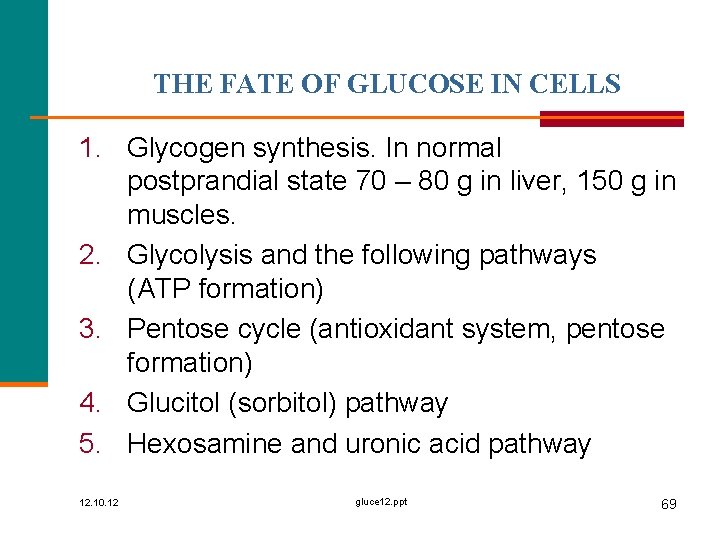
THE FATE OF GLUCOSE IN CELLS 1. Glycogen synthesis. In normal postprandial state 70 – 80 g in liver, 150 g in muscles. 2. Glycolysis and the following pathways (ATP formation) 3. Pentose cycle (antioxidant system, pentose formation) 4. Glucitol (sorbitol) pathway 5. Hexosamine and uronic acid pathway 12. 10. 12 gluce 12. ppt 69
12. 10. 12 gluce 12. ppt 70
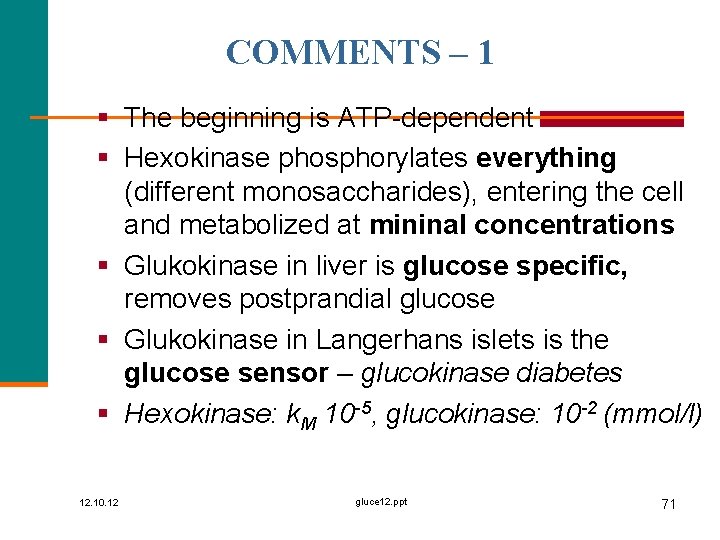
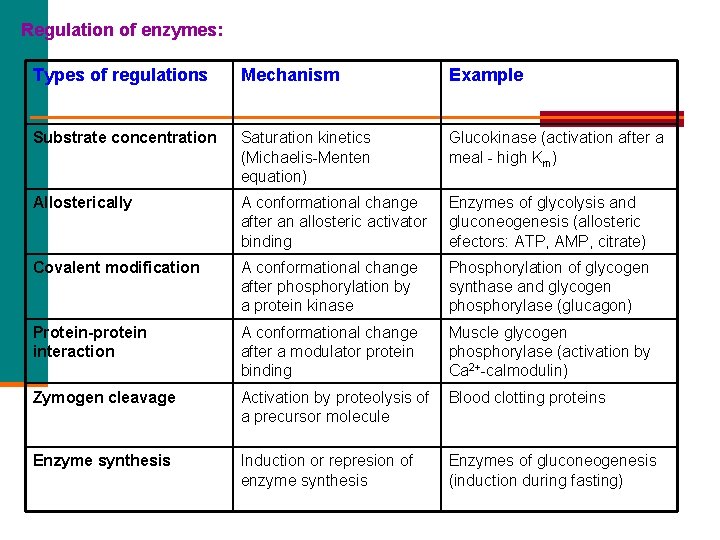
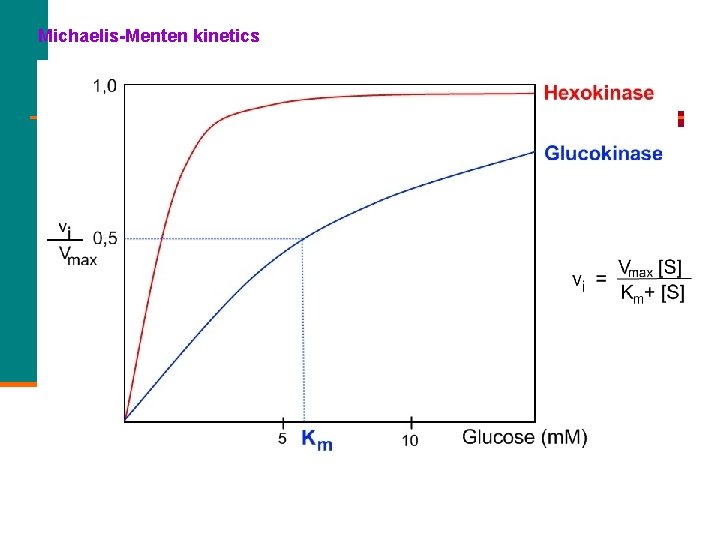
COMMENTS – 1 § The beginning is ATP-dependent § Hexokinase phosphorylates everything (different monosaccharides), entering the cell and metabolized at mininal concentrations § Glukokinase in liver is glucose specific, removes postprandial glucose § Glukokinase in Langerhans islets is the glucose sensor – glucokinase diabetes § Hexokinase: k. M 10 -5, glucokinase: 10 -2 (mmol/l) 12. 10. 12 gluce 12. ppt 71
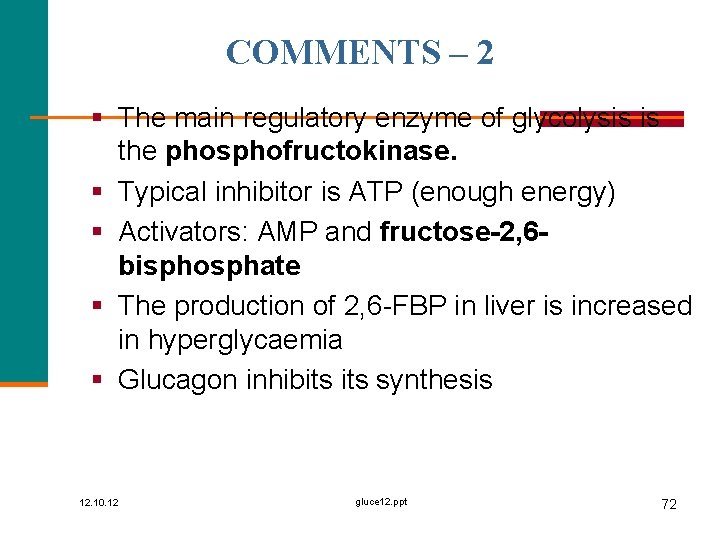
COMMENTS – 2 § The main regulatory enzyme of glycolysis is the phosphofructokinase. § Typical inhibitor is ATP (enough energy) § Activators: AMP and fructose-2, 6 bisphosphate § The production of 2, 6 -FBP in liver is increased in hyperglycaemia § Glucagon inhibits synthesis 12. 10. 12 gluce 12. ppt 72
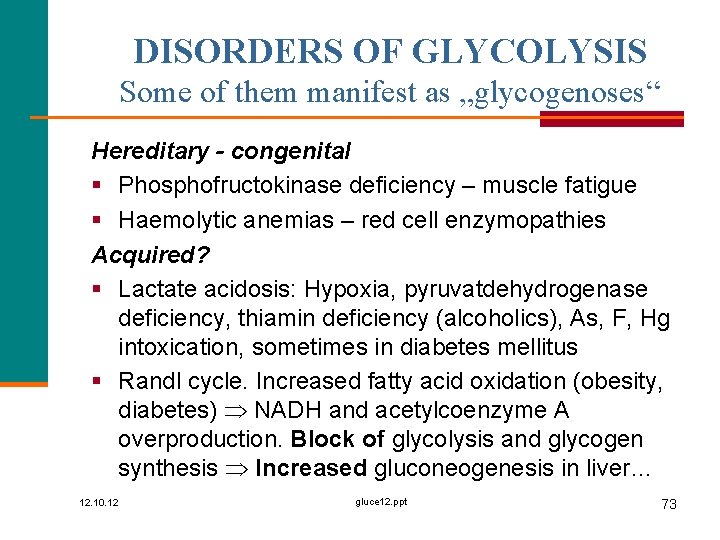
DISORDERS OF GLYCOLYSIS Some of them manifest as „glycogenoses“ Hereditary - congenital § Phosphofructokinase deficiency – muscle fatigue § Haemolytic anemias – red cell enzymopathies Acquired? § Lactate acidosis: Hypoxia, pyruvatdehydrogenase deficiency, thiamin deficiency (alcoholics), As, F, Hg intoxication, sometimes in diabetes mellitus § Randl cycle. Increased fatty acid oxidation (obesity, diabetes) NADH and acetylcoenzyme A overproduction. Block of glycolysis and glycogen synthesis Increased gluconeogenesis in liver… 12. 10. 12 gluce 12. ppt 73
SEVERE (BUT RARE) DISORDERS OF MONOSACCHARIDE METABOLISM § Galactosemia AR, 1/20 000 – 60 000 n Accumulation of galactose, gal-1 -P, galactitol cataract, mental retardation, liver cirrhosis, haemolysis, kidney failure Ä diet without milk § Fructose intolerance AR, 1/20 000 n 12. 10. 12 Accumulation of fructose & F-1 -P block of glucose metabolism (glycolysis, gluconeogenesis, glycogenolysis) hypoglycaemia after sweet fruits and sweets Ä omit them gluce 12. ppt 74
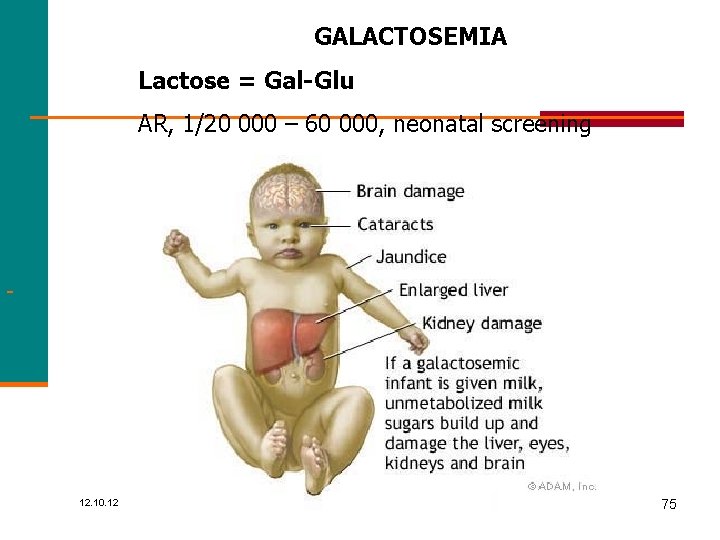
GALACTOSEMIA Lactose = Gal-Glu AR, 1/20 000 – 60 000, neonatal screening 12. 10. 12 gluce 12. ppt 75
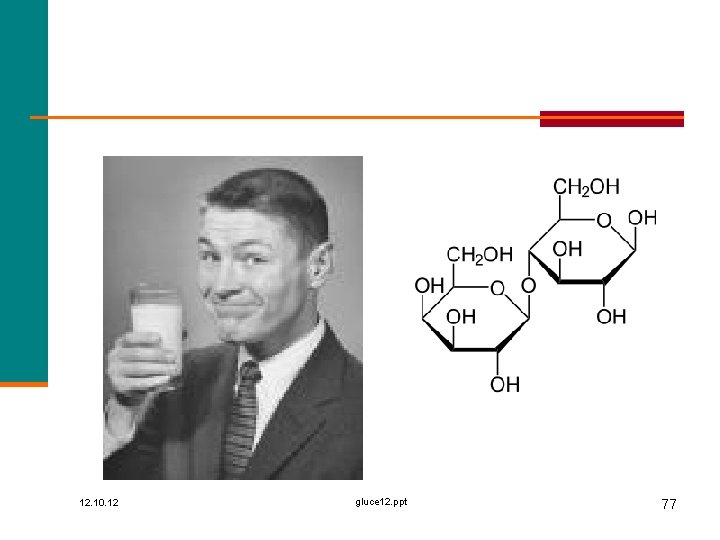
LESS SEVERE (BUT RELATIVELY COMMON) DISORDERS OF SUGAR METABOLISM § Milk intolerance – opposite mutation n Lactose is important source of energy for small children n The activity of lactase is high up to age 4 years, later decreases n Milk intolerant adult people are the nonmutants n People able consume milk in adulthood are mutants – their off switch is not working n Selection according to life style – hunters contra farmers § Fructosuria n Fructose does not enter into metabolism, excretion through urine 12. 10. 12 gluce 12. ppt 76
12. 10. 12 gluce 12. ppt 77
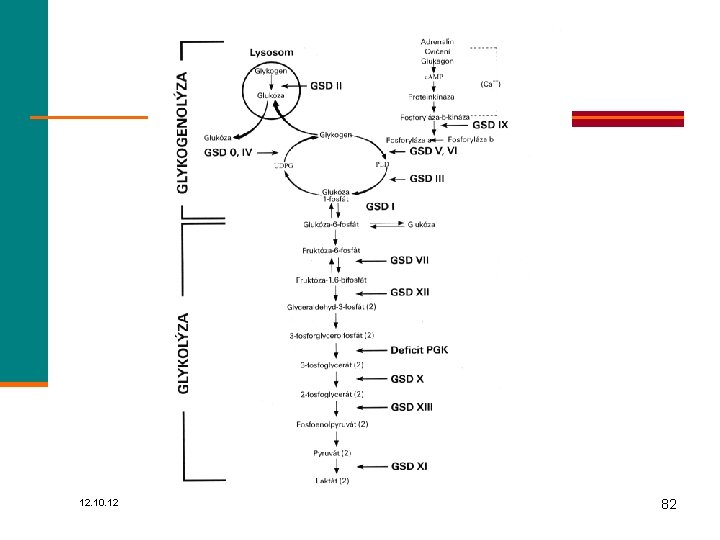
GLYCOGEN STORAGE DISEASES, GSD* § Synthesis of glycogen (energy from ATP & UTP) n n G 6 P G 1 P no problem Activation with UTP UDP-glucose primer, 1 -4 polymerisation & 1 -6 branching after 10 20 nm particles § Glycogenolysis n n phosphorylase (different from amylase) makes G 1 P debranching makes glucose *Originally I – VII, 2000 IX, Fernandes 2008 – more than 15 12. 10. 12 gluce 12. ppt 78
GLYCOGEN STORAGE DISEASES, GSD § The control of synthase & phosphorylasde through signal systems (c. AMP, Ca) and phosphorylation – dephosphorylation § Postprandial state n synthase in state on (I) phosphorylase off (b) § We need glucose!!! n n 12. 10. 12 adrenaline, glucagon c. AMP, phosphokinases Synthase off (D) phosphorylase on (a) gluce 12. ppt 79
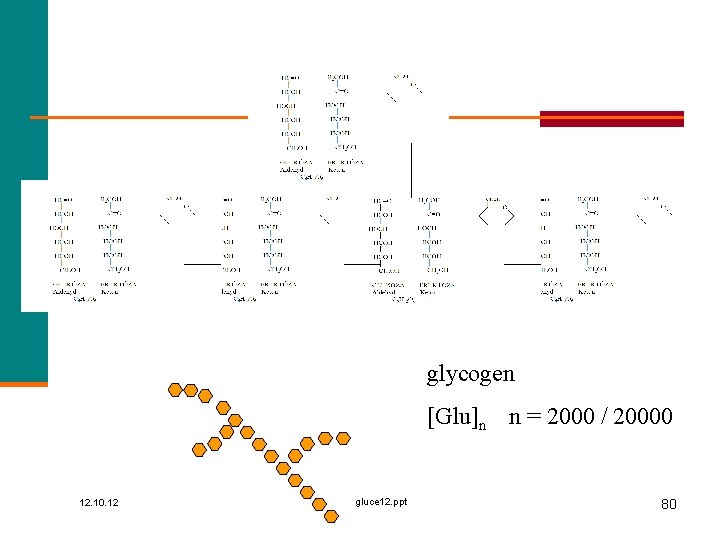
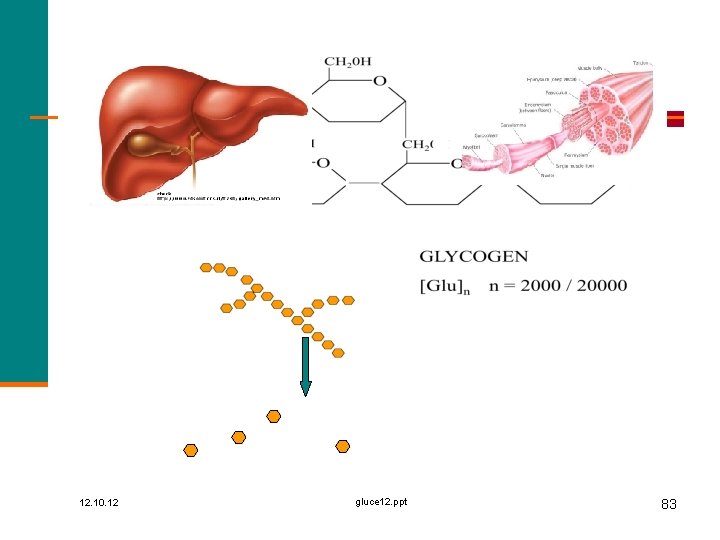
glycogen [Glu]n n = 2000 / 20000 12. 10. 12 gluce 12. ppt 80
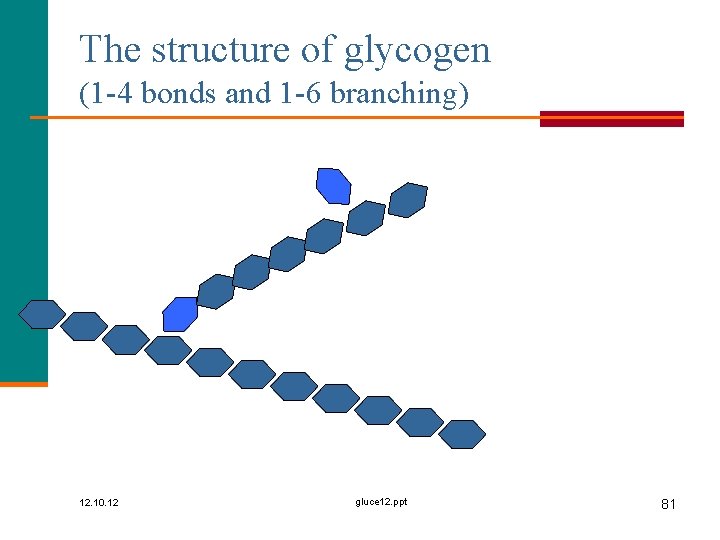
The structure of glycogen (1 -4 bonds and 1 -6 branching) 12. 10. 12 gluce 12. ppt 81
12. 10. 12 gluce 12. ppt 82
12. 10. 12 gluce 12. ppt 83
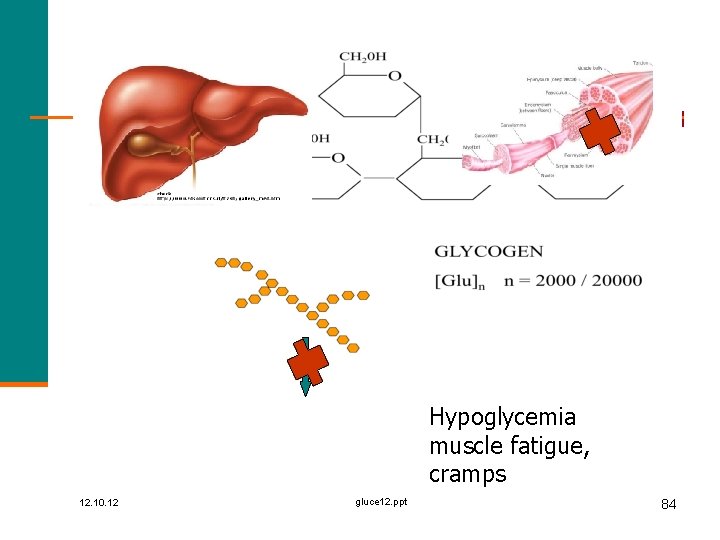
Hypoglycemia muscle fatigue, cramps 12. 10. 12 gluce 12. ppt 84
GLYCOGEN STORAGE DISEASES, GSD THE PRINCIPLE! LIVER – GLUCOSE FOR THE BODY § von Gierke (I) not a true GSD: glucose-6 phosphatase deficiency, hepatomegaly, hypoglycaemia, growth retardation for low insulin (!) § Cori (III) deficiency of debranching – as “I”, less severe § Andersen (IV) deficiency of branching – bad prognosis § Hers (VI) deficiency of phosphorylase – as “I”, less severe 12. 10. 12 gluce 12. ppt 85
GLYCOGEN STORAGE DISEASES, GSD THE PRINCIPLE! MUSCLES – “SINGLE MINDED” No gluconeogenesis No glucose-6 -phosphatase (don’t need it) Only 1 % glycogen but altogether more than in the liver § “V” Mc Ardle deficiency of muscle phosphorylase without hypoglycaemia but muscle manifestation, not very severe § “III”, “IV” similar GENERALIZED § “II” – Pompe, heart hypertrophy, muscle hypotonia, bad prognosis (not logical) 12. 10. 12 gluce 12. ppt 86
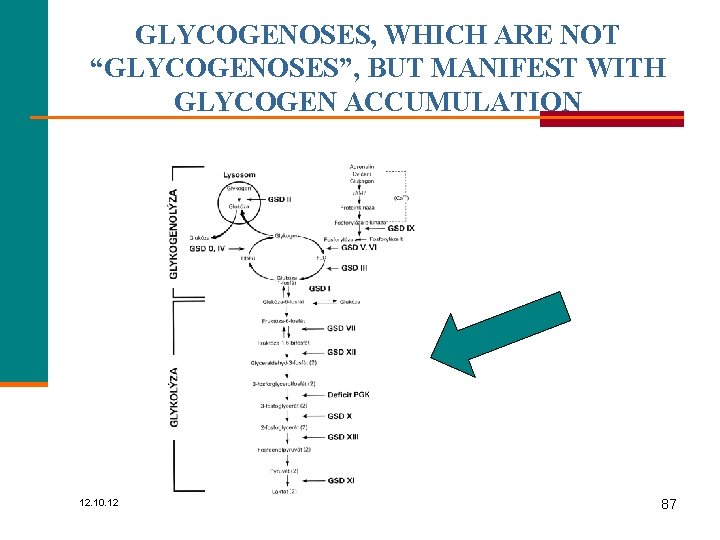
GLYCOGENOSES, WHICH ARE NOT “GLYCOGENOSES”, BUT MANIFEST WITH GLYCOGEN ACCUMULATION 12. 10. 12 gluce 12. ppt 87
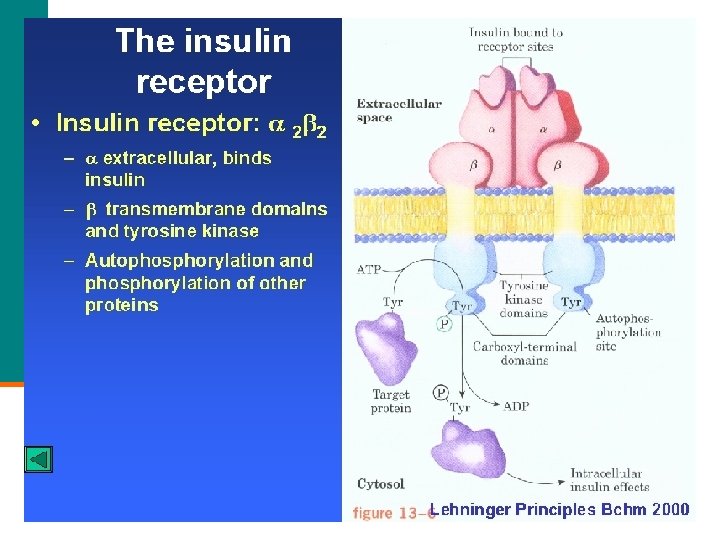
Glucose homeostasis § Insulin lowers blood glucose (yes, but. . . ) § Insulin enables glucose metabolism in cells (yes, but. . . ) § Insulin exerts its effect through insulin receptor a transmembrane protein with kinase activity § Key point of postreceptor events (a complicated cascade) is the translocation of glucose transporter GLUT 4 to the membrane of muscle and fat cells THE PLAYERS OF THE GAME: 12. 10. 12 GLUCOSE INSULIN RECEPTOR gluce 12. ppt GLUCOSE TRANSPORTER 88
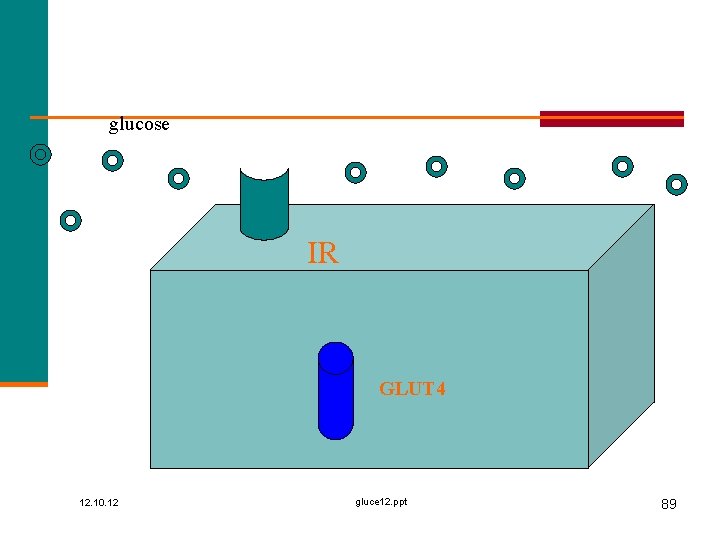
glucose IR GLUT 4 12. 10. 12 gluce 12. ppt 89
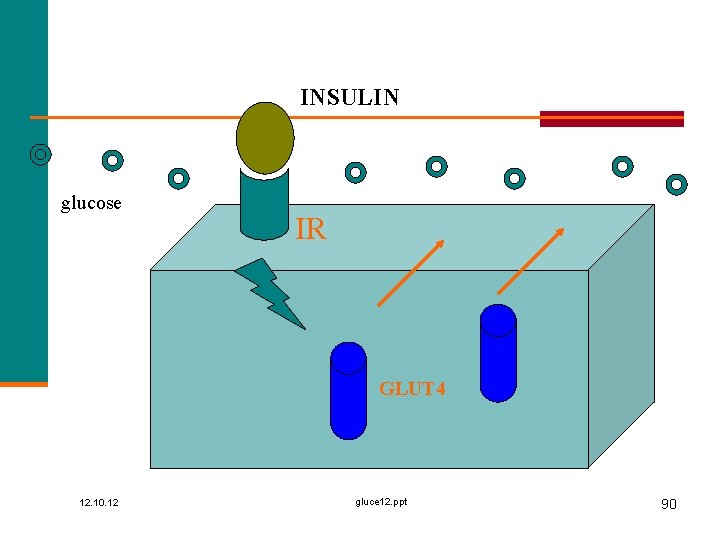
INSULIN glucose IR GLUT 4 12. 10. 12 gluce 12. ppt 90
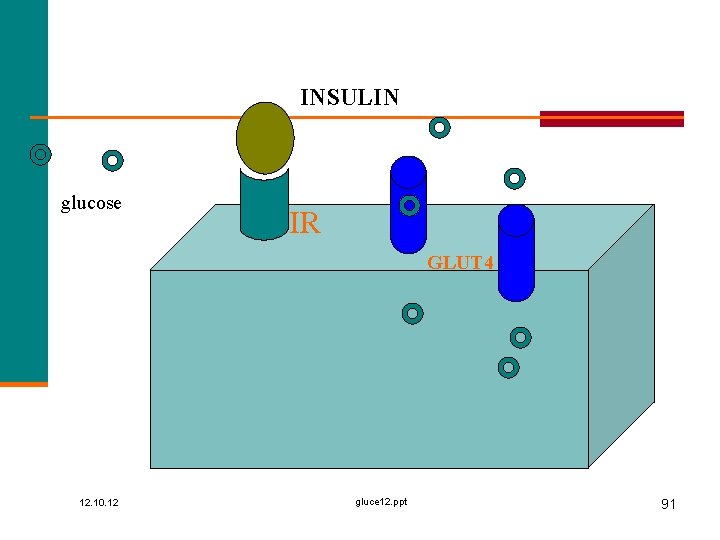
INSULIN glucose IR GLUT 4 12. 10. 12 gluce 12. ppt 91
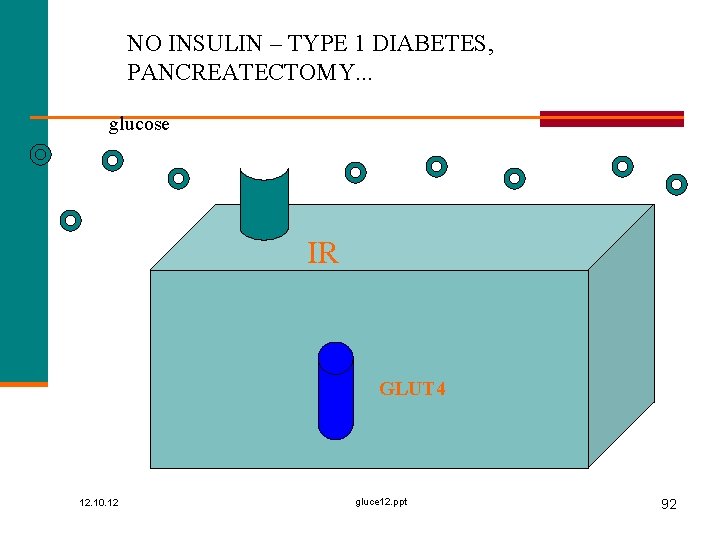
NO INSULIN – TYPE 1 DIABETES, PANCREATECTOMY. . . glucose IR GLUT 4 12. 10. 12 gluce 12. ppt 92
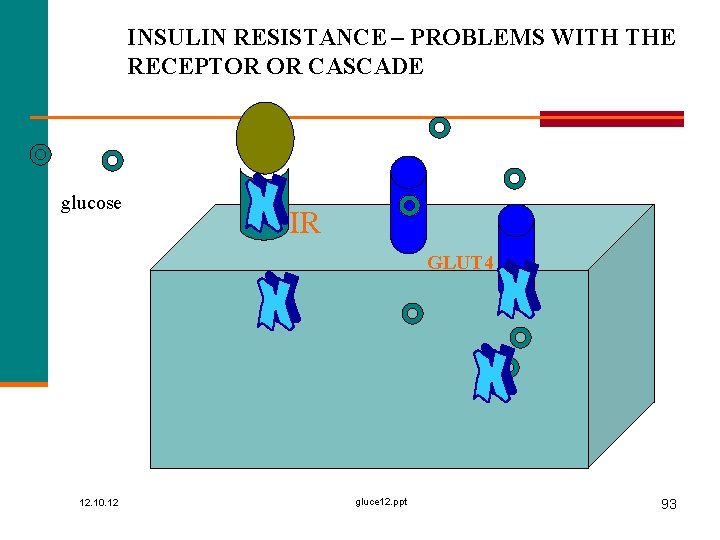
INSULIN RESISTANCE – PROBLEMS WITH THE RECEPTOR OR CASCADE glucose IR GLUT 4 12. 10. 12 gluce 12. ppt 93
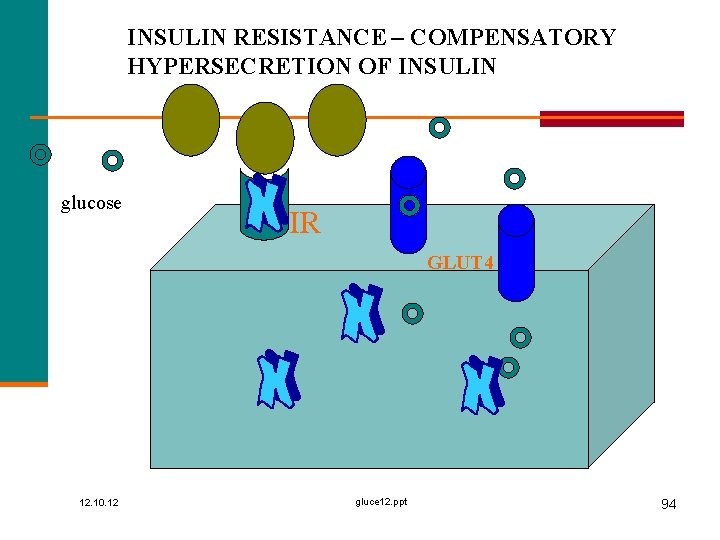
INSULIN RESISTANCE – COMPENSATORY HYPERSECRETION OF INSULIN glucose IR GLUT 4 12. 10. 12 gluce 12. ppt 94
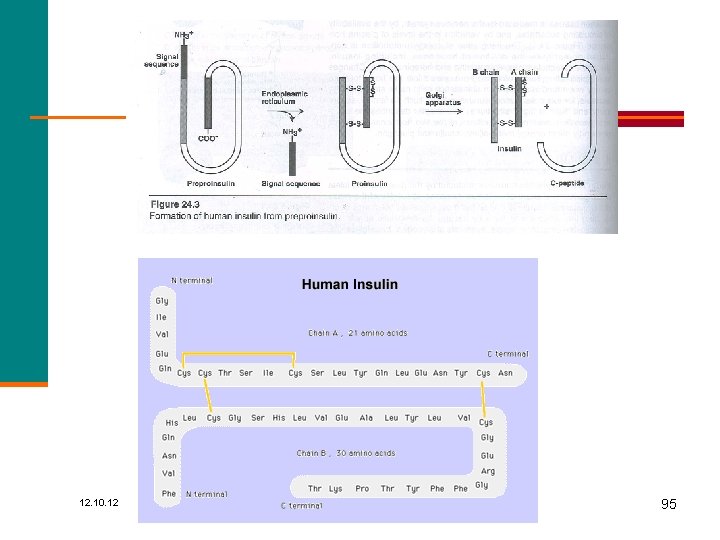
12. 10. 12 gluce 12. ppt 95
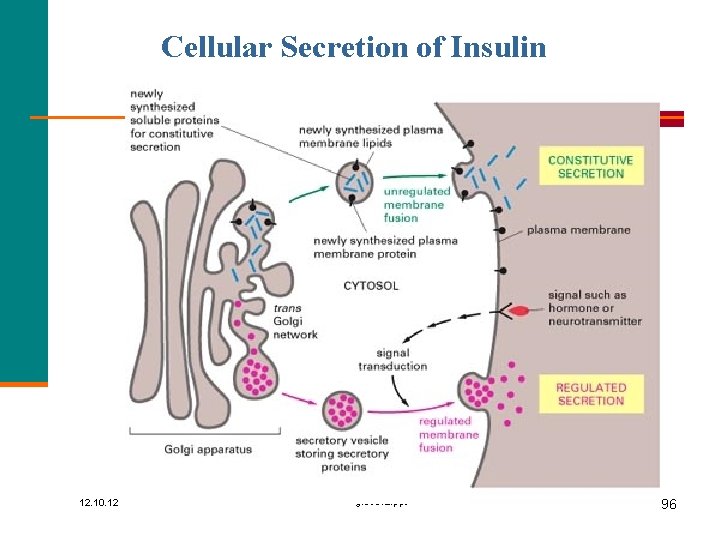
Cellular Secretion of Insulin 12. 10. 12 gluce 12. ppt 96
12. 10. 12 gluce 12. ppt 97
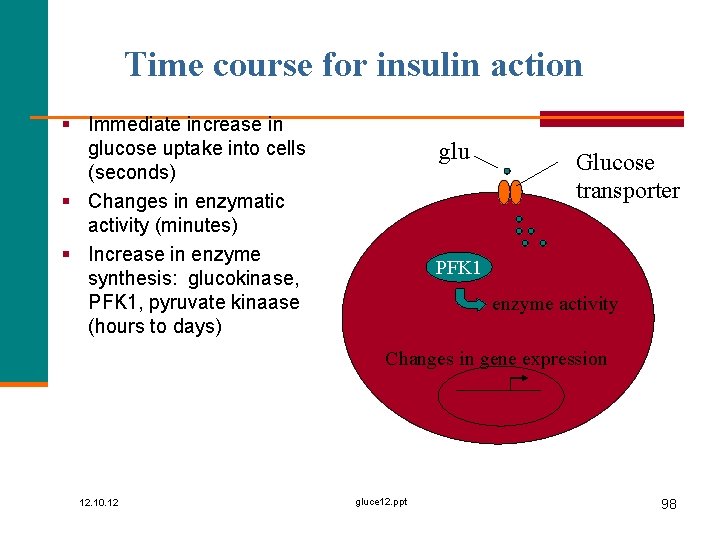
Time course for insulin action § Immediate increase in glucose uptake into cells (seconds) § Changes in enzymatic activity (minutes) § Increase in enzyme synthesis: glucokinase, PFK 1, pyruvate kinaase (hours to days) glu Glucose transporter PFK 1 enzyme activity Changes in gene expression 12. 10. 12 gluce 12. ppt 98
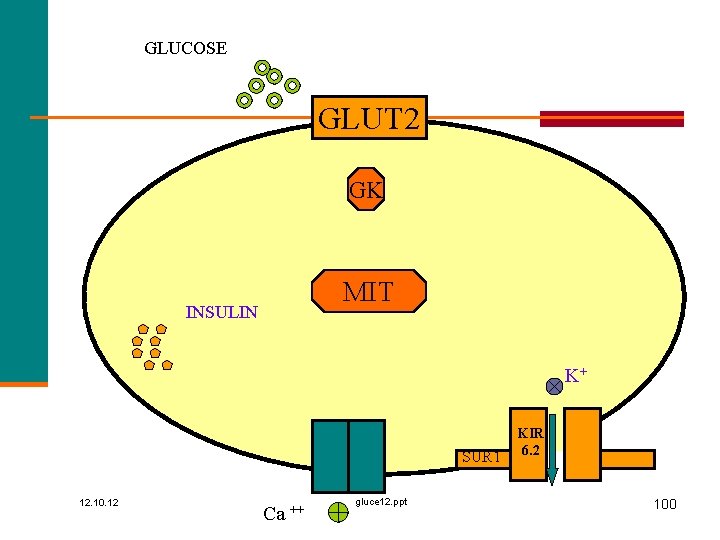
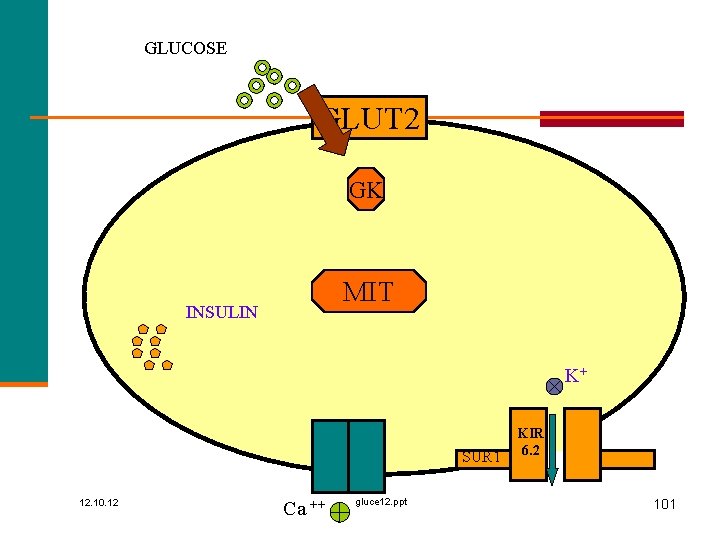
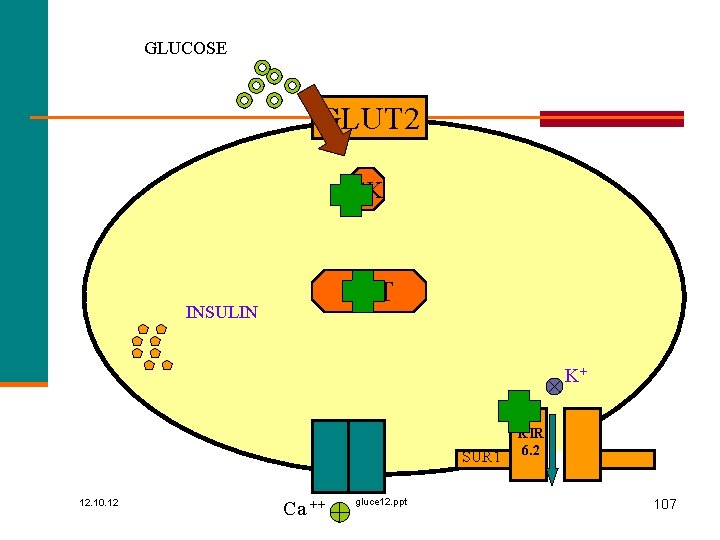
INSULIN SECRETION IN LANGERNAS ISLETS § § GLUT 2 – glucose transporter of B cells GK – glucokinase, glucose sensor MIT – mitochondriae, ATP production Kir 6. 2 -SUR 1 – Potassium inward rectifier channel (Kchannel) with receptorom for sulphanylurea 12. 10. 12 gluce 12. ppt 99
GLUCOSE GLUT 2 GK MIT INSULIN K+ SUR 1 12. 10. 12 Ca ++ gluce 12. ppt KIR 6. 2 100
GLUCOSE GLUT 2 GK MIT INSULIN K+ SUR 1 12. 10. 12 Ca ++ gluce 12. ppt KIR 6. 2 101
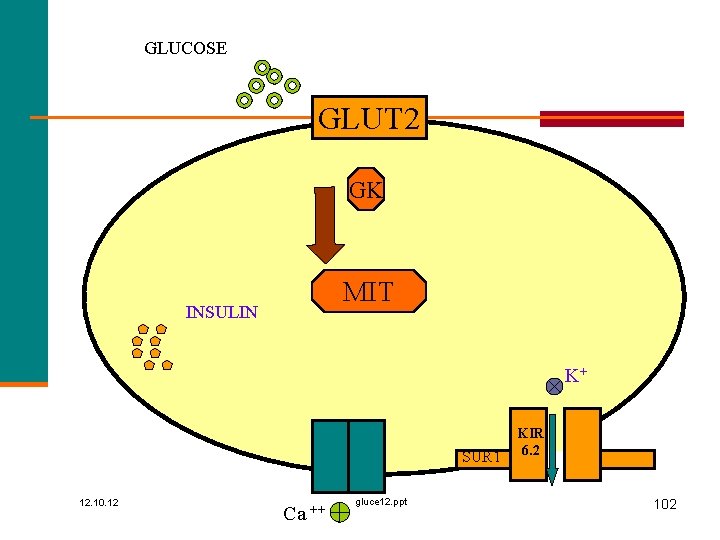
GLUCOSE GLUT 2 GK MIT INSULIN K+ SUR 1 12. 10. 12 Ca ++ gluce 12. ppt KIR 6. 2 102
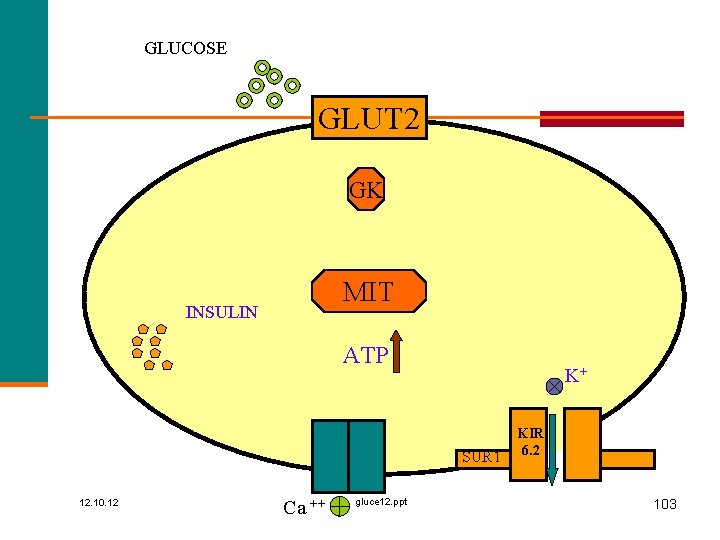
GLUCOSE GLUT 2 GK MIT INSULIN ATP K+ SUR 1 12. 10. 12 Ca ++ gluce 12. ppt KIR 6. 2 103
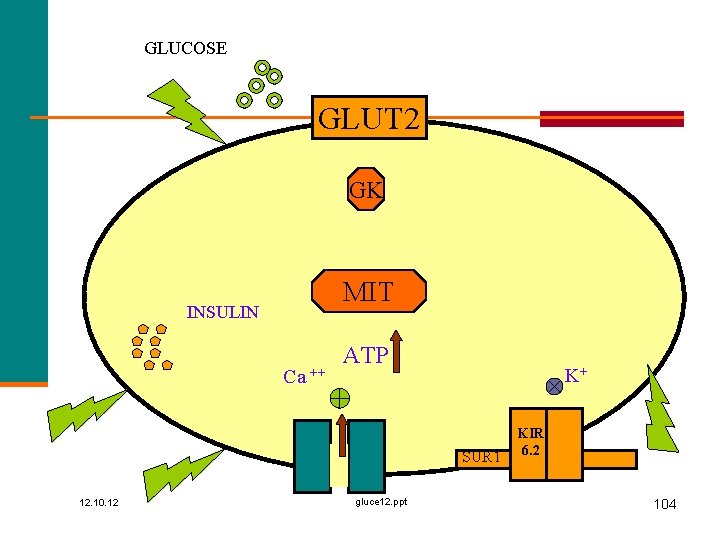
GLUCOSE GLUT 2 GK MIT INSULIN Ca ++ ATP K+ SUR 1 12. 10. 12 gluce 12. ppt KIR 6. 2 104
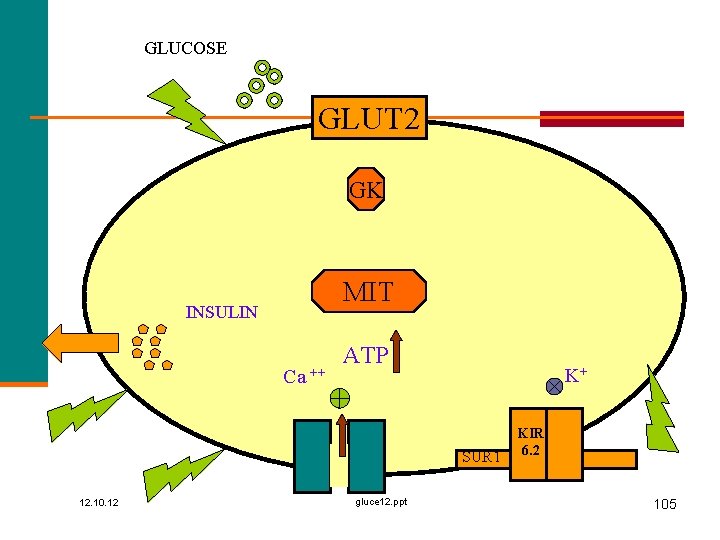
GLUCOSE GLUT 2 GK MIT INSULIN Ca ++ ATP K+ SUR 1 12. 10. 12 gluce 12. ppt KIR 6. 2 105
§ GLUT 2, GLUCOKINASE, MITOCHONDRIAE § Kir 6. 2 -SUR 1 – Potassium inward rectifier channel (Kchannel) n ATP INCREASE n CLOSING OF K-CHANNEL n MEMBRANE DEPOLARISATION n Ca++ ENTRY n INSULIN SECRETION 12. 10. 12 gluce 12. ppt 106
GLUCOSE GLUT 2 GK MIT INSULIN K+ SUR 1 12. 10. 12 Ca ++ gluce 12. ppt KIR 6. 2 107
Insulin and its antagonists § Glucagon – glycogen breakdown, gluconeogenesis glycolysis blockade in liver § Adrenaline, noradrenaline – glycogen breakdown and gluconeogenesis in muscles, lactate glucose in liver § Growth hormone (anabolic hormone), lipolysis, proteosynthesis § Glucocorticoids – gluconeogenesis, block of proteosynthesis § Thyroid hormones and oestrogens In physiological conditions synergism (counter-regulation) 12. 10. 12 gluce 12. ppt 108
Hyperglycemia = diabetes mellitus § No insulin (type 1 dm, removal of pancreas, etc. ) § Deficient action of insulin (type 2 dm) § Antagonists (glucocorticoids, adrenaline, growth hormone, gravidity) § Stress (MI, stroke) 12. 10. 12 gluce 12. ppt 109
Hypoglycemia = diabetes mellitus (? ) § Errors and mistakes in diabetes treatment § Increased insulin sensitivity (antagonist deficiency – m. Addison, panhypopituitarism) § Nondiabetic hypoglycemia (insulinoma, glycogenoses, liver failure) 12. 10. 12 gluce 12. ppt 110
Hypoglycemia – diff. dg. § Reactive & postalimentary hypoglycemia § Fasting organic hypoglycemia § Exogeneous hypoglycemia n in diabetics n in nondiabetics 12. 10. 12 gluce 12. ppt 111
Reactive & postalimentary § § Spontaneous after meal (ANS ? ) Dumping sy. (gastrectomy) Latent diabetes mellitus (? ? ? ) Fructose intolerance 12. 10. 12 gluce 12. ppt 112
Fasting organic § § § § Insulin producing tumors of L. I. Insulin (or like) producing extrapancreatic tumors Antagonist deficiency (m. Addison, hypopituitarism) Inborn errors of metabolism (pediatry) Malnutrition (severe) Liver and kidney failure Gravidity (? ? ? ) 12. 10. 12 gluce 12. ppt 113
Exogeneous § Mistakes and errors in insulin treatment n overdose, exercise, omitting of meal, insufficient education § Overdose of oral antidiabetics (sulfonylurea) § Alcohol (both in diabetics and nondiabetics) § Drugs (sulfonylurea like) 12. 10. 12 gluce 12. ppt 114
Regulation of carbohydrate metabolism
Glycolysis
Gluconeogenesis
Metabolism of glycogen
Overview of the major pathways of glucose metabolism
Regulation of enzymes: Types of regulations Mechanism Example Substrate concentration Saturation kinetics (Michaelis-Menten equation) Glucokinase (activation after a meal - high Km) Allosterically A conformational change after an allosteric activator binding Enzymes of glycolysis and gluconeogenesis (allosteric efectors: ATP, AMP, citrate) Covalent modification A conformational change after phosphorylation by a protein kinase Phosphorylation of glycogen synthase and glycogen phosphorylase (glucagon) Protein-protein interaction A conformational change after a modulator protein binding Muscle glycogen phosphorylase (activation by Ca 2+-calmodulin) Zymogen cleavage Activation by proteolysis of Blood clotting proteins a precursor molecule Enzyme synthesis Induction or represion of enzyme synthesis Enzymes of gluconeogenesis (induction during fasting)
Michaelis-Menten kinetics
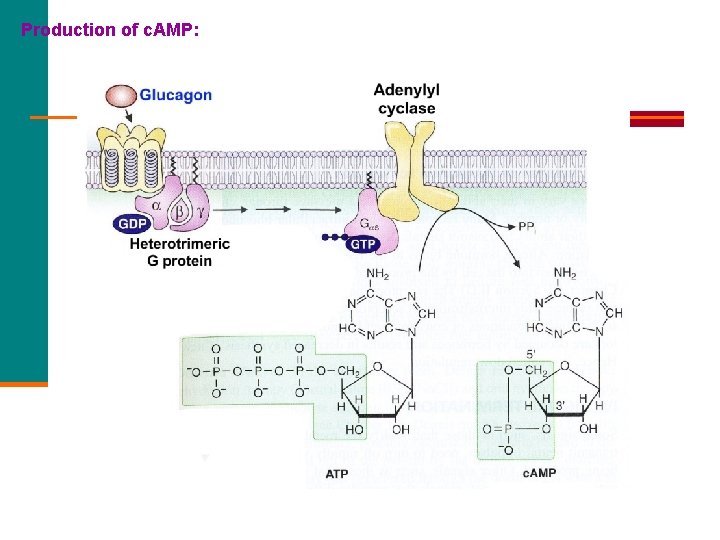
Production of c. AMP:
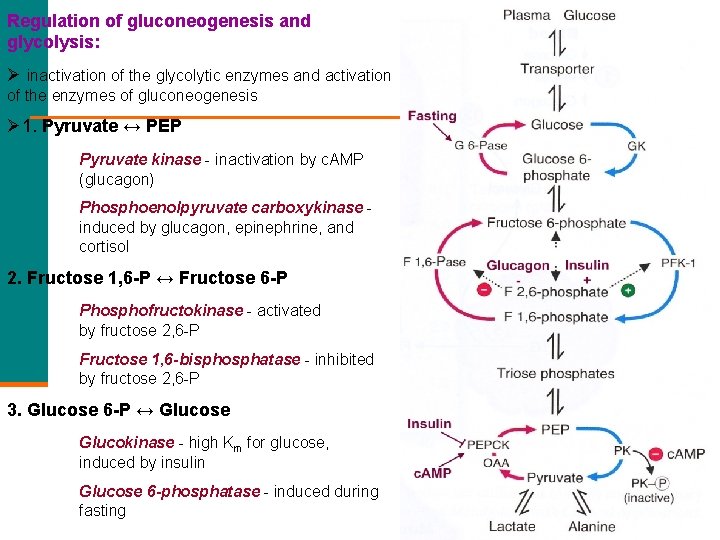
Regulation of gluconeogenesis and glycolysis: Ø inactivation of the glycolytic enzymes and activation of the enzymes of gluconeogenesis Ø 1. Pyruvate ↔ PEP Pyruvate kinase - inactivation by c. AMP (glucagon) Phosphoenolpyruvate carboxykinase induced by glucagon, epinephrine, and cortisol 2. Fructose 1, 6 -P ↔ Fructose 6 -P Phosphofructokinase - activated by fructose 2, 6 -P Fructose 1, 6 -bisphosphatase - inhibited by fructose 2, 6 -P 3. Glucose 6 -P ↔ Glucose Glucokinase - high Km for glucose, induced by insulin Glucose 6 -phosphatase - induced during fasting
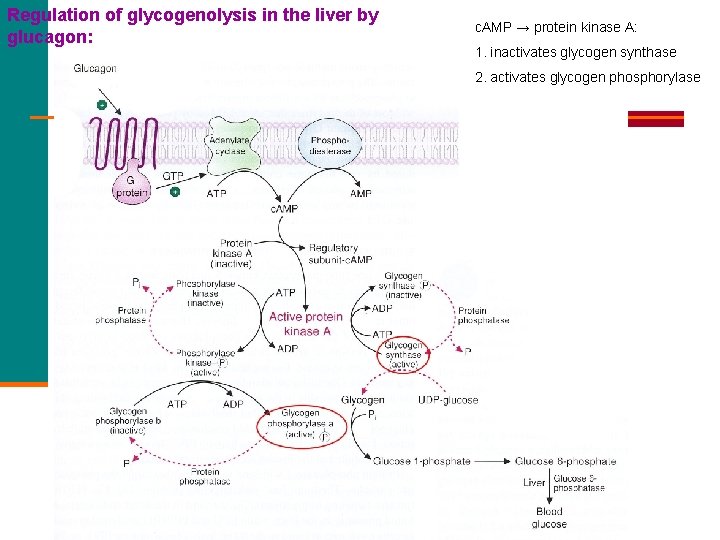
Regulation of glycogenolysis in the liver by glucagon: c. AMP → protein kinase A: 1. inactivates glycogen synthase 2. activates glycogen phosphorylase
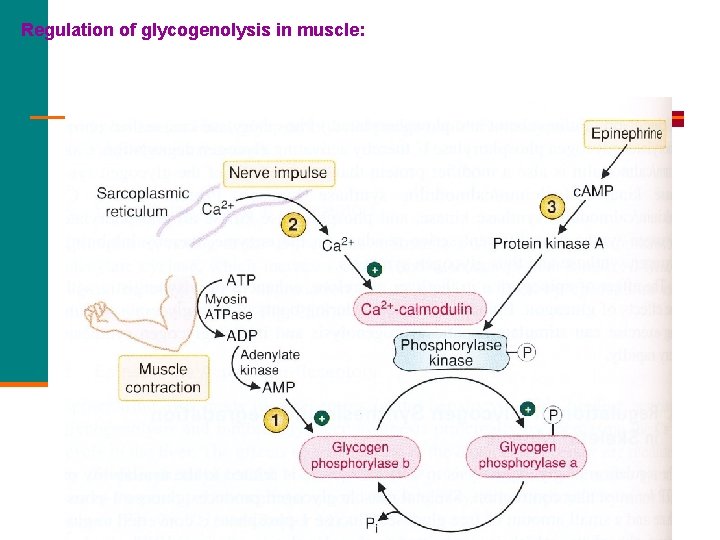
Regulation of glycogenolysis in muscle:
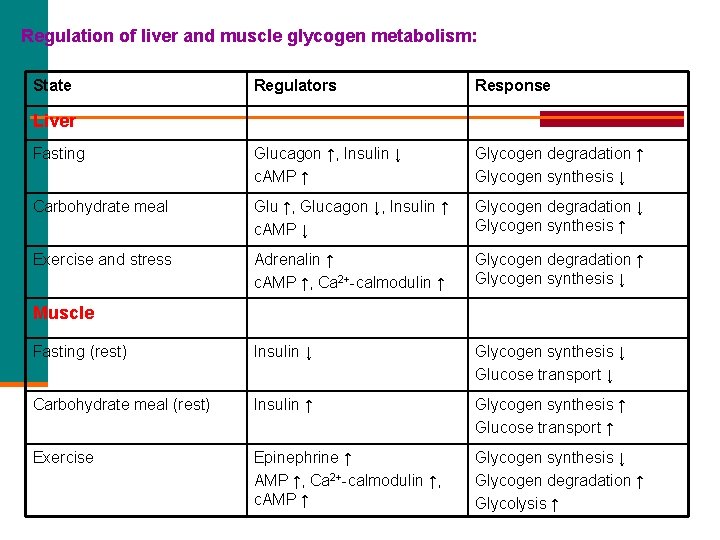
Regulation of liver and muscle glycogen metabolism: State Regulators Response Fasting Glucagon ↑, Insulin ↓ c. AMP ↑ Glycogen degradation ↑ Glycogen synthesis ↓ Carbohydrate meal Glu ↑, Glucagon ↓, Insulin ↑ c. AMP ↓ Glycogen degradation ↓ Glycogen synthesis ↑ Exercise and stress Adrenalin ↑ c. AMP ↑, Ca 2+-calmodulin ↑ Glycogen degradation ↑ Glycogen synthesis ↓ Fasting (rest) Insulin ↓ Glycogen synthesis ↓ Glucose transport ↓ Carbohydrate meal (rest) Insulin ↑ Glycogen synthesis ↑ Glucose transport ↑ Exercise Epinephrine ↑ AMP ↑, Ca 2+-calmodulin ↑, c. AMP ↑ Glycogen synthesis ↓ Glycogen degradation ↑ Glycolysis ↑ Liver Muscle
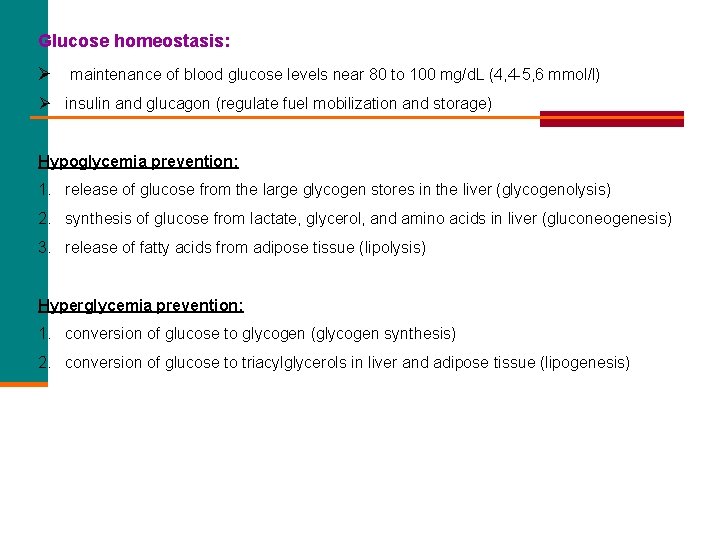
Glucose homeostasis: Ø maintenance of blood glucose levels near 80 to 100 mg/d. L (4, 4 -5, 6 mmol/l) Ø insulin and glucagon (regulate fuel mobilization and storage) Hypoglycemia prevention: 1. release of glucose from the large glycogen stores in the liver (glycogenolysis) 2. synthesis of glucose from lactate, glycerol, and amino acids in liver (gluconeogenesis) 3. release of fatty acids from adipose tissue (lipolysis) Hyperglycemia prevention: 1. conversion of glucose to glycogen (glycogen synthesis) 2. conversion of glucose to triacylglycerols in liver and adipose tissue (lipogenesis)
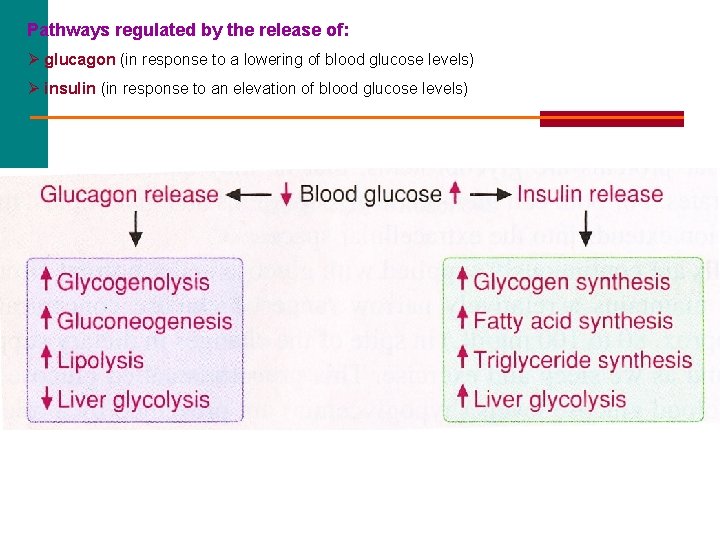
Pathways regulated by the release of: Ø glucagon (in response to a lowering of blood glucose levels) Ø insulin (in response to an elevation of blood glucose levels)
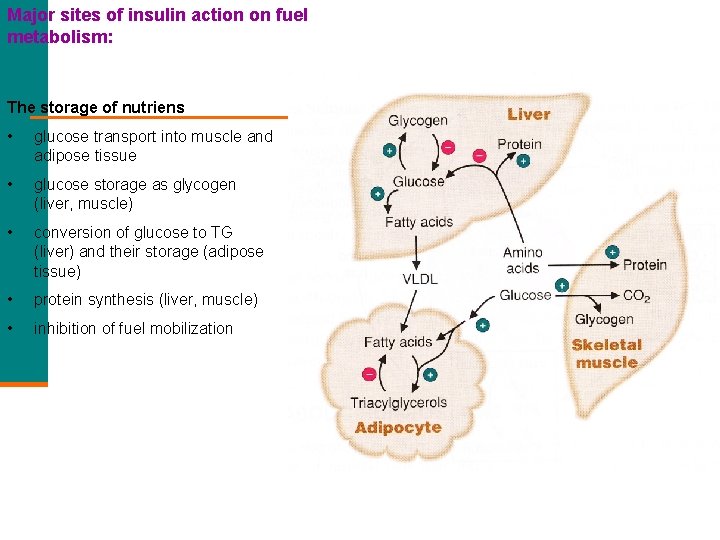
Major sites of insulin action on fuel metabolism: The storage of nutriens • glucose transport into muscle and adipose tissue • glucose storage as glycogen (liver, muscle) • conversion of glucose to TG (liver) and their storage (adipose tissue) • protein synthesis (liver, muscle) • inhibition of fuel mobilization
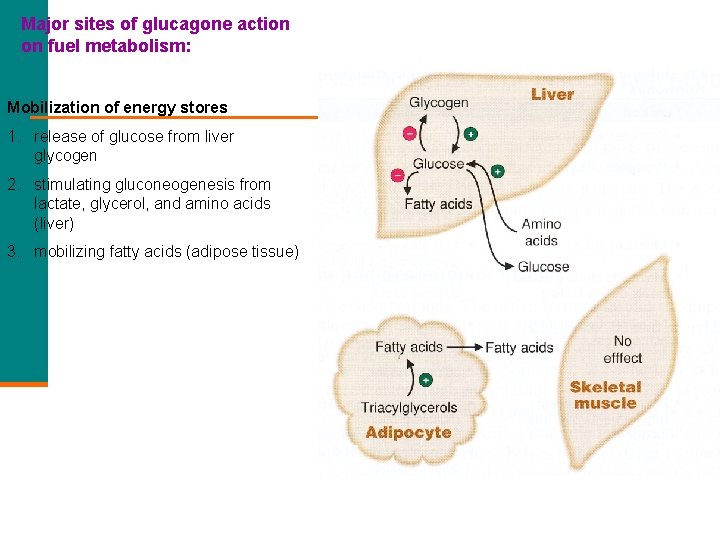
Major sites of glucagone action on fuel metabolism: Mobilization of energy stores 1. release of glucose from liver glycogen 2. stimulating gluconeogenesis from lactate, glycerol, and amino acids (liver) 3. mobilizing fatty acids (adipose tissue)
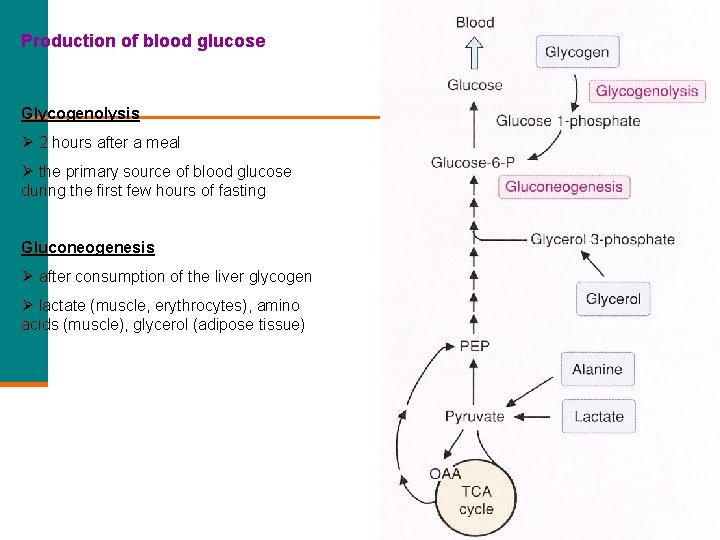
Production of blood glucose Glycogenolysis Ø 2 hours after a meal Ø the primary source of blood glucose during the first few hours of fasting Gluconeogenesis Ø after consumption of the liver glycogen Ø lactate (muscle, erythrocytes), amino acids (muscle), glycerol (adipose tissue)
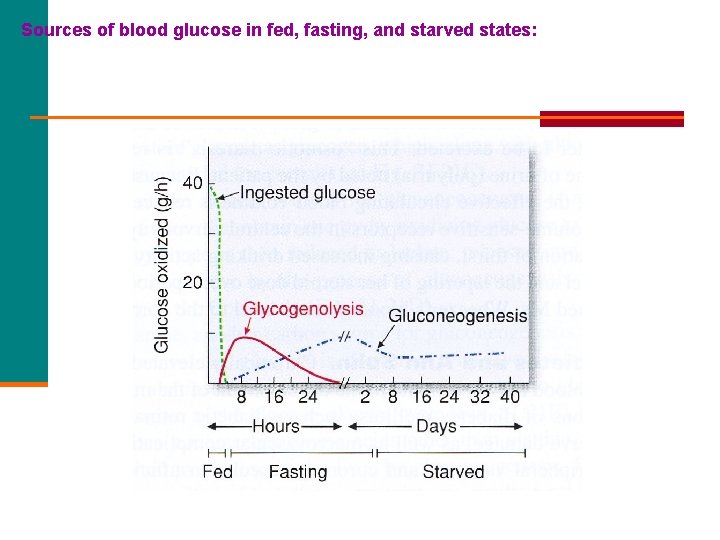
Sources of blood glucose in fed, fasting, and starved states:
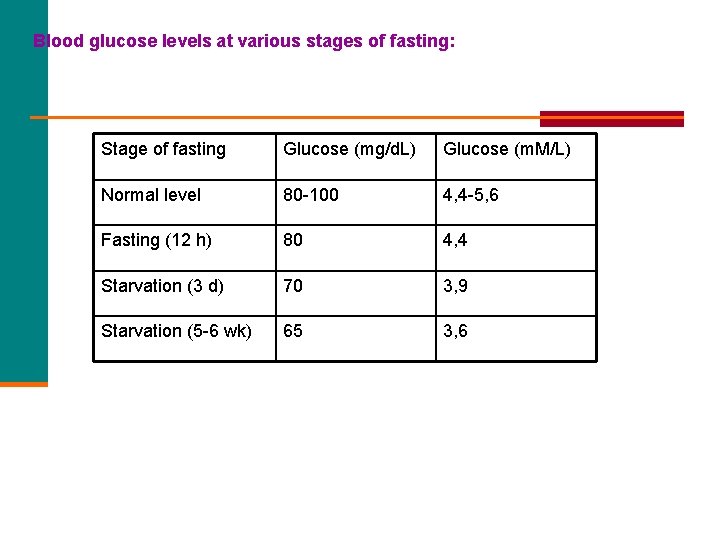
Blood glucose levels at various stages of fasting: Stage of fasting Glucose (mg/d. L) Glucose (m. M/L) Normal level 80 -100 4, 4 -5, 6 Fasting (12 h) 80 4, 4 Starvation (3 d) 70 3, 9 Starvation (5 -6 wk) 65 3, 6
Repetition: 1. 3 key enzymes for the regulation of glycolysis (their activation). The role of Fructose 2, 6 -P in the regulation of glycolysis and gluconeogenesis. 2. 3 key sites for the regulation of gluconeogenesis (their activation). 3. The signal pathway for the activation of glycogen degradation by glucagon. 4. Main regulators of glycogen degradation in liver and muscle. 5. Pathways preventing hypoglycemia and hyperglycemia.
Pictures used in the presentation: Marks´ Basic Medical Biochemistry, A Clinical Approach, third edition, 2009 (M. Lieberman, A. D. Marks)
- Slides: 135