
Cell Structure Function http koning ecsu ctstateu educell
- Slides: 31
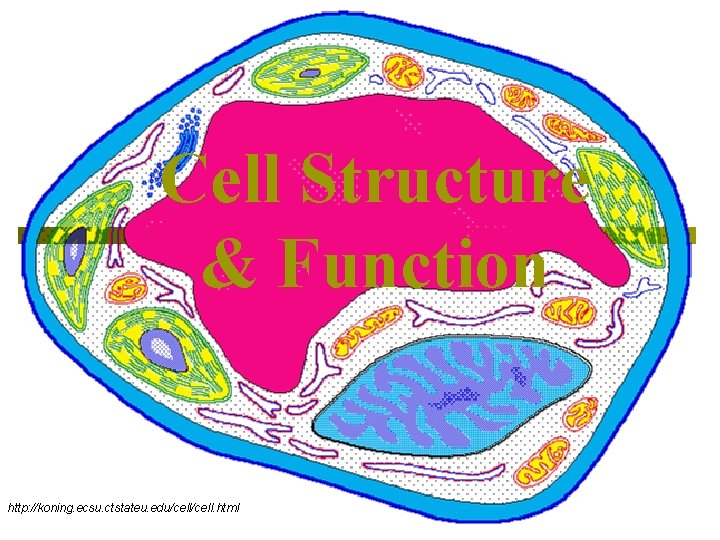
Cell Structure & Function http: //koning. ecsu. ctstateu. edu/cell. html
Cell Theory p. All living things are made up of cells. p. Cells are the smallest working units of all living things. p. All cells come from preexisting cells through cell division.
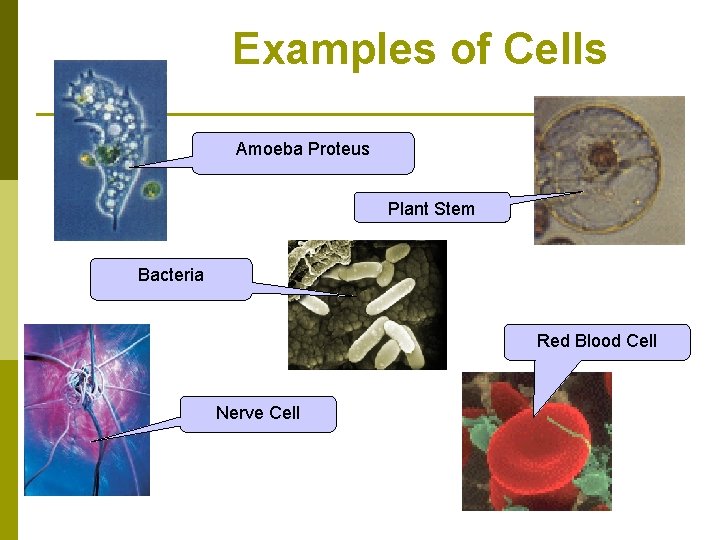
Examples of Cells Amoeba Proteus Plant Stem Bacteria Red Blood Cell Nerve Cell
Two Types of Cells p. Prokaryotic p. Eukaryotic
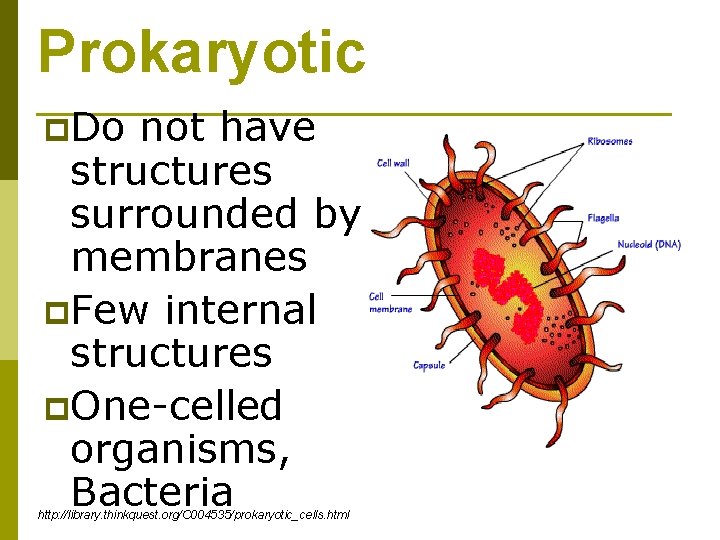
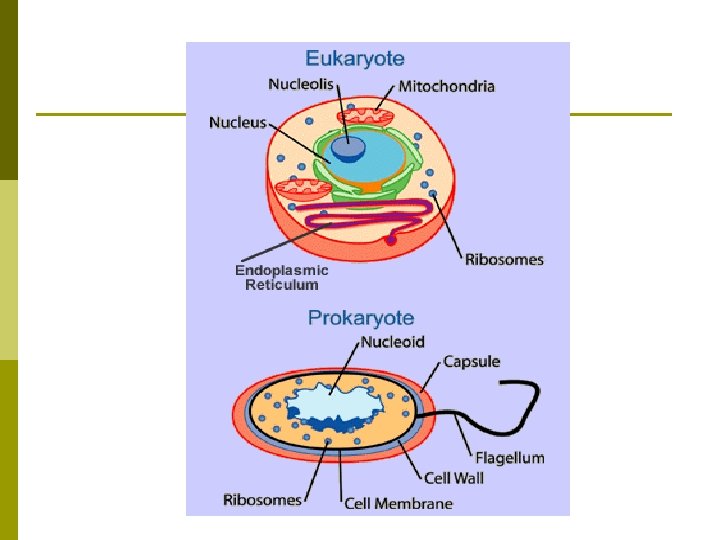
Prokaryotic p. Do not have structures surrounded by membranes p. Few internal structures p. One-celled organisms, Bacteria http: //library. thinkquest. org/C 004535/prokaryotic_cells. html
p 1—No nucleus. p 2—DNA in bacteria are one long, circular molecule that is shaped like a rubber band. p 3—Bacterial cells contain a cell wall and a cell membrane. p 4—First type of cell on Earth probably 3. 5 billion years ago.
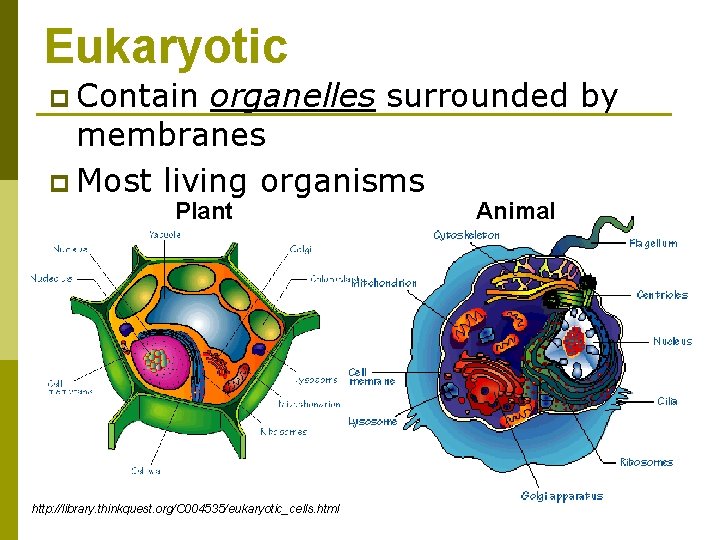
Eukaryotic p Contain organelles surrounded by membranes p Most living organisms Plant http: //library. thinkquest. org/C 004535/eukaryotic_cells. html Animal
p 1— 10 times larger than prokaryotes. p 2—All living things that are not bacteria are made of one or more eukaryotic cells. p 3—Contain more DNA than prokaryotic cell and DNA is formed in lines (linear). p 4—Some have both cell walls and cell membranes.
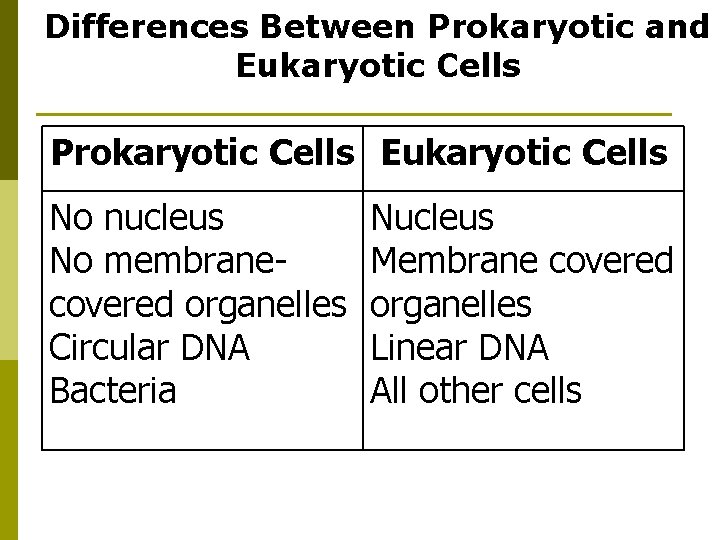
Differences Between Prokaryotic and Eukaryotic Cells Prokaryotic Cells Eukaryotic Cells No nucleus No membranecovered organelles Circular DNA Bacteria Nucleus Membrane covered organelles Linear DNA All other cells
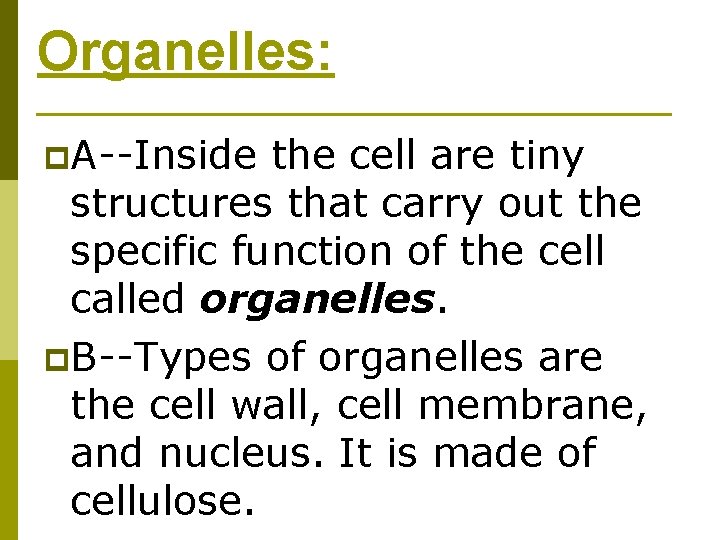
Organelles: p. A--Inside the cell are tiny structures that carry out the specific function of the cell called organelles. p. B--Types of organelles are the cell wall, cell membrane, and nucleus. It is made of cellulose.
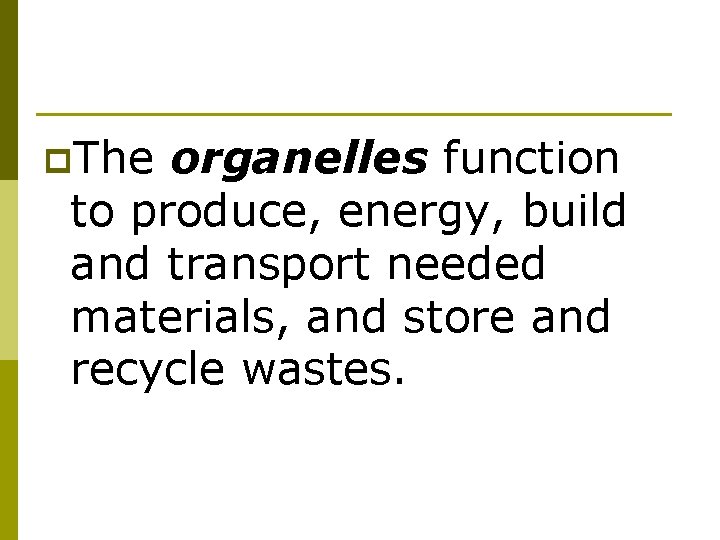
p. The organelles function to produce, energy, build and transport needed materials, and store and recycle wastes.
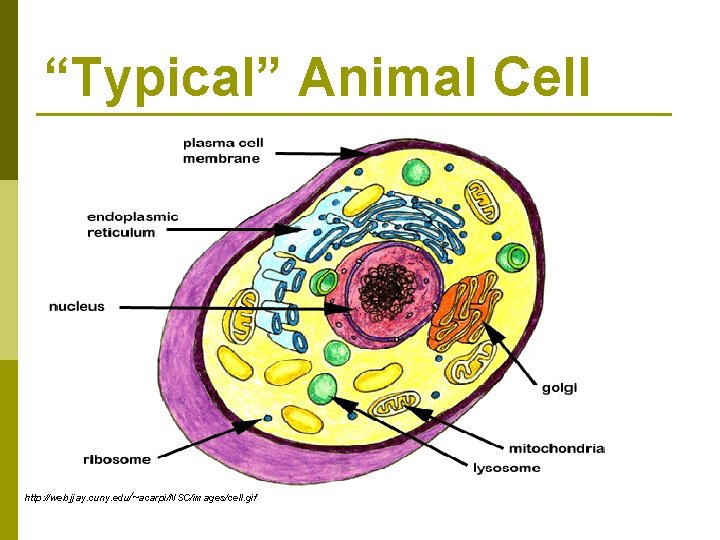
“Typical” Animal Cell http: //web. jjay. cuny. edu/~acarpi/NSC/images/cell. gif
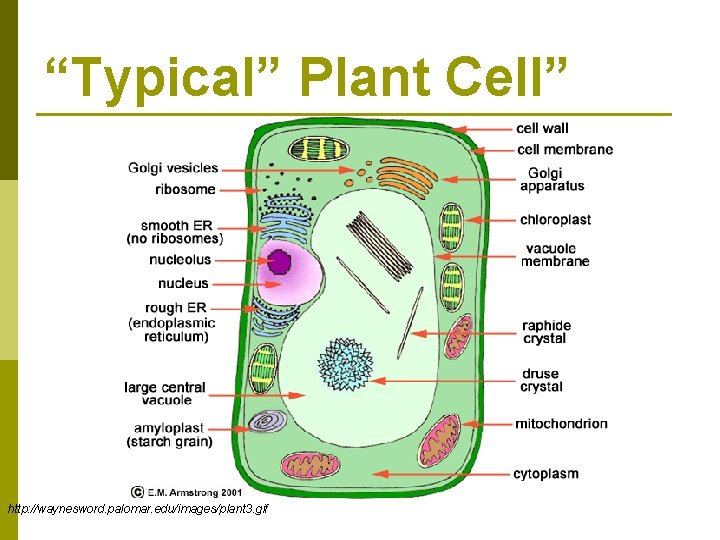
“Typical” Plant Cell” http: //waynesword. palomar. edu/images/plant 3. gif
Cell Parts Organelles
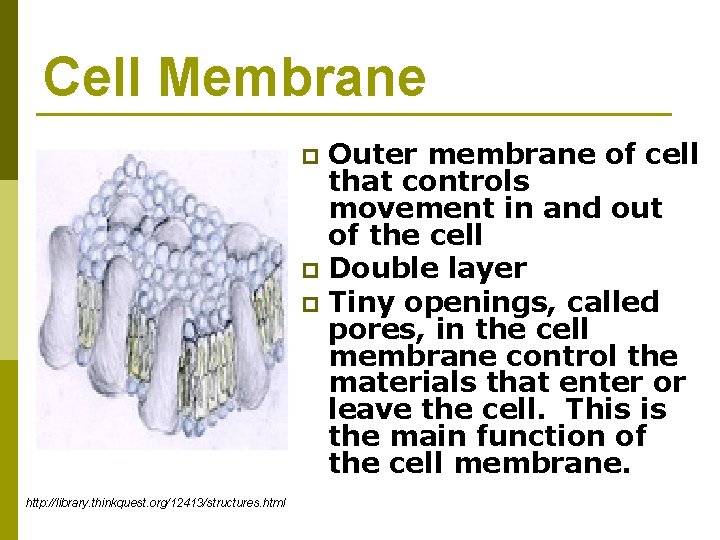
Cell Membrane Outer membrane of cell that controls movement in and out of the cell p Double layer p Tiny openings, called pores, in the cell membrane control the materials that enter or leave the cell. This is the main function of the cell membrane. p http: //library. thinkquest. org/12413/structures. html
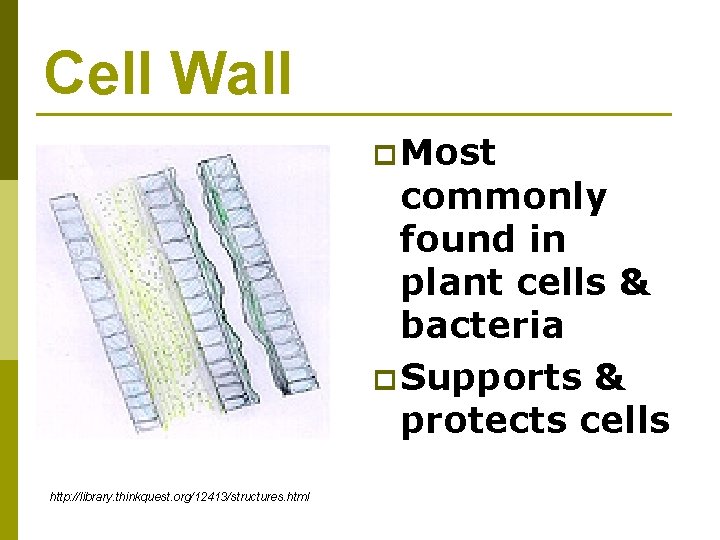
Cell Wall p Most commonly found in plant cells & bacteria p Supports & protects cells http: //library. thinkquest. org/12413/structures. html
Inside the Cell
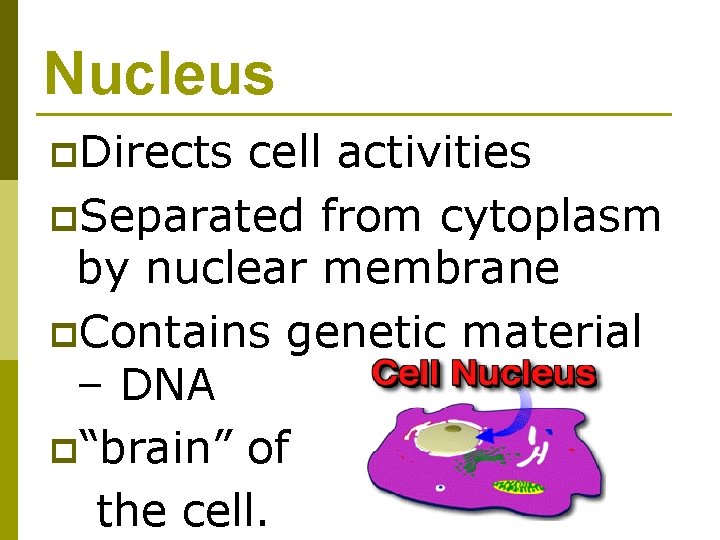
Nucleus p. Directs cell activities p. Separated from cytoplasm by nuclear membrane p. Contains genetic material – DNA p“brain” of the cell.
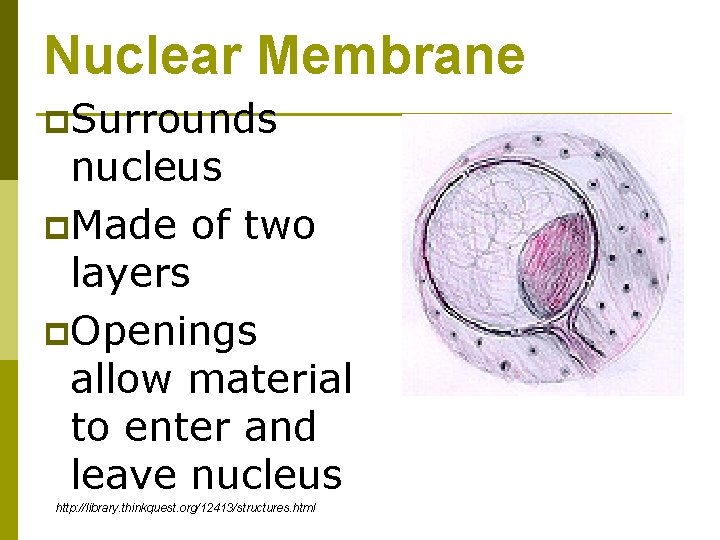
Nuclear Membrane p. Surrounds nucleus p. Made of two layers p. Openings allow material to enter and leave nucleus http: //library. thinkquest. org/12413/structures. html
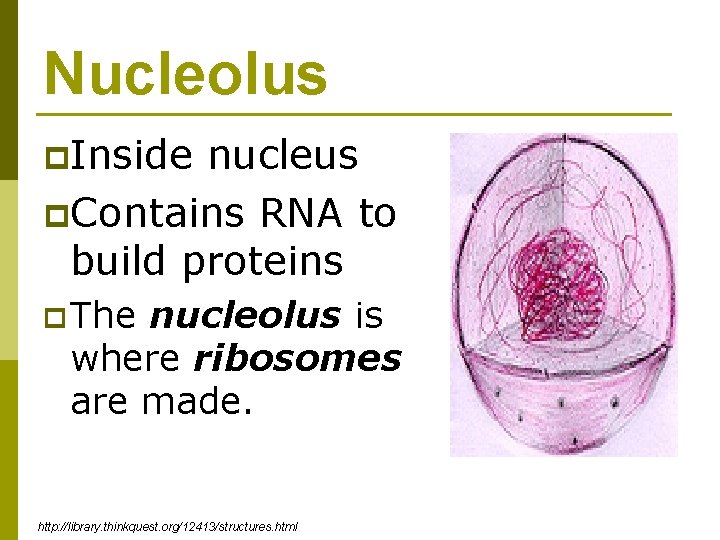
Nucleolus p. Inside nucleus p. Contains RNA to build proteins p The nucleolus is where ribosomes are made. http: //library. thinkquest. org/12413/structures. html
Cytoplasm p. Gel-like mixture p. Surrounded by cell membrane p. Contains hereditary material p. The area between the cell membrane and the
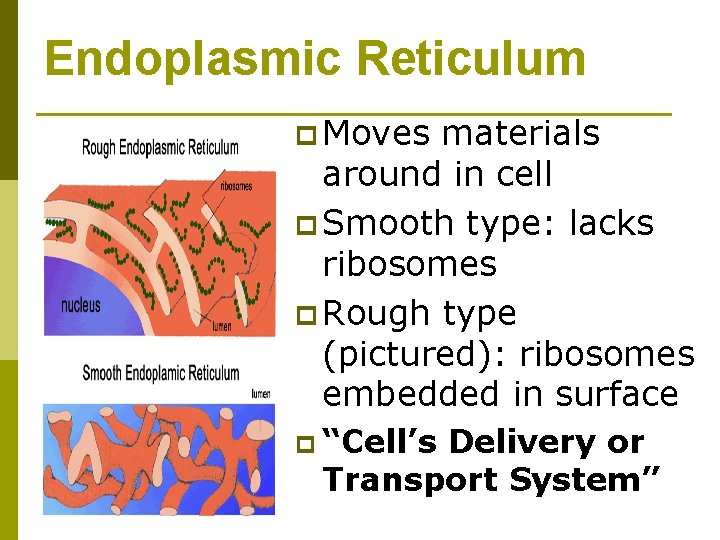
Endoplasmic Reticulum p Moves materials around in cell p Smooth type: lacks ribosomes p Rough type (pictured): ribosomes embedded in surface p “Cell’s Delivery or Transport System”
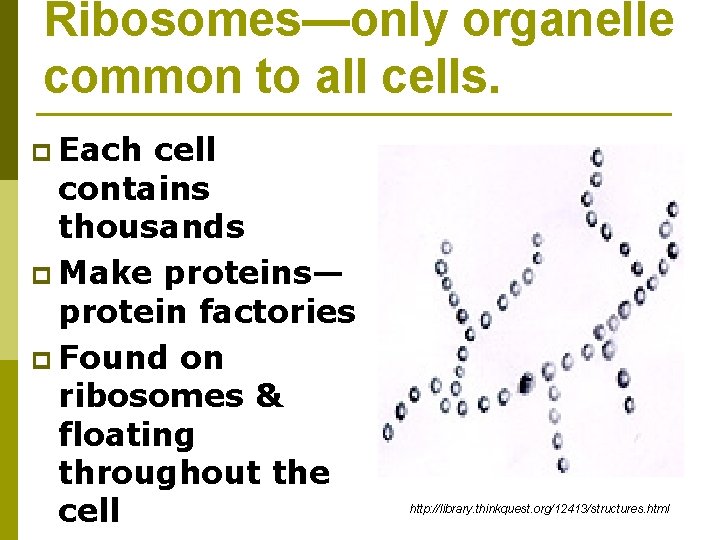
Ribosomes—only organelle common to all cells. p Each cell contains thousands p Make proteins— protein factories p Found on ribosomes & floating throughout the cell http: //library. thinkquest. org/12413/structures. html
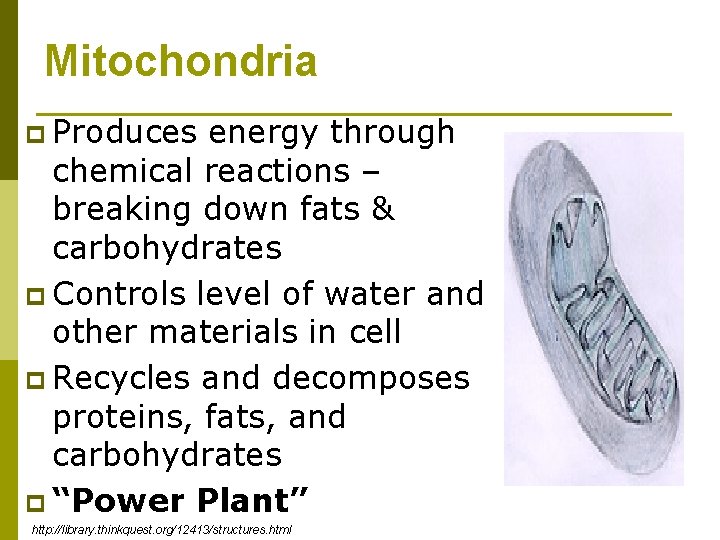
Mitochondria p Produces energy through chemical reactions – breaking down fats & carbohydrates p Controls level of water and other materials in cell p Recycles and decomposes proteins, fats, and carbohydrates p “Power Plant” http: //library. thinkquest. org/12413/structures. html
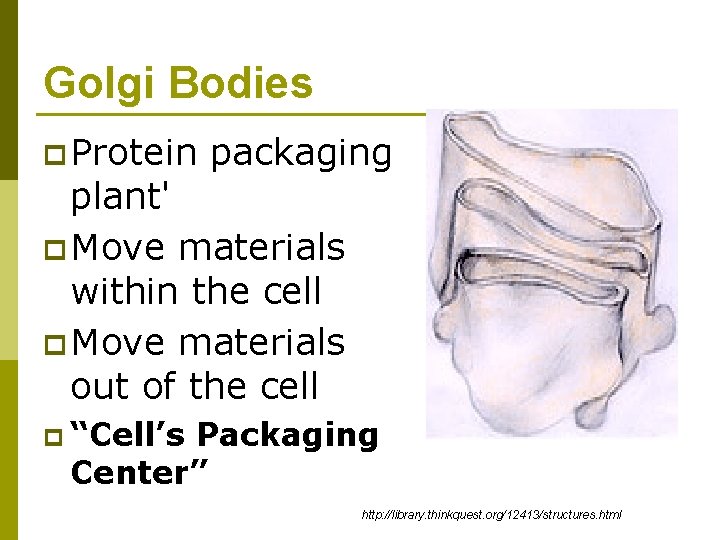
Golgi Bodies p Protein packaging plant' p Move materials within the cell p Move materials out of the cell p “Cell’s Packaging Center” http: //library. thinkquest. org/12413/structures. html
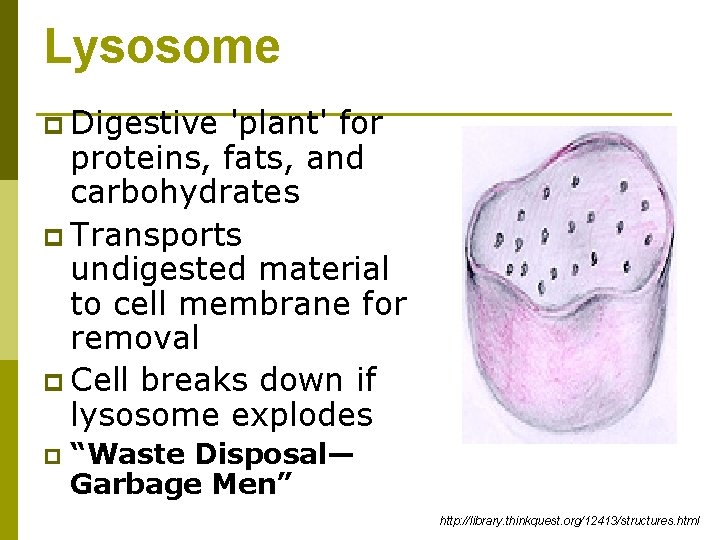
Lysosome p Digestive 'plant' for proteins, fats, and carbohydrates p Transports undigested material to cell membrane for removal p Cell breaks down if lysosome explodes p “Waste Disposal— Garbage Men” http: //library. thinkquest. org/12413/structures. html
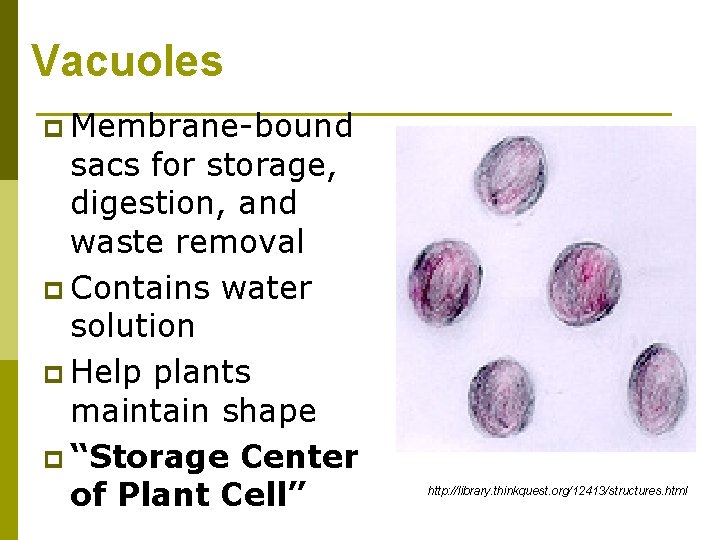
Vacuoles p Membrane-bound sacs for storage, digestion, and waste removal p Contains water solution p Help plants maintain shape p “Storage Center of Plant Cell” http: //library. thinkquest. org/12413/structures. html
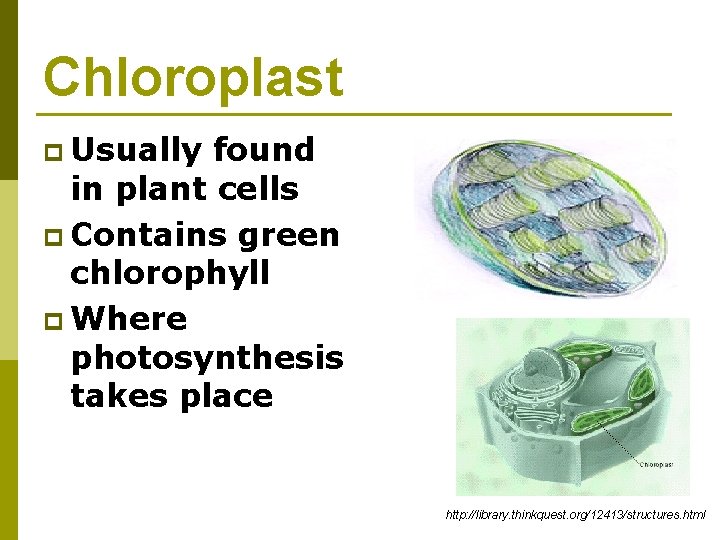
Chloroplast p Usually found in plant cells p Contains green chlorophyll p Where photosynthesis takes place http: //library. thinkquest. org/12413/structures. html
p. Plant cells have organelles that animal cells do not: a cell wall, chloroplasts and a large vacuole (animal cells have a small one).
DOL Investigation 4 Part 2 p. In this activity you will study the lives of cells more closely.