
CELL STRUCTURE FUNCTION Chapter 3 To see cells
- Slides: 27
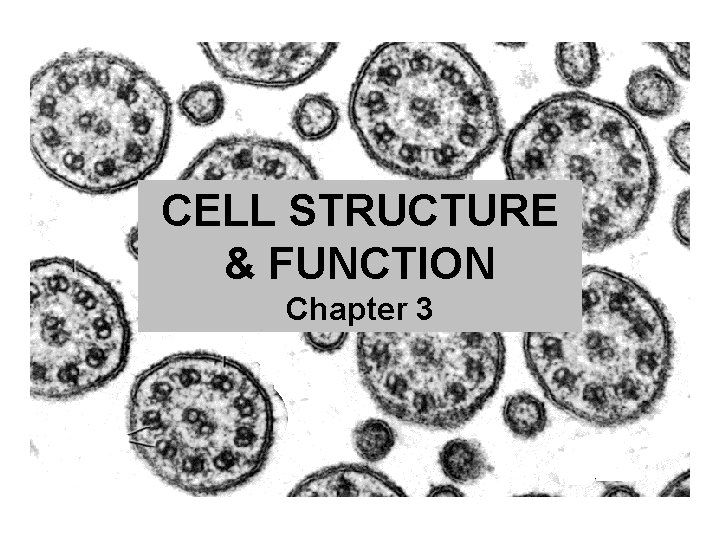
CELL STRUCTURE & FUNCTION Chapter 3
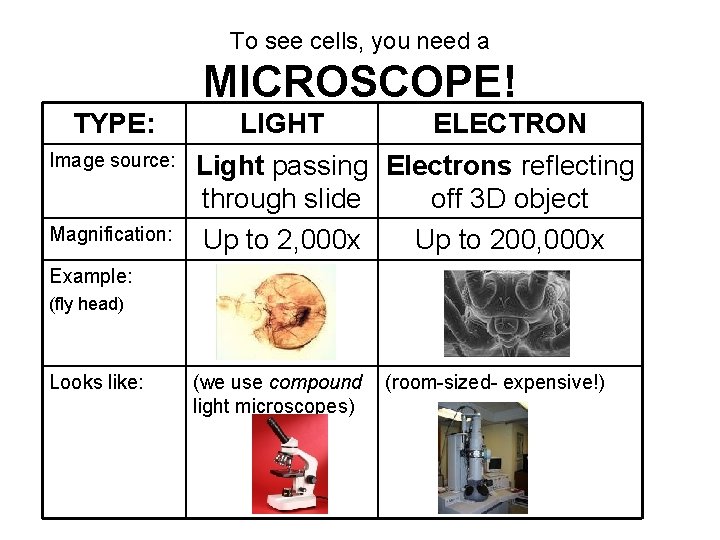
To see cells, you need a MICROSCOPE! TYPE: Image source: Magnification: LIGHT ELECTRON Light passing Electrons reflecting through slide off 3 D object Up to 2, 000 x Up to 200, 000 x Example: (fly head) Looks like: (we use compound light microscopes) (room-sized- expensive!)
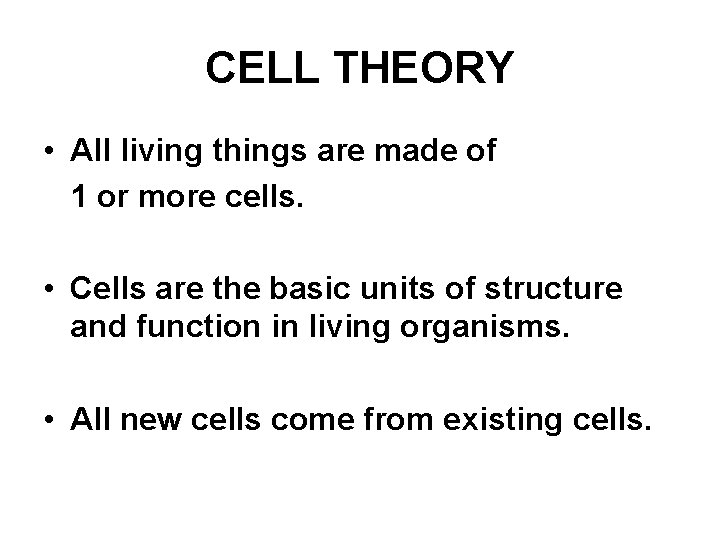
CELL THEORY • All living things are made of 1 or more cells. • Cells are the basic units of structure and function in living organisms. • All new cells come from existing cells.
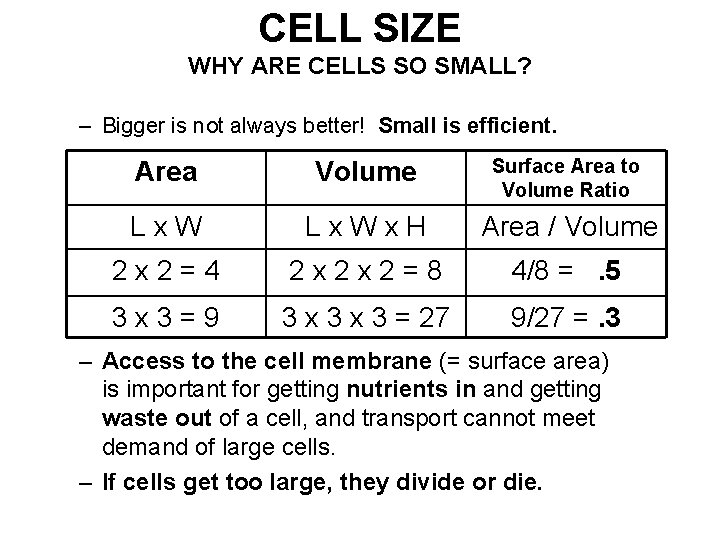
CELL SIZE WHY ARE CELLS SO SMALL? – Bigger is not always better! Small is efficient. Area Volume Surface Area to Volume Ratio Lx. Wx. H Area / Volume 2 x 2=4 2 x 2 x 2=8 4/8 =. 5 3 x 3=9 3 x 3 = 27 9/27 =. 3 – Access to the cell membrane (= surface area) is important for getting nutrients in and getting waste out of a cell, and transport cannot meet demand of large cells. – If cells get too large, they divide or die.
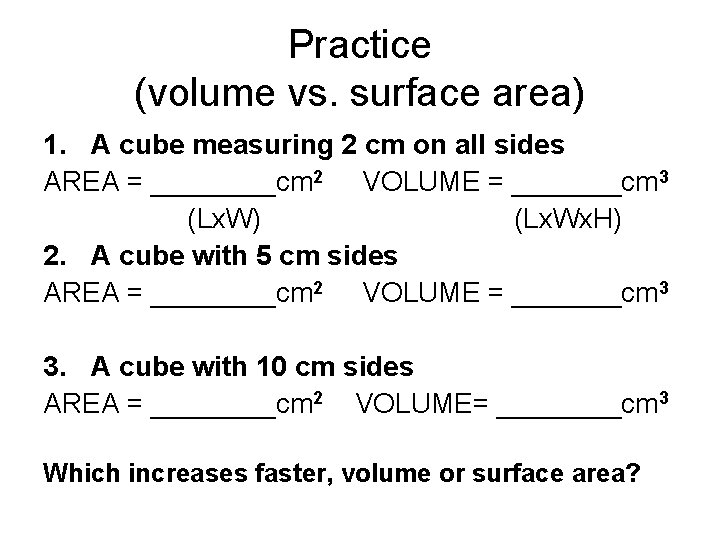
Practice (volume vs. surface area) 1. A cube measuring 2 cm on all sides AREA = ____cm 2 VOLUME = _______cm 3 (Lx. W) (Lx. Wx. H) 2. A cube with 5 cm sides AREA = ____cm 2 VOLUME = _______cm 3 3. A cube with 10 cm sides AREA = ____cm 2 VOLUME= ____cm 3 Which increases faster, volume or surface area?
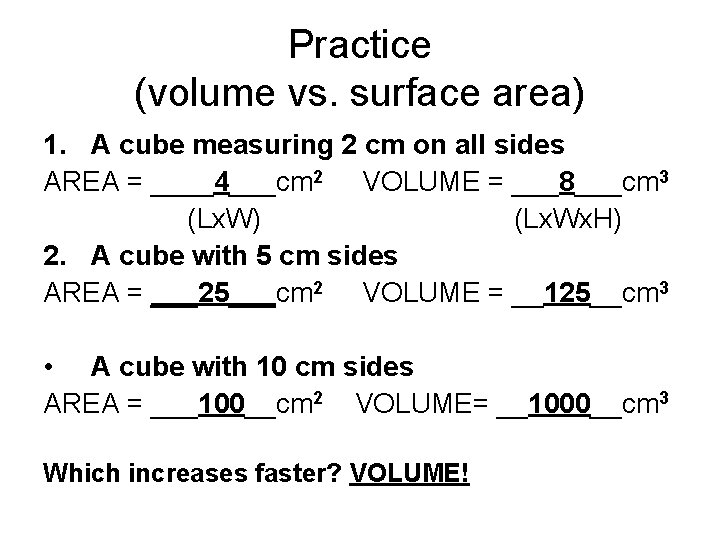
Practice (volume vs. surface area) 1. A cube measuring 2 cm on all sides AREA = ____4___cm 2 VOLUME = ___8___cm 3 (Lx. W) (Lx. Wx. H) 2. A cube with 5 cm sides AREA = ___25___cm 2 VOLUME = __125__cm 3 • A cube with 10 cm sides AREA = ___100__cm 2 VOLUME= __1000__cm 3 Which increases faster? VOLUME!
Another Example:
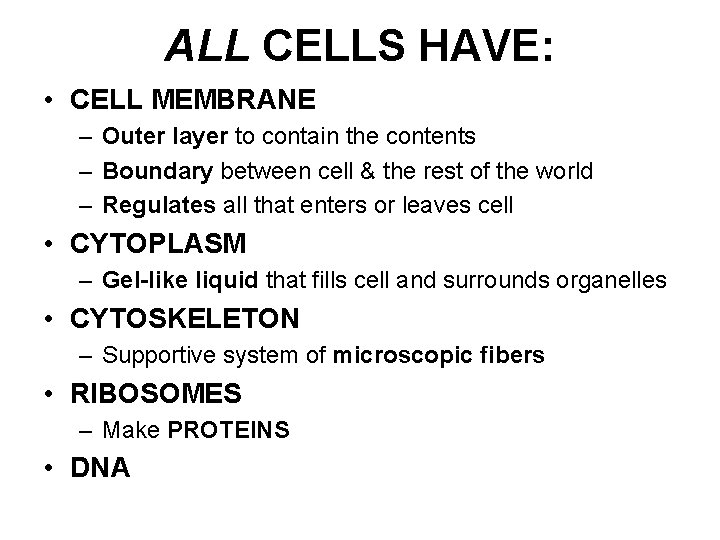
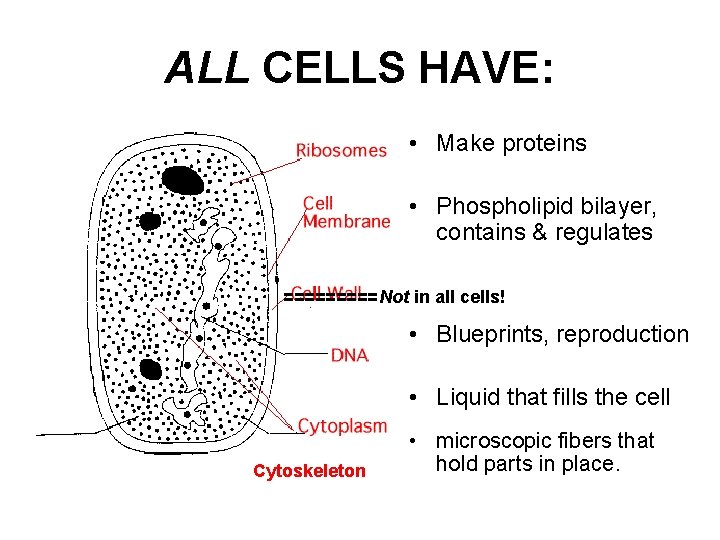
ALL CELLS HAVE: • CELL MEMBRANE – Outer layer to contain the contents – Boundary between cell & the rest of the world – Regulates all that enters or leaves cell • CYTOPLASM – Gel-like liquid that fills cell and surrounds organelles • CYTOSKELETON – Supportive system of microscopic fibers • RIBOSOMES – Make PROTEINS • DNA
ALL CELLS HAVE: • Make proteins • Phospholipid bilayer, contains & regulates ===== Not in all cells! • Blueprints, reproduction • Liquid that fills the cell Cytoskeleton • microscopic fibers that hold parts in place.
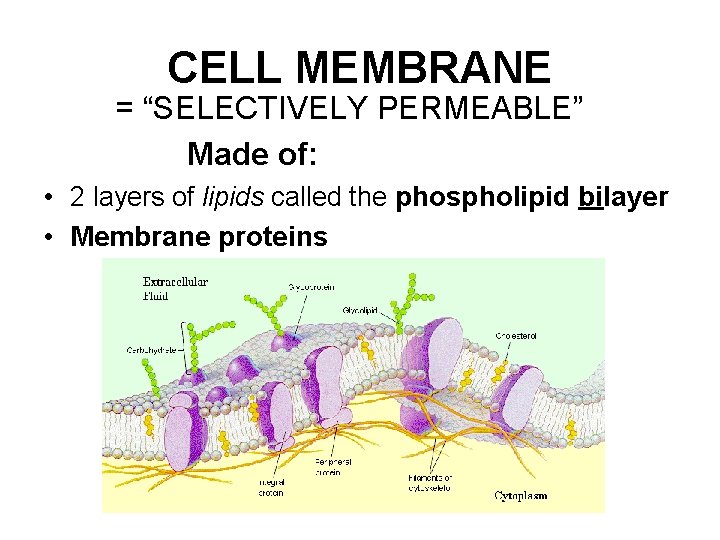
CELL MEMBRANE = “SELECTIVELY PERMEABLE” Made of: • 2 layers of lipids called the phospholipid bilayer • Membrane proteins
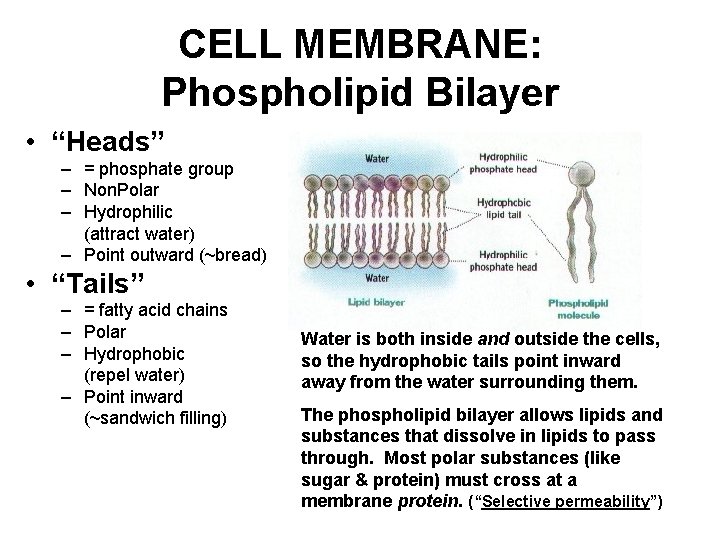
CELL MEMBRANE: Phospholipid Bilayer • “Heads” – = phosphate group – Non. Polar – Hydrophilic (attract water) – Point outward (~bread) • “Tails” – = fatty acid chains – Polar – Hydrophobic (repel water) – Point inward (~sandwich filling) Water is both inside and outside the cells, so the hydrophobic tails point inward away from the water surrounding them. The phospholipid bilayer allows lipids and substances that dissolve in lipids to pass through. Most polar substances (like sugar & protein) must cross at a membrane protein. (“Selective permeability”)
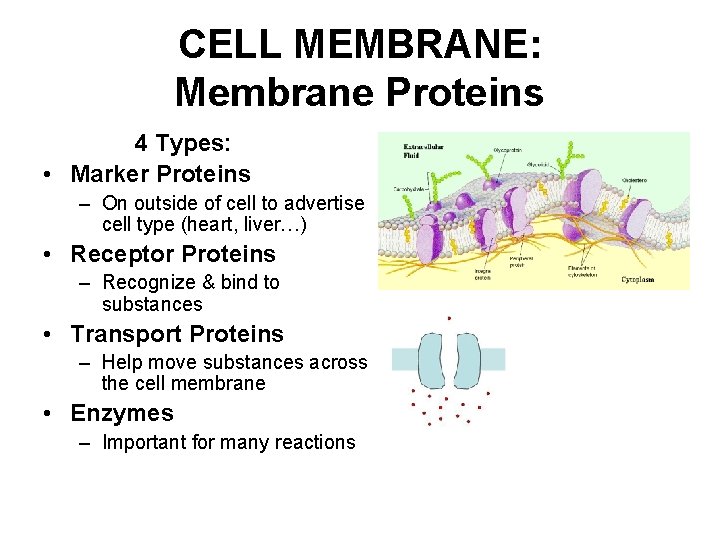
CELL MEMBRANE: Membrane Proteins 4 Types: • Marker Proteins – On outside of cell to advertise cell type (heart, liver…) • Receptor Proteins – Recognize & bind to substances • Transport Proteins – Help move substances across the cell membrane • Enzymes – Important for many reactions
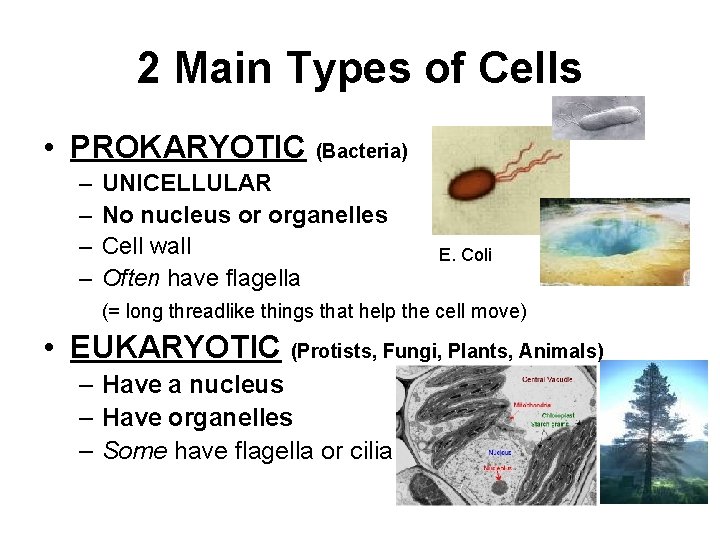
2 Main Types of Cells • PROKARYOTIC (Bacteria) – – UNICELLULAR No nucleus or organelles Cell wall Often have flagella E. Coli (= long threadlike things that help the cell move) • EUKARYOTIC (Protists, Fungi, Plants, Animals) – Have a nucleus – Have organelles – Some have flagella or cilia
ORGANELLES • The organs in your body (heart, lungs, liver. . . ) are each separate and have their own roles, but they all must work together for your body to be alive and healthy. • ORGANELLES are like the organs of your cells. They are parts of the cell that: – each have a specific function – are separated from the rest of the cell by a membrane – Must all work together for a healthy functional cell
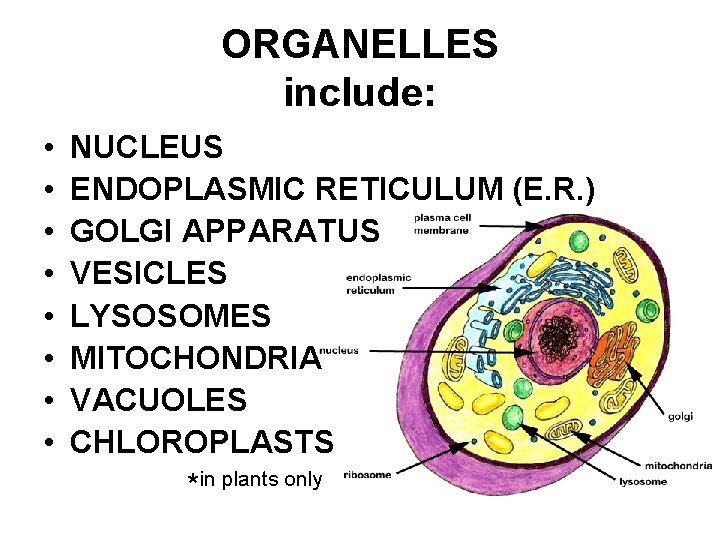
ORGANELLES include: • • NUCLEUS ENDOPLASMIC RETICULUM (E. R. ) GOLGI APPARATUS VESICLES LYSOSOMES MITOCHONDRIA VACUOLES CHLOROPLASTS *in plants only
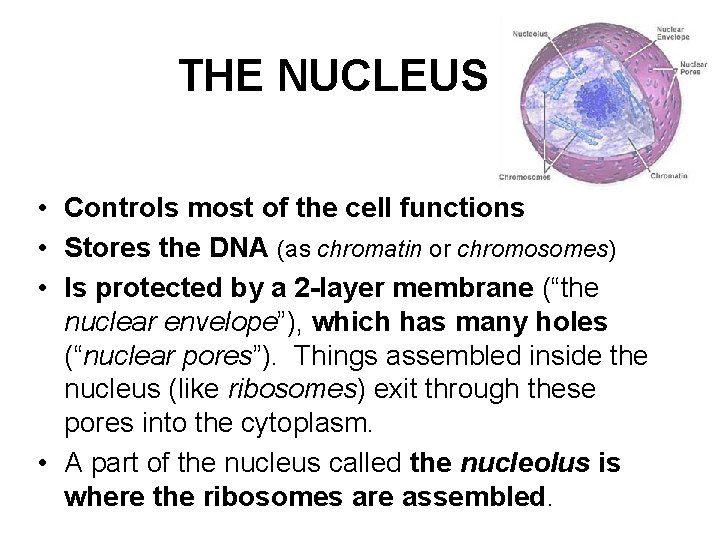
THE NUCLEUS • Controls most of the cell functions • Stores the DNA (as chromatin or chromosomes) • Is protected by a 2 -layer membrane (“the nuclear envelope”), which has many holes (“nuclear pores”). Things assembled inside the nucleus (like ribosomes) exit through these pores into the cytoplasm. • A part of the nucleus called the nucleolus is where the ribosomes are assembled.
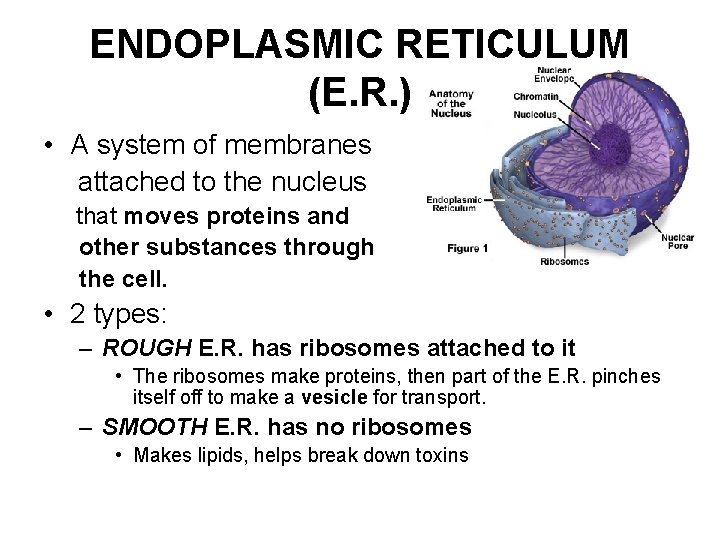
ENDOPLASMIC RETICULUM (E. R. ) • A system of membranes attached to the nucleus that moves proteins and other substances through the cell. • 2 types: – ROUGH E. R. has ribosomes attached to it • The ribosomes make proteins, then part of the E. R. pinches itself off to make a vesicle for transport. – SMOOTH E. R. has no ribosomes • Makes lipids, helps break down toxins
Journey of a Protein So, the ribosomes on the rough E. R. made some protein. Then the Endoplasmic Reticulum pinched off a bit of itself to make a vesicle. Like a little space pod, with protein as it’s cargo, the vesicle hurls through the cell’s cytoplasm until it reaches… THE GOLGI APPARATUS
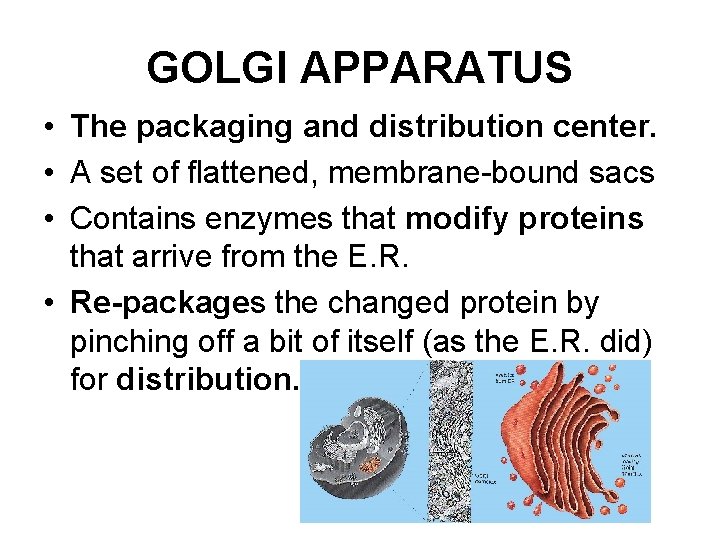
GOLGI APPARATUS • The packaging and distribution center. • A set of flattened, membrane-bound sacs • Contains enzymes that modify proteins that arrive from the E. R. • Re-packages the changed protein by pinching off a bit of itself (as the E. R. did) for distribution.
Journey of a Protein continued So, the protein (originally made by the ribosomes) traveled within the vesicle ship (made of E. R. membranes) & finally reached THE GOLGI APPARATUS where it was processed and refined. Then the Golgi apparatus pinched off a bit of itself to make a new vesicle. Like a little space pod, with modified protein as it’s cargo, the vesicle hurls through the cell’s cytoplasm until it reaches… THE CELL MEMBRANE for export
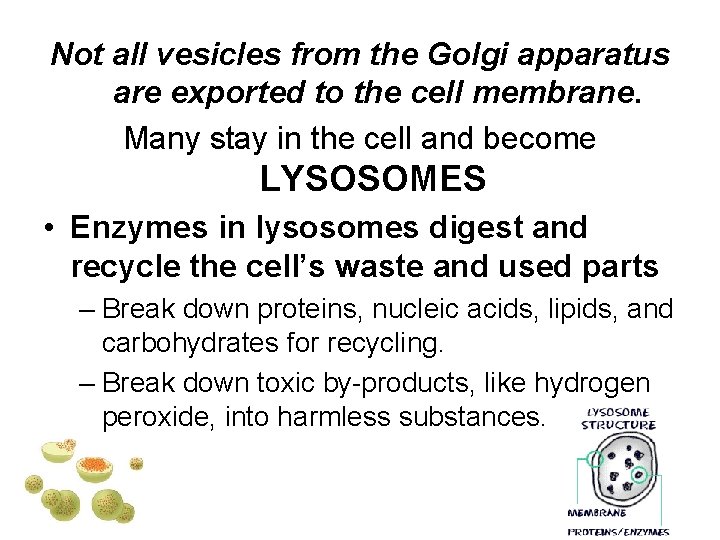
Not all vesicles from the Golgi apparatus are exported to the cell membrane. Many stay in the cell and become LYSOSOMES • Enzymes in lysosomes digest and recycle the cell’s waste and used parts – Break down proteins, nucleic acids, lipids, and carbohydrates for recycling. – Break down toxic by-products, like hydrogen peroxide, into harmless substances.
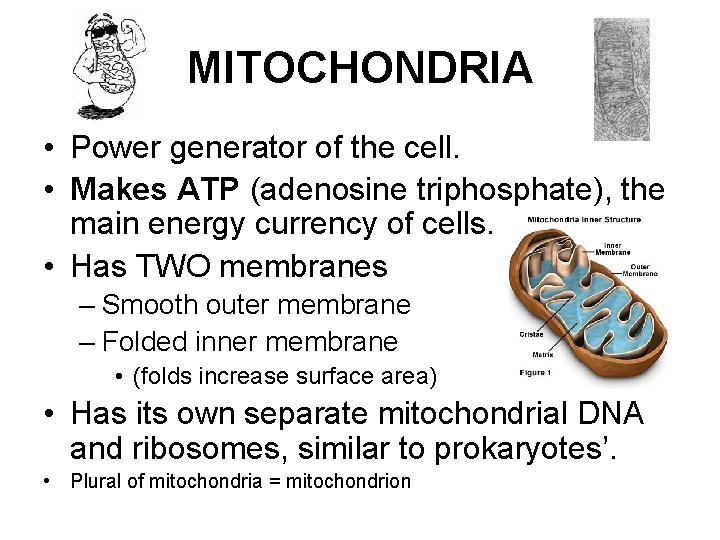
MITOCHONDRIA • Power generator of the cell. • Makes ATP (adenosine triphosphate), the main energy currency of cells. • Has TWO membranes – Smooth outer membrane – Folded inner membrane • (folds increase surface area) • Has its own separate mitochondrial DNA and ribosomes, similar to prokaryotes’. • Plural of mitochondria = mitochondrion
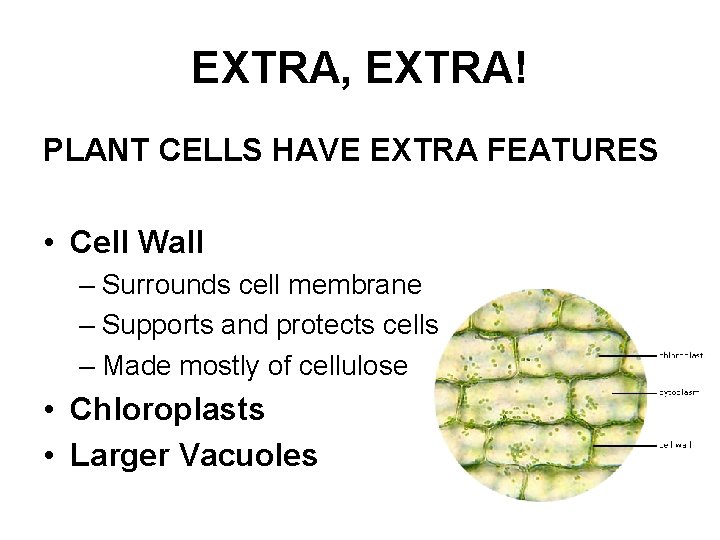
EXTRA, EXTRA! PLANT CELLS HAVE EXTRA FEATURES • Cell Wall – Surrounds cell membrane – Supports and protects cells – Made mostly of cellulose • Chloroplasts • Larger Vacuoles
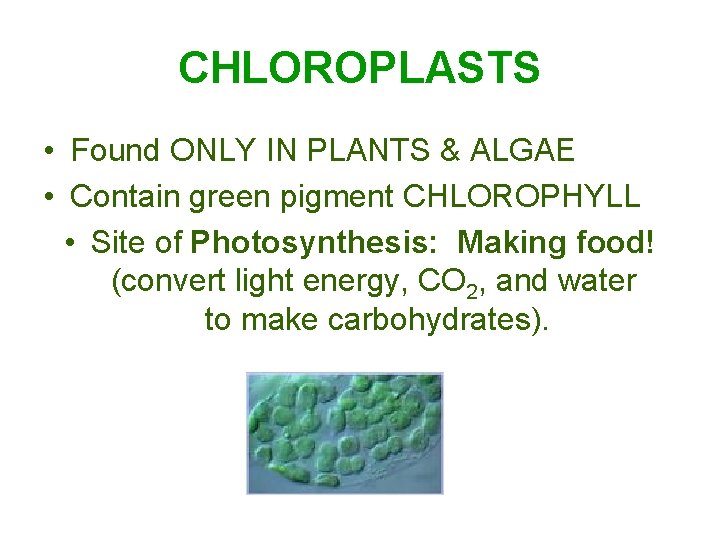
CHLOROPLASTS • Found ONLY IN PLANTS & ALGAE • Contain green pigment CHLOROPHYLL • Site of Photosynthesis: Making food! (convert light energy, CO 2, and water to make carbohydrates).
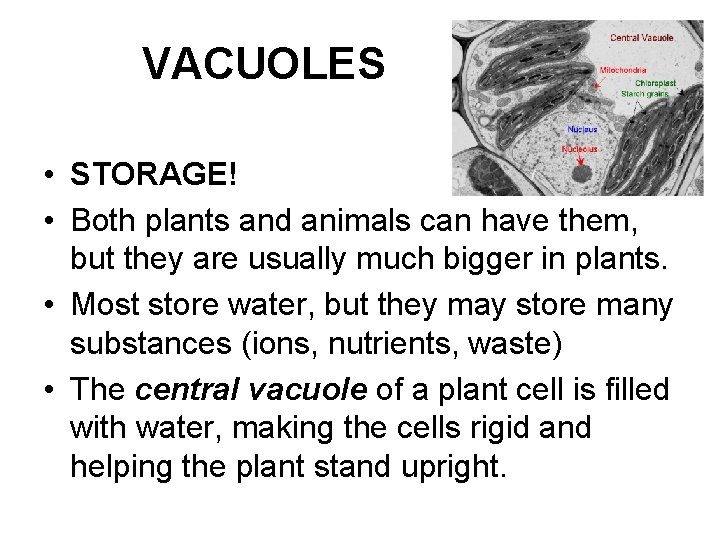
VACUOLES • STORAGE! • Both plants and animals can have them, but they are usually much bigger in plants. • Most store water, but they may store many substances (ions, nutrients, waste) • The central vacuole of a plant cell is filled with water, making the cells rigid and helping the plant stand upright.
CELL STUFF TO KNOW SO FAR: • • Cell Theory *pg 55 Why are cells small? *pg 55 Cell Membrane Structure *pg 60 -61 Cytoplasm, Cytoskeleton *pg 56 The 8 Organelles & functions *pg 62 -66 Prokaryotic vs. Eukaryotic *pg 57 -58 Plant vs. Animal *pg 66 Cell Chemistry (Notes 10, *pg 34 -37) >THERE WILL BE A CELL PROJECT AND A BIG CELL UNIT TEST IN THE NEXT COUPLE OF WEEKS START STUDYING NOW! A LITTLE EACH DAY GOES A LONG WAY!
THE END! THERE WILL BE A CELL PROJECT AND A BIG CELL UNIT TEST IN THE NEXT COUPLE OF WEEKS!