
Cell Structure Chapter 3 Examples of Cells 3
- Slides: 32
Cell Structure Chapter 3
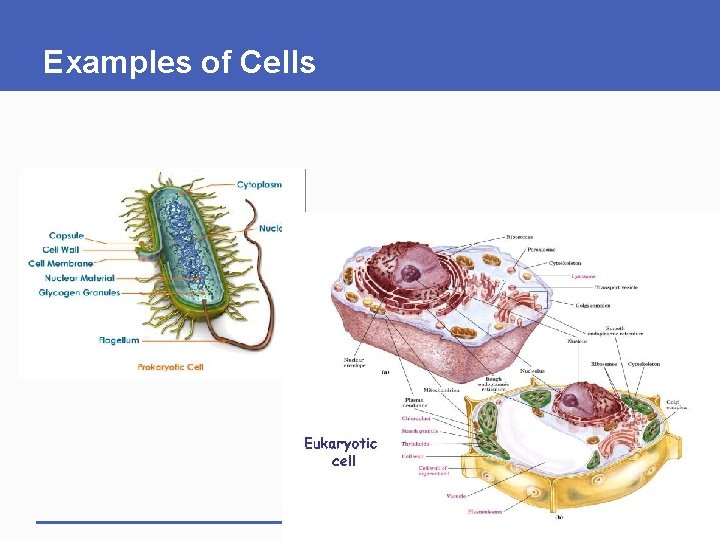
Examples of Cells
3. 2 What, Exactly, Is a Cell? Cells are the fundamental units of all life § All cells start life with a plasma membrane, cytoplasm, and a region of DNA which, in eukaryotic cells only, is enclosed by a nucleus
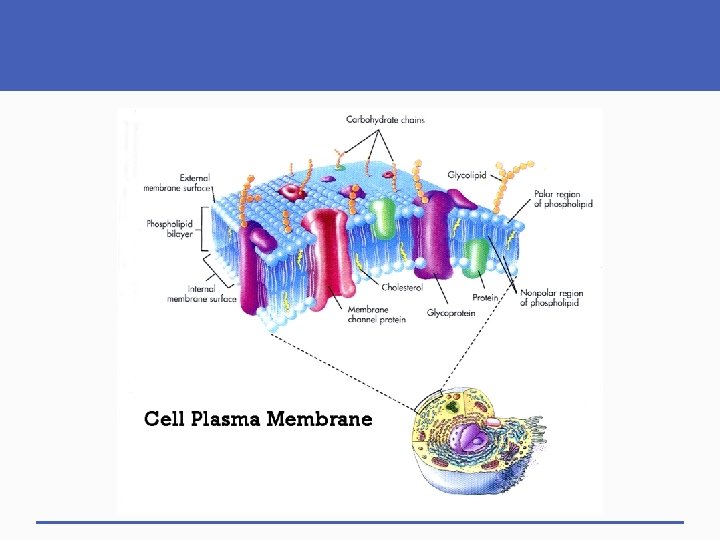
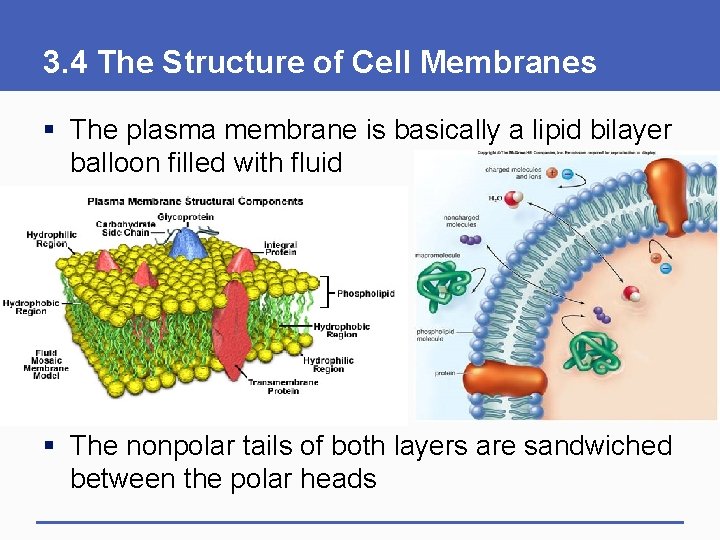
Cell Structure § A plasma membrane surrounds the cell and controls which substances move in and out § Plasma membrane • A cell’s outermost membrane § Lipid bilayer • Structural foundation of cell membranes; mainly phospholipids arranged tail-to-tail in a bilayer
Cytoplasm § An important part of homeostasis is maintaining the composition of cytoplasm, which differs from fluid outside the cell § Cytoplasm • Semifluid substance enclosed by a cell’s plasma membrane
Organelles § Cell metabolism occurs in cytoplasm and internal compartments, including organelles § Organelle • Structure that carries out a specialized metabolic function inside a cell
Prokaryotes and Eukaryotes § Cells are classed as eukaryotes or prokaryotes based on how DNA is housed in the cell § Nucleus • Organelle with two membranes that holds a eukaryotic cell’s DNA § Nucleoid • Region of cytoplasm where DNA is concentrated in a prokaryotic cell
The Cell Theory § Cell theory is the fundamental theory of biology § Cell theory • • All organisms consist of one or more cells The cell is the smallest unit of life Each new cell arises from another cell A cell passes hereditary information to its offspring
3. 3 Measuring Cells § Most cells are visible only with the help of microscopes § Different types of microscopes use light or electrons to reveal different details of cells
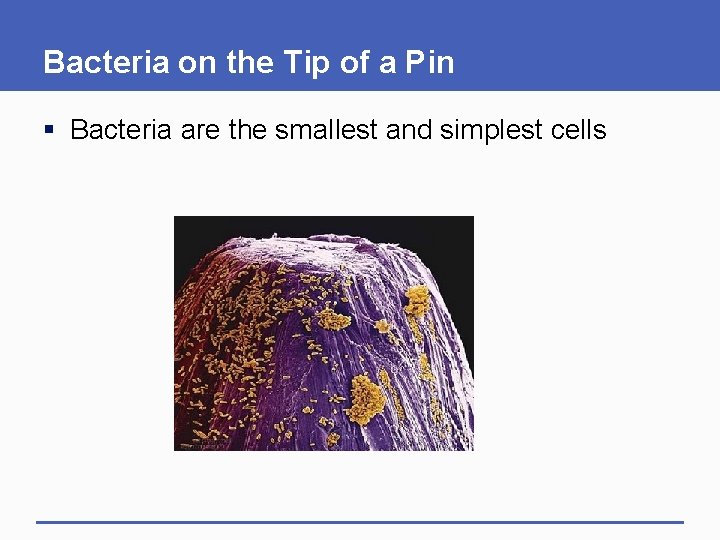
Bacteria on the Tip of a Pin § Bacteria are the smallest and simplest cells
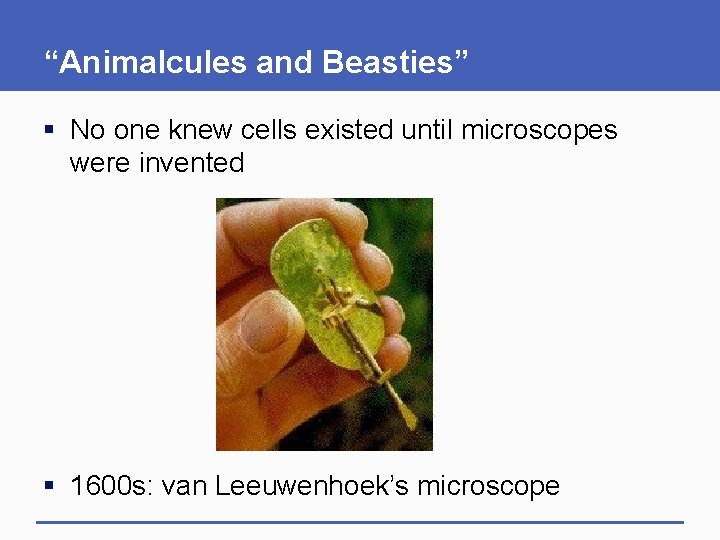
“Animalcules and Beasties” § No one knew cells existed until microscopes were invented § 1600 s: van Leeuwenhoek’s microscope
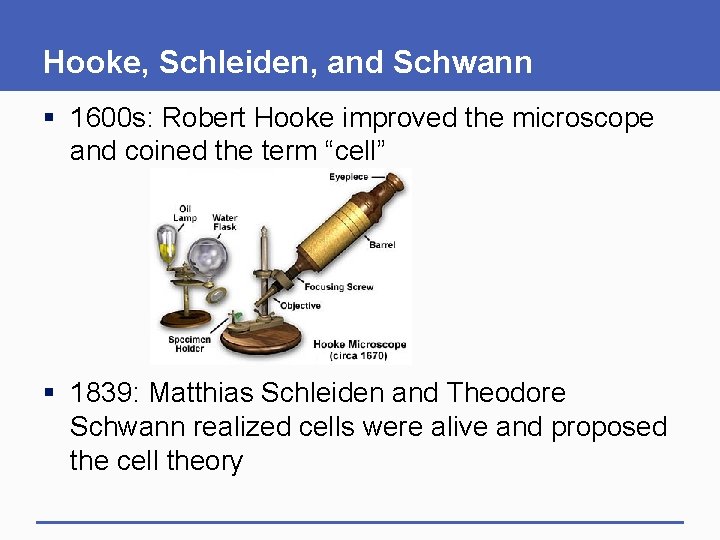
Hooke, Schleiden, and Schwann § 1600 s: Robert Hooke improved the microscope and coined the term “cell” § 1839: Matthias Schleiden and Theodore Schwann realized cells were alive and proposed the cell theory
3. 4 The Structure of Cell Membranes § The plasma membrane is basically a lipid bilayer balloon filled with fluid § The nonpolar tails of both layers are sandwiched between the polar heads
The Fluid Mosaic Model § A cell membrane is a mosaic of proteins and lipids (mainly phospholipids) that functions as a selectively permeable barrier that separates an internal environment from an external one § Fluid mosaic model • A cell membrane can be considered a twodimensional fluid of mixed composition
Membrane Proteins § Proteins associated with a membrane carry out most membrane functions • Transport proteins passively or actively assist specific ions or molecules across a membrane • Enzymes speed chemical processes • Adhesion proteins help cells stick together • Recognition proteins tag cells as “self” • Receptor proteins bind to a particular substance outside the cell
3. 5 Introducing Prokaryotic Cells § Domains Bacteria and Archaea make up the prokaryotes § Prokaryotes are single-celled organisms with no nucleus, but many have a cell wall and one or more flagella or pili
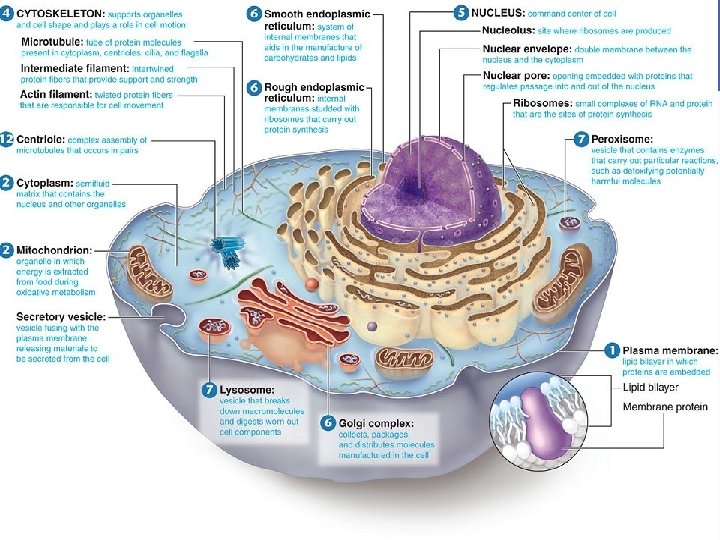
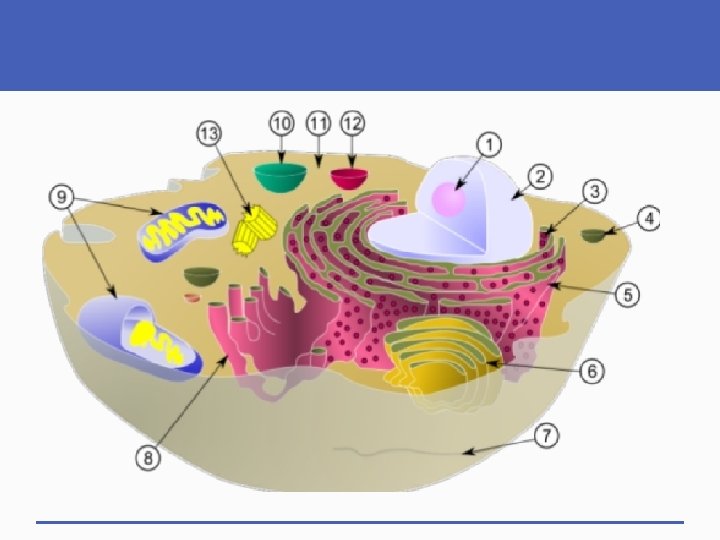
3. 6 A Peek Inside a Eukaryotic Cell § All eukaryotic cells start life with a nucleus, ribosomes, organelles of the endomembrane system (including endoplasmic reticulum, vesicles, Golgi bodies), mitochondria, and other organelles
The Nucleus § Pores, receptors, and transport proteins in the nuclear envelope control the movement of molecules into and out of the nucleus § Nuclear envelope • A double membrane that constitutes the outer boundary of the nucleus
The Endomembrane System § The endomembrane system includes rough and smooth endoplasmic reticulum, vesicles, and Golgi bodies § Endomembrane system • Series of interacting organelles between the nucleus and plasma membrane • Makes and modifies lipids and proteins • Recycles molecules and particles such as wornout cell parts, and inactivates toxins
The Endomembrane System § Endoplasmic reticulum (ER) • A continuous system of sacs and tubes that is an extension of the nuclear envelope • Rough ER is studded with ribosomes (for protein production) • Smooth ER has no ribosomes
The Endomembrane System § Vesicle • Small, membrane-enclosed, saclike organelle • Stores, transports, or degrades its contents § Peroxisome • Enzyme-filled vesicle that breaks down amino acids, fatty acids, and toxic substances § Lysosome • Vesicle with enzymes for intracellular digestion
The Endomembrane System § Golgi body • Organelle that modifies polypeptides and lipids • Sorts and packages the finished products into transport vesicles § Vacuole • A fluid-filled organelle that isolates or disposes of wastes, debris, or toxic materials
Mitochondria and Chloroplasts § Mitochondria and chloroplasts have their own DNA – they resemble bacteria and may have evolved by endosymbiosis § Mitochondrion • Double-membraned organelle that produces ATP § Chloroplast • Organelle of photosynthesis
The Cytoskeleton § Cytoskeleton • Dynamic network of protein filaments that support, organize, and move eukaryotic cells and their internal structures § The cytoskeleton interacts with accessory proteins, such as motor proteins
Cilia and False Feet § Cilia • Short, hairlike structures that project from the plasma membrane of some eukaryotic cells • Coordinated beating stirs fluid, propels motile cells • Moved by organized arrays of microtubules • Example: clears particles from airways
Flagella § Eukaryotic flagella are whiplike structures that propel cells such as sperm through fluid • Different internal structure and motion than prokaryotic flagella
False Feet § Pseudopod (false foot) • Extendable lobe of membrane-enclosed cytoplasm for movement or to engulf prey • Moved by motor proteins attached to microfilaments that drag the plasma membrane • Example: amoebas
3. 7 Cell Surface Specializations § Cell junctions • Connect a cell structurally and functionally to another cell or to extracellular matrix (ECM) § Extracellular matrix (ECM) • Complex mixture of substances secreted by cells • Supports cells and tissues • Functions in cell signaling
Types of Animal Cell Junctions § Tight junction • An array of fibrous proteins that joins epithelial cells and prevents fluids from leaking between them § Adhering junction • Anchors cells to each other or to extracellular matrix § Gap junction • Forms a channel across plasma membranes of adjoining animal cells