
Cell Structure and Transport Chapter 7 http www
- Slides: 39
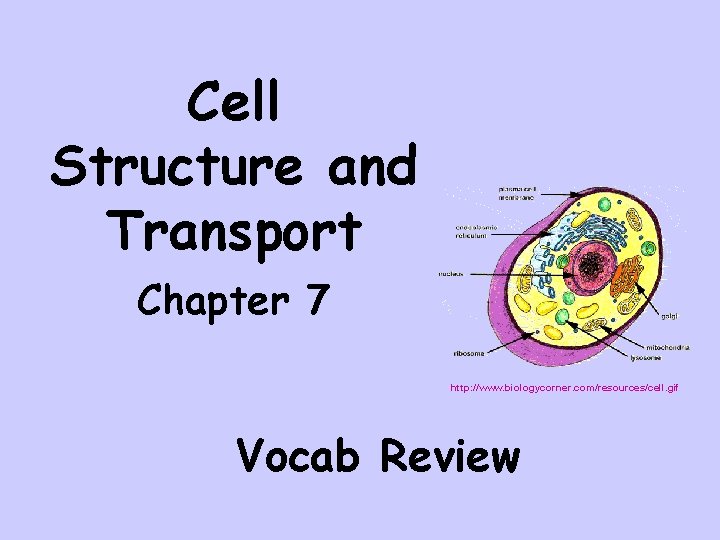
Cell Structure and Transport Chapter 7 http: //www. biologycorner. com/resources/cell. gif Vocab Review
Process in which cells change and develop into different kinds of cells doing different jobs Differentiation OR cell specialization Idea that all living things are made of cells; cells are the basic units of structure and function in living things; and new cells are produced from existing cells Cell theory
Sac of digestive enzymes used by cells to break down food, cell parts, or whole cells lysosomes Membrane stacks found inside chloroplasts where the enzymes for photosynthesis are found thylakoids
Molecule found in the cell walls of fungi that makes them sturdy chitin
Collection of living material enclosed by a barrier that separates it from its surroundings; the basic unit of life cell Log-like structures that help organize the spindle and guide the chromosomes apart during cell division in animal cells centrioles
Sac of digestive enzymes used by cells to break down food, cell parts, or whole cells lysosomes Membrane stacks found inside chloroplasts where the enzymes for photosynthesis are found thylakoids
Control center of the cell that contains the genetic material nucleus Stack of membranes in cells that modifies, sorts, and packages proteins from the ER for transport Golgi body (apparatus)
DNA with attached proteins found spread out in the nucleus of non -dividing cells chromatin Describes molecules that try to stay away from water… means “water fearing” hydrophobic
Nucleotide molecules used by cells to store and transfer energy ATP Membrane protein with sugars attached that help cells identify “self” glycoproteins
DNA with proteins attached that is tightly scrunched up into compact bundles seen in the nucleus of dividing cells chromosomes Molecule with a polar head and two hydrophobic tails used to make cell membranes phospholipid
Space used to store water, food, molecules, enzymes, or waste vacuole Many, small hair-like structures made of microtubules in a 9+2 arrangement that extend from the surface of cells and help in movement cilia
Dark spot in the cell nucleus where RNA for ribosomes is made Nucleolus Network of microtubules and microfilaments that give the cell shape and support it cytoskeleton
Organism whose cells have a nucleus and organelles surrounded by membranes eukaryote Gel-like material and the organelles found between the nucleus and cell membrane cytoplasm
Double membrane that surrounds the cell nucleus Nuclear envelope OR nuclear membrane Small particles that make proteins ribosomes
Membrane system without ribosomes attached involved in lipid synthesis, calcium regulation, and the break down of toxins Smooth ER Power plant of the cell that burns glucose and stores the energy released in ATP mitochondria
Folded inner membrane inside a mitochondrion cristae System of membranes with ribosomes attached where proteins are produced and modified and transported throughout the cell Rough ER
Organelle where photosynthesis happens chloroplast Bilayer made of phospholipids and proteins which surrounds all cells and controls what enters and leaves Plasma membrane
Double layer formed when phospholipids line up with their hydrophillic heads to the outside and their hydrophobic tails toward the center bilayer Molecule with an uneven pattern of charges… slightly positive on one side, slightly negative on the other polar
Small structure inside eukaryotic cells which carries out a specific function organelle Unicellular organism that does NOT have a nucleus and or organelles surrounded by membranes prokaryote
A living thing composed of many organ systems organism Structure found outside the cell membrane that provides support and protection Cell wall
Polysaccharide found in plant cell walls that makes them sturdy cellulose Molecule made by joining amino acid subunits that is used to make cell membranes protein
Molecule used to build bacterial cell walls instead of cellulose peptidoglycan Programmed cell death; “cell suicide” apoptosis
A few, long hair-like structures made of microtubules in a 9+2 arrangement that extend from the surface of cells and help in movement flagella Small openings in the nuclear membrane that allow molecules to pass through Nuclear pores
A group of similar cells working together tissue Organism made of many cells multi-cellular
Group of different organs working together organ system Protein found in cell membranes which helps molecules get across the membrane transport protein
“Walking proteins that interact with the microtubules in the cytoskeleton to move chromosomes or cell parts Motor proteins Protein found on the inside or outside surface of cell membranes Peripheral proteins
Theory that suggests that mitochondria and chloroplasts evolved from prokaryotic ancestors that were engulfed and stayed to live in an ancient host cell Endosymbiotic theory Protein found embedded in the phospholipid bilayer in cell membranes; these can go part way or all the way across the membrane integral proteins
http: //bio. winona. edu/berg/ANIMTNS/Directry. htm The DIFFUSION of WATER across a semi-permeable MEMBRANE OSMOSIS A state that exists when the CONCENTRATION of a substance IS THE SAME throughout a space equilibrium
The pressure of water pushing against the cell wall in a plant cell is called ________ pressure. Osmotic(turgor) Solution in which the solute concentration outside and inside a cell are EQUAL ISOTONIC
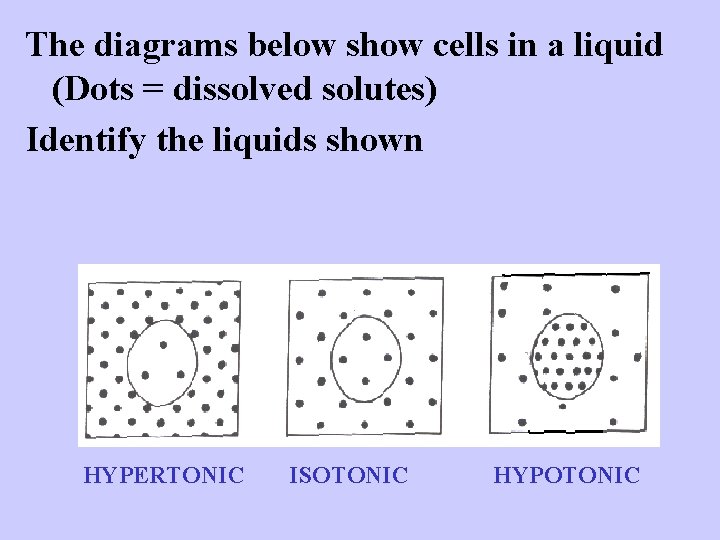
The diagrams below show cells in a liquid (Dots = dissolved solutes) Identify the liquids shown HYPERTONIC ISOTONIC HYPOTONIC
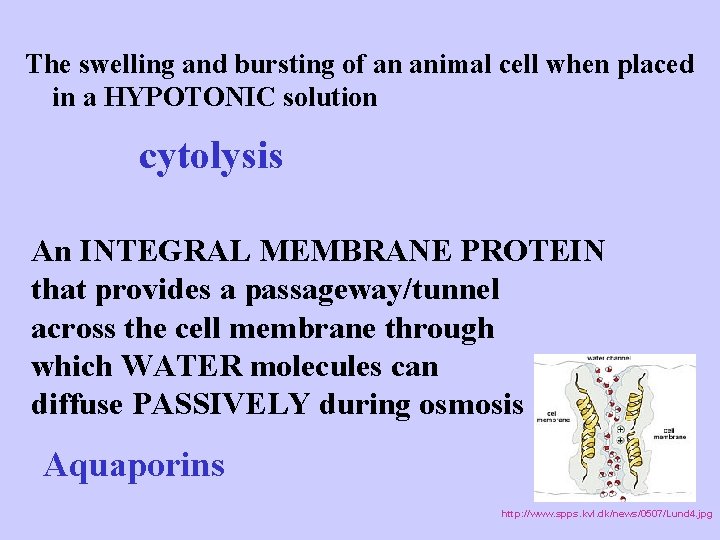
The swelling and bursting of an animal cell when placed in a HYPOTONIC solution cytolysis An INTEGRAL MEMBRANE PROTEIN that provides a passageway/tunnel across the cell membrane through which WATER molecules can diffuse PASSIVELY during osmosis Aquaporins http: //www. spps. kvl. dk/news/0507/Lund 4. jpg
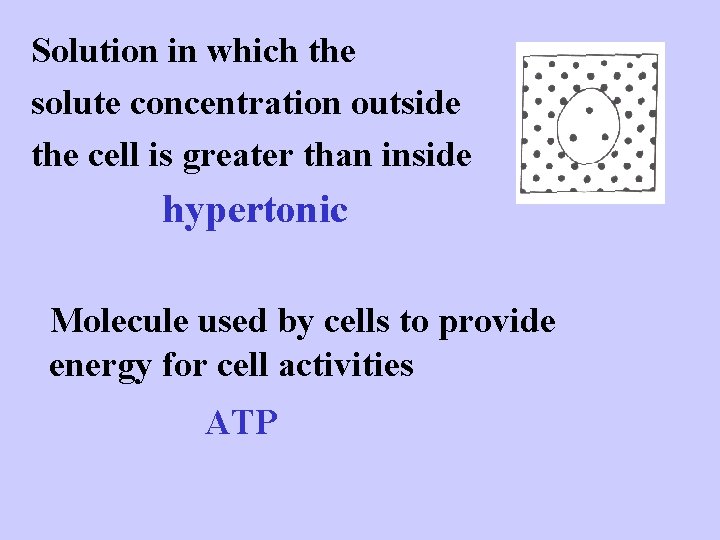
Solution in which the solute concentration outside the cell is greater than inside hypertonic Molecule used by cells to provide energy for cell activities ATP
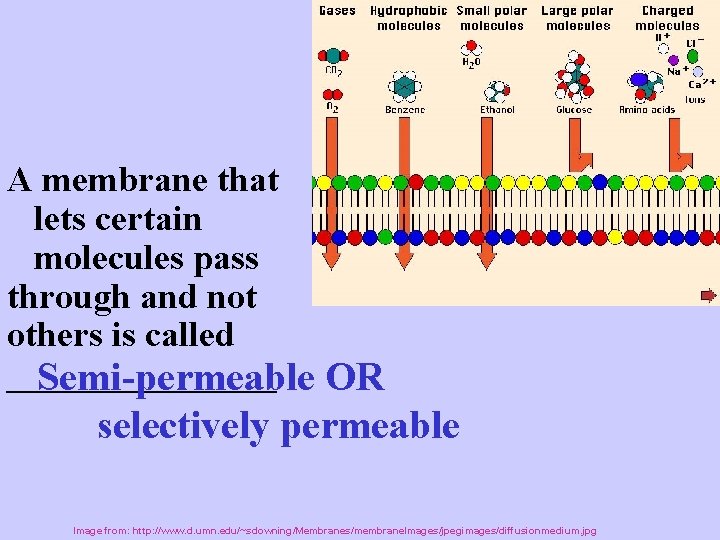
A membrane that lets certain molecules pass through and not others is called ________ Semi-permeable OR selectively permeable Image from: http: //www. d. umn. edu/~sdowning/Membranes/membrane. Images/jpegimages/diffusionmedium. jpg
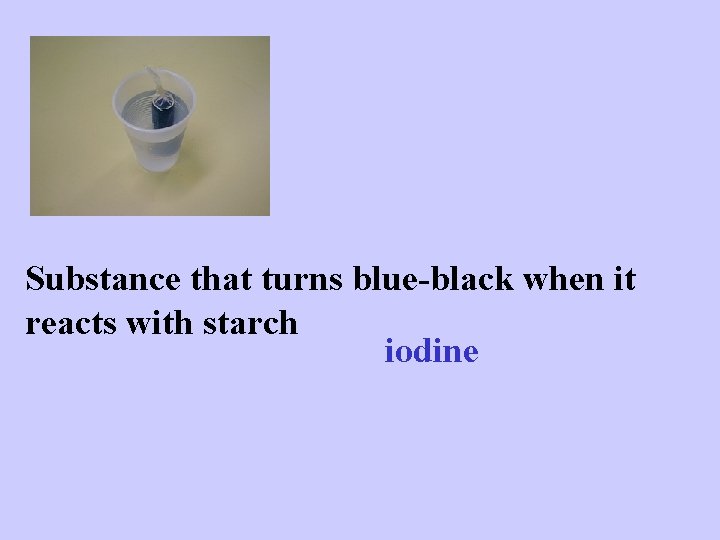
Substance that turns blue-black when it reacts with starch iodine
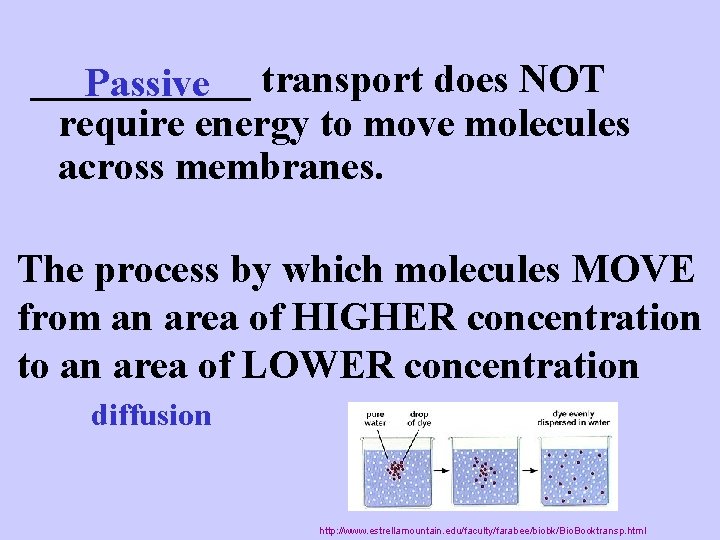
______ Passive transport does NOT require energy to move molecules across membranes. The process by which molecules MOVE from an area of HIGHER concentration to an area of LOWER concentration diffusion http: //www. estrellamountain. edu/faculty/farabee/biobk/Bio. Booktransp. html
The shrinking away of the cell membrane from the cell wall in a plant cell when placed in a HYPERTONIC environment plasmolysis Organelle that uses exocytosis to transport molecules out of the cell Golgi (body) apparatus
A small membrane bound sac in a eukaryotic cell used to transport substances around within a cell or during exocytosis or endocytosis vesicle The shrinking of animal cells when placed in a hypertonic solution is called crenation _______
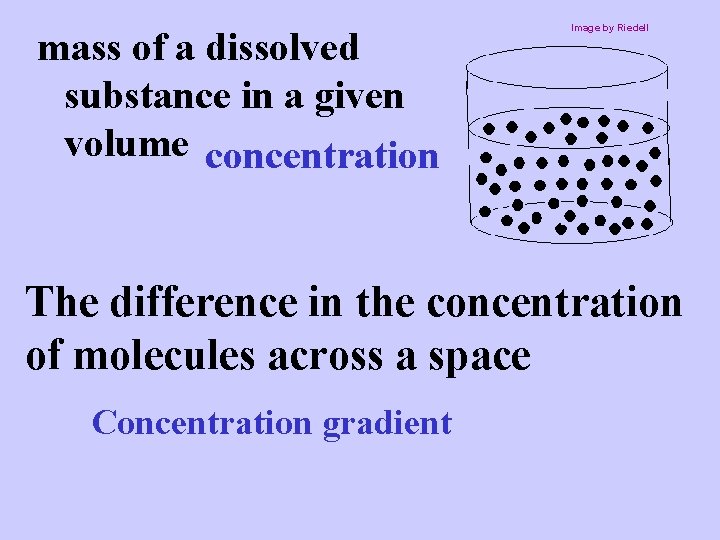
mass of a dissolved substance in a given volume concentration Image by Riedell The difference in the concentration of molecules across a space Concentration gradient
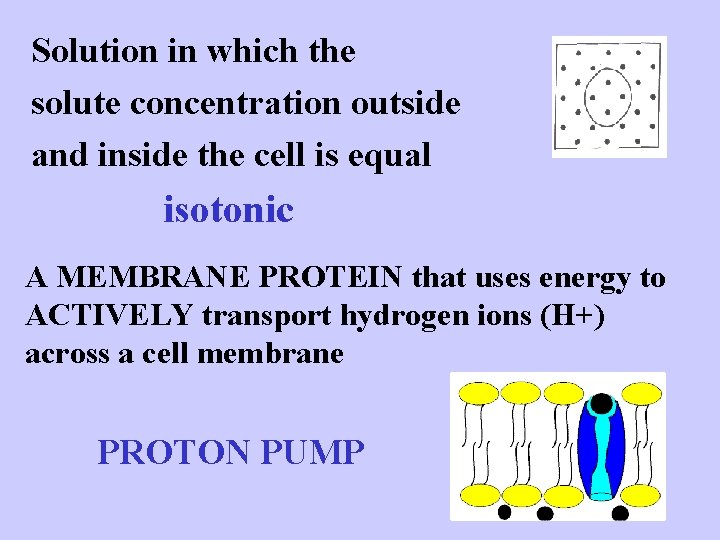
Solution in which the solute concentration outside and inside the cell is equal isotonic A MEMBRANE PROTEIN that uses energy to ACTIVELY transport hydrogen ions (H+) across a cell membrane PROTON PUMP