
Cell Structure and Function Life Science Two Categories
- Slides: 22
Cell Structure and Function Life Science
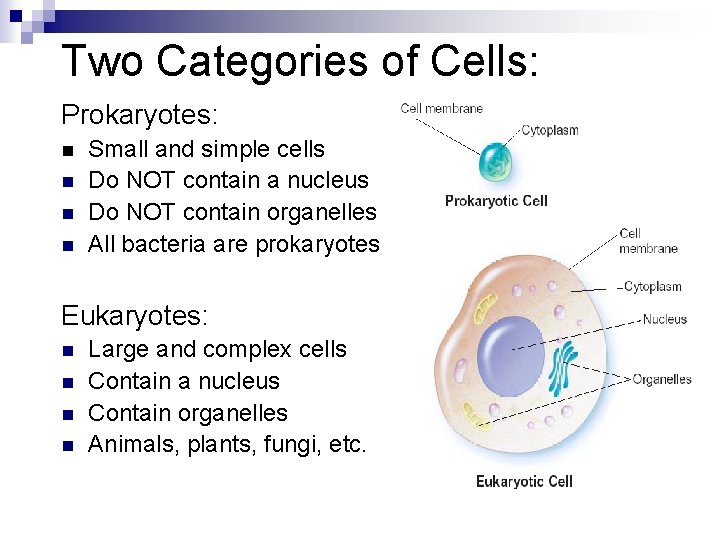
Two Categories of Cells: Prokaryotes: n n Small and simple cells Do NOT contain a nucleus Do NOT contain organelles All bacteria are prokaryotes Eukaryotes: n n Large and complex cells Contain a nucleus Contain organelles Animals, plants, fungi, etc.
Cell Structures
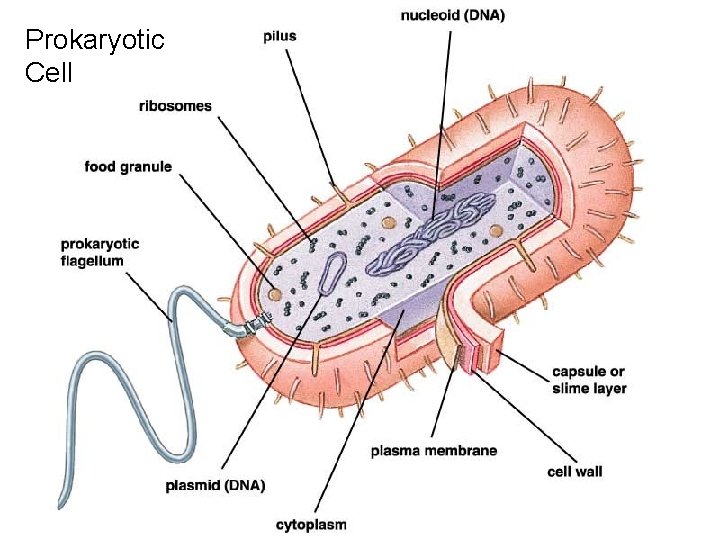
Prokaryotic Cell
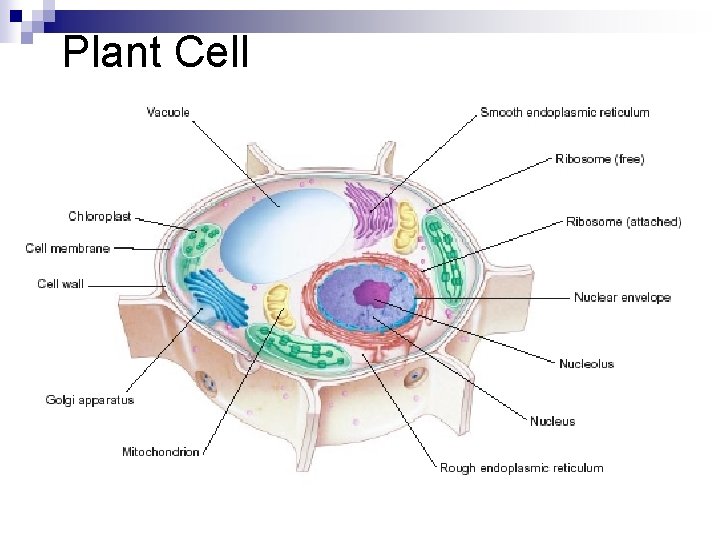
Plant Cell
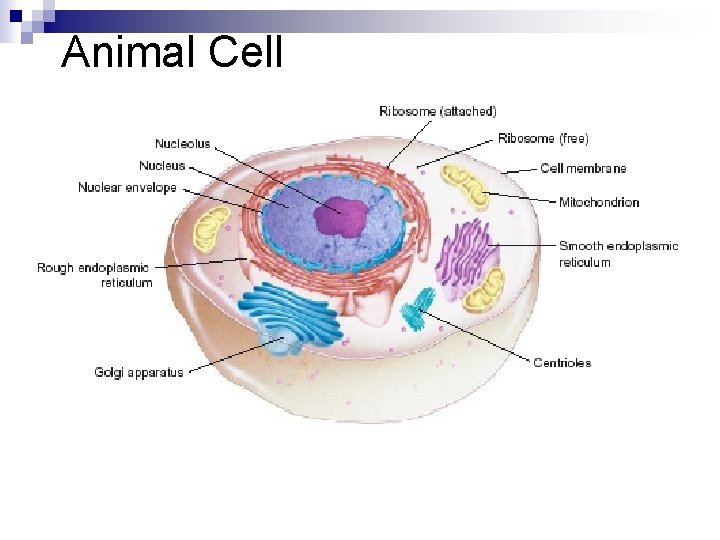
Animal Cell
Don’t forget that all cells have all these things!!! A. Cell membrane B. Cytoplasm C. Genetic material (almost all contain DNA) D. Have ribosomes, sites of protein synthesis (dehydration synthesis happens here!)
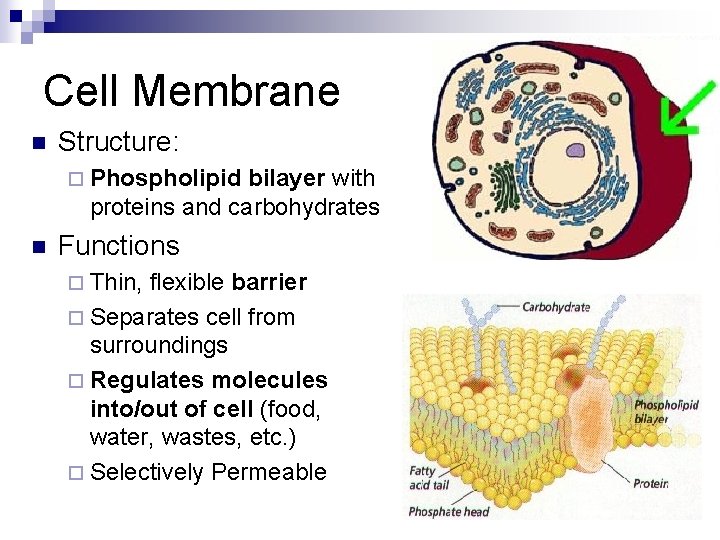
Cell Membrane n Structure: ¨ Phospholipid bilayer with proteins and carbohydrates n Functions ¨ Thin, flexible barrier ¨ Separates cell from surroundings ¨ Regulates molecules into/out of cell (food, water, wastes, etc. ) ¨ Selectively Permeable
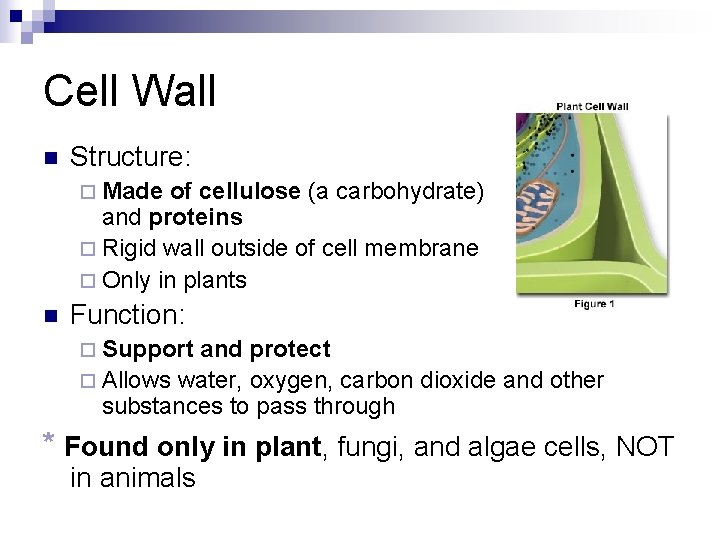
Cell Wall n Structure: ¨ Made of cellulose (a carbohydrate) and proteins ¨ Rigid wall outside of cell membrane ¨ Only in plants n Function: ¨ Support and protect ¨ Allows water, oxygen, carbon dioxide and other substances to pass through * Found only in plant, fungi, and algae cells, NOT in animals
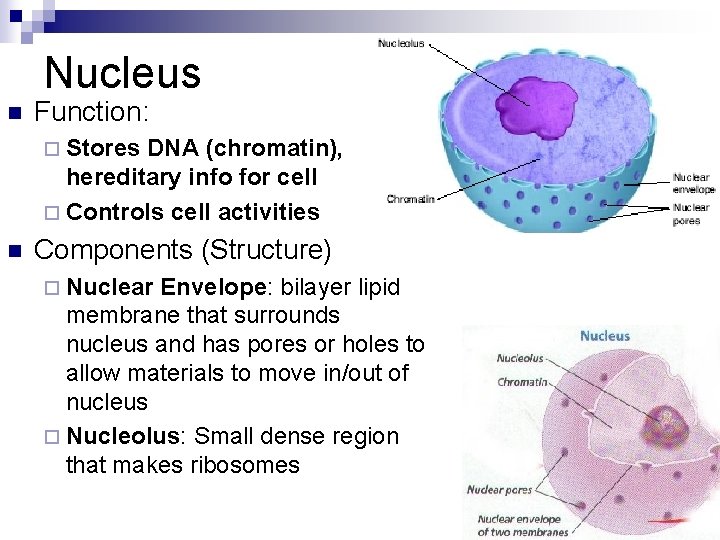
Nucleus n Function: ¨ Stores DNA (chromatin), hereditary info for cell ¨ Controls cell activities n Components (Structure) ¨ Nuclear Envelope: bilayer lipid membrane that surrounds nucleus and has pores or holes to allow materials to move in/out of nucleus ¨ Nucleolus: Small dense region that makes ribosomes
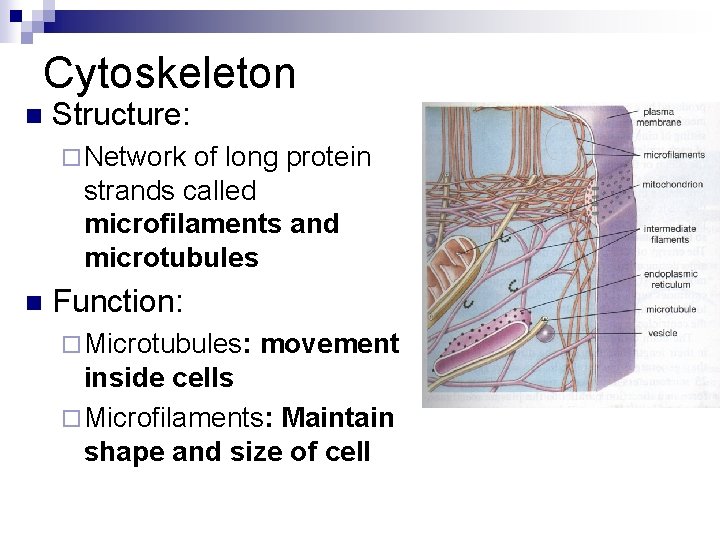
Cytoskeleton n Structure: ¨ Network of long protein strands called microfilaments and microtubules n Function: ¨ Microtubules: movement inside cells ¨ Microfilaments: Maintain shape and size of cell
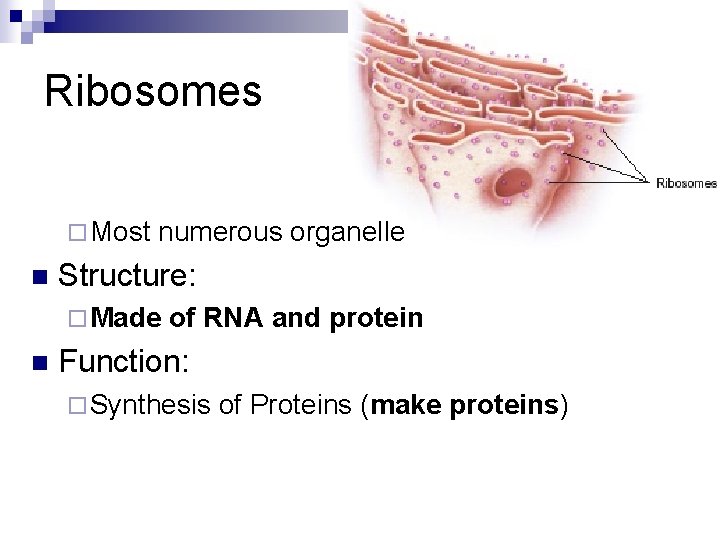
Ribosomes ¨ Most n numerous organelle Structure: ¨ Made n of RNA and protein Function: ¨ Synthesis of Proteins (make proteins)
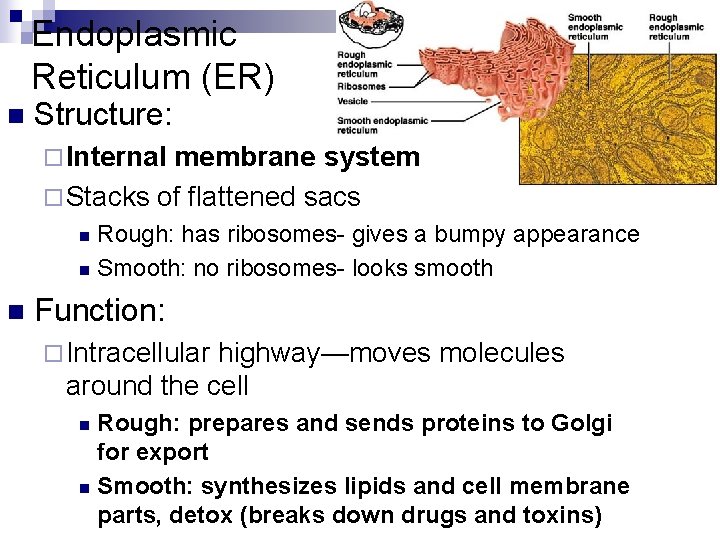
Endoplasmic Reticulum (ER) n Structure: ¨ Internal membrane system ¨ Stacks of flattened sacs Rough: has ribosomes- gives a bumpy appearance n Smooth: no ribosomes- looks smooth n n Function: ¨ Intracellular highway—moves molecules around the cell Rough: prepares and sends proteins to Golgi for export n Smooth: synthesizes lipids and cell membrane parts, detox (breaks down drugs and toxins) n
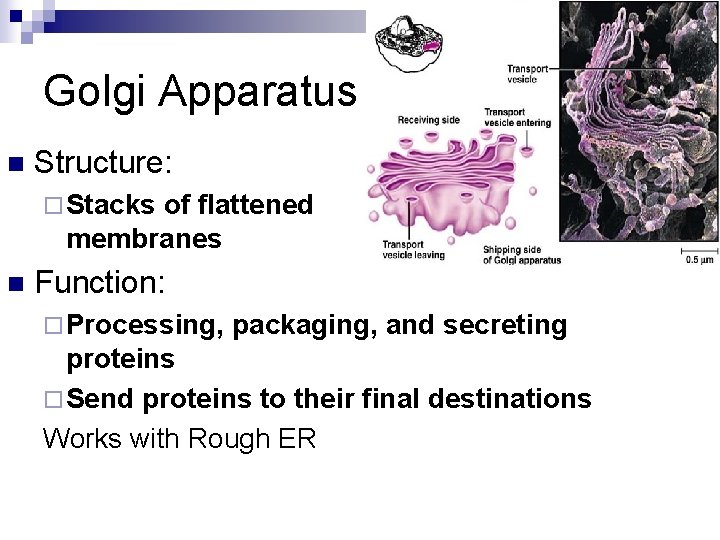
Golgi Apparatus n Structure: ¨ Stacks of flattened membranes n Function: ¨ Processing, packaging, and secreting proteins ¨ Send proteins to their final destinations Works with Rough ER
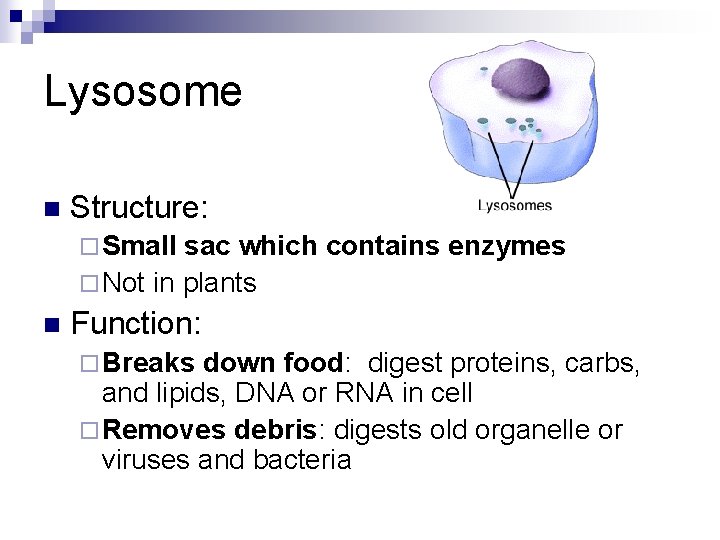
Lysosome n Structure: ¨ Small sac which contains enzymes ¨ Not in plants n Function: ¨ Breaks down food: digest proteins, carbs, and lipids, DNA or RNA in cell ¨ Removes debris: digests old organelle or viruses and bacteria
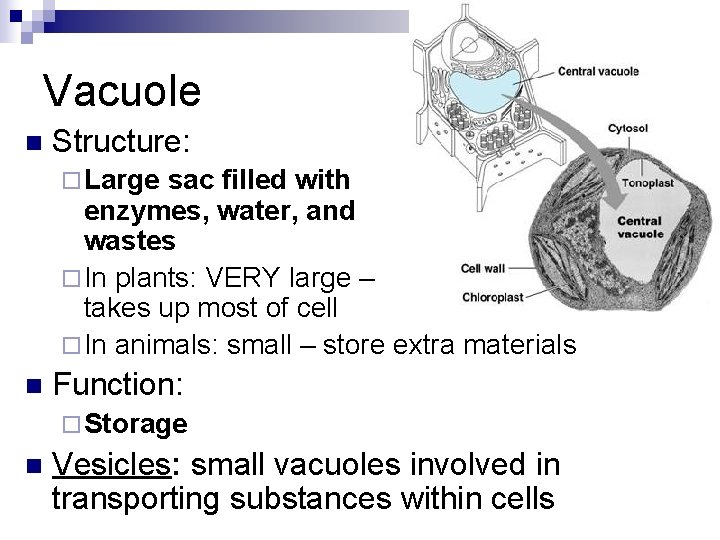
Vacuole n Structure: ¨ Large sac filled with enzymes, water, and wastes ¨ In plants: VERY large – takes up most of cell ¨ In animals: small – store extra materials n Function: ¨ Storage n Vesicles: small vacuoles involved in transporting substances within cells
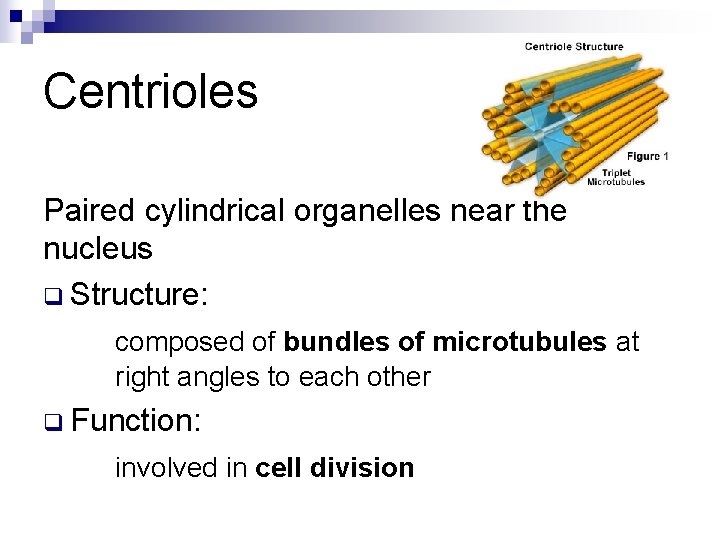
Centrioles Paired cylindrical organelles near the nucleus q Structure: composed of bundles of microtubules at right angles to each other q Function: involved in cell division
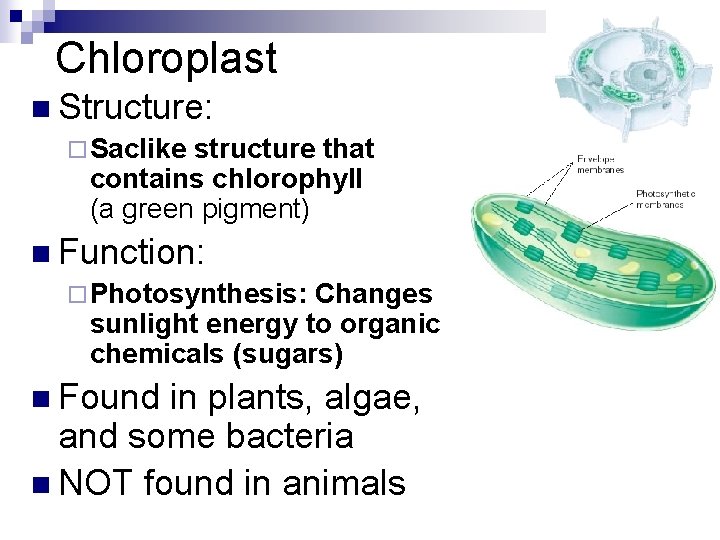
Chloroplast n Structure: ¨ Saclike structure that contains chlorophyll (a green pigment) n Function: ¨ Photosynthesis: Changes sunlight energy to organic chemicals (sugars) n Found in plants, algae, and some bacteria n NOT found in animals
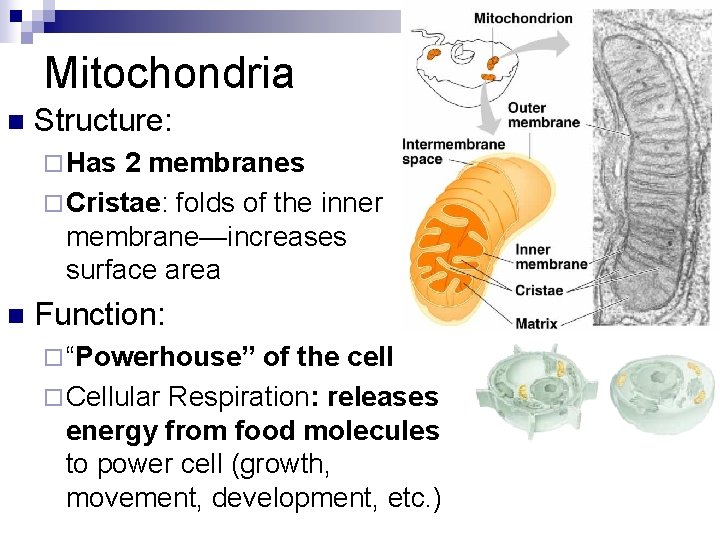
Mitochondria n Structure: ¨ Has 2 membranes ¨ Cristae: folds of the inner membrane—increases surface area n Function: ¨ “Powerhouse” of the cell ¨ Cellular Respiration: releases energy from food molecules to power cell (growth, movement, development, etc. )
Organelle DNA n n n Chloroplasts and mitochondria contain some of their own genetic information or DNA Lynn Margulis – scientist who suggested that mitochondria and chloroplasts are actually descendants of ancient prokaryotes Endosymbiotic Theory – eukaryotic cells formed from a symbiosis among several different prokaryotic organisms
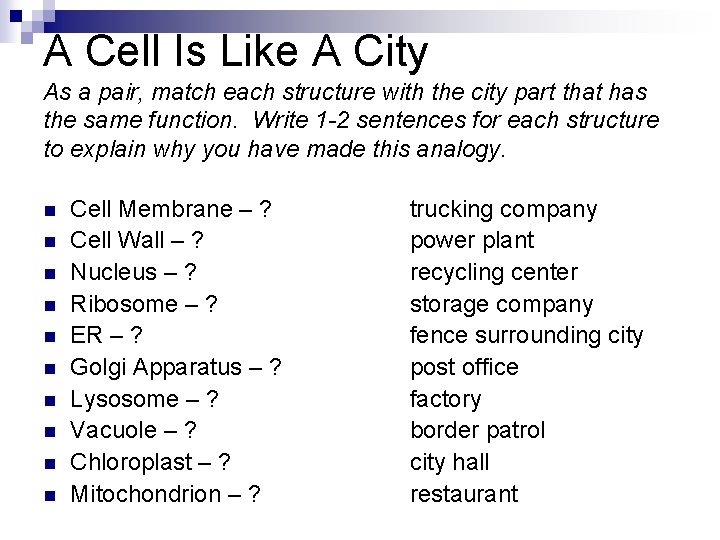
A Cell Is Like A City As a pair, match each structure with the city part that has the same function. Write 1 -2 sentences for each structure to explain why you have made this analogy. n n n n n Cell Membrane – ? Cell Wall – ? Nucleus – ? Ribosome – ? ER – ? Golgi Apparatus – ? Lysosome – ? Vacuole – ? Chloroplast – ? Mitochondrion – ? trucking company power plant recycling center storage company fence surrounding city post office factory border patrol city hall restaurant
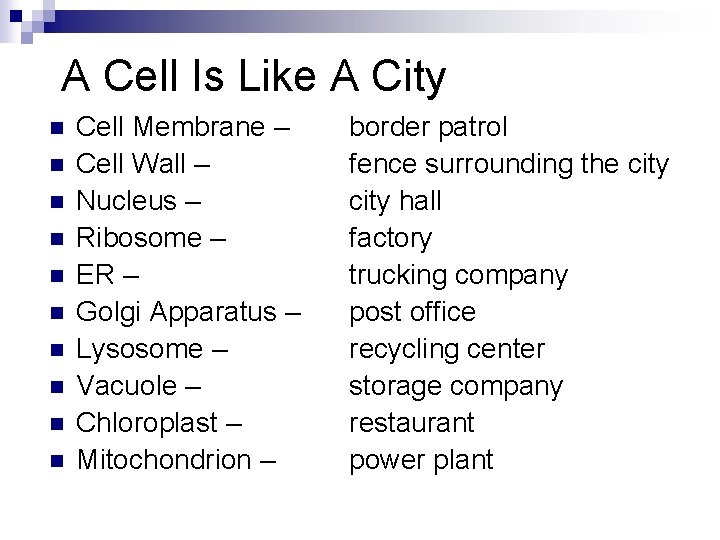
A Cell Is Like A City n n n n n Cell Membrane – Cell Wall – Nucleus – Ribosome – ER – Golgi Apparatus – Lysosome – Vacuole – Chloroplast – Mitochondrion – border patrol fence surrounding the city hall factory trucking company post office recycling center storage company restaurant power plant