
Cell Structure and Function Chapter 4 HsuehFen Juan
- Slides: 94
Cell Structure and Function Chapter 4 Hsueh-Fen Juan 阮雪芬 Sept. 25, 2012
Video: E. coli in food
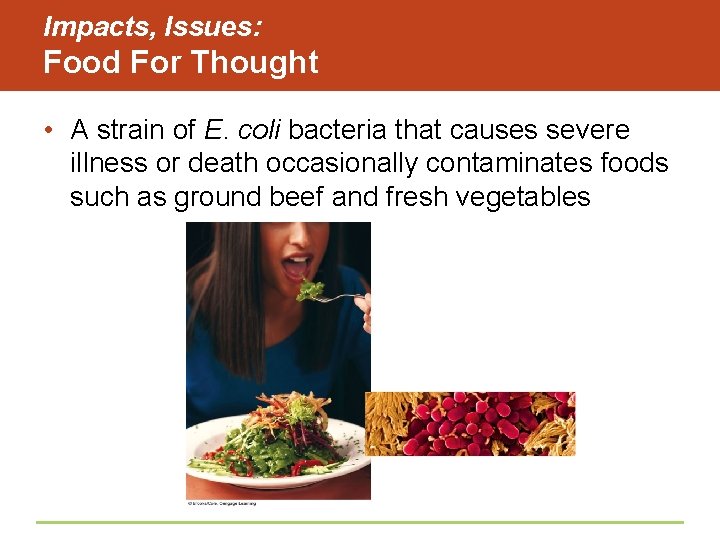
Impacts, Issues: Food For Thought • A strain of E. coli bacteria that causes severe illness or death occasionally contaminates foods such as ground beef and fresh vegetables
4. 1 The Cell Theory • The cell theory, a foundation of modern biology, states that cells are the fundamental units of life
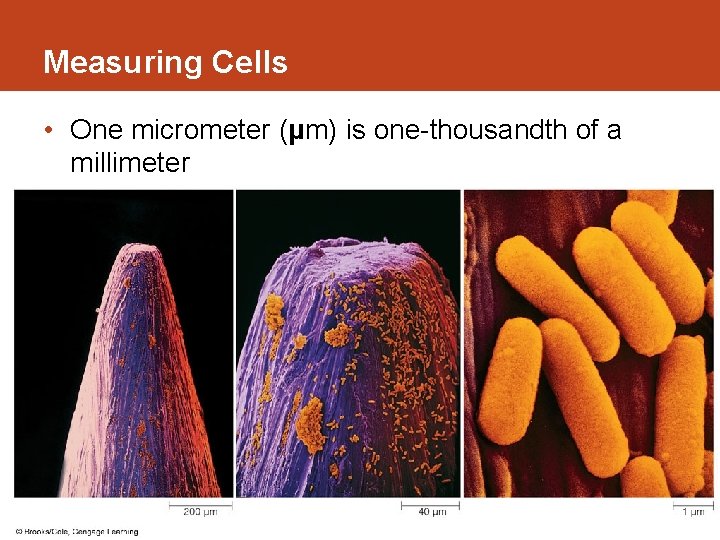
Measuring Cells • One micrometer (μm) is one-thousandth of a millimeter
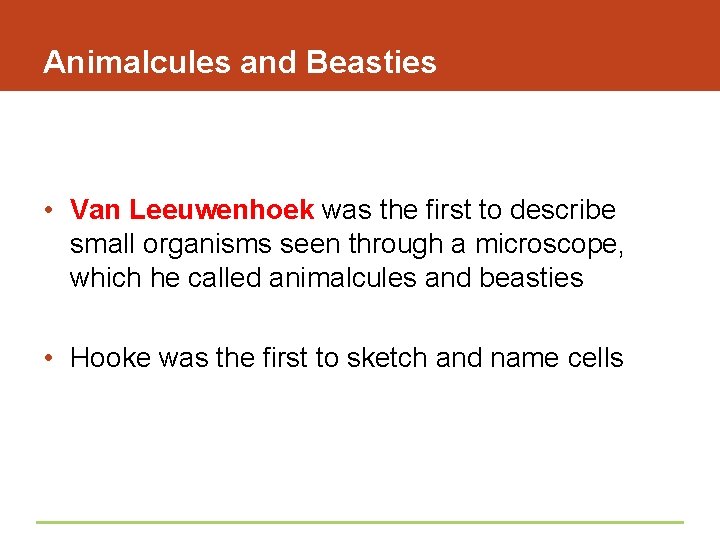
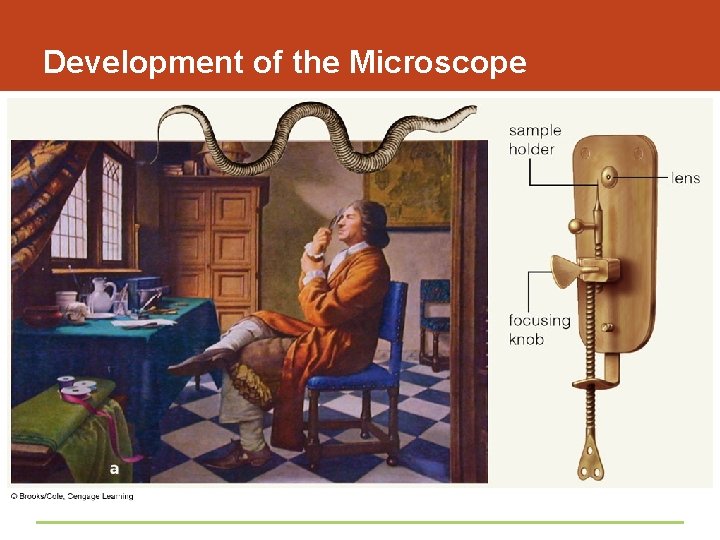
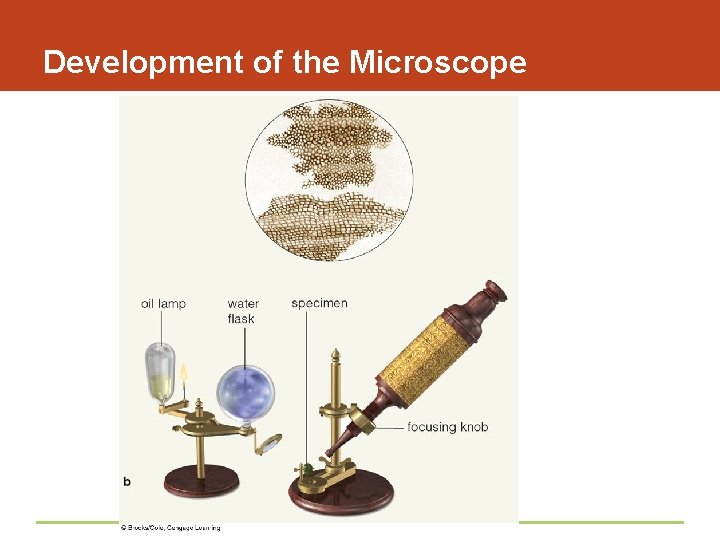
Animalcules and Beasties • Van Leeuwenhoek was the first to describe small organisms seen through a microscope, which he called animalcules and beasties • Hooke was the first to sketch and name cells
Development of the Microscope
Development of the Microscope
The Cell Theory Emerges • In 1839, Schleiden and Schwann proposed the basic concepts of the modern cell theory • All organisms consists of one or more cells • A cell is the smallest unit with the properties of life • Each new cell arises from division of another, preexisting cell • Each cell passes its hereditary material to its offspring
4. 2 What Is a Cell? • Cell • The smallest unit that shows the properties of life • All cells have a plasma membrane and cytoplasm, and all start out life with DNA
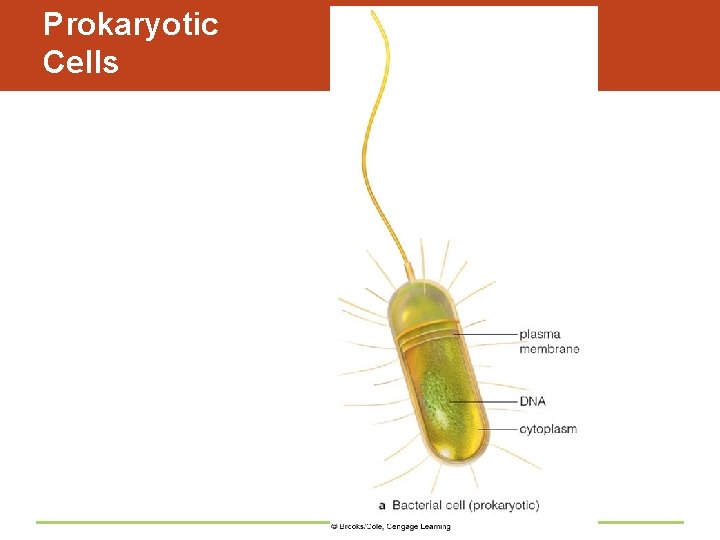
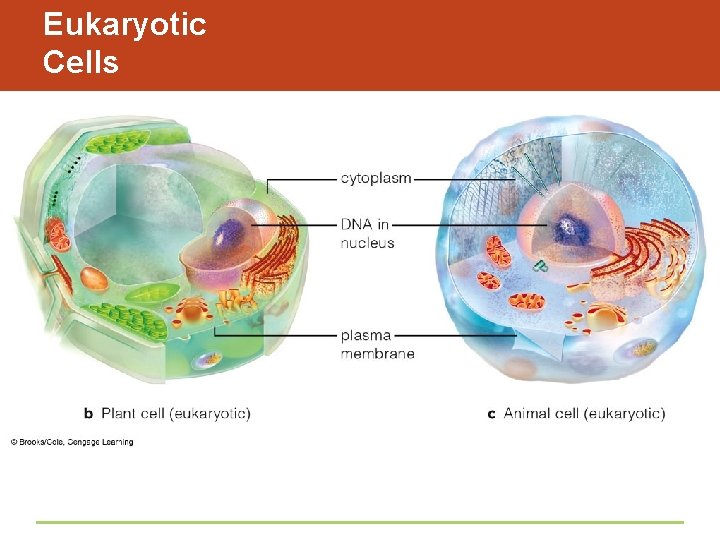
The Basics of Cell Structure • Eukaryotic cell • Cell interior is divided into functional compartments, including a nucleus • Prokaryotic cell • Small, simple cells without a nucleus
All Cells Have Three Things In Common • Plasma membrane • Controls substances passing in and out of the cell • DNA containing region • Nucleus in eukaryotic cells • Nucleoid region (核質體區) in prokaryotic cells • Cytoplasm • A semifluid mixture containing cell components
Prokaryotic Cells
Eukaryotic Cells
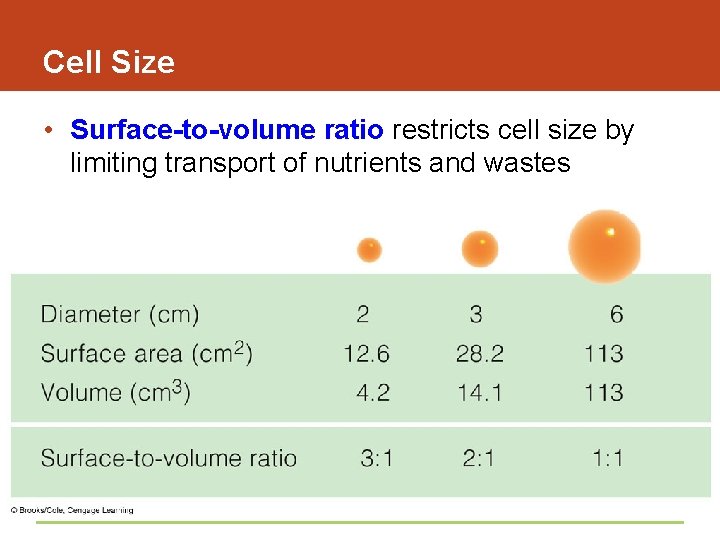
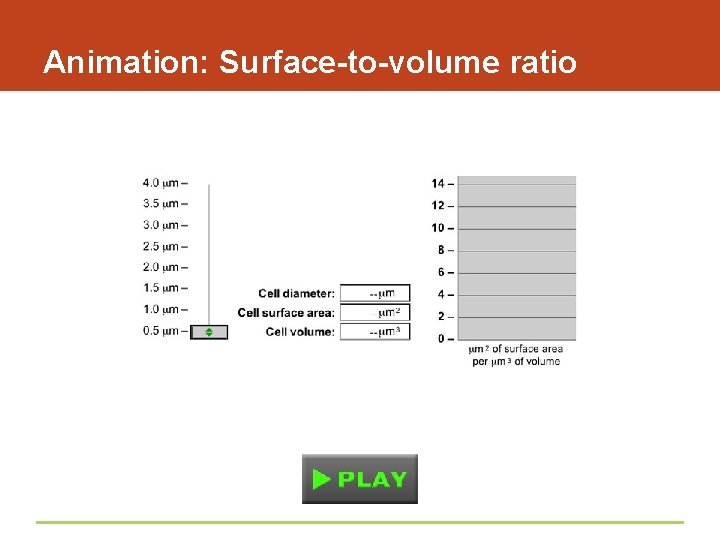
Cell Size • Surface-to-volume ratio restricts cell size by limiting transport of nutrients and wastes
Animation: Surface-to-volume ratio
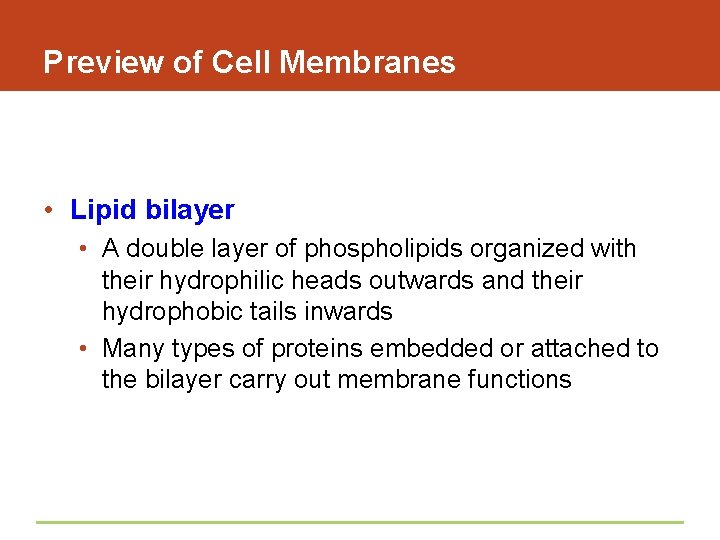
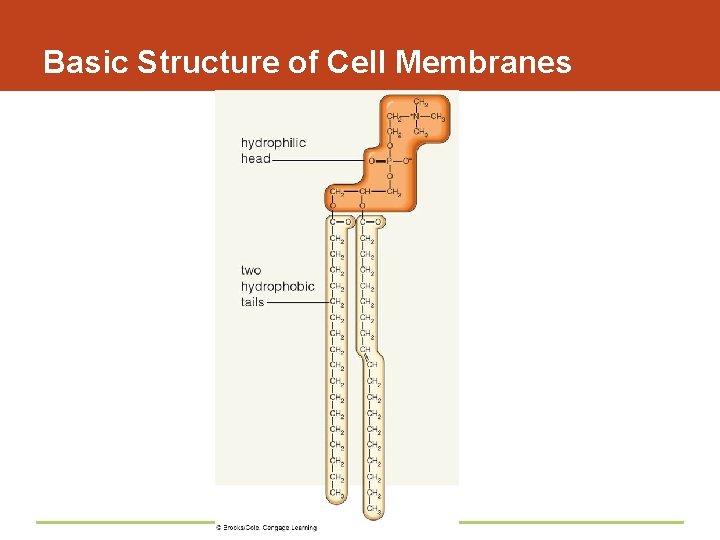
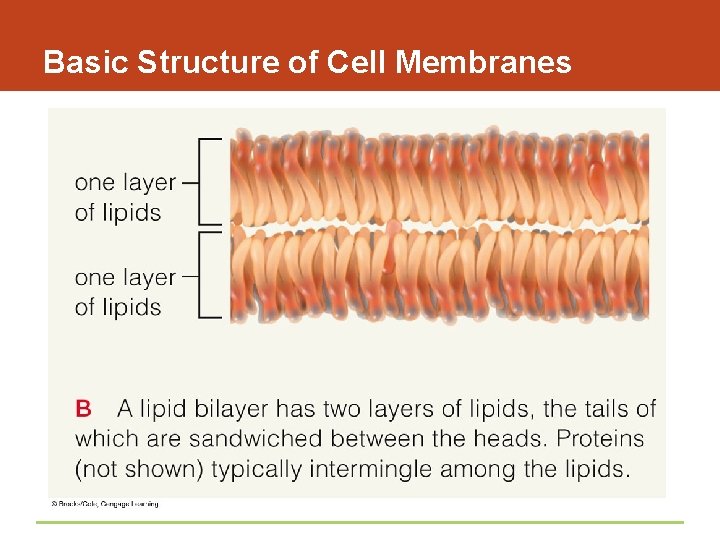
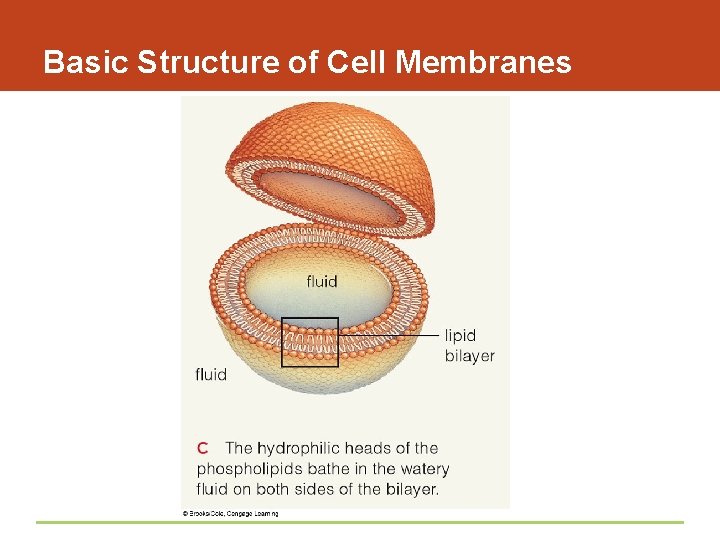
Preview of Cell Membranes • Lipid bilayer • A double layer of phospholipids organized with their hydrophilic heads outwards and their hydrophobic tails inwards • Many types of proteins embedded or attached to the bilayer carry out membrane functions
Basic Structure of Cell Membranes
Basic Structure of Cell Membranes
Basic Structure of Cell Membranes
Animation: Cell membranes To play movie you must be in Slide Show Mode PC Users: Please wait for content to load, then click to play Mac Users: CLICK HERE
4. 1 -4. 2 Key Concepts: What All Cells Have In Common • Each cell has a plasma membrane, a boundary between its interior and the outside environment • The interior consist of cytoplasm and an innermost region of DNA
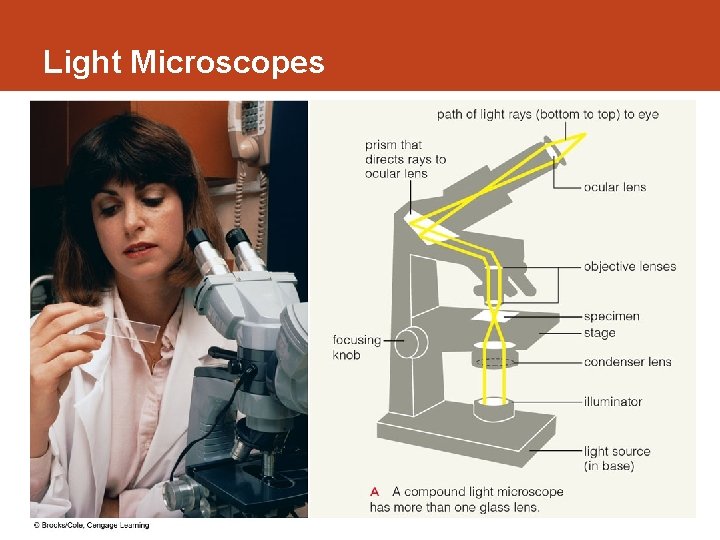
4. 3 How Do We See Cells? • We use different types of microscopes to study different aspects of organisms, from the smallest to the largest
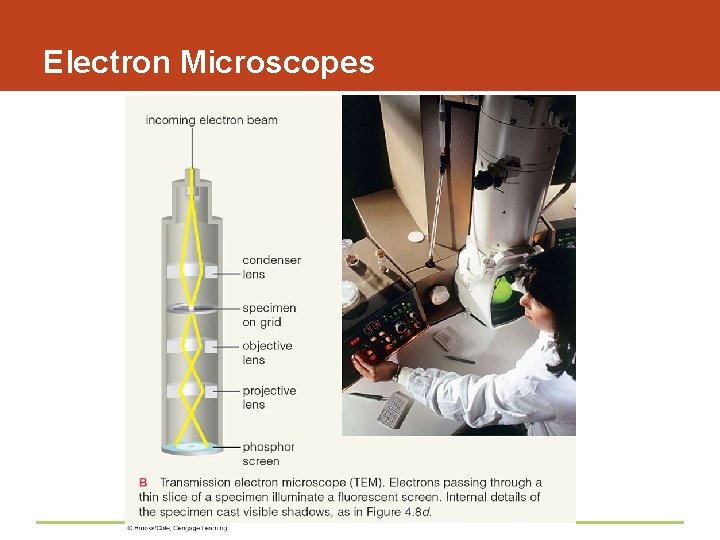
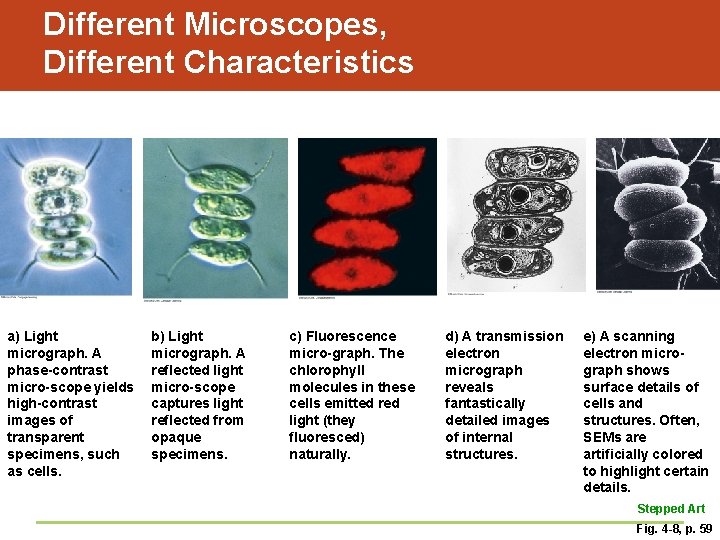
Modern Microscopes • Light microscopes • Phase-contrast microscopes • Reflected light microscopes • Fluorescence microscopes • Electron microscopes • Transmission electron microscopes • Scanning electron microscopes
Light Microscopes
Electron Microscopes
Animation: How a light microscope works To play movie you must be in Slide Show Mode PC Users: Please wait for content to load, then click to play Mac Users: CLICK HERE
Animation: How an electron microscope works To play movie you must be in Slide Show Mode PC Users: Please wait for content to load, then click to play Mac Users: CLICK HERE
Different Microscopes, Different Characteristics a) Light micrograph. A phase-contrast micro-scope yields high-contrast images of transparent specimens, such as cells. b) Light micrograph. A reflected light micro-scope captures light reflected from opaque specimens. c) Fluorescence micro-graph. The chlorophyll molecules in these cells emitted red light (they fluoresced) naturally. d) A transmission electron micrograph reveals fantastically detailed images of internal structures. e) A scanning electron micrograph shows surface details of cells and structures. Often, SEMs are artificially colored to highlight certain details. Stepped Art Fig. 4 -8, p. 59
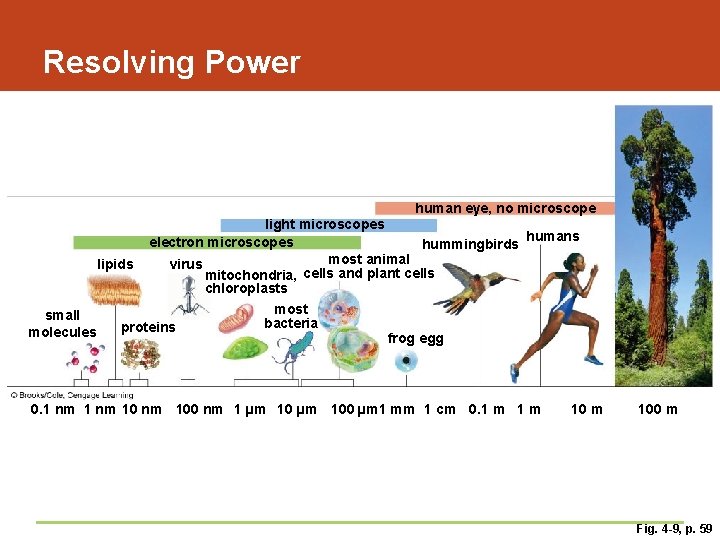
Resolving Power human eye, no microscope light microscopes humans electron microscopes hummingbirds most animal lipids virus mitochondria, cells and plant cells chloroplasts most small bacteria proteins molecules frog egg 0. 1 nm 100 nm 1 µm 100 µm 1 mm 1 cm 0. 1 m 100 m Fig. 4 -9, p. 59
4. 3 Key Concepts: Microscopes • Microscopic analysis supports three generalizations of the cell theory: • Each organism consists of one or more cells and their products • A cell has a capacity for independent life • Each new cell is descended from a living cell
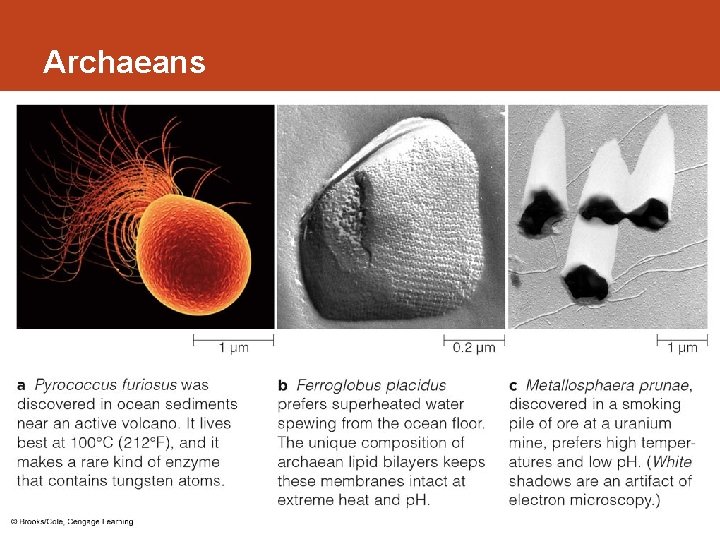
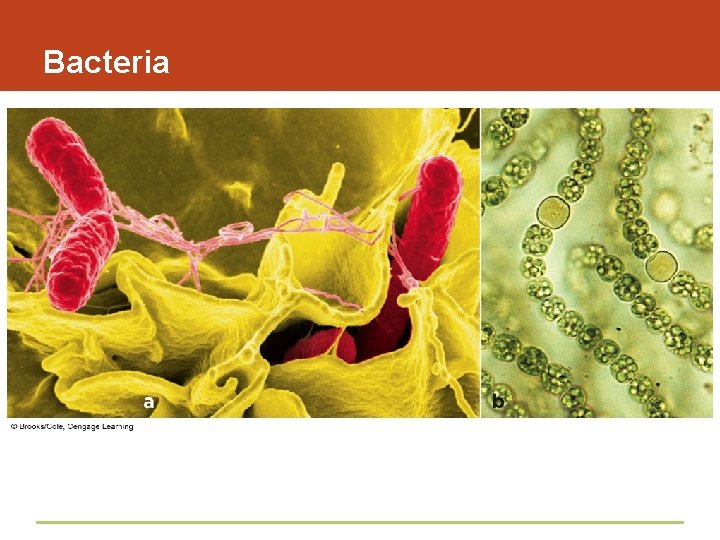
4. 4 Introducing Prokaryotic Cells • Bacteria and archaea are the prokaryotes (“before the nucleus”), the smallest and most metabolically diverse forms of life • Bacteria and archaea are similar in appearance and size, but differ in structure and metabolism
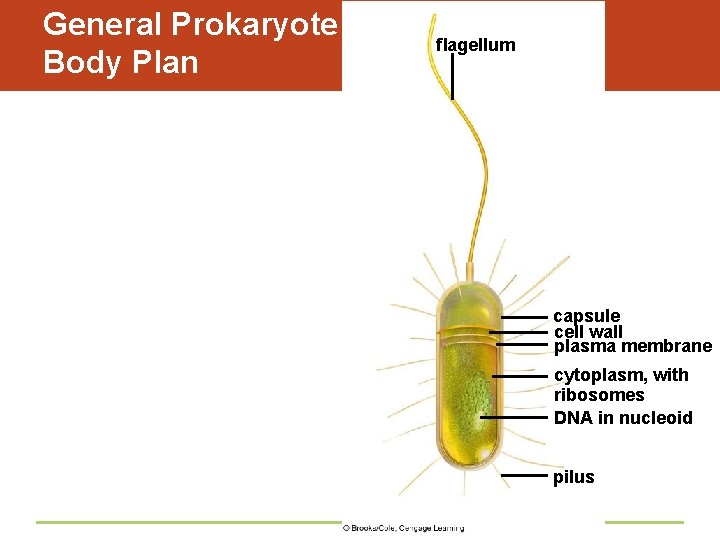
General Prokaryote Body Plan • Cell wall surrounds the plasma membrane • Made of peptidoglycan (in bacteria) or proteins (in archaea) and coated with a sticky capsule • Flagellum for motion • Pili help cells move across surfaces • Sex pilus aids in sexual reproduction
General Prokaryote Body Plan flagellum capsule cell wall plasma membrane cytoplasm, with ribosomes DNA in nucleoid pilus
Archaeans
Bacteria
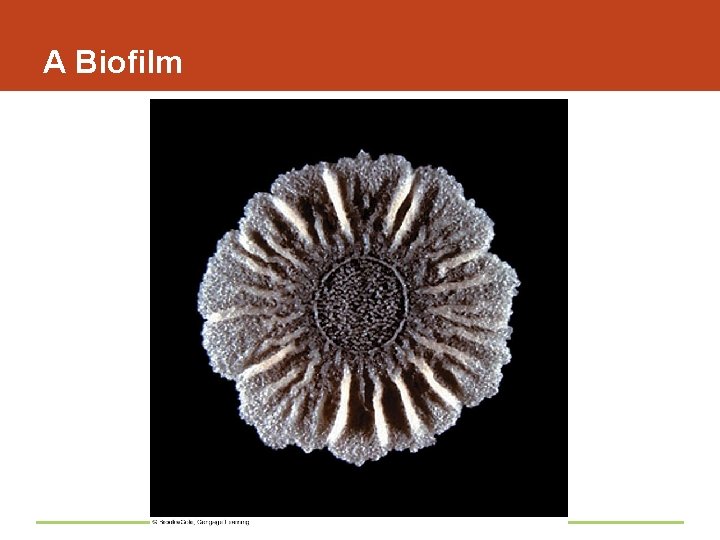
4. 5 Microbial Mobs • Although prokaryotes are all single-celled, few live alone • Biofilm • Single-celled organisms sharing a secreted layer of polysaccharides and glycoproteins • May include bacteria, algae, fungi, protists, and archaeans (多種物種)
A Biofilm
4. 4 -4. 5 Key Concepts: Prokaryotic Cells • Archaeans and bacteria are prokaryotic cells, which have few, if any, internal membraneenclosed compartments • In general, they are the smallest and structurally the simplest cells
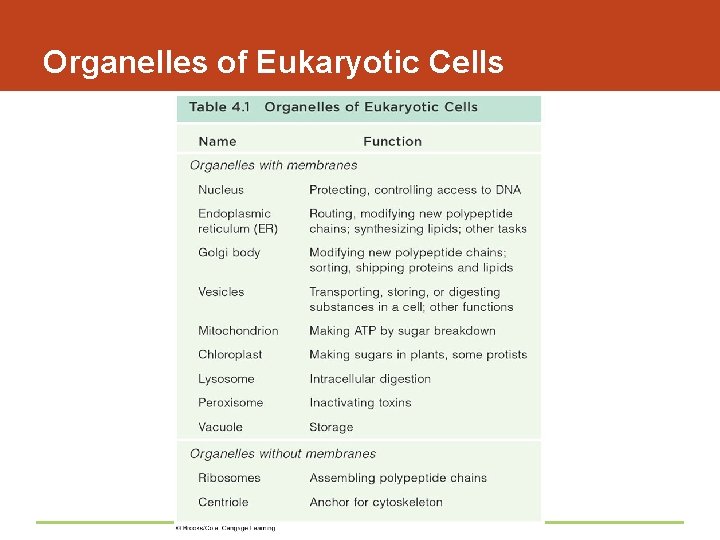
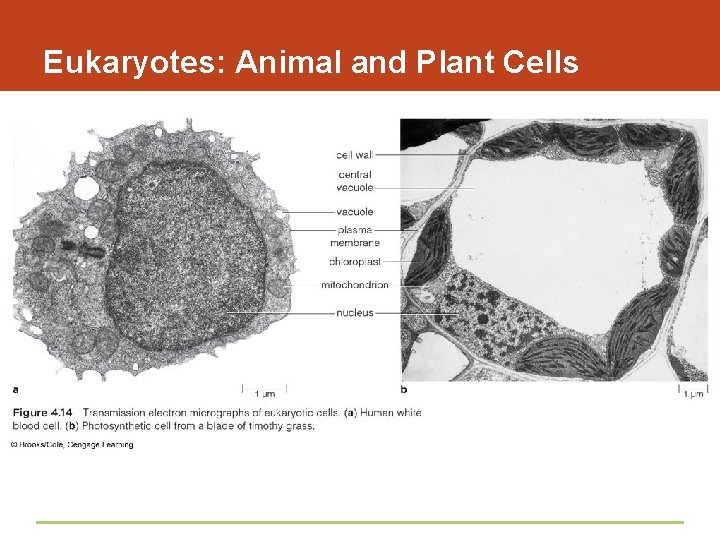
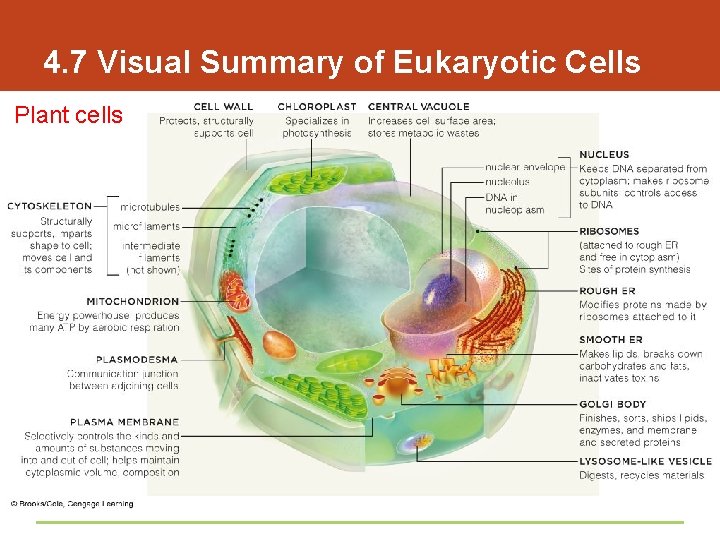
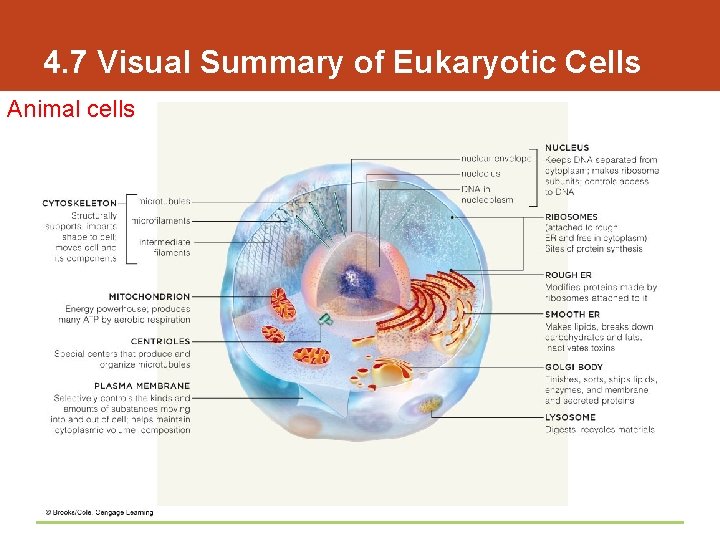
4. 6 Introducing Eukaryotic Cells • Eukaryotic (“true nucleus”) cells carry out much of their metabolism inside membrane-enclosed organelles • Organelle • A structure that carries out a specialized function within a cell
Organelles of Eukaryotic Cells
Eukaryotes: Animal and Plant Cells
4. 7 Visual Summary of Eukaryotic Cells Plant cells
4. 7 Visual Summary of Eukaryotic Cells Animal cells
4. 8 The Nucleus • The nucleus keeps eukaryotic DNA away from potentially damaging reactions in the cytoplasm • The nuclear envelope controls when DNA is accessed
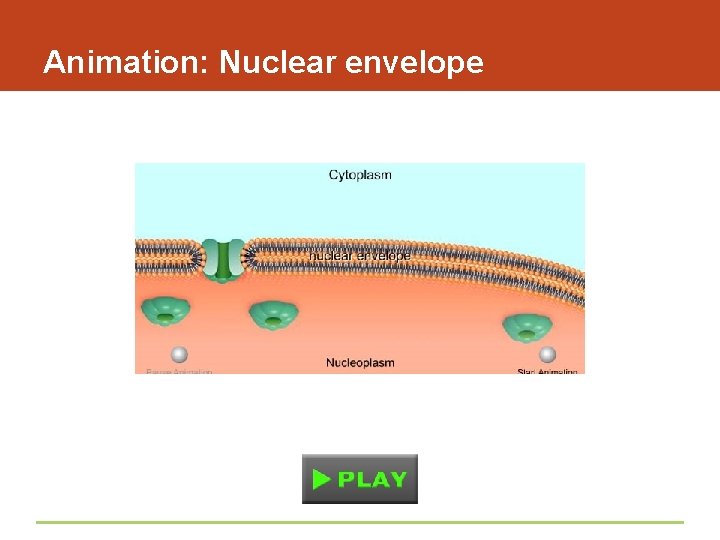
The Nuclear Envelope • Nuclear envelope • Two lipid bilayers pressed together as a single membrane surrounding the nucleus • Outer bilayer is continuous with the ER • Nuclear pores allow certain substances to pass through the membrane
Animation: Nuclear envelope
The Nucleoplasm and Nucleolus • Nucleoplasm • Viscous fluid inside the nuclear envelope, similar to cytoplasm • Nucleolus • A dense region in the nucleus where subunits of ribosomes are assembled from proteins and RNA (此為r. RNA)
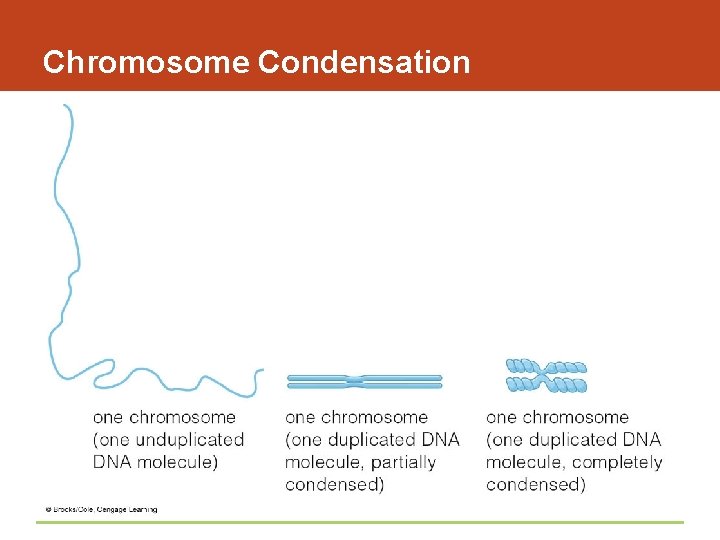
The Chromosomes • Chromatin • All DNA and its associated proteins in the nucleus • Chromosome • A single DNA molecule with its attached proteins • During cell division, chromosomes condense and become visible in micrographs • Human body cells have 46 chromosomes
Chromosome Condensation
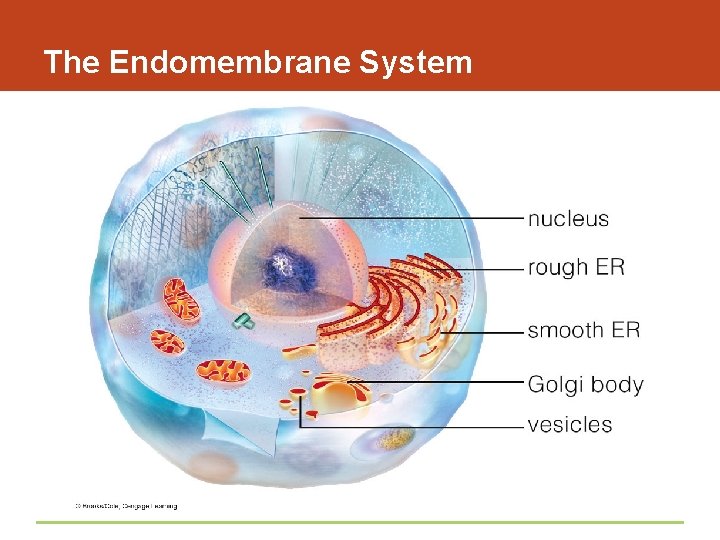
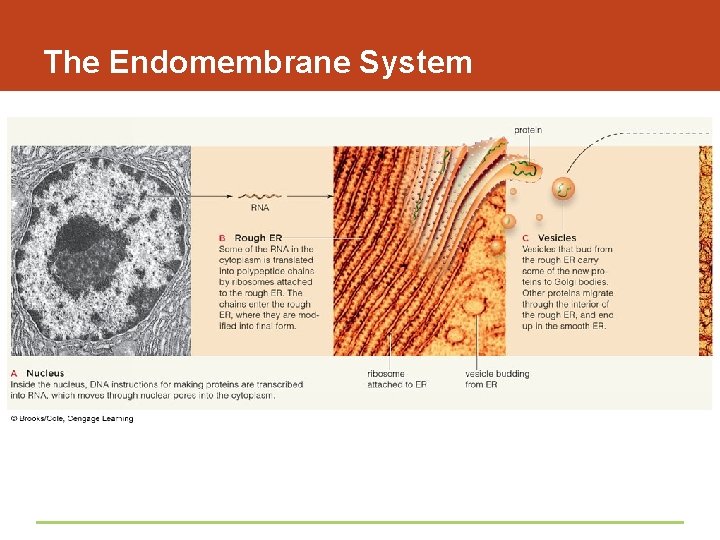
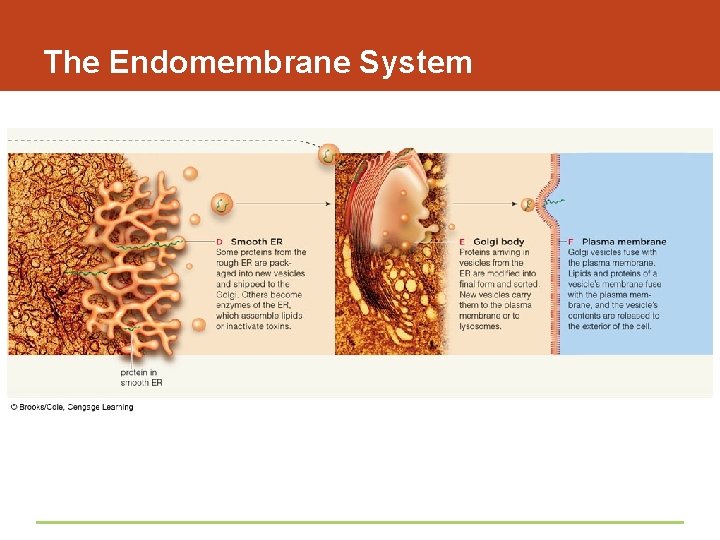
4. 9 The Endomembrane System • Endomembrane system • A series of interacting organelles between the nucleus and the plasma membrane • Makes lipids, enzymes, and proteins for secretion or insertion into cell membranes • Other specialized cell functions
The Endoplasmic Reticulum • Endoplasmic reticulum (ER) • An extension of the nuclear envelope that forms a continuous, folded compartment • Two kinds of endoplasmic reticulum • Rough ER (with ribosomes) folds polypeptides into their tertiary form • Smooth ER (no ribosomes) makes lipids, breaks down carbohydrates and lipids, detoxifies poisons
Vesicles • Small, membrane-enclosed saclike organelles that store or transport substances • Peroxisomes • Vesicles containing enzymes that break down hydrogen peroxide, alcohol, and other toxins. Also digest fatty acids and amino acid. • Vacuoles • Vesicles for waste disposal
Golgi Bodies and Lysosomes • Golgi body • A folded membrane containing enzymes that finish polypeptides and lipids delivered by the ER (記得也會運送脂肪) • Packages finished products in vesicles that carry them to the plasma membrane or to lysosomes • Lysosomes • Vesicles containing enzymes that fuse with vacuoles and digest waste materials
The Endomembrane System
The Endomembrane System
The Endomembrane System
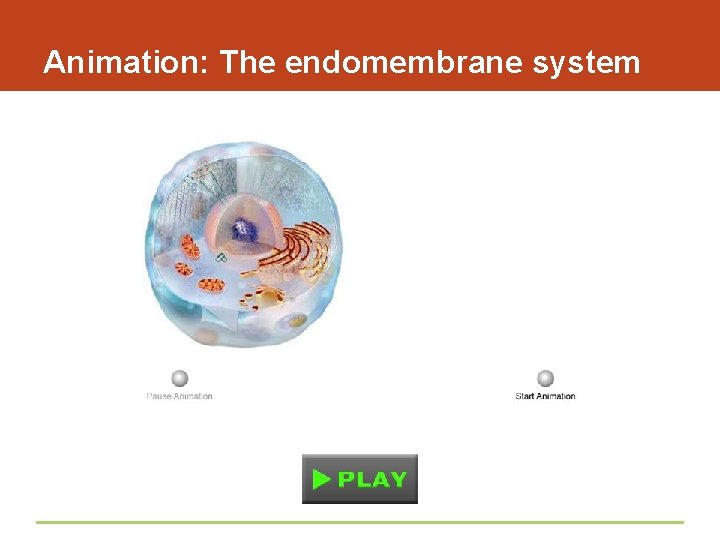
Animation: The endomembrane system
4. 10 Lysosome Malfunction • When lysosomes do not work properly, some cellular materials are not properly recycled, which can have devastating results • Different kinds of molecules are broken down by different lysosomal enzymes • One lysosomal enzyme breaks down gangliosides, a kind of lipid
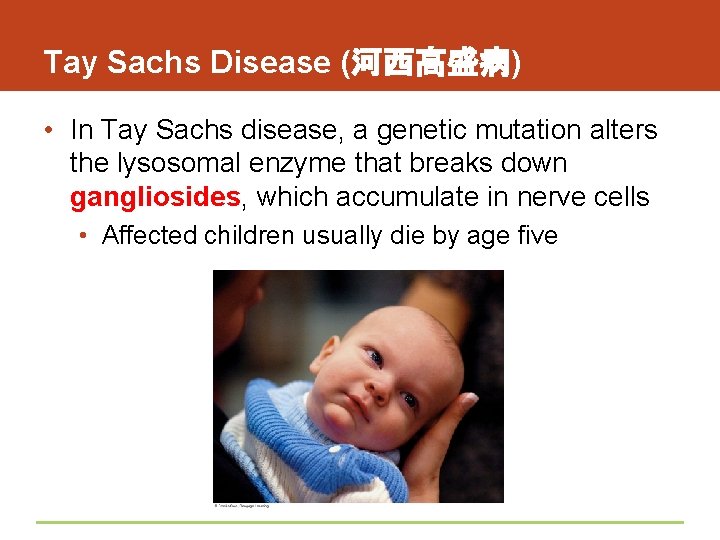
Tay Sachs Disease (河西高盛病) • In Tay Sachs disease, a genetic mutation alters the lysosomal enzyme that breaks down gangliosides, which accumulate in nerve cells • Affected children usually die by age five
4. 11 Other Organelles • Eukaryotic cells make most of their ATP in mitochondria • Plastids (色素體) function in storage and photosynthesis in plants and some types of algae (色素體包含葉綠體chloroplast、雜色體 chromoplast、澱粉體amyloplast)
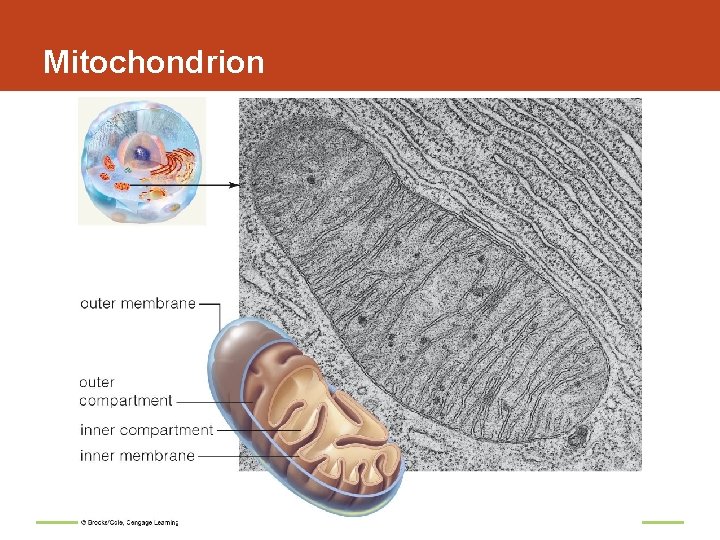
Mitochondria • Mitochondrion • Eukaryotic organelle that makes the energy molecule ATP through aerobic respiration • Contains two membranes, forming inner and outer compartments; buildup of hydrogen ions in the outer compartment drives ATP synthesis • Has its own DNA and ribosomes • Resembles bacteria; may have evolved through endosymbiosis (內共生)
Mitochondrion
Animation: Structure of a mitochondrion I To play movie you must be in Slide Show Mode PC Users: Please wait for content to load, then click to play Mac Users: CLICK HERE
Plastids • Plastids (色素體) • Organelles that function in photosynthesis or storage in plants and algae; includes chromoplasts (雜色體), amyloplasts(澱粉體), and chloroplasts(葉綠體),注意澱粉體不含色素 • Chloroplasts (葉綠體) • Plastids specialized for photosynthesis • Resemble photosynthetic bacteria; may have evolved by endosymbiosis
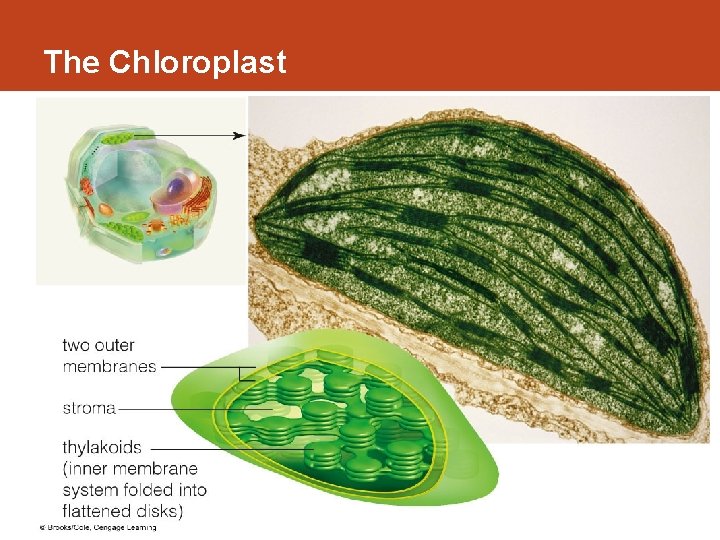
The Chloroplast
The Central Vacuole • Central vacuole • A plant organelle that occupies 50 to 90 percent of a cell’s interior • Stores amino acids, sugars, ions, wastes, toxins • Fluid pressure keeps plant cells firm
4. 12 Cell Surface Specializations • A wall or other protective covering often intervenes between a cell’s plasma membrane and the surroundings
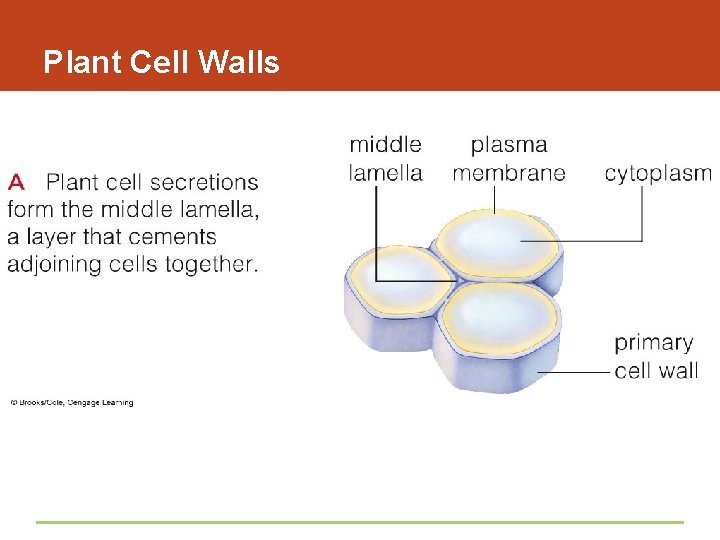
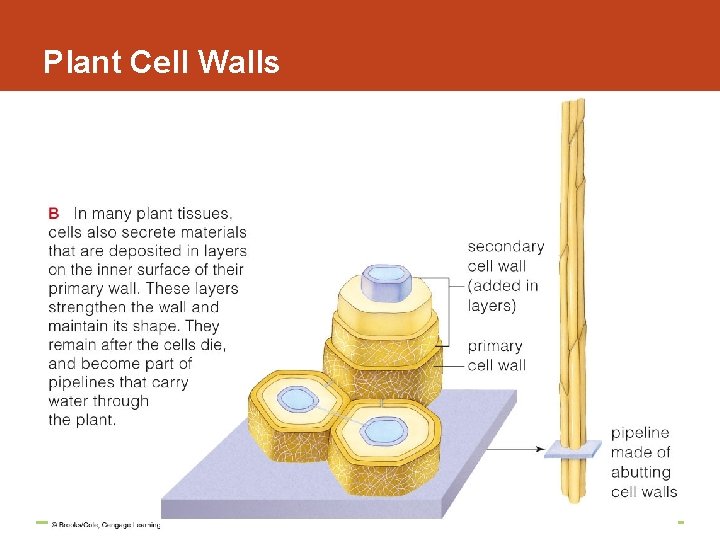
Eukaryotic Cell Walls • Animal cells do not have walls, but plant cells and many protist and fungal cells do • Primary cell wall • A thin, pliable wall formed by secretion of cellulose into the coating around young plant cells • Secondary cell wall • A strong wall composed of lignin (木質素,單體是 醇類而非�類), formed in some plant stems and roots after maturity
Plant Cell Walls
Plant Cell Walls
Plant Cell Walls
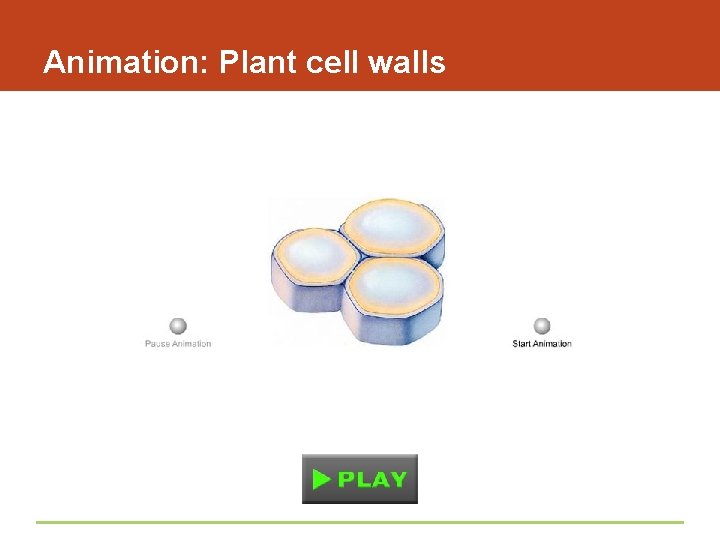
Animation: Plant cell walls
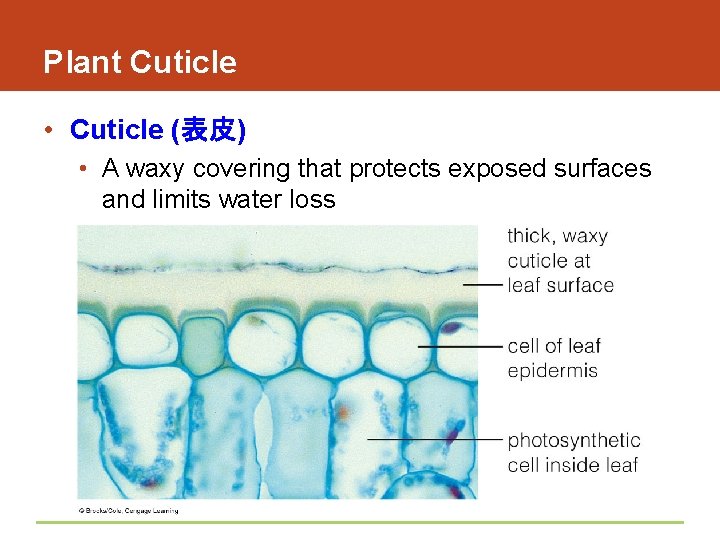
Plant Cuticle • Cuticle (表皮) • A waxy covering that protects exposed surfaces and limits water loss
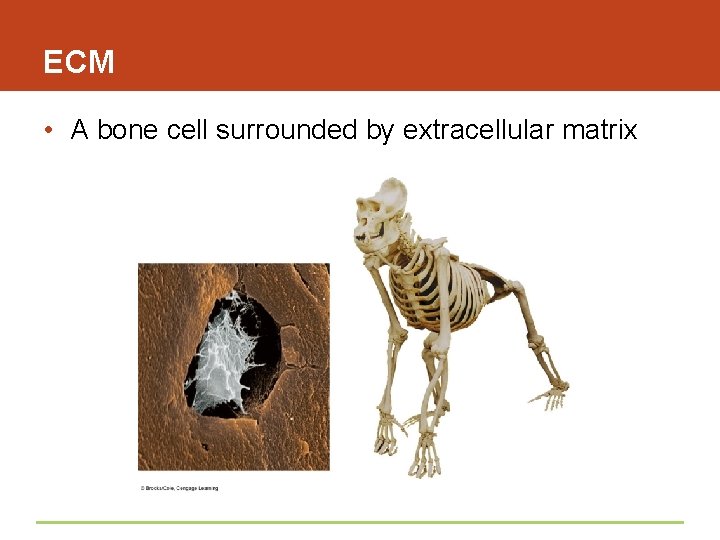
Matrixes Between Animal Cells • Extracellular matrix (ECM) • A nonliving, complex mixture of fibrous proteins and polysaccharides secreted by and surrounding cells; structure and function varies with the type of tissue • Example: Bone is mostly ECM, composed of collagen (fibrous protein) and hardened by mineral deposits
ECM • A bone cell surrounded by extracellular matrix
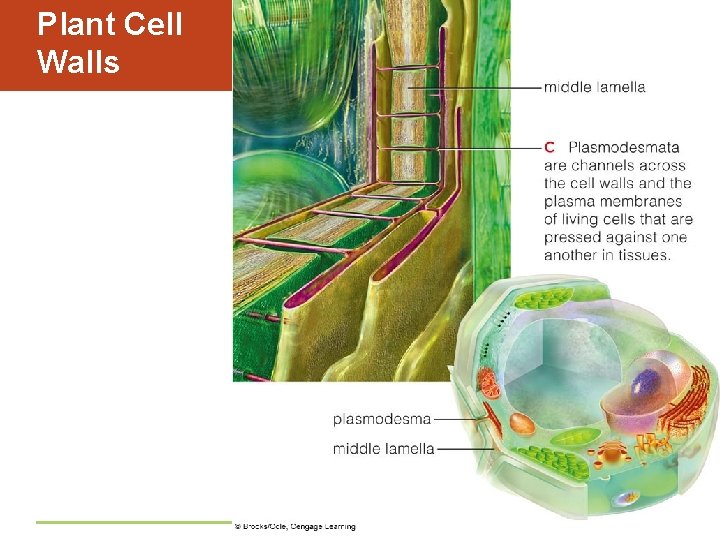
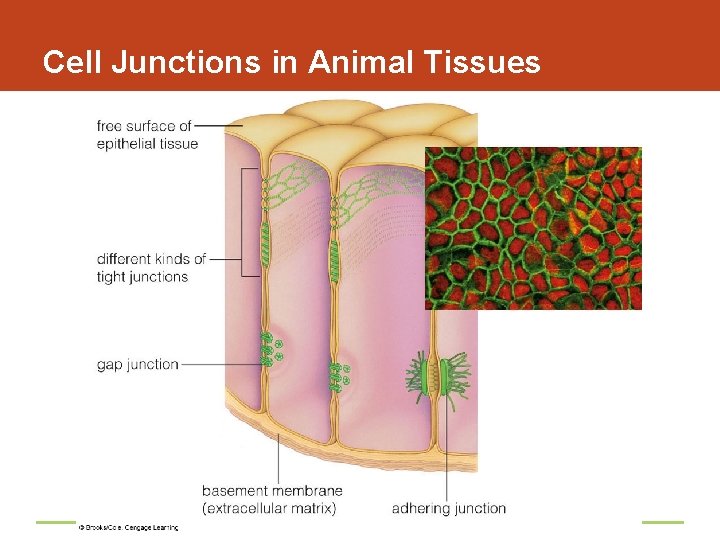
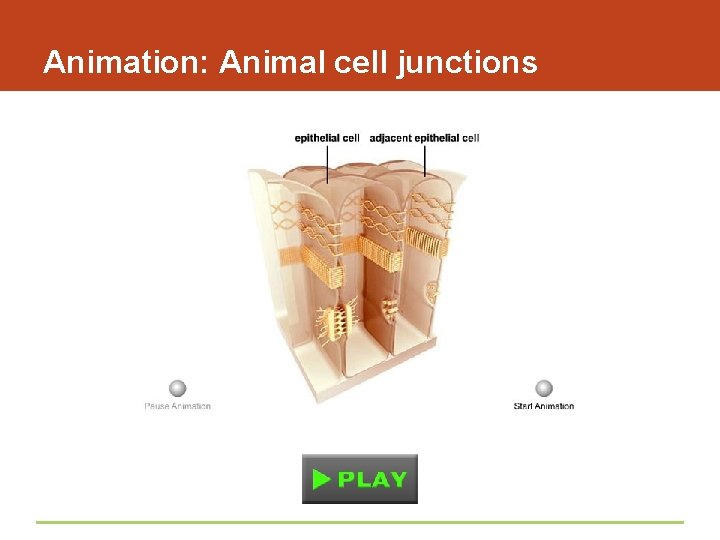
Cell Junctions • Cell junctions allow cells to interact with each other and the environment • In plants, plasmodesmata extend through cell walls to connect the cytoplasm of two cells • Animals have three types of cell junctions: tight junctions, adhering junctions, gap junctions
Cell Junctions in Animal Tissues
Animation: Animal cell junctions
4. 6 -4. 12 Key Concepts: Eukaryotic Cells • Cells of protists, plants, fungi, and animals are eukaryotic; they have a nucleus and other membrane-enclosed compartments • They differ in internal parts and surface specializations
4. 13 The Dynamic Cytoskeleton • Eukaryotic cells have an extensive and dynamic internal framework called a cytoskeleton • Cytoskeleton • An interconnected system of many protein filaments – some permanent, some temporary • Parts of the cytoskeleton reinforce, organize, and move cell structures, or even a whole cell
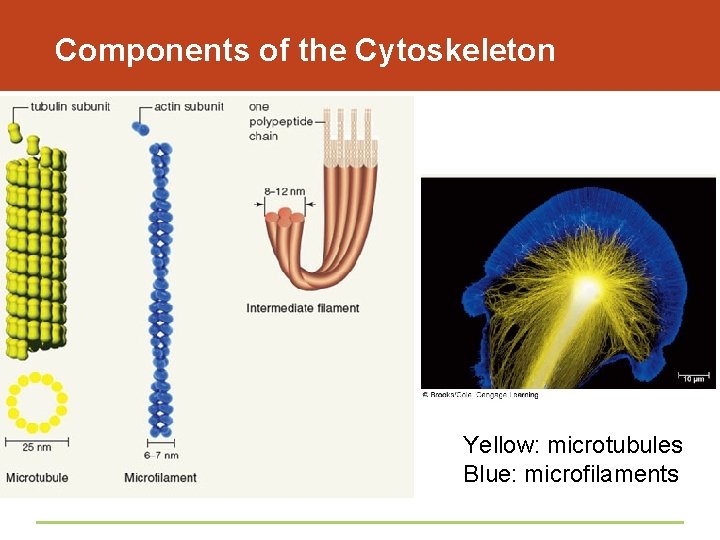
Components of the Cytoskeleton • Microtubules • Long, hollow cylinders made of tubulin • Form dynamic scaffolding for cell processes • Microfilaments • Consist mainly of the globular protein actin • Make up the cell cortex • Intermediate filaments • Maintain cell and tissue structures
Components of the Cytoskeleton Yellow: microtubules Blue: microfilaments
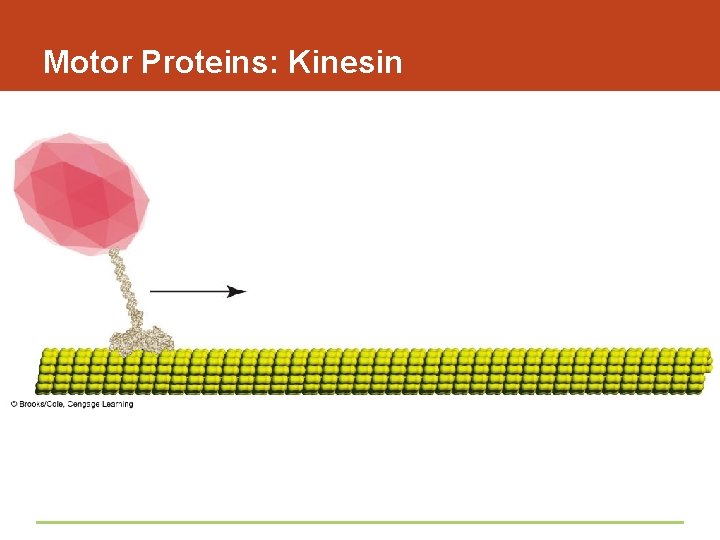
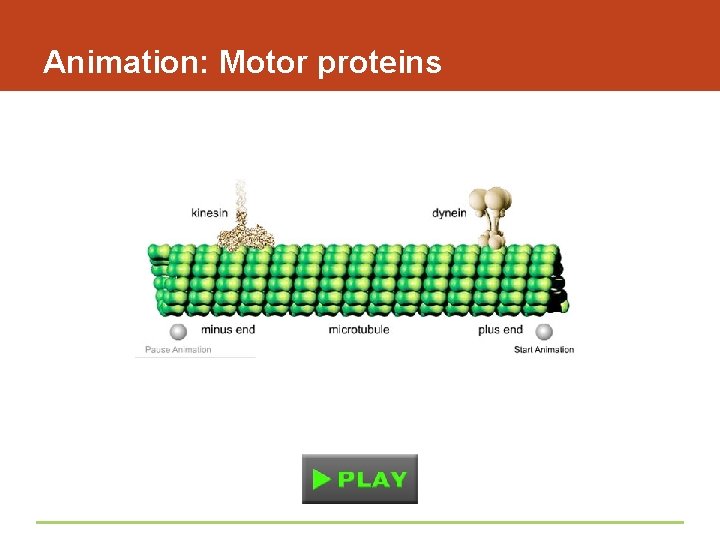
Motor Proteins • Motor proteins • Accessory proteins that move molecules through cells on tracks of microtubules and microfilaments (兩者都會動,所以都有) • Energized by ATP • Example: kinesins
Motor Proteins: Kinesin
Animation: Motor proteins
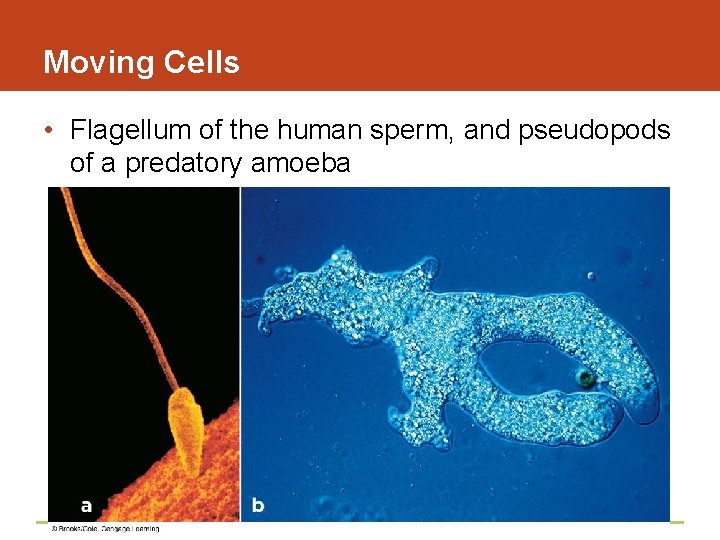
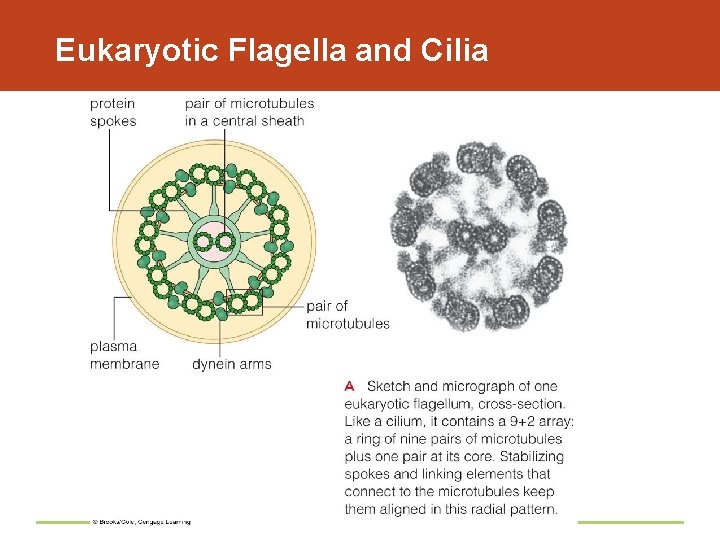
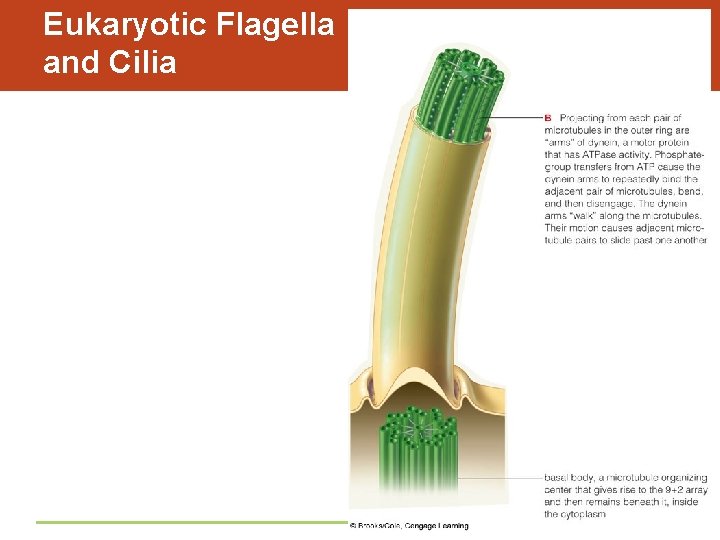
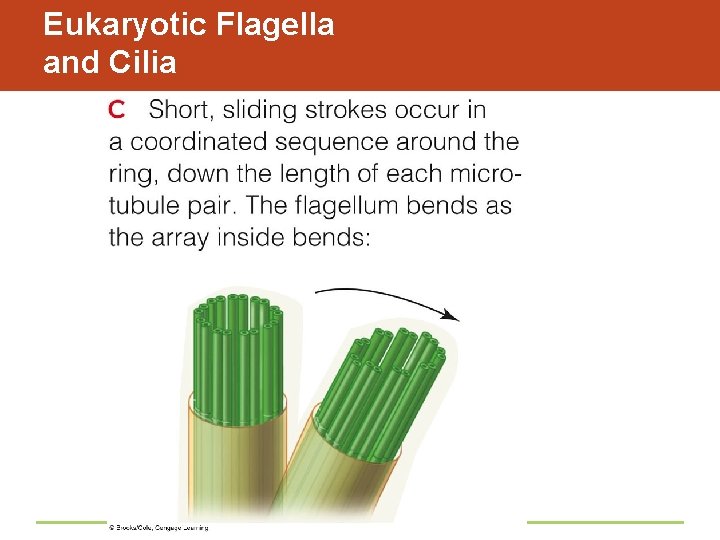
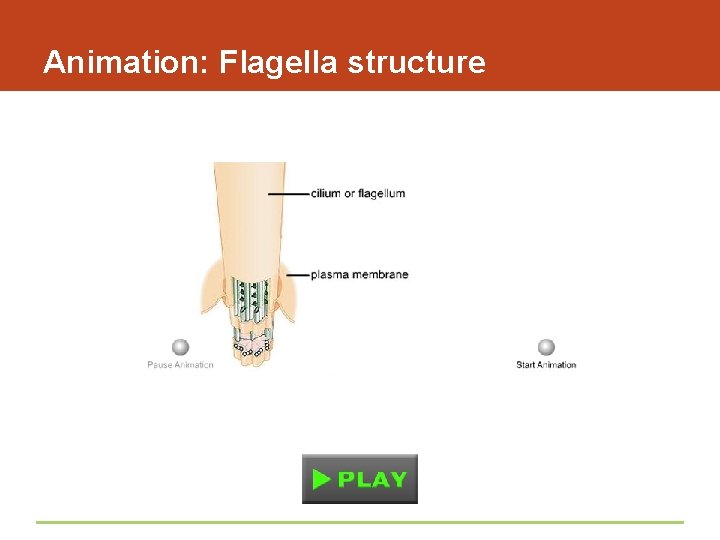
Cilia, Flagella, and False Feet • Eukaryotic flagella and cilia • Whiplike structures formed from microtubules organized into 9 + 2 arrays • Grow from a centriole which remains in the cytoplasm as a basal body • Psueudopods • “False feet” used by amoebas and other eukaryotic cells to move or engulf prey
Moving Cells • Flagellum of the human sperm, and pseudopods of a predatory amoeba
Eukaryotic Flagella and Cilia
Eukaryotic Flagella and Cilia
Eukaryotic Flagella and Cilia
Animation: Flagella structure
4. 13 Key Concepts: A Look at the Cytoskeleton • Diverse protein filaments reinforce a cell’s shape and keep its parts organized • As some filaments lengthen and shorten, they move cell structures or the whole cell
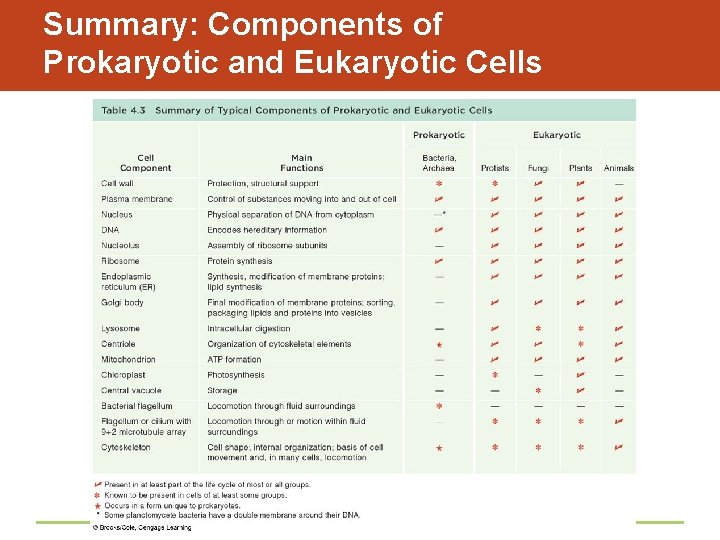
Summary: Components of Prokaryotic and Eukaryotic Cells