
Cell Signaling A Molecular View Shuchismita Dutta Ph
- Slides: 19
Cell Signaling: A Molecular View Shuchismita Dutta, Ph. D. Developed as part of the RCSB Collaborative Curriculum Development Program 2016
Learning Objectives • Introduction to Cell Communication • Cell Signaling Pathways Developed as part of the RCSB Collaborative Curriculum Development Program 2016
Learning Objectives • Introduction to Cell Communication • Cell Signaling Pathways Developed as part of the RCSB Collaborative Curriculum Development Program 2016
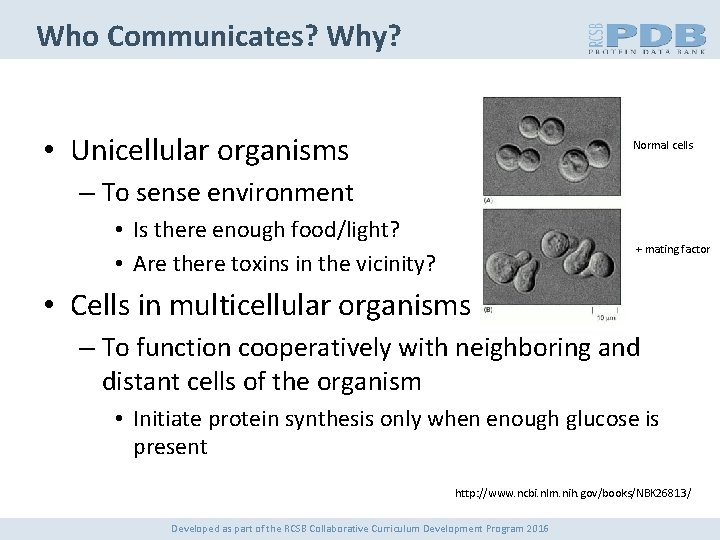
Who Communicates? Why? • Unicellular organisms Normal cells – To sense environment • Is there enough food/light? • Are there toxins in the vicinity? + mating factor • Cells in multicellular organisms – To function cooperatively with neighboring and distant cells of the organism • Initiate protein synthesis only when enough glucose is present http: //www. ncbi. nlm. nih. gov/books/NBK 26813/ Developed as part of the RCSB Collaborative Curriculum Development Program 2016
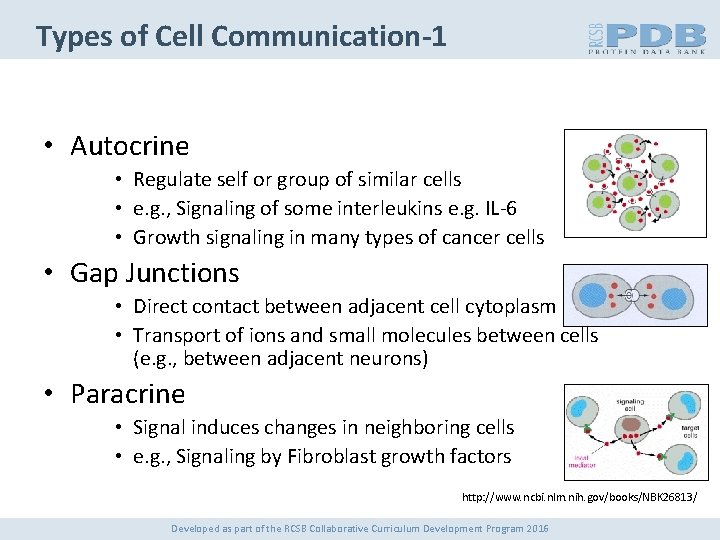
Types of Cell Communication-1 • Autocrine • Regulate self or group of similar cells • e. g. , Signaling of some interleukins e. g. IL-6 • Growth signaling in many types of cancer cells • Gap Junctions • Direct contact between adjacent cell cytoplasm • Transport of ions and small molecules between cells (e. g. , between adjacent neurons) • Paracrine • Signal induces changes in neighboring cells • e. g. , Signaling by Fibroblast growth factors http: //www. ncbi. nlm. nih. gov/books/NBK 26813/ Developed as part of the RCSB Collaborative Curriculum Development Program 2016
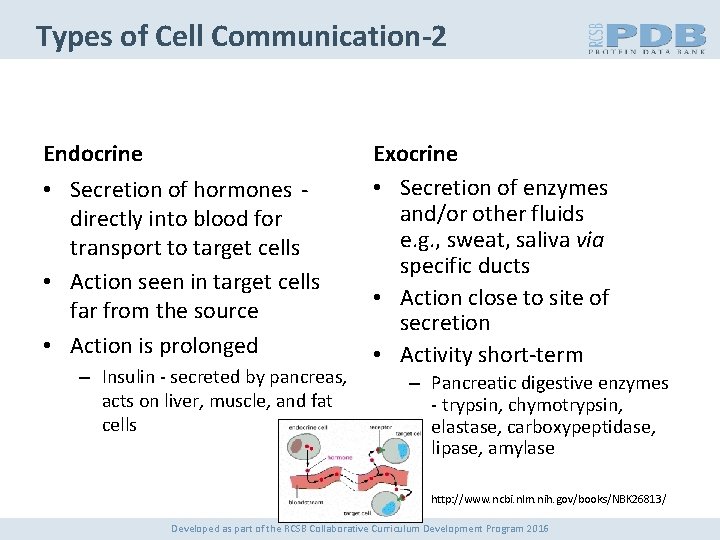
Types of Cell Communication-2 Endocrine • Secretion of hormones directly into blood for transport to target cells • Action seen in target cells far from the source • Action is prolonged – Insulin - secreted by pancreas, acts on liver, muscle, and fat cells Exocrine • Secretion of enzymes and/or other fluids e. g. , sweat, saliva via specific ducts • Action close to site of secretion • Activity short-term – Pancreatic digestive enzymes - trypsin, chymotrypsin, elastase, carboxypeptidase, lipase, amylase http: //www. ncbi. nlm. nih. gov/books/NBK 26813/ Developed as part of the RCSB Collaborative Curriculum Development Program 2016
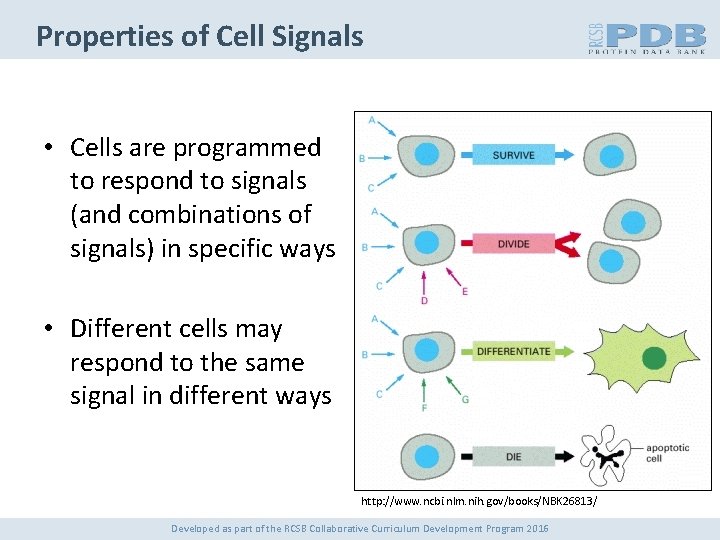
Properties of Cell Signals • Cells are programmed to respond to signals (and combinations of signals) in specific ways • Different cells may respond to the same signal in different ways http: //www. ncbi. nlm. nih. gov/books/NBK 26813/ Developed as part of the RCSB Collaborative Curriculum Development Program 2016
Learning Objectives • Introduction to Cell Communication • Cell Signaling Pathways Developed as part of the RCSB Collaborative Curriculum Development Program 2016
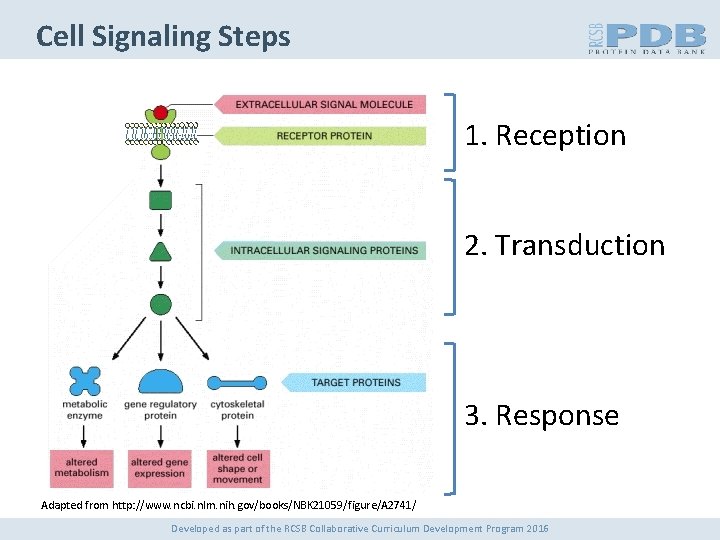
Cell Signaling Steps 1. Reception 2. Transduction 3. Response Adapted from http: //www. ncbi. nlm. nih. gov/books/NBK 21059/figure/A 2741/ Developed as part of the RCSB Collaborative Curriculum Development Program 2016
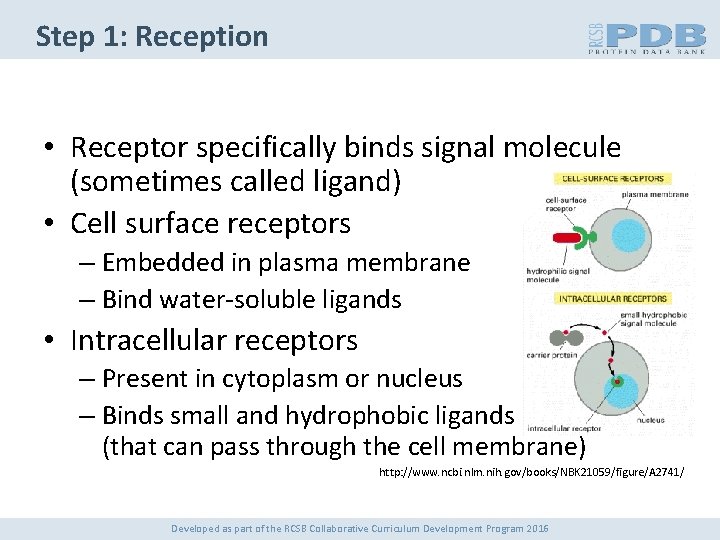
Step 1: Reception • Receptor specifically binds signal molecule (sometimes called ligand) • Cell surface receptors – Embedded in plasma membrane – Bind water-soluble ligands • Intracellular receptors – Present in cytoplasm or nucleus – Binds small and hydrophobic ligands (that can pass through the cell membrane) http: //www. ncbi. nlm. nih. gov/books/NBK 21059/figure/A 2741/ Developed as part of the RCSB Collaborative Curriculum Development Program 2016
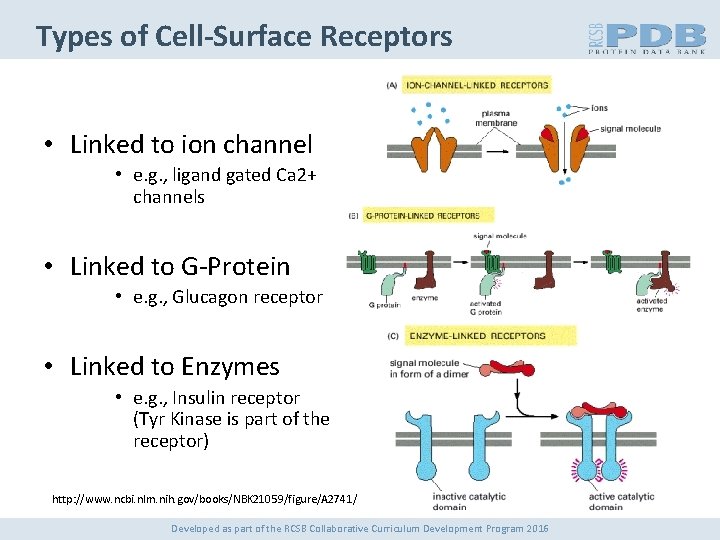
Types of Cell-Surface Receptors • Linked to ion channel • e. g. , ligand gated Ca 2+ channels • Linked to G-Protein • e. g. , Glucagon receptor • Linked to Enzymes • e. g. , Insulin receptor (Tyr Kinase is part of the receptor) http: //www. ncbi. nlm. nih. gov/books/NBK 21059/figure/A 2741/ Developed as part of the RCSB Collaborative Curriculum Development Program 2016
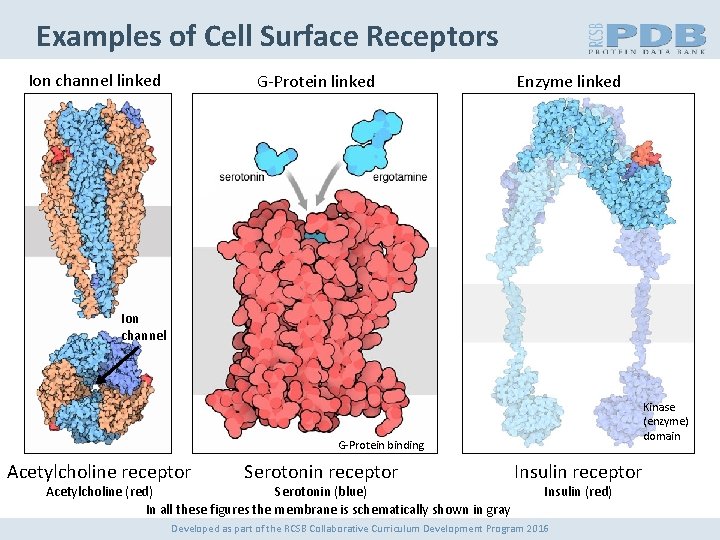
Examples of Cell Surface Receptors Ion channel linked G-Protein linked Enzyme linked Ion channel Kinase (enzyme) domain G-Protein binding Acetylcholine receptor Serotonin receptor Acetylcholine (red) Serotonin (blue) In all these figures the membrane is schematically shown in gray Insulin receptor Insulin (red) Developed as part of the RCSB Collaborative Curriculum Development Program 2016
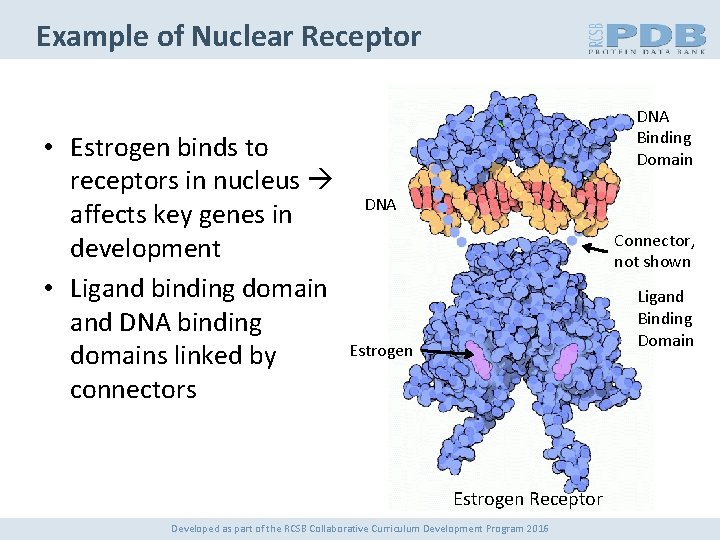
Example of Nuclear Receptor • Estrogen binds to receptors in nucleus affects key genes in development • Ligand binding domain and DNA binding domains linked by connectors DNA Binding Domain DNA Connector, not shown Ligand Binding Domain Estrogen Receptor Developed as part of the RCSB Collaborative Curriculum Development Program 2016
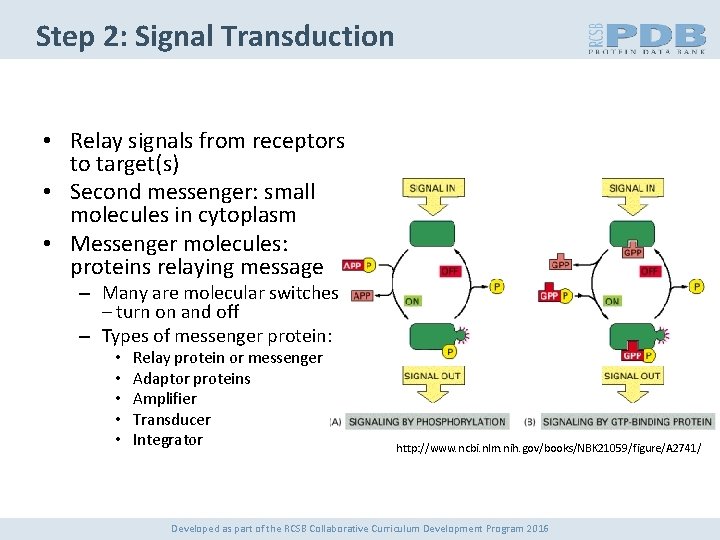
Step 2: Signal Transduction • Relay signals from receptors to target(s) • Second messenger: small molecules in cytoplasm • Messenger molecules: proteins relaying message – Many are molecular switches – turn on and off – Types of messenger protein: • • • Relay protein or messenger Adaptor proteins Amplifier Transducer Integrator http: //www. ncbi. nlm. nih. gov/books/NBK 21059/figure/A 2741/ Developed as part of the RCSB Collaborative Curriculum Development Program 2016
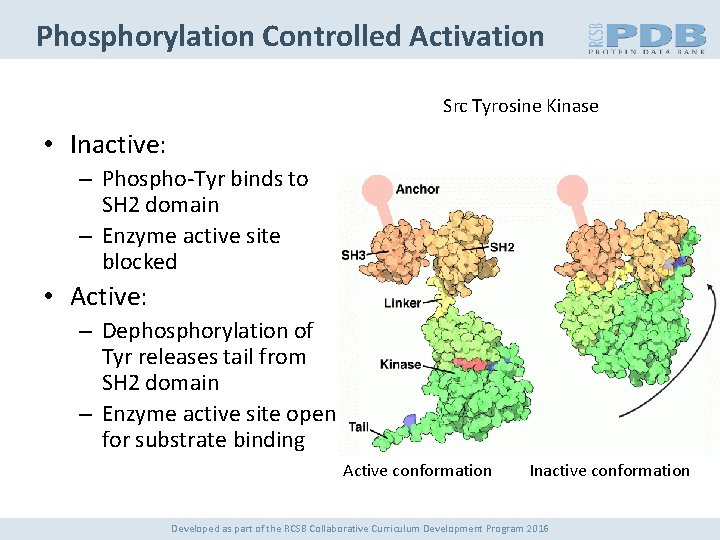
Phosphorylation Controlled Activation Src Tyrosine Kinase • Inactive: – Phospho-Tyr binds to SH 2 domain – Enzyme active site blocked • Active: – Dephosphorylation of Tyr releases tail from SH 2 domain – Enzyme active site open for substrate binding Active conformation Inactive conformation Developed as part of the RCSB Collaborative Curriculum Development Program 2016
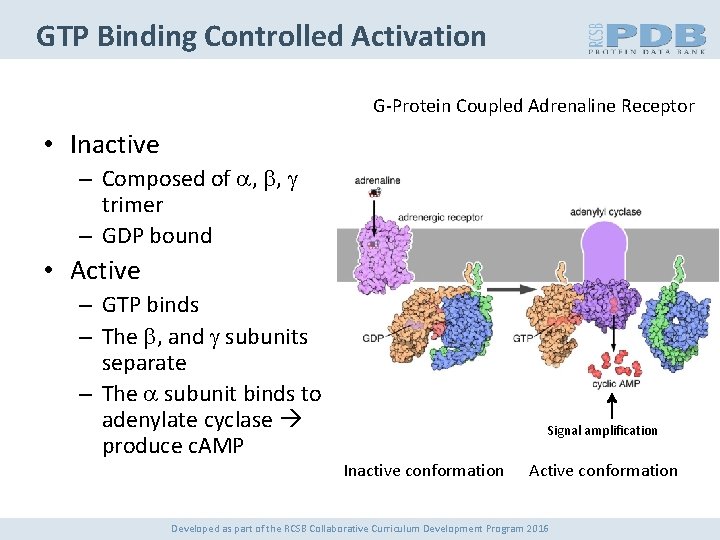
GTP Binding Controlled Activation G-Protein Coupled Adrenaline Receptor • Inactive – Composed of a, b, g trimer – GDP bound • Active – GTP binds – The b, and g subunits separate – The a subunit binds to adenylate cyclase produce c. AMP Signal amplification Inactive conformation Active conformation Developed as part of the RCSB Collaborative Curriculum Development Program 2016
Step 3: Response • Regulation of cytoplasmic activities – Rearrangement of cytoskeleton – Movement of vesicles to cell surface • Release of stored hormones, messengers etc. • Translocate specific receptors/channels to cell surface – Activation or inhibition of enzyme(s) • Regulation of nuclear activities – Gene regulation – activation or inhibition – Transcription cell proliferation/differentiation Developed as part of the RCSB Collaborative Curriculum Development Program 2016
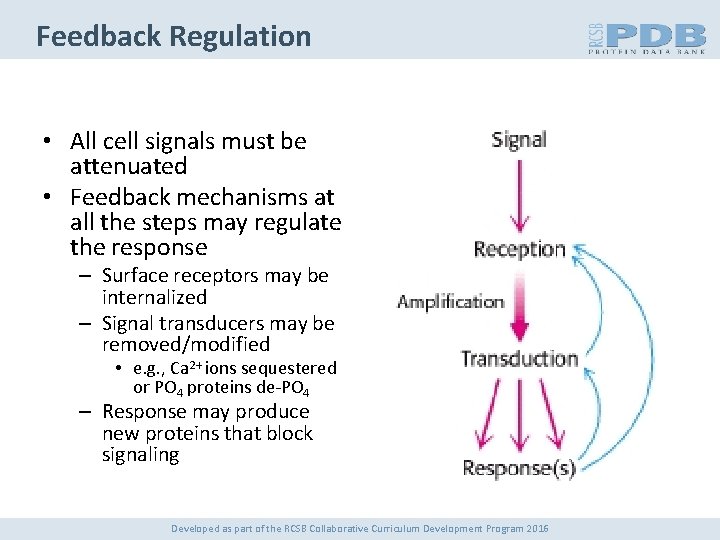
Feedback Regulation • All cell signals must be attenuated • Feedback mechanisms at all the steps may regulate the response – Surface receptors may be internalized – Signal transducers may be removed/modified • e. g. , Ca 2+ ions sequestered or PO 4 proteins de-PO 4 – Response may produce new proteins that block signaling Developed as part of the RCSB Collaborative Curriculum Development Program 2016
Summary • Introduction to Cell Communication – Types and Properties • Cell Signaling Pathways – Reception, Signal Transduction and Response Developed as part of the RCSB Collaborative Curriculum Development Program 2016