
CELL RESPIRATION Energy is converted to a usable
CELL RESPIRATION Energy is converted to a usable form in cell respiration. AHL Topic 8. 2 IB Biology Miss Werba
TOPIC 8 – HL MOLECULAR BIOLOGY 8. 1 METABOLISM 8. 3 PHOTOSYNTHESIS J WERBA – IB BIOLOGY 8. 2 CELL RESPIRATION 2
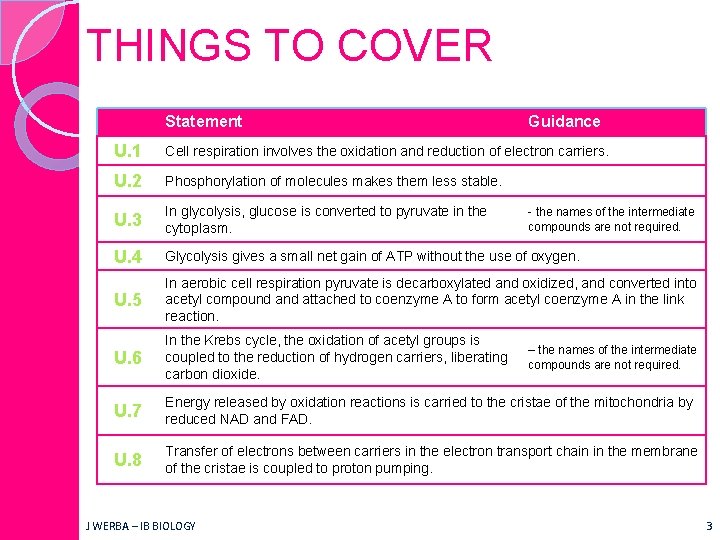
THINGS TO COVER Statement Guidance U. 1 Cell respiration involves the oxidation and reduction of electron carriers. U. 2 Phosphorylation of molecules makes them less stable. U. 3 In glycolysis, glucose is converted to pyruvate in the cytoplasm. U. 4 Glycolysis gives a small net gain of ATP without the use of oxygen. U. 5 In aerobic cell respiration pyruvate is decarboxylated and oxidized, and converted into acetyl compound attached to coenzyme A to form acetyl coenzyme A in the link reaction. U. 6 In the Krebs cycle, the oxidation of acetyl groups is coupled to the reduction of hydrogen carriers, liberating carbon dioxide. U. 7 Energy released by oxidation reactions is carried to the cristae of the mitochondria by reduced NAD and FAD. U. 8 Transfer of electrons between carriers in the electron transport chain in the membrane of the cristae is coupled to proton pumping. J WERBA – IB BIOLOGY - the names of the intermediate compounds are not required. – the names of the intermediate compounds are not required. 3
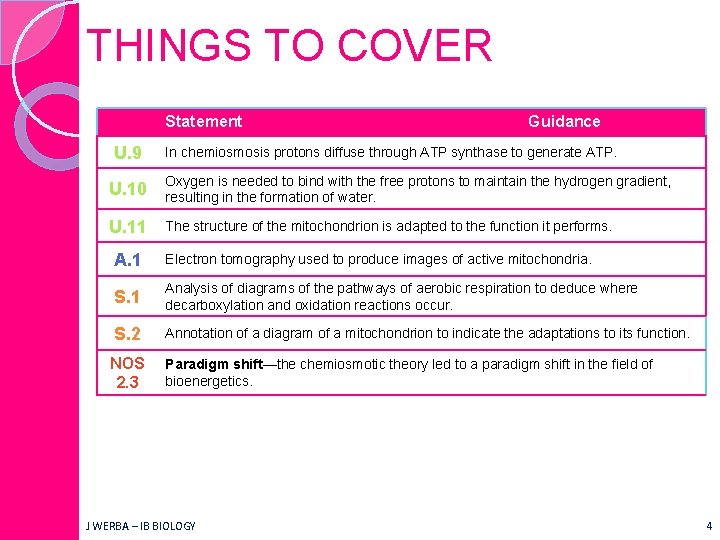
THINGS TO COVER Statement U. 9 Guidance In chemiosmosis protons diffuse through ATP synthase to generate ATP. U. 10 Oxygen is needed to bind with the free protons to maintain the hydrogen gradient, resulting in the formation of water. U. 11 The structure of the mitochondrion is adapted to the function it performs. A. 1 Electron tomography used to produce images of active mitochondria. S. 1 Analysis of diagrams of the pathways of aerobic respiration to deduce where decarboxylation and oxidation reactions occur. S. 2 Annotation of a diagram of a mitochondrion to indicate the adaptations to its function. NOS 2. 3 Paradigm shift—the chemiosmotic theory led to a paradigm shift in the field of bioenergetics. J WERBA – IB BIOLOGY 4
CELL RESPIRATION � The controlled release of energy from organic compounds in cells to form ATP � Involves enzymes � Involves metabolic pathways (chains and cycles) � Involves end-product inhibition � Involves glucose � Phosphorylates J WERBA – IB BIOLOGY to ADP to make ATP 5
CELL RESPIRATION C 6 H 12 O 6 + 6 O 2 – RESPIRATION –> 6 CO 2 + 6 H 2 O � Respiration There’s lots to learn – so stay sharp! includes: ◦ glycolysis ◦ link reaction ◦ Kreb’s cycle ◦ Electron Transport Chain (ETC) ◦ chemiosmosis J WERBA – IB BIOLOGY = OXIDATIVE PHOSPHORYLATION 6
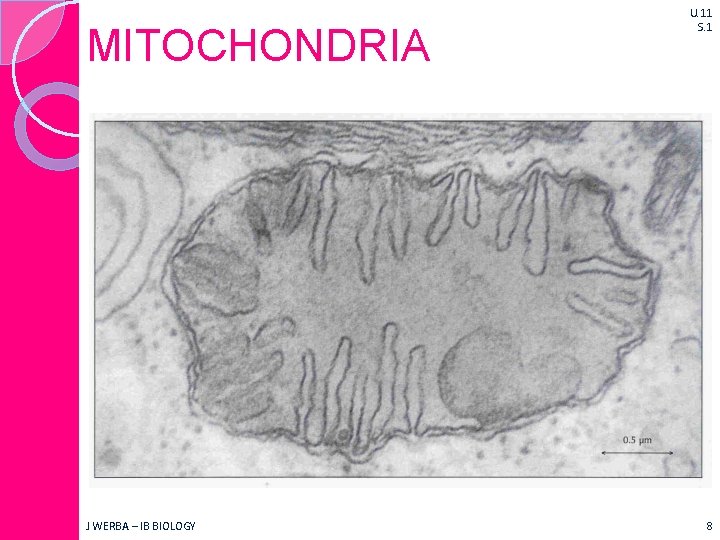
MITOCHONDRIA U. 11 S. 1 � If oxygen is present, the reactions move to the mitochondria. � The structure of the mitochondrion is adapted to the function it performs. � You need to be able to annotate a diagram of a mitochondrion to show the way its structure is adapted to its function. J WERBA – IB BIOLOGY 7
MITOCHONDRIA J WERBA – IB BIOLOGY U. 11 S. 1 8
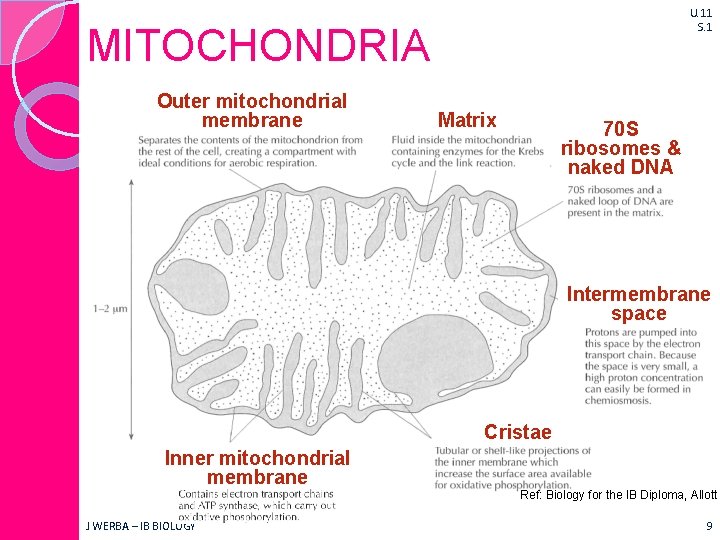
U. 11 S. 1 MITOCHONDRIA Outer mitochondrial membrane Matrix 70 S ribosomes & naked DNA Intermembrane space Cristae Inner mitochondrial membrane J WERBA – IB BIOLOGY Ref: Biology for the IB Diploma, Allott 9
MITOCHONDRIA U. 11 S. 1 � Cristae: ◦ form a large surface area ◦ have enzymes needed for the electron transport chain embedded in their membrane � Intermembrane space: ◦ small to allow ions to accumulate and create a concentration gradient � Matrix: ◦ fluid containing enzymes needed for the Krebs cycle. J WERBA – IB BIOLOGY 10
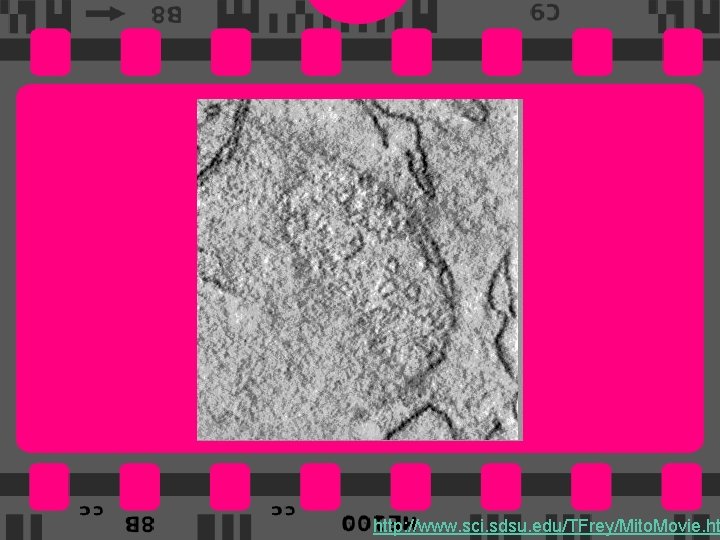
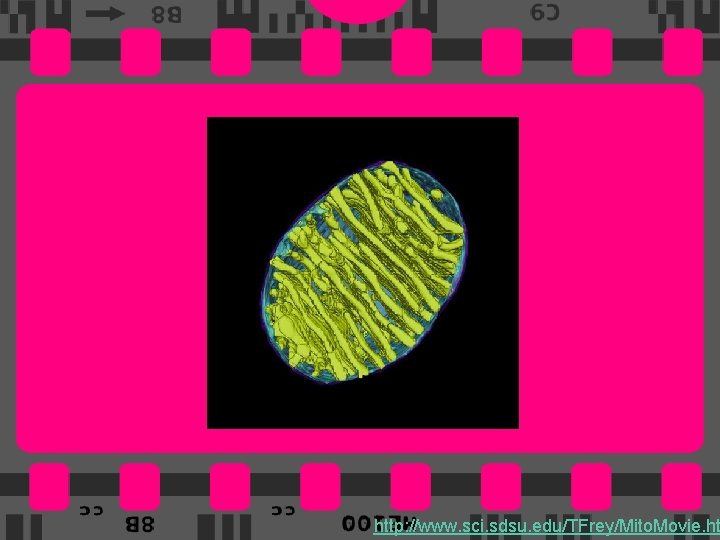
A. 1 MITOCHONDRIA � Electron tomography: technique for getting 3 D structures of sub-cellular structures using electron micrographs � Technique has been used to produce images of active mitochondria � http: //www. sci. sdsu. edu/TFrey/Mito. Movie. htm J WERBA – IB BIOLOGY 11
12 http: //www. sci. sdsu. edu/TFrey/Mito. Movie. ht
13 http: //www. sci. sdsu. edu/TFrey/Mito. Movie. ht
U. 1 OXIDATION & REDUCTION � Cell respiration involves different reactions that are known as redox reactions (ie. oxidation or reduction reactions) � Oxidation & reduction occur together - as one reactant is oxidised, the other is reduced. � Remember: OIL RIG ◦ Oxidation Is Loss (of electrons) ◦ Reduction Is Gain (of electrons) J WERBA – IB BIOLOGY 14
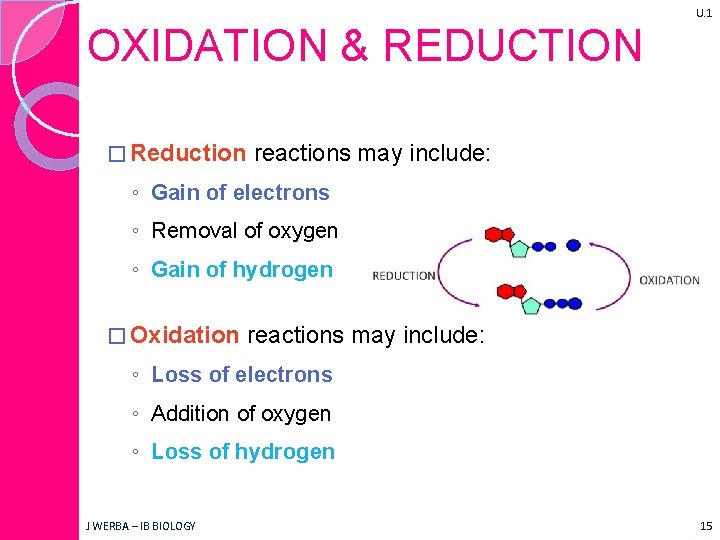
U. 1 OXIDATION & REDUCTION � Reduction reactions may include: ◦ Gain of electrons ◦ Removal of oxygen ◦ Gain of hydrogen � Oxidation reactions may include: ◦ Loss of electrons ◦ Addition of oxygen ◦ Loss of hydrogen J WERBA – IB BIOLOGY 15
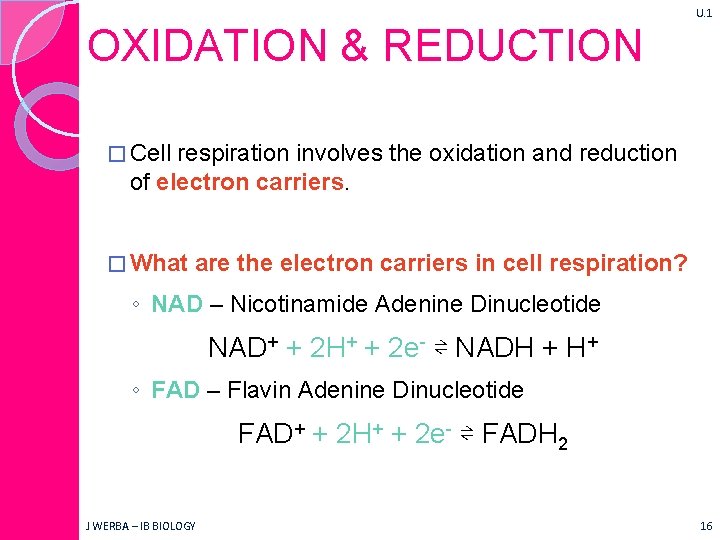
U. 1 OXIDATION & REDUCTION � Cell respiration involves the oxidation and reduction of electron carriers. � What are the electron carriers in cell respiration? ◦ NAD – Nicotinamide Adenine Dinucleotide NAD+ + 2 H+ + 2 e- ⇌ NADH + H+ ◦ FAD – Flavin Adenine Dinucleotide FAD+ + 2 H+ + 2 e- ⇌ FADH 2 J WERBA – IB BIOLOGY 16
CELL RESPIRATION THROUGH ART
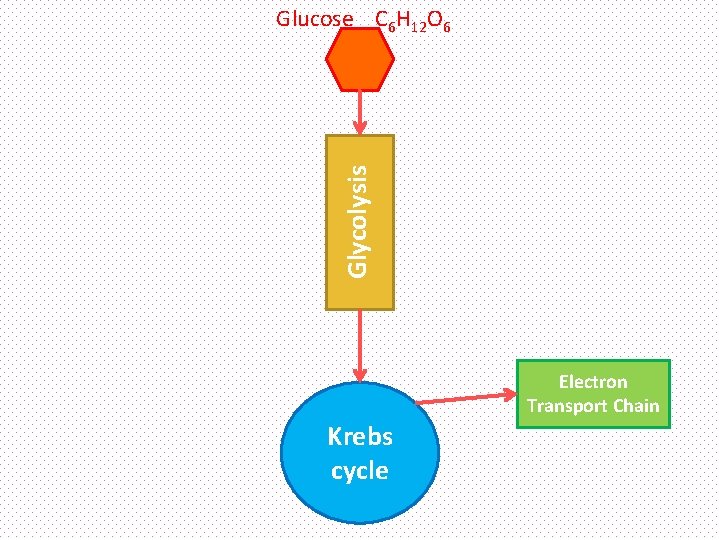
Glycolysis Glucose C 6 H 12 O 6 Electron Transport Chain Krebs cycle
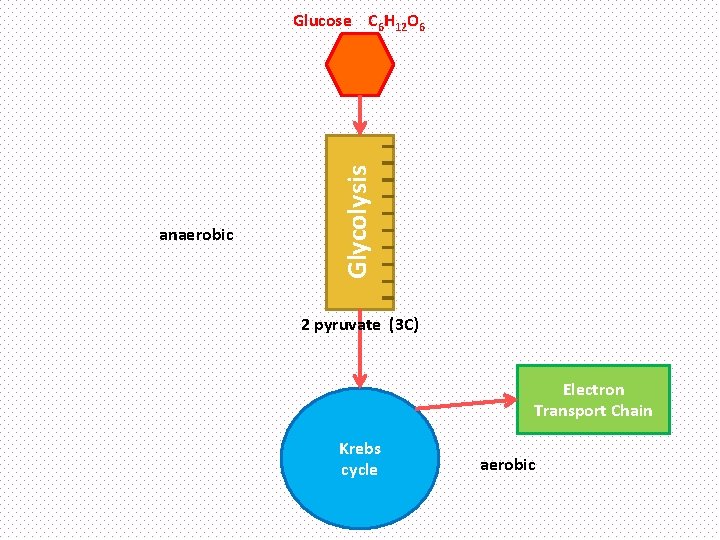
anaerobic Glycolysis Glucose C 6 H 12 O 6 2 pyruvate (3 C) Electron Transport Chain Krebs cycle aerobic
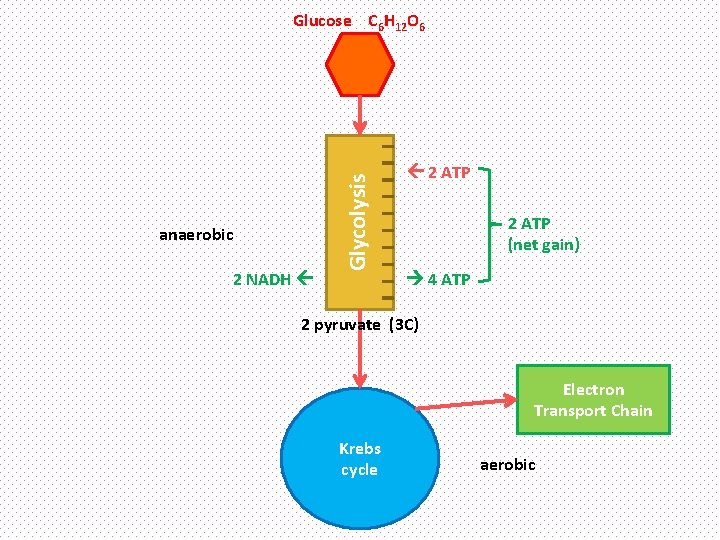
anaerobic 2 NADH Glycolysis Glucose C 6 H 12 O 6 2 ATP (net gain) 4 ATP 2 pyruvate (3 C) Electron Transport Chain Krebs cycle aerobic
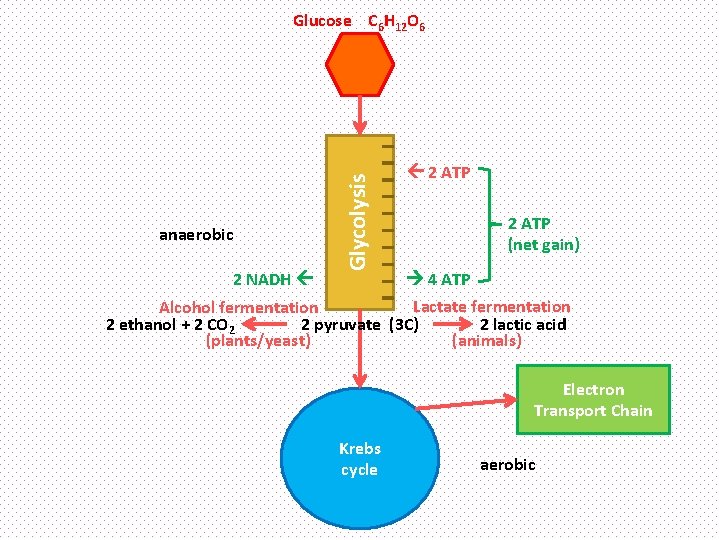
anaerobic 2 NADH Glycolysis Glucose C 6 H 12 O 6 2 ATP (net gain) 4 ATP Lactate fermentation Alcohol fermentation 2 ethanol + 2 CO 2 2 pyruvate (3 C) 2 lactic acid (plants/yeast) (animals) Electron Transport Chain Krebs cycle aerobic
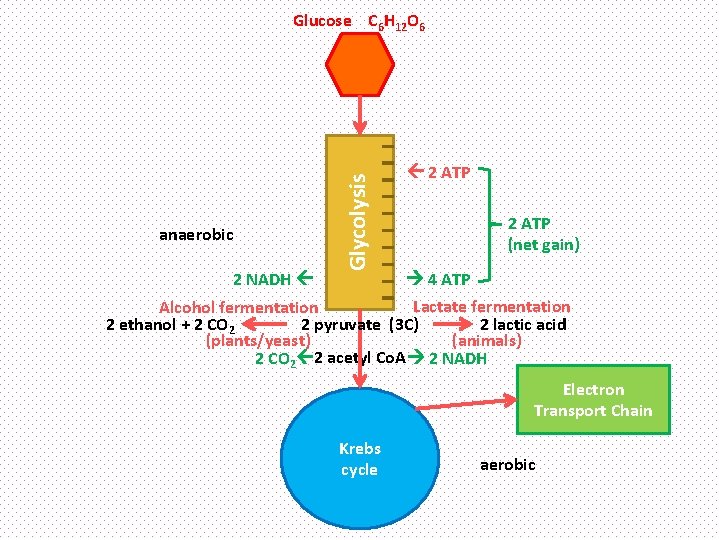
anaerobic 2 NADH Glycolysis Glucose C 6 H 12 O 6 2 ATP (net gain) 4 ATP Lactate fermentation Alcohol fermentation 2 ethanol + 2 CO 2 2 pyruvate (3 C) 2 lactic acid (plants/yeast) (animals) 2 CO 2 2 acetyl Co. A 2 NADH Electron Transport Chain Krebs cycle aerobic
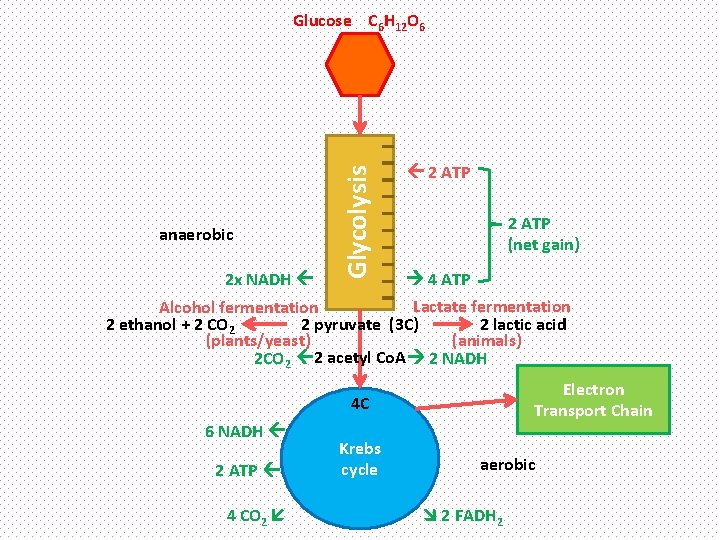
anaerobic 2 x NADH Glycolysis Glucose C 6 H 12 O 6 2 ATP (net gain) 4 ATP Lactate fermentation Alcohol fermentation 2 ethanol + 2 CO 2 2 pyruvate (3 C) 2 lactic acid (plants/yeast) (animals) 2 CO 2 2 acetyl Co. A 2 NADH Electron Transport Chain 4 C 6 NADH 2 ATP 4 CO 2 Krebs cycle aerobic 2 FADH 2
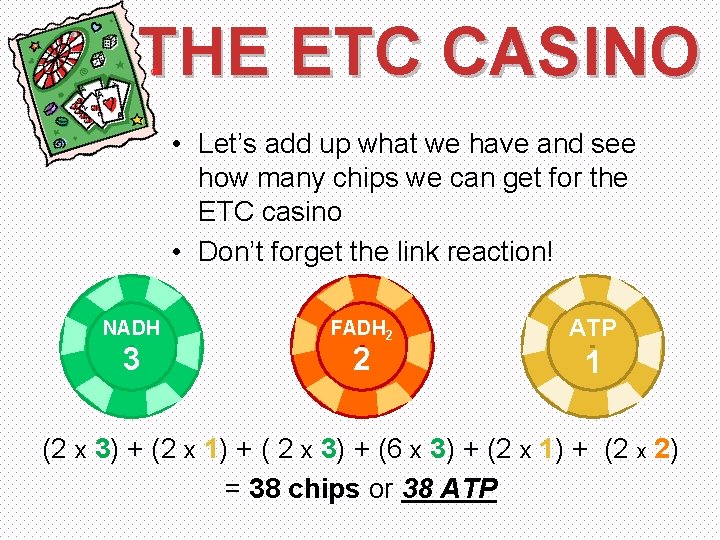
THE ETC CASINO • Let’s add up what we have and see how many chips we can get for the ETC casino • Don’t forget the link reaction! NADH 3 FADH 2 2 ATP 1 (2 x 3) + (2 x 1) + ( 2 x 3) + (6 x 3) + (2 x 1) + (2 x 2) = 38 chips or 38 ATP
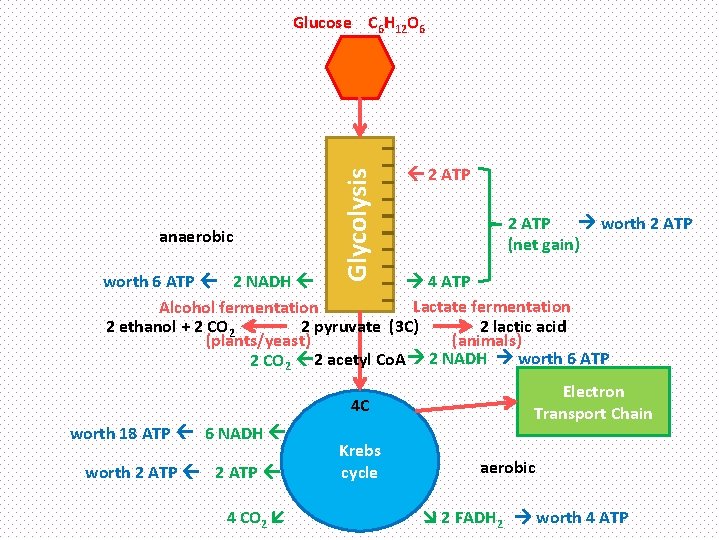
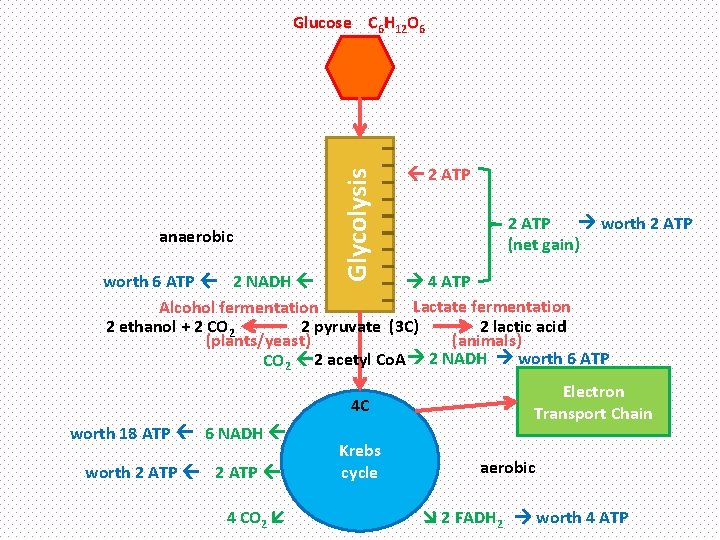
anaerobic Glycolysis Glucose C 6 H 12 O 6 2 ATP worth 2 ATP (net gain) worth 6 ATP 2 NADH 4 ATP Lactate fermentation Alcohol fermentation 2 ethanol + 2 CO 2 2 pyruvate (3 C) 2 lactic acid (plants/yeast) (animals) 2 CO 2 2 acetyl Co. A 2 NADH worth 6 ATP 4 C worth 18 ATP 6 NADH worth 2 ATP 4 CO 2 Krebs cycle Electron Transport Chain aerobic 2 FADH 2 worth 4 ATP
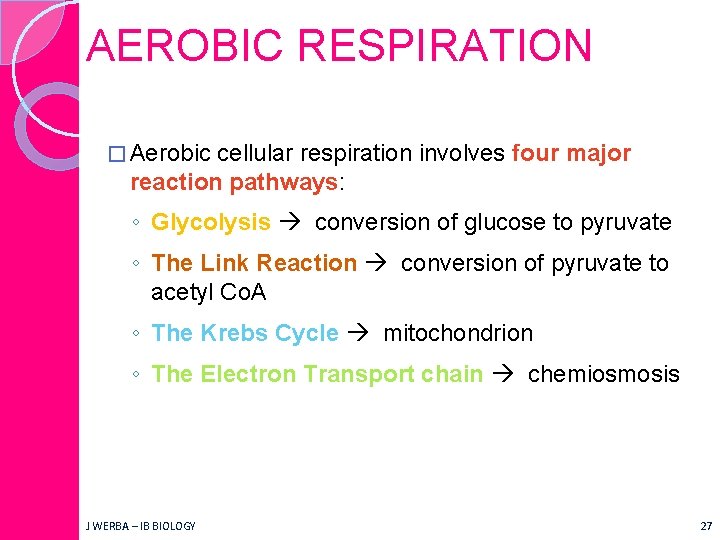
AEROBIC RESPIRATION � Aerobic cellular respiration involves four major reaction pathways: ◦ Glycolysis conversion of glucose to pyruvate ◦ The Link Reaction conversion of pyruvate to acetyl Co. A ◦ The Krebs Cycle mitochondrion ◦ The Electron Transport chain chemiosmosis J WERBA – IB BIOLOGY 27
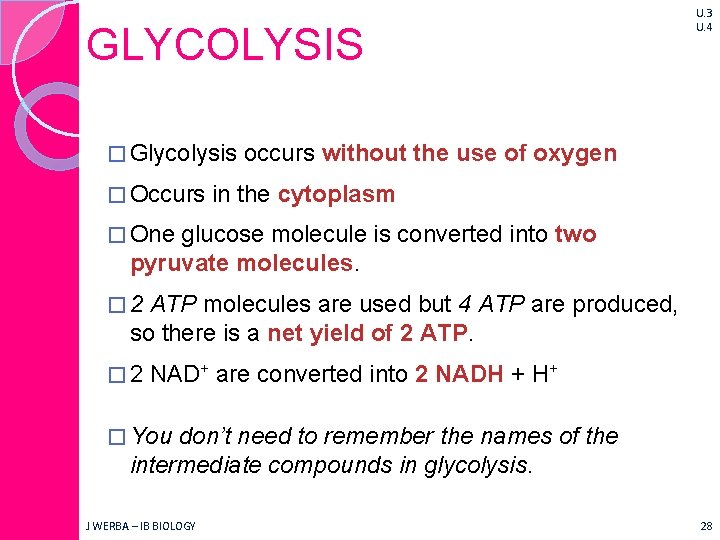
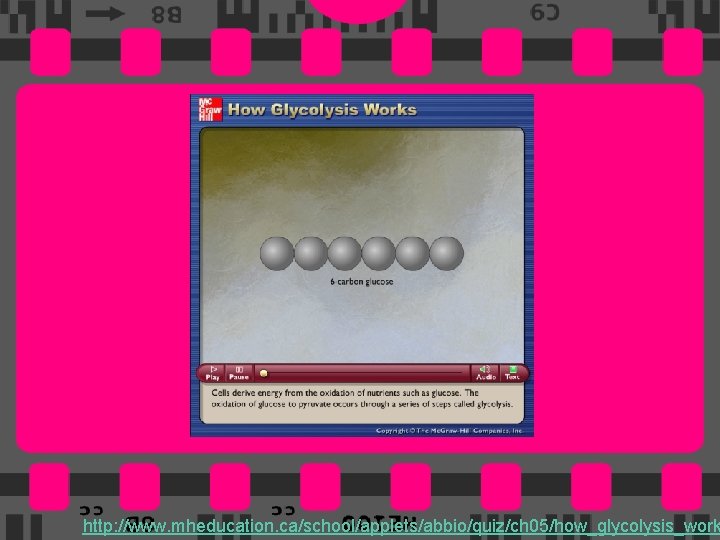
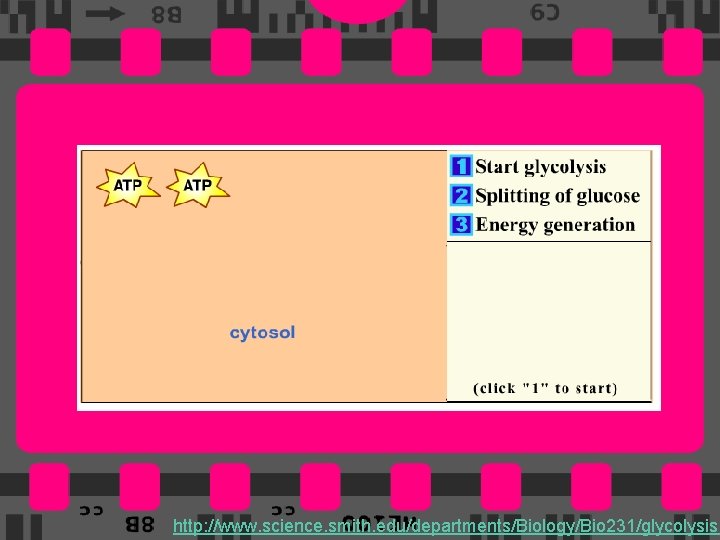
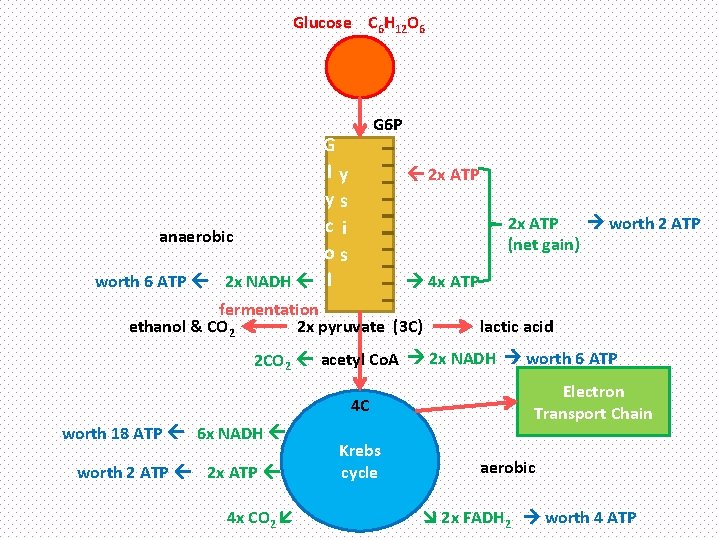
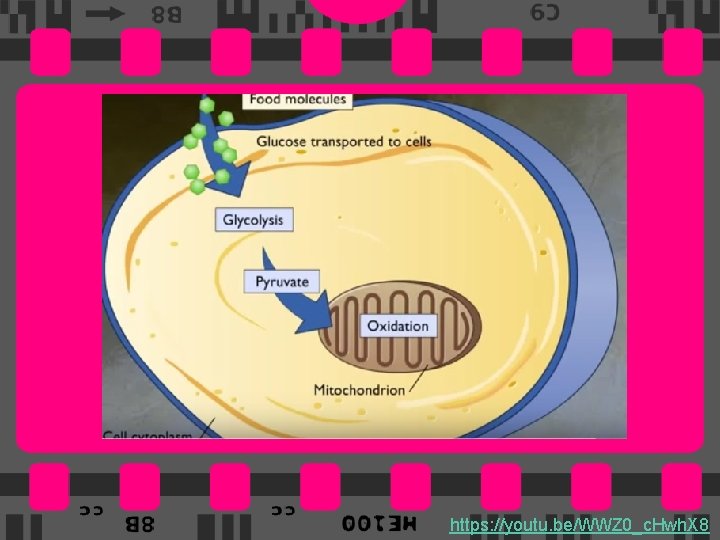
GLYCOLYSIS � Glycolysis � Occurs U. 3 U. 4 occurs without the use of oxygen in the cytoplasm � One glucose molecule is converted into two pyruvate molecules. � 2 ATP molecules are used but 4 ATP are produced, so there is a net yield of 2 ATP. � 2 NAD+ are converted into 2 NADH + H+ � You don’t need to remember the names of the intermediate compounds in glycolysis. J WERBA – IB BIOLOGY 28
29 http: //www. mheducation. ca/school/applets/abbio/quiz/ch 05/how_glycolysis_work
30 http: //www. science. smith. edu/departments/Biology/Bio 231/glycolysis.
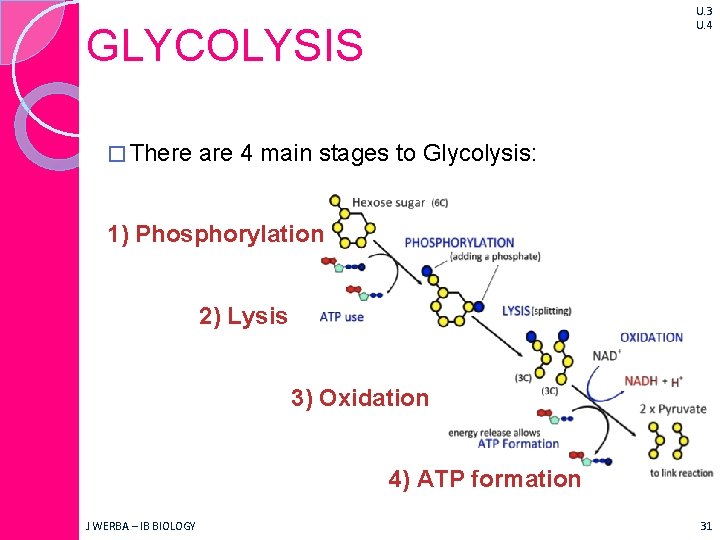
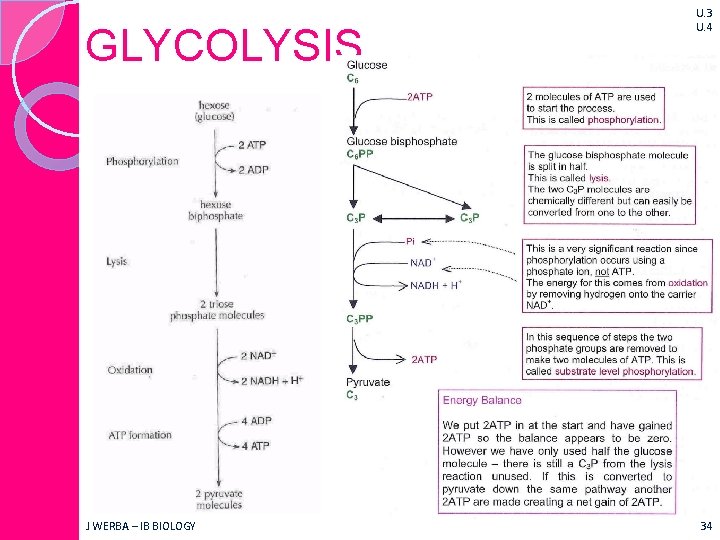
U. 3 U. 4 GLYCOLYSIS � There are 4 main stages to Glycolysis: 1) Phosphorylation 2) Lysis 3) Oxidation 4) ATP formation J WERBA – IB BIOLOGY 31
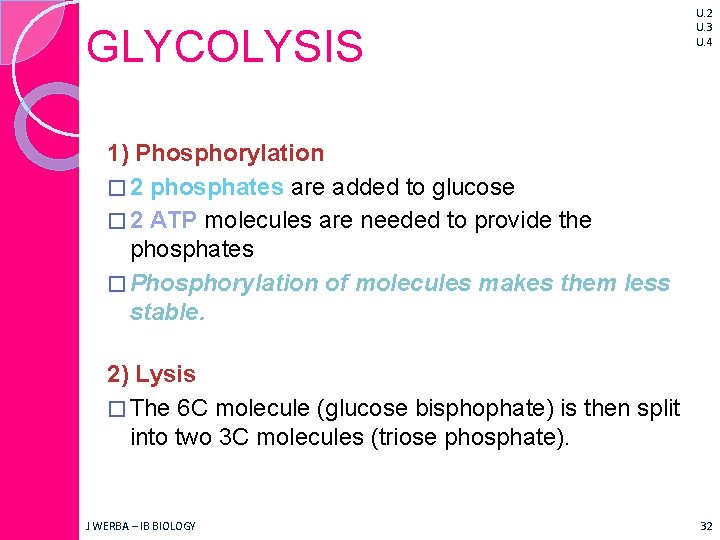
GLYCOLYSIS U. 2 U. 3 U. 4 1) Phosphorylation � 2 phosphates are added to glucose � 2 ATP molecules are needed to provide the phosphates � Phosphorylation of molecules makes them less stable. 2) Lysis � The 6 C molecule (glucose bisphophate) is then split into two 3 C molecules (triose phosphate). J WERBA – IB BIOLOGY 32
GLYCOLYSIS U. 3 U. 4 3) Oxidation � 2 hydrogen atoms are removed from each 3 C molecule NAD+ accepts them � 2 phosphate groups are added to each molecule using the energy released. 4) ATP formation � 2 phosphate groups are removed from each molecule passed to ADP � This forms two molecules of pyruvate and ATP. � This is called substrate level phosphorylation. J WERBA – IB BIOLOGY 33
GLYCOLYSIS J WERBA – IB BIOLOGY U. 3 U. 4 34
Glucose C 6 H 12 O 6 G 6 P G ly ys ci anaerobic os worth 6 ATP 2 x NADH l 2 x ATP worth 2 ATP (net gain) 4 x ATP fermentation ethanol & CO 2 2 x pyruvate (3 C) lactic acid 2 CO 2 acetyl Co. A 2 x NADH worth 6 ATP 4 C worth 18 ATP 6 x NADH worth 2 ATP 2 x ATP 4 x CO 2 Krebs cycle Electron Transport Chain aerobic 2 x FADH 2 worth 4 ATP
U. 5 THE LINK REACTION � After glycolysis, pyruvate moves to the mitochondrion. � Enzymes in the mitochondrial matrix are used to: ◦ oxidise the pyruvate remove hydrogen NAD+ accepts it ◦ decarboxylate the pyruvate remove carbon CO 2 is released J WERBA – IB BIOLOGY 36
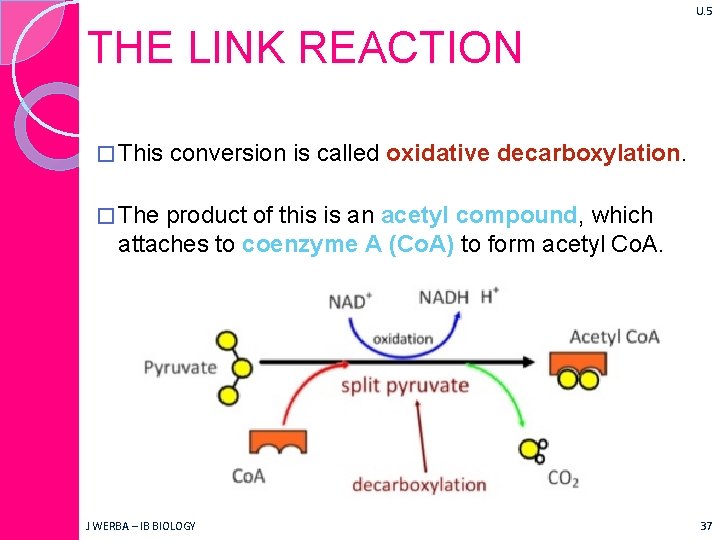
U. 5 THE LINK REACTION � This conversion is called oxidative decarboxylation. � The product of this is an acetyl compound, which attaches to coenzyme A (Co. A) to form acetyl Co. A. J WERBA – IB BIOLOGY 37
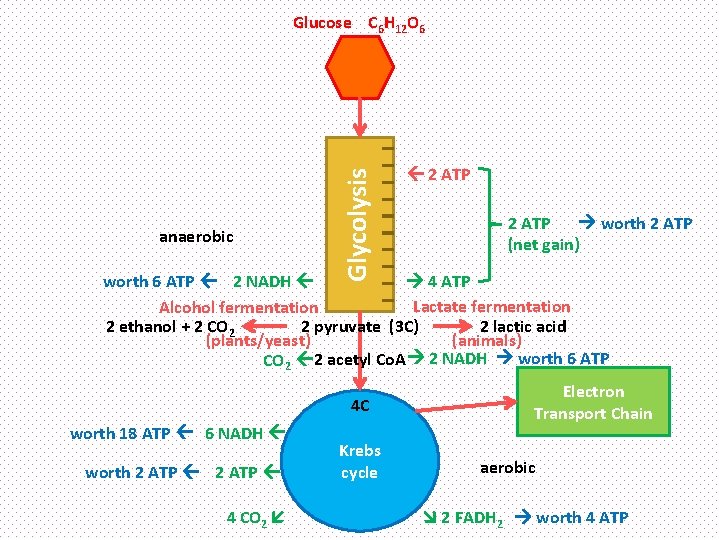
anaerobic Glycolysis Glucose C 6 H 12 O 6 2 ATP worth 2 ATP (net gain) worth 6 ATP 2 NADH 4 ATP Lactate fermentation Alcohol fermentation 2 ethanol + 2 CO 2 2 pyruvate (3 C) 2 lactic acid (plants/yeast) (animals) CO 2 2 acetyl Co. A 2 NADH worth 6 ATP 4 C worth 18 ATP 6 NADH worth 2 ATP 4 CO 2 Krebs cycle Electron Transport Chain aerobic 2 FADH 2 worth 4 ATP
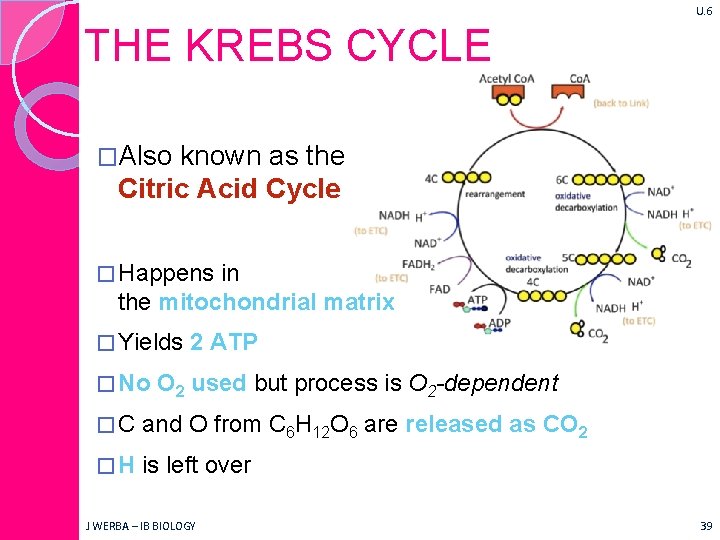
U. 6 THE KREBS CYCLE �Also known as the Citric Acid Cycle � Happens in the mitochondrial matrix � Yields � No 2 ATP O 2 used but process is O 2 -dependent �C and O from C 6 H 12 O 6 are released as CO 2 �H is left over J WERBA – IB BIOLOGY 39
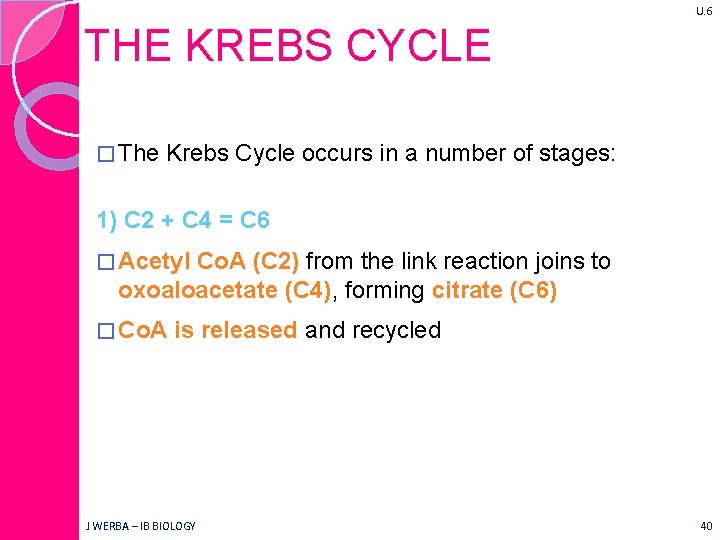
U. 6 THE KREBS CYCLE � The Krebs Cycle occurs in a number of stages: 1) C 2 + C 4 = C 6 � Acetyl Co. A (C 2) from the link reaction joins to oxoaloacetate (C 4), forming citrate (C 6) � Co. A is released and recycled J WERBA – IB BIOLOGY 40
U. 6 THE KREBS CYCLE 2) C 6 C 5 + CO 2 � Decarboxylation – CO 2 is released from citrate (C 6), leaving a 5 -carbon (C 5) compound � Reduction – NAD+ accepts 2 H atoms forms NADH 3) C 5 C 4 + CO 2 � Decarboxylation – CO 2 is released from the C 5 compound forms a C 4 compound � Reduction – NAD+ accepts 2 H atoms forms NADH J WERBA – IB BIOLOGY 41
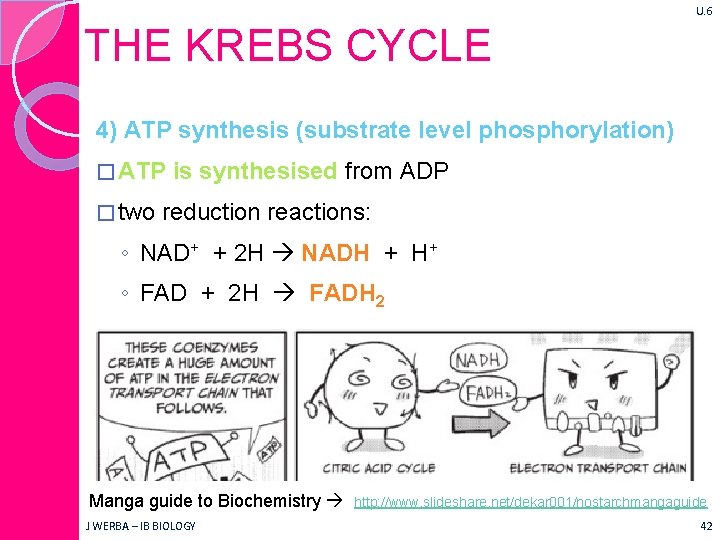
U. 6 THE KREBS CYCLE 4) ATP synthesis (substrate level phosphorylation) � ATP � two is synthesised from ADP reduction reactions: ◦ NAD+ + 2 H NADH + H+ ◦ FAD + 2 H FADH 2 Manga guide to Biochemistry J WERBA – IB BIOLOGY http: //www. slideshare. net/dekar 001/nostarchmangaguide 42
U. 6 THE KREBS CYCLE � One turn of the Krebs Cycle yields: ◦ 2 CO 2 ◦ 3 NADH + 3 H+ ◦ 1 FADH 2 ◦ 1 ATP (by substrate level phosphorylation) � Remember that there are 2 turns of the Krebs cycle for each glucose molecule!!! J WERBA – IB BIOLOGY 43
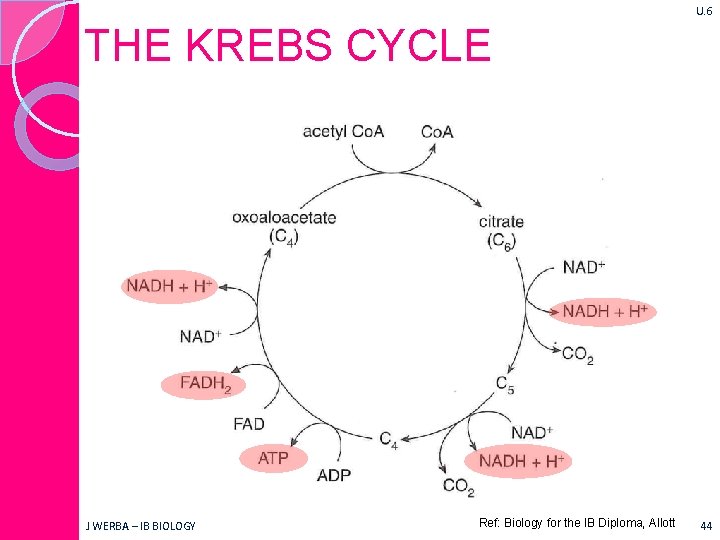
U. 6 THE KREBS CYCLE J WERBA – IB BIOLOGY Ref: Biology for the IB Diploma, Allott 44
https: //youtu. be/WWZ 0_c. Hwh. X 845
anaerobic Glycolysis Glucose C 6 H 12 O 6 2 ATP worth 2 ATP (net gain) worth 6 ATP 2 NADH 4 ATP Lactate fermentation Alcohol fermentation 2 ethanol + 2 CO 2 2 pyruvate (3 C) 2 lactic acid (plants/yeast) (animals) CO 2 2 acetyl Co. A 2 NADH worth 6 ATP 4 C worth 18 ATP 6 NADH worth 2 ATP 4 CO 2 Krebs cycle Electron Transport Chain aerobic 2 FADH 2 worth 4 ATP
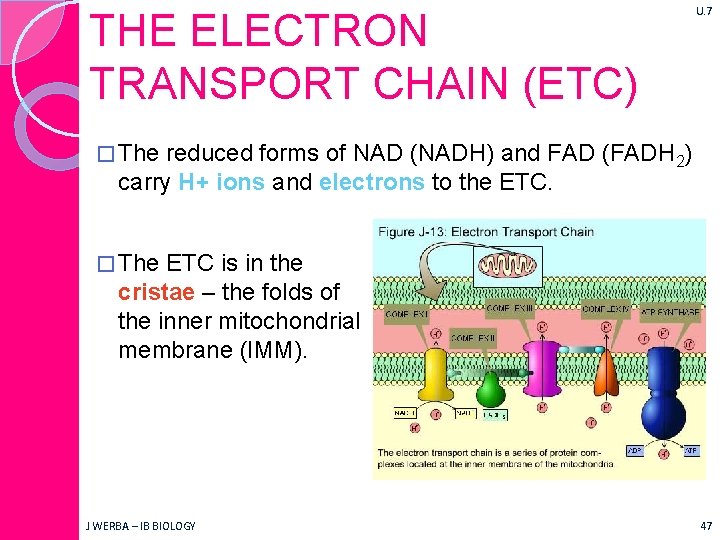
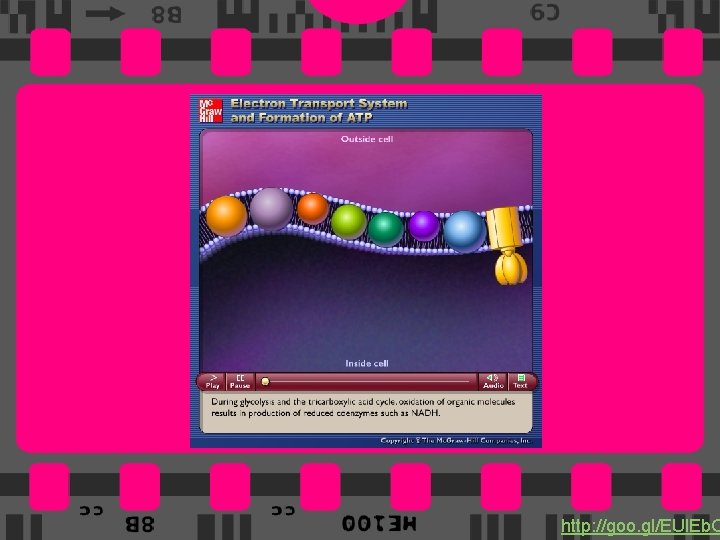
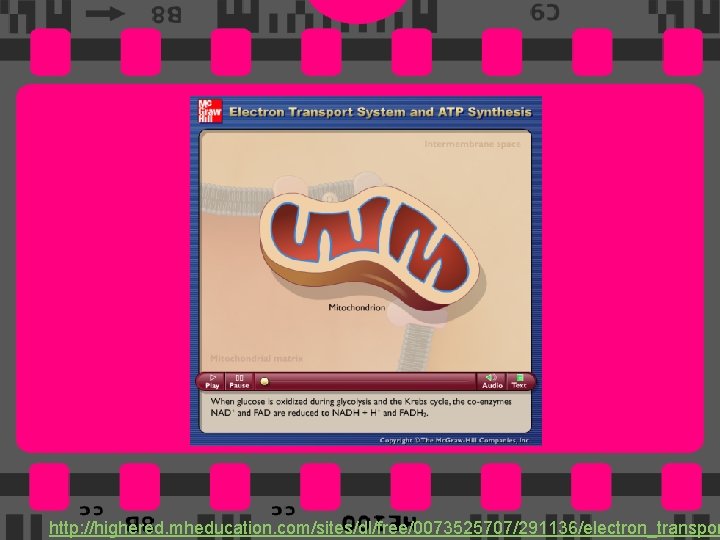
THE ELECTRON TRANSPORT CHAIN (ETC) U. 7 � The reduced forms of NAD (NADH) and FAD (FADH 2) carry H+ ions and electrons to the ETC. � The ETC is in the cristae – the folds of the inner mitochondrial membrane (IMM). J WERBA – IB BIOLOGY 47
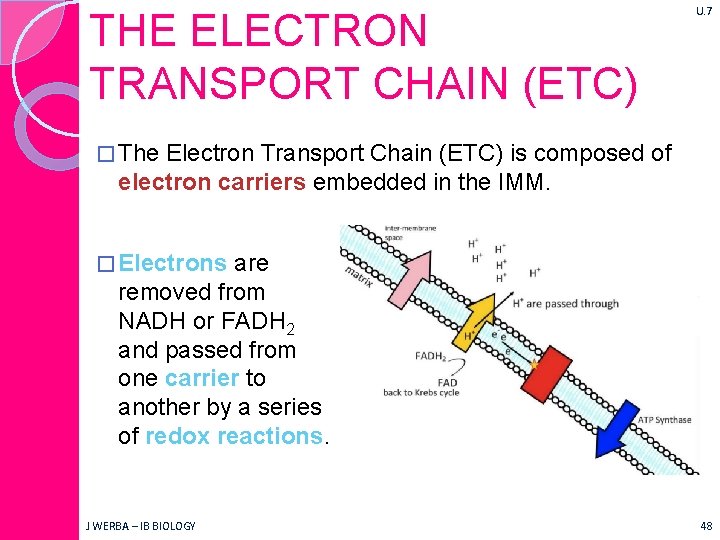
THE ELECTRON TRANSPORT CHAIN (ETC) U. 7 � The Electron Transport Chain (ETC) is composed of electron carriers embedded in the IMM. � Electrons are removed from NADH or FADH 2 and passed from one carrier to another by a series of redox reactions. J WERBA – IB BIOLOGY 48
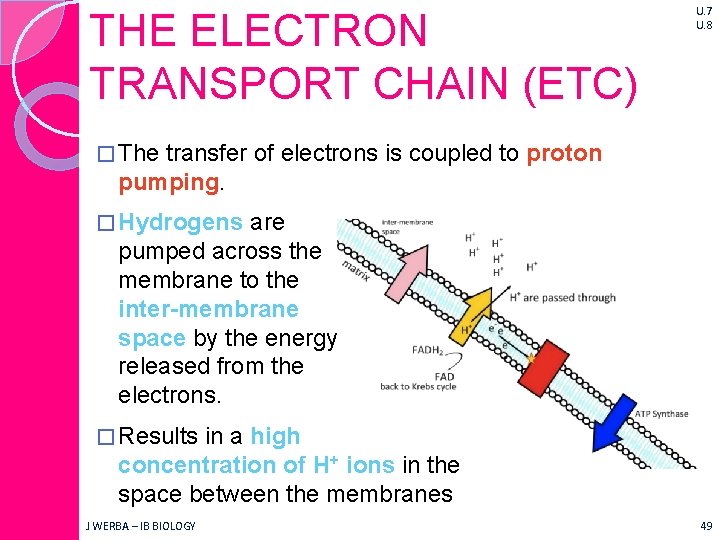
THE ELECTRON TRANSPORT CHAIN (ETC) U. 7 U. 8 � The transfer of electrons is coupled to proton pumping. � Hydrogens are pumped across the membrane to the inter-membrane space by the energy released from the electrons. � Results in a high concentration of H+ ions in the space between the membranes J WERBA – IB BIOLOGY 49
CHEMIOSMOSIS U. 9 U. 10 � In chemiosmosis, protons diffuse through ATP synthase to generate ATP. � Oxygen is needed to bind with the free protons to maintain the hydrogen gradient, resulting in the formation of water. � This occurs in the matrix of the mitochondrion. J WERBA – IB BIOLOGY 50
NOS. 2. 3 CHEMIOSMOSIS Paradigm shift The chemiosmotic theory led to a paradigm shift in the field of bioenergetics. J WERBA – IB BIOLOGY 51
NOS 2. 3 CHEMIOSMOSIS � In 1961, Peter Mitchell, a British biochemist, proposed the chemiosmotic theory of ATP production. � He received a Nobel prize for this work in 1978. � His ideas explained how ATP synthesis is coupled to electron transport and the movement of protons. � His ideas were different to previous explanations, but after many years, theory was accepted. J WERBA – IB BIOLOGY 52
53 http: //goo. gl/EUl. Eb. O
54 http: //highered. mheducation. com/sites/dl/free/0073525707/291136/electron_transpor
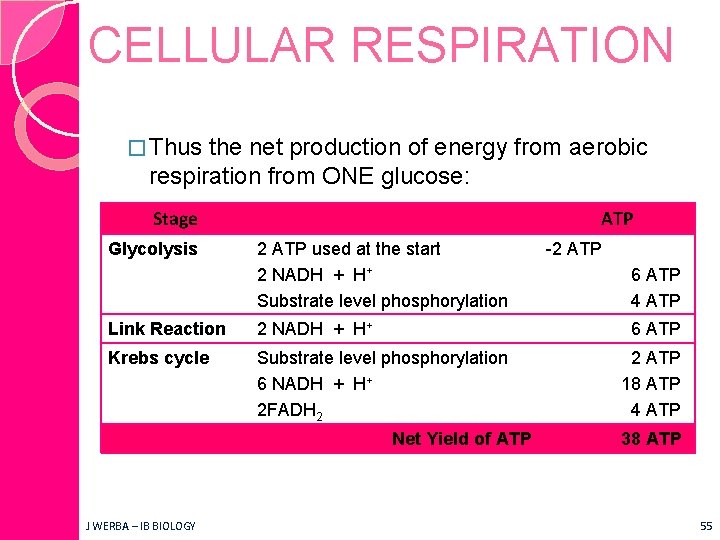
CELLULAR RESPIRATION � Thus the net production of energy from aerobic respiration from ONE glucose: Stage Glycolysis ATP 2 ATP used at the start 2 NADH + H+ Substrate level phosphorylation Link Reaction 2 NADH + H+ Krebs cycle Substrate level phosphorylation 6 NADH + H+ 2 FADH 2 6 ATP 4 ATP 6 ATP Net Yield of ATP J WERBA – IB BIOLOGY -2 ATP 18 ATP 4 ATP 38 ATP 55
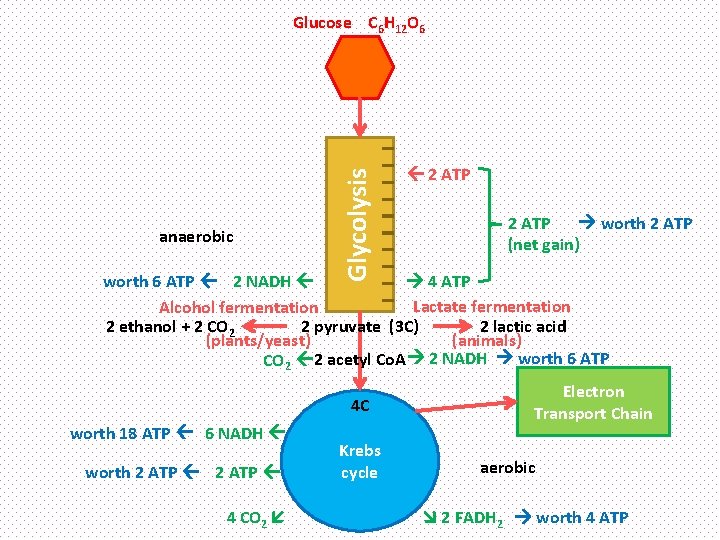
anaerobic Glycolysis Glucose C 6 H 12 O 6 2 ATP worth 2 ATP (net gain) worth 6 ATP 2 NADH 4 ATP Lactate fermentation Alcohol fermentation 2 ethanol + 2 CO 2 2 pyruvate (3 C) 2 lactic acid (plants/yeast) (animals) CO 2 2 acetyl Co. A 2 NADH worth 6 ATP 4 C worth 18 ATP 6 NADH worth 2 ATP 4 CO 2 Krebs cycle Electron Transport Chain aerobic 2 FADH 2 worth 4 ATP
CELL RESPIRATION Q 1. During glycolysis, a hexose sugar is broken down to two pyruvate molecules. What is the correct sequence of stages? A. phosphorylation → oxidation → lysis B. oxidation → phosphorylation → lysis C. phosphorylation → lysis → oxidation D. lysis → oxidation → phosphorylation J WERBA – IB BIOLOGY 57
CELL RESPIRATION Q 2. What is the role of NADH + H+ in aerobic cell respiration? A. To transfer hydrogen to the electron transport chain B. To reduce intermediates in the Krebs cycle C. To accept electrons from the electron transport chain D. To combine with oxygen to produce water J WERBA – IB BIOLOGY 58
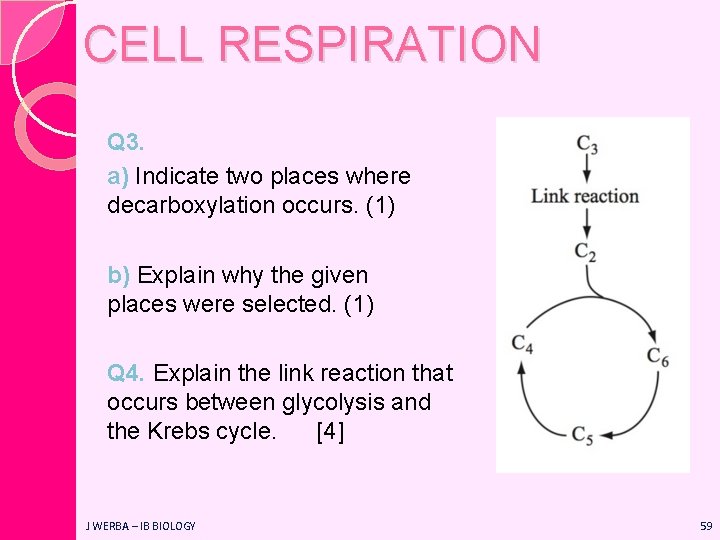
CELL RESPIRATION Q 3. a) Indicate two places where decarboxylation occurs. (1) b) Explain why the given places were selected. (1) Q 4. Explain the link reaction that occurs between glycolysis and the Krebs cycle. [4] J WERBA – IB BIOLOGY 59
CELL RESPIRATION Q 5. The enzyme ATP synthase has an essential role in aerobic cell respiration. Describe its location. [1] b) Describe its function. [1] a) J WERBA – IB BIOLOGY 60
- Slides: 60