
Cell respiration Definition The series of chemical reactions
- Slides: 12
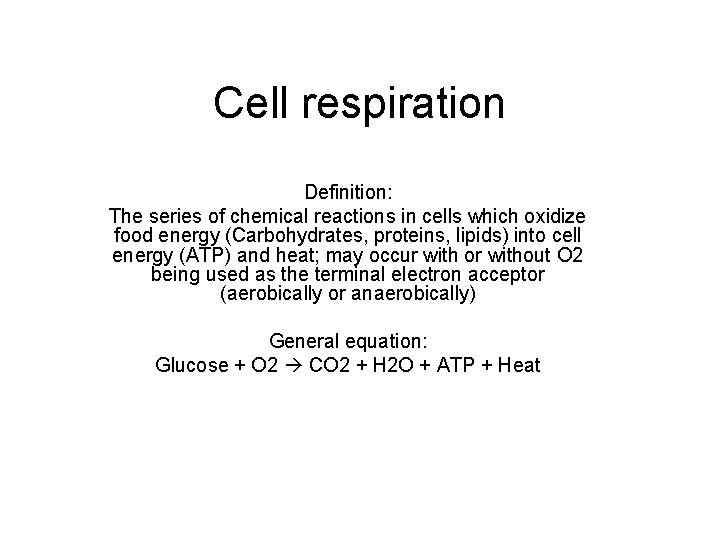
Cell respiration Definition: The series of chemical reactions in cells which oxidize food energy (Carbohydrates, proteins, lipids) into cell energy (ATP) and heat; may occur with or without O 2 being used as the terminal electron acceptor (aerobically or anaerobically) General equation: Glucose + O 2 CO 2 + H 2 O + ATP + Heat
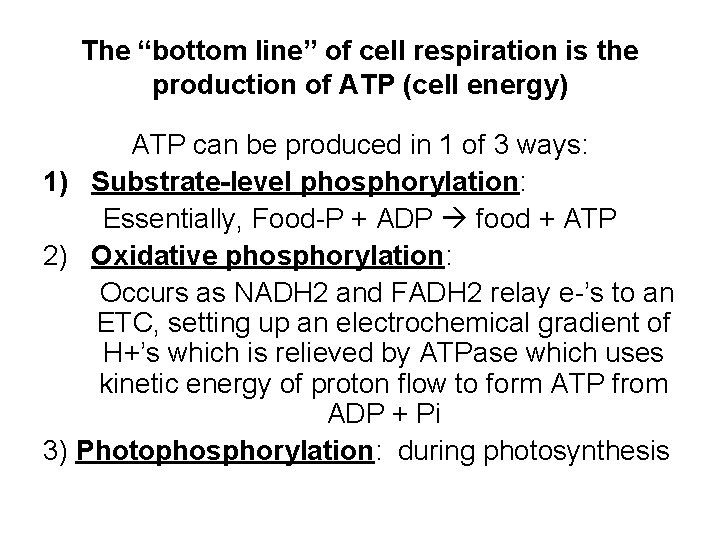
The “bottom line” of cell respiration is the production of ATP (cell energy) ATP can be produced in 1 of 3 ways: 1) Substrate-level phosphorylation: Essentially, Food-P + ADP food + ATP 2) Oxidative phosphorylation: Occurs as NADH 2 and FADH 2 relay e-’s to an ETC, setting up an electrochemical gradient of H+’s which is relieved by ATPase which uses kinetic energy of proton flow to form ATP from ADP + Pi 3) Photophosphorylation: during photosynthesis
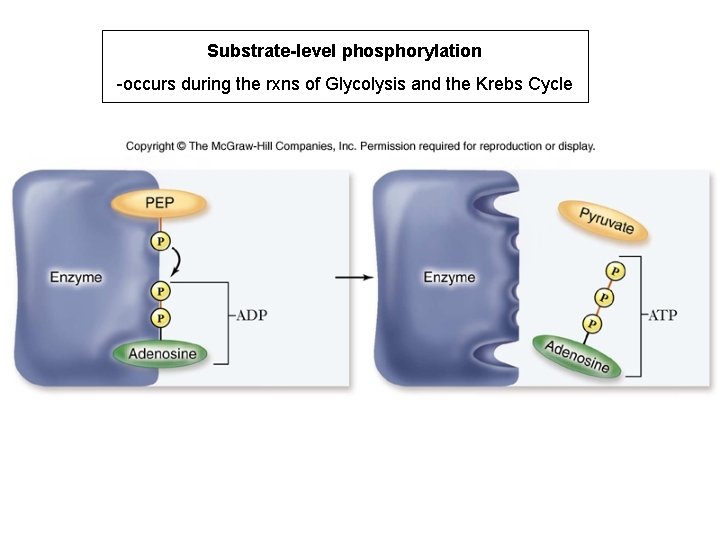
Substrate-level phosphorylation -occurs during the rxns of Glycolysis and the Krebs Cycle
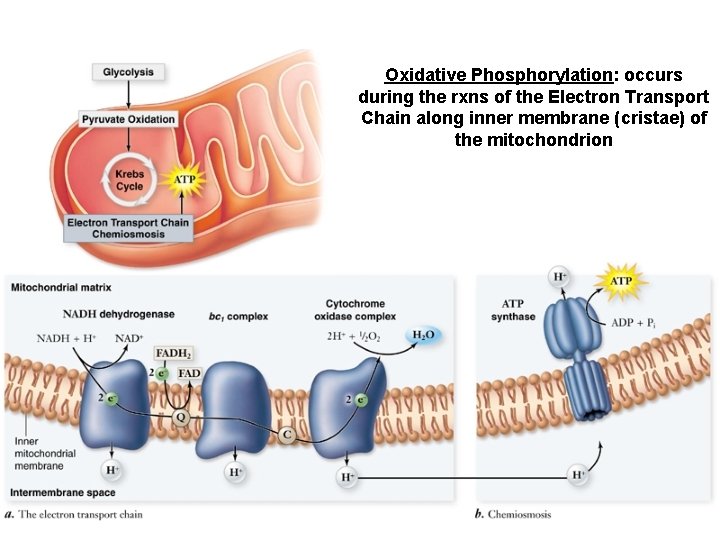
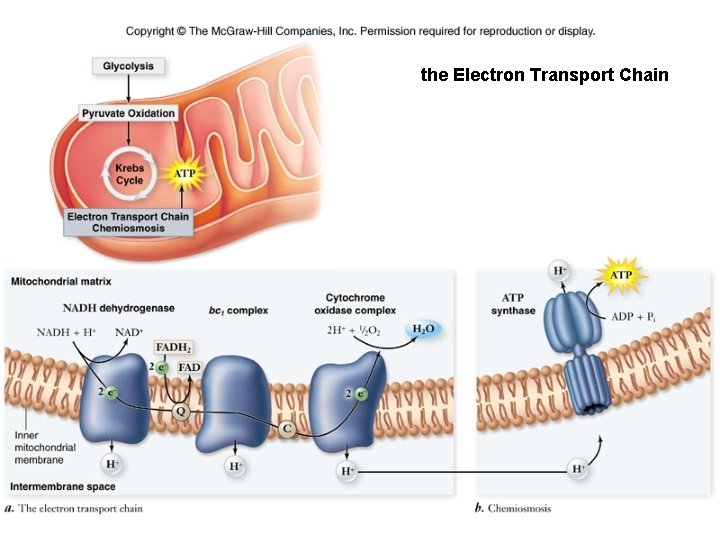
Oxidative Phosphorylation: occurs during the rxns of the Electron Transport Chain along inner membrane (cristae) of the mitochondrion
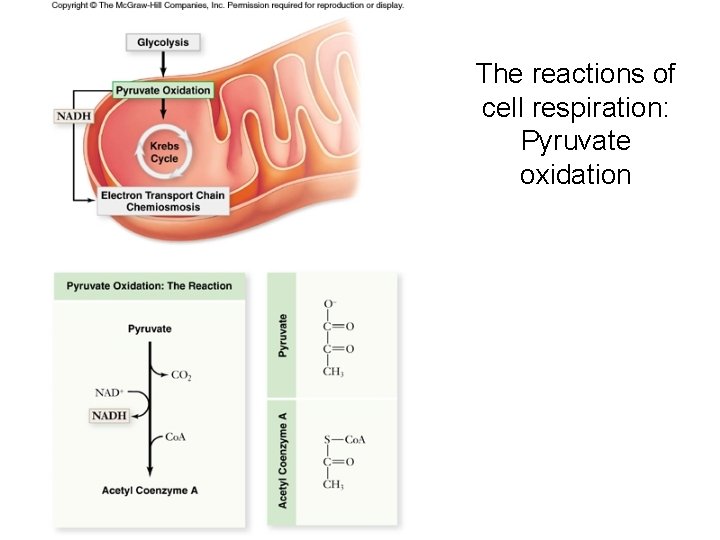
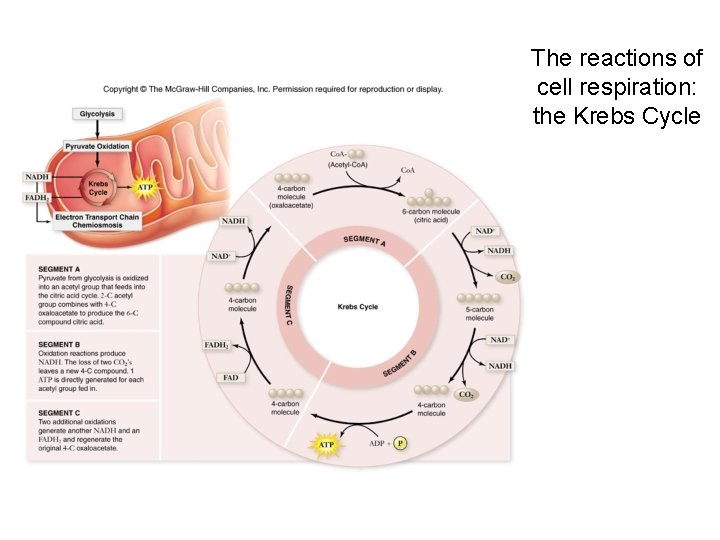
The complete oxidation of food Aerobic respiration Equation: Glucose + O 2 CO 2 + H 2 O + energy The above set of reactions occur in 4 distinct steps: 1) 2) 3) 4) Glycolysis – splits 6 -C glucose into 2 X 3 -C pyruvic acids (pyruvates) Pyruvate oxidation – removes 1 C from each pyruvate to form 2 X 2 -C acetyl groups which may enter the rxns of the Krebs Cycle – cyclical series of rxns which break down each of the 2 -C acetyl groups into 2 CO 2 Electron Transport Chain – electron carrying coenzymes relay their e-’s to a series of electron carrying proteins to O 2 setting up an electrochemical gradient which is relieved through ATPase which transforms the kinetic energy of proton flow into ATP formation
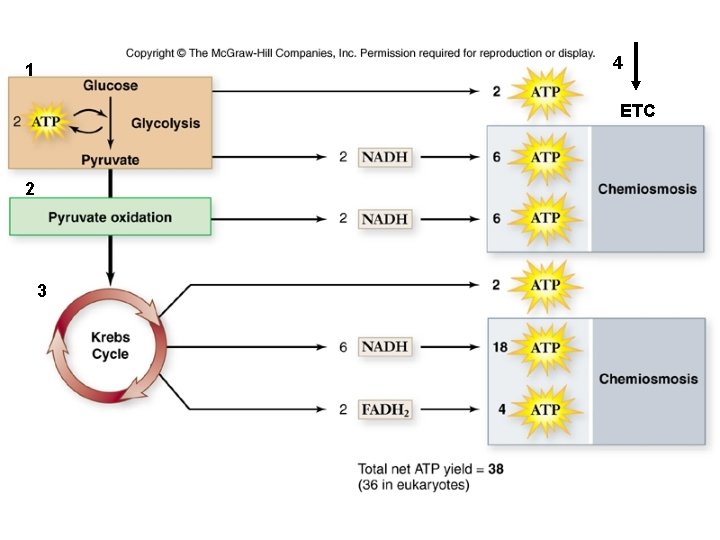
During each step of the process, energy is released!! In Glycolysis: 4 total ATP’s are formed (yet, there is only a net gain of 2 ATP’s) and 2 NAD coenzymes are reduced to NADH 2 In Pyruvate oxidation: 2 NADH 2’s are produced In the Krebs Cycle: 2 ATP’s are formed, 6 NADH 2’s are produced, and 2 FADH 2’s In Electron Transport: 32 ATP’s are formed as 10 NADH 2’s and 2 FADH 2’s are oxidized back to NAD+ and FAD+ and recycled back to the system and re-used
4 1 ETC 2 3
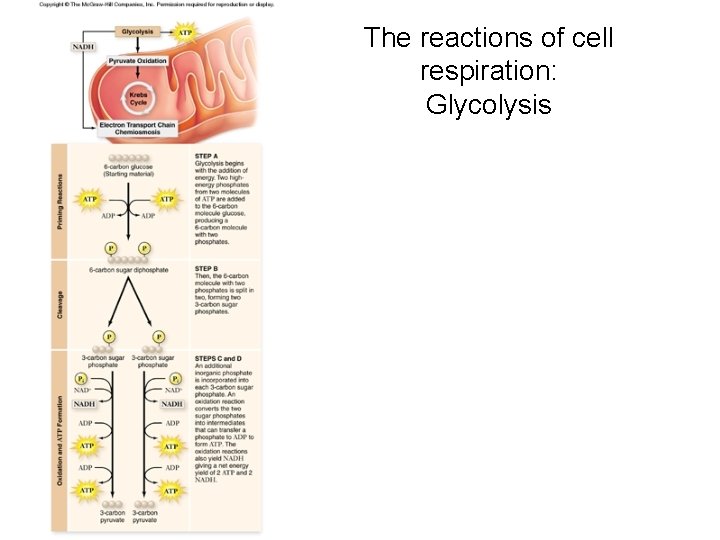
The reactions of cell respiration: Glycolysis
The reactions of cell respiration: Pyruvate oxidation
The reactions of cell respiration: the Krebs Cycle
the Electron Transport Chain
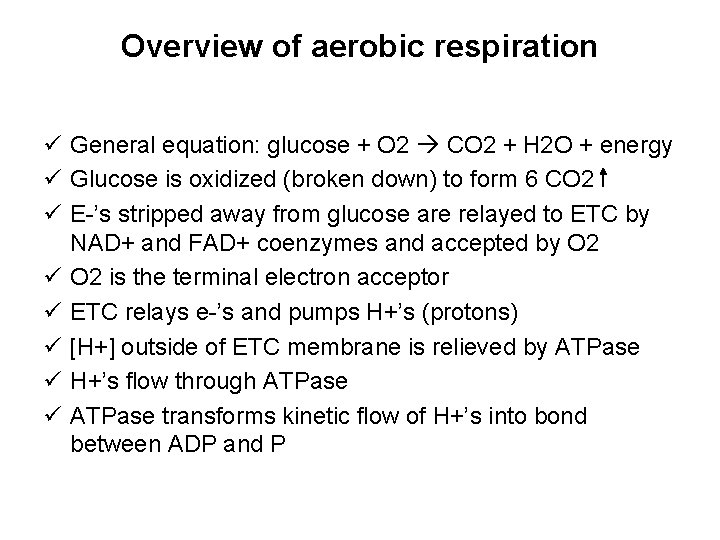
Overview of aerobic respiration ü General equation: glucose + O 2 CO 2 + H 2 O + energy ü Glucose is oxidized (broken down) to form 6 CO 2 ü E-’s stripped away from glucose are relayed to ETC by NAD+ and FAD+ coenzymes and accepted by O 2 ü O 2 is the terminal electron acceptor ü ETC relays e-’s and pumps H+’s (protons) ü [H+] outside of ETC membrane is relieved by ATPase ü H+’s flow through ATPase ü ATPase transforms kinetic flow of H+’s into bond between ADP and P