
Cell Reproduction You began life as a single
• • • Cell Reproduction You began life as a single cell But now you are made up of about 3 trillion cells • In fact, everyday, your body makes about 25 million new cells • Every cell in your body comes from the division of pre-existing cells
Mitosis • • • Results in two new cells with genetic material that is identical to the original cell • It is a form of asexual reproduction – Which means that the offspring come from a single parent cell
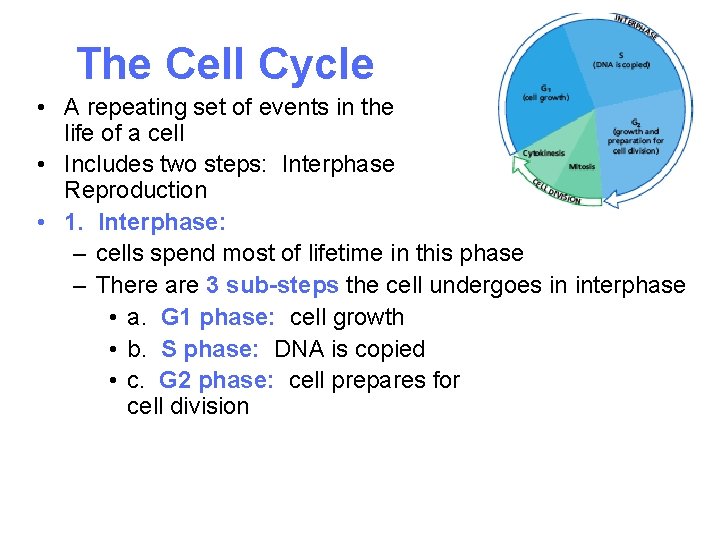
The Cell Cycle • A repeating set of events in the life of a cell • Includes two steps: Interphase and Reproduction • 1. Interphase: – cells spend most of lifetime in this phase – There are 3 sub-steps the cell undergoes in interphase • a. G 1 phase: cell growth • b. S phase: DNA is copied • c. G 2 phase: cell prepares for cell division
• 2. Reproduction (Mitosis or Meiosis) – Mitosis has 5 sub-steps: – A. Prophase: – Nuclear membrane disappears – DNA coils tighten – Spindle fibers form – B. Metaphase: – The chromosomes line up on the equator of the cell
– C. Anaphase: – The chromosomes split into chromatids & begin to move to opposite ends of the cell – D. Telophase: – Chromatids reach opposite ends of the cell – The spindle fibers breakdown – Nuclear membrane reappears
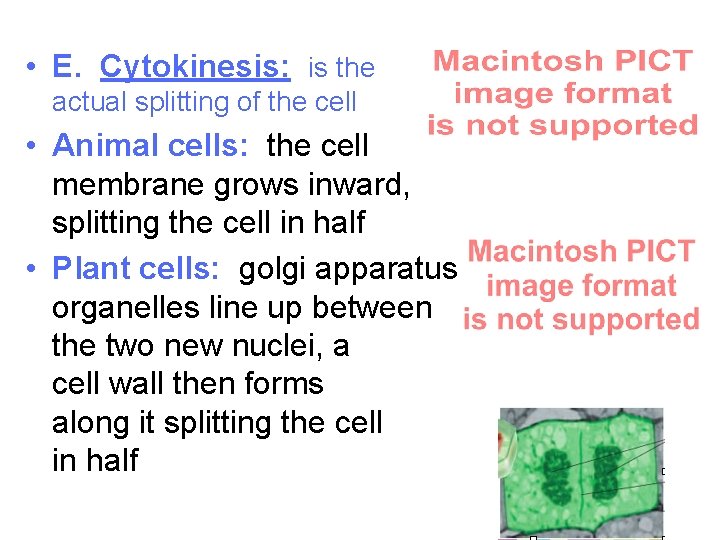
• E. Cytokinesis: is the actual splitting of the cell • Animal cells: the cell membrane grows inward, splitting the cell in half • Plant cells: golgi apparatus organelles line up between the two new nuclei, a cell wall then forms along it splitting the cell in half
Cell Division in Prokaryotic cells • Since prokaryotic cells are simpler than eukaryotic cells, so is cell division • The process by which prokaryotic cells divide is called Binary fission • The cell duplicates its DNA & then grows to about twice its normal size • Then the cell membrane grows inward, pinching the cell in two
Stem Cells • They are unspecialized cells that renew themselves • When exposed to the right chemicals, they will become a certain cell – Ie: if a stem cell is exposed to cardiogenol it will develop into a cardiac cell
Types of Stem Cells… • There are two types of stem cells: • Embryonic stem cells: come from embryos – Pros: have no limit to their ability to differentiate (the types of cells they can turn into) – Show more promise in research – Cons: harder to get – Highly controversial
• Adult Stem Cells: come from certain areas of the body such as: bone marrow, muscles & brain – Pros: easier to obtain from donors – Less controversial to use because they would only be able to be used in the donor – Cons: shorter lifespan in the lab – Adult stem cells are limited in their ability to differentiate
- Slides: 10