
Cell Reproduction Mitosis Why is Cell Division Important
- Slides: 19
Cell Reproduction Mitosis
Why is Cell Division Important? In humans cell division is needed for: 1. Repair 2. Growth 3. Replacement like skin and bone cells. 4. Cell division is important to onecelled organisms, too—it’s how they reproduce themselves.
The Cell Cycle A life cycle begins with the organism’s formation, is followed by growth and development, and finally ends in death. n The cell cycle is a series of events that takes place from one cell division to the next.
Interphase n n Most of the life of any eukaryotic cell—is spent in a period of growth and development called interphase. Cells in your body that no longer divide, such as nerve and muscle cells, are always in interphase.
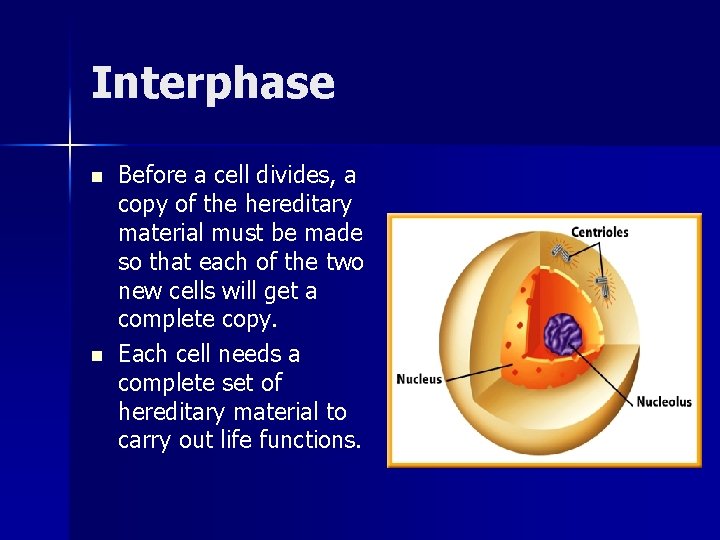
Interphase The cell grows- doubles in size n DNA is replicated n Chromatin-threadlike coils of DNA strung out within the nucleus condense into compacted bodies of chromosomes. n Centrioles replicate- most plants do not have centrioles. n
Interphase n n Before a cell divides, a copy of the hereditary material must be made so that each of the two new cells will get a complete copy. Each cell needs a complete set of hereditary material to carry out life functions.
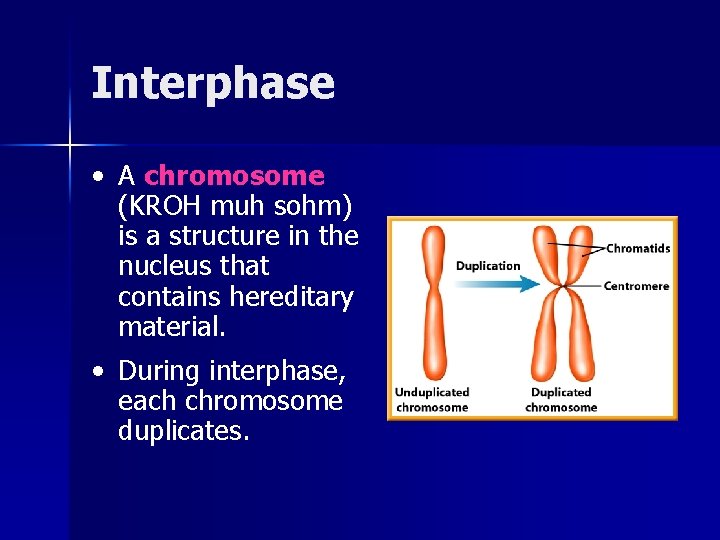
Interphase • A chromosome (KROH muh sohm) is a structure in the nucleus that contains hereditary material. • During interphase, each chromosome duplicates.
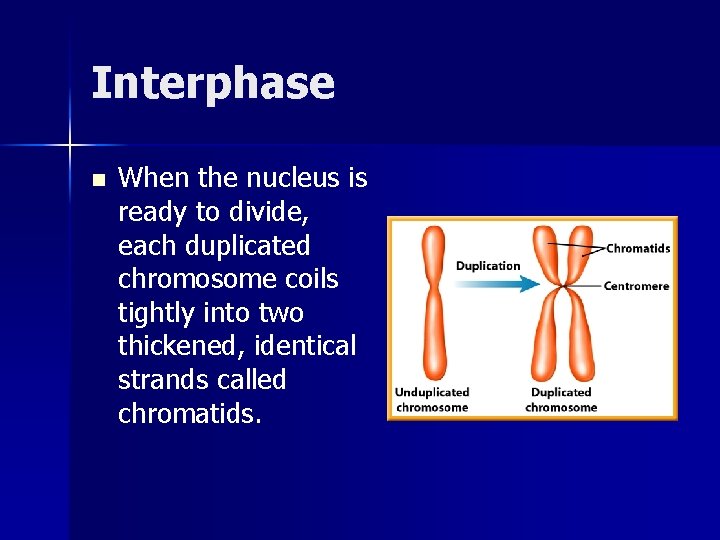
Interphase n When the nucleus is ready to divide, each duplicated chromosome coils tightly into two thickened, identical strands called chromatids.
Mitosis n n 1. 2. 3. 4. Mitosis process in which the nucleus divides to form two identical nuclei. Each new nucleus also is identical to the original nucleus. The steps of mitosis in order are named: prophase metaphase anaphase telophase
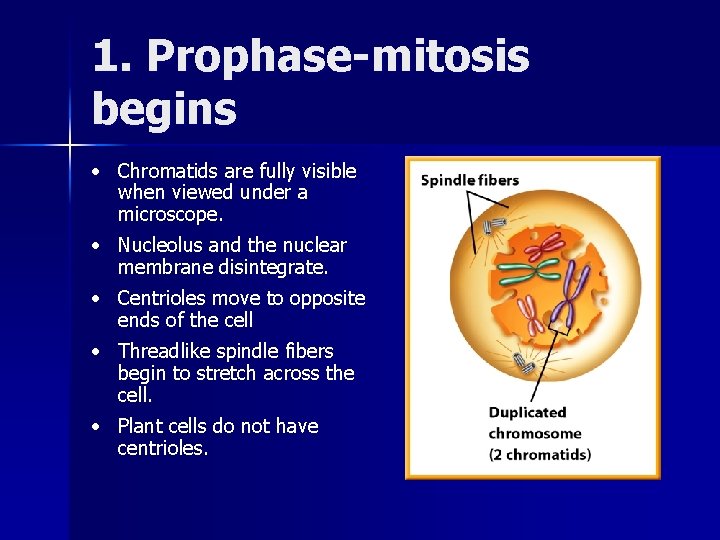
1. Prophase-mitosis begins • Chromatids are fully visible when viewed under a microscope. • Nucleolus and the nuclear membrane disintegrate. • Centrioles move to opposite ends of the cell • Threadlike spindle fibers begin to stretch across the cell. • Plant cells do not have centrioles.
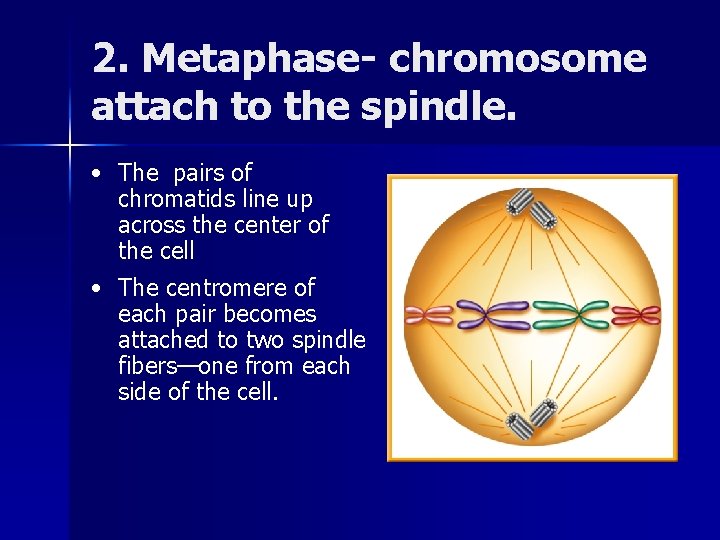
2. Metaphase- chromosome attach to the spindle. • The pairs of chromatids line up across the center of the cell • The centromere of each pair becomes attached to two spindle fibers—one from each side of the cell.
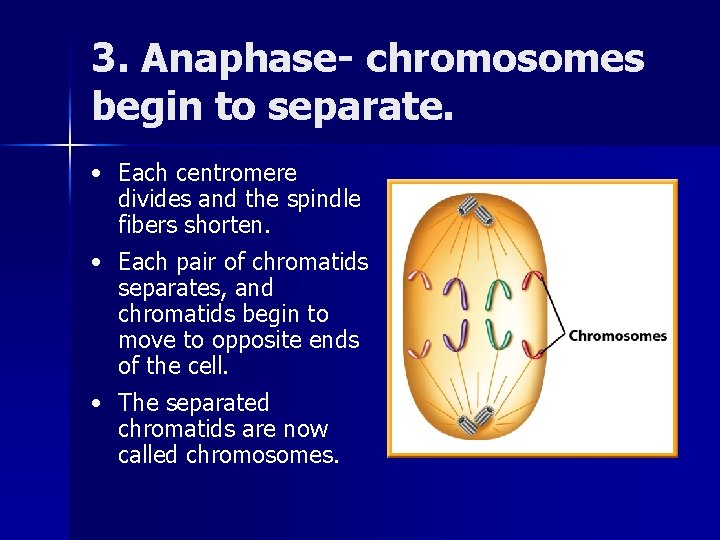
3. Anaphase- chromosomes begin to separate. • Each centromere divides and the spindle fibers shorten. • Each pair of chromatids separates, and chromatids begin to move to opposite ends of the cell. • The separated chromatids are now called chromosomes.
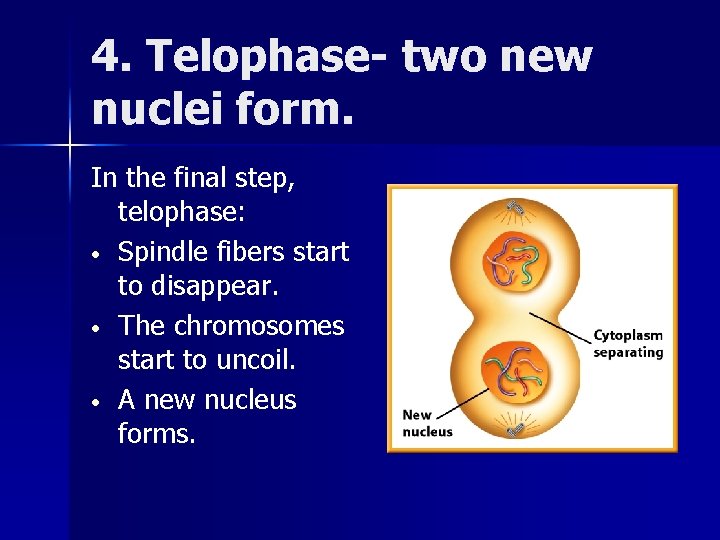
4. Telophase- two new nuclei form. In the final step, telophase: • Spindle fibers start to disappear. • The chromosomes start to uncoil. • A new nucleus forms.
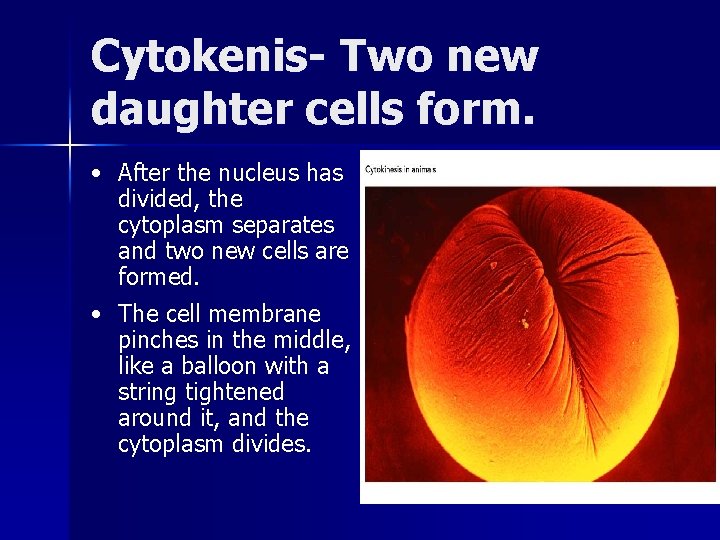
Cytokenis- Two new daughter cells form. • After the nucleus has divided, the cytoplasm separates and two new cells are formed. • The cell membrane pinches in the middle, like a balloon with a string tightened around it, and the cytoplasm divides.
Cytokinesis • In plant cells, the appearance of a cell plate tells you that the cytoplasm is being divided. • New cell walls form along the cell plate, and new cell membranes develop inside the cell walls. • Following division of the cytoplasm, most new cells begin the period of growth, or interphase, again.
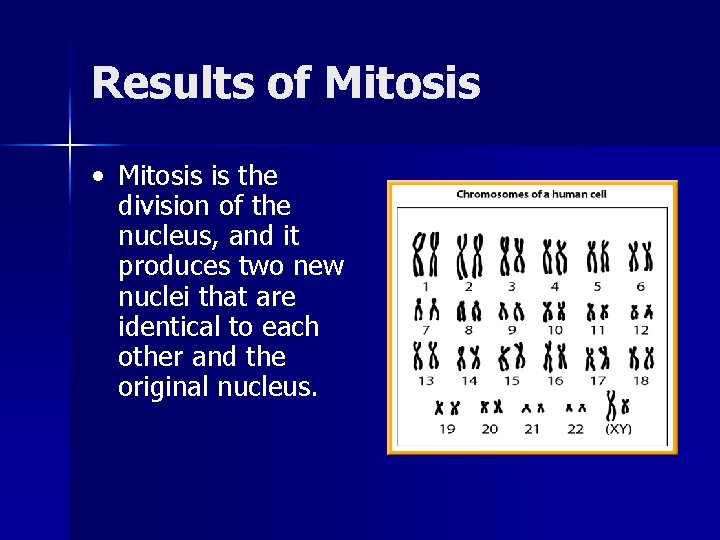
Results of Mitosis • Mitosis is the division of the nucleus, and it produces two new nuclei that are identical to each other and the original nucleus.
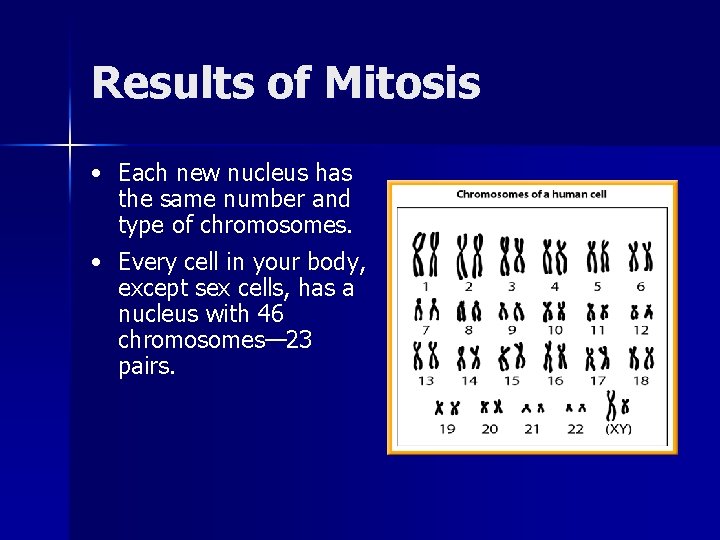
Results of Mitosis • Each new nucleus has the same number and type of chromosomes. • Every cell in your body, except sex cells, has a nucleus with 46 chromosomes— 23 pairs.
Results of Mitosis • Each of the trillions of cells in your body, except sex cells, has a copy of the same hereditary material. • All of your cells use different parts of the same hereditary material to become different types of cells.
Results of Mitosis • Cell division allows growth and replaces worn out or damaged cells. • If you cut yourself, the wound heals because cell division replaces damaged cells. • Another way some organisms use cell division is to produce new organisms.