
Cell Reproduction 18 1 Dividing Cells Bridge Generations

Cell Reproduction
18. 1 Dividing Cells Bridge Generations § The continuity of life depends on the ability of cells—and whole organisms—to faithfully reproduce themselves § Dividing cells are the bridge between these generations

Divisions of “Parent” Nucleus Sorts DNA into Nucleus for Each Daughter Cell (1) § Reproduction • Produces a new generation of cells • Produces a new individual • Part of the life cycle; series of recurring events in which individuals: • • Grow Develop Maintain themselves Reproduce
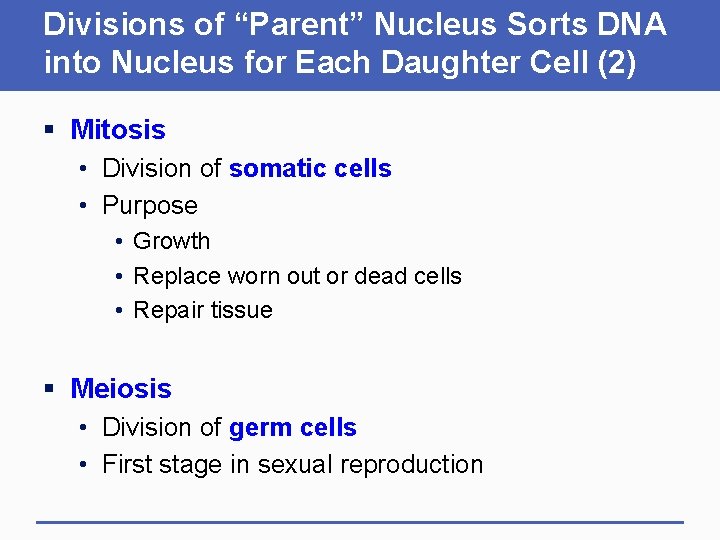
Divisions of “Parent” Nucleus Sorts DNA into Nucleus for Each Daughter Cell (2) § Mitosis • Division of somatic cells • Purpose • Growth • Replace worn out or dead cells • Repair tissue § Meiosis • Division of germ cells • First stage in sexual reproduction
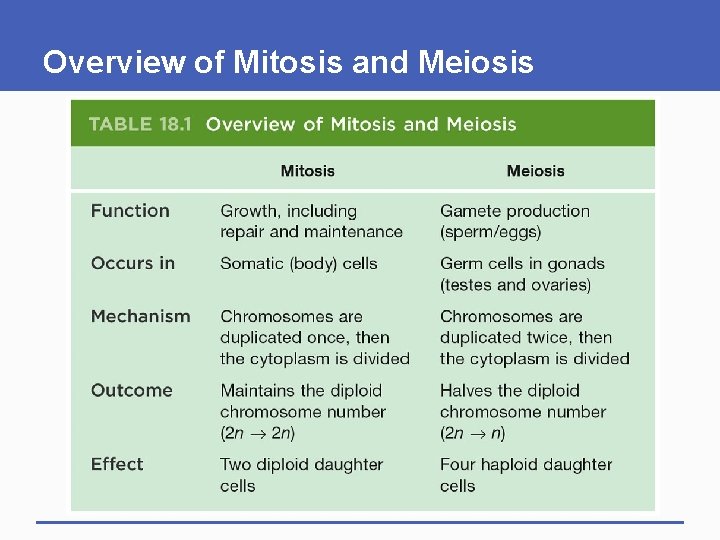
Overview of Mitosis and Meiosis
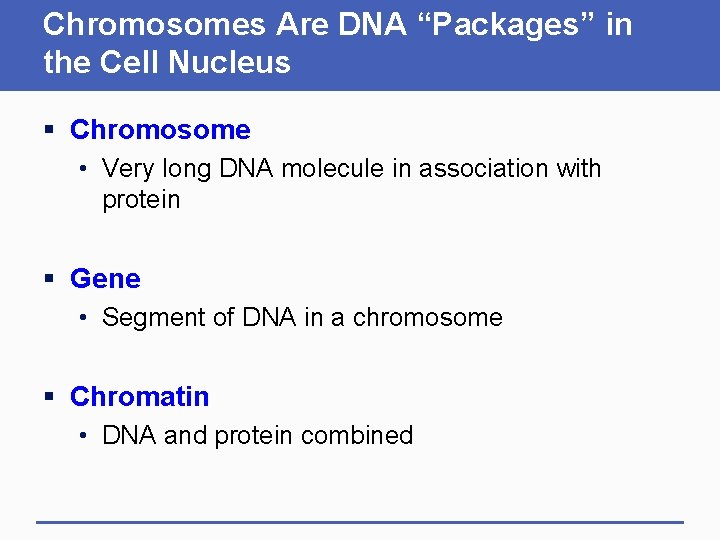
Chromosomes Are DNA “Packages” in the Cell Nucleus § Chromosome • Very long DNA molecule in association with protein § Gene • Segment of DNA in a chromosome § Chromatin • DNA and protein combined
Having Two Sets of Chromosomes Makes a Cell Diploid § Chromosome number • • • Sum of chromosomes in a given type of cell Humans have 46; 23 from each parent Diploid (2 n): two sets of chromosomes Autosomes: pairs 1– 22 Sex chromosomes • XX in females • XY in males • Homologous chromosomes • Paired corresponding chromosomes
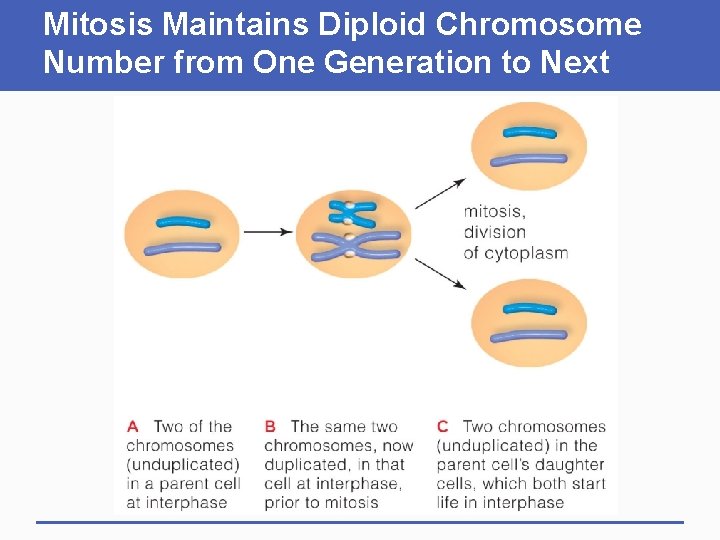
Mitosis Maintains Diploid Chromosome Number from One Generation to Next
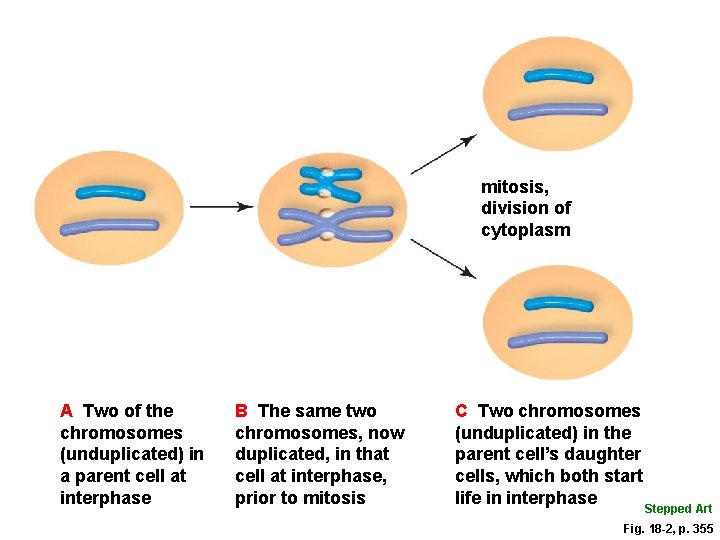
mitosis, division of cytoplasm A Two of the chromosomes (unduplicated) in a parent cell at interphase B The same two chromosomes, now duplicated, in that cell at interphase, prior to mitosis C Two chromosomes (unduplicated) in the parent cell’s daughter cells, which both start life in interphase Stepped Art Fig. 18 -2, p. 355
Having Only One Set of Chromosomes Makes a Cell Haploid § Meiosis • Reductional division • Reduces the number of chromosomes to a haploid number (n) • Occurs in spermatogonia or oogonia
18. 2 A Brief Look at Chromosomes § A chromosome is nothing more than coiled loops of DNA and proteins
A Chromosome Undergoes Changes in Preparation for Cell Division § Before cell division, chromosomes replicate • Sister chromatids: chromosome and its copy § During early stages of cell division • Duplicated chromosomes coil and condense • Importance of histones § Once coiling is completed • Chromosome has its typical size and shape • Centromere: region of attachment to the microtubule
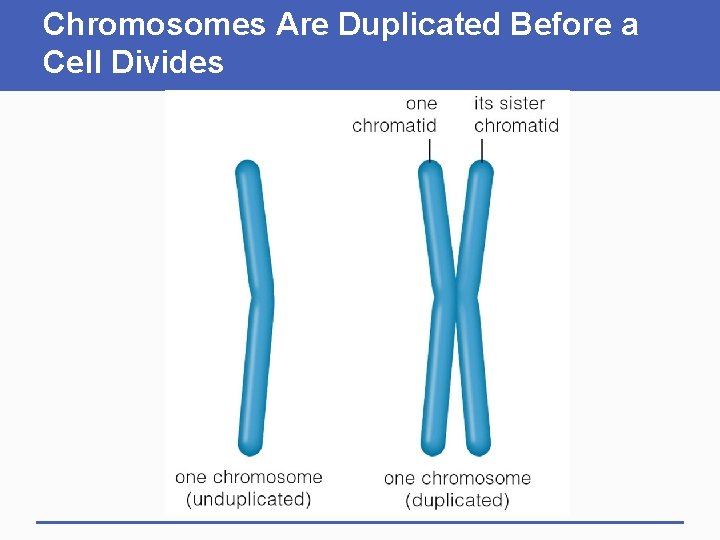
Chromosomes Are Duplicated Before a Cell Divides
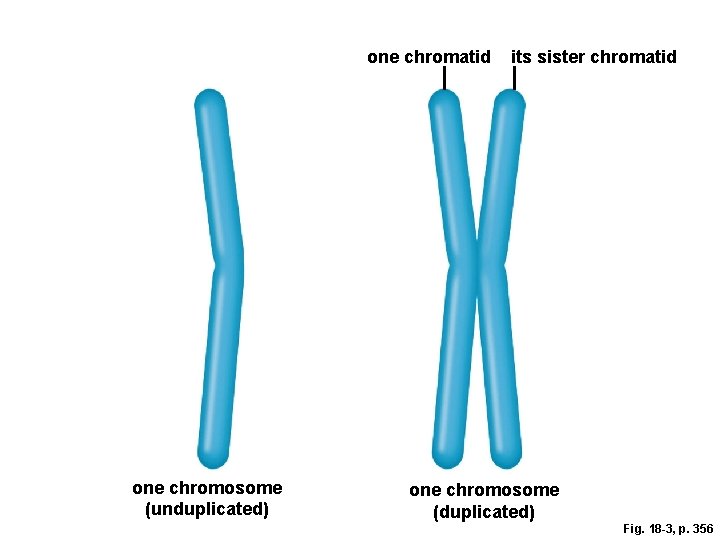
one chromatid one chromosome (unduplicated) its sister chromatid one chromosome (duplicated) Fig. 18 -3, p. 356
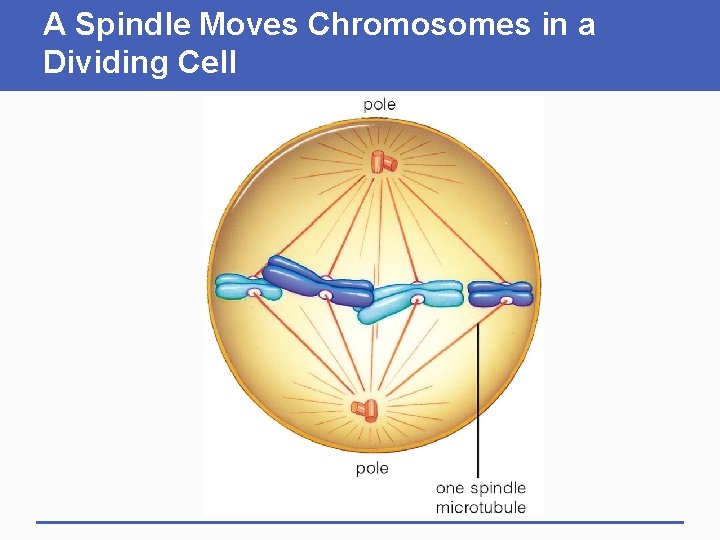
A Spindle Moves Chromosomes in a Dividing Cell
The Cell Cycle § Cell cycle • “Lifetime” of a somatic cell • Varies depending on cell type § Interphase • G 1: cell growth • S: DNA copied and its chromosomes are duplicated • G 2: Preparation for mitosis § Mitosis: chromosomes sorted into two sets and the cytoplasm divides; four phases
18. 4 The Four Stages of Mitosis § When interphase ends, a cell has stopped making new parts and its DNA has been replicated § Mitosis can begin
The Four Stages of Mitosis § Prophase § Metaphase § Anaphase § Telophase
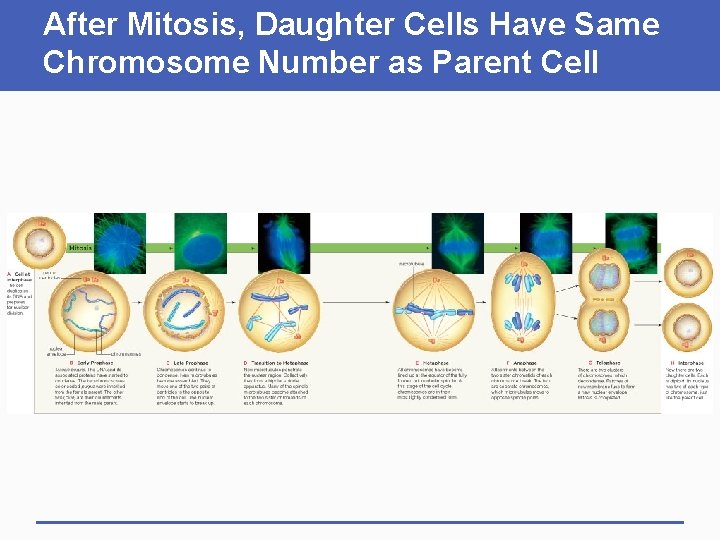
After Mitosis, Daughter Cells Have Same Chromosome Number as Parent Cell

Fig. 18 -7 (a-d), p. 358
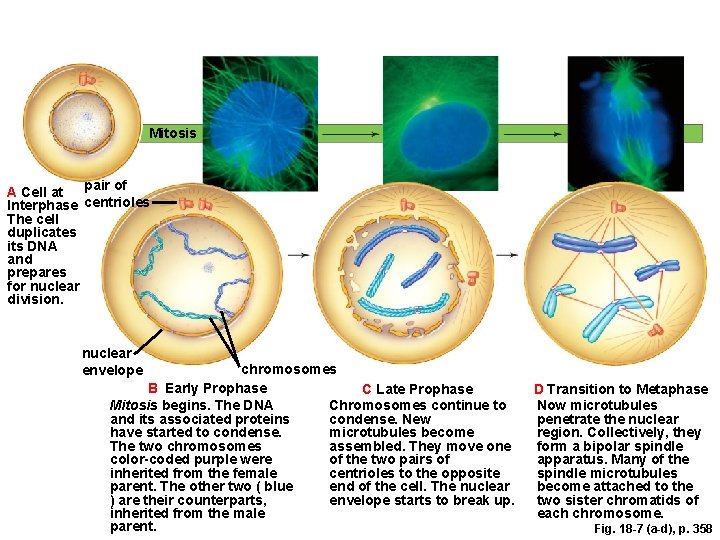
Mitosis pair of A Cell at Interphase centrioles The cell duplicates its DNA and prepares for nuclear division. nuclear envelope chromosomes B Early Prophase C Late Prophase Mitosis begins. The DNA Chromosomes continue to and its associated proteins condense. New have started to condense. microtubules become The two chromosomes assembled. They move one color-coded purple were of the two pairs of inherited from the female centrioles to the opposite parent. The other two ( blue end of the cell. The nuclear ) are their counterparts, envelope starts to break up. inherited from the male parent. D Transition to Metaphase Now microtubules penetrate the nuclear region. Collectively, they form a bipolar spindle apparatus. Many of the spindle microtubules become attached to the two sister chromatids of each chromosome. Fig. 18 -7 (a-d), p. 358
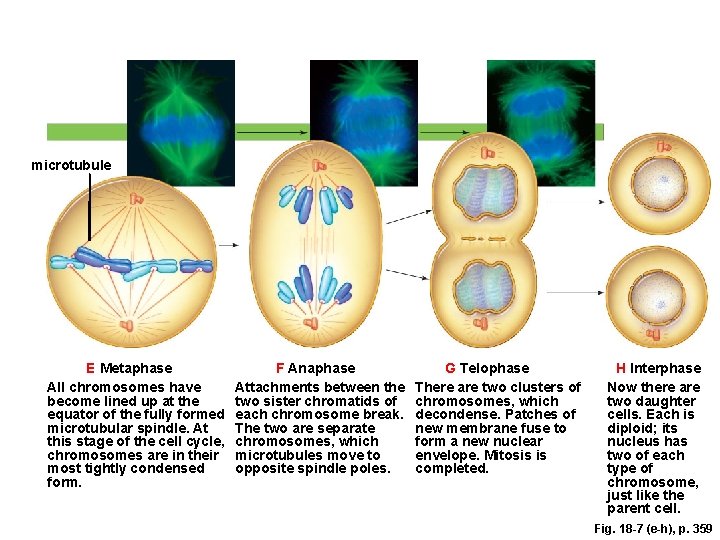
microtubule E Metaphase All chromosomes have become lined up at the equator of the fully formed microtubular spindle. At this stage of the cell cycle, chromosomes are in their most tightly condensed form. F Anaphase Attachments between the two sister chromatids of each chromosome break. The two are separate chromosomes, which microtubules move to opposite spindle poles. G Telophase There are two clusters of chromosomes, which decondense. Patches of new membrane fuse to form a new nuclear envelope. Mitosis is completed. H Interphase Now there are two daughter cells. Each is diploid; its nucleus has two of each type of chromosome, just like the parent cell. Fig. 18 -7 (e-h), p. 359
Mitosis Begins with Prophase § Early prophase • Coiling and condensing of the chromosomes • Microtubules forming § Late prophase • Chromosomes condense into thick rods • Nuclear membrane begins breaking up • If present, microtubules move centrioles to the opposite poles
Next Comes Metaphase § Prometaphase • Nuclear membrane breaks apart • Microtubules penetrate the nuclear region • Chromosomes interact with the microtubules § Metaphase • Duplicated chromosomes align midway between the poles of the cell
Anaphase, Then Telophase Follow § Anaphase • Sister chromatids split; become independent chromosomes • Pulled by the microtubules toward the pole region • Spindle elongates, pushing the poles farther apart § Telophase • Chromosomes no longer connected to the spindle • Chromosomes are threadlike, once again • Nuclear envelope forms around each cluster
18. 5 How the Cytoplasm Divides § After mitosis produces two new cell nuclei, each with a set of the parent cell’s chromosomes, the parent cell’s cytoplasm also must be divided between the two daughter cells
How the Cytoplasm Divides § Cytokinesis • Division of the cytoplasm • Begins toward the end of anaphase • Cleavage furrow forms • Microfilaments (actin) pull the plasma membrane inward all around the cell • Pinches the cell in two
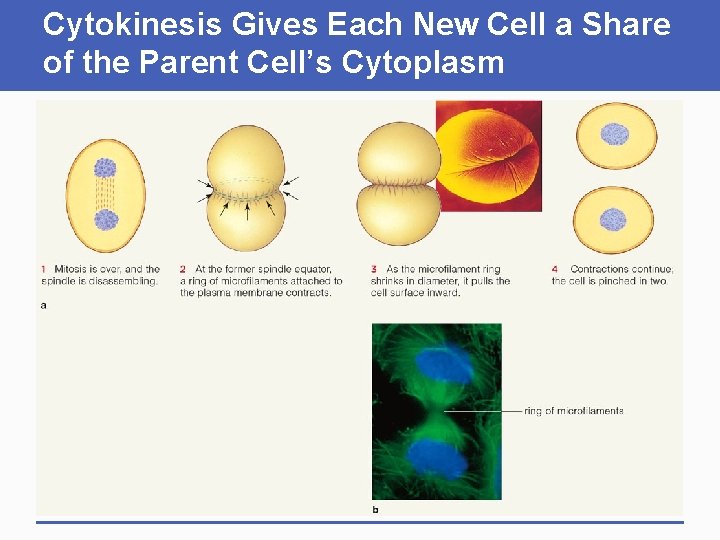
Cytokinesis Gives Each New Cell a Share of the Parent Cell’s Cytoplasm
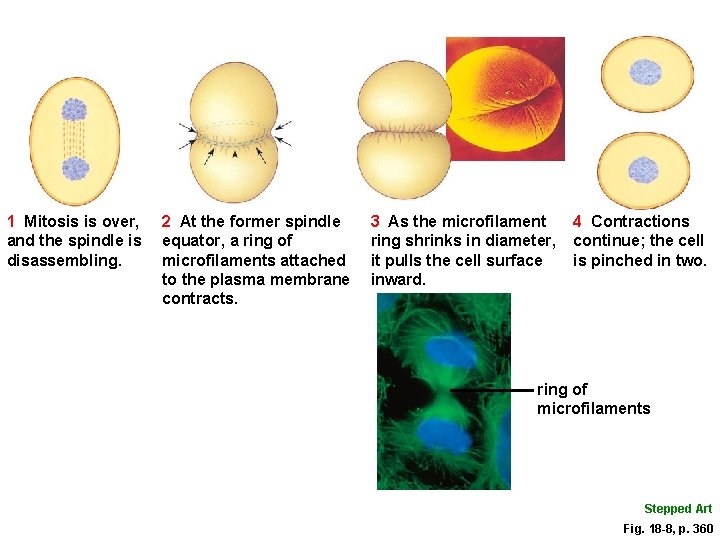
1 Mitosis is over, and the spindle is disassembling. 2 At the former spindle equator, a ring of microfilaments attached to the plasma membrane contracts. 3 As the microfilament ring shrinks in diameter, it pulls the cell surface inward. 4 Contractions continue; the cell is pinched in two. ring of microfilaments Stepped Art Fig. 18 -8, p. 360
18. 7 Meiosis: The Beginnings of Eggs and Sperm § Meiosis divides the nuclei of germ cells in a way that halves the number of chromosomes in daughter cells § It is the first step toward the gametes required for sexual reproduction
In Meiosis the Parent Cell Nucleus Divides Twice § Interphase • Germ cell copies its DNA § Meiosis: two consecutive divisions of the chromosomes • Meiosis I • Homologues pair up and then separate • Meiosis II • Sister chromatids split • Four haploid cells formed
Meiosis Leads to the Formation of Gametes (1) § Spermatogenesis • Diploid germ cell increases in size • This primary spermatocyte → four haploid spermatids → change in form to become sperm
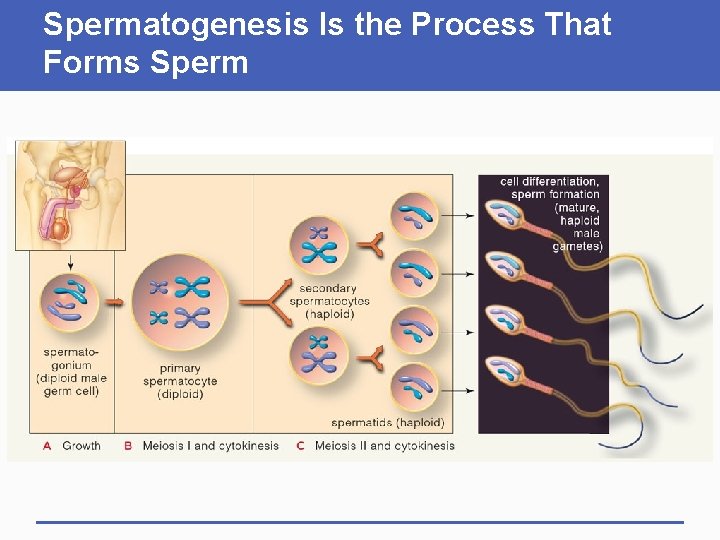
Spermatogenesis Is the Process That Forms Sperm
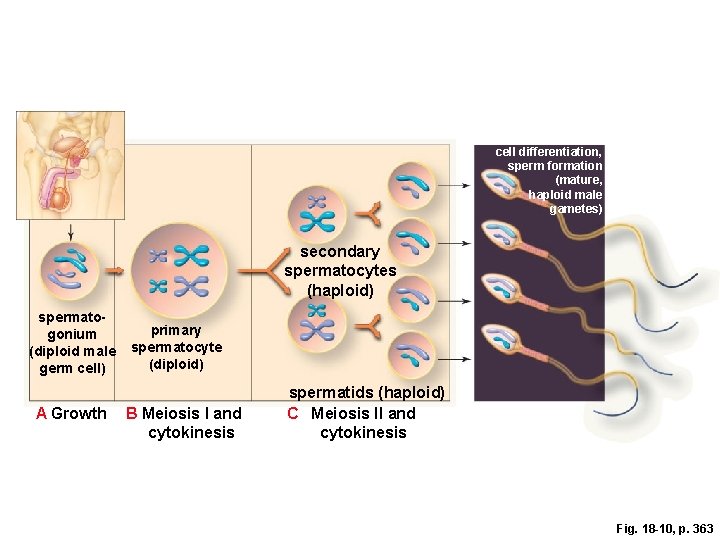
cell differentiation, sperm formation (mature, haploid male gametes) secondary spermatocytes (haploid) spermatogonium (diploid male germ cell) A Growth primary spermatocyte (diploid) B Meiosis I and cytokinesis spermatids (haploid) C Meiosis II and cytokinesis Fig. 18 -10, p. 363
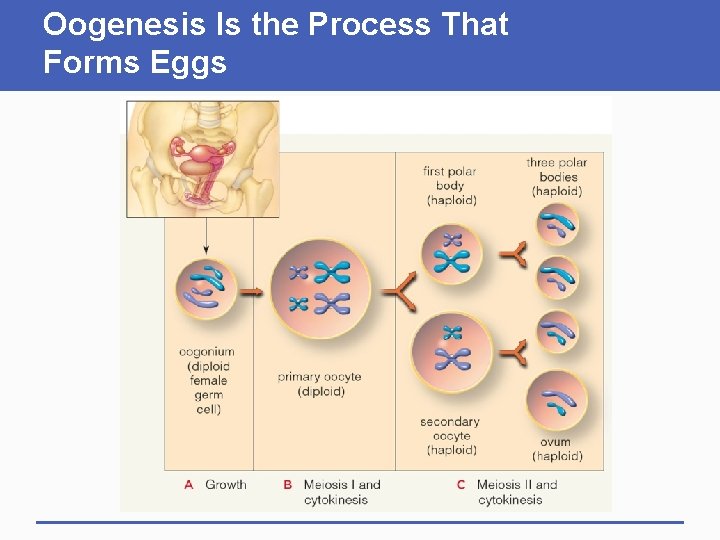
Oogenesis Is the Process That Forms Eggs
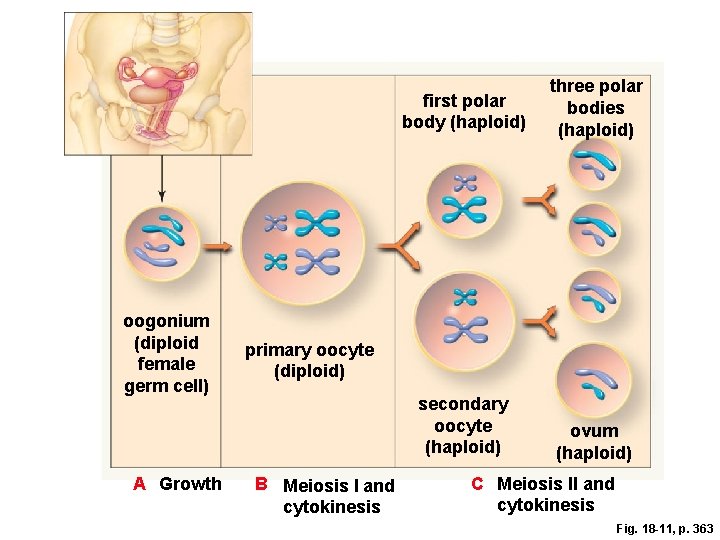
oogonium (diploid female germ cell) A Growth first polar body (haploid) three polar bodies (haploid) secondary oocyte (haploid) ovum (haploid) primary oocyte (diploid) B Meiosis I and cytokinesis C Meiosis II and cytokinesis Fig. 18 -11, p. 363
Meiosis Leads to the Formation of Gametes (2) § Oogenesis • Female at birth has primary oocytes arrested in prophase I • Meiosis resumes each month in one oocyte → secondary oocyte (receives most of the cytoplasm) • Meiosis stops in metaphase II • One large cell (haploid) is produced • Meiosis will be completed only after fertilization
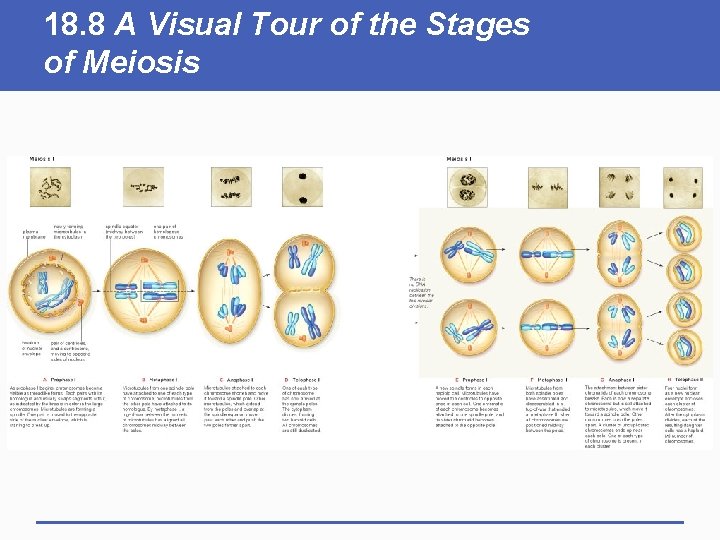
18. 8 A Visual Tour of the Stages of Meiosis
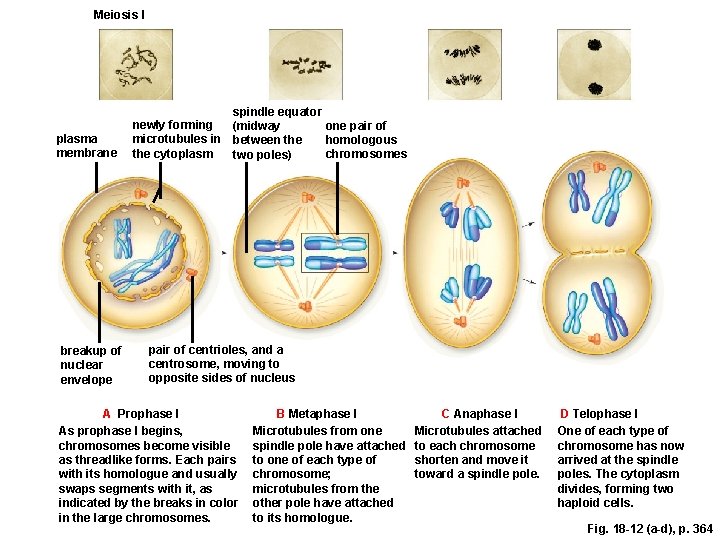
Meiosis I plasma membrane breakup of nuclear envelope spindle equator newly forming one pair of (midway microtubules in between the homologous the cytoplasm chromosomes two poles) pair of centrioles, and a centrosome, moving to opposite sides of nucleus A Prophase I As prophase I begins, chromosomes become visible as threadlike forms. Each pairs with its homologue and usually swaps segments with it, as indicated by the breaks in color in the large chromosomes. B Metaphase I Microtubules from one spindle pole have attached to one of each type of chromosome; microtubules from the other pole have attached to its homologue. C Anaphase I Microtubules attached to each chromosome shorten and move it toward a spindle pole. D Telophase I One of each type of chromosome has now arrived at the spindle poles. The cytoplasm divides, forming two haploid cells. Fig. 18 -12 (a-d), p. 364
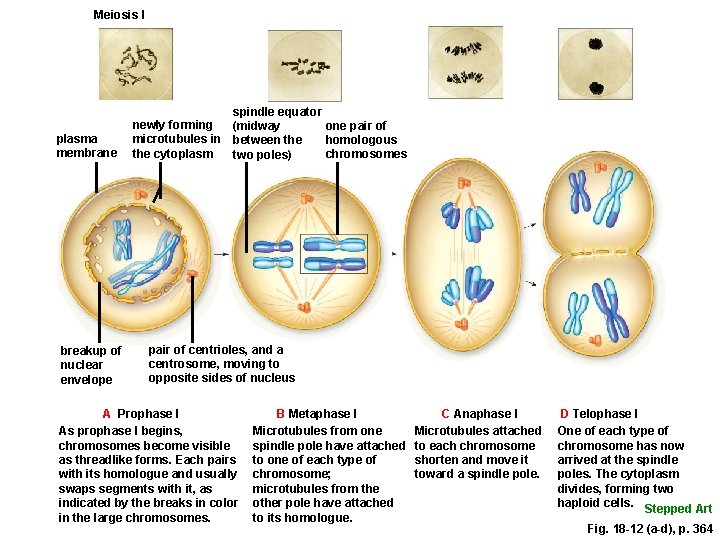
Meiosis I plasma membrane breakup of nuclear envelope spindle equator newly forming one pair of (midway microtubules in between the homologous the cytoplasm chromosomes two poles) pair of centrioles, and a centrosome, moving to opposite sides of nucleus A Prophase I As prophase I begins, chromosomes become visible as threadlike forms. Each pairs with its homologue and usually swaps segments with it, as indicated by the breaks in color in the large chromosomes. B Metaphase I Microtubules from one spindle pole have attached to one of each type of chromosome; microtubules from the other pole have attached to its homologue. C Anaphase I Microtubules attached to each chromosome shorten and move it toward a spindle pole. D Telophase I One of each type of chromosome has now arrived at the spindle poles. The cytoplasm divides, forming two haploid cells. Stepped Art Fig. 18 -12 (a-d), p. 364
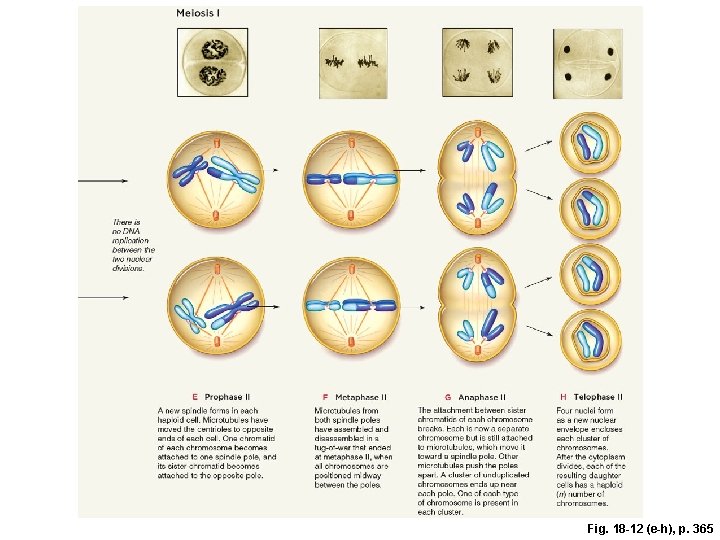
Fig. 18 -12 (e-h), p. 365
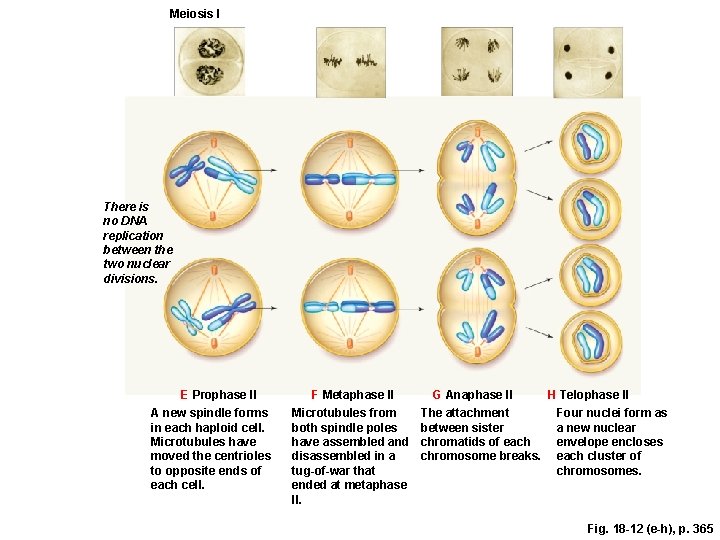
Meiosis I There is no DNA replication between the two nuclear divisions. E Prophase II A new spindle forms in each haploid cell. Microtubules have moved the centrioles to opposite ends of each cell. F Metaphase II Microtubules from both spindle poles have assembled and disassembled in a tug-of-war that ended at metaphase II. G Anaphase II H Telophase II The attachment Four nuclei form as between sister a new nuclear chromatids of each envelope encloses chromosome breaks. each cluster of chromosomes. Fig. 18 -12 (e-h), p. 365
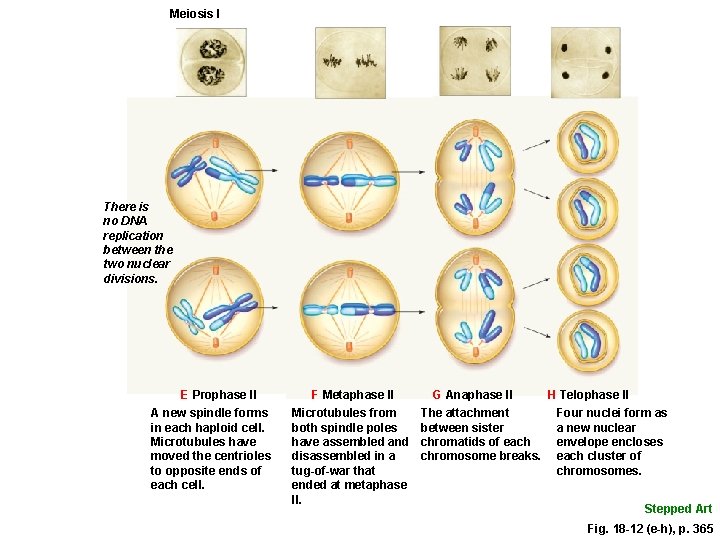
Meiosis I There is no DNA replication between the two nuclear divisions. E Prophase II A new spindle forms in each haploid cell. Microtubules have moved the centrioles to opposite ends of each cell. F Metaphase II Microtubules from both spindle poles have assembled and disassembled in a tug-of-war that ended at metaphase II. G Anaphase II H Telophase II The attachment Four nuclei form as between sister a new nuclear chromatids of each envelope encloses chromosome breaks. each cluster of chromosomes. Stepped Art Fig. 18 -12 (e-h), p. 365
Pieces of Chromosomes May Be Exchanged § Some genetic variations occur during prophase I • Crossing over: • Nonsister chromatids break at same places along their length • Exchange corresponding segments • Genetic recombination: genes may have different chemical forms • Variations can be passed on to offspring
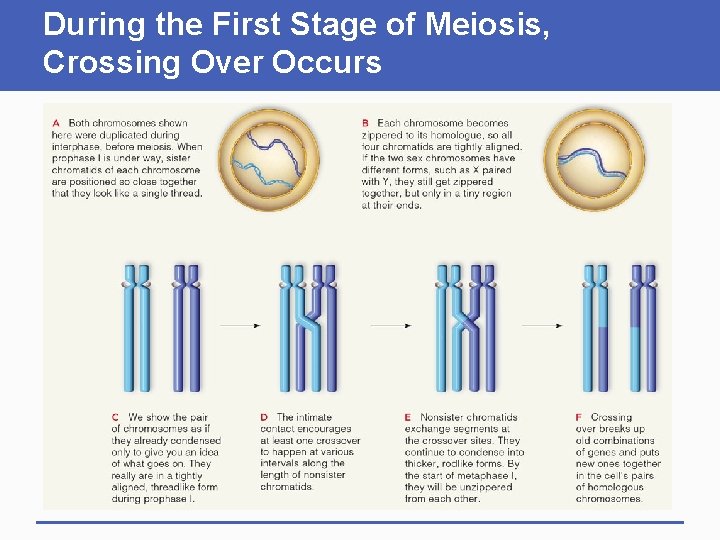
During the First Stage of Meiosis, Crossing Over Occurs
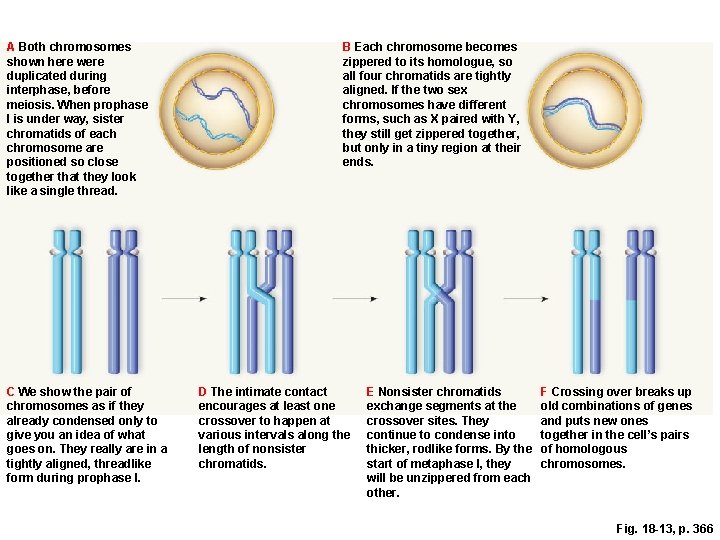
A Both chromosomes shown here were duplicated during interphase, before meiosis. When prophase I is under way, sister chromatids of each chromosome are positioned so close together that they look like a single thread. C We show the pair of chromosomes as if they already condensed only to give you an idea of what goes on. They really are in a tightly aligned, threadlike form during prophase I. B Each chromosome becomes zippered to its homologue, so all four chromatids are tightly aligned. If the two sex chromosomes have different forms, such as X paired with Y, they still get zippered together, but only in a tiny region at their ends. D The intimate contact encourages at least one crossover to happen at various intervals along the length of nonsister chromatids. E Nonsister chromatids exchange segments at the crossover sites. They continue to condense into thicker, rodlike forms. By the start of metaphase I, they will be unzippered from each other. F Crossing over breaks up old combinations of genes and puts new ones together in the cell’s pairs of homologous chromosomes. Fig. 18 -13, p. 366
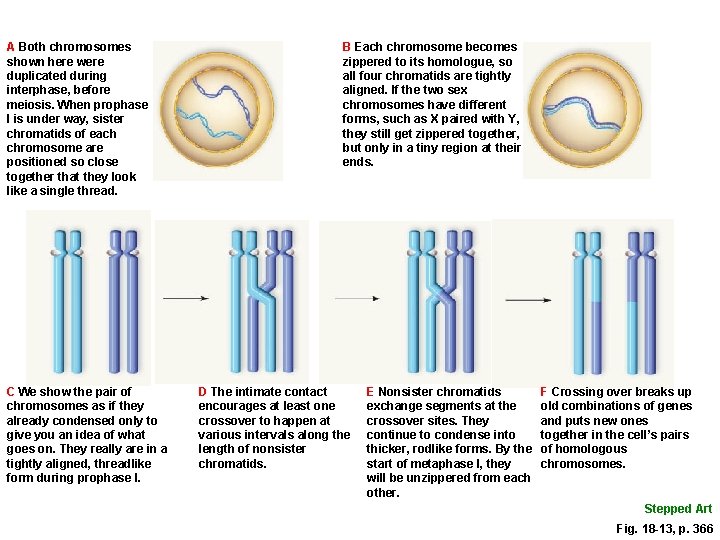
A Both chromosomes shown here were duplicated during interphase, before meiosis. When prophase I is under way, sister chromatids of each chromosome are positioned so close together that they look like a single thread. C We show the pair of chromosomes as if they already condensed only to give you an idea of what goes on. They really are in a tightly aligned, threadlike form during prophase I. B Each chromosome becomes zippered to its homologue, so all four chromatids are tightly aligned. If the two sex chromosomes have different forms, such as X paired with Y, they still get zippered together, but only in a tiny region at their ends. D The intimate contact encourages at least one crossover to happen at various intervals along the length of nonsister chromatids. E Nonsister chromatids exchange segments at the crossover sites. They continue to condense into thicker, rodlike forms. By the start of metaphase I, they will be unzippered from each other. F Crossing over breaks up old combinations of genes and puts new ones together in the cell’s pairs of homologous chromosomes. Stepped Art Fig. 18 -13, p. 366
Gametes Receive Random Assortment of Maternal and Paternal Chromosomes § Homologous pairs of chromosomes line up at random during metaphase I § These pairs separate (disjunction) during anaphase I and go to opposite poles of dividing cell § Possible number of combinations: 223
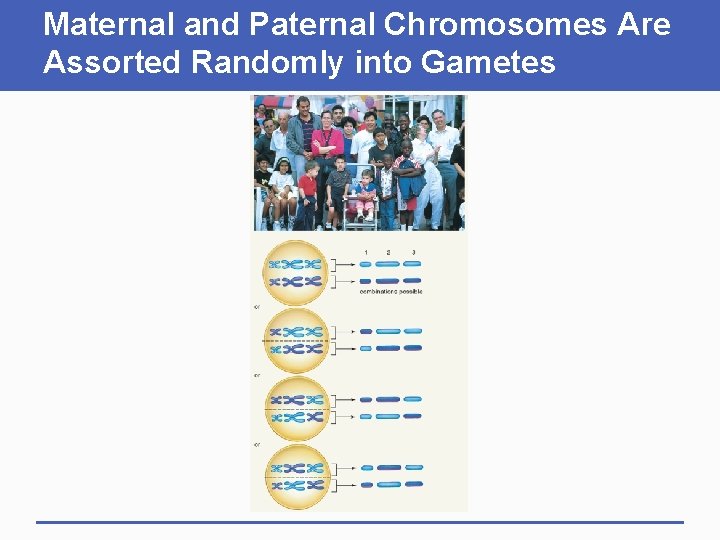
Maternal and Paternal Chromosomes Are Assorted Randomly into Gametes
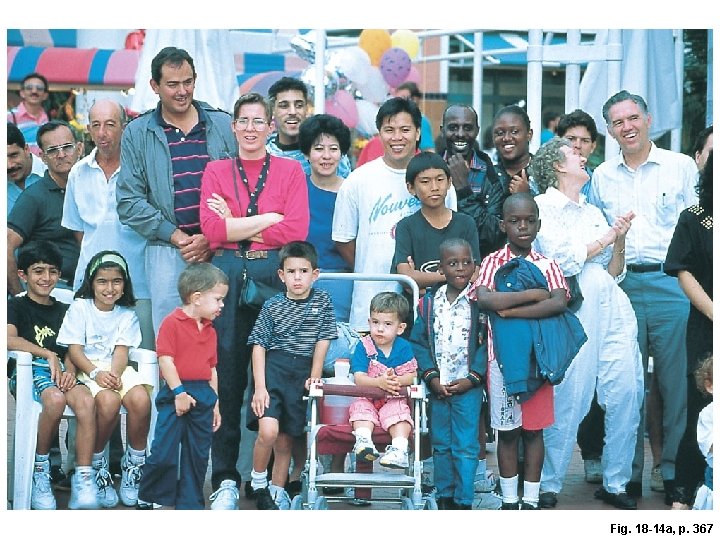
Fig. 18 -14 a, p. 367
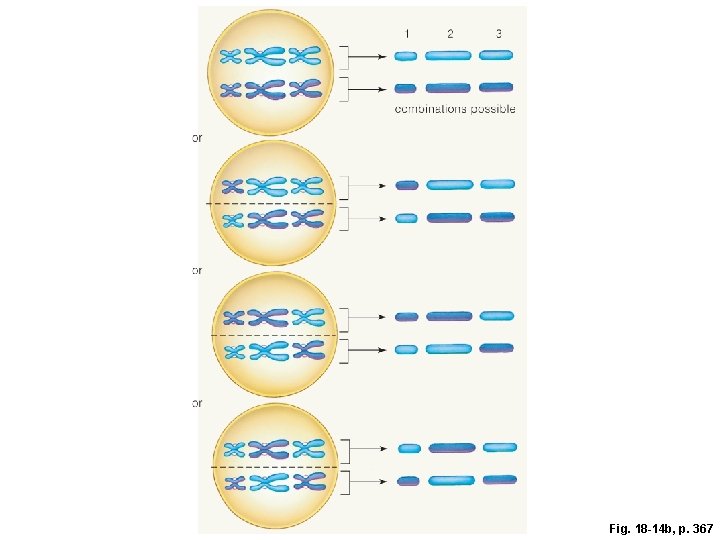
Fig. 18 -14 b, p. 367
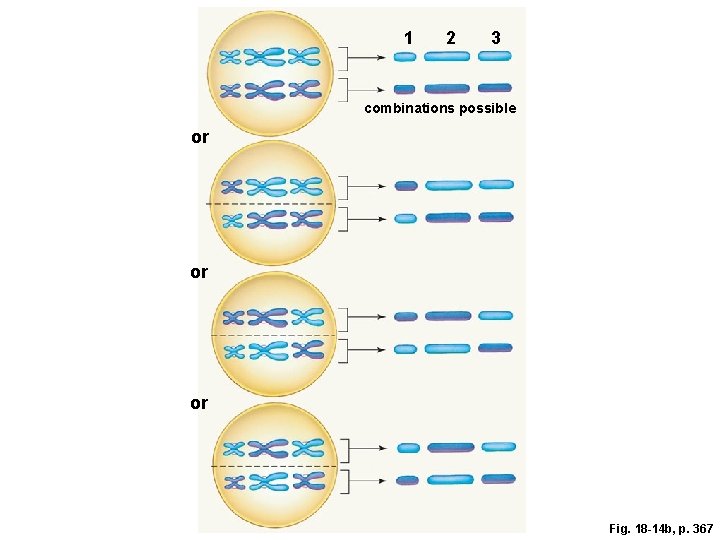
1 2 3 combinations possible or or or Fig. 18 -14 b, p. 367
18. 10 Meiosis and Mitosis Compared § Mitosis occurs in somatic cells, while meiosis takes place in germ cells § The diagrams presented here summarize the similarities and key differences of these mechanisms
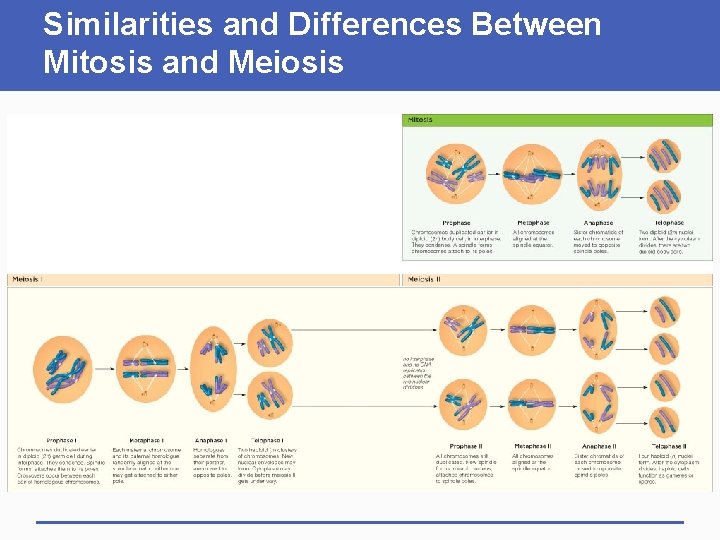
Similarities and Differences Between Mitosis and Meiosis
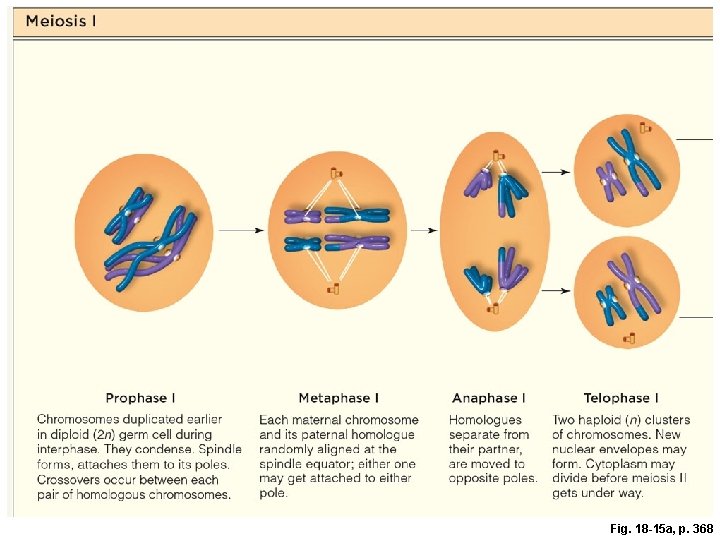
Fig. 18 -15 a, p. 368
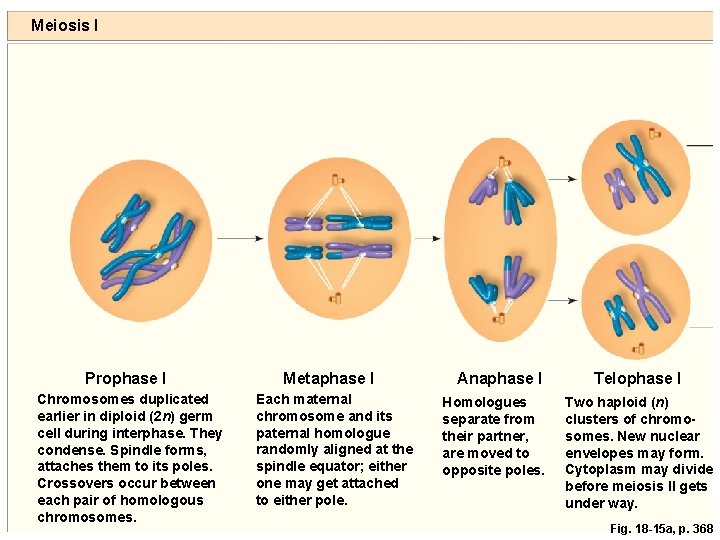
Meiosis I Prophase I Chromosomes duplicated earlier in diploid (2 n) germ cell during interphase. They condense. Spindle forms, attaches them to its poles. Crossovers occur between each pair of homologous chromosomes. Metaphase I Each maternal chromosome and its paternal homologue randomly aligned at the spindle equator; either one may get attached to either pole. Anaphase I Homologues separate from their partner, are moved to opposite poles. Telophase I Two haploid (n) clusters of chromosomes. New nuclear envelopes may form. Cytoplasm may divide before meiosis II gets under way. Fig. 18 -15 a, p. 368
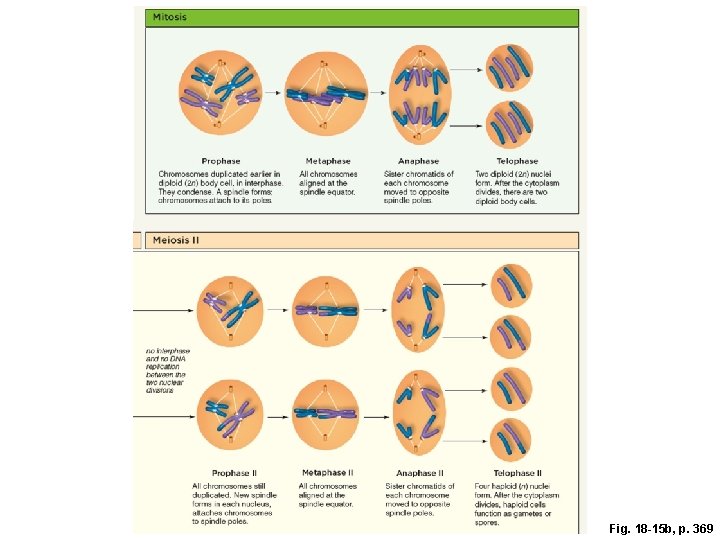
Fig. 18 -15 b, p. 369
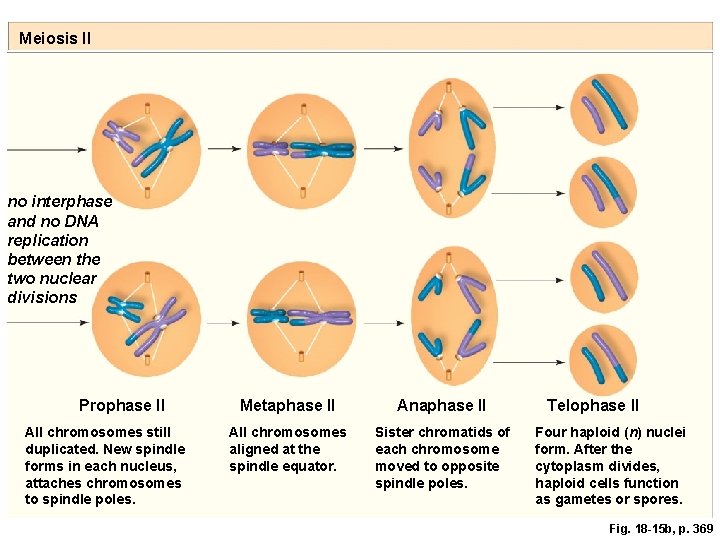
Meiosis II no interphase and no DNA replication between the two nuclear divisions Prophase II All chromosomes still duplicated. New spindle forms in each nucleus, attaches chromosomes to spindle poles. Metaphase II Anaphase II All chromosomes aligned at the spindle equator. Sister chromatids of each chromosome moved to opposite spindle poles. Telophase II Four haploid (n) nuclei form. After the cytoplasm divides, haploid cells function as gametes or spores. Fig. 18 -15 b, p. 369
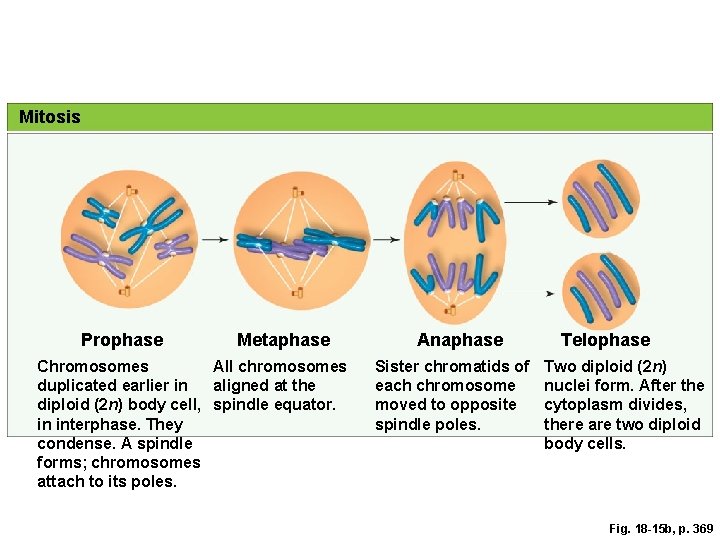
Mitosis Prophase Metaphase Chromosomes All chromosomes duplicated earlier in aligned at the diploid (2 n) body cell, spindle equator. in interphase. They condense. A spindle forms; chromosomes attach to its poles. Anaphase Sister chromatids of each chromosome moved to opposite spindle poles. Telophase Two diploid (2 n) nuclei form. After the cytoplasm divides, there are two diploid body cells. Fig. 18 -15 b, p. 369
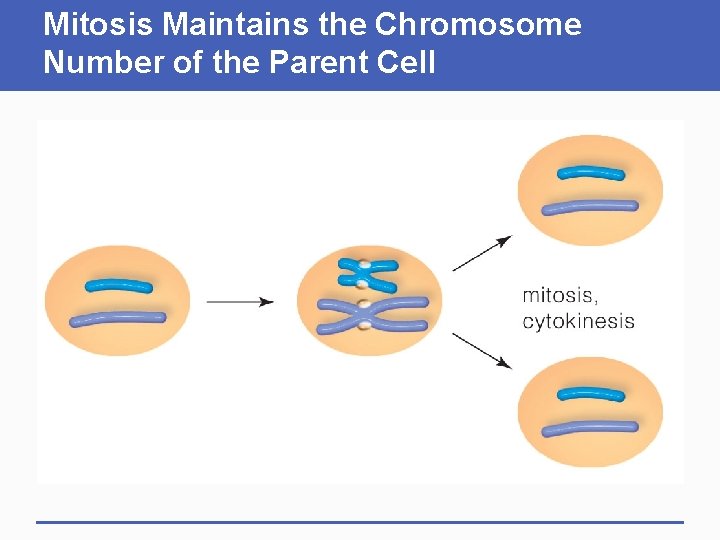
Mitosis Maintains the Chromosome Number of the Parent Cell
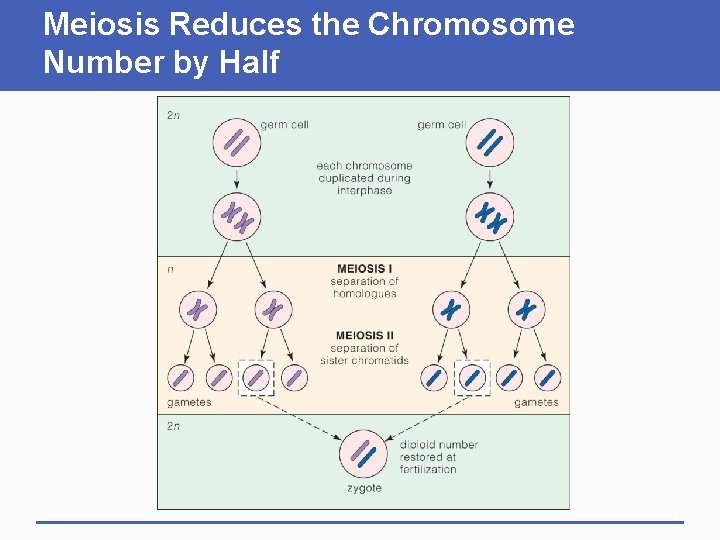
Meiosis Reduces the Chromosome Number by Half
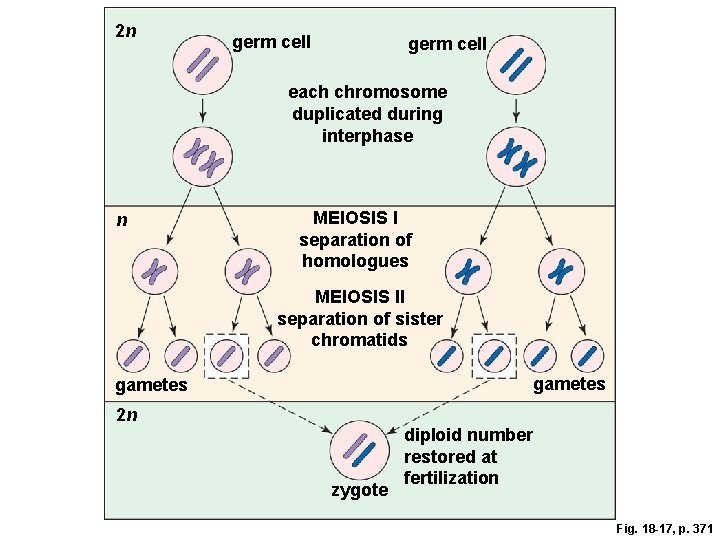
2 n germ cell each chromosome duplicated during interphase n MEIOSIS I separation of homologues MEIOSIS II separation of sister chromatids gametes 2 n zygote diploid number restored at fertilization Fig. 18 -17, p. 371
- Slides: 62