
Cell Processes Diffusion Osmosis How Substances Move into
Cell Processes Diffusion & Osmosis
How Substances Move into and out of a Cell. • 1. Diffusion Passive Transport • 2. Osmosis • 3. Active Transport
Diffusion • The process by which molecules move from an area of higher concentration to an area of lower concentration. • Concentration of a substance is the amount of the substance in a given volume.
What causes Diffusion? • Molecules are always moving. • They bump into each other. • The more molecules there are in an area, the more collisions there will be. • Collisions cause molecules to push away from one another and spread apart. • Eventually they spread evenly throughout the area.
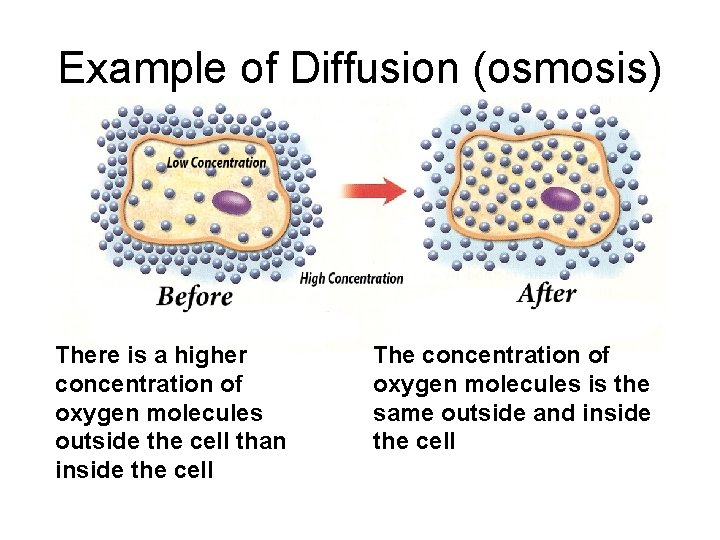
Example of Diffusion (osmosis) There is a higher concentration of oxygen molecules outside the cell than inside the cell The concentration of oxygen molecules is the same outside and inside the cell
Osmosis • Osmosis is the diffusion of water molecules through a selectively permeable membrane. (cell membrane) • Very important! Cells cannot function properly without adequate water.
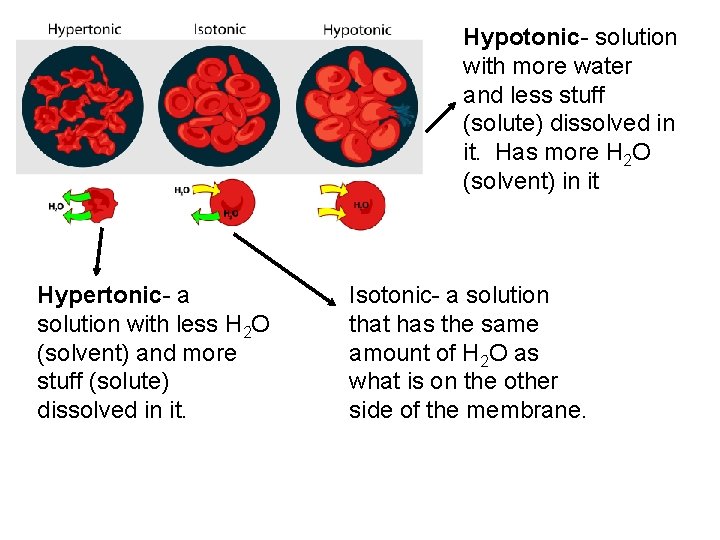
Hypotonic- solution with more water and less stuff (solute) dissolved in it. Has more H 2 O (solvent) in it Hypertonic- a solution with less H 2 O (solvent) and more stuff (solute) dissolved in it. Isotonic- a solution that has the same amount of H 2 O as what is on the other side of the membrane.
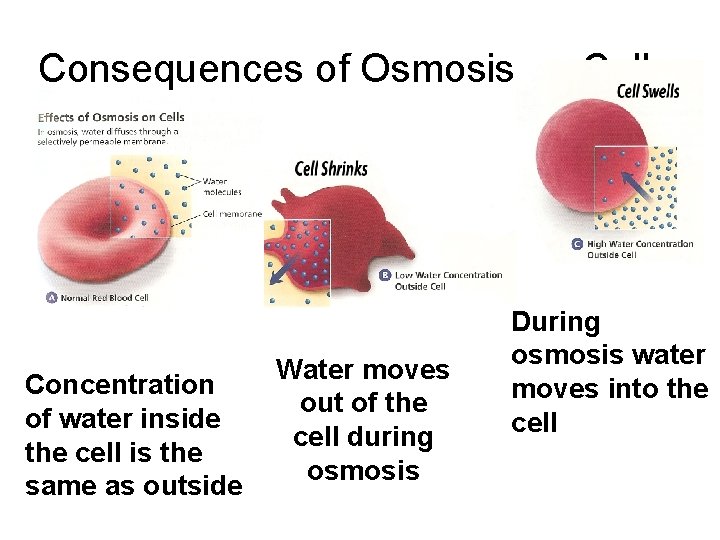
Consequences of Osmosis on Cells. Concentration of water inside the cell is the same as outside Water moves out of the cell during osmosis During osmosis water moves into the cell
- Slides: 8